
What is a compound microscope - Ray Optics - eSaral

eSaral Academic and Editorial Team
Compound Microscope is consists of two convergent lenses of short focal lengths. If you don't know what is a compound microscope then this article is for you.
Compound Microscope
Construction:
It consists of two convergent lenses of short focal lengths and apertures arranged co-axially lens (of focal length $\mathrm{f}_{\mathrm{O}}$) facing the object is called objective or field lens while the lens (of focal length $\mathrm{f}_{\mathrm{e}}$) facing the eye, eye-piece or ocular. The objective has a smaller aperture and smaller focal length than the eye-piece. the separation between objective and eye-piece can be varied.
Image Formation:
The object is placed between F and 2F of the objective so the image IM formed by objective (called intermediate image) is inverted, real enlarged and at a distance greater than $\mathrm{f}_{0}$ on the other side of the lens. This image IM acts as an object for the eye-piece and is within its focus. So, eye-piece forms final image I which is erect, Virtual, and enlarged with respect to intermediate image $\mathrm{I}_{\mathrm{M}}$. So, the final image I with respect to the object is Inverted, virtual, enlarged, and at a distance D to from eye on the same side of eye-piece as $\mathrm{I}_{\mathrm{M}}$. This all is shown in fig.
Magnifying power (MP) magnifying Power of an optical instrument is defined as –
$\mathrm{MP}=\frac{\text { Visual angle with instrument }}{\text { Max } \text { Visual angle for unadded eye }}$
$=\frac{\theta}{\theta_{0}}$
If the size of the object is h, and the least distance of distinct vision is D
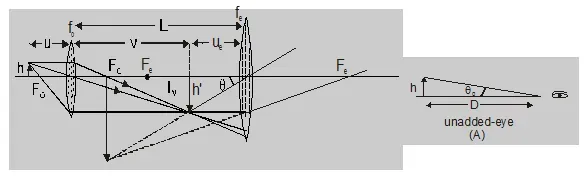
$\theta_{0}=\frac{\mathrm{h}}{\mathrm{D}}$
$\theta=\frac{\mathrm{h}^{\prime}}{\mathrm{u}_{\mathrm{e}}}$ $\mathrm{MP}=\frac{\theta}{\theta_{0}}=\left[\frac{\mathrm{h}^{\prime}}{\mathrm{u}_{\mathrm{e}}}\right] \mathrm{x}\left[\frac{\mathrm{D}}{\mathrm{h}}\right]=\left[\frac{\mathrm{h}^{\prime}}{\mathrm{h}}\right]\left[\frac{\mathrm{D}}{\mathrm{u}_{\mathrm{e}}}\right]$
But for objective
$\mathrm{m}=\frac{1}{\mathrm{O}}=\frac{\mathrm{v}}{\mathrm{u}}$
i.e., $\quad \frac{\mathrm{h}^{\prime}}{\mathrm{h}}=-\frac{\mathrm{v}}{\mathrm{u}}[$ as $\mathrm{u}$ is - ve $]$
so $\mathrm{MP}=-\frac{\mathrm{v}}{\mathrm{u}}\left[\frac{\mathrm{D}}{\mathrm{u}_{\mathrm{e}}}\right]$
with the length of the tube
$L=v+u_{e}$......(1)
now there are two possibilities –
($\mathbf{b}_{1}$) If the final image is at infinity (far point) :
This situation is called normal adjustment as in this situation eye is least strained or relaxed. In this situation as for eye - piece $v=\infty$
$\frac{1}{-D}-\frac{1}{-u_{e}}=\frac{1}{f_{e}}$
i.e., $\frac{1}{\mathrm{u}_{\mathrm{e}}}=\frac{1}{\mathrm{D}}\left[1+\frac{\mathrm{D}}{\mathrm{f}_{\mathrm{e}}}\right]$
Substituting this value of ue in Eqn. (1), we have
$\mathrm{MP}=-\frac{\mathrm{v}}{\mathrm{u}}\left[1+\frac{\mathrm{D}}{\mathrm{f}_{\mathrm{e}}}\right]$
with $L=v+\frac{f_{e} D}{f_{e}+D}$.......(3)
In this situation as $\mathrm{u}_{\mathrm{e}}$ is minimum, MP is maximum and the eye is most strained.
In microscope focal length of objective lens $f_{0}$ is small and object is placed very closed to the objective lens so–
$\mathrm{u} \approx \mathrm{f}_{\circ}$ $\mathrm{L}=\mathrm{v}+\mathrm{u}_{\mathrm{e}}$
$\left[u_{e}<<v\right]$ $\mathrm{L} \approx \mathrm{v}$ $|\mathrm{MP}|=\frac{\mathrm{LD}}{\mathrm{f}_{0} \mathrm{f}_{e}}$
Discussion :
- The magnifying power of a microscope is negative so it produces final image always inverted.
- $\mathrm{m}_{\mathrm{e}}=\frac{\mathrm{v}_{\mathrm{e}}}{\mathrm{u}_{\mathrm{e}}}=\frac{\mathrm{D}}{\mathrm{u}_{\mathrm{e}}}=\left[1+\frac{\mathrm{D}}{\mathrm{f}_{\mathrm{e}}}\right]$,
$\mathrm{m}_{0}=\frac{\mathrm{v}_{0}}{\mathrm{u}_{0}}=\frac{\mathrm{v}}{\mathrm{u}}$
$\mathrm{MP}=\mathrm{m}_{0} \times \mathrm{m}_{\mathrm{e}}$ - $(\mathrm{MP})_{\min }=-\frac{\mathrm{V}}{\mathrm{u}} \frac{\mathrm{D}}{\mathrm{f}_{\mathrm{e}}}$
$(\mathrm{MP})_{\max }=-\frac{\mathrm{v}}{\mathrm{u}}\left[1+\frac{\mathrm{D}}{\mathrm{f}_{\mathrm{e}}}\right]$ - $|\mathrm{MP}|=-\frac{\mathrm{LD}}{\mathrm{f}_{0} \mathrm{f}_{\mathrm{e}}}$
- MP does not change appreciably if the objective lens and eye-piece are interchanged
$\left[\mathrm{MP} \sim\left(\mathrm{LD} / \mathrm{f}_{0} \mathrm{f}_{\mathrm{e}}\right)\right]$.
MP is increased by decreasing the focal length of both lenses. - If the distance between the eye and eyepiece lens is D then distance between final image in eye-piece lens D' = (D – d)
$\mathrm{MP}=\frac{\mathrm{LD}^{\prime}}{\mathrm{f}_{0} \mathrm{f}_{\mathrm{e}}}=\frac{\mathrm{L}(\mathrm{D}-\mathrm{d})}{\mathrm{f}_{0} \mathrm{f}_{\mathrm{e}}}$
$=\mathrm{MP}\left[1-\frac{\mathrm{d}}{\mathrm{D}}\right]<\mathrm{MP}$ - $\mathrm{RP}=\frac{1}{\mathrm{RL}} \alpha \frac{1}{\lambda}$ (Resolving power)
- In electron microscope $\lambda=\sqrt{(150 / \mathrm{V})} \mathrm{A}$
where : V = Potential difference
So, that's all from this article. I hope you get the idea about what is a compound microscope. If you liked this explanation then please share it with your friends. If you have any confusion related to this topic then feel free to ask in the comments section down below.
For a better understanding of this chapter, please check the detailed notes of Chapter Ray Optics. To watch Free Learning Videos on physics by Saransh Gupta sir Install the eSaral App.
Team eSaral
eSaral Academic and Editorial Team
Team eSaral is the collective author profile for educational content created by eSaral’s teachers and academic contributors. The team draws on expertise from IIT graduates, doctors, experienced educators and subject specialists to develop resources for JEE, NEET and school students. Our articles aim to explain concepts clearly and help students study with confidence.
Related Posts

BITSAT 2027: Registration Date, Exam Date, Syllabus, Eligibility, Pattern & Fees
BITSAT 2027 exam dates, registration timeline, eligibility criteria, exam pattern, marking scheme, syllabus and fees in one page.

BITSAT Previous Year Question Paper PDF (2017-2026)
Download BITSAT previous year question papers PDF from 2017 to 2026,session-wise. Memory-based papers,exam pattern, paper analysis and how to practise

CBSE Class 10 Date Sheet 2027: Expected Exam Dates, Release Date, Admit Card & Result Timeline
CBSE Class 10 date sheet 2027 is awaited. See the expected exam dates, release window, how to download the PDF, admit card and result timelines.

NCERT Physics Class 10 Book PDF in Hindi 2026-27 – भौतिक विज्ञान के 4 अध्याय (Free Download)
NCERT Physics Class 10 book PDF in Hindi 2026-27: download all 4 chapters (अध्याय 9–12) free, with topics and important formulas.

NCERT Biology Class 9 Book Anveshan PDF in Hindi - जीव विज्ञान कक्षा 9 पुस्तक अन्वेषण PDF
Download NCERT Biology Class 9 book PDF in Hindi chapterwise for 2026-27: Cell, Tissues, Reproduction and Diversity. Free PDFs.

Essay On Artificial Intelligence in English (100,150, 200, 250, 300, 500 Words)
This is in contrast to the natural intelligence of humans. With Artificial Intelligence, machines can perform

Essay on 78th India Independence Day in English for Student (100, 150, 200, 250, 300, 500 Words)
Read the best essays on India's Independence Day in English. Short & long essays (100, 150, 200, 250, 300, 500 words) perfect for school exams
NCERT Class 11 English Snapshots book - Free PDF download- Esaral
Download NCERT Class 11 English Snapshots book PDF for free. Get all 8 chapters, chapter-wise. Start your prep today!
NCERT Class 10 biology book pdf - Free PDF Download - eSaral
NCERT Class 10 Biology book PDF 2026-27: all 5 chapters (Life Processes to Our Environment) in English & Hindi, with CBSE syllabus, marks & practical

Essay on Global Warming in English (100,150, 200, 250, 300, 500 Words)
Global warming means the Earth is getting hotter. This happens because of things like pollution from cars and factories.