
Difference Between Land Breeze and Sea Breeze: Definition, Diagram and Causes

eSaral Academic and Editorial Team
Summary
The main difference between land breeze and sea breeze is the direction and the time. A land breeze blows from the land to the sea at night, when the land cools faster than the water. A sea breeze blows from the sea to the land in the day, when the land heats faster than the water. Both are caused by the unequal heating of land and water, which creates a pressure difference. This page gives the definitions, diagrams, causes, a comparison table, a memory trick and FAQs.
Coastal weather is different from inland weather because of two winds: the land breeze and the sea breeze. They are the best known local winds, and the topic is taught in the NCERT Class 7 Science chapter Winds, Storms and Cyclones, and again as local winds in higher-class Geography. This page explains the land breeze and sea breeze, shows both with diagrams, and gives the difference between land breeze and sea breeze in a table.
The land breeze and sea breeze both start from one fact: land and water heat up and cool down at different rates. Land heats up quickly in the sun and loses its heat quickly after sunset, while water heats and cools slowly. This one fact makes the wind change its direction twice in 24 hours along a coast.
What Is a Land Breeze?
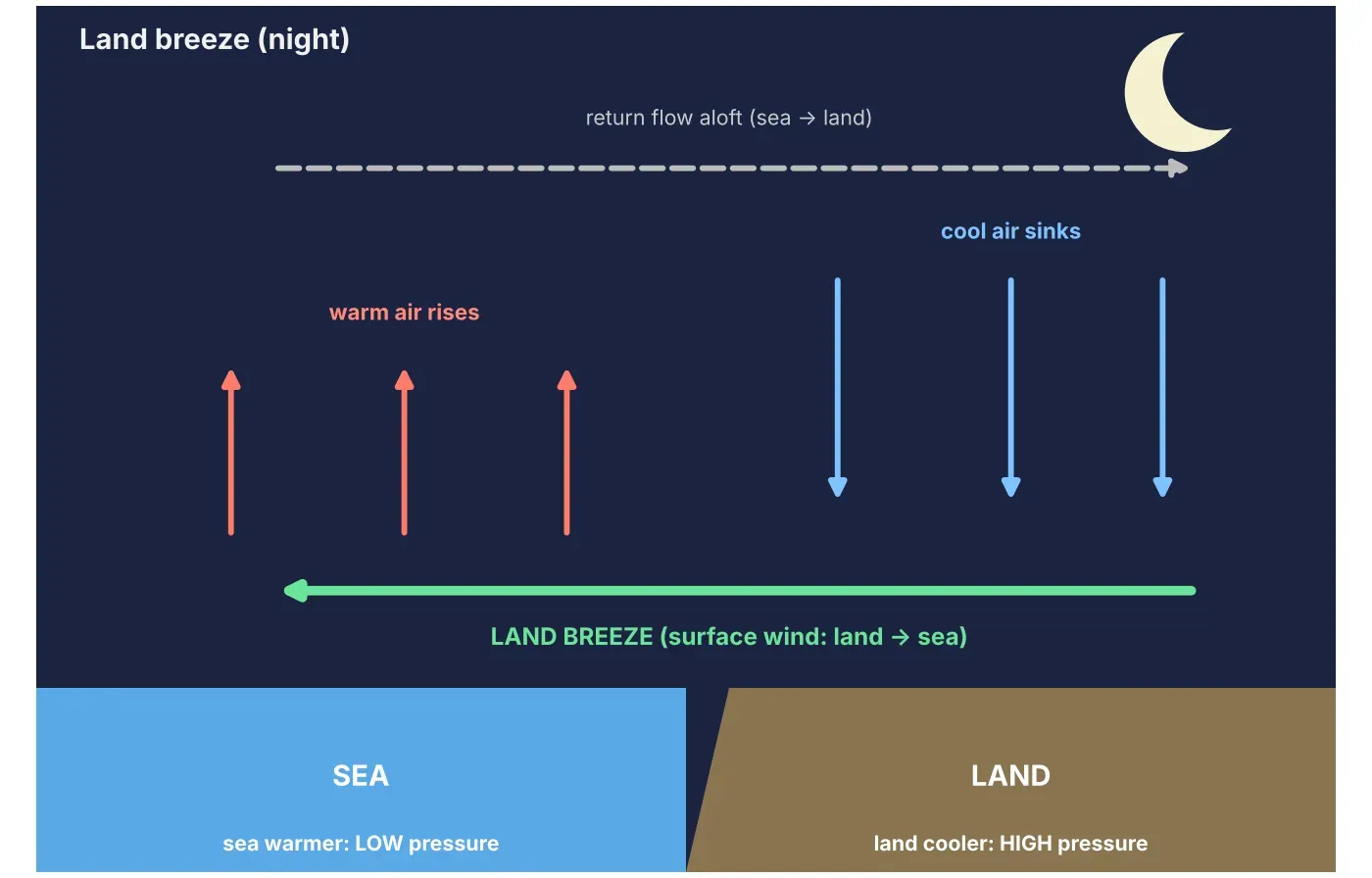
A land breeze is a wind that blows from the land towards the sea. It forms at night or in the early morning, when the land has cooled faster than the sea.
How a Land Breeze Forms, Step by Step
- After sunset, the land loses its heat quickly and cools down.
- The sea keeps its warmth longer, because water has a high specific heat capacity.
- The air over the cool land becomes denser, so a high pressure forms over the land.
- The air over the warmer sea becomes lighter and rises, so a low pressure forms over the sea.
- Air flows from the high pressure (land) to the low pressure (sea). This is the land breeze.
A land breeze is usually dry, weak and shallow. It is more noticeable on clear, calm nights.
What Is a Sea Breeze?
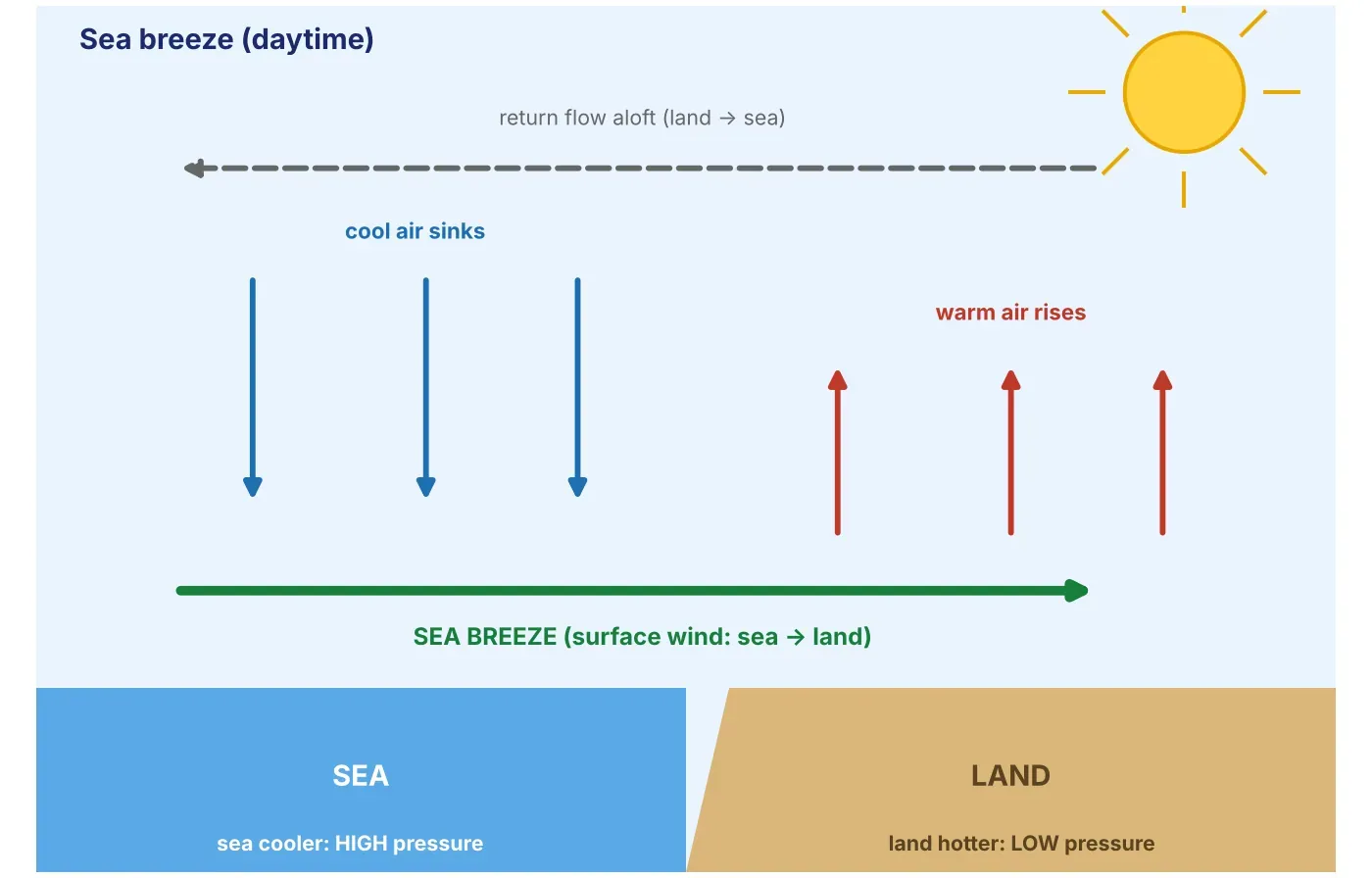
A sea breeze is a wind that blows from the sea towards the land. It forms in the day, usually between late morning and early evening, when the land has become hotter than the sea.
How a Sea Breeze Forms, Step by Step
- After sunrise, the sun heats the land surface quickly.
- The sea warms more slowly, because of its higher specific heat capacity.
- The warm air over the land rises (convection), so a low pressure forms over the land.
- The cooler, denser air over the sea has a high pressure.
- Air flows from the high pressure (sea) to the low pressure (land). This is the sea breeze.
A sea breeze is cool, moist and usually stronger and deeper than a land breeze. It is more noticeable in summer, and it can bring clouds to the coast.
What Causes Land Breeze and Sea Breeze?
Land breeze and sea breeze have the same cause: the unequal heating of land and water. Two ideas explain it.
Specific Heat Capacity: The Core Reason
Water has a specific heat capacity of about 4,200 J/kg·K, and dry land (soil and rock) has about 800 to 1,000 J/kg·K. Water needs much more energy for the same rise of temperature, so:
- In the day: the land heats much faster, so the air over it rises, and the sea breeze flows in.
- At night: the land cools much faster, so the air over it sinks, and the land breeze flows out.
The Pressure Difference: What Drives the Wind
Warm air is less dense and rises, which leaves a low pressure behind. Cool air is denser and sinks, which makes a high pressure. Wind blows from the high pressure to the low pressure. Both breezes follow this rule, but at different times of the day, and the air returns at a height to complete a circulation.
Difference Between Land Breeze and Sea Breeze
Basis | Land Breeze | Sea Breeze |
|---|---|---|
Definition | Blows from the land to the sea | Blows from the sea to the land |
Time | Night and early morning | Day |
Pressure over the land | High | Low |
Pressure over the sea | Low | High |
Temperature of the land | Cooler than the sea | Hotter than the sea |
Temperature of the sea | Warmer than the land | Cooler than the land |
Type of air | Drier | Moist and cool |
Strength | Weaker | Usually stronger |
Depth | Shallow | Deeper |
More noticeable in | Clear, calm nights (winter and autumn) | Summer days |
Other name | Offshore wind | Onshore wind |
Effect on the coast | Little effect on the temperature | Cools the coastal area, and can help clouds to form |
Helps boats to | Go out to the sea | Return to the shore |
Land Breeze and Sea Breeze Diagram: How to Draw It in an Exam
Examiners expect a labelled diagram of the land breeze and sea breeze, so follow these steps:
- Draw the sea on the left and the land on the right, with the coast between them.
- For a sea breeze (day): draw a long arrow near the surface from the sea to the land. Draw an upward arrow over the land (warm air rises) and a downward arrow over the sea (cool air sinks). Draw a return arrow at a height from the land to the sea.
- For a land breeze (night): reverse every arrow.
- Label high pressure over the cooler surface and low pressure over the warmer surface, and write "day" or "night".
Characteristics of Land Breeze and Sea Breeze
These are the main characteristics of the land breeze and sea breeze that questions ask.
What They Have in Common
- Both are local winds caused by the unequal heating of land and sea.
- Both blow mostly in the coastal belt, which is some tens of kilometres wide.
- Both form a circulation: a surface wind in one direction and a return flow at a height in the other.
- The temperature of the land changes much more between day and night than the temperature of the sea surface.
How They Differ
- Moisture: land breezes carry drier air, and sea breezes carry moist air.
- Cloud formation: sea breezes can help cumulus clouds to form over land, but land breezes rarely do.
- Navigation: a land breeze helps boats to go out to the sea, and a sea breeze helps them to return.
- Pollution: in coastal industrial areas, land breezes can carry pollutants out to sea, and sea breezes can bring them back inland.
Tips to Remember the Difference Between Land Breeze and Sea Breeze
Use these tips to remember the land breeze and sea breeze in the exam.
Memory device | Land Breeze | Sea Breeze |
|---|---|---|
Time | Night breeze | Day breeze |
Direction | Land to sea | Sea to land |
Air | Drier | Moist |
Strength | Weaker | Stronger |
Other name | Offshore | Onshore |
Mnemonic to Remember the Direction
"Land breezes Leave the land at night; sea breezes Seek the shore by day."
Another way: a land breeze is named from where it starts (the land), and a sea breeze is named from where it starts (the sea). Both are named after their source.
More Science Revision
For more concept-based practice after the land breeze and sea breeze, see eSaral's NCERT Solutions for Class 9 Science and Class 10 Science.
Frequently Asked Questions
What is the difference between land breeze and sea breeze?
The main difference is the direction and the time. A land breeze blows from the land to the sea at night, when the land cools faster than the sea. A sea breeze blows from the sea to the land during the day, when the land heats faster than the sea. The cause of both is the difference in the heating of land and water.
Which is stronger, a land breeze or a sea breeze?
A sea breeze is usually stronger. In the daytime, the land becomes much hotter than the sea, so the pressure difference is larger. At night, the land is only a little cooler than the sea, so the land breeze is weaker and shallower.
Why does a sea breeze blow during the day and a land breeze at night?
In the day, the sun heats the land faster than the sea, so the air over the land rises and a low pressure forms, and cooler air from the sea moves in. At night, the land loses heat faster than the sea, so the air over the sea is warmer and rises, and the cooler air from the land moves out towards the sea.
What causes land breeze and sea breeze?
Land breeze and sea breeze are caused by the unequal heating of land and water. Water has a much higher specific heat capacity than land, so it heats and cools slowly. The temperature difference creates a pressure difference, and wind blows from the high pressure to the low pressure.
How do you draw a land breeze and sea breeze diagram?
Draw the sea on one side and the land on the other. For a sea breeze (day), draw an arrow at the surface from the sea to the land, an upward arrow over the land, a return arrow at a height from the land to the sea, and a downward arrow over the sea. For a land breeze (night), reverse all the arrows. Label the high pressure and the low pressure.
What is an offshore wind and an onshore wind?
An offshore wind blows from the land towards the sea, so a land breeze is an offshore wind. An onshore wind blows from the sea towards the land, so a sea breeze is an onshore wind.
Why is a sea breeze moist and a land breeze dry?
A sea breeze brings air that has passed over the water, so it carries water vapour and is moist and cool. A land breeze brings air that has passed over the land, so it is drier.
How do land breeze and sea breeze help fishermen and sailors?
A land breeze blows towards the sea, so it helps boats to go out to the sea, in the night or the early morning. A sea breeze blows towards the land, so it helps boats to return to the shore in the day. This is why traditional fishermen have used these winds.
How do land breeze and sea breeze affect the weather of a coastal area?
A sea breeze brings cooler and moister air to the coast in the day, which lowers the temperature, and it can help clouds to form. A land breeze takes the air from the land towards the sea at night. Both winds can also move air pollution, and they change the temperature and the humidity of the coastal belt.
In which NCERT class are land breeze and sea breeze taught?
They are taught in the NCERT Class 7 Science chapter Winds, Storms and Cyclones, and they come again as local winds in higher-class Geography. The ideas used are specific heat capacity, convection and pressure difference.
In which season are land breeze and sea breeze strongest?
A sea breeze is most noticeable in summer, when the day heating of the land is strong. A land breeze is more noticeable on clear, calm nights, when the land cools quickly. The strength depends on the temperature difference, so it changes from place to place.
Where can I find more Science notes and NCERT solutions?
eSaral has NCERT Solutions for Science for Class 9 and Class 10, and Science and Physics notes for the higher classes. The main links are given at the end of this page.
Team eSaral
eSaral Academic and Editorial Team
Team eSaral is the collective author profile for educational content created by eSaral’s teachers and academic contributors. The team draws on expertise from IIT graduates, doctors, experienced educators and subject specialists to develop resources for JEE, NEET and school students. Our articles aim to explain concepts clearly and help students study with confidence.
Related Posts

BITSAT 2027: Registration Date, Exam Date, Syllabus, Eligibility, Pattern & Fees
BITSAT 2027 exam dates, registration timeline, eligibility criteria, exam pattern, marking scheme, syllabus and fees in one page.

BITSAT Previous Year Question Paper PDF (2017-2026)
Download BITSAT previous year question papers PDF from 2017 to 2026,session-wise. Memory-based papers,exam pattern, paper analysis and how to practise

CBSE Class 10 Date Sheet 2027: Expected Exam Dates, Release Date, Admit Card & Result Timeline
CBSE Class 10 date sheet 2027 is awaited. See the expected exam dates, release window, how to download the PDF, admit card and result timelines.

NCERT Physics Class 10 Book PDF in Hindi 2026-27 – भौतिक विज्ञान के 4 अध्याय (Free Download)
NCERT Physics Class 10 book PDF in Hindi 2026-27: download all 4 chapters (अध्याय 9–12) free, with topics and important formulas.

NCERT Biology Class 9 Book Anveshan PDF in Hindi - जीव विज्ञान कक्षा 9 पुस्तक अन्वेषण PDF
Download NCERT Biology Class 9 book PDF in Hindi chapterwise for 2026-27: Cell, Tissues, Reproduction and Diversity. Free PDFs.

Essay On Artificial Intelligence in English (100,150, 200, 250, 300, 500 Words)
This is in contrast to the natural intelligence of humans. With Artificial Intelligence, machines can perform

Essay on 78th India Independence Day in English for Student (100, 150, 200, 250, 300, 500 Words)
Read the best essays on India's Independence Day in English. Short & long essays (100, 150, 200, 250, 300, 500 words) perfect for school exams
NCERT Class 11 English Snapshots book - Free PDF download- Esaral
Download NCERT Class 11 English Snapshots book PDF for free. Get all 8 chapters, chapter-wise. Start your prep today!
NCERT Class 10 biology book pdf - Free PDF Download - eSaral
NCERT Class 10 Biology book PDF 2026-27: all 5 chapters (Life Processes to Our Environment) in English & Hindi, with CBSE syllabus, marks & practical

Essay on Global Warming in English (100,150, 200, 250, 300, 500 Words)
Global warming means the Earth is getting hotter. This happens because of things like pollution from cars and factories.