
What is Pulley ?

eSaral Academic and Editorial Team
Pulley
A single fixed pulley changes the direction of force only and in general assumed to be massless and frictionless.
It is clear from the example given below.
Ex. A bucket of mass $25 \mathrm{~kg}$ is raised by a $50 \mathrm{~kg}$ man in two different ways as shown in fig. What is the action on the floor by the man in the two cases? If the floor yields to a normal force of 700 N, which mode should the man adopt to lift the bucket without the floor yielding?
Sol. Here, mass of the bucket, $m=25 \mathrm{~kg} ;$ mass of the man, $M=50 \mathrm{~kg}$

Force applied to lift the bucket, $\mathrm{F}=\mathrm{mg}=25 \times 9.8=245 \mathrm{~N}$
Weight of the man, $\mathrm{Mg}=50 \times 9.8=490 \mathrm{~N}$
Fig. (a) When the bucket is raised by the man by applying force $F$ in upward direction, reaction equal and opposite to $F$
will act on the floor in addition to the weight of the man.
Therefore, action on the floor $=\mathrm{Mg}+\mathrm{F}=490+245=735 \mathrm{~N}$
Fig. (b) When the bucket is raised by the man by applying force $F$ over the rope (passed over the pulley) in downward direction, reaction equal and opposite to $F$ will act on the floor.
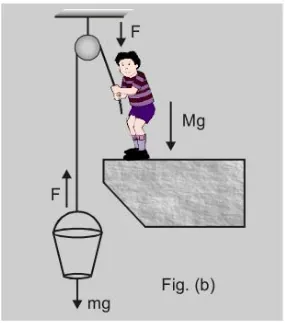
Therefore, action on the floor $=\mathrm{Mg}-\mathrm{F}=490-245=245 \mathrm{~N}$
Since the floor yields to a normal force of $700 \mathrm{~N}$.
The mode (b) should be adopted by the man to lift the bucket.
Case I
$m_{1}=m_{2}=m$
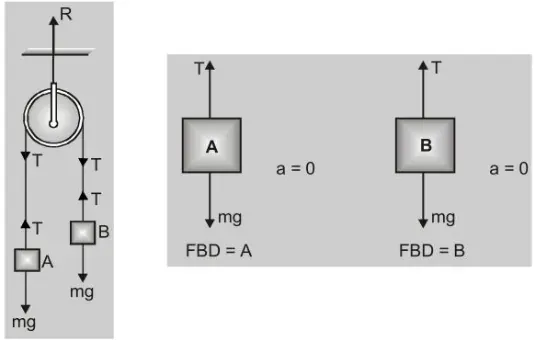
Tension in the string $\mathrm{T}=\mathrm{mg}$
Acceleration ' $a$ ' = zero.
Reaction at the pulley
$\mathrm{R}=2 \mathrm{~T}=2 \mathrm{mg}$
[Strength of support or suspension]
Case II
$m_{1}>m_{2}$
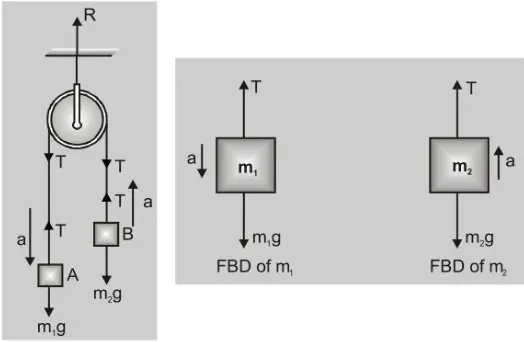
for mass $m_{1}, \quad m_{1} g-T=m_{1} a \ldots \ldots$ ....(i)
for mass $m_{2}, \quad T-m_{2} g=m_{2} a \ldots \ldots$ .....(ii)
Solving, we get
$a=\left(\frac{m_{1}-m_{2}}{m_{1}+m_{2}}\right) g$
or $\quad T=\frac{\left(2 m_{1} m_{2}\right) g}{\left(m_{1}+m_{2}\right)}$
reaction at the pulley $R=2 T=\frac{4 m_{1} m_{2} g}{\left(m_{1}+m_{2}\right)}$
Case III
The forces acting on the system are shown in the fig.
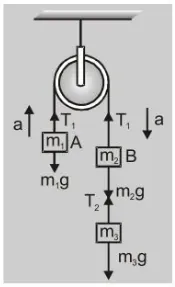
For mass $m_{1}: \quad T_{1}-m_{1} g=m_{1} a \quad \ldots \ldots \ldots$ ......(i)
For mass $m_{2}: \quad m_{2} g+T_{2}-T_{1}=m_{2} a$ ........(ii)
For mass $m_{3}: m_{3} g-T_{2}=m_{3} a$ .......(iii)
Solving these equations, we get $a=\left(\frac{m_{2}+m_{3}-m_{1}}{m_{1}+m_{2}+m_{3}}\right) g$
Putting the value of 'a' in equation (i) and (iii) tension $\mathrm{T}_{1}$ and $\mathrm{T}_{2}$ can be calculated.
Alternative Method :
$\mathrm{T}_{1}=\mathrm{m}_{1}(\mathrm{~g}+\mathrm{a})$ .......(1) $\left(T_{1}=\right.$ effective weight of $\left.m_{1}\right)$
$T_{1}=\left(m_{2}+m_{3}\right)(g-a)$ .......(2) $\left(T_{1}=\right.$ effective weight of $\left.m_{2}+m_{3}\right)$
$\mathrm{T}_{2}=\mathrm{m}_{3}(\mathrm{~g}-\mathrm{a})$ .......(3) $\left(T_{2}=\right.$ effective weight of $\left.m_{3}\right)$
eq $^{n} .(1)$ and $e q^{n} .(2)$ gives us
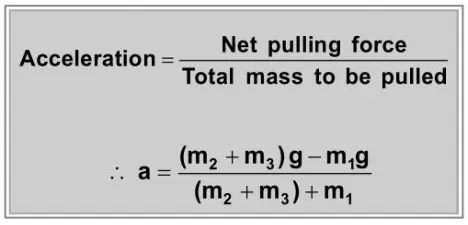
$m_{1} g+m_{1} a=\left(m_{2}+m_{3}\right) g-\left(m_{2}+m_{3}\right) a$
$\left(m_{1}+m_{2}+m_{3}\right) a=\left(m_{2}+m_{3}-m_{1}\right) g$
$a=\left(\frac{m_{2}+m_{3}-m_{1}}{m_{1}+m_{2}+m_{3}}\right) g$ ......(4)
From $\mathrm{eq}^{\mathrm{n}} \cdot(1)$ and $\mathrm{eq}^{\mathrm{n}} .$ (4)
$\mathrm{T}_{1}=\mathrm{m}_{1} \mathrm{~g}\left\{1+\frac{\mathrm{m}_{2}+\mathrm{m}_{3}-\mathrm{m}_{1}}{\mathrm{~m}_{1}+\mathrm{m}_{2}+\mathrm{m}_{3}}\right\} \quad \mathrm{T}_{1}=\frac{2 \mathrm{~m}_{1}\left(\mathrm{~m}_{2}+\mathrm{m}_{3}\right)}{\mathrm{m}_{1}+\left(\mathrm{m}_{2}+\mathrm{m}_{3}\right)} \mathrm{g}$
$\mathrm{T}_{2}=\mathrm{m}_{3} \mathrm{~g}\left\{1-\frac{\left(\mathrm{m}_{2}+\mathrm{m}_{3}-\mathrm{m}_{1}\right)}{\mathrm{m}_{1}+\mathrm{m}_{2}+\mathrm{m}_{3}}\right\}=\frac{2 \mathrm{~m}_{1} \mathrm{~m}_{3}}{\mathrm{~m}_{1}+\mathrm{m}_{2}+\mathrm{m}_{3}}$
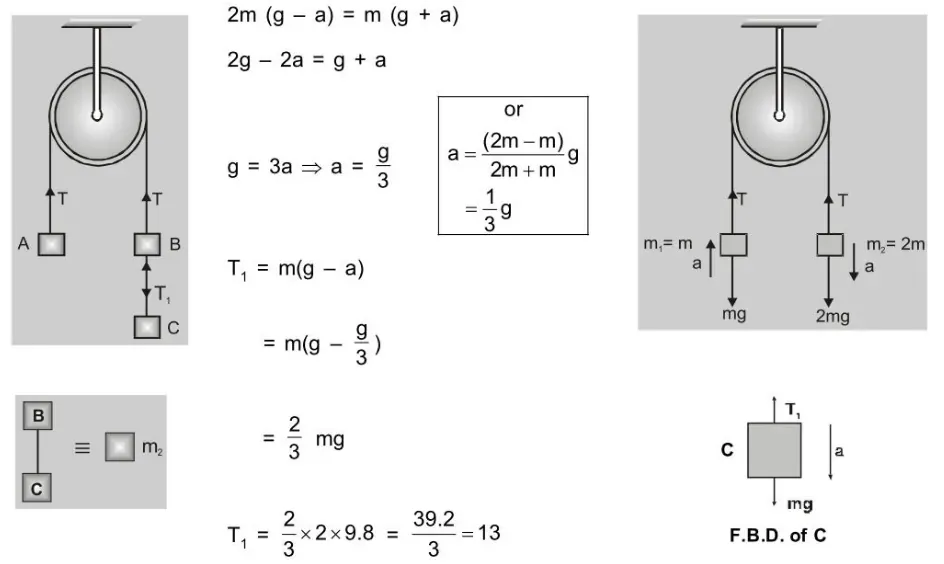
Ex. Three equal weights A, B, C of mass $2 \mathrm{~kg}$ each are hanging on a string passing over a fixed frictionless pulley as shown in fig. below. Find out tension in the string connecting weights $B$ and $C$.
Sol. $\quad T=2 m(g-a)$ effective weight of $m_{2}$
$\mathrm{T}=\mathrm{m}(\mathrm{g}+\mathrm{a})$ effective weight of $m_{1}$
Case IV
(a) Without friction :
For mass $m_{1}: T=m_{1} a$
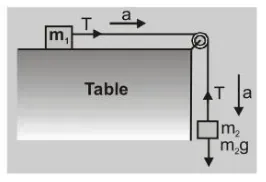
for mass $m_{2}: m_{2} g-T=m_{2} a$
Solving, we get
Acceleration $a=\frac{m_{2} g}{\left(m_{1}+m_{2}\right)}$
$\mathrm{T}=\frac{\mathrm{m}_{1} \mathrm{~m}_{2} \mathrm{~g}}{\left(\mathrm{~m}_{1}+\mathrm{m}_{2}\right)}$
(b) With friction : (Friction in bet". surface and block)
For mass $m_{1}: T-\mu m_{1} g=m_{1} a$
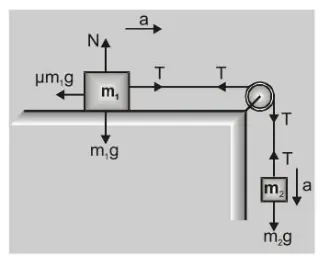
For mass $m_{2}: m_{2} g-T=m_{2} a$
Solving, we get
Acceleration $\quad \mathrm{a}=\frac{\left(\mathrm{m}_{2}-\mu \mathrm{m}_{1}\right) \mathrm{g}}{\left(\mathrm{m}_{1}+\mathrm{m}_{2}\right)}$
$\mathrm{T}=\frac{\mathrm{m}_{1} \mathrm{~m}_{2}(1+\mu) \mathrm{g}}{\left(\mathrm{m}_{1}+\mathrm{m}_{2}\right)}$
Case V
$\left(m_{1}>m_{2}\right)$
$\mathrm{m}_{1} \mathrm{~g}-\mathrm{T}_{1}=\mathrm{m}_{1} \mathrm{a} \quad \ldots \ldots$ (i)
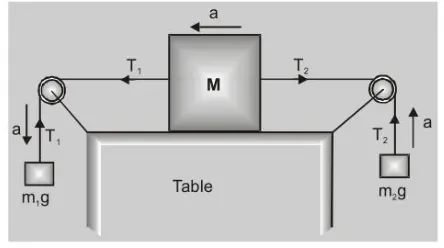
$\mathrm{T}_{2}-\mathrm{m}_{2} \mathrm{~g}=\mathrm{m}_{2} \mathrm{a}$
$\mathrm{T}_{1}-\mathrm{T}_{2}=\mathrm{Ma}$
Solving (i), (ii) and (iii), we get
$a=\frac{\left(m_{1}-m_{2}\right) g}{\left(m_{1}+m_{2}+M\right)}$
$\mathrm{T}_{1}=\mathrm{m}_{1} \mathrm{~g}\left[\frac{2 \mathrm{~m}_{2}+\mathrm{M}}{\mathrm{m}_{1}+\mathrm{m}_{2}+\mathrm{M}}\right], \quad \mathrm{T}_{2}=\mathrm{m}_{2} \mathrm{~g}\left[\frac{2 \mathrm{~m}_{1}+\mathrm{M}}{\mathrm{m}_{1}+\mathrm{m}_{2}+\mathrm{M}}\right]$
Also Read
To watch Free Learning Videos on JEE by Kota’s top IITian Faculties Install the eSaral App
Team eSaral
eSaral Academic and Editorial Team
Team eSaral is the collective author profile for educational content created by eSaral’s teachers and academic contributors. The team draws on expertise from IIT graduates, doctors, experienced educators and subject specialists to develop resources for JEE, NEET and school students. Our articles aim to explain concepts clearly and help students study with confidence.
Related Posts

BITSAT 2027: Registration Date, Exam Date, Syllabus, Eligibility, Pattern & Fees
BITSAT 2027 exam dates, registration timeline, eligibility criteria, exam pattern, marking scheme, syllabus and fees in one page.

BITSAT Previous Year Question Paper PDF (2017-2026)
Download BITSAT previous year question papers PDF from 2017 to 2026,session-wise. Memory-based papers,exam pattern, paper analysis and how to practise

CBSE Class 10 Date Sheet 2027: Expected Exam Dates, Release Date, Admit Card & Result Timeline
CBSE Class 10 date sheet 2027 is awaited. See the expected exam dates, release window, how to download the PDF, admit card and result timelines.

NCERT Physics Class 10 Book PDF in Hindi 2026-27 – भौतिक विज्ञान के 4 अध्याय (Free Download)
NCERT Physics Class 10 book PDF in Hindi 2026-27: download all 4 chapters (अध्याय 9–12) free, with topics and important formulas.

NCERT Biology Class 9 Book Anveshan PDF in Hindi - जीव विज्ञान कक्षा 9 पुस्तक अन्वेषण PDF
Download NCERT Biology Class 9 book PDF in Hindi chapterwise for 2026-27: Cell, Tissues, Reproduction and Diversity. Free PDFs.

Essay On Artificial Intelligence in English (100,150, 200, 250, 300, 500 Words)
This is in contrast to the natural intelligence of humans. With Artificial Intelligence, machines can perform

Essay on 78th India Independence Day in English for Student (100, 150, 200, 250, 300, 500 Words)
Read the best essays on India's Independence Day in English. Short & long essays (100, 150, 200, 250, 300, 500 words) perfect for school exams
NCERT Class 11 English Snapshots book - Free PDF download- Esaral
Download NCERT Class 11 English Snapshots book PDF for free. Get all 8 chapters, chapter-wise. Start your prep today!
NCERT Class 10 biology book pdf - Free PDF Download - eSaral
NCERT Class 10 Biology book PDF 2026-27: all 5 chapters (Life Processes to Our Environment) in English & Hindi, with CBSE syllabus, marks & practical

Essay on Global Warming in English (100,150, 200, 250, 300, 500 Words)
Global warming means the Earth is getting hotter. This happens because of things like pollution from cars and factories.