
Wisdom Paves the Way Summary: Characters, Scene-Wise Explanation and Moral (Class 8 Poorvi)

eSaral Academic and Editorial Team
Summary
Wisdom Paves the Way summary: four young men, Ram Datt, Shiv Datt, Har Datt and Dev Datt, travel to Ujjain to look for work. On the road, each of them reads a different clue from a camel’s tracks, and a merchant who has lost his camel accuses them of stealing it. In the King’s court, they explain their reasoning, the King rejects the accusation and makes them his advisers. The play shows that careful observation and clear thinking open doors, and that hasty accusations lead to shame.
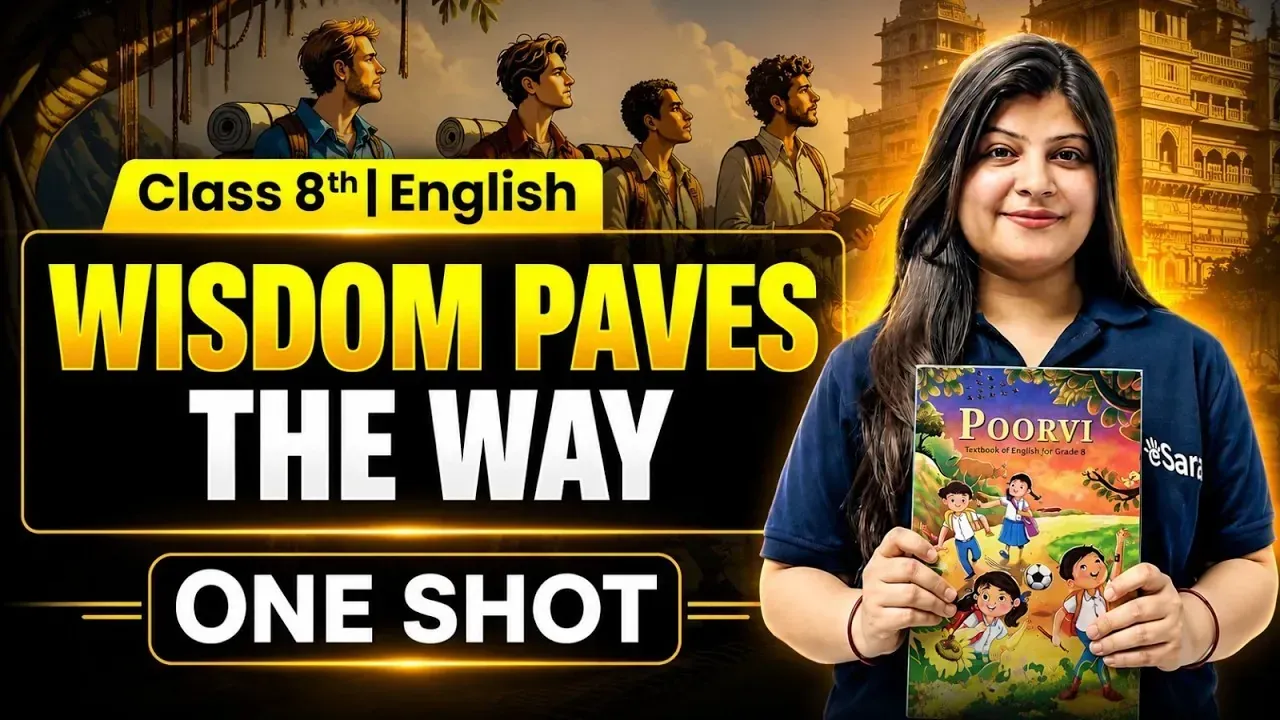
“Wisdom Paves the Way” is a play in the NCERT Class 8 English textbook Poorvi. It is the third lesson of Unit 1, “Wit and Wisdom”. This Wisdom Paves the Way summary covers the characters, the setting, a scene-wise explanation, word meanings, the moral and model answers to the textbook questions.
Wisdom Paves the Way: About the Play
This Wisdom Paves the Way summary starts with the basic facts of the play.
Detail | Information |
|---|---|
Textbook | NCERT Class 8 English, Poorvi |
Unit | Unit 1: Wit and Wisdom (third lesson) |
Type of text | A play in two scenes |
Setting | Scene I: the road leading to Ujjain. Scene II: the King’s court. The time is midday. |
Main characters | Ram Datt, Shiv Datt, Har Datt, Dev Datt, the Merchant, the King of Ujjain |
Main idea | Observation and reasoning (wisdom) lead to recognition, and hasty accusations lead to shame |
What Does “Wisdom Paves the Way” Mean?
The textbook begins the lesson by explaining that knowledge is learning facts and information, while wisdom is using that knowledge with good judgement. “Paves the way” means to prepare a path or make something possible. So the title means that wisdom clears the path to success.
In the play, the four men have no plan to meet the King. Their careful observation and reasoning bring them to his court and lead them to a position they had not dared to dream of. A Hindi saying also fits the theme: जहाँ चाह होती है, वहाँ राह होती है।
Characters in Wisdom Paves the Way
The Wisdom Paves the Way summary below refers to these characters often.
Character | Role | Key trait |
|---|---|---|
Ram Datt | One of the four young men | Observant and confident. He notices that the camel is lame. |
Shiv Datt | One of the four young men | Analytical. He deduces that the camel is blind in the right eye. |
Har Datt | One of the four young men | Thoughtful and practical. He says they need to devise a strategy, and he deduces the short tail. |
Dev Datt | One of the four young men | Insightful and calm. He reasons that the camel has a pain in the stomach. |
The Merchant | The owner of the lost camel | Hasty and emotional. He accuses the men without proof. |
The King of Ujjain | A young king | Wise and fair. He listens to evidence and rewards talent. |
Two Sentries | Guards of the palace | Minor characters who bring the merchant and the four men to the King |
Tip from the eSaral English team: Exam questions often ask which man noticed what. Make a small table with each name and his finding, and you will not mix them up.
Setting of Wisdom Paves the Way
The setting is an important part of any Wisdom Paves the Way summary.
- Scene I: The Road to Ujjain. A dusty road leads to the city of Ujjain, which is visible in the distance. The sun is high, as it is midday, and the noise of the bustling city faintly reaches the travellers.
- Scene II: The King’s Court. The court hall is decorated with rich tapestries, tall columns and a golden canopy. The King sits on the throne with his courtiers.
The road is where the real wisdom is shown, because the men make all their deductions from the tracks without ever seeing the camel.
Wisdom Paves the Way Summary: Scene I (The Road to Ujjain)
Wisdom Paves the Way Summary: The Four Men Walk to Ujjain
Four young men, Ram Datt, Shiv Datt, Har Datt and Dev Datt, are walking along a dusty road to Ujjain. They look travel-worn but resolute (determined). They have been on the road for ten days and have not yet found work. Dev Datt says that ten days are only a short time in the larger scheme of things, and Ram Datt hopes that the King of Ujjain will recognise their talent. Har Datt points out that meeting the King is not easy, and that they need to devise a strategy.
Wisdom Paves the Way Summary: They Notice the Camel’s Tracks
Shiv Datt notices that a camel has passed that way recently, and the tracks are fresh. As the men continue, each of them studies the tracks closely and notices something different. Then a merchant comes running, in a hurry, as if some trouble were chasing him.
Wisdom Paves the Way Summary: What Each Man Observed
Man | What he observed | What he concluded |
|---|---|---|
Ram Datt | Only three feet left clear prints, and the fourth was faint | The camel is lame in one leg |
Shiv Datt | The camel ate leaves only on the left side of the road | The camel is blind in its right eye |
Har Datt | Small drops of blood along the track, probably from mosquito bites | The camel has a short tail, so it could not drive the insects away |
Dev Datt | The front prints were deep and clear, but the hind prints were faint | The camel has a pain in its belly and is drawing up its hind legs |
Wisdom Paves the Way Summary: The Merchant Accuses Them
The merchant asks the men whether they have seen his camel, which has strayed. The four men ask him questions about the animal: is it lame, is it blind in the right eye, does it have a short tail, and has it had a stomach pain? The surprised merchant says yes to all of them. When the men say they do not know where the camel is, he becomes angry. He calls them deceivers and says they must have stolen the camel. Dev Datt calmly replies that the merchant is free to take them to the King. All four agree to go with him to the palace.
Wisdom Paves the Way Summary: Scene II (The King’s Court)
Wisdom Paves the Way Summary: The King Hears the Case
The Sentry tells the King that the merchant has a complaint against four travellers, accusing them of stealing his camel. The King asks the merchant to state his accusation clearly, and the merchant says that the men know every detail of the camel, yet insist they have never seen it, so they must be the thieves.
Wisdom Paves the Way Summary: Each Man Explains His Reasoning
The King asks each man how he knew. Ram Datt explains the faint fourth print, which showed a limp. Shiv Datt explains that only the leaves on the left side were nibbled, while the right side was untouched. Har Datt explains the drops of blood, which showed that the camel could not drive away mosquitoes with a long tail. Dev Datt explains the deep front prints and faint hind prints, which showed that the camel was in pain and was moving carefully. The King praises each explanation.
Wisdom Paves the Way Summary: The King’s Verdict and Offer
The King tells the merchant that his accusation is baseless and asks him to be careful in future about whom he accuses. The merchant, chastened and embarrassed, leaves with his face red with shame. The King then tells the four men that they have shown remarkable intelligence and the ability to see beyond the obvious, and offers them the honour of becoming his advisers. They accept with humility and gratitude, and the court applauds. Their journey ends in a way they had never anticipated.
Wisdom Paves the Way Summary: Events of Scene II in Order
- The King asks the merchant to state his accusation clearly.
- The merchant accuses the four men of knowing too much about his missing camel.
- Ram Datt explains how he inferred from the tracks that the camel is lame.
- Shiv Datt explains that the camel is blind in its right eye, because it chewed only the leaves on the left side.
- Har Datt explains how he knew that the camel has a short tail.
- Dev Datt explains his observation about the camel’s pain and careful movement.
- The King praises the young men and dismisses the merchant’s accusation.
- The King makes the four young men his advisers.
Word Meanings in Wisdom Paves the Way
These words from the textbook margins will help you understand the Wisdom Paves the Way summary.
Word or phrase | Meaning |
|---|---|
adorned | beautified |
tapestries | heavy decorative fabrics woven with pictures or patterns |
resolute | determined |
bustling | busy |
eludes | is difficult to obtain |
devise (here) | to think of |
deliberate | to think carefully |
scrutinise | to look carefully at |
in haste | in a hurry |
pursued (here) | chased |
countenance | facial expression |
distressed | worried |
astray | away from the correct path |
indignant | angry |
yonder | over there |
grievance | complaint |
accusations | claims that someone has done something wrong |
deduce | to determine by reasoning |
discern | to see or notice something |
foliage | green leaves and plants |
insight | a clear or deep understanding |
flawless | perfect |
chastened | felt sorry |
counsel | advice |
beacon | a guiding light |
Moral and Themes of Wisdom Paves the Way
This Wisdom Paves the Way summary highlights four themes.
Wisdom and observation lead to success. The four men had no contacts or plan, but their habit of careful observation and clear reasoning brought them to the King and gave them a respected position.
Do not accuse without proof. The merchant accused the men because they knew too much about his camel, and he did not think about how they could know it. His haste ended in shame in front of the court.
A good ruler is fair. The King listened to both sides, asked for reasons, and rewarded talent instead of punishing the travellers.
Knowledge is not enough. The men noticed small clues (knowledge), and then used good judgement to draw the right conclusions (wisdom).
Wisdom Paves the Way Questions and Answers (Class 8 Poorvi)
Use these answers after you have read the Wisdom Paves the Way summary above.
1. What does the dusty road leading to Ujjain tell us about the challenges of the young men’s journey?
It shows that their journey was long and tiring. They have walked for ten days without finding work, and they look travel-worn, but they continue with determination.
2. Why did the merchant become suspicious of the four men? What does this tell us about him?
The men described his camel perfectly, but said they had not seen it. This made the merchant think that they had stolen it. It shows that he was hasty and quick to blame others without thinking.
3. How do the four young men’s observations about the camel serve as a turning point in the play?
Their observations connect them with the merchant, which leads to the King’s court. There, their reasoning changes their position from suspects to wise people, and it results in the offer to become advisers.
4. Why did the King believe the four young men and not the merchant?
Each man explained his conclusion with clear evidence from the tracks. The merchant had only a suspicion and no proof. The King judged by reasons and not by emotion.
5. How does the capability of the four young men make them suitable to become advisers?
They notice small details, think logically, stay calm under accusation and explain their reasoning clearly. These are the qualities of good advisers.
6. Why does the merchant feel ashamed for accusing the four young men?
He realised that he had accused innocent men without proof, and the King publicly corrected him. His haste had also wasted the time of the court.
Read more Class 8 Poorvi lessons on eSaral: A Tale of Valour and Somebody’s Mother.
For more reading on CBSE Class 9 English chapters and their explanations, refer to the NCERT Solutions for Class 9 on eSaral.
Frequently Asked Questions
What is the Wisdom Paves the Way summary?
Wisdom Paves the Way is a two-scene play about four young men, Ram Datt, Shiv Datt, Har Datt and Dev Datt, who travel to Ujjain to find work. They work out details of a lost camel from its tracks. A merchant accuses them of stealing it, but in the King’s court they explain their reasoning, and the King makes them his advisers. The Wisdom Paves the Way summary on eSaral explains each scene in detail.
Which class and book is Wisdom Paves the Way in?
Wisdom Paves the Way is in the NCERT Class 8 English textbook Poorvi, Unit 1, “Wit and Wisdom”. It is the third lesson of the unit. This Wisdom Paves the Way summary follows the textbook version.
Who are the characters in Wisdom Paves the Way?
The characters are the four young men (Ram Datt, Shiv Datt, Har Datt and Dev Datt), the Merchant, the King of Ujjain and two Sentries. The Wisdom Paves the Way summary above shows what each of them does.
What did each man observe about the camel?
Ram Datt noticed that only three feet left clear prints, so the camel was lame. Shiv Datt saw that only the leaves on the left side were eaten, so the camel was blind in the right eye. Har Datt saw drops of blood, so the camel had a short tail. Dev Datt noticed deep front prints and faint hind prints, so the camel had a pain in its belly. These findings are set out in a table in the Wisdom Paves the Way summary.
What is the moral of Wisdom Paves the Way?
The moral of Wisdom Paves the Way is that wisdom, built on careful observation and clear thinking, opens the path to success, and that we should not accuse others without proof. The merchant’s haste shows what happens when we judge without evidence.
Why did the merchant accuse the four men?
The four men described his camel in exact detail, but said they did not know where it was. The merchant concluded that they must have stolen it, without thinking that they could have worked out the details from the tracks. The Wisdom Paves the Way summary explains this in Scene I.
Why did the King make the four men his advisers?
The King was impressed by their observation, reasoning and calm behaviour. He said that they had shown the ability to see beyond the obvious, and that minds like theirs were rare and valuable in his court.
What is the meaning of the title “Wisdom Paves the Way”?
It means that wisdom, which is the use of knowledge with good judgement, clears the path to success. In the play, the men’s wisdom brings them to the King and wins them a place as advisers.
Is Wisdom Paves the Way a story or a play?
It is a play, written in dialogue, with two scenes. Scene I is on the road to Ujjain, and Scene II is in the King’s court. The textbook also suggests staging it as a play in class.
Team eSaral
eSaral Academic and Editorial Team
Team eSaral is the collective author profile for educational content created by eSaral’s teachers and academic contributors. The team draws on expertise from IIT graduates, doctors, experienced educators and subject specialists to develop resources for JEE, NEET and school students. Our articles aim to explain concepts clearly and help students study with confidence.
Related Posts

BITSAT 2027: Registration Date, Exam Date, Syllabus, Eligibility, Pattern & Fees
BITSAT 2027 exam dates, registration timeline, eligibility criteria, exam pattern, marking scheme, syllabus and fees in one page.

BITSAT Previous Year Question Paper PDF (2017-2026)
Download BITSAT previous year question papers PDF from 2017 to 2026,session-wise. Memory-based papers,exam pattern, paper analysis and how to practise

CBSE Class 10 Date Sheet 2027: Expected Exam Dates, Release Date, Admit Card & Result Timeline
CBSE Class 10 date sheet 2027 is awaited. See the expected exam dates, release window, how to download the PDF, admit card and result timelines.

NCERT Physics Class 10 Book PDF in Hindi 2026-27 – भौतिक विज्ञान के 4 अध्याय (Free Download)
NCERT Physics Class 10 book PDF in Hindi 2026-27: download all 4 chapters (अध्याय 9–12) free, with topics and important formulas.

NCERT Biology Class 9 Book Anveshan PDF in Hindi - जीव विज्ञान कक्षा 9 पुस्तक अन्वेषण PDF
Download NCERT Biology Class 9 book PDF in Hindi chapterwise for 2026-27: Cell, Tissues, Reproduction and Diversity. Free PDFs.

Essay On Artificial Intelligence in English (100,150, 200, 250, 300, 500 Words)
This is in contrast to the natural intelligence of humans. With Artificial Intelligence, machines can perform

Essay on 78th India Independence Day in English for Student (100, 150, 200, 250, 300, 500 Words)
Read the best essays on India's Independence Day in English. Short & long essays (100, 150, 200, 250, 300, 500 words) perfect for school exams
NCERT Class 11 English Snapshots book - Free PDF download- Esaral
Download NCERT Class 11 English Snapshots book PDF for free. Get all 8 chapters, chapter-wise. Start your prep today!
NCERT Class 10 biology book pdf - Free PDF Download - eSaral
NCERT Class 10 Biology book PDF 2026-27: all 5 chapters (Life Processes to Our Environment) in English & Hindi, with CBSE syllabus, marks & practical

Essay on Global Warming in English (100,150, 200, 250, 300, 500 Words)
Global warming means the Earth is getting hotter. This happens because of things like pollution from cars and factories.