
Work Energy and Power Class 11 Physics Notes for IIT JEE | NEET
eSaral › Class 11› Work Energy and Power Class 11 Physics Notes

🚀 Checkout eSaral Courses
Chapter Overview & Exam Weightage
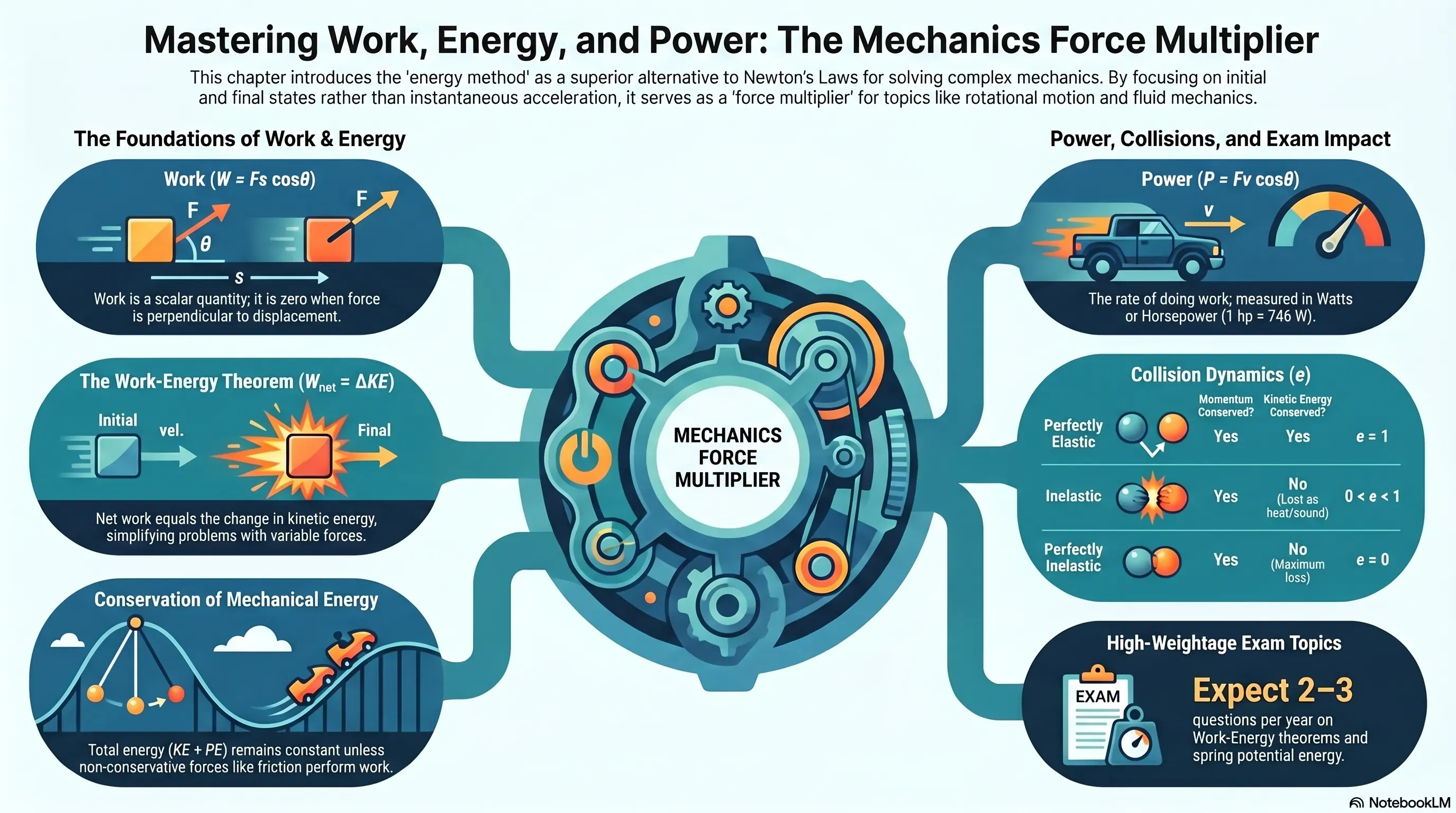
Work, Energy and Power is Chapter 6 of NCERT Class 11 Physics. It is one of the mega chapters of mechanics — concepts from this chapter appear not only in their own right but as tools inside problems on rotational motion, centre of mass, fluid mechanics, and even thermodynamics.
The chapter introduces the energy method of solving mechanics problems. Instead of resolving forces and applying Newton's second law (which requires knowing acceleration at every instant), the energy method uses initial and final states only — making it vastly more powerful for complex problems.
Exam Weightage
Exam | Questions Per Year (approx.) | Marks | Most Tested Topics |
|---|---|---|---|
JEE Main | 2–3 | 8–12 | Work-energy theorem, spring PE, power, collisions |
JEE Advanced | 1–2 | 4–8 | Variable force work, energy conservation in complex systems |
NEET | 2–3 | 8–12 | KE-PE interconversion, conservative forces, work formula |
CBSE Class 11 Board | 3–5 | 10–15 | All NCERT definitions, derivations, solved examples |
💡 Expert Tip by Saransh Gupta, IIT Bombay AIR-41: "Work-Energy and Power is what I call a 'force multiplier' chapter. Students who master energy methods here solve NLM problems faster, rotational problems without torque calculations, and fluid problems without pressure integration. The effort invested here multiplies across the entire mechanics syllabus."
Work, Energy, and Power Class 11 Physics Notes
India's Best Exam Preparation for Class 11th - Download Now
India's Best Exam Preparation for Class 11th - Download Now
India's Best Exam Preparation for Class 11th - Download Now
India's Best Exam Preparation for Class 11th - Download Now
India's Best Exam Preparation for Class 11th - Download Now
India's Best Exam Preparation for Class 11th - Download Now
India's Best Exam Preparation for Class 11th - Download Now
India's Best Exam Preparation for Class 11th - Download Now
India's Best Exam Preparation for Class 11th - Download Now
Work — Definition, Formula & Special Cases
Definition
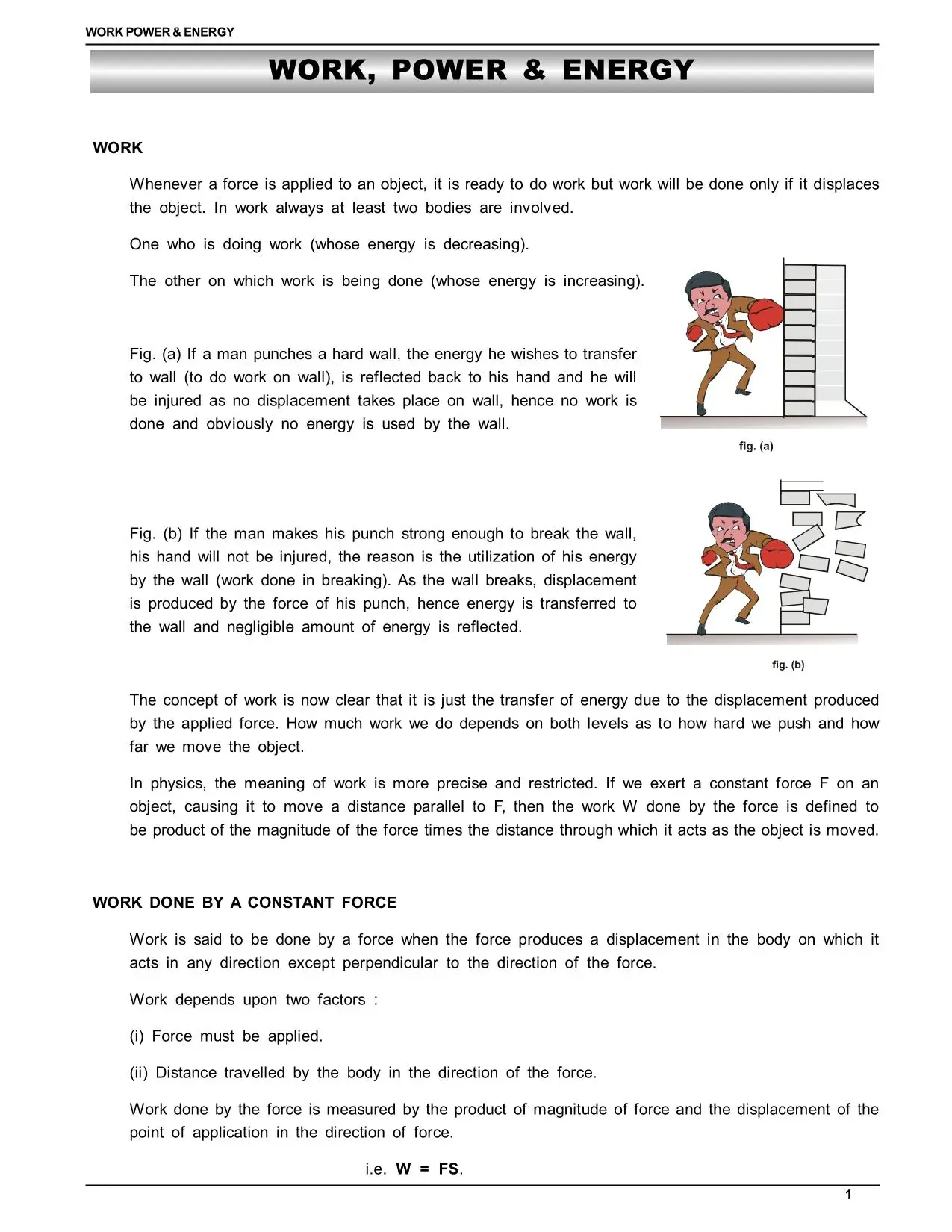
Work is done by a force on an object when the force causes displacement of the object. Work is a scalar quantity.
Formula
For a constant force F acting on an object that undergoes a displacement s, the work done is:
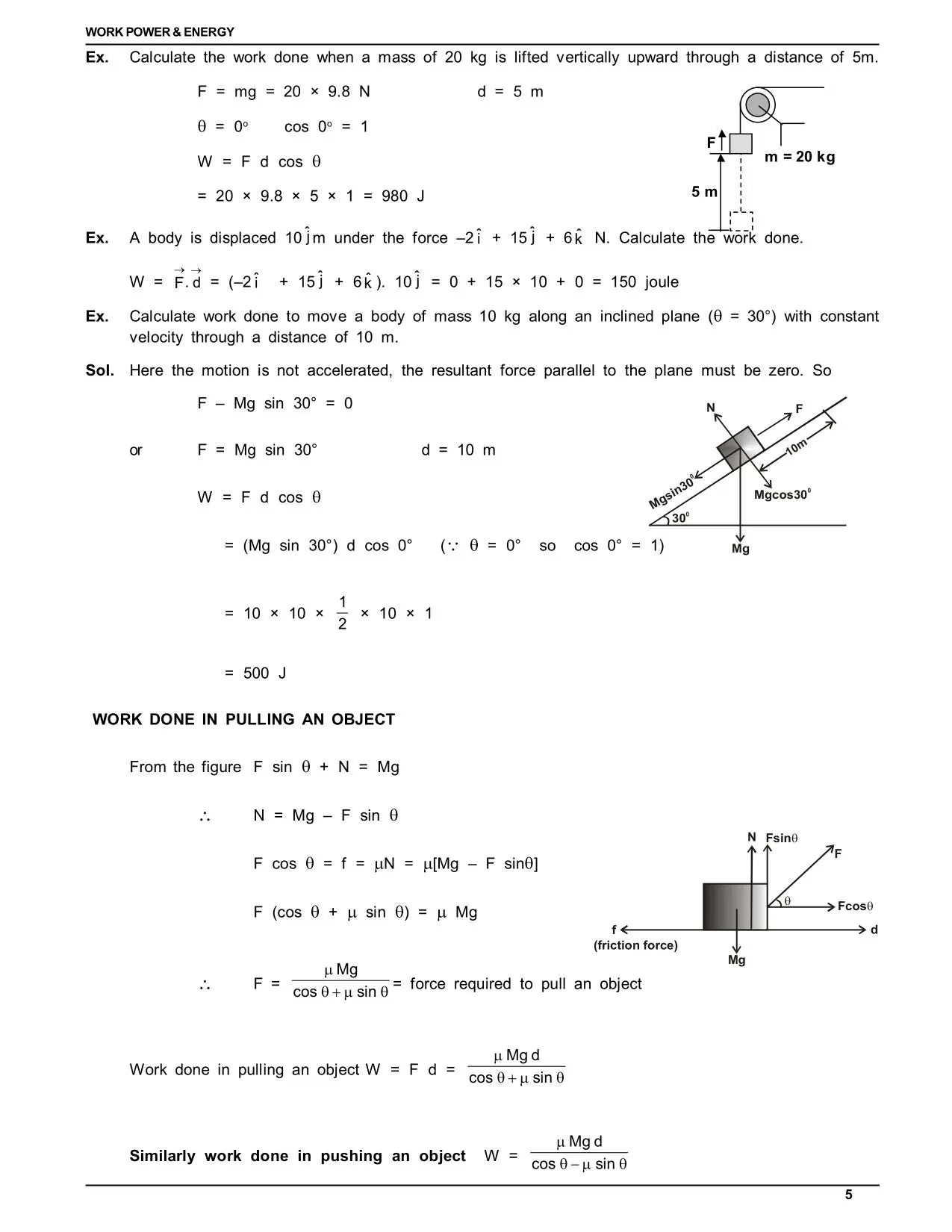
W = F·s = Fs cosθ
where θ is the angle between the force vector and the displacement vector.
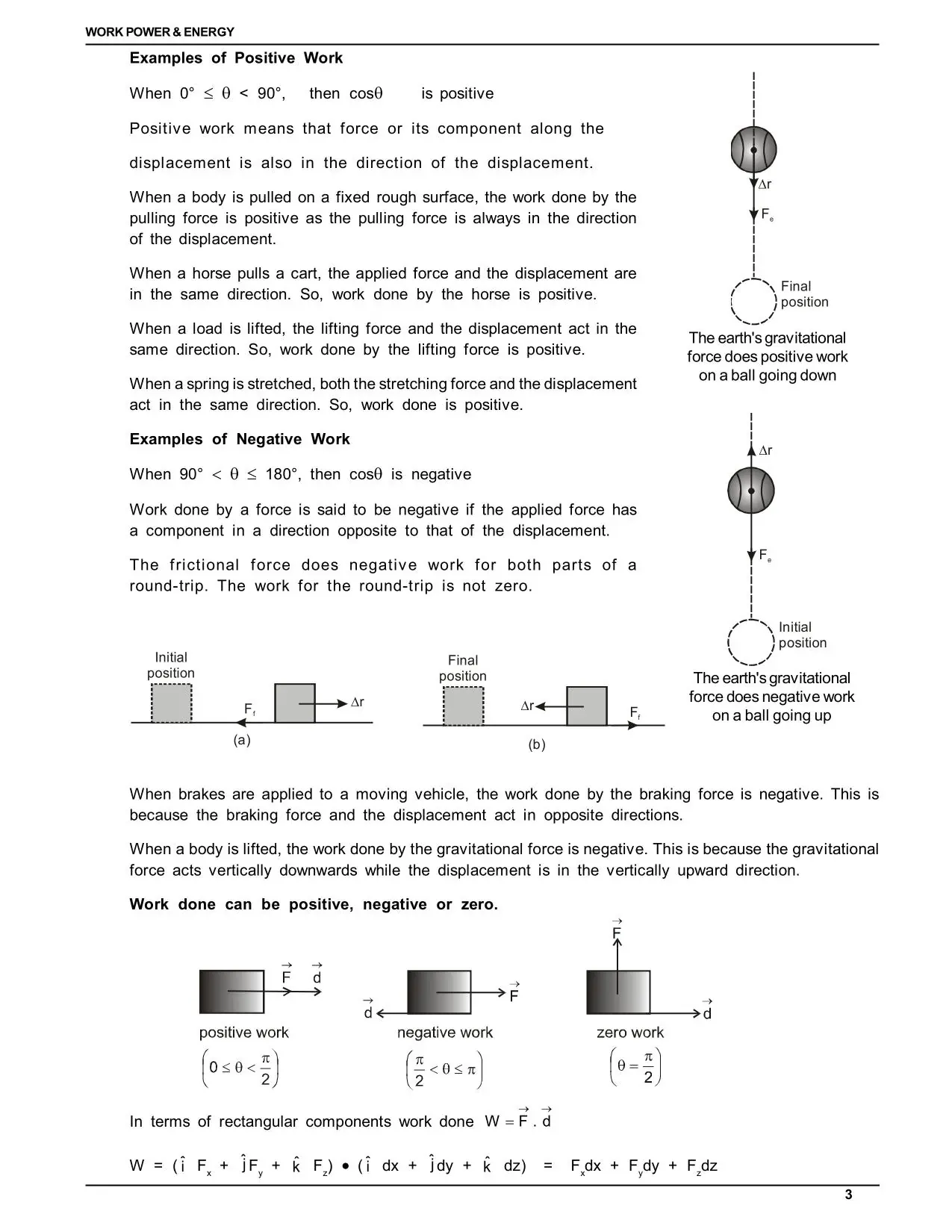
- W = Fs when F ∥ s (θ = 0°) → maximum positive work
- W = 0 when F ⊥ s (θ = 90°) → no work done (e.g., centripetal force, normal force on horizontal surface)
- W = –Fs when F anti-parallel to s (θ = 180°) → maximum negative work (e.g., friction opposing motion)
SI unit of work: Joule (J) = N·m = kg·m²/s²
Work Done by Variable Force
When force varies with position, work is calculated by integration:
W = ∫F·ds (from initial to final position)
Graphically: work = area under the F–x graph (F vs. displacement graph).
Special Cases of Work
Situation | Work Done | Reason |
|---|---|---|
Carrying a bag horizontally (weight acts down, motion horizontal) | W = 0 | F ⊥ displacement |
Pushing against a wall (no movement) | W = 0 | Displacement = 0 |
Friction on a sliding object | W = –fs (negative) | Force opposite to displacement |
Gravity on a falling object | W = +mgh (positive) | Force and displacement both downward |
Gravity on a rising object | W = –mgh (negative) | Force downward, displacement upward |
Spring force compressing the spring by x | W = –½kx² | Spring force opposes compression |
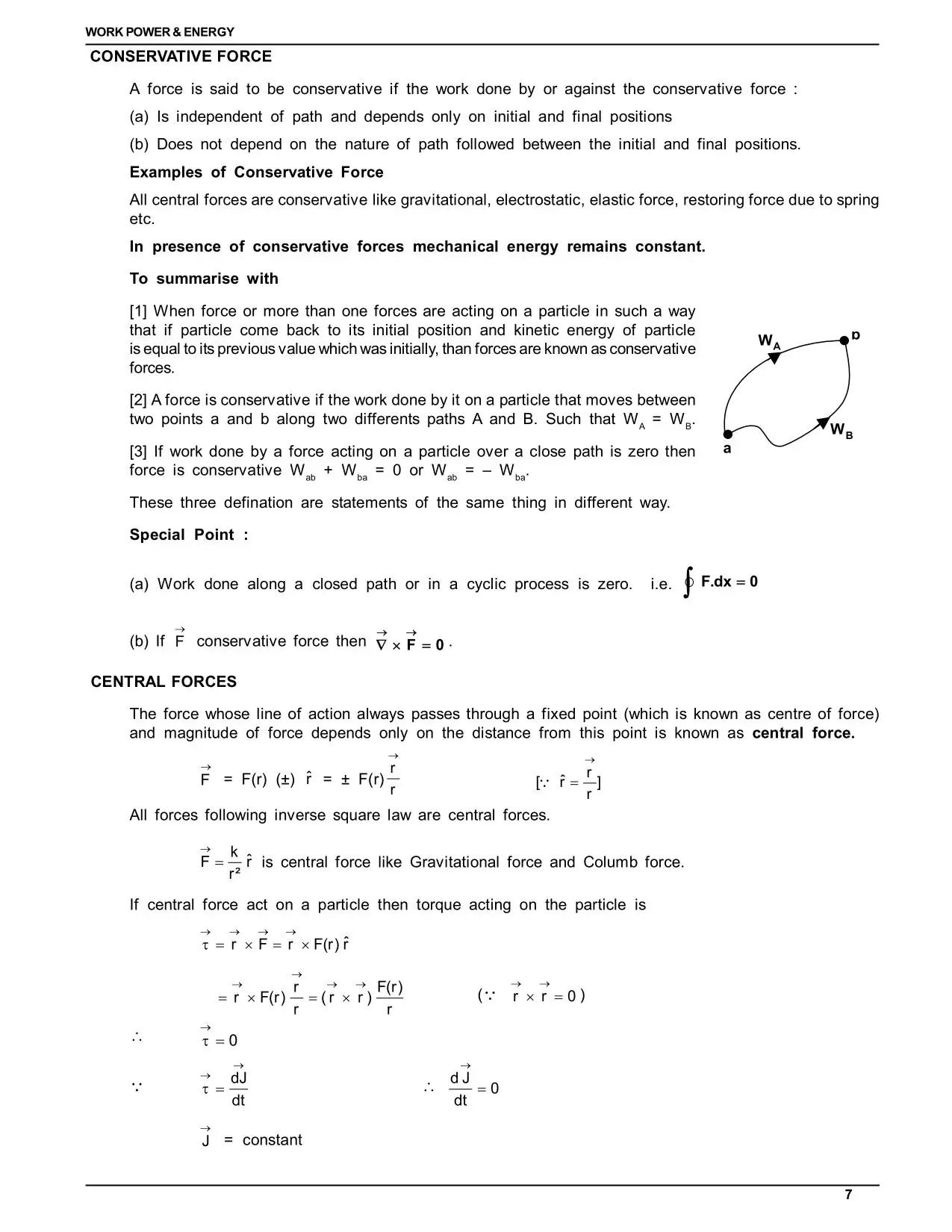
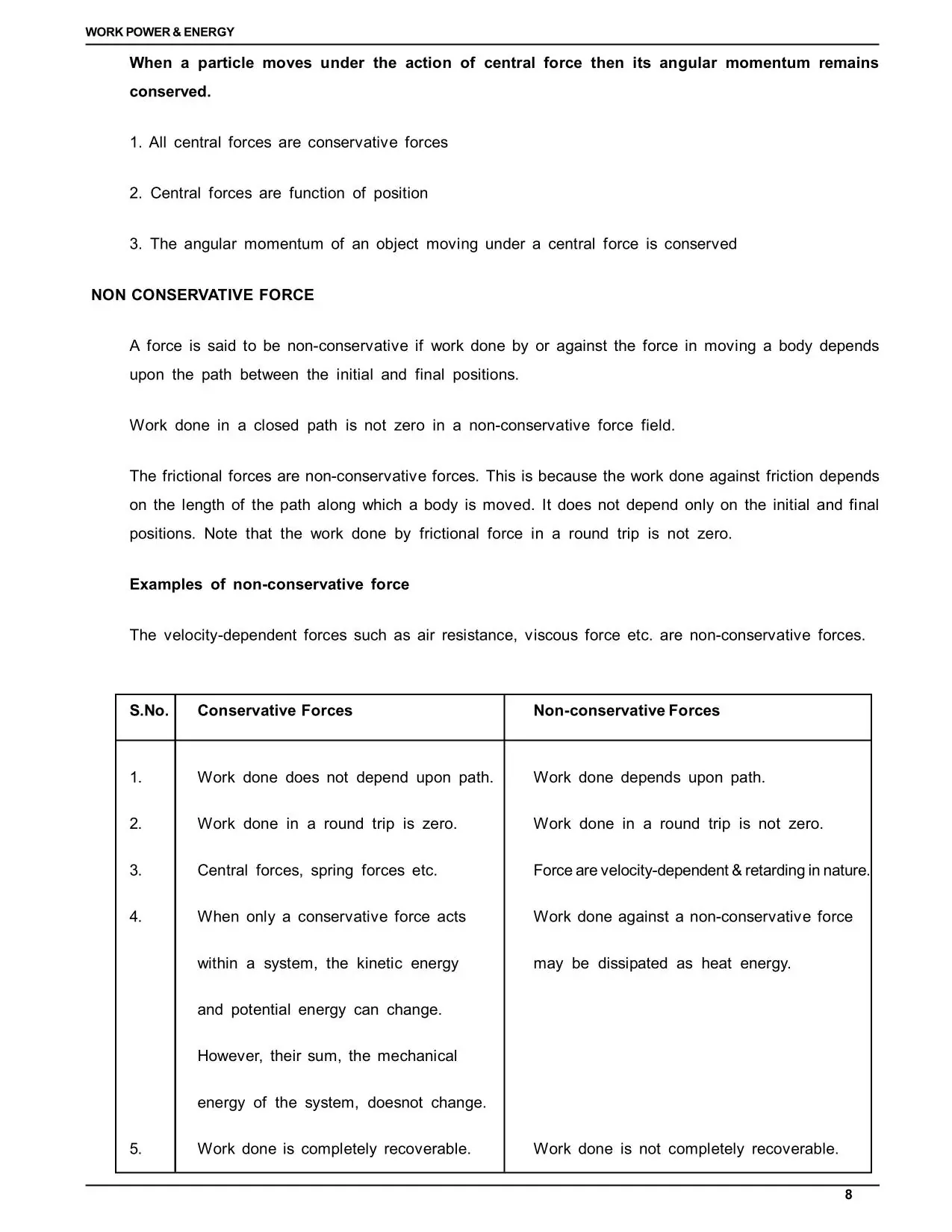
Conservative vs Non-Conservative Forces
Property | Conservative Force | Non-Conservative Force |
|---|---|---|
Work done depends on? | Only start and end points | Path taken |
Work in a closed loop | Zero | Non-zero |
Associated PE | Yes | No |
Examples | Gravity, spring force, electrostatic force | Friction, air resistance, viscosity |
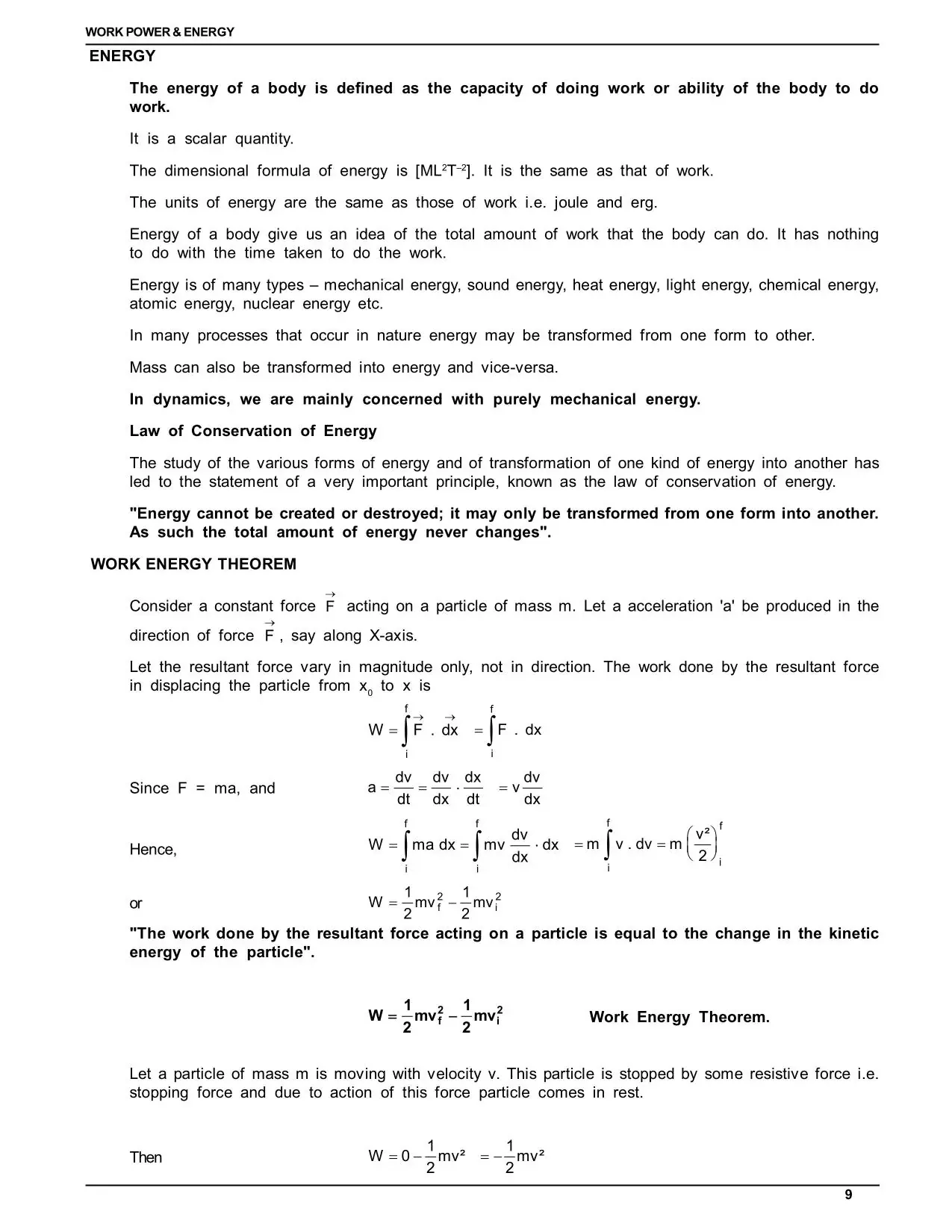
Work-Energy Theorem
Statement
The net work done on an object by all forces acting on it equals the change in its kinetic energy:
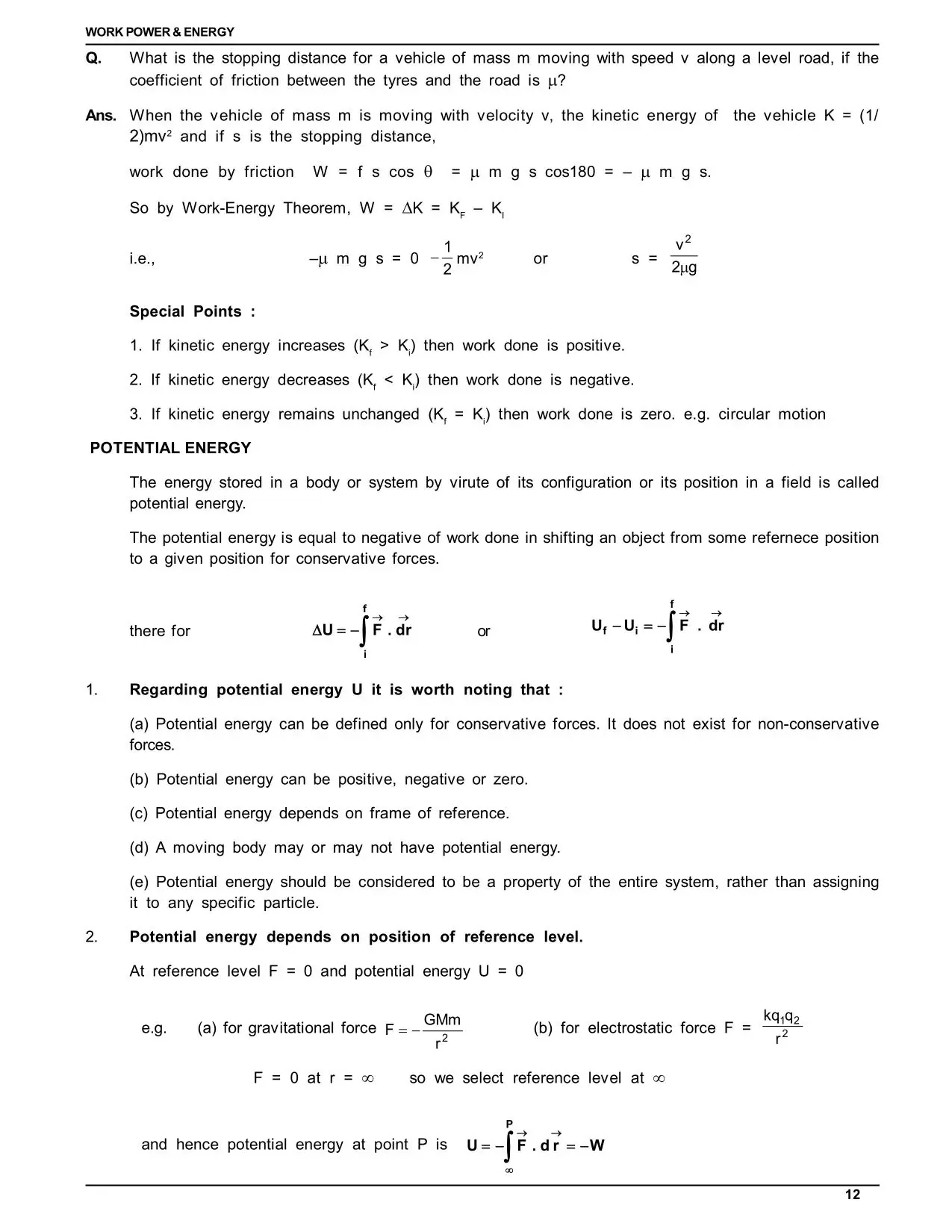
W_net = ΔKE = KE_final – KE_initial = ½mv² – ½mu²
Derivation (from Newton's Second Law)
From Newton's 2nd law: F = ma
Using kinematics: v² = u² + 2as → as = (v² – u²)/2
Therefore: W = F·s = ma·s = m·(v² – u²)/2 = ½mv² – ½mu² = ΔKE ✓
Key Applications of the Work-Energy Theorem
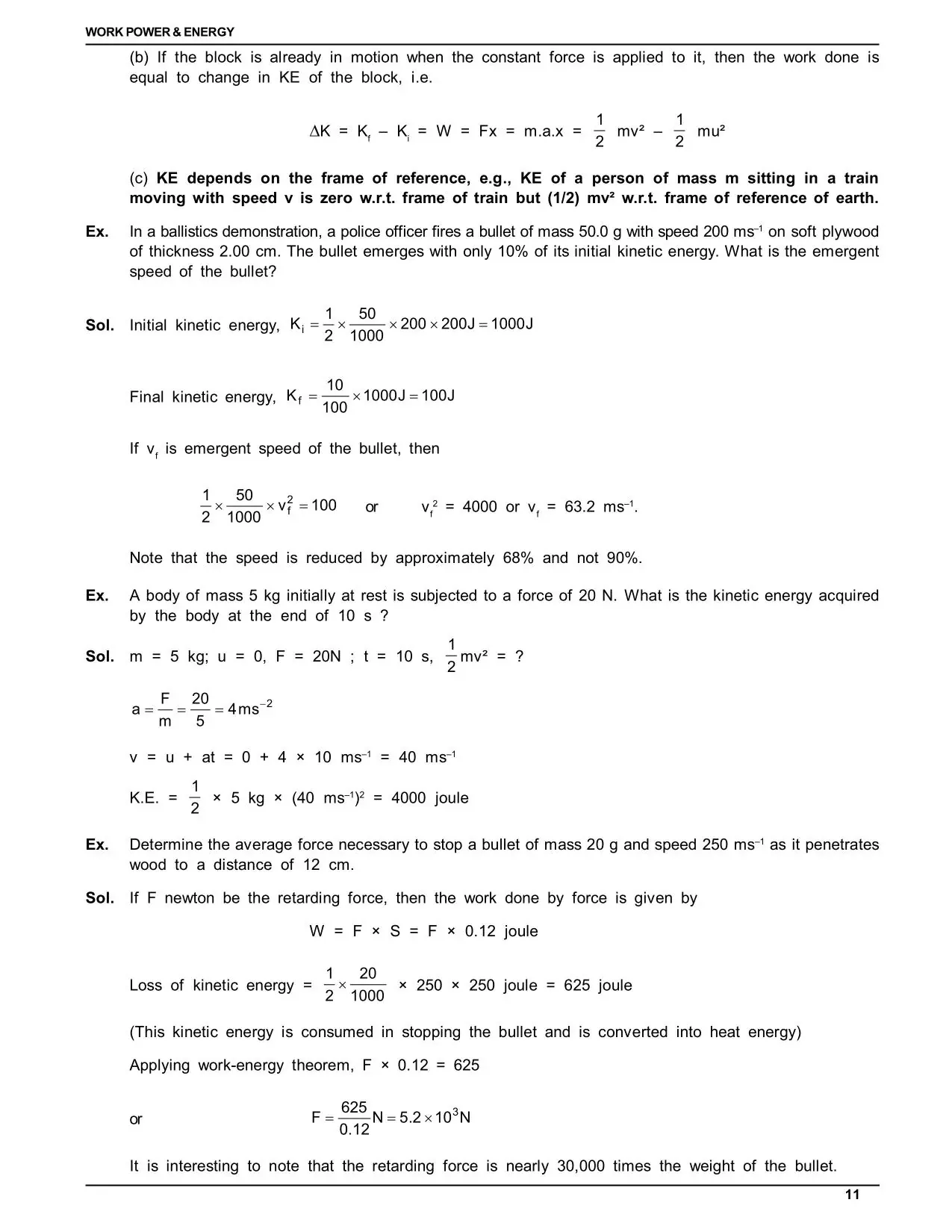
- Finding velocity after a force acts over a known displacement — without needing time
- Finding displacement when the initial and final speeds are known, and the force is known
- Finding the force required to change an object's speed over a given distance
- Problems where multiple forces act — sum all work done and equate to ΔKE
Work-Energy Theorem with Friction
When friction acts:
W_net = W_applied + W_friction + W_gravity = ΔKE
W_friction = –f × d (always negative — friction removes energy from the system)
💡 Expert Tip by Saransh Gupta, IIT Bombay AIR-41: "In JEE problems, whenever you see a question asking for speed at a certain point after a force has acted — reach for the work-energy theorem first. It avoids the need to know acceleration at every instant, which is often impossible in problems with variable forces or multiple simultaneous forces."
Kinetic Energy
Definition
Kinetic energy is the energy possessed by an object due to its motion.
KE = ½mv²
where m = mass, v = speed. KE is always non-negative.
Key Relations
Relation | Formula | Use |
|---|---|---|
KE in terms of momentum p | KE = p²/(2m) | When momentum is given, not velocity |
Momentum in terms of KE | p = √(2m·KE) | Convert between KE and momentum |
Ratio of KE of same momentum | KE ∝ 1/m | A lighter body has more KE for same p |
Ratio of momentum at same KE | p ∝ √m | Heavier body has more momentum for same KE |
KE and Momentum — Important Comparisons (JEE/NEET Favourite)
If two bodies A and B have the same kinetic energy:
- p_A/p_B = √(m_A/m_B) → heavier body has larger momentum
If two bodies A and B have the same momentum:
- KE_A/KE_B = m_B/m_A → lighter body has larger kinetic energy
Potential Energy — Gravitational & Spring
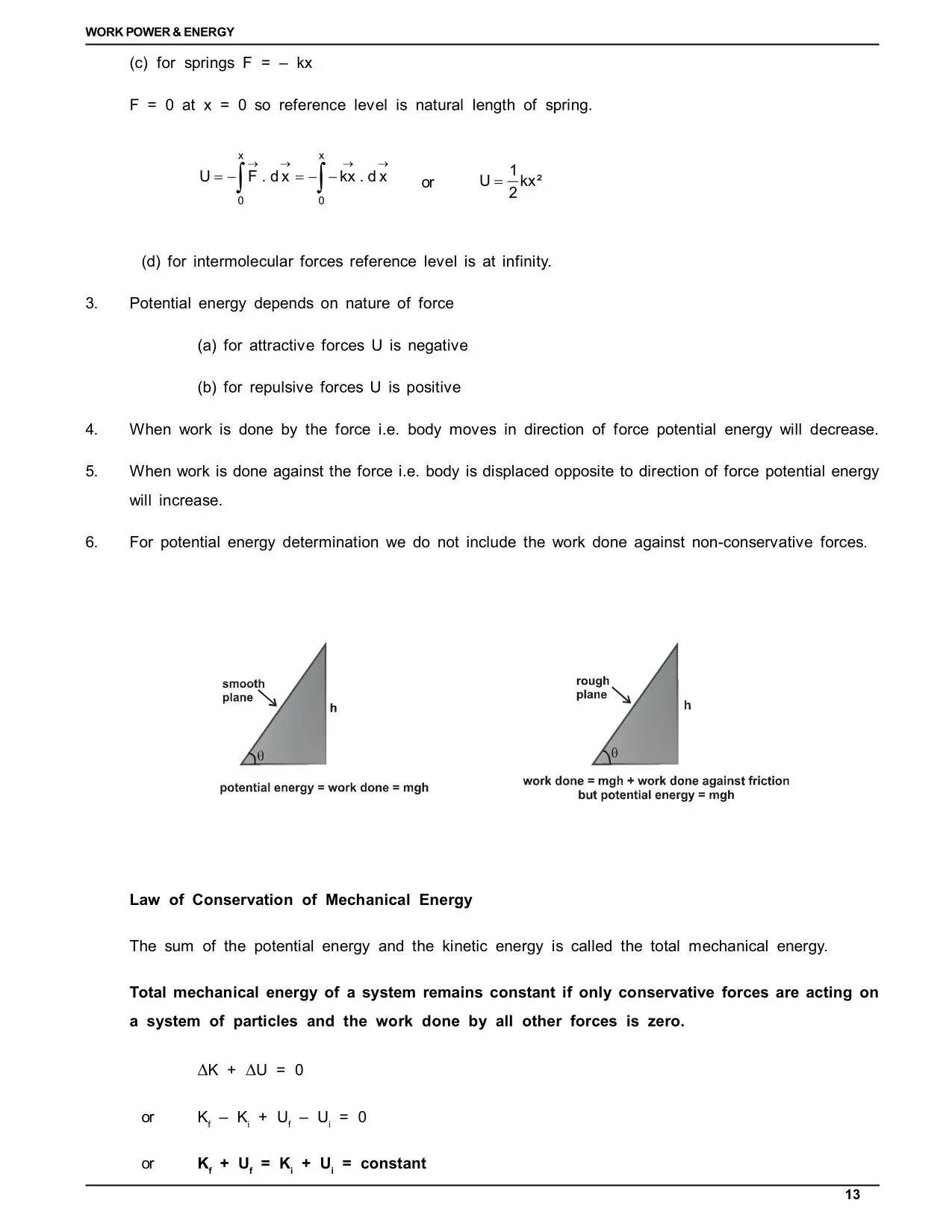
Potential energy is the energy stored in an object due to its position or configuration in a force field. It is associated only with conservative forces.
Gravitational Potential Energy
PE_gravity = mgh
where h is the height above the chosen reference level (usually ground).
- Reference level is chosen by the problem — PE can be negative if the object is below reference level
- Only the change in PE matters, not the absolute value
- ΔPE_gravity = mg(h₂ – h₁)
Spring Potential Energy (Elastic Potential Energy)
For a spring with spring constant k, compressed or stretched by x from its natural length:
PE_spring = ½kx²
- Always positive (stored energy, whether compressed or stretched)
- Maximum at maximum compression/extension
- Zero at natural length
Relation Between Conservative Force and Potential Energy
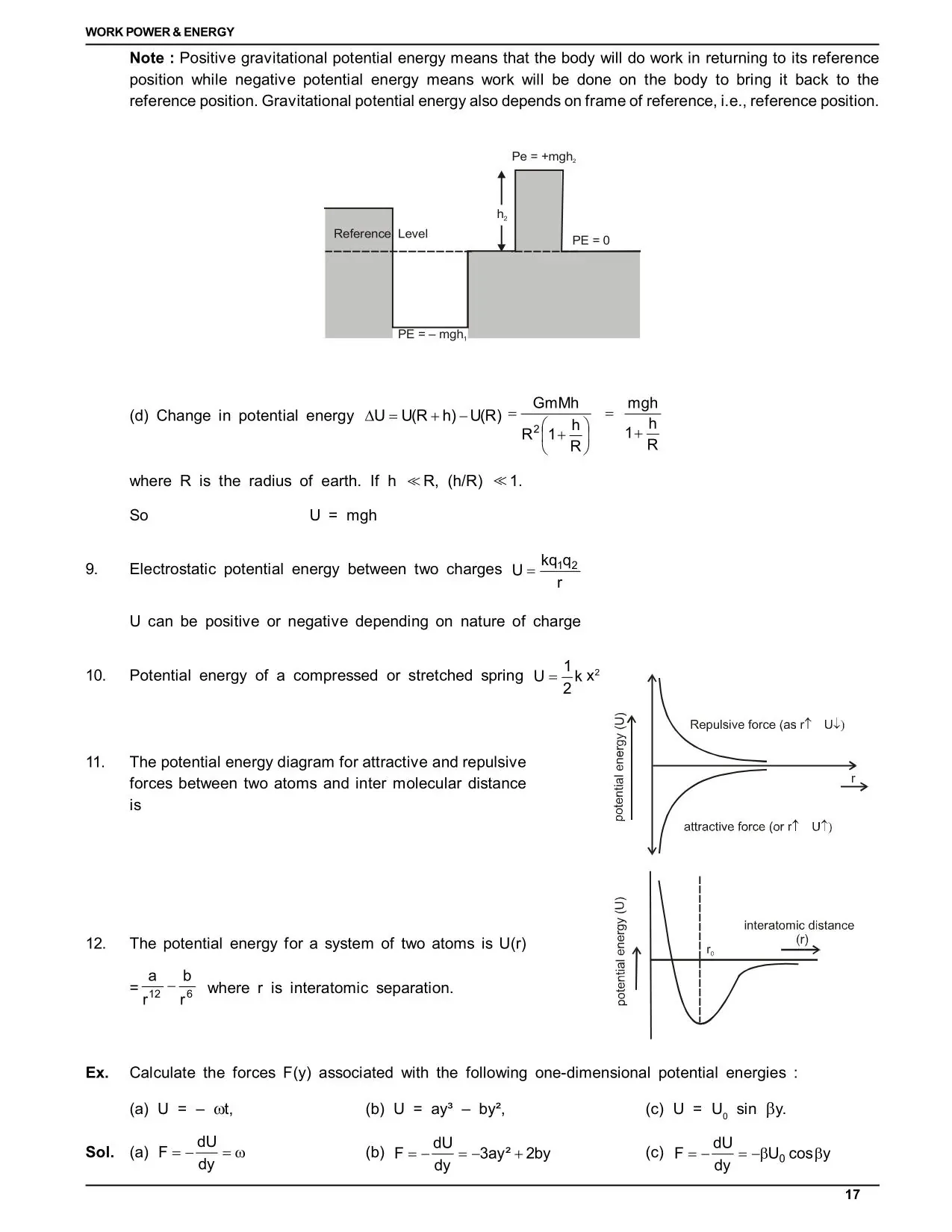
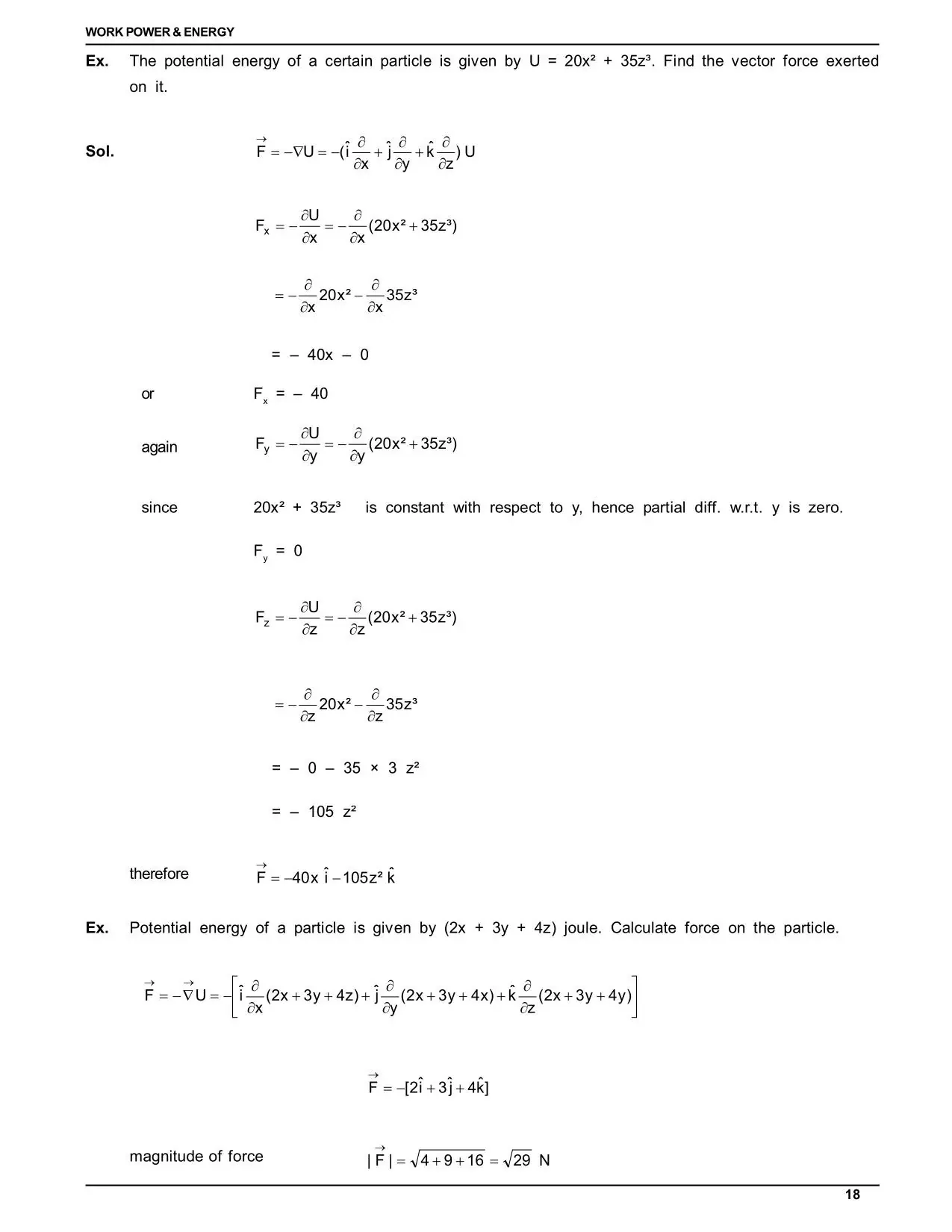
F = –dU/dx (in one dimension)
The conservative force is the negative derivative of potential energy with respect to position. This is analogous to E = –dV/dx in electrostatics.
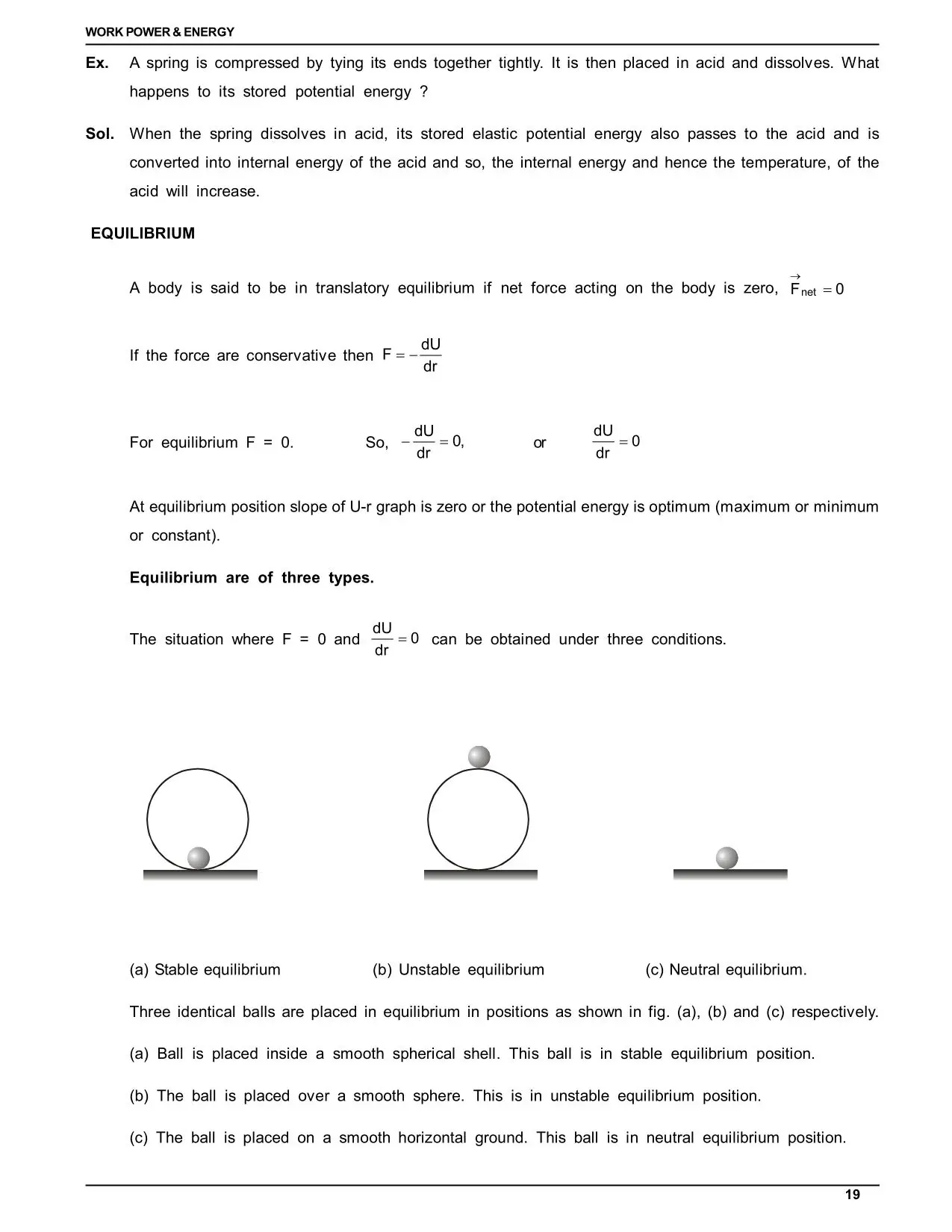
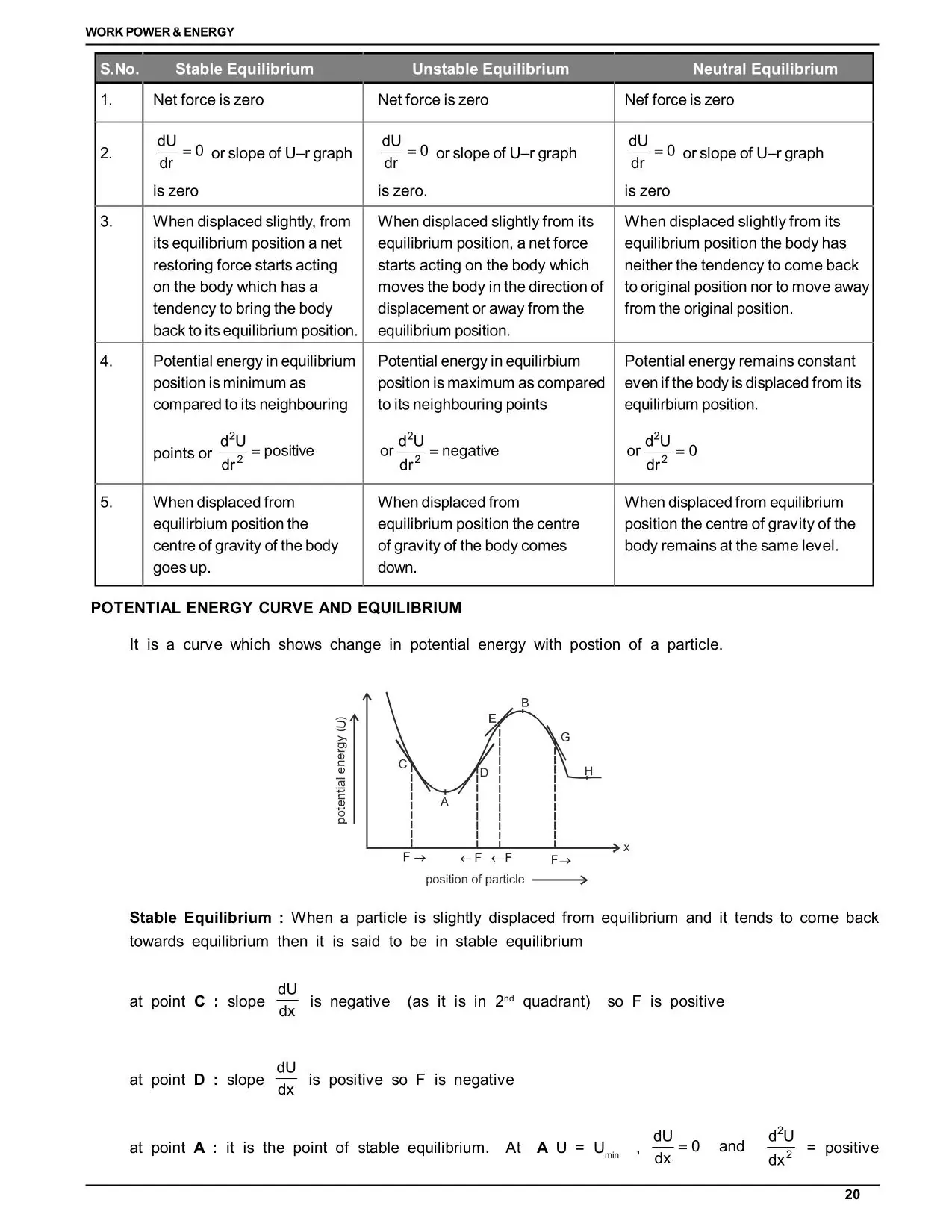
Equilibrium from Potential Energy
Condition | dU/dx | d²U/dx² | Type of Equilibrium |
|---|---|---|---|
Stable | 0 | > 0 (minimum U) | Returns to equilibrium when displaced |
Unstable | 0 | < 0 (maximum U) | Moves away when displaced |
Neutral | 0 | 0 (constant U) | Stays in new position |
Conservation of Mechanical Energy
Statement
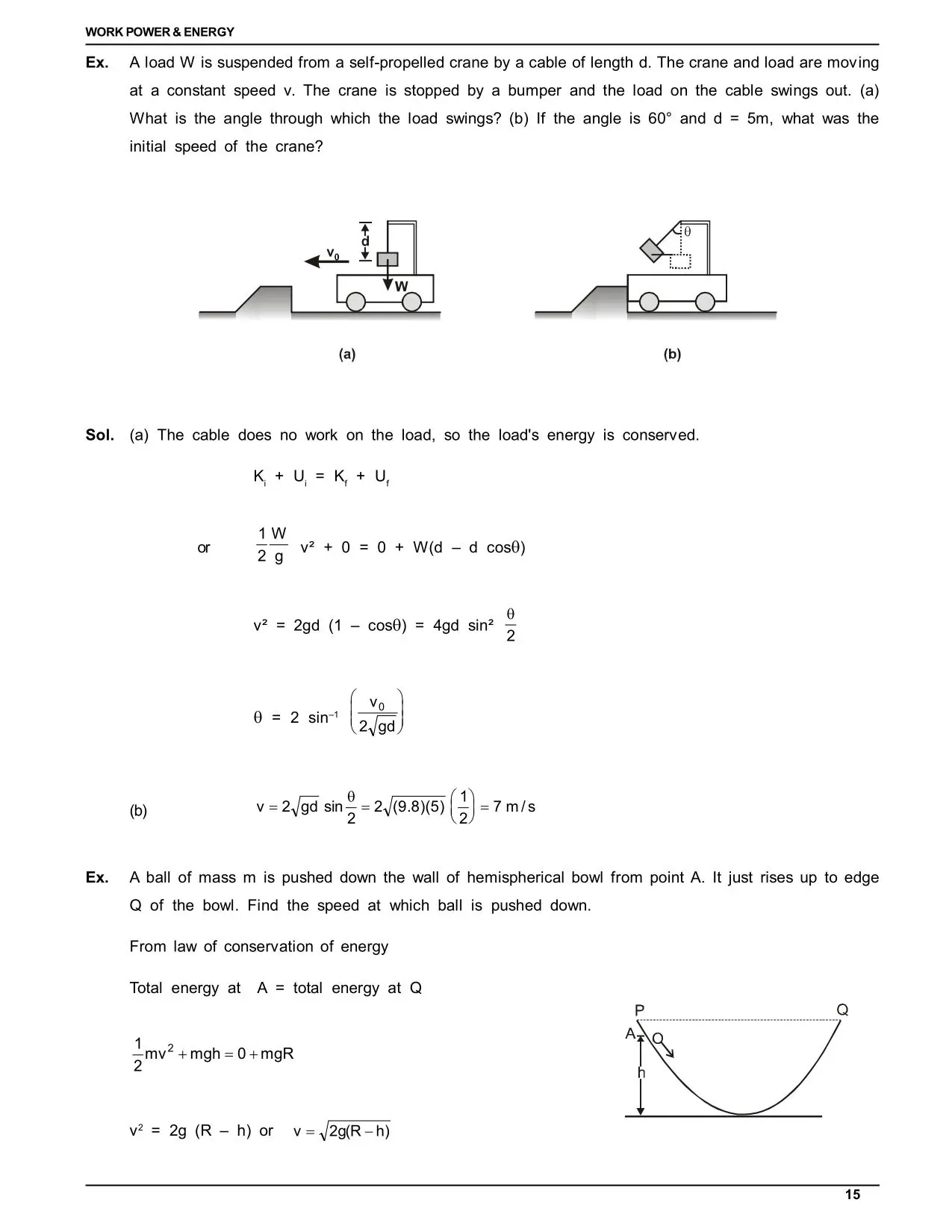
In the absence of non-conservative forces (friction, air resistance), the total mechanical energy of a system remains constant:
KE + PE = constant
½mv₁² + U₁ = ½mv₂² + U₂
When Energy is NOT Conserved
If non-conservative forces (friction, viscosity) act:
W_friction = ΔKE + ΔPE = ΔE_mechanical
The work done by friction equals the loss in mechanical energy of the system. This energy is converted to heat.
Standard Applications
Problem | Energy Conservation Equation |
|---|---|
Ball dropped from height h | mgh = ½mv² → v = √(2gh) |
Block sliding down frictionless incline | mgh = ½mv² (same result) |
Spring-mass system at maximum compression | ½mv² = ½kx² → x = v√(m/k) |
Pendulum — max height from lowest point | mgh = ½mv₀² → h = v₀²/(2g) |
Block on spring (friction present) | ½mv² = ½kx² + f·x (friction does negative work) |
Power
Definition
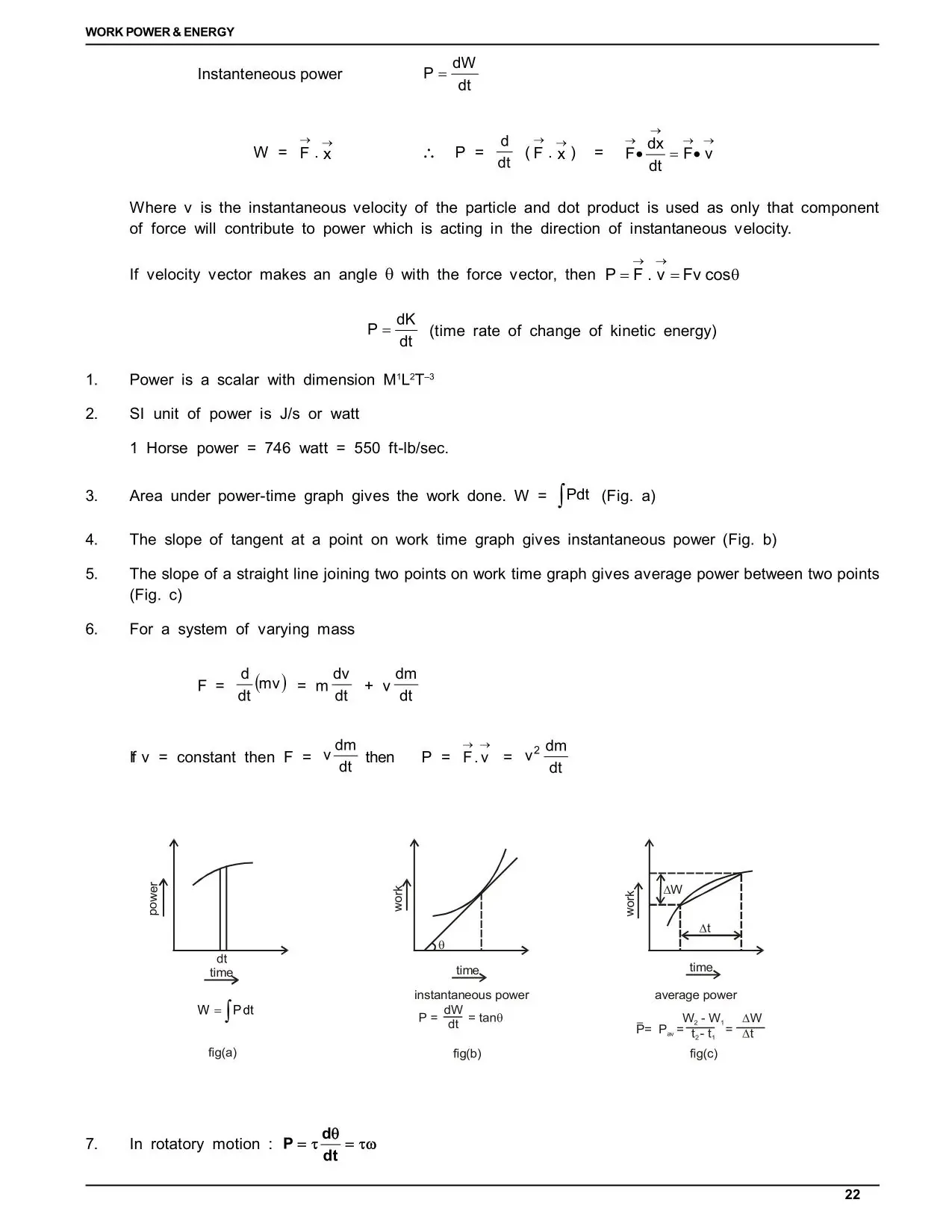
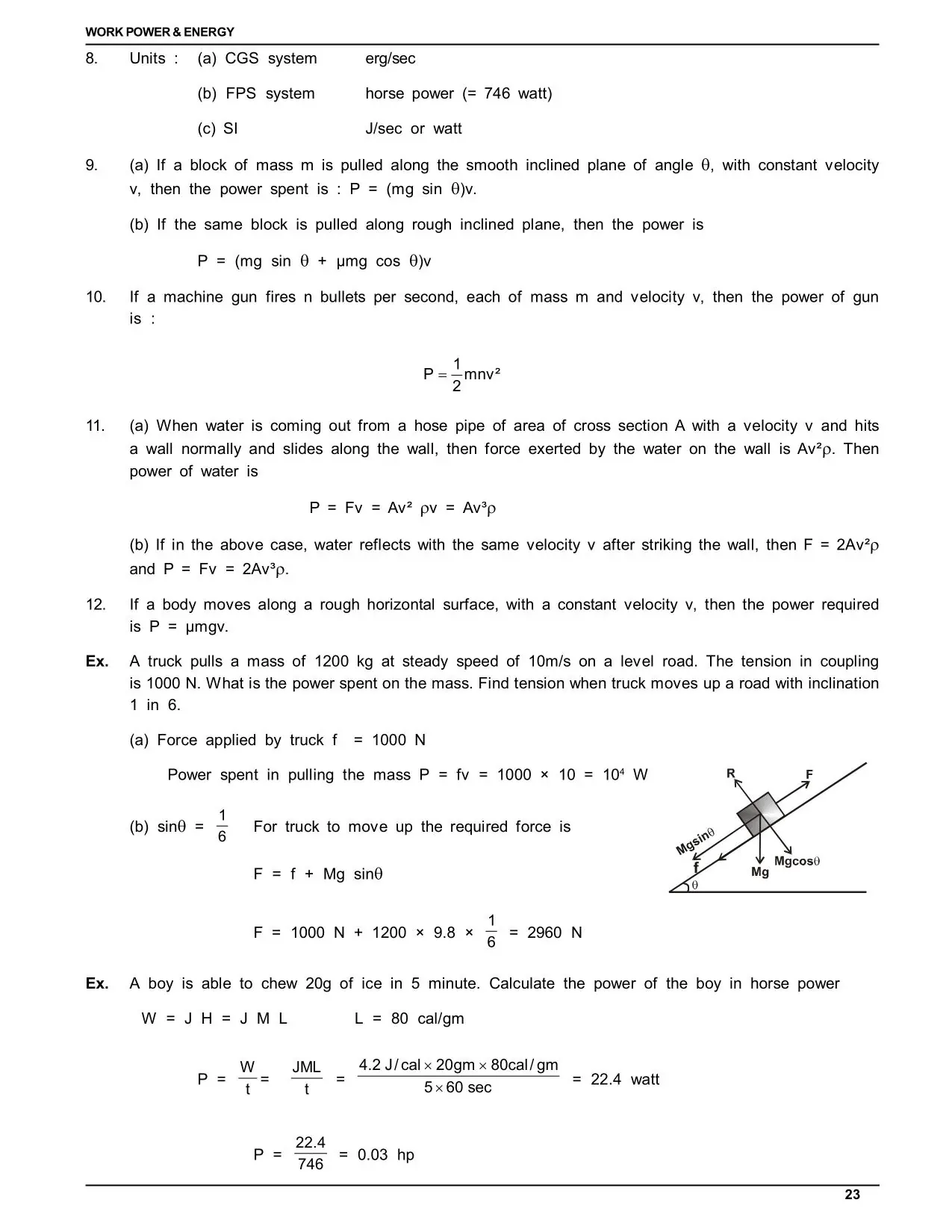
Power is the rate of doing work — the work done per unit time.
P = W/t = F·v cosθ
For maximum power (F parallel to v): P = Fv
SI unit of power: Watt (W) = J/s = kg·m²/s³
Other units: 1 horsepower (hp) = 746 W; 1 kW = 1000 W
Instantaneous vs Average Power
Type | Formula | When to Use |
|---|---|---|
Average power | P_avg = W_total/t_total | Constant or varying force over time interval |
Instantaneous power | P_inst = F·v = Fv cosθ | At a specific instant |
Important Power Formulas
Situation | Formula |
|---|---|
Constant force, constant velocity | P = Fv |
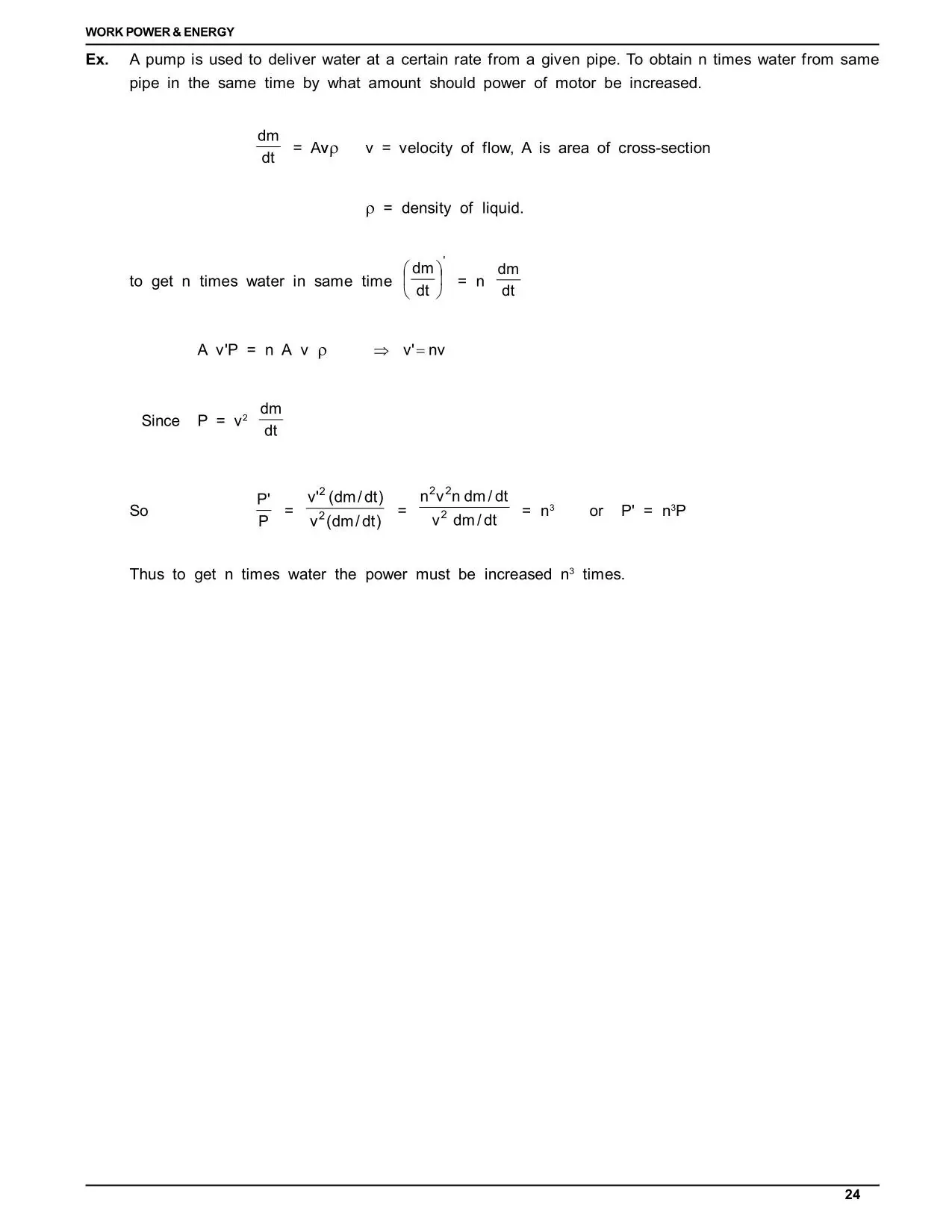
Pump lifting water | P = ρVgh/t = ρAhvg (where v = h/t) |
Engine at terminal velocity (F_engine = F_friction) | P_engine = F_friction × v |
Electric power | P = VI = I²R = V²/R |
Efficiency
η = (Useful power output / Total power input) × 100%
η = (Useful work output / Total work input) × 100%
Collisions — Elastic & Inelastic
Collisions are governed by conservation of momentum (always) and conservation of kinetic energy (only for elastic collisions).
Types of Collisions
Type | Momentum Conserved? | KE Conserved? | Coefficient of Restitution (e) |
|---|---|---|---|
Perfectly Elastic | Yes | Yes | e = 1 |
Inelastic | Yes | No (KE lost as heat/sound) | 0 < e < 1 |
Perfectly Inelastic | Yes | Maximum loss | e = 0 |
Coefficient of Restitution (e)
e = (Relative velocity of separation) / (Relative velocity of approach)
e = (v₂ – v₁) / (u₁ – u₂)
For elastic collision: e = 1; for perfectly inelastic: e = 0.
Head-On Elastic Collision — Final Velocities
For two masses m₁ and m₂ with initial velocities u₁ and u₂:
v₁ = [(m₁ – m₂)u₁ + 2m₂u₂] / (m₁ + m₂)
v₂ = [(m₂ – m₁)u₂ + 2m₁u₁] / (m₁ + m₂)
Special Cases of Elastic Collision
Condition | Result |
|---|---|
m₁ = m₂ (equal masses) | Velocities exchange: v₁ = u₂, v₂ = u₁ |
m₁ >> m₂ (massive hitting light, u₂ = 0) | v₁ ≈ u₁, v₂ ≈ 2u₁ (light body bounces at ≈ 2u₁) |
m₂ >> m₁ (light hitting massive, u₂ = 0) | v₁ ≈ –u₁ (reverses), v₂ ≈ 0 |
Perfectly Inelastic Collision
Both objects stick together after collision:
m₁u₁ + m₂u₂ = (m₁ + m₂)v_common
v_common = (m₁u₁ + m₂u₂) / (m₁ + m₂)
KE lost = ½m₁u₁² + ½m₂u₂² – ½(m₁+m₂)v²
Most Important Formulas — Quick Reference
Work
Formula | Use |
|---|---|
W = Fs cosθ | Constant force at angle θ to displacement |
W = ∫F·dx | Variable force |
W = area under F–x graph | Graphical problems |
W_gravity = mgh (down) | Object falls height h |
W_spring = ½kx² | Spring compressed/stretched by x |
Energy
Formula | Use |
|---|---|
KE = ½mv² | From speed |
KE = p²/(2m) | From momentum |
PE_gravity = mgh | Height above reference |
PE_spring = ½kx² | Spring compression/extension |
W_net = ΔKE | Work-energy theorem |
KE + PE = constant | Conservation (no friction) |
F = –dU/dx | Force from PE function |
Power
Formula | Use |
|---|---|
P = W/t | Average power |
P = Fv cosθ | Instantaneous power |
P = Fv | Maximum (F ∥ v) |
η = P_out/P_in × 100% | Efficiency |
Collisions
Formula | Use |
|---|---|
m₁u₁ + m₂u₂ = m₁v₁ + m₂v₂ | Conservation of momentum |
e = (v₂–v₁)/(u₁–u₂) | Coefficient of restitution |
v_common = (m₁u₁+m₂u₂)/(m₁+m₂) | Perfectly inelastic |
Most Asked Topics — JEE Main & NEET
JEE Main (2018–2024)
Topic | Frequency | Question Type |
|---|---|---|
Work-energy theorem (with friction) | Very High | MCQ — find speed or stopping distance |
Spring PE and energy conservation | High | MCQ — max compression, speed at natural length |
Power = Fv problems | High | MCQ — instantaneous or average power |
Elastic collision — final velocities | High | MCQ — speed after collision |
KE–momentum relation | Medium | MCQ — comparison problems |
Conservative vs non-conservative forces | Medium | MCQ — conceptual |
NEET (2018–2024)
Topic | Frequency | Question Type |
|---|---|---|
Work done formula (angle problems) | Very High | MCQ — calculate W given F, s, θ |
Conservation of mechanical energy | High | MCQ — height to speed conversion |
Power = W/t and P = Fv | High | MCQ — calculate power |
Perfectly inelastic collision | High | MCQ — common velocity after collision |
KE and PE interconversion | Medium | MCQ — at what height is KE = PE? |
To master Work, Energy and Power at the JEE Advanced level, it is important to practice challenging problems beyond theory. After studying these notes, solve the relevant questions from our Irodov Questions in JEE Syllabus collection to strengthen your concepts and develop advanced problem-solving skills.
Although work is a scalar, many mechanics setups still depend on choosing directions and components correctly; revise vector fundamentals for 2D motion if that step is unclear.
Frequently Asked Questions
What is the work-energy theorem in Class 11 Physics?
The work-energy theorem states that the net work done on an object by all forces acting on it equals the change in its kinetic energy: W_net = ΔKE = ½mv² – ½mu². It applies whether the forces are constant or variable and is derived directly from Newton's second law combined with kinematics. It is one of the most powerful tools in mechanics for finding speeds without knowing acceleration at every instant.
What are the most important formulas in work energy and power for JEE?
The highest-priority formulas are: W = Fs cosθ (work by constant force), W_net = ΔKE (work-energy theorem), KE = ½mv² = p²/(2m), PE_spring = ½kx², PE_gravity = mgh, mechanical energy conservation (KE + PE = constant), P = Fv (instantaneous power), and collision formulas (e = relative velocity ratio; common velocity for perfectly inelastic). These cover over 85% of all JEE Main and NEET questions from this chapter.
What is the weightage of work energy and power in JEE Main?
Work, Energy and Power carries approximately 4–6% weightage in JEE Main Physics, contributing 2–3 questions (8–12 marks) per year. Based on JEE Main papers from 2018 to 2024, work-energy theorem applications, spring energy conservation, and power (P = Fv) problems are the most consistently tested topics. The chapter is foundational — its concepts also appear embedded in rotational dynamics and collision problems.
What is the difference between elastic and inelastic collision?
In an elastic collision, both momentum and kinetic energy are conserved (coefficient of restitution e = 1). In an inelastic collision, momentum is conserved but kinetic energy is lost as heat or sound (0 < e < 1). In a perfectly inelastic collision, the objects stick together after impact, momentum is conserved, and kinetic energy loss is maximum (e = 0). All real-world collisions are inelastic to some degree.
When is work done by a force equal to zero?
Work done by a force is zero when: (1) the force is perpendicular to the displacement (θ = 90°) — for example, the normal force on a horizontal surface, or centripetal force in circular motion, (2) there is no displacement (the object does not move), or (3) the force is zero. The formula W = Fs cosθ confirms all three cases: cosθ = 0 for perpendicular force, and either F or s = 0 for the other cases.