
Work Energy and Power Class 11 Physics Notes for CBSE, JEE and NEET

eSaral Academic and Editorial Team
Summary
Work Energy and Power Class 11 notes cover Chapter 5 of NCERT Class 11 Physics: work by constant and variable forces, kinetic and potential energy, the work-energy theorem, conservation of mechanical energy, power, motion in a vertical circle and collisions. This page gives the formulas, tables and solved examples for CBSE, JEE Main, JEE Advanced and NEET.
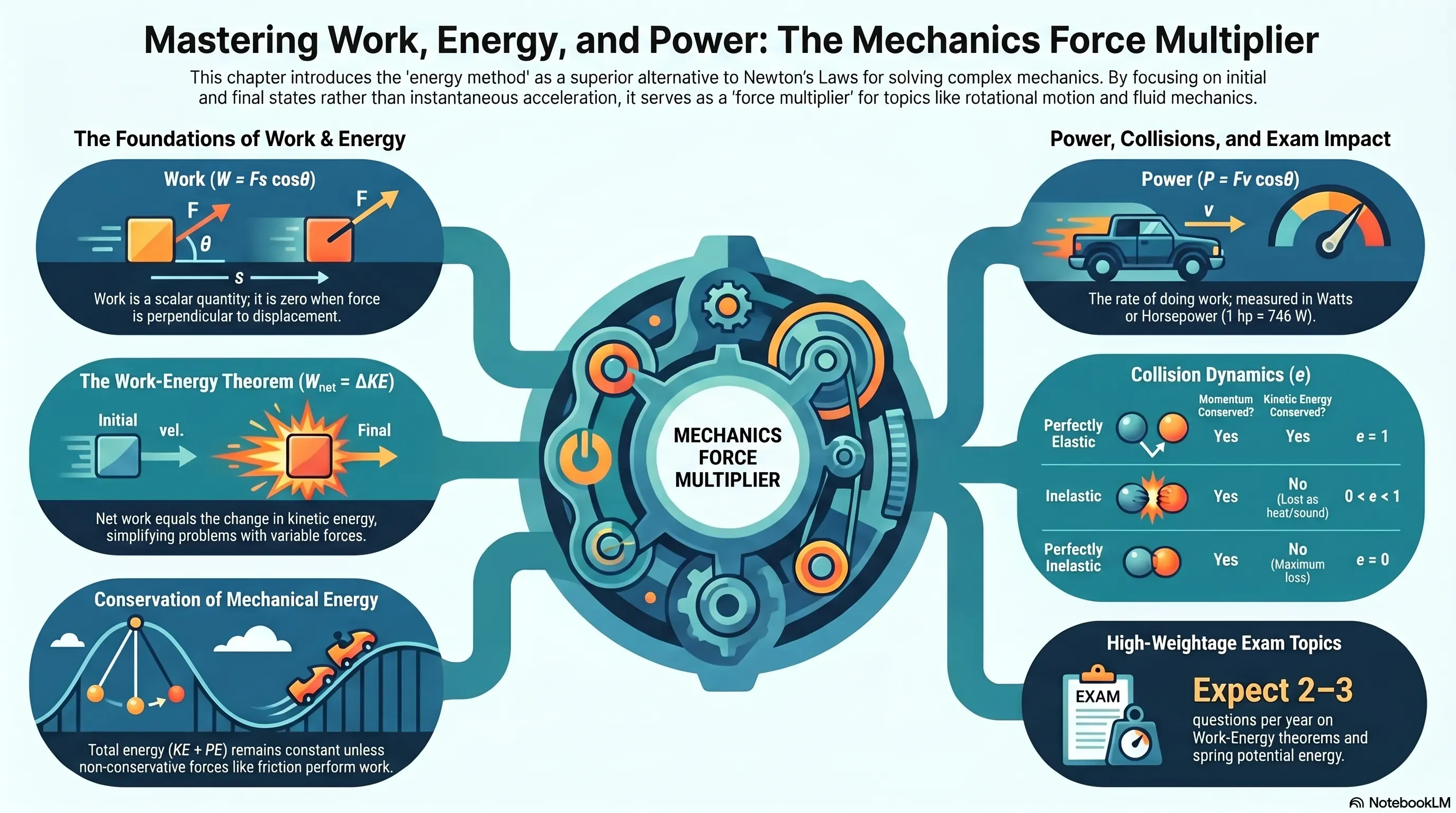
These Work Energy and Power Class 11 notes follow the current NCERT textbook, where the chapter is Chapter 5 of Class 11 Physics (Part 1). Older books and some websites number it Chapter 6, so check the edition you use. The notes below use the energy method: instead of tracking the acceleration at every instant, you compare the initial and final states of a system. This makes many problems in mechanics much easier.
Work Energy and Power Class 11: Chapter Overview
According to the CBSE Class 11 Physics syllabus for 2026-27, Chapter 5 covers:
- Work done by a constant force and a variable force
- Kinetic energy, the work-energy theorem and power
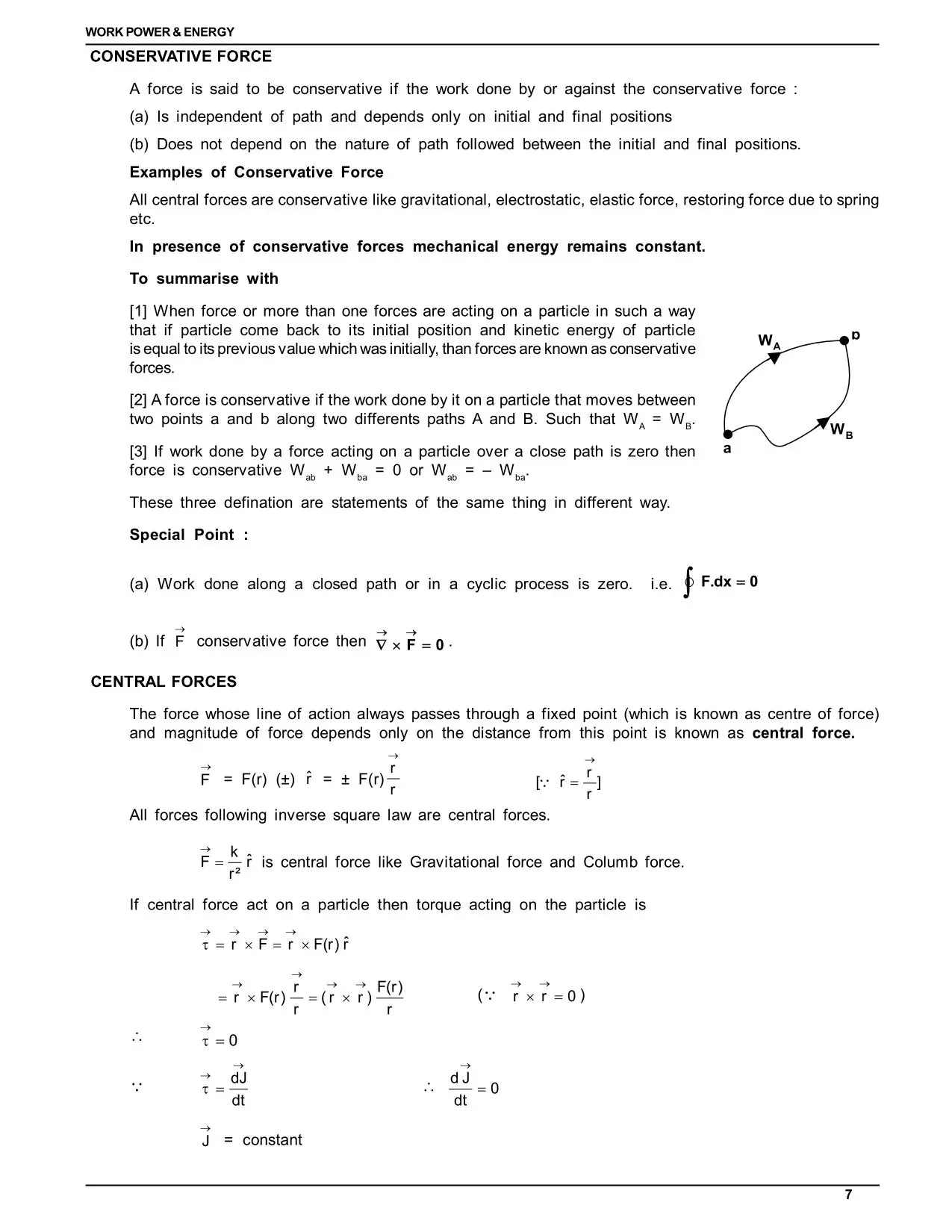
- The notion of potential energy, the potential energy of a spring, conservative and non-conservative forces
- Conservation of mechanical energy and motion in a vertical circle
- Elastic and inelastic collisions in one and two dimensions
This chapter is part of the JEE Main and NEET syllabi, and its ideas are used again in rotational motion, gravitation and thermodynamics. The number of questions changes from year to year, so use the topic lists below as a guide and solve previous year questions for your exam.
💡 Expert Tip by Saransh Gupta, IIT Bombay AIR-41: "Work-Energy and Power is what I call a 'force multiplier' chapter. Students who master energy methods here solve NLM problems faster, rotational problems without torque calculations, and fluid problems without pressure integration. The effort invested here multiplies across the entire mechanics syllabus."
Work, Energy, and Power Class 11 Physics Notes
India's Best Exam Preparation for Class 11th - Download Now
India's Best Exam Preparation for Class 11th - Download Now
India's Best Exam Preparation for Class 11th - Download Now
India's Best Exam Preparation for Class 11th - Download Now
India's Best Exam Preparation for Class 11th - Download Now
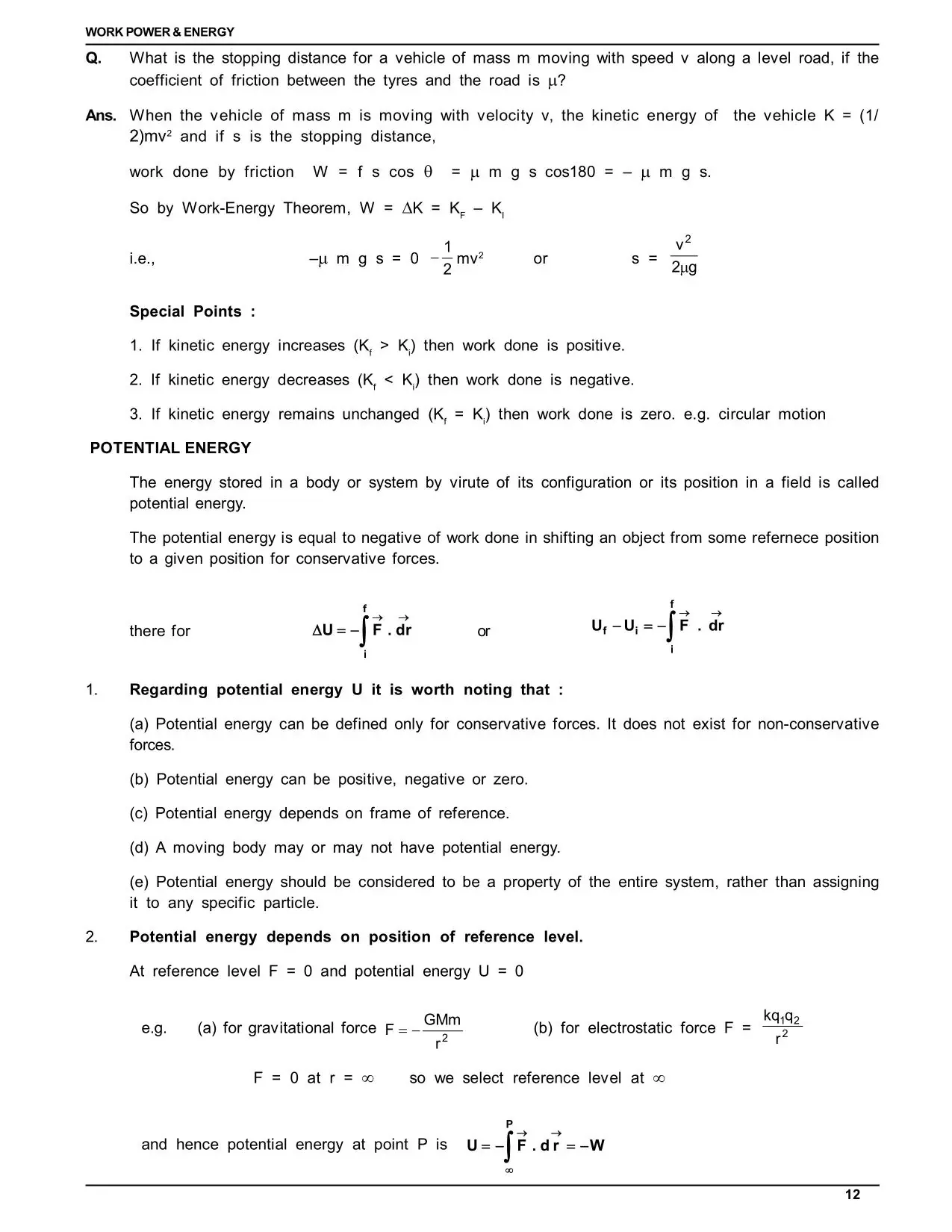
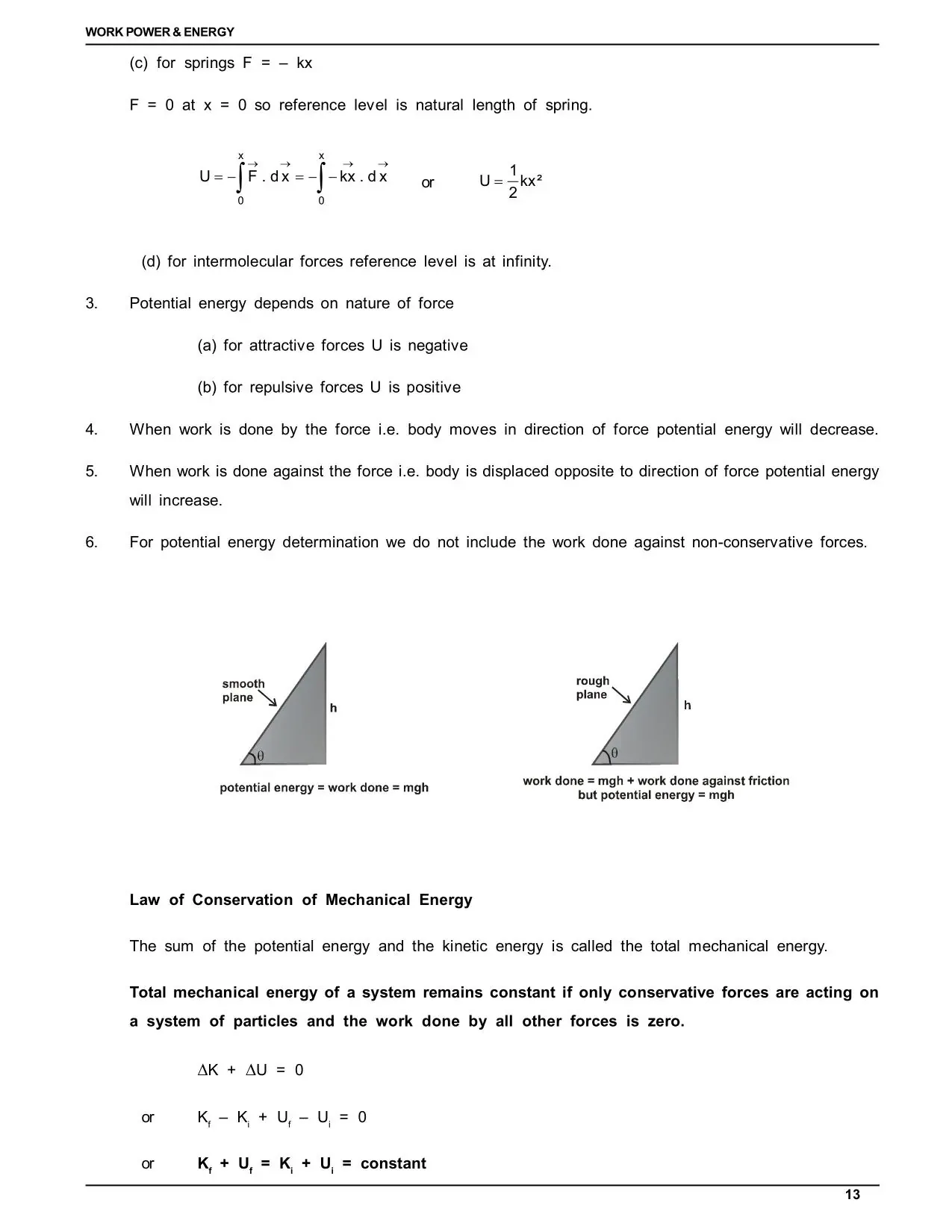
India's Best Exam Preparation for Class 11th - Download Now
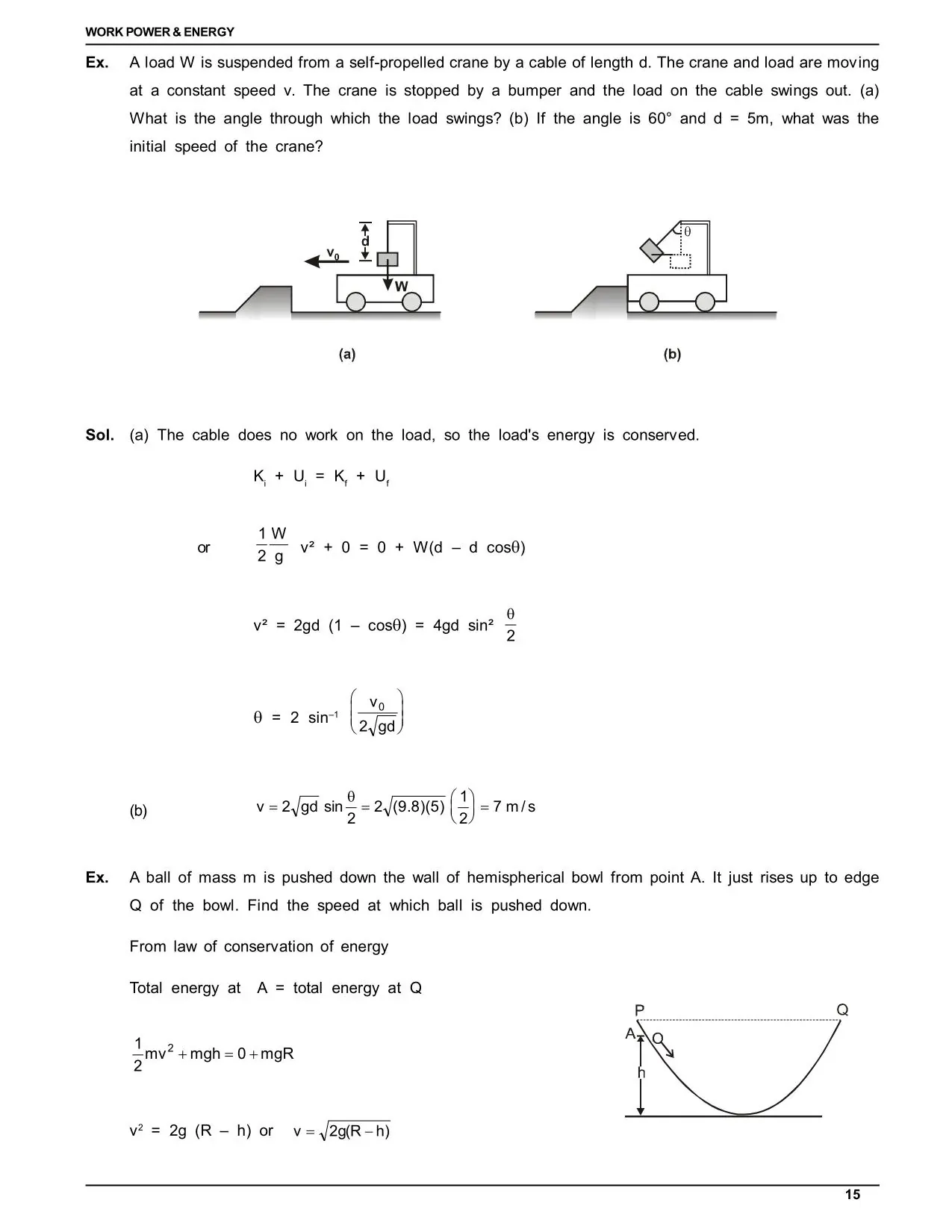
India's Best Exam Preparation for Class 11th - Download Now
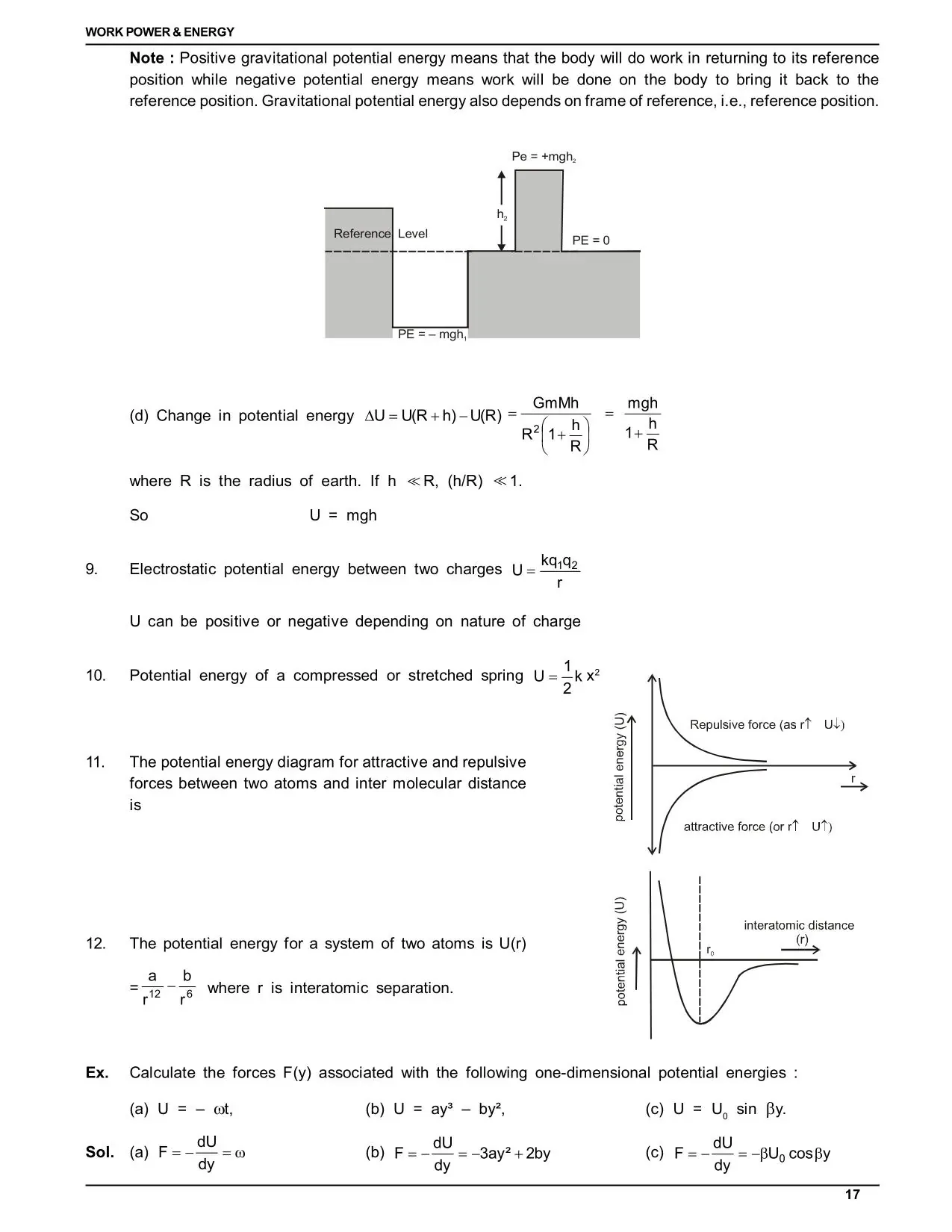
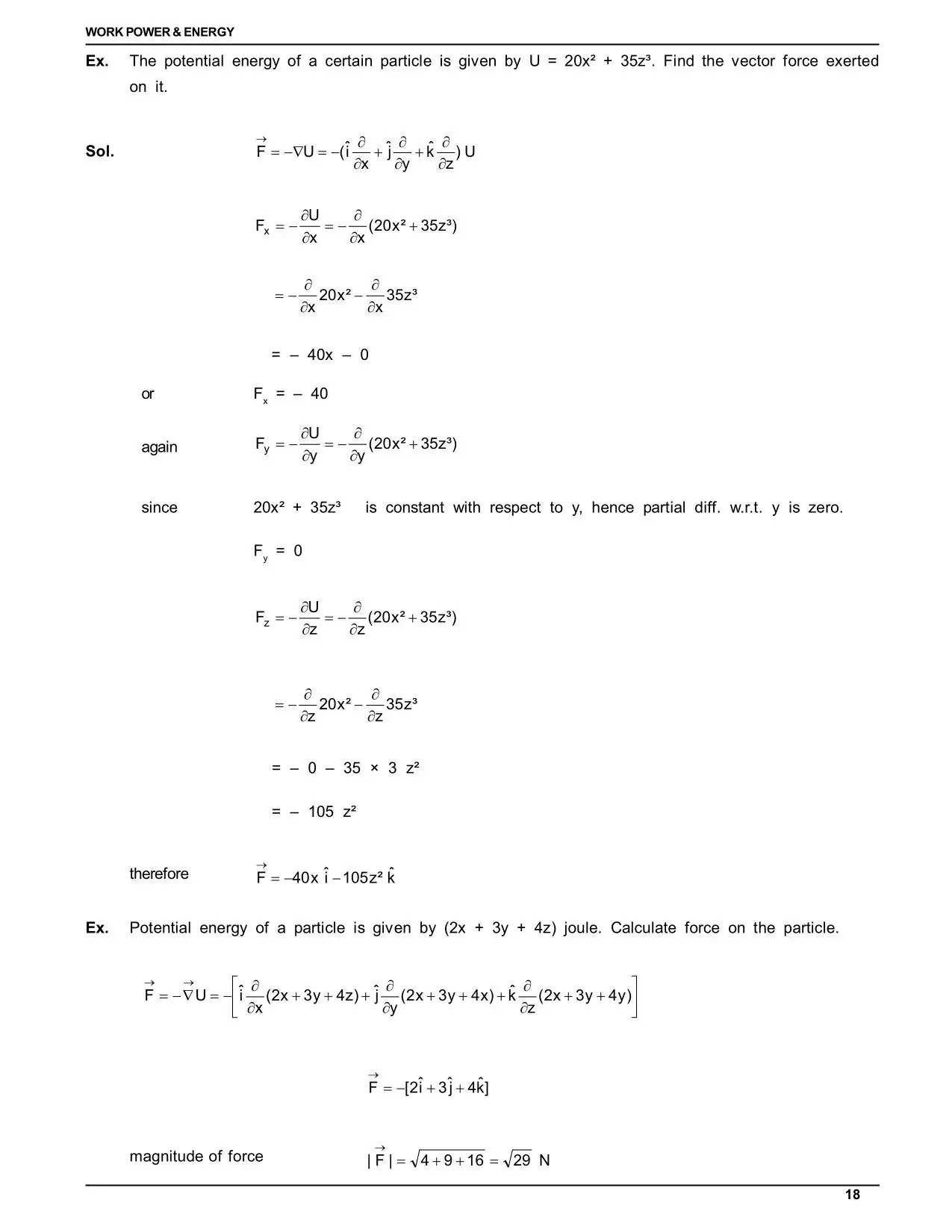
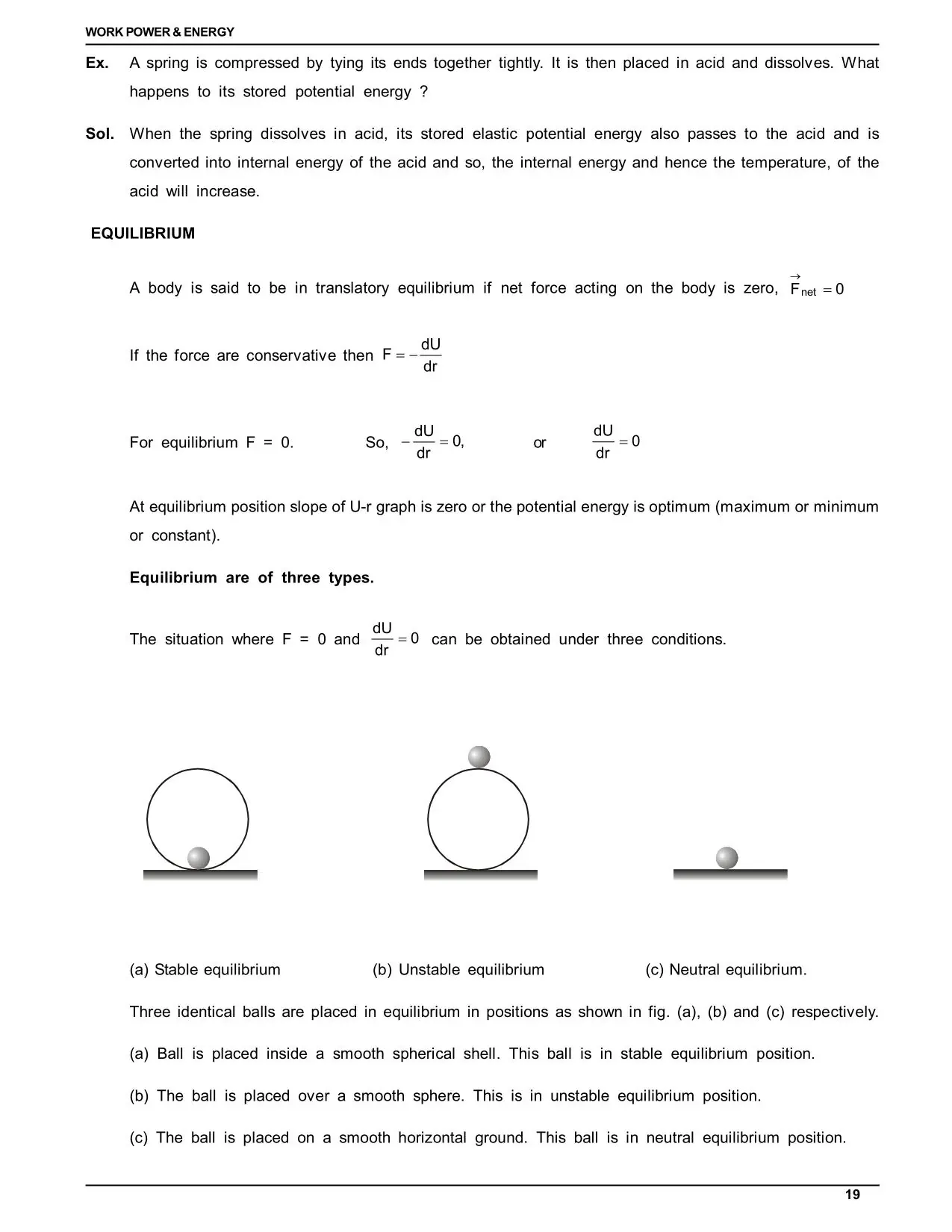
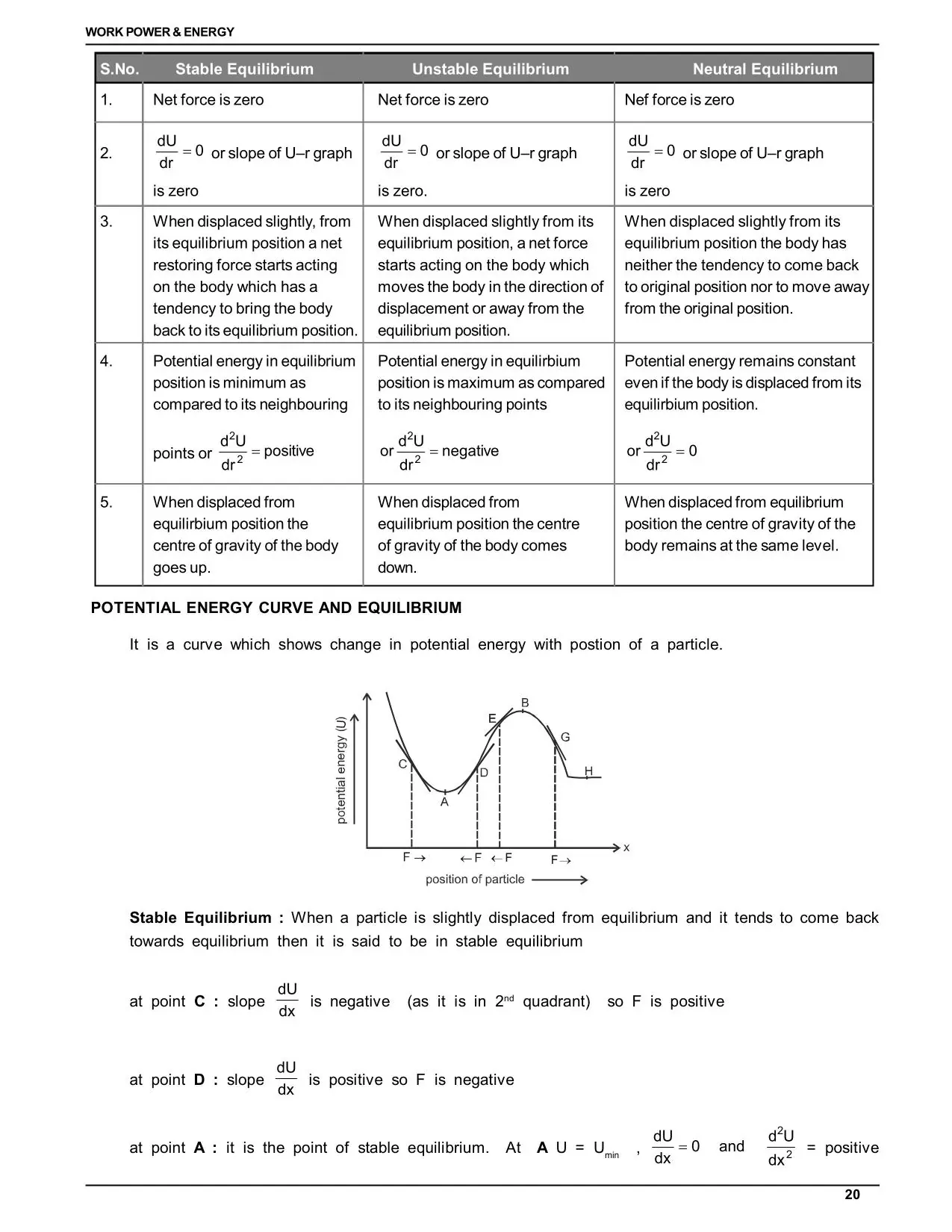
India's Best Exam Preparation for Class 11th - Download Now
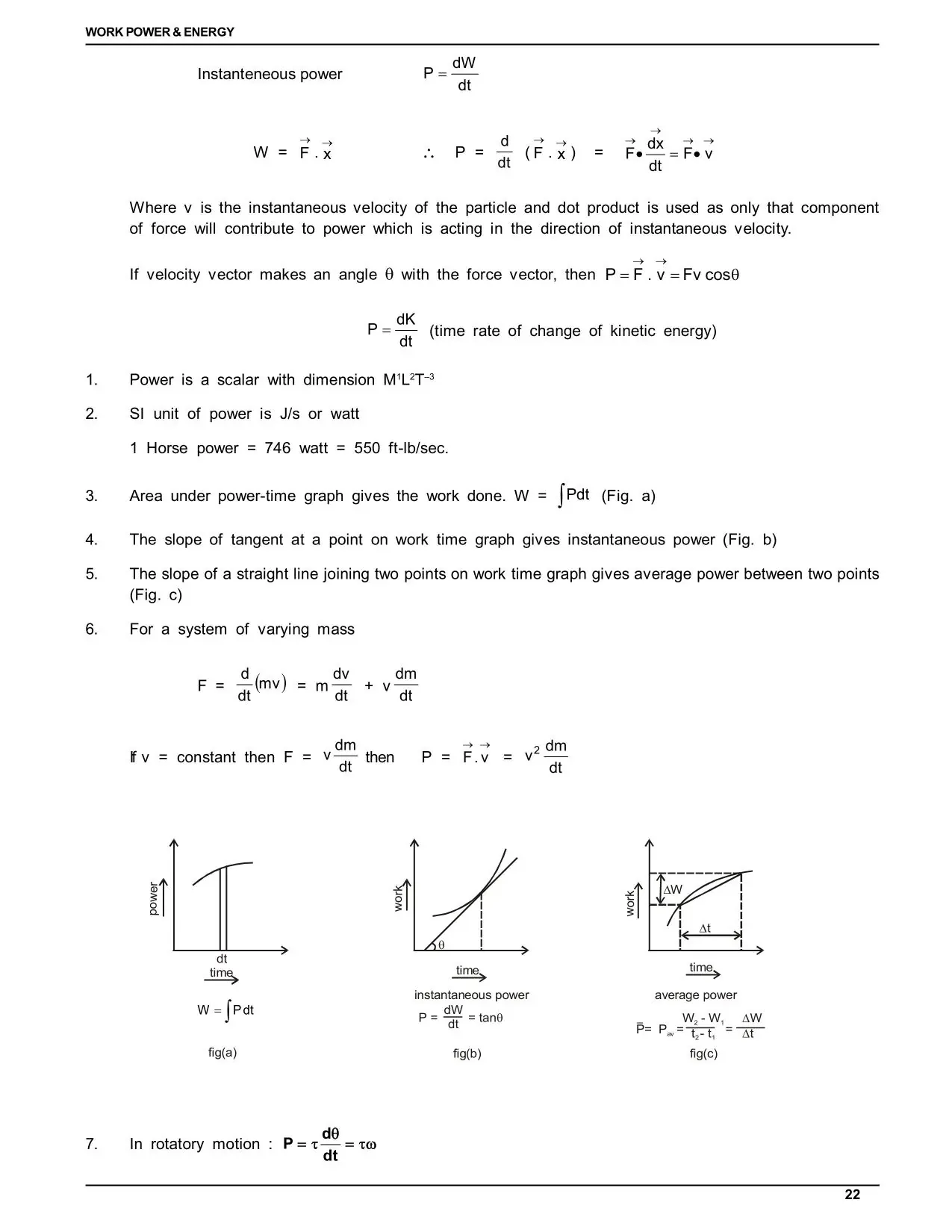
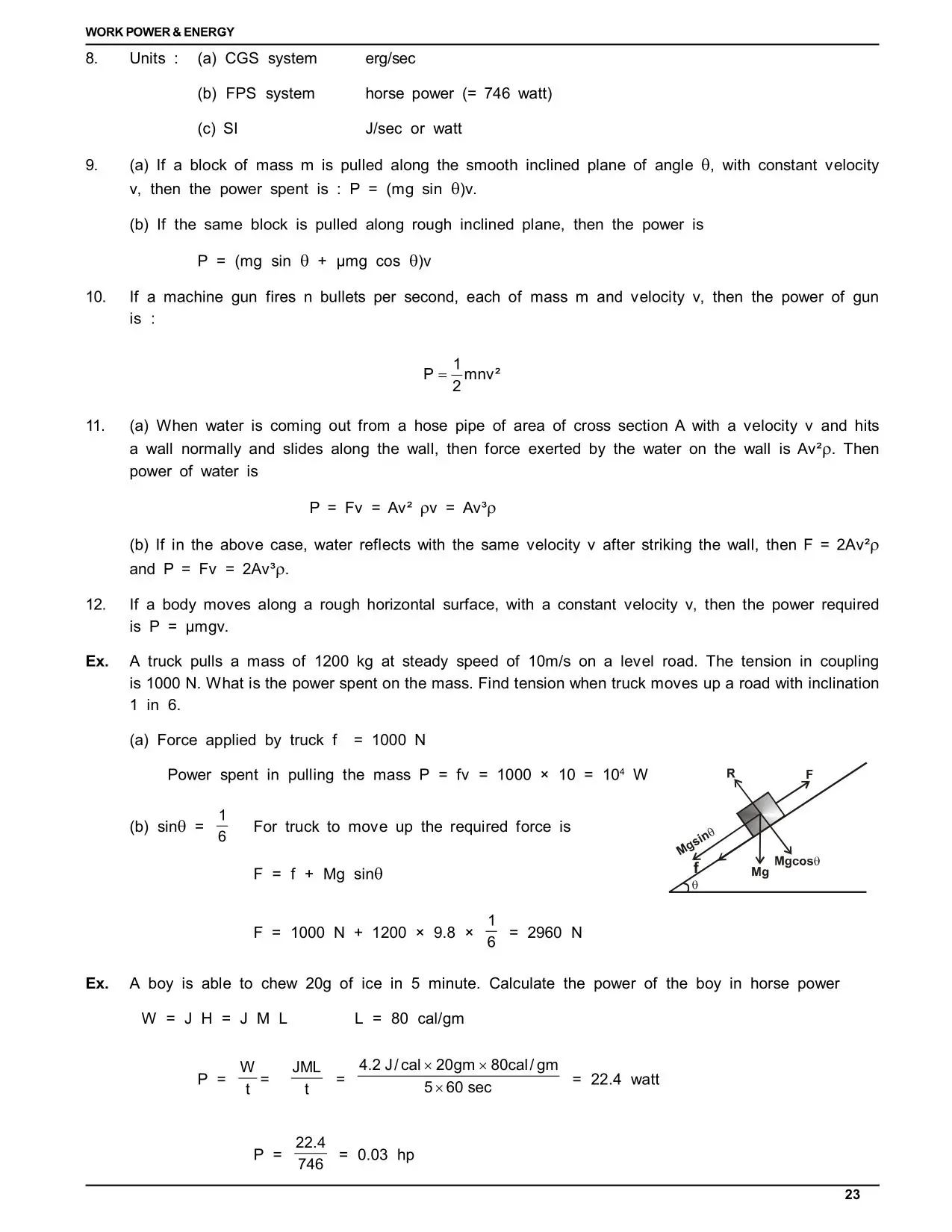
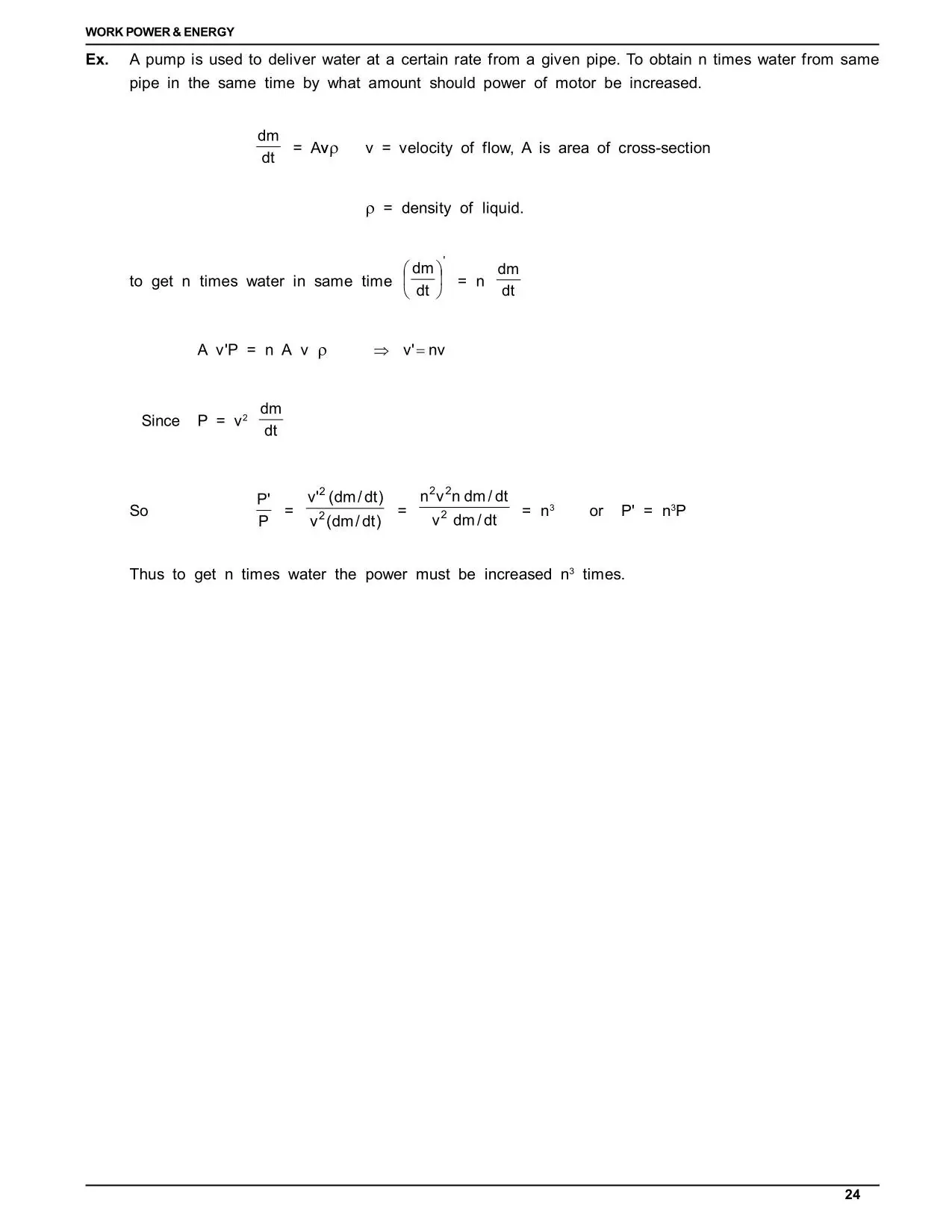
India's Best Exam Preparation for Class 11th - Download Now
Work in Work Energy and Power Class 11: Definition, Formula and Special Cases
Definition and Formula
Work is done by a force when it causes a displacement of the object. Work is a scalar quantity. For a constant force F and displacement s:
W = F·s = Fs cos θ, where θ is the angle between the force and the displacement.
- θ = 0°: W = Fs (maximum positive work)
- θ = 90°: W = 0 (for example, the normal force on a horizontal surface and the centripetal force in circular motion)
- θ = 180°: W = −Fs (maximum negative work, for example, friction opposing motion)
SI unit of work: joule (J) = N·m = kg·m²/s².
Work Done by a Variable Force
When the force changes with position, W = ∫F·dx from the initial to the final position. On an F–x graph, the work is the area under the graph.
Special Cases of Work
Situation | Work done | Reason |
|---|---|---|
Carrying a bag horizontally | 0 | Force is perpendicular to the displacement |
Pushing against a wall that does not move | 0 | Displacement is zero |
Friction on a sliding object | −fs | Force is opposite to the displacement |
Gravity on a falling object | +mgh | Force and displacement are both downward |
Gravity on a rising object | −mgh | Force is downward, displacement is upward |
Spring force when the spring is compressed or stretched by x | −½kx² | Spring force opposes the displacement |
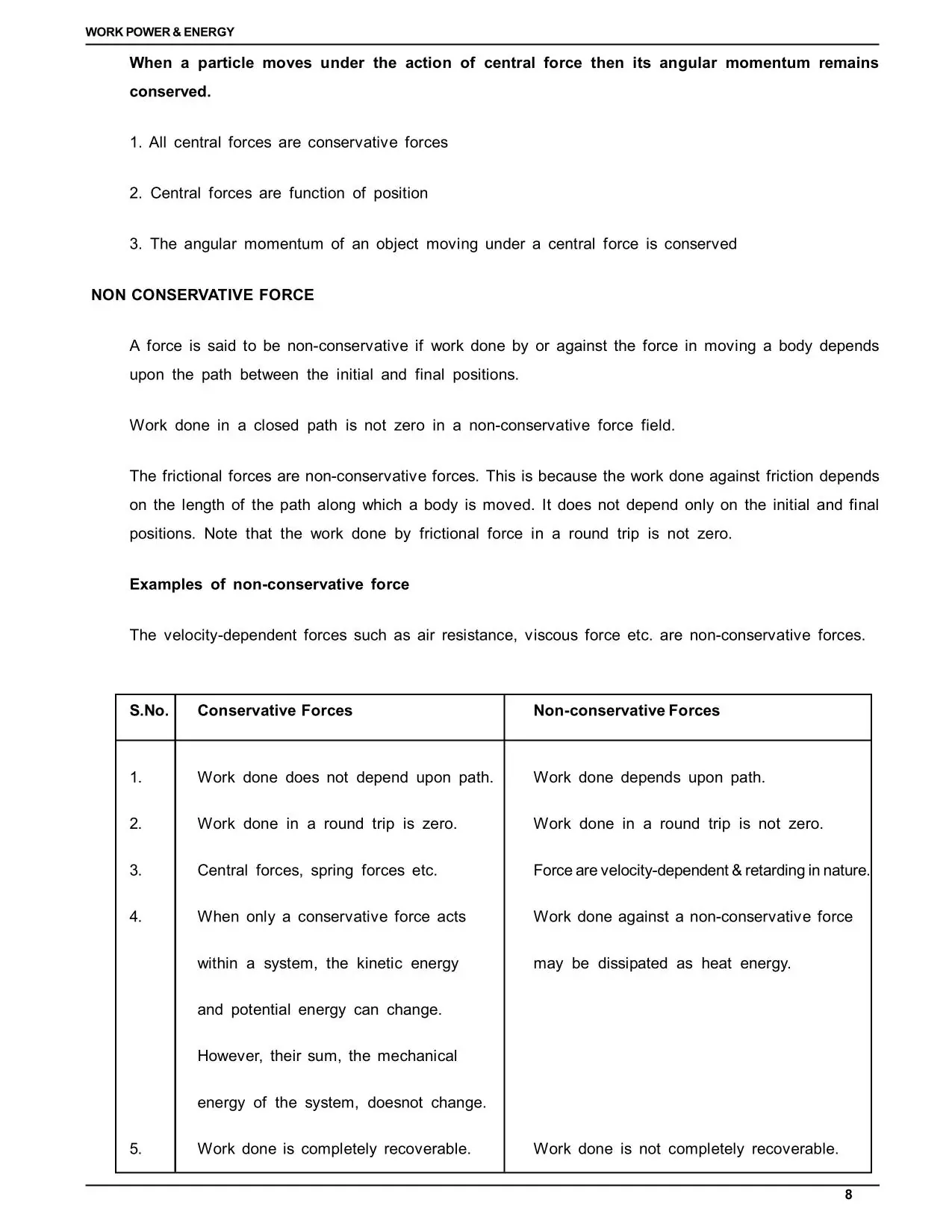
Conservative and Non-Conservative Forces
Property | Conservative force | Non-conservative force |
|---|---|---|
Work done depends on | Only the initial and final positions | The path taken |
Work in a closed loop | Zero | Not zero |
Potential energy | Can be defined | Cannot be defined |
Examples | Gravity, spring force, electrostatic force | Friction, air resistance, viscous force |
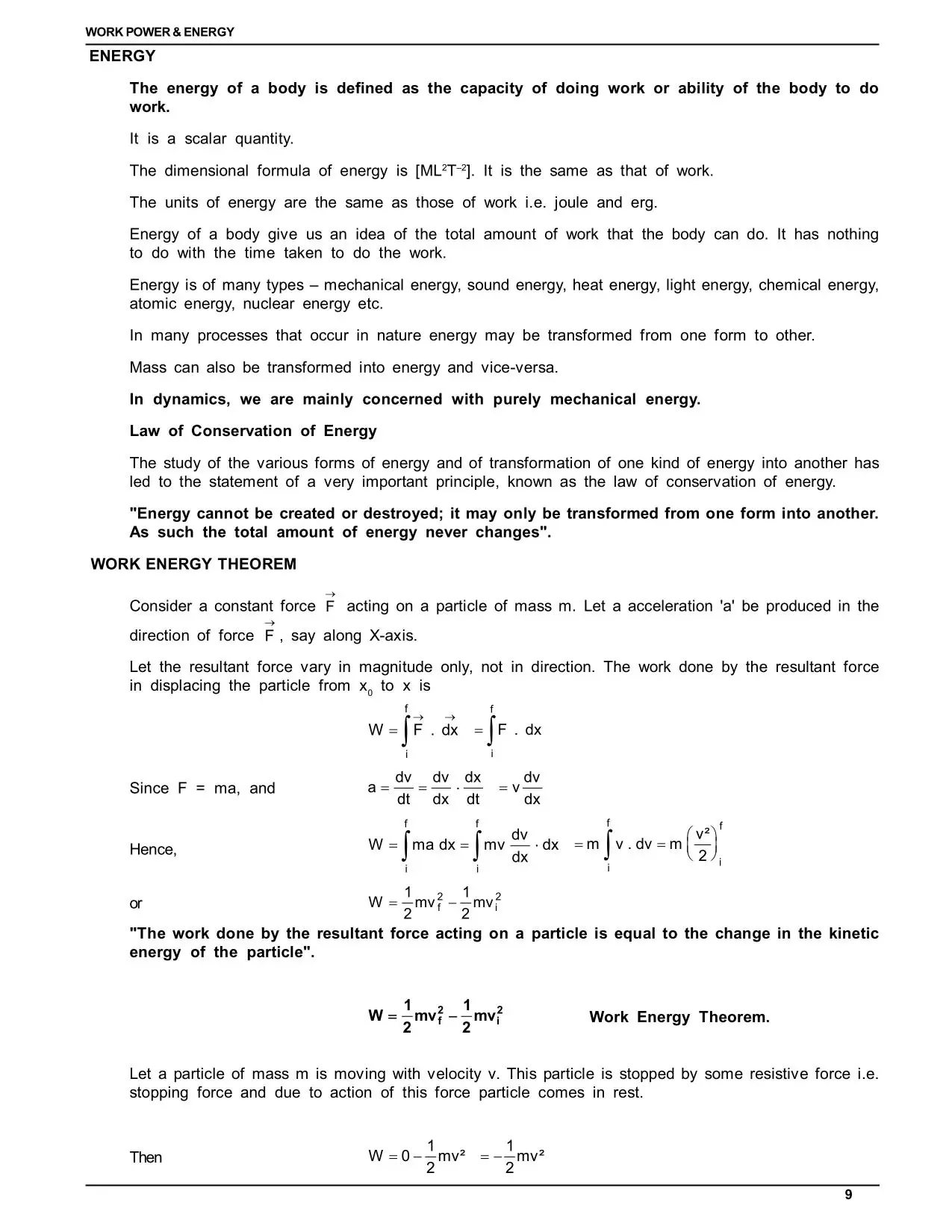
Work-Energy Theorem in Work Energy and Power Class 11
Statement
The net work done on an object by all forces equals the change in its kinetic energy:
W_net = ΔKE = ½mv² − ½mu²
Derivation for a Constant Force
From Newton’s second law, F = ma, and from kinematics, v² = u² + 2as, so as = (v² − u²)/2.
W = F·s = m·a·s = ½mv² − ½mu² = ΔKE
For a variable force, F = m v (dv/dx), so W = ∫F dx = ∫m v dv = ½mv² − ½mu². The theorem therefore holds for both constant and variable forces.
Applications of the Work-Energy Theorem
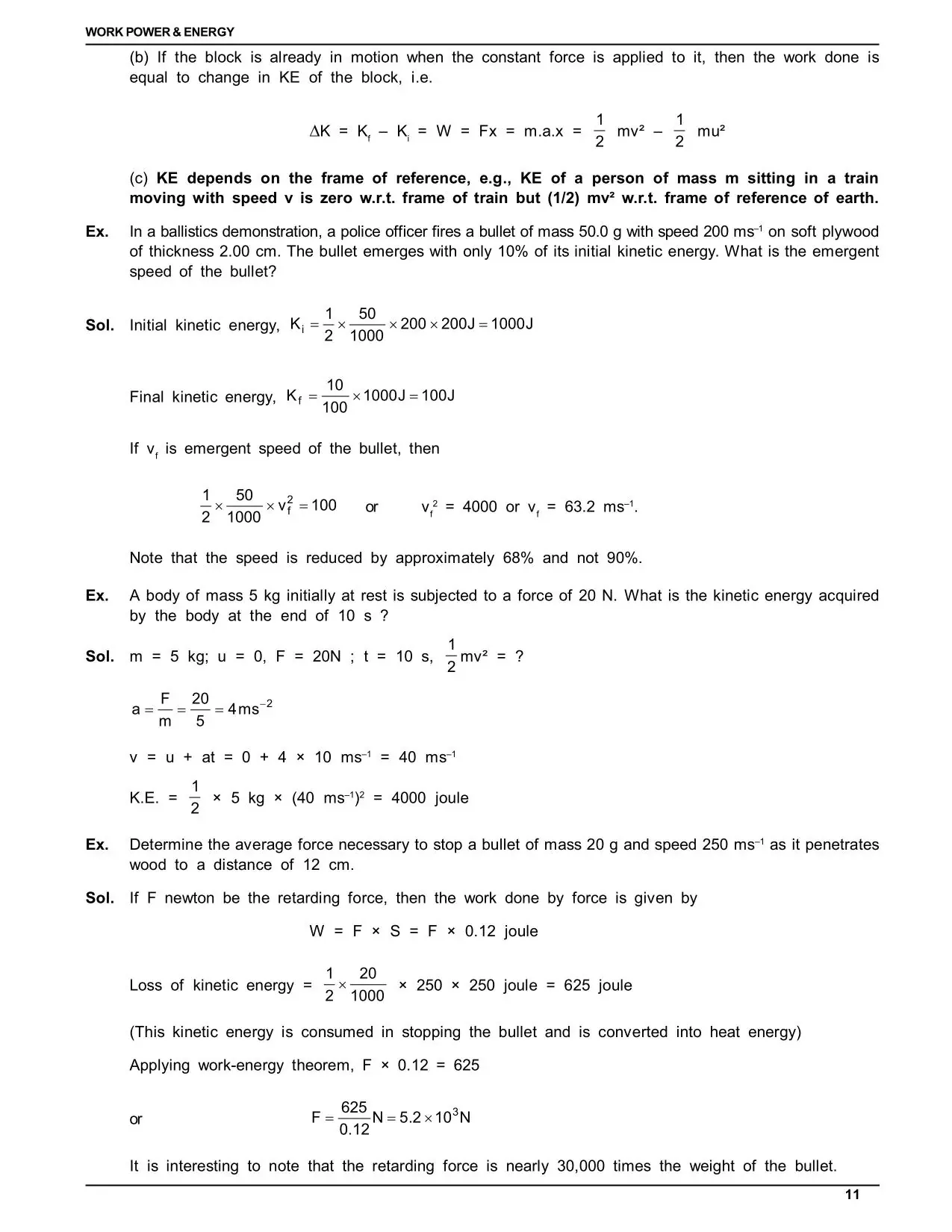
- Find the speed after a force acts over a known distance, without knowing the time.
- Find the stopping distance when the initial speed and the opposing force are known.
- Find the force needed to change the speed of an object over a given distance.
- Handle problems with many forces by adding the work of every force and equating it to ΔKE.
With friction: W_net = W_applied + W_friction + W_gravity = ΔKE, where the work of friction is negative (−f × d).
The solved examples in these Work Energy and Power Class 11 notes use g = 10 m/s² wherever needed.
Solved example 1: A 2 kg block at rest is pushed by a constant 10 N force over 5 m on a rough surface where the friction force is 4 N. Find its final speed.
Net work = (10 − 4) × 5 = 30 J. By the work-energy theorem, ½ × 2 × v² = 30, so v = √30 ≈ 5.5 m/s.
Kinetic Energy in Work Energy and Power Class 11
Kinetic energy is the energy of motion, KE = ½mv², and it is never negative.
Relation | Formula | Use |
|---|---|---|
KE in terms of momentum | KE = p²/(2m) | When momentum is given |
Momentum in terms of KE | p = √(2m·KE) | To convert KE to momentum |
Same momentum | KE ∝ 1/m | The lighter body has more KE |
Same KE | p ∝ √m | The heavier body has more momentum |
Potential Energy in Work Energy and Power Class 11: Gravitational and Spring
Potential energy is energy stored because of position or configuration, and it is defined only for conservative forces.
- Gravitational potential energy: PE = mgh, where h is the height above the chosen reference level. Only the change in PE matters, ΔPE = mg(h₂ − h₁).
- Spring potential energy: PE = ½kx², where x is the compression or extension from the natural length. It is zero at the natural length and is never negative.
- Force from potential energy: F = −dU/dx in one dimension.
Equilibrium from the Potential Energy Curve
Equilibrium | dU/dx | d²U/dx² | Behaviour after a small displacement |
|---|---|---|---|
Stable | 0 | Positive (minimum of U) | Returns to the equilibrium position |
Unstable | 0 | Negative (maximum of U) | Moves away |
Neutral | 0 | 0 (constant U) | Stays in the new position |
Conservation of Mechanical Energy in Work Energy and Power Class 11
If only conservative forces do work, the total mechanical energy is constant:
½mv₁² + U₁ = ½mv₂² + U₂, or KE + PE = constant.
When friction or another non-conservative force acts, the mechanical energy decreases, and the work done by the non-conservative force equals the change in mechanical energy (ΔKE + ΔPE). The lost energy appears mostly as heat.
Problem | Equation |
|---|---|
Ball dropped from a height h | mgh = ½mv², so v = √(2gh) |
Block sliding down a frictionless incline | mgh = ½mv² |
Block hitting a spring (no friction) | ½mv² = ½kx², so x = v√(m/k) |
Pendulum rising from the lowest point | mgh = ½mv₀², so h = v₀²/(2g) |
Block compressing a spring with friction | ½mv² = ½kx² + fx |
Solved example 2: A 0.5 kg block moving at 4 m/s hits a spring of constant 200 N/m on a frictionless surface. Find the maximum compression.
x = v√(m/k) = 4 × √(0.5/200) = 4 × 0.05 = 0.2 m.
Motion in a Vertical Circle in Work Energy and Power Class 11
For a mass tied to a string and moving in a vertical circle of radius R:
- At the top, the string stays taut only if the speed is at least √(gR).
- To complete the circle, the speed at the lowest point must be at least √(5gR), which follows from energy conservation.
- The difference in tension between the lowest and the highest point is 6mg.
Solved example 3: Find the minimum speed at the lowest point for a stone on a 0.9 m string to complete the vertical circle (take g = 10 m/s²).
v = √(5gR) = √(5 × 10 × 0.9) = √45 ≈ 6.7 m/s.
Power in Work Energy and Power Class 11
Power is the rate of doing work: P = W/t. For a force acting on a moving body, P = F·v = Fv cos θ, and P = Fv when the force and velocity are parallel.
SI unit: watt (W) = J/s. Also, 1 kW = 1000 W and 1 horsepower = 746 W.
Type | Formula | When to use |
|---|---|---|
Average power | P_avg = W_total / t_total | Over a time interval |
Instantaneous power | P = Fv cos θ | At a specific instant |
Efficiency: η = (useful output ÷ total input) × 100%, for either work or power.
Solved example 4: A motor lifts a 120 kg load at a constant speed of 0.5 m/s. Find the power delivered (g = 10 m/s²).
The force equals the weight, so P = Fv = 120 × 10 × 0.5 = 600 W.
Collisions in Work Energy and Power Class 11: Elastic and Inelastic
In every collision, momentum is conserved. Kinetic energy is conserved only in an elastic collision.
Type | Momentum conserved? | KE conserved? | Coefficient of restitution (e) |
|---|---|---|---|
Perfectly elastic | Yes | Yes | e = 1 |
Inelastic | Yes | No (some KE is lost as heat and sound) | 0 < e < 1 |
Perfectly inelastic | Yes | No (maximum KE is lost) | e = 0 |
Coefficient of restitution: e = (relative speed of separation) ÷ (relative speed of approach) = (v₂ − v₁)/(u₁ − u₂).
Head-On Elastic Collision
v₁ = [(m₁ − m₂)u₁ + 2m₂u₂] / (m₁ + m₂) and v₂ = [(m₂ − m₁)u₂ + 2m₁u₁] / (m₁ + m₂)
Condition | Result |
|---|---|
m₁ = m₂ | The velocities are exchanged |
m₁ ≫ m₂, with m₂ at rest | v₁ ≈ u₁ and v₂ ≈ 2u₁ |
m₂ ≫ m₁, with m₂ at rest | v₁ ≈ −u₁ (the light body bounces back) and v₂ ≈ 0 |
Perfectly Inelastic Collision
The bodies stick together: v = (m₁u₁ + m₂u₂)/(m₁ + m₂). The loss of kinetic energy is ½m₁u₁² + ½m₂u₂² − ½(m₁ + m₂)v².
Solved example 5: A 3 kg body moving at 4 m/s hits a 1 kg body at rest, and they stick together. Find the common velocity and the loss of kinetic energy.
v = (3 × 4)/(3 + 1) = 3 m/s. KE lost = ½ × 3 × 4² − ½ × 4 × 3² = 24 − 18 = 6 J.
Collisions in Two Dimensions
In a two-dimensional collision, momentum is conserved separately along the x-axis and the y-axis. If two equal masses collide elastically and one is initially at rest, they move off at 90° to each other after the collision (unless the collision is head-on).
Most Important Formulas for Work Energy and Power Class 11
Topic | Formula |
|---|---|
Work (constant force) | W = Fs cos θ |
Work (variable force) | W = ∫F·dx = area under the F–x graph |
Work-energy theorem | W_net = ΔKE |
Kinetic energy | KE = ½mv² = p²/(2m) |
Gravitational PE | U = mgh |
Spring PE | U = ½kx² |
Force from PE | F = −dU/dx |
Conservation of energy | KE + PE = constant |
Average power | P = W/t |
Instantaneous power | P = Fv cos θ |
Efficiency | η = (output ÷ input) × 100% |
Momentum conservation | m₁u₁ + m₂u₂ = m₁v₁ + m₂v₂ |
Coefficient of restitution | e = (v₂ − v₁)/(u₁ − u₂) |
Vertical circle (string) | v_top ≥ √(gR), v_bottom ≥ √(5gR) |
Common Mistakes in Work Energy and Power Class 11 Problems
Mistake | Correct approach |
|---|---|
Using the mechanical energy conservation equation when friction acts | Include the work done by friction, or use W_net = ΔKE |
Forgetting that friction does negative work | Write W_friction = −f × d |
Applying energy conservation to an inelastic collision | Use momentum conservation, because KE is not conserved |
Mixing up energy and power | Power is the rate of doing work, in watts |
Taking the wrong sign for work when θ > 90° | Work is negative if the force opposes the displacement |
Using the wrong reference level for PE | Choose the reference level first, and use only the change in PE |
Commonly Asked Topics from Work Energy and Power Class 11
- CBSE: definitions, the work-energy theorem, spring energy, conservation of energy and collisions.
- JEE Main and NEET: the work-energy theorem with friction, spring and energy conservation problems, power (P = Fv), elastic collisions, perfectly inelastic collisions, and vertical circular motion.
- JEE Advanced: variable force work, energy conservation in multi-body systems and multi-concept problems.
To practise Work Energy and Power Class 11 at the JEE Advanced level, solve the selected problems from our Irodov Questions in JEE Syllabus collection after studying these notes. The Irodov set includes a section for Work, Energy and Power problems.
Although work is a scalar, many mechanics setups still need correct directions and components. Revise the vector fundamentals for 2D motion if that step is unclear. For the textbook questions, use eSaral’s NCERT Solutions for Class 11 Physics Chapter 5.
Frequently Asked Questions
What is the work-energy theorem in Work Energy and Power Class 11?
The work-energy theorem states that the net work done on an object by all forces equals the change in its kinetic energy, W_net = ½mv² − ½mu². It holds for constant and variable forces, and it lets you find a speed without knowing the acceleration at every instant.
Which chapter number is Work Energy and Power in Class 11 Physics?
In the current NCERT Class 11 Physics textbook, Work, Energy and Power is Chapter 5. Older editions numbered it Chapter 6. The eSaral notes and NCERT solutions follow the current numbering.
What topics are included in Work Energy and Power Class 11 for 2026-27?
The syllabus covers work by constant and variable forces, kinetic energy, the work-energy theorem, power, potential energy, the potential energy of a spring, conservative and non-conservative forces, motion in a vertical circle, and elastic and inelastic collisions in one and two dimensions.
What are the most important formulas in work energy and power for JEE and NEET?
For Work Energy and Power Class 11, learn W = Fs cos θ, W_net = ΔKE, KE = ½mv² = p²/(2m), U = mgh, U = ½kx², KE + PE = constant, P = Fv, the momentum conservation equation and e = (v₂ − v₁)/(u₁ − u₂). Practise previous year questions to see how they are used.
What is the difference between elastic and inelastic collisions?
In Work Energy and Power Class 11, in an elastic collision, both momentum and kinetic energy are conserved (e = 1). In an inelastic collision, momentum is conserved but some kinetic energy is lost (0 < e < 1). In a perfectly inelastic collision, the bodies stick together and the loss of kinetic energy is maximum (e = 0).
When is the work done by a force zero?
In Work Energy and Power Class 11, work is zero when the force is perpendicular to the displacement (for example, the normal force on a horizontal surface), when the displacement is zero, or when the force is zero.
What is the difference between work, energy and power?
In Work Energy and Power Class 11, work is the energy transferred by a force over a displacement. Energy is the capacity to do work. Power is the rate at which work is done, so two machines can do the same work but have different power if they take different times.
Is the work-energy theorem valid for a variable force?
Yes. In Work Energy and Power Class 11, for a variable force, the work is W = ∫F dx, and it equals the change in kinetic energy, so the theorem holds in the same form.
Is Work Energy and Power Class 11 important for JEE Main and NEET?
Yes. The chapter is part of both syllabi, and its ideas (energy methods and collisions) are used in many other mechanics problems. The number of direct questions varies each year, so practise previous year questions. eSaral’s Work Energy and Power Class 11 notes include solved examples and formula tables for quick revision.
Team eSaral
eSaral Academic and Editorial Team
Team eSaral is the collective author profile for educational content created by eSaral’s teachers and academic contributors. The team draws on expertise from IIT graduates, doctors, experienced educators and subject specialists to develop resources for JEE, NEET and school students. Our articles aim to explain concepts clearly and help students study with confidence.
Related Posts

BITSAT 2027: Registration Date, Exam Date, Syllabus, Eligibility, Pattern & Fees
BITSAT 2027 exam dates, registration timeline, eligibility criteria, exam pattern, marking scheme, syllabus and fees in one page.

BITSAT Previous Year Question Paper PDF (2017-2026)
Download BITSAT previous year question papers PDF from 2017 to 2026,session-wise. Memory-based papers,exam pattern, paper analysis and how to practise

CBSE Class 10 Date Sheet 2027: Expected Exam Dates, Release Date, Admit Card & Result Timeline
CBSE Class 10 date sheet 2027 is awaited. See the expected exam dates, release window, how to download the PDF, admit card and result timelines.

NCERT Physics Class 10 Book PDF in Hindi 2026-27 – भौतिक विज्ञान के 4 अध्याय (Free Download)
NCERT Physics Class 10 book PDF in Hindi 2026-27: download all 4 chapters (अध्याय 9–12) free, with topics and important formulas.

NCERT Biology Class 9 Book Anveshan PDF in Hindi - जीव विज्ञान कक्षा 9 पुस्तक अन्वेषण PDF
Download NCERT Biology Class 9 book PDF in Hindi chapterwise for 2026-27: Cell, Tissues, Reproduction and Diversity. Free PDFs.

Essay On Artificial Intelligence in English (100,150, 200, 250, 300, 500 Words)
This is in contrast to the natural intelligence of humans. With Artificial Intelligence, machines can perform

Essay on 78th India Independence Day in English for Student (100, 150, 200, 250, 300, 500 Words)
Read the best essays on India's Independence Day in English. Short & long essays (100, 150, 200, 250, 300, 500 words) perfect for school exams
NCERT Class 11 English Snapshots book - Free PDF download- Esaral
Download NCERT Class 11 English Snapshots book PDF for free. Get all 8 chapters, chapter-wise. Start your prep today!
NCERT Class 10 biology book pdf - Free PDF Download - eSaral
NCERT Class 10 Biology book PDF 2026-27: all 5 chapters (Life Processes to Our Environment) in English & Hindi, with CBSE syllabus, marks & practical

Essay on Global Warming in English (100,150, 200, 250, 300, 500 Words)
Global warming means the Earth is getting hotter. This happens because of things like pollution from cars and factories.