
Angular Momentum Formula: Definition, Derivation, Dimensional Formula & Solved Examples
eSaral › Class 11 Physics › Angular Momentum Formula: Definition, Derivation, Dimensional Formula & Solved Examples

What Is the Angular Momentum Formula?
The angular momentum formula gives the rotational equivalent of linear momentum, and it takes one of two forms depending on what you're analysing:
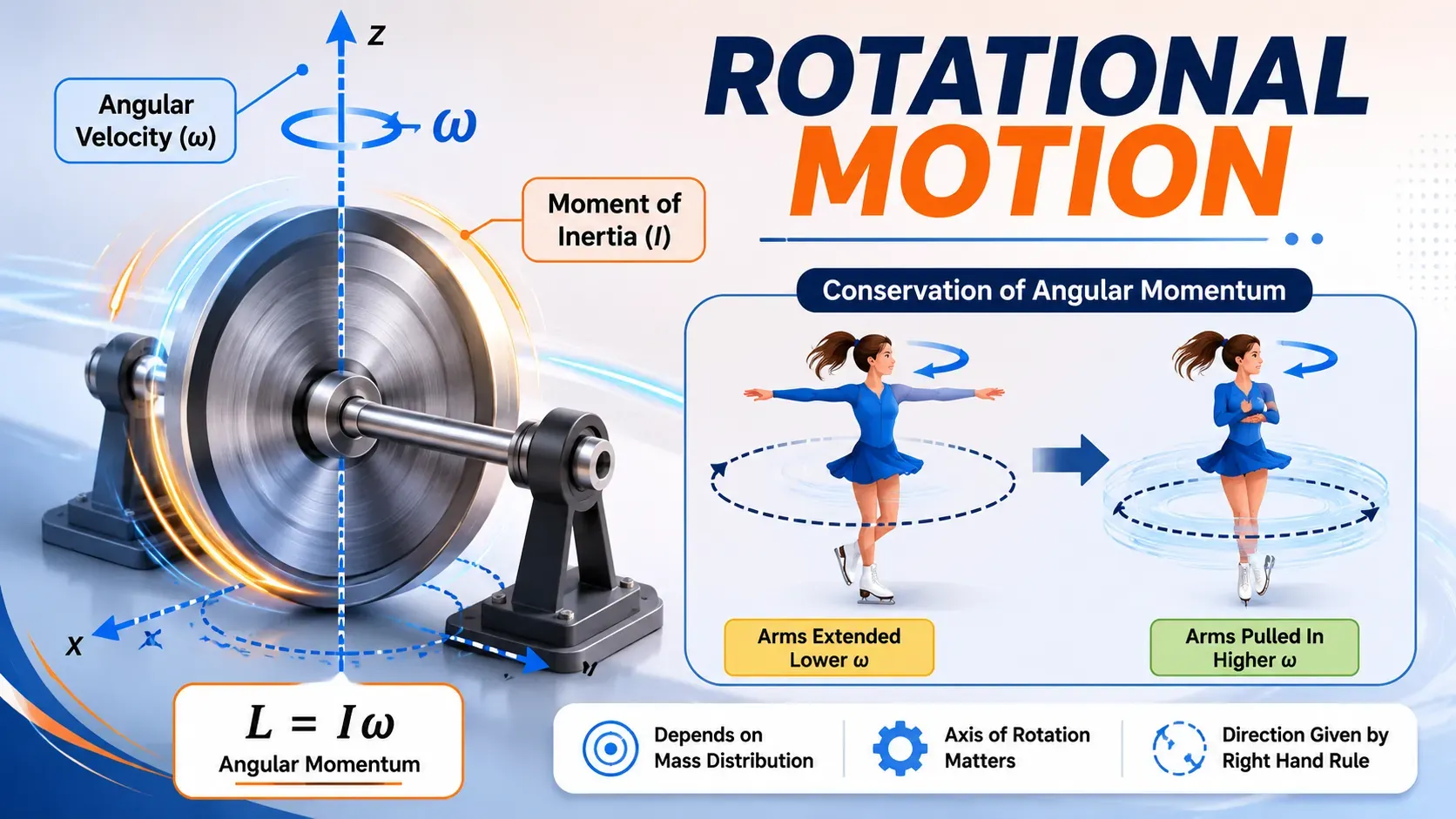
- Rigid body rotating about a fixed axis: L = Iω, where L is angular momentum, I is the moment of inertia about that axis, and ω is the angular velocity.
- Single particle in motion: L = r × p, where r is the position vector from the axis of rotation and p is linear momentum (p = mv). In magnitude form, L = rp sin θ, where θ is the angle between r and p.
Just as p = mv captures how much "straight-line motion" an object has, the angular momentum formula L = Iω captures how much "rotational motion" a spinning or orbiting object has. Both are vector quantities, but angular momentum points perpendicular to the plane of rotation rather than along the direction of travel.
New to this chapter? Start with System of Particles and Rotational Motion Class 11 Notes →
Is Angular Momentum a Scalar or a Vector?
Angular momentum is always a vector, specifically an axial vector, meaning its direction is fixed perpendicular to the plane of rotation and found using the right-hand rule (curl the fingers in the direction of rotation; the thumb points along L).
SI Unit and Dimensional Formula of Angular Momentum
Before applying the angular momentum formula in a numerical, it helps to lock down its unit and dimensional formula a topic asked directly and often in JEE Main.
Property | Value |
|---|---|
SI Unit | kg·m²/s (equivalently, J·s) |
CGS Unit | g·cm²/s |
Dimensional Formula | [M¹L²T⁻¹] |
Type of Quantity | Vector (axial vector, perpendicular to the plane of rotation) |
How is the dimensional formula for angular momentum derived?
Since L = Iω, and the moment of inertia I has dimension [M¹L²] while angular velocity ω has dimension [T⁻¹], multiplying the two gives the angular momentum dimensional formula: [M¹L²T⁻¹]. This is one of the most frequently tested dimensional-formula questions in JEE Main and NEET, precisely because students often forget to combine the moment-of-inertia dimension correctly.
Angular Momentum Formula for Class 11 and Class 12 (NCERT-Aligned)
The angular momentum formula appears at two different depths across Class 11 and Class 12, which is exactly where most students get confused.
Class 11 (System of Particles and Rotational Motion): You're introduced to both L = Iω (rigid body) and L = r × p (particle), along with the torque-angular momentum relation τ = dL/dt and the conservation of angular momentum law. This is the version tested most heavily in JEE Main and NEET.
Class 12: The same angular momentum formula reappears in new contexts: orbital angular momentum in Bohr's model of the atom (Atomic Structure) and the quantization condition L = nh/2π, plus Kepler's second law in planetary motion, which is really conservation of angular momentum applied to an orbiting planet.
Knowing which "version" of the angular momentum formula a question is testing Class 11's mechanical L = Iω or Class 12's quantized orbital form is often the fastest way to identify the correct approach under exam pressure.
How Is the Angular Momentum Equation Derived from Torque?
Just as force is the rate of change of linear momentum (F = dp/dt), torque is the rate of change of angular momentum:
τ = dL/dt
For a rigid body with constant moment of inertia I, since L = Iω:
τ = d(Iω)/dt = I(dω/dt) = Iα
This shows that τ = Iα, the familiar rotational analogue of F = ma, is really a special case of the more general angular momentum formula τ = dL/dt. It's also the direct basis of the conservation of angular momentum formula: when no external torque acts on a system, dL/dt = 0, so angular momentum L stays constant.
Conservation of Angular Momentum Formula Quick Reference
Condition | Result |
|---|---|
External torque = 0 | L₁ = L₂ (angular momentum conserved) |
Moment of inertia decreases | Angular velocity increases (L constant) |
Moment of inertia increases | Angular velocity decreases (L constant) |
A spinning skater pulling their arms inward is the textbook illustration: moment of inertia I drops, so angular velocity ω must rise to keep L = Iω constant.
What Is the Relationship Between Angular Momentum and Moment of Inertia?
Since the angular momentum formula is L = Iω, angular momentum and moment of inertia are directly proportional at a fixed angular velocity but for a fixed angular momentum, a smaller moment of inertia forces a larger angular velocity, and vice versa. This inverse trade-off, not the direct formula alone, is what shows up most often in JEE-level conceptual questions.
Rotational Momentum Formula vs Linear Momentum Formula Side-by-Side Comparison
"Rotational momentum formula" is simply another common name for the angular momentum formula, and comparing it directly to linear momentum is the fastest way to avoid mixing the two up under time pressure.
Feature | Linear Momentum | Angular Momentum (Rotational Momentum) |
|---|---|---|
Formula | p = mv | L = Iω (or L = r × p) |
Related quantity | Mass (m) | Moment of inertia (I) |
Governing law | F = dp/dt | τ = dL/dt |
SI unit | kg·m/s | kg·m²/s |
Conserved when | No external force acts | No external torque acts |
Quantity type | Vector, along direction of motion | Vector, perpendicular to plane of rotation |
Angular Momentum Vector Formula: Understanding L = r × p
For a particle moving with linear momentum p at position vector r from the axis of rotation, the angular momentum vector formula is L = r × p. Because this is a cross product, the magnitude works out to L = rp sin θ, where θ is the angle between r and p, and the direction of L is found using the right-hand rule — always perpendicular to the plane containing r and p.
This vector form of the angular momentum formula matters most in particle-based problems — circular motion, projectile angular momentum about a point, or orbital mechanics — where there's no single rigid rotation axis to plug into L = Iω directly.
Angular Momentum Formula in Chemistry (Orbital Angular Momentum)
Outside mechanics, the angular momentum formula also shows up in chemistry and atomic physics, describing the orbital angular momentum of an electron around the nucleus: L = n(h/2π), where n is the principal quantum number and h is Planck's constant. This quantized version of angular momentum explains why electron orbitals occupy only specific discrete energy levels rather than a continuous range — a direct extension of the same L = Iω logic applied at the atomic scale.
How Do You Solve Problems Using the Angular Momentum Formula? (Solved Examples)
Example 1: Basic angular momentum calculation using L = Iω
A disc has a moment of inertia of 2 kg·m² and rotates with an angular velocity of 5 rad/s. Find its angular momentum. Solution: L = Iω = 2 × 5 = 10 kg·m²/s
Example 2: Angular momentum of a particle using L = r × p.
A particle of mass 0.5 kg moves with a velocity of 4 m/s in a circle of radius 2 m. Find its angular momentum about the centre. Solution: L = rp sin θ = r(mv) sin 90° = 2 × (0.5 × 4) × 1 = 4 kg·m²/s
Example 3: Finding angular velocity from angular momentum.
A rotating wheel has an angular momentum of 40 kg·m²/s and a moment of inertia of 8 kg·m². Find its angular velocity. Solution: ω = L/I = 40/8 = 5 rad/s
Example 4: Torque from rate of change of angular momentum.
The angular momentum of a rotating body changes from 20 kg·m²/s to 32 kg·m²/s in 4 seconds. Find the average torque acting on it. Solution: τ = ΔL/Δt = (32 − 20)/4 = 12/4 = 3 N·m
Example 5 — Applying conservation of angular momentum
A skater with moment of inertia 6 kg·m² spins at 2 rad/s with arms out. Pulling arms in reduces I to 1.5 kg·m². Find the new angular velocity.
Solution: L is conserved → I₁ω₁ = I₂ω₂ → 6 × 2 = 1.5 × ω₂ → ω₂ = 8 rad/s
Why Is the Angular Momentum Formula Important for JEE and NEET?
Angular momentum is one of the highest-weightage concepts in the System of Particles and Rotational Motion chapter, contributing 2–3 questions in JEE Main and 1–2 in NEET most years. It also connects directly to later topics planetary motion in Gravitation (Kepler's second law is a direct consequence of angular momentum conservation), and quantization of angular momentum in Atomic Structure. A strong grasp of the angular momentum formula therefore pays off well beyond this single chapter.
How Should Students Practice Angular Momentum Formula Problems?
- Start with direct substitution problems (L = Iω) before attempting L = r × p particle-based questions.
- Always check whether the problem involves a rigid body (use L = Iω) or a single particle in circular/general motion (use L = r × p).
- Practice torque-angular momentum problems (τ = dL/dt) alongside conservation-of-angular-momentum problems, since exams frequently combine both.
- Use the linear-vs-angular momentum comparison table above to avoid mixing up formulas under exam pressure this is one of the most common error sources in rotational motion numericals.
Which Other eSaral Physics Resources Should Class 11 Students Check Next?
- System of Particles and Rotational Motion Class 11 Notes JEE & NEET
- NCERT Solutions Class 11 Physics Chapter 6 System of Particles and Rotational Motion
- State the Law of Conservation of Angular Momentum
- Conservation of Angular Momentum Examples
- Radius of Gyration Class 11 Definition & Equation
- Rotational Motion Problems and Solutions
- Momentum Formula Definition, Derivation & Solved Examples
Want to master angular momentum, torque, and rotational motion with solved JEE and NEET problems? eSaral's Class 11 Physics course covers System of Particles and Rotational Motion in depth with concept videos by IIT Bombay faculty and chapter-wise practice tests. Explore Class 11 Physics Courses on eSaral →
Frequently Asked Questions
Is angular momentum a scalar or a vector quantity?
Angular momentum is a vector quantity, specifically an axial vector, meaning its direction is always perpendicular to the plane of rotation, determined using the right-hand rule.
What is the SI unit of angular momentum?
The SI unit of angular momentum is kilogram-metre-squared per second (kg·m²/s), which is dimensionally equivalent to joule-second (J·s).
What is the formula for angular momentum?
The formula for angular momentum is L = Iω for a rigid body, where I is moment of inertia and ω is angular velocity. For a single particle, it is L = r × p, the cross product of the position vector and linear momentum.
What is the dimensional formula of angular momentum?
The dimensional formula of angular momentum is [M¹L²T⁻¹], derived from L = Iω, since moment of inertia has dimension [M¹L²] and angular velocity has dimension [T⁻¹].
What is the difference between linear momentum and angular momentum?
Linear momentum (p = mv) describes motion in a straight line and depends on mass, while angular momentum (L = Iω) describes rotational motion and depends on moment of inertia, which accounts for how mass is distributed relative to the axis of rotation.
How is the angular momentum formula related to torque?
Torque equals the rate of change of angular momentum: τ = dL/dt. For a rigid body with constant moment of inertia, this simplifies to τ = Iα, the rotational equivalent of F = ma.
Why is angular momentum important for JEE and NEET Physics?
Angular momentum is a high-weightage topic in Rotational Motion and also underlies concepts in later chapters like planetary motion in Gravitation and quantization of angular momentum in Atomic Structure, making it essential across multiple units of the syllabus.
How do you find angular momentum using L = r × p?
For a particle moving with linear momentum p at a position vector r from the axis of rotation, angular momentum is L = r × p, with magnitude L = rp sin θ, where θ is the angle between the position vector and the momentum vector.
What is the relationship between angular momentum and moment of inertia?
Since L = Iω, angular momentum and moment of inertia are directly related for a given angular velocity, but for a fixed angular momentum, a smaller moment of inertia results in a larger angular velocity, and vice versa.
When is angular momentum conserved?
Angular momentum is conserved when no external torque acts on a system, meaning dL/dt = 0. This is why a spinning ice skater rotates faster when pulling their arms in — their moment of inertia decreases, so angular velocity increases to keep L constant.
Does the angular momentum formula apply in chemistry too?
Yes — in chemistry and atomic physics, the angular momentum formula for an electron's orbital motion is L = n(h/2π), explaining why electrons occupy only quantized, discrete energy levels.
What is the angular momentum formula for Class 11 and Class 12 students?
In Class 11, the angular momentum formula covers L = Iω and L = r × p under rotational motion; in Class 12, it extends to orbital angular momentum in Atomic Structure (L = nh/2π) and Kepler's second law in Gravitation.