
Applications of Amperes Law: Straight Wire, Cylinder, Solenoid and Toroid (Class 12)

eSaral Academic and Editorial Team
Summary
Ampere's circuital law, $\oint \vec{B}\cdot d\vec{\ell} = \mu_0 I_{enc}$, gives the magnetic field of a current distribution that has symmetry. The applications of amperes law are the field of a long straight wire, a solid cylinder, a hollow cylinder, a solenoid, a toroid and an infinite current sheet. This page gives the statement, a method for choosing the Amperian loop, each derivation, solved examples, common mistakes and FAQs for Class 12, JEE and NEET.
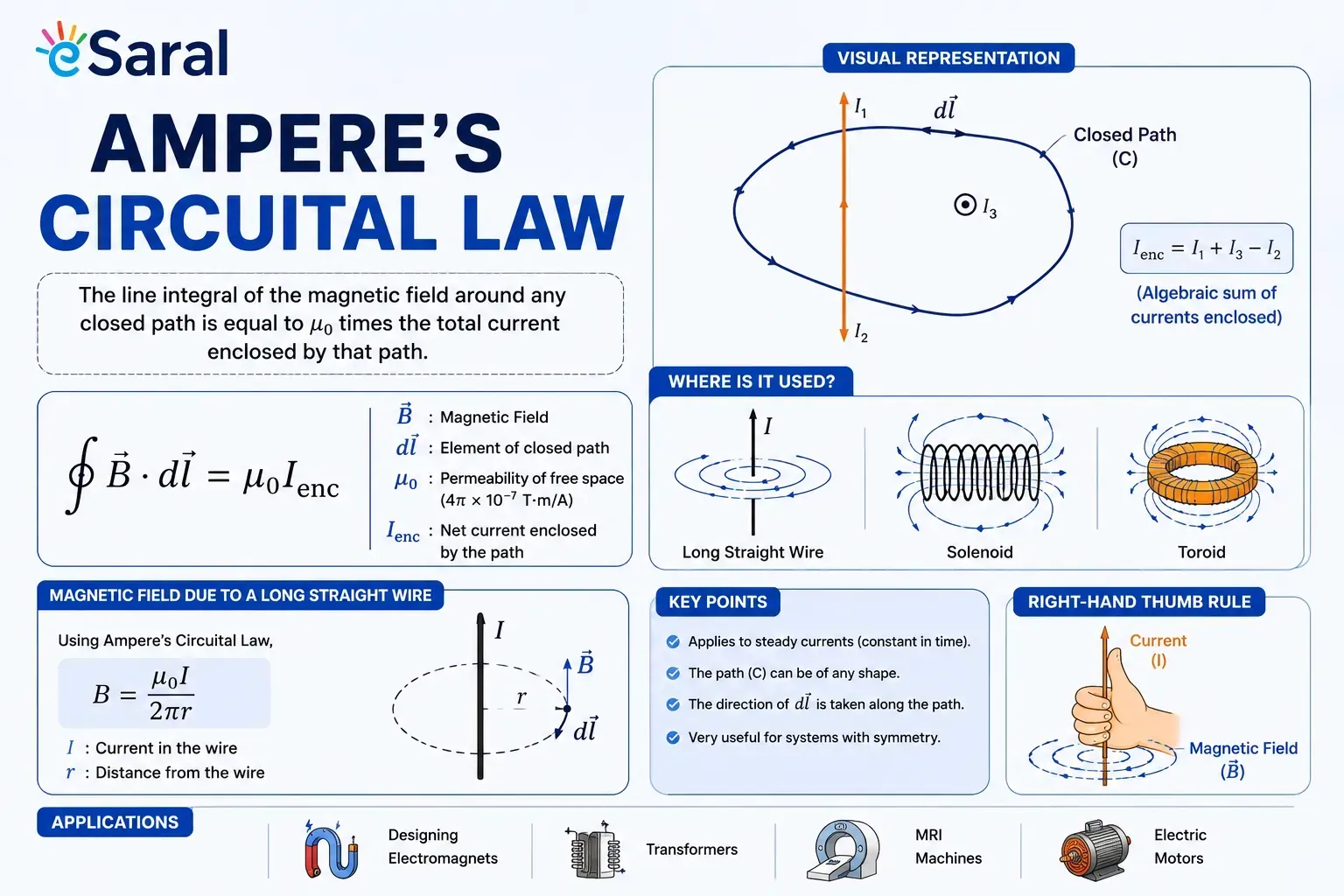
Ampere's law is the quick way to find a magnetic field when the current has a high symmetry. The Biot-Savart law can do the same job for any shape, but it needs an integration, so Biot-Savart and the magnetic effect of electric current are best read first. This page covers the main applications of amperes law that come in Class 12, JEE and NEET, with the derivations.
Ampere's Circuital Law: Statement and Formula
The line integral of the magnetic field $\vec{B}$ around any closed path (the Amperian loop) is equal to $\mu_0$ times the net current that passes through the surface bounded by the path:
$$\oint \vec{B}\cdot d\vec{\ell} = \mu_0 I_{enc}, \qquad \mu_0 = 4\pi\times 10^{-7}\ \text{T m/A}$$
- The law holds for steady currents, and the result does not depend on the size or the shape of the loop.
- The direction of the loop and the sign of the current follow the right-hand rule: if the fingers curl along the loop, the current in the direction of the thumb is positive.
- For currents that change with time, Maxwell added the displacement current: $\oint \vec{B}\cdot d\vec{\ell} = \mu_0\left(I + \varepsilon_0\dfrac{d\Phi_E}{dt}\right)$.
How to Apply Ampere's Law in 4 Steps
Use these steps in all the applications of amperes law.
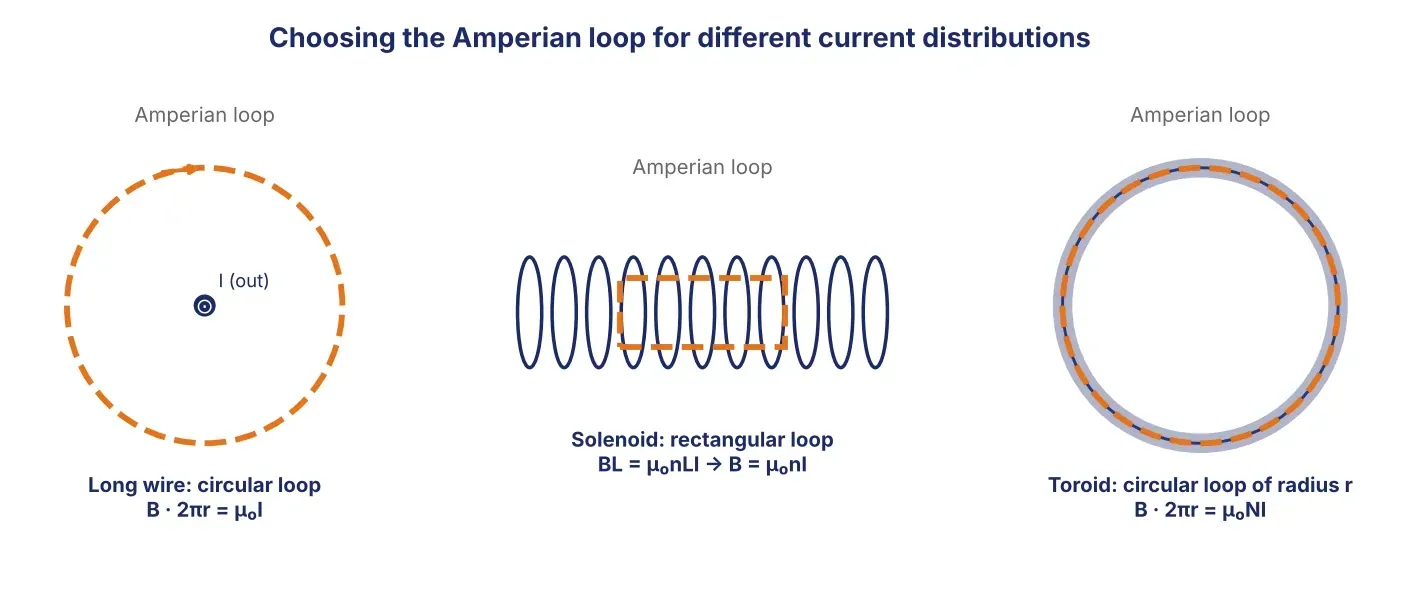
- Check the symmetry of the current distribution: a line, a cylinder, a plane or a ring.
- Choose an Amperian loop on which $B$ is constant in magnitude and parallel to $d\vec{\ell}$, or perpendicular to it, or zero.
- Find the current enclosed by the loop, $I_{enc}$.
- Write $\oint \vec{B}\cdot d\vec{\ell} = \mu_0 I_{enc}$ and solve for $B$.
Applications of Amperes Law: Summary of Results
This table lists the results of the applications of amperes law that are derived below.
Current distribution | Amperian loop | Magnetic field |
|---|---|---|
Long straight wire | Circle of radius $r$ | $B = \dfrac{\mu_0 I}{2\pi r}$ |
Solid cylinder, $r \geq R$ | Circle of radius $r$ | $B = \dfrac{\mu_0 I}{2\pi r}$ |
Solid cylinder, $r < R$ | Circle of radius $r$ | $B = \dfrac{\mu_0 I r}{2\pi R^2}$ |
Hollow cylinder, $r < r_1$ | Circle of radius $r$ | $B = 0$ |
Hollow cylinder, $r_1 < r < r_2$ | Circle of radius $r$ | $B = \dfrac{\mu_0 I (r^2 - r_1^2)}{2\pi r (r_2^2 - r_1^2)}$ |
Hollow cylinder, $r \geq r_2$ | Circle of radius $r$ | $B = \dfrac{\mu_0 I}{2\pi r}$ |
Long solenoid (inside) | Rectangle | $B = \mu_0 nI$ |
Toroid (inside the core) | Circle of radius $r$ | $B = \dfrac{\mu_0 NI}{2\pi r}$ |
Infinite current sheet | Rectangle | $B = \dfrac{\mu_0 K}{2}$ |
Applications of Amperes Law (a): Magnetic Field of a Long Straight Wire
A long straight wire carries a current $I$. By symmetry, the field lines are circles around the wire, and $B$ has the same magnitude at every point at a distance $r$.
Take a circular Amperian loop of radius $r$ around the wire. At every point, $\vec{B}$ is along the tangent, so $\vec{B}$ and $d\vec{\ell}$ are parallel:
$$\oint \vec{B}\cdot d\vec{\ell} = B\oint d\ell = B\,(2\pi r)$$
The enclosed current is $I$. So $B\,(2\pi r) = \mu_0 I$, and
$$B = \frac{\mu_0 I}{2\pi r}$$
Applications of Amperes Law (b): Magnetic Field of a Solid Cylinder
A long straight wire of radius $R$ carries a current $I$ that is uniformly distributed over its cross-section. Take a circular loop of radius $r$ with its centre on the axis of the wire.
Outside the wire ($r \geq R$): the loop encloses the whole current $I$, so
$$B = \frac{\mu_0 I}{2\pi r}$$
Inside the wire ($r < R$): the current per unit area is $\dfrac{I}{\pi R^2}$, so the current enclosed by the loop is
$$I' = \frac{I}{\pi R^2}\times \pi r^2 = \frac{Ir^2}{R^2}$$
Then $B\,(2\pi r) = \mu_0 \dfrac{Ir^2}{R^2}$, and
$$B = \frac{\mu_0 I r}{2\pi R^2}$$
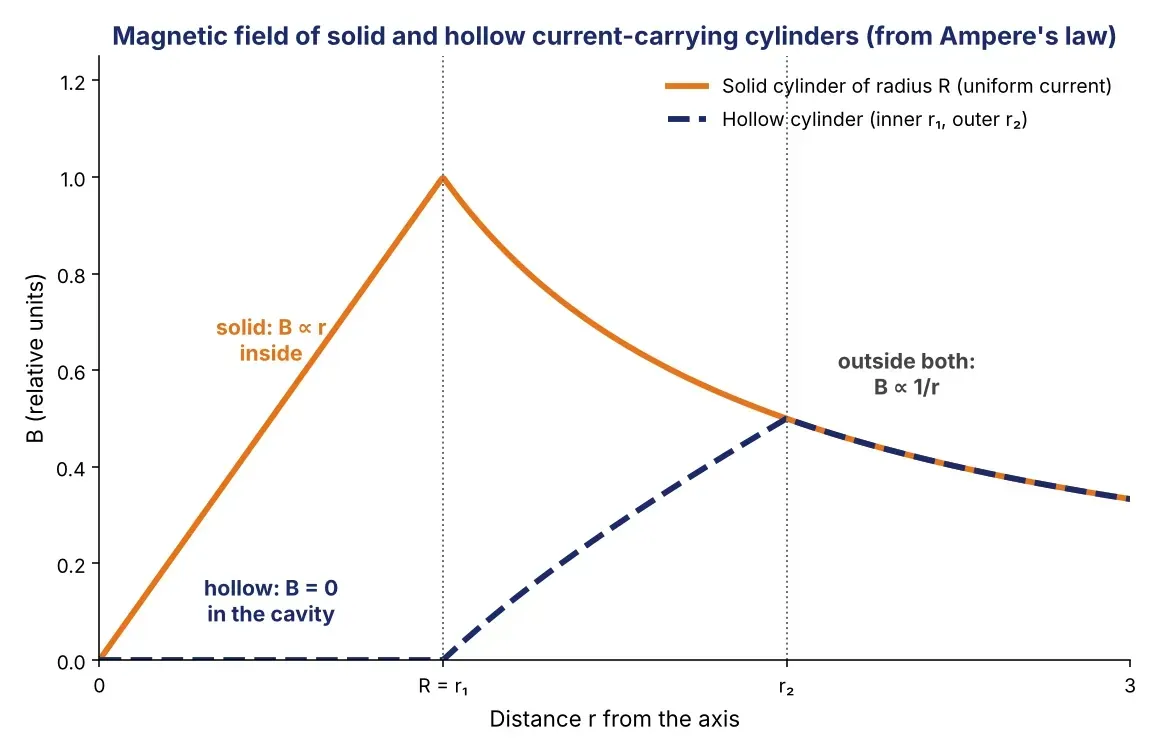
The field increases linearly with $r$ inside the wire, and $B \to 0$ at the axis. Both results give $B = \dfrac{\mu_0 I}{2\pi R}$ at $r = R$, so the field is continuous at the surface.
Applications of Amperes Law (c): Magnetic Field of a Hollow Cylinder
A hollow conducting cylinder has an inner radius $r_1$ and an outer radius $r_2$, and the current $I$ is uniformly distributed over the wall.
For $r < r_1$ (the cavity): the loop encloses no current, so $\sum I = 0$ and $B = 0$.
For $r_1 < r < r_2$ (inside the wall): the current per unit area is $\dfrac{I}{\pi (r_2^2 - r_1^2)}$, so the enclosed current is
$$I' = I\,\frac{r^2 - r_1^2}{r_2^2 - r_1^2}$$
Then $B\,(2\pi r) = \mu_0 I\,\dfrac{r^2 - r_1^2}{r_2^2 - r_1^2}$, and
$$B = \frac{\mu_0 I}{2\pi r}\left[\frac{r^2 - r_1^2}{r_2^2 - r_1^2}\right]$$
For $r \geq r_2$ (outside): the loop encloses the whole current, so $B = \dfrac{\mu_0 I}{2\pi r}$. At $r = r_2$ the two expressions give the same value.
For a thin hollow cylinder, $B = 0$ inside and $B = \dfrac{\mu_0 I}{2\pi r}$ outside.
Applications of Amperes Law (d): Magnetic Field of a Solenoid
A long solenoid has $n$ turns per unit length and carries a current $I$. Take a rectangular Amperian loop $abcd$ with the side $ab$ of length $L$ inside the solenoid, parallel to its axis, and the side $cd$ outside.
- Inside, $B$ is uniform and along the axis, so the line integral along $ab$ is $BL$.
- Outside, $B$ is almost zero, so the line integral along $cd$ is zero.
- On the sides $bc$ and $da$, $\vec{B}$ is perpendicular to the path (or zero), so these sides do not contribute.
The enclosed current is $nLI$, so $BL = \mu_0 nLI$, and
$$B = \mu_0 nI$$
At the end of a long solenoid, the field is half of this value, $\dfrac{\mu_0 nI}{2}$. The full derivation is on eSaral's magnetic field of a solenoid page.
Applications of Amperes Law (e): Magnetic Field of a Toroid
A toroid is a solenoid bent into a ring. It has $N$ turns, and the mean radius of the ring is $r$.
- Inside the core: take a circular loop of radius $r$ in the core. Then $B\,(2\pi r) = \mu_0 NI$, so
$$B = \frac{\mu_0 NI}{2\pi r} = \mu_0 nI \quad \left(n = \frac{N}{2\pi r}\right)$$
- Outside the toroid and in the hollow centre: a loop there encloses zero net current (the current enters and comes out equally), so $B = 0$.
Applications of Amperes Law (f): Magnetic Field of an Infinite Current Sheet
A large flat sheet carries a surface current density $K$ (current per unit width, perpendicular to the width). By symmetry, $B$ is parallel to the sheet and perpendicular to the current, with opposite directions on the two sides.
Take a rectangular loop of length $L$ that crosses the sheet, with two sides parallel to the sheet at equal distances. The two parallel sides give $BL + BL$, and the enclosed current is $KL$:
$$2BL = \mu_0 KL \;\Rightarrow\; B = \frac{\mu_0 K}{2}$$
The field is uniform, and it does not depend on the distance from the sheet.
Solved Examples on Applications of Amperes Law
These examples use the results of the applications of amperes law.
Example 1: Long straight wire
Find the magnetic field at a distance of 5 cm from a long straight wire that carries 10 A.
$$B = \frac{\mu_0 I}{2\pi r} = \frac{2\times 10^{-7}\times 10}{0.05} = 4\times 10^{-5}\ \text{T}$$
Example 2: Solid cylinder
A long solid cylinder of radius 2 cm carries a uniformly distributed current of 20 A. Find $B$ at $r = 1$ cm and at $r = 4$ cm.
At $r = 1$ cm (inside): $B = \dfrac{\mu_0 I r}{2\pi R^2} = \dfrac{2\times 10^{-7}\times 20\times 0.01}{(0.02)^2} = 1\times 10^{-4}$ T.
At $r = 4$ cm (outside): $B = \dfrac{\mu_0 I}{2\pi r} = \dfrac{2\times 10^{-7}\times 20}{0.04} = 1\times 10^{-4}$ T.
Example 3: Hollow cylinder
A hollow cylinder has $r_1 = 2$ cm and $r_2 = 4$ cm, and carries 30 A in its wall. Find $B$ at $r = 3$ cm.
$$B = \frac{\mu_0 I}{2\pi r}\cdot\frac{r^2 - r_1^2}{r_2^2 - r_1^2} = \frac{2\times 10^{-7}\times 30}{0.03}\times\frac{9 - 4}{16 - 4} = 2\times 10^{-4}\times\frac{5}{12} \approx 8.3\times 10^{-5}\ \text{T}$$
Example 4: Solenoid
A long solenoid has 2000 turns per metre and carries 2 A. Find $B$ inside.
$$B = \mu_0 nI = 4\pi\times 10^{-7}\times 2000\times 2 \approx 5.0\times 10^{-3}\ \text{T}$$
Example 5: Toroid
A toroid has 1000 turns, a mean radius of 10 cm and a current of 0.5 A. Find $B$ in the core.
$$B = \frac{\mu_0 NI}{2\pi r} = \frac{2\times 10^{-7}\times 1000\times 0.5}{0.10} = 1\times 10^{-3}\ \text{T}$$
Ampere's Law and the Biot-Savart Law
The applications of amperes law are limited to symmetric currents, and the Biot-Savart law has no such limit.
Biot-Savart law | Ampere's law | |
|---|---|---|
What it gives | The field of a current element at a point | A relation between $\oint \vec{B}\cdot d\vec{\ell}$ and the enclosed current |
Where it works | Any shape of the conductor | Easy to use only when the current has high symmetry |
Method | Integration over the current elements | Choice of an Amperian loop, and an algebraic step |
Link | Ampere's law for steady currents can be derived from it | Gives the same results as Biot-Savart in the symmetric cases |
Common Mistakes in Applications of Amperes Law
These mistakes cost marks in the applications of amperes law.
Mistake | Correct approach |
|---|---|
Using the total current instead of the enclosed current | Only the current that passes through the loop counts. Inside a solid cylinder, $I' = Ir^2/R^2$ |
Choosing a loop without symmetry | The loop must have $B$ constant and parallel to $d\vec{\ell}$ on it, or perpendicular, or zero |
Using the formula of the wall for a point in the cavity of a hollow cylinder | For $r < r_1$, $B = 0$ |
Writing the denominator of the wall formula as $r_1^2 - r_1^2$ | It is $r_2^2 - r_1^2$ |
Taking the wrong length in $n = N/L$ for a toroid | The length is the mean circumference, so $n = N/(2\pi r)$, where $r$ is the mean radius |
Using the solenoid formula for a short solenoid | $B = \mu_0 nI$ is for a long ideal solenoid, and at its end $B = \mu_0 nI/2$ |
Notes, Videos and Practice
For more applications of amperes law and the full chapter, see eSaral's Moving Charges and Magnetism notes, and the complete Class 12 Physics notes. You can watch the video tutorials of the magnetic effect of current on eSaral's YouTube channel. For practice, solve the important questions for Class 12 Physics Chapter 4. For free video lectures and study material, download the eSaral app.
Frequently Asked Questions
What are the applications of amperes law?
The main applications of amperes law are finding the magnetic field of a long straight wire, a solid cylinder carrying a uniform current, a hollow cylinder, a solenoid, a toroid and an infinite current sheet. In each case, a symmetric Amperian loop is chosen so that $B$ can be taken out of the integral.
What is Ampere's circuital law?
Ampere's circuital law states that the line integral of the magnetic field $\vec{B}$ around any closed path equals $\mu_0$ times the net current enclosed by the path: $\oint \vec{B}\cdot d\vec{\ell} = \mu_0 I_{enc}$, where $\mu_0 = 4\pi\times 10^{-7}\ \text{T m/A}$. It is valid for steady currents.
What is the difference between Ampere's law and the Biot-Savart law?
Both give the magnetic field of a steady current. The Biot-Savart law works for any shape of conductor, but it needs an integration over the current elements. Ampere's law is much simpler, but it can be used to find $B$ only when the current has a high symmetry, as in a long wire, a cylinder, a solenoid or a toroid. For a long straight wire, both give $B = \dfrac{\mu_0 I}{2\pi r}$.
How do you choose the Amperian loop?
In the applications of amperes law, choose a closed path so that, on each part of it, $B$ is either constant in magnitude and parallel to $d\vec{\ell}$, or perpendicular to $d\vec{\ell}$, or zero. It is a circle for a wire, a cylinder and a toroid, and a rectangle for a solenoid and a current sheet. Then find the current that passes through the loop, and solve for $B$.
How does the magnetic field vary inside a solid cylindrical conductor?
For a loop of radius $r < R$, the enclosed current is $I' = \dfrac{Ir^2}{R^2}$, so $B = \dfrac{\mu_0 I r}{2\pi R^2}$. The field increases linearly with $r$, is maximum at the surface, $B = \dfrac{\mu_0 I}{2\pi R}$, and then decreases as $1/r$ outside.
Why is the magnetic field zero inside a hollow cylindrical conductor?
A loop drawn in the cavity ($r < r_1$) encloses no current, so $\oint \vec{B}\cdot d\vec{\ell} = 0$. By symmetry, $B$ is the same at every point of the loop, so $B = 0$. In the wall, $B = \dfrac{\mu_0 I (r^2 - r_1^2)}{2\pi r (r_2^2 - r_1^2)}$, and outside, $B = \dfrac{\mu_0 I}{2\pi r}$.
What is the magnetic field inside a solenoid using Ampere's law?
Among the applications of amperes law, for a long ideal solenoid with $n$ turns per unit length carrying a current $I$, a rectangular Amperian loop gives $BL = \mu_0 nLI$, so $B = \mu_0 nI$ inside, which is uniform and along the axis. The field outside is almost zero, and at the end of the solenoid it is $\dfrac{\mu_0 nI}{2}$. eSaral has a separate page with the full derivation.
What is the magnetic field of a toroid, and why is it zero outside?
For a toroid with $N$ turns and mean radius $r$, a circular loop inside the core gives $B\cdot 2\pi r = \mu_0 NI$, so $B = \dfrac{\mu_0 NI}{2\pi r}$. Outside the toroid and in its hollow centre, a loop encloses zero net current (the current goes in and comes out equally), so $B = 0$.
What is the magnetic field due to an infinite current sheet?
For a sheet with a surface current density $K$ (current per unit width), a rectangular loop crossing the sheet gives $2BL = \mu_0 KL$, so $B = \dfrac{\mu_0 K}{2}$. The field is uniform, parallel to the sheet and perpendicular to the current, and it has opposite directions on the two sides.
Is Ampere's law in the JEE Main and JEE Advanced syllabus?
Yes. The JEE Main and JEE Advanced syllabus lists the Biot-Savart law and Ampere's law, with the field of a straight wire and a solenoid. Ampere's law is a section of the NCERT Class 12 chapter Moving Charges and Magnetism (Chapter 4), and it is not a separate chapter. Check the latest official syllabus for the exact topics. eSaral's chapter notes cover the topic for boards, JEE and NEET.
What is the Ampere-Maxwell law?
Maxwell added the displacement current to Ampere's law, so that it also holds when the electric field changes with time: $\oint \vec{B}\cdot d\vec{\ell} = \mu_0\left(I + \varepsilon_0\dfrac{d\Phi_E}{dt}\right)$. For steady currents, the second term is zero, and it reduces to Ampere's circuital law.
Where can I find notes and questions on the applications of amperes law?
eSaral has the Moving Charges and Magnetism notes for Class 12, the solenoid derivation page, the video playlist on the magnetic effect of current, and the important questions for Class 12 Physics Chapter 4. All of them are linked on this page.
Team eSaral
eSaral Academic and Editorial Team
Team eSaral is the collective author profile for educational content created by eSaral’s teachers and academic contributors. The team draws on expertise from IIT graduates, doctors, experienced educators and subject specialists to develop resources for JEE, NEET and school students. Our articles aim to explain concepts clearly and help students study with confidence.
Related Posts

BITSAT 2027: Registration Date, Exam Date, Syllabus, Eligibility, Pattern & Fees
BITSAT 2027 exam dates, registration timeline, eligibility criteria, exam pattern, marking scheme, syllabus and fees in one page.

BITSAT Previous Year Question Paper PDF (2017-2026)
Download BITSAT previous year question papers PDF from 2017 to 2026,session-wise. Memory-based papers,exam pattern, paper analysis and how to practise

CBSE Class 10 Date Sheet 2027: Expected Exam Dates, Release Date, Admit Card & Result Timeline
CBSE Class 10 date sheet 2027 is awaited. See the expected exam dates, release window, how to download the PDF, admit card and result timelines.

NCERT Physics Class 10 Book PDF in Hindi 2026-27 – भौतिक विज्ञान के 4 अध्याय (Free Download)
NCERT Physics Class 10 book PDF in Hindi 2026-27: download all 4 chapters (अध्याय 9–12) free, with topics and important formulas.

NCERT Biology Class 9 Book Anveshan PDF in Hindi - जीव विज्ञान कक्षा 9 पुस्तक अन्वेषण PDF
Download NCERT Biology Class 9 book PDF in Hindi chapterwise for 2026-27: Cell, Tissues, Reproduction and Diversity. Free PDFs.

Essay On Artificial Intelligence in English (100,150, 200, 250, 300, 500 Words)
This is in contrast to the natural intelligence of humans. With Artificial Intelligence, machines can perform

Essay on 78th India Independence Day in English for Student (100, 150, 200, 250, 300, 500 Words)
Read the best essays on India's Independence Day in English. Short & long essays (100, 150, 200, 250, 300, 500 words) perfect for school exams
NCERT Class 11 English Snapshots book - Free PDF download- Esaral
Download NCERT Class 11 English Snapshots book PDF for free. Get all 8 chapters, chapter-wise. Start your prep today!
NCERT Class 10 biology book pdf - Free PDF Download - eSaral
NCERT Class 10 Biology book PDF 2026-27: all 5 chapters (Life Processes to Our Environment) in English & Hindi, with CBSE syllabus, marks & practical

Essay on Global Warming in English (100,150, 200, 250, 300, 500 Words)
Global warming means the Earth is getting hotter. This happens because of things like pollution from cars and factories.