
Magnetic Field of a Solenoid || Class 12 Physics Notes

eSaral Academic and Editorial Team
Summary
<p><strong>Magnetic Field of a Solenoid:</strong> A current-carrying solenoid produces a uniform magnetic field inside it, with field strength given by <em>B = μ₀nI</em> at the center of a long solenoid and <em>B = (μ₀nI)/2</em> at its ends; the field is parallel to the axis and its direction is determined by the right-hand thumb rule.</p>
eSaral › Class 12 ›Magnetic Field of a Solenoid

🚀 Checkout eSaral Courses
Magnetic Field of a Solenoid
A solenoid is a long cylindrical helix. It is made by winding closely a large number of turns of insulated copper wire over a tube of cardboard or china-clay. When an electric current is passed through the solenoid, a magnetic field is produced around and within the solenoid.
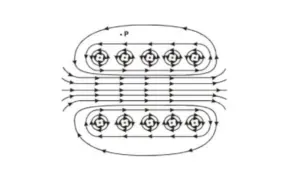
The figure shows the lines of force of the magnetic field due to a solenoid. The lines of force inside the solenoid are nearly parallel which indicates that the magnetic field 'within' the solenoid is uniform and parallel to the axis of the solenoid.
Magnetic Field of a Solenoid Derivation
Let there be a long solenoid of radius 'a' and carrying a current I. Let n be the number of turns per unit length of the solenoid. Let $P$ be a point on the axis of the solenoid.
Let us imagine the solenoid to be divided up into a number of narrow coils and consider one such coil AB of width $\delta x$. The number of turns in this coil is n\deltax. Let $x$ be the distance of the point $P$ from the centre $\mathrm{C}$ of this coil. The magnetic field at $\mathrm{P}$ due to this elementary coil is given by
Let average distance of circumference is r and $\delta \theta$ the angle subtended by the coil at P.
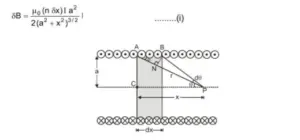
$$ \sin \theta=\frac{\mathrm{BN}}{\mathrm{AB}}=\frac{\mathrm{r} \delta \theta}{\delta \mathrm{x}} \quad \text { or } \quad \delta \mathrm{x}=\frac{\mathrm{r} \delta \theta}{\sin \theta} $$
In $\Delta \mathrm{ACP},$ we have $\quad \mathrm{a}^{2}+\mathrm{x}^{2}=\mathrm{r}^{2}$
$$ r^{3}=\left(a^{2}+x^{2}\right)^{3 / 2} $$
Substiuting these values of $\delta x$ and $\left(a^{2}+x^{2}\right)^{3 / 2}$ in eq. (i), we get
$$ \delta \mathrm{B}=\frac{\mu_{0}(\mathrm{nr} \delta \theta) \mathrm{I} \mathrm{a}^{2}}{2 \mathrm{r}^{3} \sin \theta}=\frac{\mu_{0} \mathrm{nI} \mathrm{a}^{2}}{2 \mathrm{r}^{2}} \frac{\delta \theta}{\sin \theta} $$

The magnetic field $\mathrm{B}$ at $\mathrm{P}$ due to the whole solenoid can be obtained by integrating the above expression between the limits $\theta_{1}$ and $\theta_{2},$ where $\theta_{1}$ and $\theta_{2}$ are the semi-vertical angles subtended at $P$ by the first and the last turn of the solenoid respectively. Thus
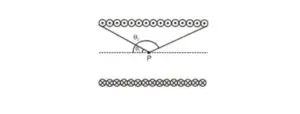

or $\quad \mathrm{B}=\frac{1}{2} \mu_{0} \mathrm{n} \mathrm{I}\left(\cos \theta_{1}-\cos \theta_{2}\right)$ ..........(ii)
If the observation point P is well inside a very long solenoid
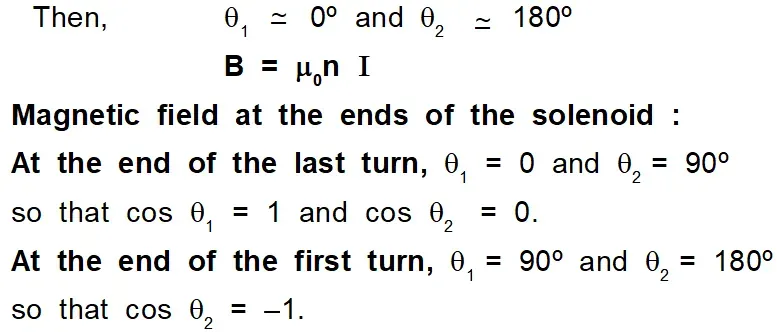
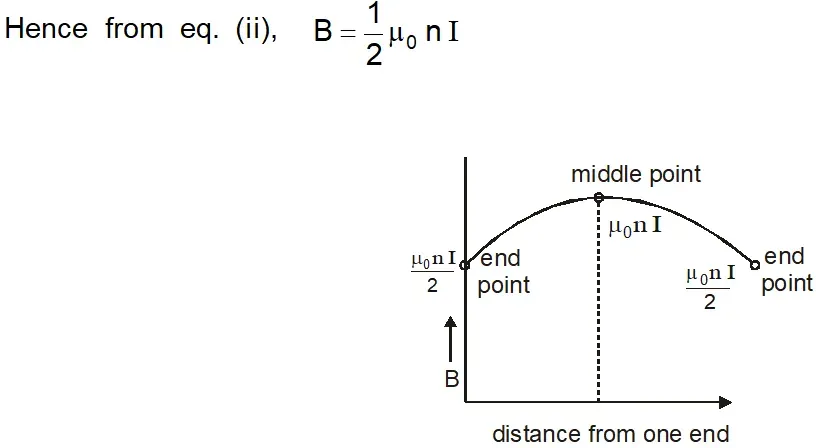
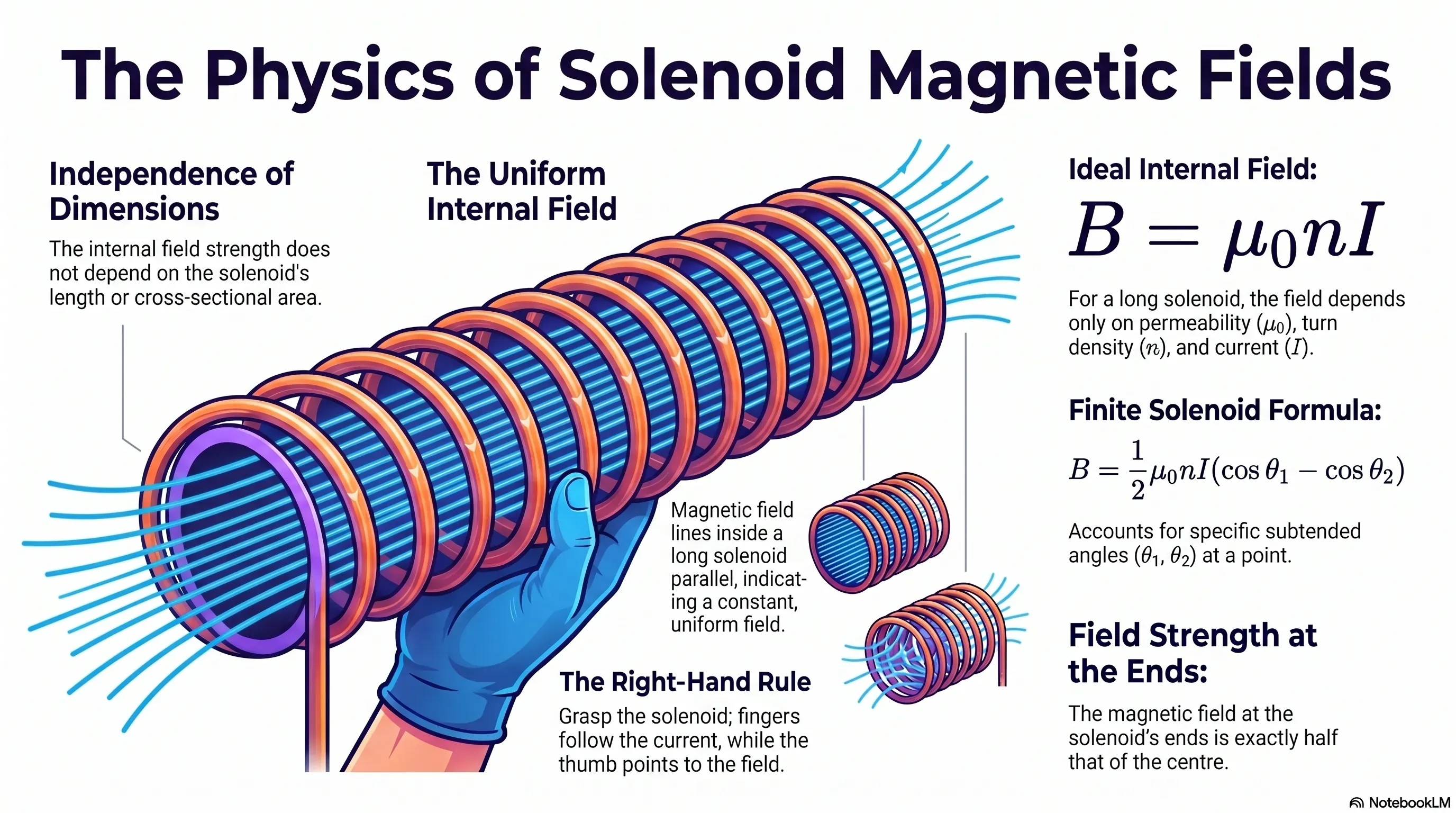
Thus, the magnetic field at the ends of a 'long' solenoid is half of that at the center. If the solenoid is sufficiently long, the field within it (except near the ends) in uniform. It does not depend upon the length and area of the cross-section of the solenoid. Just as a parallel-plate capacitor produces a uniform and known electric field, a solenoid produces a uniform and known magnetic field.
The 'uniform' magnetic field within a long solenoid is parallel to the solenoid axis.
Its direction along the axis is given by a curled-straight right-hand rule. "If we grasp the solenoid with our right hand so that our fingers follow the direction of the current in the winding's, then out extended right thumb will point in the direction of the axial magnetic field".
Click here for the Video tutorials of Magnetic Effect of Current Class 12
For free video lectures and complete study material, Download eSaral APP.
Frequently Asked Questions
What is the magnetic field inside a solenoid?
The magnetic field inside a long solenoid is B = μ₀nI, where μ₀ = 4π × 10⁻⁷ T·m/A is the permeability of free space, n is the number of turns per unit length (turns/metre), and I is the current in amperes. This field is uniform and directed along the axis of the solenoid, independent of its radius or total length.
What is the magnetic field at the end of a solenoid?
At the open end of a long solenoid, the magnetic field is B = μ₀nI / 2 — exactly half the value at the centre. This result follows directly from integrating the elementary coil contributions with limits θ₁ = 0° and θ₂ = 90°. It is a standard result asked in both CBSE board exams and JEE Main.
How is the solenoid derivation done using Ampere's Law?
Using Ampere's circuital law (∮ B·dl = μ₀ I_enclosed), a rectangular Amperian loop is drawn with one side inside the solenoid along the axis and three sides outside. The contribution outside is zero. The inside segment of length L encloses nL turns, each carrying current I. This gives B·L = μ₀·nL·I, so B = μ₀nI — the same result as the integration method.
Does the radius of a solenoid affect its magnetic field?
No. The magnetic field inside a solenoid B = μ₀nI does not depend on the radius or cross-sectional area of the solenoid. Only the number of turns per unit length (n) and the current (I) determine the interior field strength. This is a common trap in JEE Main multiple-choice questions.
What is the SI unit of the magnetic field, and what are the typical values for a solenoid?
The SI unit of magnetic field B is the Tesla (T). A typical laboratory solenoid with n = 1000 turns/m and I = 2 A produces B = μ₀ × 1000 × 2 ≈ 2.51 × 10⁻³ T (about 25 Gauss). Superconducting solenoids in MRI machines can reach 1.5 T to 7 T.
Team eSaral
eSaral Academic and Editorial Team
Team eSaral is the collective author profile for educational content created by eSaral’s teachers and academic contributors. The team draws on expertise from IIT graduates, doctors, experienced educators and subject specialists to develop resources for JEE, NEET and school students. Our articles aim to explain concepts clearly and help students study with confidence.
Related Posts

Plant Cell Diagram: Labelled Structure, Parts and Functions
Simple, labelled plant cell diagram with parts and functions. Covers plant cell structure for Class 6, 7, 8, 9, 10 and 11 students, CBSE-aligned.

Saransh Gupta Sir's Visit to IIT Patna: Hostel Life, Placements & Lessons for JEE Aspirants
Inside Saransh Gupta Sir's IIT Patna visit — hostel life, the library, placements, internships, and real advice for JEE aspirants from students living the IIT dream.
Molality Formula: Formula for Molality, Derivation & Solved Examples
Molality formula is $m = \dfrac{n}{W}$. Learn the formula of molality, its SI unit, derivation, relation with molarity, and solved examples for Class 11, JEE and NEET.
BITSAT Previous Year Question Paper PDF
Download BITSAT previous year question papers PDF. Get year-wise BITSAT PYQs, memory-based papers, exam pattern, and preparation tips to improve your BITSAT preparation.

Teachers’ Day 2026 at eSaral Gurukul: Celebrating the Bond Between Students, Teachers & Mentors
See how Teachers’ Day 2026 was celebrated at eSaral Gurukul, reflecting the bond among students, teachers, and mentors, and the role of guidance beyond academics.

JEE Advanced Attempts: Can You Give It a Third Time? Rules Explained
JEE Advanced attempts: current rule is 2 consecutive years only: full eligibility criteria, the 2025 third-attempt controversy, and the latest 2026 petition news.

Best JEE Preparation App
Best JEE preparation app for Main & Advanced: AI mock tests, live doubt-solving, thousands of practice questions. JEE preparation app for droppers & Class 11-12.
Coordinate Geometry Class 10: Formulas, Notes & Solved Examples
Coordinate geometry class 10: complete CBSE formulas — distance, section, midpoint and area of triangle — with derivation, notes and solved examples.
How to make Notes For JEE Smart Notes Strategy of an AIR 41
Learn how to make notes for JEE the way toppers do — indexing, shorthand, and smart short notes for JEE that cut revision time to just 5–7 days.
SL Arora Physics Class 12 Index – Chapter List for Volume 1 & 2
SL Arora Physics Class 12 index — complete chapter list for Volume 1 & 2, mapped to NCERT solutions for board, JEE Main, and NEET preparation.