
Molality Formula: Formula for Molality, Derivation & Solved Examples
eSaral › Class 11 Chemistry › Molality Formula

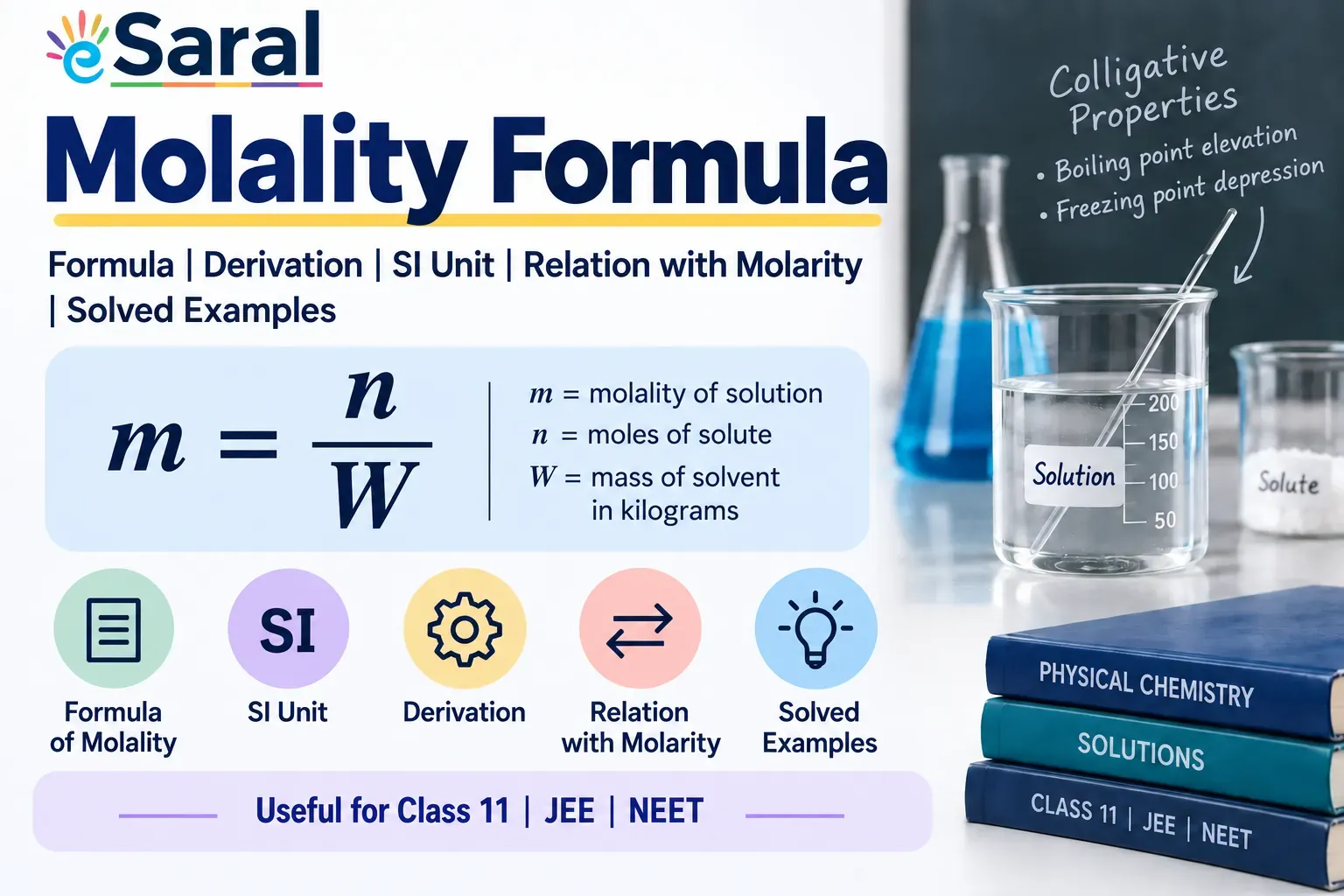
The molality formula is $m = \dfrac{n}{W}$, where $m$ is the molality of the solution, $n$ is the number of moles of solute, and $W$ is the mass of the solvent in kilograms, expressed in $\mathrm{mol,kg^{-1}}$ or molal (m). It tells us the amount of solute present per kilogram of solvent, and unlike molarity, it does not change with temperature — a property that makes it one of the most important concentration formulas in Class 11 and Class 12 Chemistry, especially for colligative property numericals like boiling point elevation and freezing point depression in JEE and NEET.
What Is Molality?
$m = \dfrac{\text{Moles of solute}}{\text{Mass of solvent in kilograms}}$
Therefore,
$m = \dfrac{n}{W}$
Where:
Quantity | Symbol | Meaning |
|---|---|---|
Molality | $m$ | Concentration of the solution |
Number of moles | $n$ | Moles of solute present |
Mass of solvent | $W$ | Mass of solvent in kilograms |
Important Points About Molality
- Molality depends on the mass of the solvent, not the mass or volume of the solution.
- The mass used must be the mass of the solvent alone, not the total solution.
- If the mass of solvent is given in grams, it must be converted to kilograms before applying $m = \dfrac{n}{W}$.
- Molality is temperature-independent because mass does not change with temperature, unlike volume.
- Molality is commonly used in colligative property calculations, cryoscopy, and ebullioscopy.
For a deeper grounding in moles before working through these formulas, see the Mole Concept notes for Class 11, IIT JEE & NEET.
What Is the Formula of Molality?
The formula of molality is:
$m = \dfrac{n}{W}$
Here:
- $m$ = molality of solution in $\mathrm{mol,kg^{-1}}$
- $n$ = number of moles of solute
- $W$ = mass of solvent in kilograms
If the number of moles is not given directly, it can be calculated using:
$n = \dfrac{w}{M_{\mathrm{molar}}}$
where:
- $w$ = mass of solute in grams
- $M_{\mathrm{molar}}$ = molar mass of solute in $\mathrm{g,mol^{-1}}$
Substituting this value in the molality formula:
$m = \dfrac{w}{M_{\mathrm{molar}} \times W}$
where $W$ is in kilograms.
Molality Formula When Mass of Solute Is Given
When the mass of the solute is given in grams and the mass of the solvent is given in grams as well, the commonly used formula for molality is:
$m = \dfrac{w}{M_{\mathrm{molar}}} \times \dfrac{1000}{W_{\mathrm{g}}}$
Where:
- $w$ = mass of solute in grams
- $M_{\mathrm{molar}}$ = molar mass of solute in $\mathrm{g,mol^{-1}}$
- $W_{\mathrm{g}}$ = mass of solvent in grams
Example: Molality Using Mass of Solute
Suppose $10\ \mathrm{g}$ of $\ce{NaOH}$ is dissolved in $500\ \mathrm{g}$ of water.
Molar mass of $\ce{NaOH}$:
$M_{\mathrm{molar}} = 40\ \mathrm{g,mol^{-1}}$
Therefore,
$m = \dfrac{10}{40} \times \dfrac{1000}{500}$
$m = 0.25 \times 2 = 0.5\ \mathrm{m}$
Hence, the molality of the $\ce{NaOH}$ solution is:
$\boxed{0.5\ \mathrm{m}}$
SI Unit and Symbol of Molality
The unit of molality is $\mathrm{mol,kg^{-1}}$.
Quantity | Details |
|---|---|
Symbol of molality | $m$ |
Common unit | $\mathrm{mol,kg^{-1}}$ |
Common notation | $\mathrm{1\ m}$, $\mathrm{0.5\ m}$, etc. |
SI base-unit expression | $\mathrm{mol,kg^{-1}}$ (already SI) |
Formula | $m = \dfrac{n}{W}$ |
Temperature dependence | No |
Note: Molality is one of the few concentration terms whose unit, $\mathrm{mol,kg^{-1}}$, is already expressed directly in SI base units — this is why it's preferred for precise, temperature-sensitive experimental work.
Derivation of Molality Formula
The definition of molality is:
$m = \dfrac{\text{Number of moles of solute}}{\text{Mass of solvent in kilograms}}$
The number of moles of solute is:
$n = \dfrac{w}{M_{\mathrm{molar}}}$
Substituting this into the molality equation:
$m = \dfrac{w}{M_{\mathrm{molar}} \times W}$
where $W$ is in kilograms.
If the mass of solvent is given in grams:
$W(\mathrm{kg}) = \dfrac{W_{\mathrm{g}}}{1000}$
Therefore,
$m = \dfrac{w}{M_{\mathrm{molar}} \times \left(\dfrac{W_{\mathrm{g}}}{1000}\right)}$
Hence,
$\boxed{m = \dfrac{w}{M_{\mathrm{molar}}} \times \dfrac{1000}{W_{\mathrm{g}}}}$
This is the most commonly used expanded molality formula in numerical problems.
Molality vs Molarity vs Mole Fraction
Molarity, molality, and mole fraction are different ways of expressing the concentration or composition of a solution.
Term | Formula | Depends On | Temperature Dependence |
|---|---|---|---|
Molarity ($M$) | $M = \dfrac{n_{\mathrm{solute}}}{V_{\mathrm{solution}}}$ | Volume of solution | Yes |
Molality ($m$) | $m = \dfrac{n_{\mathrm{solute}}}{W_{\mathrm{solvent}}\ (\mathrm{kg})}$ | Mass of solvent | No |
Mole fraction ($x$) | $x_i = \dfrac{n_i}{n_{\mathrm{total}}}$ | Moles of all components | No |
Molarity numericals follow the same solutions framework — see the complete Molarity Formula guide for the volume-based approach and dilution equation.
Key Difference Between Molality and Molarity
The main difference is that molality uses the mass of solvent, whereas molarity uses the volume of solution.
Since mass does not change appreciably with temperature, molality stays constant when temperature changes. Volume, on the other hand, expands on heating, so molarity decreases as temperature rises. This is exactly why colligative property laws — $\Delta T_b = K_b \times m$ and $\Delta T_f = K_f \times m$ — are defined using molality rather than molarity.
Relation Between Molarity and Molality
If the molarity ($M$), density of solution ($d$, in $\mathrm{g,mL^{-1}}$), and molar mass of solute ($M_{\mathrm{molar}}$) are known, molality can be calculated as:
$\boxed{m = \dfrac{1000M}{1000d - M \times M_{\mathrm{molar}}}}$
This relation is frequently asked in JEE Main and JEE Advanced, especially in problems where density is given instead of the mass of solvent directly.
Solved Examples on Molality Formula
Example 1: Molality From Number of Moles
Calculate the molality of a solution containing $0.5$ moles of $\ce{NaOH}$ dissolved in $2\ \mathrm{kg}$ of water.
Using the molality formula:
$m = \dfrac{n}{W}$
Substituting the given values:
$m = \dfrac{0.5}{2}$
$m = 0.25\ \mathrm{m}$
$\boxed{m = 0.25\ \mathrm{m}}$
Example 2: Molality From Mass of Solute
Find the molality of a solution prepared by dissolving $2.5\ \mathrm{g}$ of acetic acid ($\ce{CH3COOH}$) in $75\ \mathrm{g}$ of benzene.
Given: $w = 2.5\ \mathrm{g}$, $M_{\mathrm{molar}} = 60\ \mathrm{g,mol^{-1}}$, $W_{\mathrm{g}} = 75\ \mathrm{g}$
Using:
$m = \dfrac{w}{M_{\mathrm{molar}}} \times \dfrac{1000}{W_{\mathrm{g}}}$
Therefore,
$m = \dfrac{2.5}{60} \times \dfrac{1000}{75}$
$m = 0.0417 \times 13.33$
$m \approx 0.556\ \mathrm{m}$
$\boxed{m \approx 0.556\ \mathrm{m}}$
Example 3: Molality of Sugar Solution
What is the molality of a solution containing $34.2\ \mathrm{g}$ of sugar $\ce{C12H22O11}$ dissolved in $500\ \mathrm{g}$ of water?
Given: $w = 34.2\ \mathrm{g}$, $M_{\mathrm{molar}} = 342\ \mathrm{g,mol^{-1}}$, $W_{\mathrm{g}} = 500\ \mathrm{g}$
Using:
$m = \dfrac{w}{M_{\mathrm{molar}}} \times \dfrac{1000}{W_{\mathrm{g}}}$
Therefore,
$m = \dfrac{34.2}{342} \times \dfrac{1000}{500}$
$m = 0.1 \times 2$
$m = 0.2\ \mathrm{m}$
$\boxed{m = 0.2\ \mathrm{m}}$
Example 4: Molality From Molarity and Density
A solution has a molarity of $2\ \mathrm{M}$, density $1.2\ \mathrm{g,mL^{-1}}$, and the solute is $\ce{NaCl}$ ($M_{\mathrm{molar}} = 58.5\ \mathrm{g,mol^{-1}}$). Find the molality.
Given: $M = 2\ \mathrm{M}$, $d = 1.2\ \mathrm{g,mL^{-1}}$, $M_{\mathrm{molar}} = 58.5\ \mathrm{g,mol^{-1}}$
Using:
$m = \dfrac{1000M}{1000d - M \times M_{\mathrm{molar}}}$
Therefore,
$m = \dfrac{1000 \times 2}{1000 \times 1.2 - 2 \times 58.5}$
$m = \dfrac{2000}{1200 - 117}$
$m = \dfrac{2000}{1083}$
$m \approx 1.85\ \mathrm{mol,kg^{-1}}$
$\boxed{m \approx 1.85\ \mathrm{m}}$
Example 5: Mass of Solvent Required for a Given Molality
Calculate the mass of water required to dissolve $9\ \mathrm{g}$ of glucose ($M_{\mathrm{molar}} = 180\ \mathrm{g,mol^{-1}}$) to prepare a $0.25\ \mathrm{m}$ solution.
Given: $w = 9\ \mathrm{g}$, $M_{\mathrm{molar}} = 180\ \mathrm{g,mol^{-1}}$, $m = 0.25\ \mathrm{m}$
Using:
$m = \dfrac{w}{M_{\mathrm{molar}}} \times \dfrac{1000}{W_{\mathrm{g}}}$
Rearranging:
$W_{\mathrm{g}} = \dfrac{w \times 1000}{M_{\mathrm{molar}} \times m}$
Substituting the values:
$W_{\mathrm{g}} = \dfrac{9 \times 1000}{180 \times 0.25}$
$W_{\mathrm{g}} = \dfrac{9000}{45}$
$W_{\mathrm{g}} = 200\ \mathrm{g}$
$\boxed{W_{\mathrm{g}} = 200\ \mathrm{g}}$
Once these solved patterns feel familiar, test your speed with eSaral's JEE Test Series, which includes dedicated Mole Concept and Solutions mock sections.
Important Formulas Related to Molality
Concept | Formula |
|---|---|
Basic molality | $m = \dfrac{n}{W}$ |
Moles from mass | $n = \dfrac{w}{M_{\mathrm{molar}}}$ |
Molality using mass and mass of solvent in kg | $m = \dfrac{w}{M_{\mathrm{molar}} \times W}$ |
Molality using mass and mass of solvent in g | $m = \dfrac{w}{M_{\mathrm{molar}}} \times \dfrac{1000}{W_{\mathrm{g}}}$ |
Relation with molarity | $m = \dfrac{1000M}{1000d - M \times M_{\mathrm{molar}}}$ |
Molarity | $M = \dfrac{n}{V}$ |
Mole fraction | $x_i = \dfrac{n_i}{n_{\mathrm{total}}}$ |
Boiling point elevation | $\Delta T_b = K_b \times m$ |
Freezing point depression | $\Delta T_f = K_f \times m$ |
Quick Revision: Molality Formula
The most important formula to remember is:
$\boxed{m = \dfrac{n}{W}}$
If mass is given:
$\boxed{m = \dfrac{w}{M_{\mathrm{molar}}} \times \dfrac{1000}{W_{\mathrm{g}}}}$
For conversion from molarity:
$\boxed{m = \dfrac{1000M}{1000d - M \times M_{\mathrm{molar}}}}$
Molality Formula at a Glance
Given Information | Formula to Use |
|---|---|
Moles and mass of solvent in kg | $m = \dfrac{n}{W}$ |
Mass of solute and mass of solvent in kg | $m = \dfrac{w}{M_{\mathrm{molar}} \times W}$ |
Mass of solute and mass of solvent in g | $m = \dfrac{w}{M_{\mathrm{molar}}} \times \dfrac{1000}{W_{\mathrm{g}}}$ |
Molarity, density, and molar mass known | $m = \dfrac{1000M}{1000d - M \times M_{\mathrm{molar}}}$ |
This same set of formulas is equally important for NEET — practice their application with NEET Chapterwise PYQ, where colligative property numericals appear regularly.
Continue Your Mole Concept & Solutions Preparation
- Compare with the Molarity Formula guide to master the volume-based vs mass-based approach.
- Revise quickly with Mole Concept short notes before your exam.
- Practise more questions with solved numericals on Mole Concept, including molality-based problems.
- Attempt Mole Concept NEET previous year questions to understand how concentration concepts are tested.
- Cross-check your preparation with the NCERT Solutions for Class 11 Chemistry.
Want structured practice on every concentration formula, not just this one? Explore eSaral's JEE Course or NEET Course, both built around exactly these numerical patterns.
Frequently Asked Questions
What is the Molality Formula?
The Molality Formula is $m = \dfrac{n}{W}$, where $m$ is the molality, $n$ is the number of moles of solute, and $W$ is the mass of the solvent in kilograms.
Why doesn't molality change with temperature?
Molality doesn't change with temperature because it depends on the mass of the solvent, and mass doesn't expand or contract with heat, unlike volume, which molarity depends on. This is why the Molality Formula is preferred for colligative property calculations such as boiling point elevation and freezing point depression.
What is the SI unit of molality?
The SI-accepted unit of molality is $\mathrm{mol,kg^{-1}}$, commonly called molal and denoted by the symbol $m$. Unlike molarity's unit $\mathrm{mol,L^{-1}}$, $\mathrm{mol,kg^{-1}}$ is already expressed in SI units.
What is the difference between molality and molarity?
The Molality Formula $m = \dfrac{n}{W}$ uses the mass of the solvent in kilograms and stays constant regardless of temperature, while the Molarity Formula $M = \dfrac{n}{V}$ uses the volume of the solution in litres and changes with temperature because volume expands or contracts with heat.
How do you convert molarity to molality?
Molarity can be converted to molality using the formula $m = \dfrac{1000M}{1000d - M M_0}$, where $M$ is the molarity, $d$ is the density of the solution in $\mathrm{g,mL^{-1}}$, and $M_0$ is the molar mass of the solute. This is a common application of the Molality Formula in JEE Main and JEE Advanced when density is given instead of the solvent's mass.
What does a "1 molal" solution mean?
A 1 molal (1 m) solution contains exactly 1 mole of solute dissolved in 1 kilogram of solvent. For example, dissolving 40 g of NaOH, which is 1 mole, in exactly 1 kg of water gives a 1 molal NaOH solution.
Which chapter is molality from?
The Molality Formula is introduced in Class 11 Chemistry, Chapter 1, Some Basic Concepts of Chemistry, under the topic of methods of expressing concentration, and is reused in Class 12 Chemistry, Chapter 2, Solutions, for colligative property numericals.
Is molality used in JEE and NEET?
Yes, the Molality Formula is a frequently tested concept in both JEE and NEET, especially in numericals involving colligative properties such as boiling point elevation and freezing point depression.