
Molarity Formula – Formula for Molarity, Derivation & Examples
eSaral › Class 11 Chemistry › Chemical Formula of Ammonia

Molarity Formula: Formula for Molarity, Derivation & Solved Examples
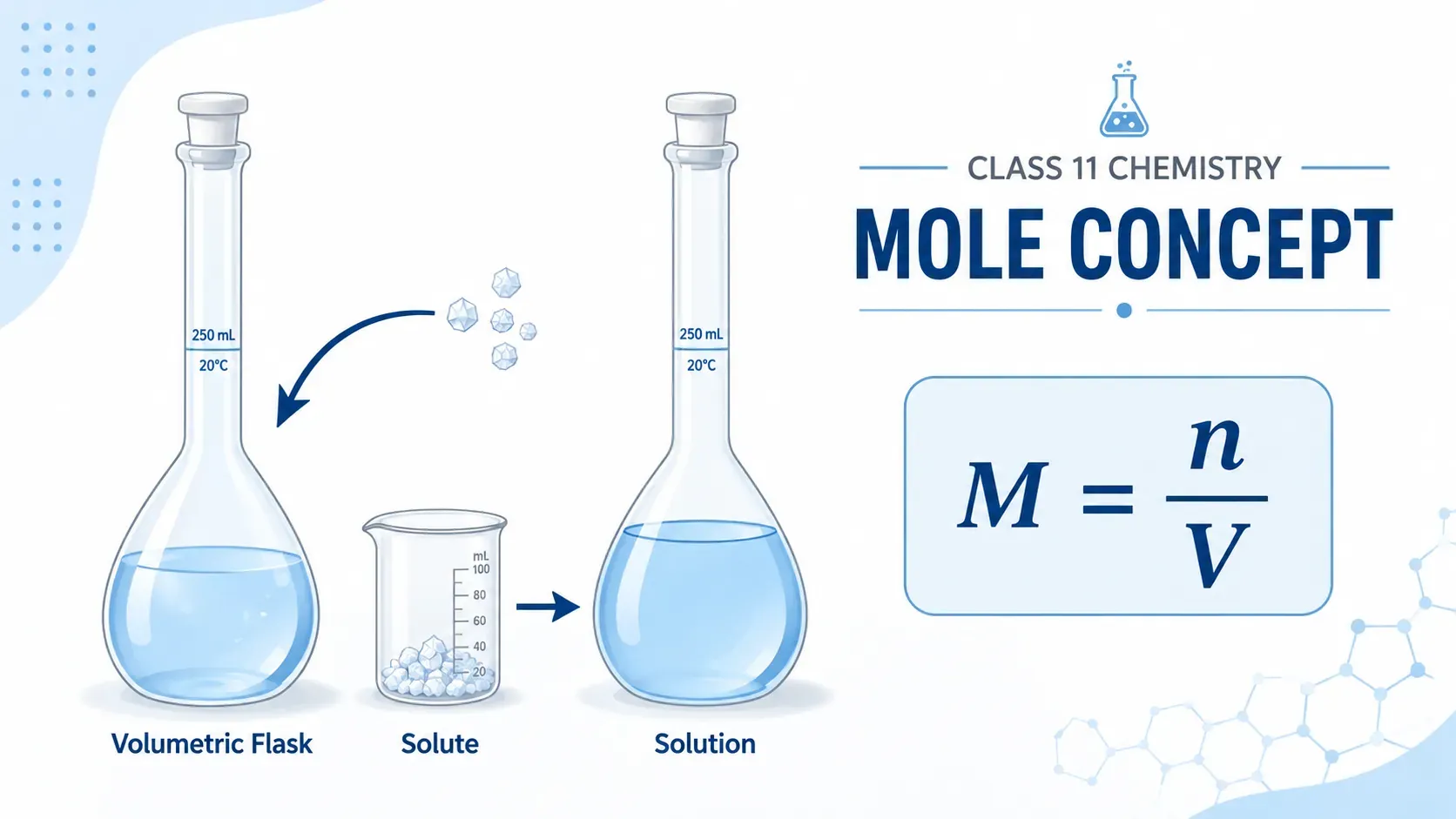
The molarity formula is $M = \dfrac{n}{V}$, where $M$ is the molarity of the solution, $n$ is the number of moles of solute, and $V$ is the volume of the solution measured in litres. Molarity, also called molar concentration, is expressed in $\mathrm{mol,L^{-1}}$ or molar (M). It tells us the amount of solute present in one litre of solution.
The formula for molarity is one of the most important concentration formulas in Class 11 Chemistry and is frequently used in numerical problems based on solutions, titrations, stoichiometry, and equilibrium.
For a detailed understanding of the mole concept, refer to the Mole Concept notes for Class 11, IIT JEE & NEET.
What Is Molarity?
$M = \dfrac{\text{Moles of solute}}{\text{Volume of solution in litres}}$
Therefore,
$M = \dfrac{n}{V}$
Where:
Quantity | Symbol | Meaning |
|---|---|---|
Molarity | $M$ | Concentration of the solution |
Number of moles | $n$ | Moles of solute present |
Volume | $V$ | Volume of the final solution in litres |
Important Points About Molarity
- Molarity depends on the volume of the solution, not the volume of the solvent.
- The volume used in the formula must be the final volume of the solution.
- If volume is given in millilitres, it should be converted into litres when using $M = \dfrac{n}{V}$.
- Molarity is temperature-dependent because the volume of a solution can change with temperature.
- Molarity is commonly used in laboratory calculations, titrations, and chemical reactions.
What Is the Formula of Molarity?
The formula of molarity is:
$M = \dfrac{n}{V}$
Here:
- $M$ = molarity of solution in $\mathrm{mol,L^{-1}}$
- $n$ = number of moles of solute
- $V$ = volume of solution in litres
If the number of moles is not given directly, it can be calculated using:
$n = \dfrac{w}{M_{\mathrm{molar}}}$
where:
- $w$ = mass of solute in grams
- $M_{\mathrm{molar}}$ = molar mass of solute in $\mathrm{g,mol^{-1}}$
Substituting this value in the molarity formula:
$M = \dfrac{w}{M_{\mathrm{molar}} \times V}$
where $V$ is in litres.
Molarity Formula When Mass of Solute Is Given
When the mass of the solute is given in grams and the volume of solution is given in millilitres, the commonly used formula for molarity is:
$M = \dfrac{w}{M_{\mathrm{molar}}} \times \dfrac{1000}{V_{\mathrm{mL}}}$
Where:
- $w$ = mass of solute in grams
- $M_{\mathrm{molar}}$ = molar mass of solute in $\mathrm{g,mol^{-1}}$
- $V_{\mathrm{mL}}$ = volume of solution in millilitres
Example
Suppose $20\ \mathrm{g}$ of $\ce{NaOH}$ is dissolved in enough water to make $500\ \mathrm{mL}$ of solution.
Molar mass of $\ce{NaOH}$:
$M_{\mathrm{molar}} = 40\ \mathrm{g,mol^{-1}}$
Therefore,
$M = \dfrac{20}{40} \times \dfrac{1000}{500}$
$M = 0.5 \times 2 = 1\ \mathrm{M}$
Hence, the molarity of the $\ce{NaOH}$ solution is:
$\boxed{1\ \mathrm{M}}$
SI Unit and Symbol of Molarity
The commonly used unit of molarity is $\mathrm{mol,L^{-1}}$, also written as $\mathrm{mol,dm^{-3}}$.
Quantity | Details |
|---|---|
Symbol of molarity | $M$ |
Common unit | $\mathrm{mol,L^{-1}}$ |
Equivalent unit | $\mathrm{mol,dm^{-3}}$ |
Common notation | $\mathrm{1\ M}$, $\mathrm{0.5\ M}$, etc. |
SI base-unit expression | $\mathrm{mol,m^{-3}}$ |
Formula | $M = \dfrac{n}{V}$ |
Temperature dependence | Yes |
Note: $\mathrm{mol,L^{-1}}$ is the standard unit commonly used for molarity, while the SI coherent unit is $\mathrm{mol,m^{-3}}$.
Derivation of Molarity Formula
The definition of molarity is:
$M = \dfrac{\text{Number of moles of solute}}{\text{Volume of solution in litres}}$
The number of moles of solute is:
$n = \dfrac{w}{M_{\mathrm{molar}}}$
Substituting this into the molarity equation:
$M = \dfrac{w}{M_{\mathrm{molar}} \times V}$
where $V$ is in litres.
If the volume is given in millilitres:
$V(\mathrm{L}) = \dfrac{V_{\mathrm{mL}}}{1000}$
Therefore,
$M = \dfrac{w}{M_{\mathrm{molar}} \times \left(\dfrac{V_{\mathrm{mL}}}{1000}\right)}$
Hence,
$\boxed{M = \dfrac{w}{M_{\mathrm{molar}}} \times \dfrac{1000}{V_{\mathrm{mL}}}}$
This is the most commonly used expanded molarity formula in numerical problems.
Molarity vs Molality vs Mole Fraction
Molarity, molality, and mole fraction are different ways of expressing the concentration or composition of a solution.
Term | Formula | Depends On | Temperature Dependence |
|---|---|---|---|
Molarity ($M$) | $M = \dfrac{n_{\mathrm{solute}}}{V_{\mathrm{solution}}}$ | Volume of solution | Yes |
Molality ($m$) | $m = \dfrac{n_{\mathrm{solute}}}{W_{\mathrm{solvent}}}$ | Mass of solvent | No |
Mole fraction ($x$) | $x_i = \dfrac{n_i}{n_{\mathrm{total}}}$ | Moles of all components | No |
For molality, the mass of solvent must be expressed in kilograms:
$m = \dfrac{n_{\mathrm{solute}}}{W_{\mathrm{solvent}}\ (\mathrm{kg})}$ Since molarity remains one of the most numerically tested concepts in solutions chemistry, practice how it's applied in JEE Main Chapterwise PYQ.
Key Difference Between Molarity and Molality
The main difference is that molarity uses the volume of solution, whereas molality uses the mass of solvent.
Since volume changes with temperature, molarity also changes with temperature. Mass does not appreciably change with temperature, so molality remains independent of temperature.
Molarity Dilution Formula
When a concentrated solution is diluted by adding solvent, the number of moles of solute remains constant.
Before dilution:
$n = M_1V_1$
After dilution:
$n = M_2V_2$
Since the number of moles of solute remains unchanged:
$M_1V_1 = M_2V_2$
Therefore, the dilution formula is:
$\boxed{M_1V_1 = M_2V_2}$
Where:
$M_1$ = Initial molarity
$V_1$ = Initial volume
$M_2$ = Final molarity
$V_2$ = Final volume
Symbol | Meaning |
|---|---|
$M_1$ | Initial molarity |
$V_1$ | Initial volume |
$M_2$ | Final molarity |
$V_2$ | Final volume |
This equation is widely used while preparing solutions of a required concentration.
You can also practise concentration-based questions through solved numericals on Mole Concept. This equation is widely used while preparing solutions of a required concentration, and dilution-based numericals are a recurring pattern in JEE Advanced Chapterwise PYQ.
Solved Examples on Molarity Formula
Example 1: Molarity From Number of Moles
Calculate the molarity of a solution containing $2$ moles of $\ce{NaOH}$ in $4\ \mathrm{L}$ of solution.
Solution
Using the molarity formula:
$M = \dfrac{n}{V}$
Substituting the given values:
$M = \dfrac{2}{4}$
$M = 0.5\ \mathrm{M}$
$\boxed{M = 0.5\ \mathrm{M}}$
Therefore, the molarity of the $\ce{NaOH}$ solution is $0.5\ \mathrm{M}$.
Example 2: Molarity From Mass of Solute
Find the molarity of a solution prepared by dissolving $20\ \mathrm{g}$ of $\ce{NaOH}$ in enough water to make $500\ \mathrm{mL}$ of solution.
Given:
$w = 20\ \mathrm{g}$
$M_{\mathrm{molar}} = 40\ \mathrm{g,mol^{-1}}$
$V = 500\ \mathrm{mL}$
Using:
$M = \dfrac{w}{M_{\mathrm{molar}}} \times \dfrac{1000}{V_{\mathrm{mL}}}$
Therefore,
$M = \dfrac{20}{40} \times \dfrac{1000}{500}$
$M = 0.5 \times 2$
$M = 1\ \mathrm{M}$
$\boxed{M = 1\ \mathrm{M}}$
Example 3: Molarity of Sugar Solution
What is the concentration of sugar $\ce{C12H22O11}$ in $\mathrm{mol,L^{-1}}$ if $20\ \mathrm{g}$ of sugar is dissolved in enough water to make a final volume of $2\ \mathrm{L}$?
Given:
$w = 20\ \mathrm{g}$
$M_{\mathrm{molar}} = 342\ \mathrm{g,mol^{-1}}$
$V = 2\ \mathrm{L}$
Using:
$M = \dfrac{w}{M_{\mathrm{molar}} \times V}$
Therefore,
$M = \dfrac{20}{342 \times 2}$
$M \approx 0.0292\ \mathrm{mol,L^{-1}}$
Hence,
$M \approx 0.0292\ \mathrm{M}$
$\boxed{M \approx 0.0292\ \mathrm{M}}$
Example 4: Molarity After Dilution
$100\ \mathrm{mL}$ of a $2\ \mathrm{M}$ $\ce{HCl}$ solution is diluted to $500\ \mathrm{mL}$. Find the new molarity.
Given:
$M_1 = 2\ \mathrm{M}$
$V_1 = 100\ \mathrm{mL}$
$V_2 = 500\ \mathrm{mL}$
Using the dilution formula:
$M_1V_1 = M_2V_2$
Therefore,
$2 \times 100 = M_2 \times 500$
$M_2 = \dfrac{200}{500}$
$M_2 = 0.4\ \mathrm{M}$
$\boxed{M_2 = 0.4\ \mathrm{M}}$
Example 5: Mass Required to Prepare a Molar Solution
Calculate the mass of sodium acetate $\ce{CH3COONa}$ required to prepare $500\ \mathrm{mL}$ of a $0.375\ \mathrm{M}$ aqueous solution.
Given:
$M = 0.375\ \mathrm{M}$
$M_{\mathrm{molar}} = 82.02\ \mathrm{g,mol^{-1}}$
$V = 500\ \mathrm{mL}$
Using:
$M = \dfrac{w}{M_{\mathrm{molar}}} \times \dfrac{1000}{V_{\mathrm{mL}}}$
Rearranging:
$w = \dfrac{M \times M_{\mathrm{molar}} \times V_{\mathrm{mL}}}{1000}$
Substituting the values:
$w = \dfrac{0.375 \times 82.02 \times 500}{1000}$
$w = 15.37875\ \mathrm{g}$
Therefore,
$w \approx 15.38\ \mathrm{g}$
$\boxed{w \approx 15.38\ \mathrm{g}}$
Hence, approximately $15.38\ \mathrm{g}$ of $\ce{CH3COONa}$ is required.
Once these solved patterns feel familiar, test your speed with eSaral's JEE Test Series, which includes dedicated Mole Concept and Solutions mock sections.
Important Formulas Related to Molarity
Concept | Formula |
|---|---|
Basic molarity | $M = \dfrac{n}{V}$ |
Moles from mass | $n = \dfrac{w}{M_{\mathrm{molar}}}$ |
Molarity using mass and volume in litres | $M = \dfrac{w}{M_{\mathrm{molar}}V}$ |
Molarity using mass and volume in mL | $M = \dfrac{w}{M_{\mathrm{molar}}} \times \dfrac{1000}{V_{\mathrm{mL}}}$ |
Dilution formula | $M_1V_1 = M_2V_2$ |
Molality | $m = \dfrac{n_{\mathrm{solute}}}{W_{\mathrm{solvent}}\ (\mathrm{kg})}$ |
Mole fraction | $x_i = \dfrac{n_i}{n_{\mathrm{total}}}$ |
Quick Revision: Molarity Formula
The most important formula to remember is:
$\boxed{M = \dfrac{n}{V}}$
If mass is given:
$\boxed{M = \dfrac{w}{M_{\mathrm{molar}}} \times \dfrac{1000}{V_{\mathrm{mL}}}}$
For dilution:
$\boxed{M_1V_1 = M_2V_2}$
Molarity Formula at a Glance
Given Information | Formula to Use |
|---|---|
Moles and volume in litres | $M = \dfrac{n}{V}$ |
Mass and volume in litres | $M = \dfrac{w}{M_{\mathrm{molar}}V}$ |
Mass and volume in mL | $M = \dfrac{w}{M_{\mathrm{molar}}} \times \dfrac{1000}{V_{\mathrm{mL}}}$ |
Initial and final concentration | $M_1V_1 = M_2V_2$ |
This same set of formulas is equally important for NEET — practice their application with NEET Chapterwise PYQ, where solution-concentration numericals appear regularly.
Continue Your Mole Concept & Solutions Preparation
- Read the complete Mole Concept notes for Class 11, IIT JEE & NEET for molarity, molality, mole fraction, and stoichiometry.
- Revise quickly with Mole Concept short notes before your exam.
- Practise more questions with solved numericals on Mole Concept, including molarity and dilution problems.
- Attempt Mole Concept NEET previous year questions to understand how concentration concepts are tested.
- Cross-check your preparation with the NCERT Solutions for Class 11 Chemistry.
Want structured practice on every concentration formula, not just this one? Explore eSaral's JEE Course or NEET Course, both built around exactly these numerical patterns.
Frequently Asked Questions
Why does molarity change with temperature?
Molarity changes with temperature because it depends on the volume of the solution, and volume increases on heating due to thermal expansion, while the number of moles of solute in the solution stays the same.
What is the SI unit of molarity?
The SI-accepted unit of molarity is mol/L
Why does the molarity formula use the volume of solution instead of the volume of solvent?
The molarity formula uses the volume of the final solution because that volume determines how concentrated the solute actually is once fully dissolved — the solvent's original volume can change once the solute is added, especially for larger quantities. Using solution volume gives an accurate, directly measurable concentration value.
What is the difference between molarity and mole fraction?
Molarity expresses concentration as moles of solute per litre of solution, while mole fraction expresses it as the ratio of moles of one component to the total moles of all components in the mixture. Unlike molarity, mole fraction is a dimensionless quantity and does not depend on temperature or volume at all.
Can molarity be zero or negative?
Molarity can be zero when a solution contains no dissolved solute, such as pure water, but it cannot be negative, since both the number of moles of solute and the volume of a solution are always positive physical quantities.
What is the molarity formula for dilution?
The molarity formula for dilution is M₁V₁ = M₂V₂, where M₁ and V₁ are the molarity and volume before dilution, and M₂ and V₂ are the molarity and volume after dilution. It holds because the number of moles of solute stays constant during dilution — only the volume changes.
What is the molarity formula?
The molarity formula is M = n/V, where M is the molarity of the solution, n is the number of moles of solute, and V is the volume of the solution in litres. It expresses the concentration of a solution as moles of solute dissolved per litre.
What is the difference between molarity and molality?
Molarity is defined using the volume of the solution, while molality is defined using the mass of the solvent in kilograms. Since volume changes with temperature but mass does not, molarity is temperature-dependent while molality remains constant regardless of temperature.