
JEE Advanced Attempts: Can You Give It a Third Time? Rules Explained
eSaral › JEE › JEE Advanced Attempts: Can You Give It a Third Time? Rules Explained

If you're asking whether a JEE Advanced 3rd attempt is possible, the short answer right now is no — but the rule has been unstable before, and there's a fresh, active petition pushing to change it again. This page explains the current JEE Advanced eligibility rules, walks through the 2025 controversy where a third attempt was announced and then withdrawn within two weeks, and covers the latest September 2026 petition news, so you know exactly where things stand before you plan your attempts.
What Is the Current JEE Advanced Number of Attempts Allowed?
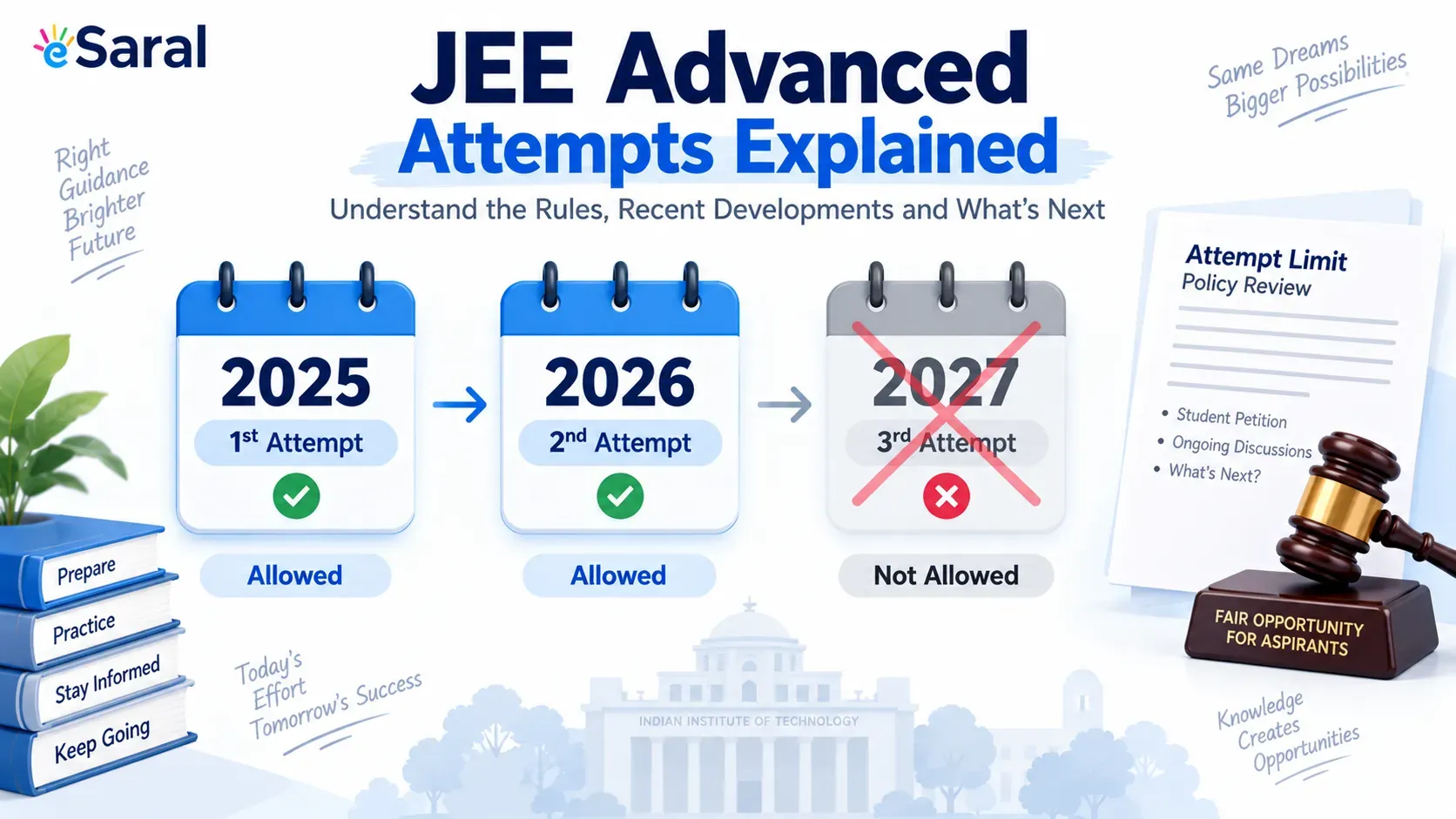
Under the current, officially in-force rule, the jee advanced number of attempts is capped at two, and both attempts must fall in two consecutive years:
- Your first JEE Advanced attempt must be in the same year you pass (or appear for) your Class 12 board exam.
- Your second attempt, if needed, must be the very next year — not any year after that.
- There is no option to skip a year and come back later; a gap year forfeits your second attempt entirely.
This is different from a simple "two attempts in a lifetime" rule — the consecutive-year condition is what most students trip up on, since it means dropping for one year and returning two years later does not preserve your JEE Advanced eligibility.
Can You Give JEE Advanced a Third Time in 2027?
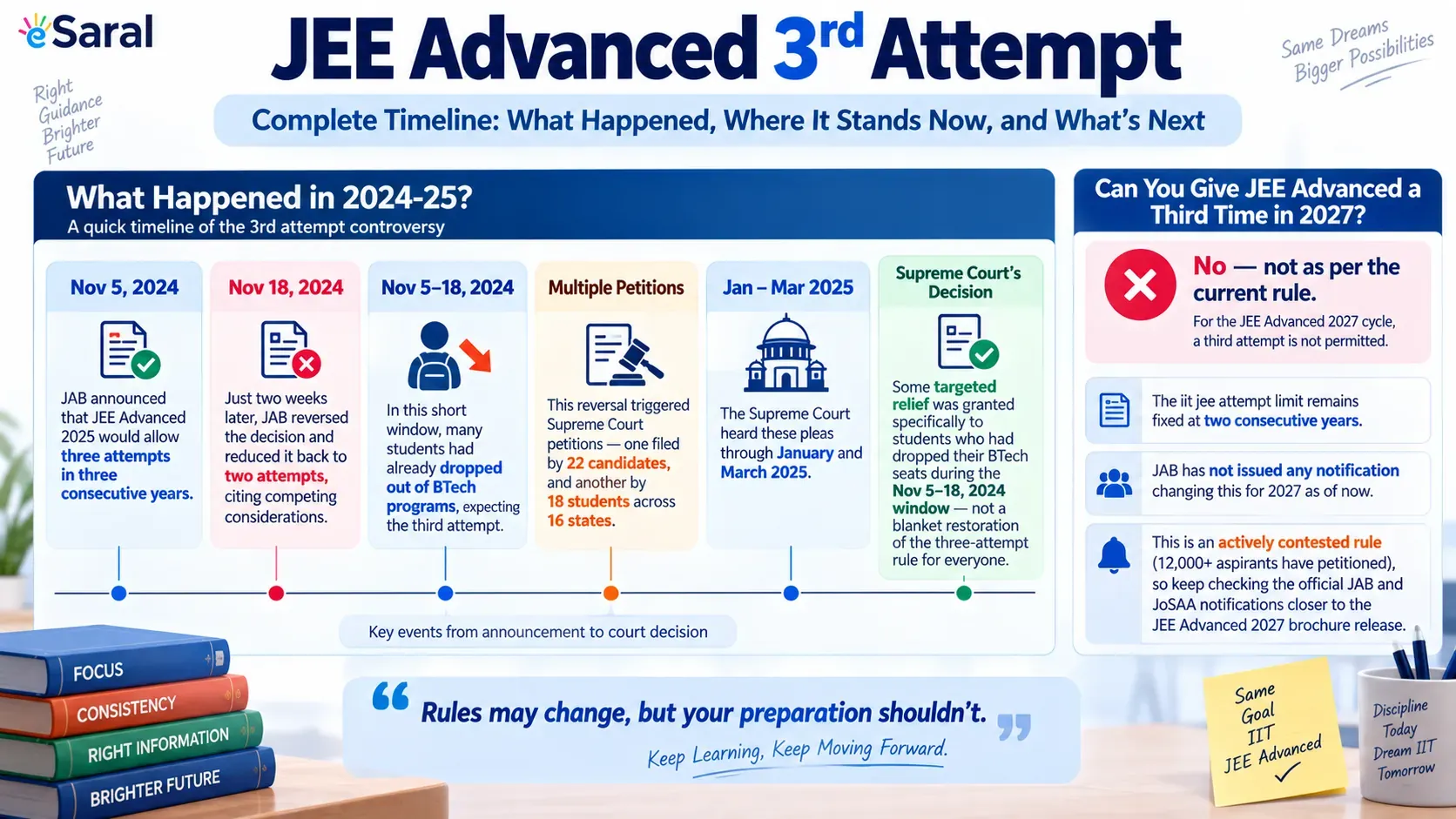
No — under the rule currently in force for the JEE Advanced 2027 cycle, a third attempt is not permitted. The iit jee attempt limit remains fixed at two consecutive years, and JAB has not issued any notification changing this for 2027 as of now. However, this is an actively contested rule (see the petition update below), so aspirants should keep checking the official JAB and JoSAA notifications closer to the JEE Advanced 2027 brochure release.
Why Did JEE Advanced Briefly Allow Three Attempts in 2025?
To understand why "jee advanced 3rd attempt" is such a heavily searched question, it helps to know what actually happened in the 2024-25 cycle:
- November 5, 2024: JAB announced that JEE Advanced 2025 would allow three attempts in three consecutive years, a major change from the earlier two-attempt rule.
- November 18, 2024: Just two weeks later, JAB reversed the decision and reduced it back to two attempts, citing competing considerations.
- In that short two-week window, a number of students had already dropped out of BTech programs they were enrolled in, banking on the newly announced third attempt.
- This reversal triggered multiple Supreme Court petitions — one filed by 22 candidates, and a separate one by 18 students across 16 states — seeking restoration of the third attempt or specific relief for students affected during that two-week window.
- The Supreme Court heard these pleas through January and March 2025, and some targeted relief was granted specifically to students who had dropped their BTech seats during the November 5–18, 2024 window — not a blanket restoration of the three-attempt rule for everyone.
This episode is exactly why the rule feels unstable to many aspirants, and why every fresh petition on this topic gets so much attention.
Also Explore
- Check the complete eligibility breakdown: JEE Advanced Eligibility Criteria →
- Plan your preparation around the current syllabus: JEE Advanced 2027 Syllabus →
- Start mock-test practice for your attempts: JEE Test Series 2027-2028 — 200+ Advanced & 100+ Main Mocks →
Latest News: 12,000+ Aspirants Petition for a JEE Advanced 3rd Attempt (September 2026)
In the first week of September 2026, more than 12,000 IIT aspirants signed and submitted a petition to the Ministry of Education, the IIT Council, and the Joint Admission Board, asking for one of two changes:
- Increase the jee advanced number of attempts from two to three, or
- Keep it at two attempts, but allow them within three consecutive years instead of two — removing the strict back-to-back-year requirement.
The petitioners' core argument is that JEE Main already allows three consecutive years of attempts (with two sessions each year), so restricting JEE Advanced to a tighter two-consecutive-year window creates an inconsistency within the same admission system. They also point to the COVID-era precedent, when an additional attempt was granted without diluting exam quality or increasing unfair competition, since the number of IIT seats stays fixed regardless of how many students attempt the exam.
Current status: As of this writing, this is an active petition with no official decision from JAB, the IIT Council, or the Ministry of Education. No change to the JEE Advanced attempts rule has been confirmed for JEE Advanced 2027. Aspirants should treat the current two-consecutive-year rule as binding for planning purposes and watch for any official JAB notification before assuming otherwise.
What Are the Complete JEE Advanced Eligibility Criteria?
Beyond the attempt limit, JEE Advanced eligibility depends on four other conditions, all of which must be met simultaneously:
Criterion | Requirement |
|---|---|
Performance in JEE Main | Must rank among the top 2,50,000 candidates (category-wise) in JEE Main |
Age limit | Born on or after October 1, 2002 (SC/ST/PwD candidates get a 5-year relaxation — born on or after October 1, 1997) |
Number of attempts | Maximum of 2 attempts, in 2 consecutive years |
Class 12 appearance | First Class 12 appearance must be in the current year or the year immediately before |
Prior IIT admission | Candidates who have previously accepted and retained a seat at any IIT are generally not eligible to appear again |
Missing even one of these five conditions leads to disqualification, regardless of how well a candidate scores in the exam itself.
How Is the JEE Advanced Attempt Limit Different from JEE Main Eligibility Criteria?
A common point of confusion is assuming JEE Main and JEE Advanced follow the same attempt rules — they don't. Here's how the JEE Main eligibility criteria compare to the JEE Advanced attempt limit:
Basis | JEE Main | JEE Advanced |
|---|---|---|
Number of attempts | 3 consecutive years, 2 sessions per year (up to 6 total attempts) | 2 attempts only, in 2 consecutive years |
Gap year allowed? | Yes — attempts just need to fall within 3 consecutive years, not back-to-back sessions | No — a gap year forfeits the second attempt entirely |
Age limit | No upper age limit | Born on or after October 1, 2002 (5-year relaxation for SC/ST/PwD) |
Eligibility gate | Class 12 pass (current, previous, or appearing year) | Must additionally rank in the top 2,50,000 of JEE Main |
This gap — 6 possible JEE Main attempts vs just 2 JEE Advanced attempts — is exactly the inconsistency the September 2026 petition is pushing back against.
What Happens If You Exhaust Your JEE Advanced Attempts?
If both of your consecutive-year JEE Advanced attempts are used up without qualifying, you become ineligible for JEE Advanced permanently under the current rule — there is no third chance, and no waiting-year option to "reset" your eligibility. Your only path back into the IIT system at that point would be a rule change like the one currently being petitioned for, which is not guaranteed and should not be relied upon while planning your preparation.
Whether this is your first JEE Advanced attempt or your last consecutive-year shot, don't waste it on avoidable mistakes. eSaral's JEE Test Series gives you 200+ JEE Advanced mocks with AI-powered 20-page performance reports, built by IIT Bombay and IIT Kanpur faculty, so every attempt counts. Start your eSaral JEE Advanced test today →
Frequently Asked Questions
Is there any update on JEE Advanced getting a third attempt in 2026 or 2027?
As of September 2026, over 12,000 IIT aspirants have petitioned the Ministry of Education, IIT Council, and JAB for a third attempt or a 3-consecutive-year window, but no official decision or rule change has been announced by JAB for JEE Advanced 2027.
Can you give JEE Advanced a third time?
No, under the rule currently in force, a jee advanced 3rd attempt is not allowed. A third attempt was briefly announced for the 2025 cycle on November 5, 2024, but was reversed just two weeks later on November 18, 2024, back to two attempts.
What is the current JEE Advanced attempt limit?
The current JEE Advanced attempt limit is two attempts, and both must fall in two consecutive years — the first attempt in the year you pass Class 12, and the second in the following year only.
What are the full JEE Advanced eligibility criteria besides the attempt limit?
Besides the iit jee attempt limit, candidates must rank in the top 2,50,000 of JEE Main, meet the age requirement (born on or after October 1, 2002, with relaxation for SC/ST/PwD), have their first Class 12 appearance in the current or previous year, and not have previously accepted and retained an IIT seat.
How many attempts does JEE Main allow compared to JEE Advanced?
JEE Main allows attempts across 3 consecutive years with 2 sessions per year (up to 6 total attempts), while JEE Advanced allows only 2 attempts in 2 consecutive years — a key part of jee mains eligibility criteria that differs sharply from JEE Advanced.
Can I take a gap year and still use my second JEE Advanced attempt later?
No, the jee advanced number of attempts rule requires both attempts to be in strictly consecutive years — if you take a gap year after your first attempt, you permanently lose your second JEE Advanced attempt.
Should I plan my JEE preparation assuming a third attempt will be approved?
No — since the third-attempt petition is still pending with no official approval as of now, you should plan your JEE Advanced preparation strictly around the current two-consecutive-year rule, and treat any future change as a bonus rather than something to rely on.
What happened during the 2025 JEE Advanced third-attempt controversy?
JAB announced three attempts for JEE Advanced 2025 on November 5, 2024, then reversed it to two attempts on November 18, 2024. Students who had already dropped BTech seats during that window filed Supreme Court petitions, and the court granted some relief specifically to those affected students, not a blanket restoration for all candidates.