
Plant Cell Diagram: Labelled Structure, Parts and Functions
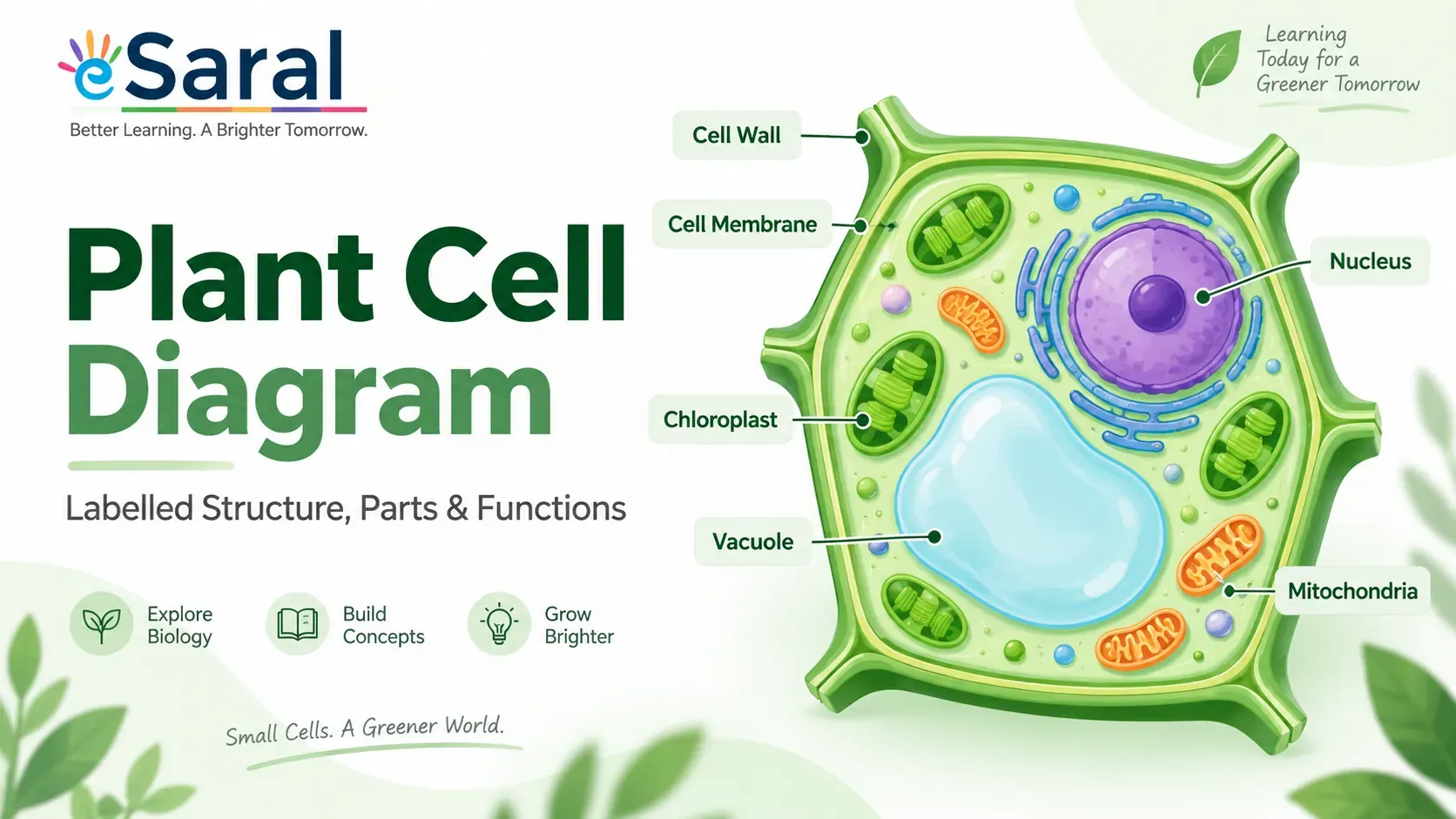

A plant cell diagram labels the internal structure of a plant cell — its cell wall, nucleus, chloroplast, mitochondria, and vacuole. Understanding plant cell structure is one of the earliest biology topics students study, starting from Class 6 and building up through Class 9, 10, and 11. Below, you'll find a labelled plant cell diagram, a simpler version for younger students, and a full breakdown of each organelle's function.
What Is a Plant Cell?
A plant cell is the basic structural and functional unit of all plants. Its plant cell structure includes a true, membrane-bound nucleus and several specialised organelles, since it is a eukaryotic cell. Unlike other cell types, a plant cell has three defining structures: a cell wall, a large central vacuole, and plastids (chloroplasts, leucoplasts, chromoplasts). These allow the cell to photosynthesise, stay rigid, and store water and nutrients efficiently.
Labelled Diagram of Plant Cell
A plant cell is surrounded by a rigid cell wall, with the cell membrane sitting just inside it. Within the cytoplasm, the nucleus sits off to one side, often pushed there by the large central vacuole that dominates most of the cell's interior. Chloroplasts and mitochondria are scattered through the remaining space, while the endoplasmic reticulum and Golgi apparatus sit closer to the nucleus, since they work together to process and transport proteins. This arrangement is what a complete labelled plant cell diagram is expected to show:
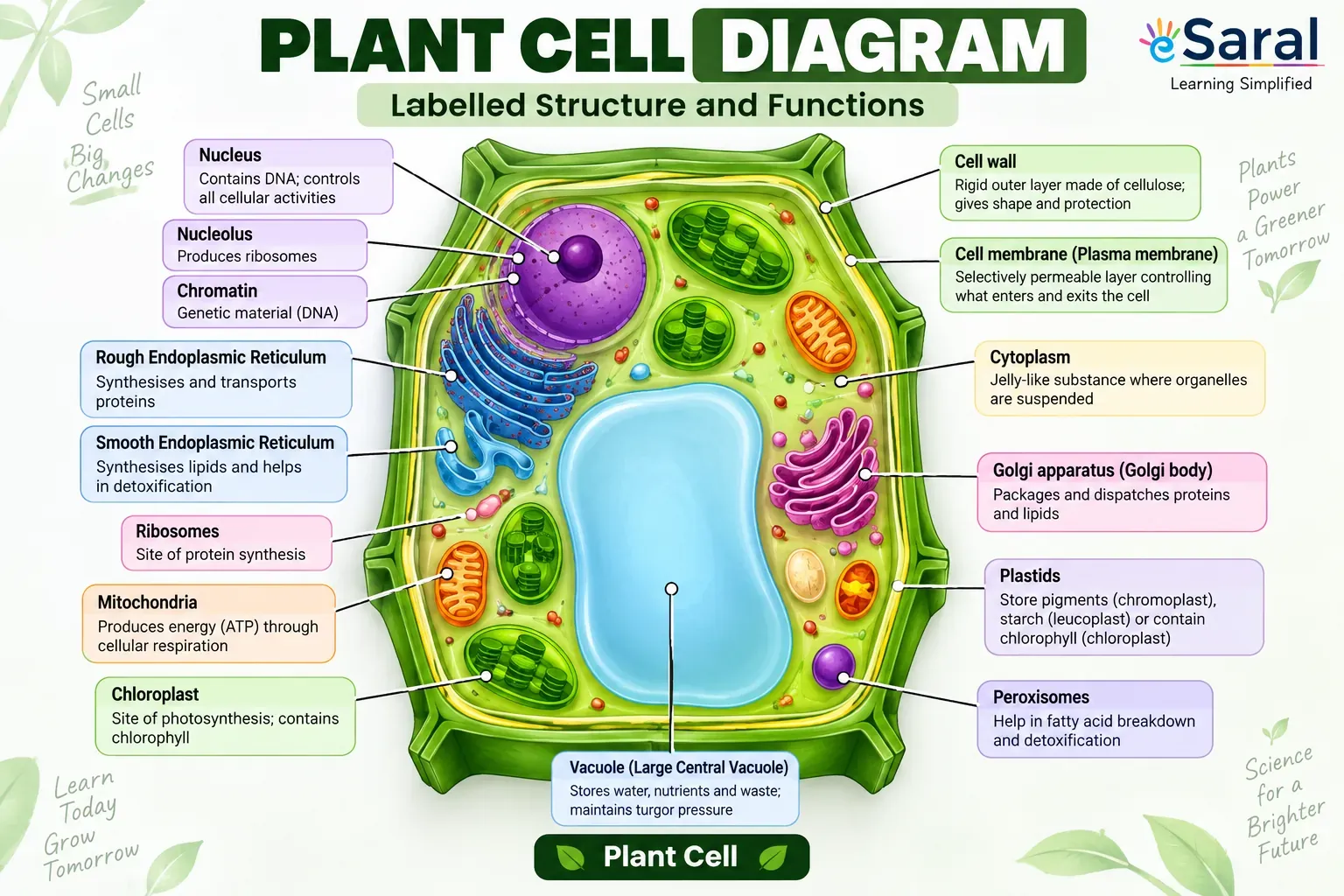
A complete labelled plant cell diagram shows the following structures:
- Cell wall
- Cell membrane (plasma membrane)
- Nucleus (with nuclear membrane, nucleolus, chromatin)
- Cytoplasm
- Chloroplast
- Mitochondria
- Endoplasmic reticulum (rough and smooth)
- Golgi apparatus (Golgi body)
- Ribosomes
- Vacuole (large, central)
- Plastids (chloroplast, leucoplast, chromoplast)
- Peroxisomes
Simple Plant Cell Diagram for Class 6, 7 and 8 Students
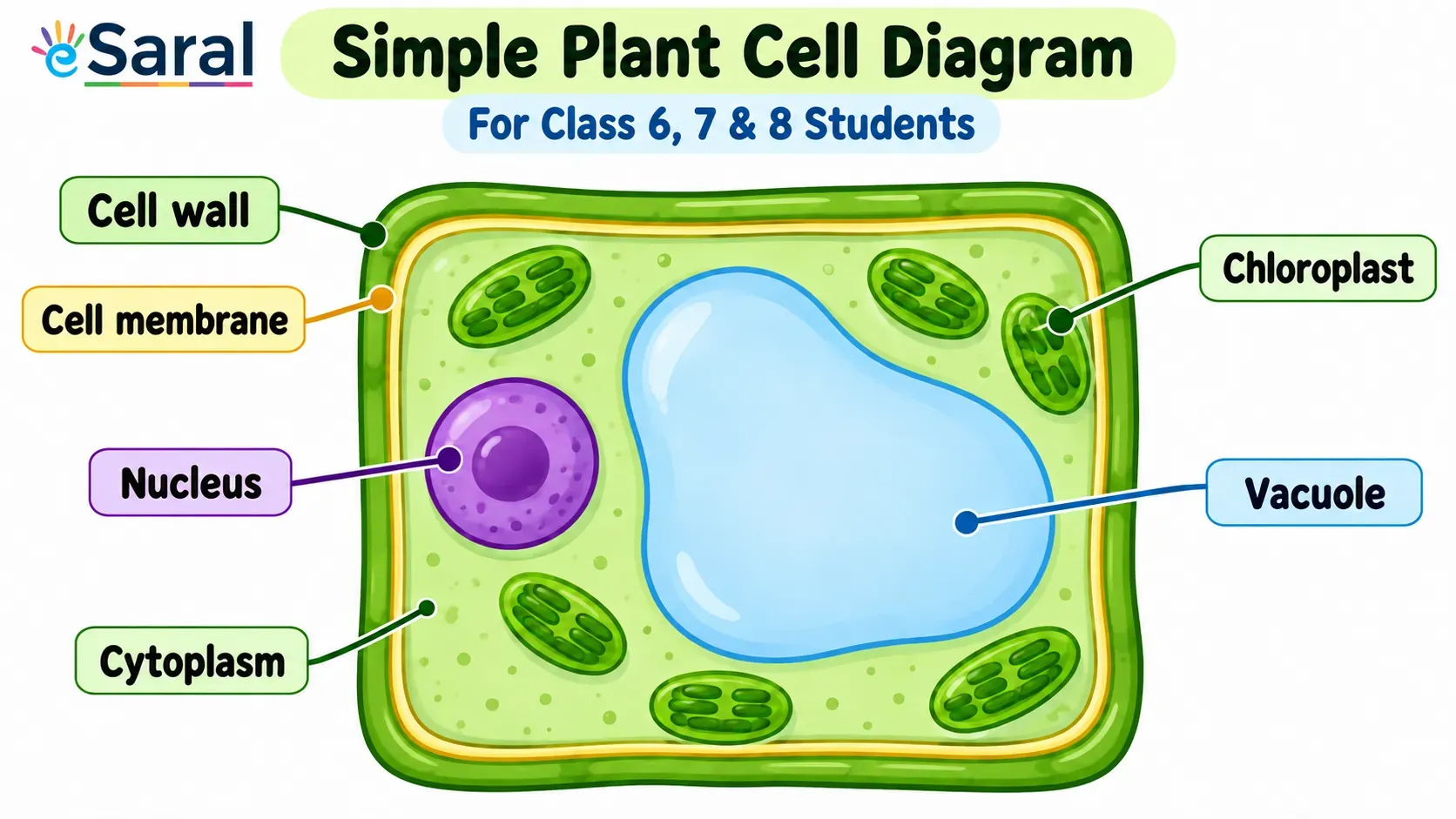
For Class 6, 7, and 8 students, a simple plant cell diagram usually needs to show only the basic, easily identifiable structures rather than every organelle:
- Cell wall
- Cell membrane
- Nucleus
- Cytoplasm
- Chloroplast
- Vacuole
A plant cell diagram simple enough for this age group leaves out organelles like the endoplasmic reticulum and Golgi apparatus, since the focus at Class 6 and Class 7 is on recognising the overall shape and a handful of major parts, not their detailed function. By Class 8, students are expected to also name what each labelled part does, in one line, even though the diagram itself doesn't yet need every organelle shown at Class 9 level.
Plant Cell Diagram for Class 9 (CBSE)
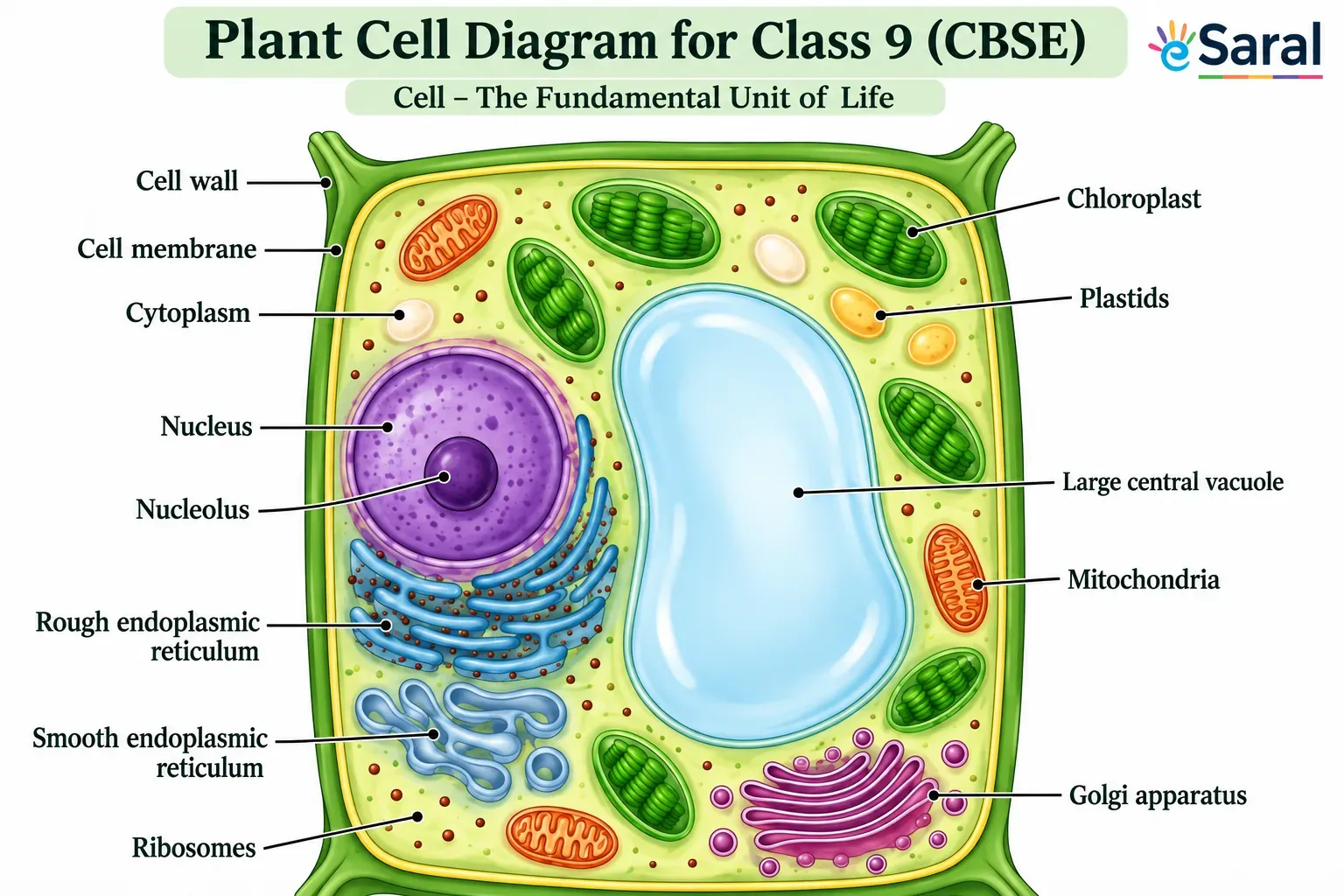
The plant cell diagram for Class 9 is more detailed and forms part of the "Cell – The Fundamental Unit of Life" chapter in CBSE Science. At this level, students are expected to label and explain the function of each major organelle, including the endoplasmic reticulum, Golgi apparatus, and plastids, not just identify them.
Parts of a Plant Cell and Their Functions
Each organelle plays a role that CBSE Class 9 exams expect students to explain, not just label. The cell wall keeps the cell's shape fixed, while the cell membrane controls what moves in and out. The nucleus holds the DNA and directs all cell activity, chloroplasts drive photosynthesis, and mitochondria release energy from glucose. The endoplasmic reticulum and Golgi apparatus work together to build and package proteins, while the large central vacuole stores water and keeps the plant upright through pressure against the cell wall.
Organelle | Function |
|---|---|
Cell wall | Rigid outer layer made of cellulose; gives shape and protects the cell |
Cell membrane | Selectively permeable layer controlling what enters and exits the cell |
Nucleus | Contains DNA; controls all cellular activities and heredity |
Chloroplast | Site of photosynthesis; contains chlorophyll that captures sunlight |
Mitochondria | Produces energy (ATP) through cellular respiration |
Endoplasmic reticulum | Transports proteins (rough ER) and synthesises lipids (smooth ER) |
Golgi apparatus | Packages and dispatches proteins and lipids for use inside or outside the cell |
Ribosomes | Synthesise proteins |
Vacuole | Large sac storing water, nutrients, and waste; maintains turgor pressure |
Plastids | Store pigments (chromoplast) or starch (leucoplast) |
This table covers exactly what CBSE Class 9 exams test directly, since labelling and function-matching questions are common in board papers.
Plant Cell Diagram for Class 10 and Class 11
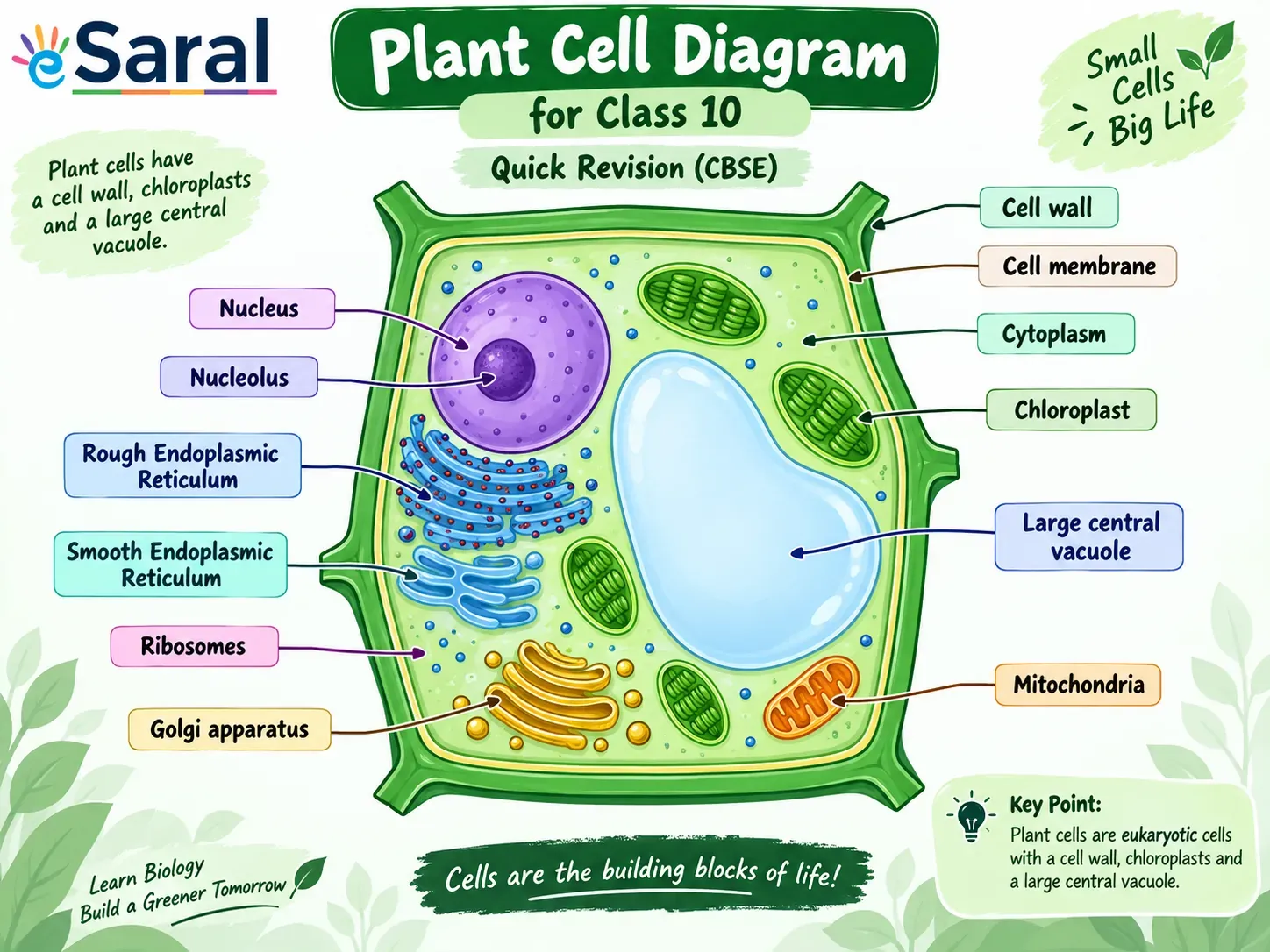
By Class 10, the plant cell diagram is usually revised briefly alongside topics like tissues and reproduction, rather than taught fresh.
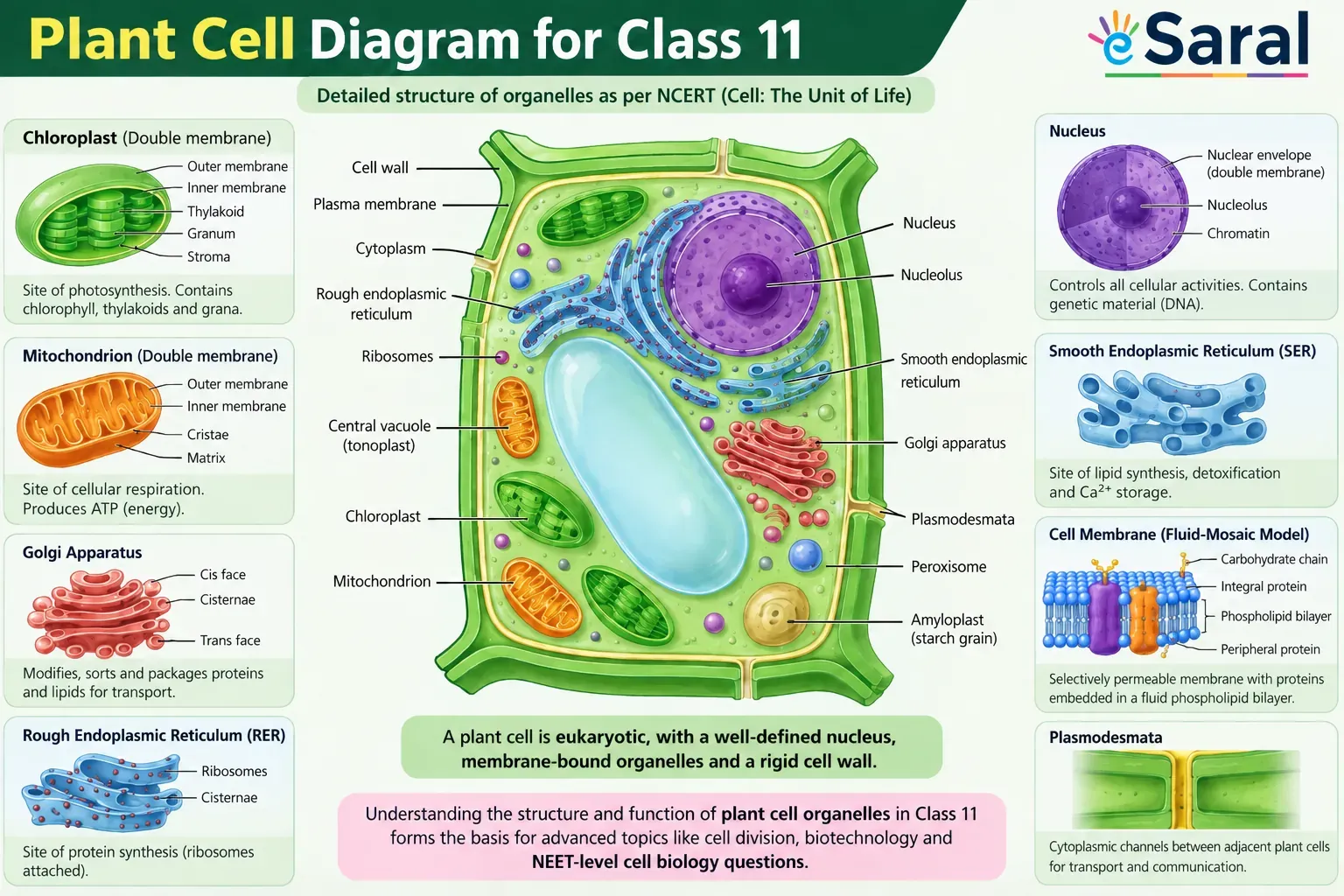
The plant cell diagram for Class 11 goes into far more depth as part of NCERT Biology's "Cell: The Unit of Life" chapter — covering the structure of organelles at a sub-cellular level, such as the double membrane of mitochondria and chloroplasts, the fluid-mosaic model of the cell membrane, and the role of the endomembrane system. This forms the base for Class 12 topics like cell division, biotechnology, and eventually NEET-level cell biology questions.
How to Draw a Plant Cell Diagram Step by Step
- Draw a rectangle or oval outline to represent the cell wall.
- Draw a slightly smaller outline just inside it for the cell membrane.
- Add a large vacuole occupying most of the central space.
- Draw the nucleus off to one side, near the cell membrane.
- Scatter small oval shapes for chloroplasts and mitochondria in the remaining cytoplasm.
- Add wavy lines near the nucleus for the endoplasmic reticulum.
- Draw a stack of curved lines for the Golgi apparatus.
- Label every structure clearly with straight lines pointing to each part.
Explore More on eSaral
- Cells in Plants and Animals — for the full plant vs animal cell comparison, including a side-by-side diagram and 10+ key differences
- CBSE Class 9 Science Notes – Cell: The Fundamental Unit of Life — detailed notes covering everything in this diagram, with practice questions
- NCERT Class 11 Biology Book PDF — for the full "Cell: The Unit of Life" chapter referenced above
- NCERT Class 12 Biology Book PDF — continue into Class 12 topics like cell division and biotechnology
- CBSE Class 9 Science NCERT Solutions — chapter-end question answers for exam practice
- Class 9 Science Revision Notes (All Chapters) — for revising other topics alongside Cell structure
Frequently Asked Questions
What is a plant cell diagram?
A plant cell diagram is a labelled illustration showing the internal structures of a plant cell, including the cell wall, nucleus, chloroplast, mitochondria, and vacuole.
What is the plant cell structure?
Plant cell structure refers to the arrangement of organelles inside a plant cell — a rigid cell wall on the outside, a cell membrane beneath it, and organelles like the nucleus, chloroplast, mitochondria, and a large central vacuole inside the cytoplasm.
Is the plant cell diagram different for Class 6, 9 and 11?
Yes. Class 6–8 diagrams cover only the basic, easily visible parts. Class 9 CBSE requires labelling and explaining each organelle's function. Class 11 goes into much greater structural detail, preparing students for NEET-level cell biology. eSaral's class-wise Biology notes follow this same progression, chapter by chapter.
What are the main parts of a plant cell?
The main parts are the cell wall, cell membrane, nucleus, cytoplasm, chloroplast, mitochondria, endoplasmic reticulum, Golgi apparatus, ribosomes, and vacuole.
Which organelle is unique to plant cells?
Chloroplasts, the cell wall, and the large central vacuole are structures typically associated with plant cells and used to identify them in diagrams.
Where can I get a simple plant cell diagram for revision?
You can use the labelled diagrams and parts table on this page directly, or download eSaral's Class 9 Science chapter notes on cell structure for a printable, exam-ready version.
Is the plant cell diagram important for CBSE exams?
Yes. It's tested directly in CBSE Class 9 Science and revisited in Class 11 Biology. eSaral's CBSE notes cover this chapter with labelled diagrams and simplified explanations for quick revision.
Is the plant cell diagram same for Class 8 and Class 10?
Not exactly. Class 8 covers a simpler version with fewer labelled parts, focused on recognition rather than function. Class 10 briefly revises the same diagram from Class 9, without introducing new organelles, since the chapter isn't retaught in depth that year.
How can I practice labelling a plant cell diagram?
The best way is to draw the outline from memory, then add labels one at a time — cell wall, nucleus, chloroplast, mitochondria, vacuole — checking each against a reference diagram. eSaral's Class 9 Science worksheets include unlabelled diagrams for this kind of practice.
What is the difference between the plant cell diagram for Class 10 and Class 11?
The Class 10 diagram is a brief revision of the same organelles taught in Class 9, with no new additions. The Class 11 diagram goes into sub-cellular detail, showing the double membrane of mitochondria and chloroplasts, chromatin, plastids, and the endomembrane system, since Class 11 Biology treats cell structure as a dedicated NCERT chapter rather than a quick revision topic.
Is the plant cell diagram relevant for NEET?
Yes. Cell biology, including plant cell structure and organelle function, is a recurring NEET topic, and the Class 11 NCERT chapter this diagram is based on carries forward directly into NEET Biology. eSaral's NEET notes cover this chapter in more depth for exam-focused revision.