
Atomic Structure - JEE Main Previous Year Questions with Solutions

Home > JEE Main Previous Year Questions > Atomic Structure JEE Main PYQs with Solutions

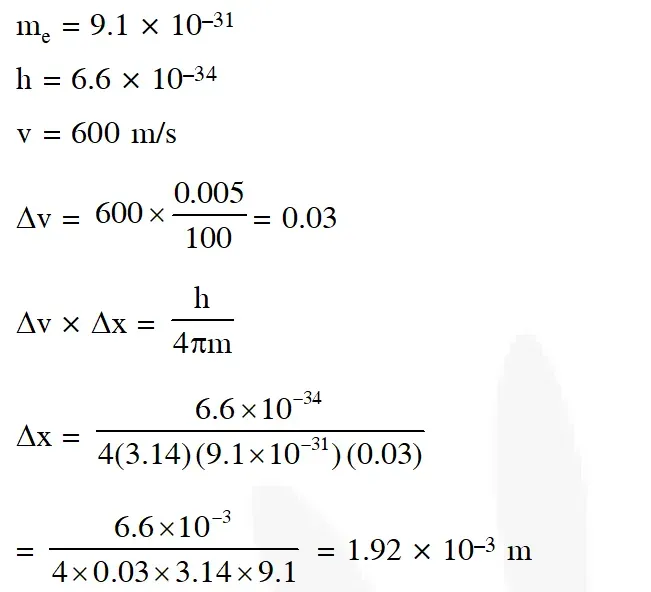
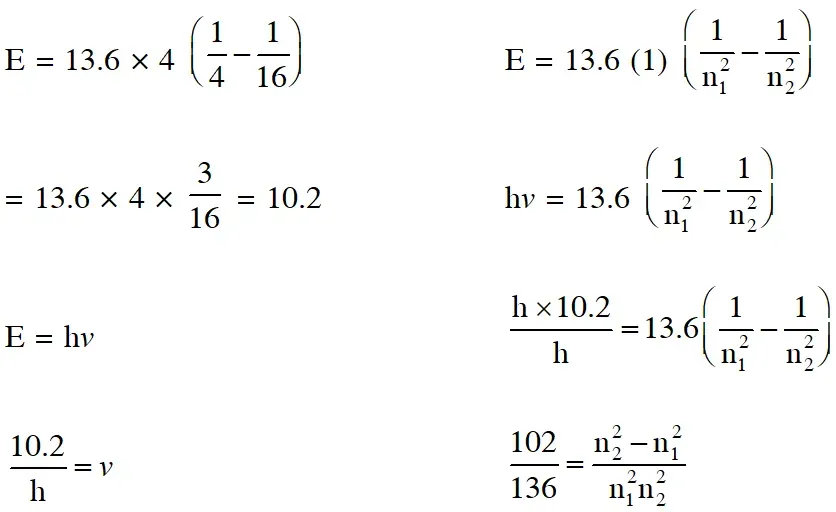
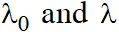
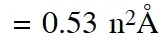
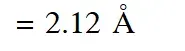
JEE Main Previous Year Papers Questions of Chemistry With Solutions are available at eSaral. Simulator Previous Years AIEEE/JEE Mains Questions [esquestion] In an atom, an electron is moving with a speed of 600 m/s with an accuracy of 0.005%. Certainity with which the position of the electron can be located is ($\mathrm{Ch}=6.6 \times 10^{-34} \mathrm{kg} \mathrm{m}^{2} \mathrm{s}^{-1}$, mass of electron, $\mathrm{e}_{\mathrm{m}}=9.1 \times 10^{-31} \mathrm{kg}$):- (1) $1.92 \times 10^{-3} \mathrm{m}$ (2) $3.84 \times 10^{-3} \mathrm{m}$ (3) $1.52 \times 10^{-4} \mathrm{m}$ (4) $5.10 \times 10^{-3} \mathrm{m}$ #tag# [AIEEE-2009] #sol# (1) [/esquestion] [esquestion] Calculate the wavelength (in nanometer) associated with a proton moving at $1.0 \times 10^{3} \mathrm{ms}^{-1}$ (Mass of proton = $1.67 \times 10^{-27} \mathrm{kg}$ and $\mathrm{h}=6.63 \times 10^{-34} \mathrm{Js}$) :- (1) 2.5 nm (2) 14.0 nm (3) 0.032 nm (4) 0.40 nm #tag# [AIEEE-2009] #sol# (4) $\mathrm{m}_{\mathrm{p}}=1.67 \times 10^{-27}$ $\mathrm{h}=6.63 \times 10^{-34}$ $\mathrm{v}=10^{3}$ $\lambda=\frac{\mathrm{h}}{\mathrm{mv}}=\frac{6.63 \times 10^{-34}}{1.67 \times 10^{-27} \times 10^{3}}$ $=3.97 \times 10^{-7+3}$ $=3.97 \times 10^{-10}$ $=\frac{3.9 \times 10^{-10}}{10^{-9}} \mathrm{nm} \quad=0.40 \mathrm{nm}$ [/esquestion] [esquestion] The energy required to break one mole of Cl–Cl bonds in Cl2 is 242 kJ $\mathrm{mol}^{-1}$. The longest wavelength of light capable of breaking a single Cl–Cl bond is $\left(\mathrm{C}=3 \times 10^{8} \mathrm{ms}^{-1} \text { and } \mathrm{N}_{\mathrm{A}}=6.02 \times 10^{23} \mathrm{mol}^{-1}\right)$ (1) 494 nm (2) 594 nm (3) 640 nm (4) 700 nm #tag# [AIEEE-2010] #sol# (1) $\mathrm{B.E.}=242 \mathrm{kJ} / \mathrm{mol}$ $\mathrm{E}=\frac{\mathrm{hcN}_{\mathrm{A}}}{\lambda}$ $10^{3} \times 242 \times \lambda=3 \times 10^{8} \times 6.626 \times 10^{-34} \times 6.02 \times 10^{23}$ $\lambda=\frac{3 \times 6.626 \times 6.02 \times 10^{-26+23}}{242}$ $=0.494 \times 10^{-3} \times 10^{-3}$ = 494 nm [/esquestion] [esquestion] Ionisation energy of $\mathrm{He}^{+}$ is $19.6 \times 10^{-18} \mathrm{J}$ atom $^{-1}$. The energy of the first stationary state (n = 1) of $\mathrm{L} \mathbf{i}^{2+}$ is:- (1) $8.82 \times 10^{-17} \mathrm{J}$ atom $^{-1}$ (2) $4.41 \times 10^{-16} \mathrm{J}$ atom $^{-1}$ (3) $-4.41 \times 10^{-17} \mathrm{J}$ atom $^{-1}$ (4) $-2.2 \times 10^{-15} \mathrm{J}$ atom $^{-1}$ #tag# [AIEEE-2010] #sol# (3) I.E. $=19.6 \times 10^{-18}$ I.E $\propto \mathrm{z}^{2}$ $\frac{(\mathrm{I.E.})_{\mathrm{Li}^{+2}}}{(\mathrm{I.E.})_{\mathrm{He}}}=\frac{\mathrm{Z}_{\mathrm{Li}}^{2}}{\mathrm{Z}_{\mathrm{He}}^{2}} \quad \mathrm{E}_{1}=\frac{9}{4} \times 19.6 \times 10^{-18}$ $=-4.41 \times 10^{-17}$ [/esquestion] [esquestion] The frequency of light emitted for the transition n = 4 to n = 2 of He+ is equal to the transition in H atom corresponding to which of the following (1) n = 3 to n = 1 (2) n = 2 to n = 1 (3) n = 3 to n = 2 (4) n = 4 to n = 3 #tag# [AIEEE-2011] #sol# (2) [/esquestion] [esquestion] The electrons identified by quantum numbers n and :- (a) n = 4 , = 1 (b) n = 4, = 0 (c) n = 3, = 2 (d) n = 3, = 1 Can be placed in order of increasing energy as (1) (a) < (c) < (b) < (d) (2) (c) < (d) < (b) < (a) (3) (d) < (b) < (c) < (a) (4) (b) < (d) < (a) < (c) (3) (d) < (b) < (c) < (a) (4) (b) < (d) < (a) < (c) #tag# [AIEEE-2012] #sol# (3) (d) < (b) < (c) < (a) Acc. to (n + ) rule. [/esquestion] [esquestion] If the kinetic energy of an electron is increased four times, the wavelength of the de-Broglie wave associated with it would become :- (1) Two times (2) Half (3) One fourth (4) Four time #tag# [JEE-Main(online2012] #sol# (2) $\lambda \propto \frac{1}{\sqrt{\mathrm{KE}}}$ [/esquestion] [esquestion] The wave number of the first emission line in the Balmer series of H-Spectrum is : (R = Rydberg constant) : (1) $\frac{3}{4} \mathrm{R}$ (2) $\frac{9}{400} \mathrm{R}$ (3) $\frac{5}{36} \mathrm{R}$ (4) $\frac{7}{6} \mathrm{R}$ #tag# [JEE-Main(online) 2013] #sol# (3) $\bar{v}=\frac{1}{\mathrm{R}}\left(\frac{1}{2^{2}}-\frac{1}{3^{2}}\right)=\frac{5}{36 \mathrm{R}}$ [/esquestion] [esquestion] The de Broglie wavelength of a car of mass 1000 kg and velocity 36 km/hr is : $\left(\mathrm{h}=6.63 \times 10^{-34} \mathrm{J} \mathrm{s}\right)$ (1) $6.626 \times 10^{-31} \mathrm{m}$ (2) $6.626 \times 10^{-34} \mathrm{m}$ (3) $6.626 \times 10^{-38} \mathrm{m}$ (4) $6.626 \times 10^{-30} \mathrm{m}$ #tag# [JEE-Main(online) 2013] #sol# (3) [/esquestion] [esquestion] For which of the following particles will it be most difficult to experimentally verify the de-Broglie relationship? (1) a dust particle (2) an electron (3) a proton (4) an -particle. #tag# [JEE-Main(online) 2014] #sol# (1) [/esquestion] [esquestion] If the binding energy of the electron in a hydrogen atom is 13.6 eV, the energy required to remove the electron from the first excited state of $\mathbf{L} \mathbf{i}^{++}$ is : (1) 13.6 eV (2) 30.6 eV (3) 122.4 eV (4) 3.4 eV #tag# [JEE-Main(online) 2014] #sol# (2) B.E. $=3.4 \times 9=30.6 \mathrm{eV}$ [/esquestion] [esquestion] Based on the equation $\Delta \mathrm{E}=-2.0 \times 10^{-18} \mathrm{J}\left(\frac{1}{\mathrm{n}_{2}^{2}}-\frac{1}{\mathrm{n}_{1}^{2}}\right)$ the wavelength of the light that must be absorbed to excite hydrogen electron from level n = 1 to level n $=2$ will be $\left(\mathrm{h}=6.625 \times 10^{-34} \mathrm{Js}, \mathrm{C}=3 \times 10^{8} \mathrm{ms}^{-1}\right)$ (1) $2.650 \times 10^{-7} \mathrm{m}$ (2) $1.325 \times 10^{-7} \mathrm{m}$ (3) $1.325 \times 10^{-10} \mathrm{m}$ (4) $5.300 \times 10^{-10} \mathrm{m}$ #tag# [JEE-Main(online) 2014] #sol# (2) $\frac{1}{\lambda}=\frac{2 \times 10^{-18}}{\mathrm{hc}}\left[\frac{1}{(1)^{2}}-\frac{1}{(2)^{2}}\right]$ $\Rightarrow \frac{1}{\lambda}=\frac{2 \times 10^{-18}}{6.625 \times 10^{-34} \times 3 \times 10^{8}} \times \frac{3}{4}$ $\Rightarrow \lambda=\frac{2 \times 6.625 \times 10^{-34} \times 10^{8}}{10^{-18}}$ $=13.25 \times 10^{-8}$ $=1.325 \times 10^{-7} \mathrm{m}$ [/esquestion] [esquestion] If be the threshold wavelength and wavelength of incident light, the velocity of photoelectron ejected from the metal surface is #tag# [JEE-Main(online) 2014] #sol# (1) $\mathrm{E}=\phi+\frac{1}{2} \mathrm{mv}^{2}$ $\Rightarrow \frac{\mathrm{hc}}{\lambda}=\frac{\mathrm{hc}}{\lambda_{0}}+\frac{1}{2} \mathrm{mv}^{2}$ $\Rightarrow \mathrm{v}^{2}=\frac{2 \mathrm{hc}}{\mathrm{m}}\left[\frac{1}{\lambda}-\frac{1}{\lambda_{0}}\right] \Rightarrow \mathrm{v}=\sqrt{\frac{2 \mathrm{hc}}{\mathrm{m}}\left[\frac{1}{\lambda}-\frac{1}{\lambda_{0}}\right]}$ $\Rightarrow \mathrm{v}=\sqrt{\frac{2 \mathrm{hc}}{\mathrm{m}}\left[\frac{\lambda_{0}-\lambda}{\lambda \lambda_{0}}\right]}$ [/esquestion] [esquestion] Ionization energy of gaseous Na atoms is 495.5 $\mathrm{kjmol}^{-1}$ . The lowest possible frequency of light that ionizes a sodium atom is $\left(\mathrm{h}=6.626 \times 10^{-34} \mathrm{Js}, \mathrm{N}_{\mathrm{A}}=6.022 \times 10^{23} \mathrm{mol}^{-1}\right)$ (1) $3.15 \times 10^{15} \mathrm{s}^{-1}$ (2) $4.76 \times 10^{14} \mathrm{s}^{-1}$ (3) $1.24 \times 10^{15} \mathrm{s}^{-1}$ (4) $7.50 \times 10^{4} \mathrm{s}^{-1}$ #tag# [JEE-Main(online) 2014] #sol# (3) $\Delta \mathrm{E}=\mathrm{hv}$ $\mathrm{v}=\frac{\Delta \mathrm{E}}{\mathrm{h}}$ $\mathrm{v}=\frac{495.5 \times 10^{3} \mathrm{Joule}}{6.023 \times 10^{23}} \times \frac{1}{6.626 \times 10^{-34}}$ $\mathrm{v}=1.24 \times 10^{15} \mathrm{sec}^{-1}$ [/esquestion] [esquestion] Which of the following is the energy of a possible excited state of hydrogen? (1) –3.4 eV (2) +6.8 eV (3) +13.6 eV (4) –6.8 eV #tag# [JEE-Main(offline) 2015] #sol# (1) For H-atom, (Z = 1) $\mathrm{E}_{\mathrm{n}}=-13.6 \times \frac{\mathrm{Z}^{2}}{\mathrm{n}^{2}} \mathrm{eV}$ $\begin{aligned} \therefore \text { So for } \mathrm{E}_{1} &=-13.6 \mathrm{eV} \\ \mathrm{E}_{2} &=-3.4 \mathrm{eV} \end{aligned}$ [/esquestion] [esquestion] A stream of electrons from a heated filament was passed between two charged plates kept at a potential difference V esu. If e and m are charge and mass of an electron respectively, then the value of $\mathrm{h} / \lambda$ (where $\lambda$is wavelength associated with electron wave) is given by : (1) $\sqrt{2 \mathrm{meV}}$ (2) mev (3) $2 \mathrm{meV}$ (4) $\sqrt{\mathrm{meV}}$ #tag# [JEE-Main 2016] #sol# (1) As electron of charge 'e' is passed through 'V' volt, kinetic energy of electron becomes = 'eV' As wavelength of $e^{-}$ wave = $(\lambda)=\frac{\mathrm{h}}{\sqrt{2 \mathrm{m} \cdot \mathrm{K} \cdot \mathrm{E}}}$ $\lambda=\frac{\mathrm{h}}{\sqrt{2 \mathrm{meV}}}$ $\therefore \quad \frac{\mathrm{h}}{\lambda}=\sqrt{2 \mathrm{meV}}$ [/esquestion] [esquestion] The radius of the second Bohr orbit for hydrogen atom is : (Planks const. $\mathrm{h}=6.6262 \times 10^{-34} \mathrm{Js}$; mass of electron $=9.1091 \times 10^{-31} \mathrm{kg} ;$ charge of electron $\mathrm{e}=$ $1.60210 \times 10^{-19} \mathrm{C}:$ permittivity of vaccuml $\left.\epsilon_{0}=8.854185 \times 10^{-12} \mathrm{kg}^{-1} \mathrm{m}^{-3} \mathrm{A}^{2}\right)$ #tag# [JEE-Main 2017] #sol# (4) Radius of $\mathbf{n}^{\mathrm{th}}$ Bohr orbit in H-atom Radius of II Bohr orbit $=0.53 \times(2)^{2}$ [/esquestion]



Once Atomic Structure is complete, students can use the JEE Mains PYQ chapter-wise PDF download resource to continue their chapter-wise practice offline.
Don't stop at Atomic Structure alone — our JEE Main last year question paper lets you attempt complete question sets exactly as NTA set them.
Frequently Asked Questions
Is Atomic Structure asked in JEE Advanced as well?
Yes. JEE Advanced tests Atomic Structure at a deeper level — multi-concept problems combining quantum numbers, spectral lines, and ionisation energies in one question. The JEE Main questions on this page build the foundation needed before attempting JEE Advanced problems.
Which is the most important formula in Atomic Structure for JEE Main?
The de Broglie equation (λ = h/mv) and Bohr's energy formula (Eₙ = −13.6Z²/n² eV) are the two most tested formulas. Together, they cover at least 50% of all Atomic Structure questions in JEE Main. Memorise both with their SI unit forms.
How many questions from Atomic Structure appear in JEE Main each year?
JEE Main typically includes 1–2 questions from Atomic Structure every year, carrying 4–8 marks. The chapter has appeared in every paper from 2009 to 2023 without exception. Focus on de Broglie wavelength and Bohr's model for the highest return on study time.
Can I score full marks in Atomic Structure by only studying NCERT?
NCERT covers the conceptual backbone, but JEE Main questions require applied numerical practice beyond NCERT examples. Complete NCERT Solutions for Class 11 Chemistry first, then work through all previous year questions on this page. That combination is sufficient for a full 4/4 in this chapter.
What is the difference between the Balmer series and the Lyman series in JEE Main questions?
The Lyman series involves transitions to n=1 (UV region); the Balmer series involves transitions to n=2 (visible region). JEE Main most commonly asks about the first line of the Balmer series (n=3 → n=2), which gives wave number = 5R/36.
How do I avoid calculation errors in de Broglie and Heisenberg problems?
Convert all values to SI units (metres, kilograms, seconds, joules) before substituting into any formula. Write h = 6.626 × 10⁻³⁴ J·s and mₑ = 9.1 × 10⁻³¹ kg at the top of each problem. This single habit eliminates the most common error type seen in these questions.