
JEE Main Previous Year Question Paper PDF Download with Solutions
eSaral › JEE › JEE Main ›JEE Main Previous Year Question Paper with Solutions

Reviewed by Senior JEE Faculty
Every JEE Main previous year question paper from 2019 to 2026, across all sessions and shifts, is downloadable below as a solved PDF — updated for the latest JEE Main 2026 exam pattern. For students who prefer targeted revision, explore the JEE Main PYQ chapter-wise index to practice previous-year questions topic-wise instead of attempting complete papers.
JEE Main Previous Year Question Paper (2026-2019)
Download every JEE Main previous year question paper from 2019 to 2026, organised year-wise with PDF solutions. Each paper follows NTA's exact exam format, giving you real, exam-condition practice at home.
Prefer drilling one topic instead of a full paper? Use the chapter-wise previous year question paper archive to work through a single chapter. Not sure which chapters to prioritize first? Check the JEE Main 2027 syllabus →
Preparing with previous year papers alone? Pair them with eSaral's JEE Main Test Series for full-length mocks that mirror the real NTA interface and get an All-India percentile instantly.
What Is a JEE Main Previous Year Question Paper and Why It Matters for 2027
A JEE Main previous year question paper is the actual test set by the National Testing Agency in a past session — the real questions, the real difficulty curve, the real time pressure, shift by shift. Unlike a coaching-built mock test, a real JEE Main question paper tells you precisely how NTA phrases questions and how marks are spread across chapters.
Analysis across the last five sessions shows roughly 60–70% of questions each year are conceptually repeated from earlier papers — the numbers change, the logic usually doesn't. That's why a structured PYQ routine should start 4–6 months before the exam, not in the final fortnight. If you're just getting started, pair this archive with our JEE Main 2027 syllabus and JEE Main exam pattern pages so you know exactly what each paper is testing before you attempt it.
Want a fully structured 2027 plan built around these papers? Explore eSaral's JEE Main 2027 batch →
How a JEE Main PYQ Paper Differs from a Mock Test
A PYQ paper is a real, already-administered exam. A mock test is a coaching platform's prediction of that pattern. Both belong in your plan (comparison table below), but PYQs should come first — they calibrate exactly how a real JEE Main question paper feels.
JEE Main 2022 Question Papers July Session 2
The July 2022 session offers a second difficulty benchmark from the same year as June. Use both 2022 JEE Main PYQ sets together for realistic mixed-difficulty practice.
Month and Year | Maths | Physics | Chemistry |
25th July- Shift 1 | |||
25th July- Shift 2 | |||
26th July- Shift 1 | |||
26th July- Shift 2 | |||
27th July- Shift 1 | |||
27th July- Shift 2 | |||
28th July- Shift 1 | |||
28th July- Shift 2 | |||
29th July- Shift 1 | |||
29th July- Shift 2 |
JEE Main 2022 Question Papers June Session 1
2022 marked NTA's return to the two-session format, closer to today's JEE Main structure. This JEE main previous year question paper set is a strong benchmark for the current pattern.
Month and Year | Maths | Physics | Chemistry |
24th June -Shift 1 | |||
24th June -Shift 2 | |||
25th June Shift 11 | |||
25th June -Shift 2 | |||
26th June -Shift 1 | |||
26th June -Shift 2 | |||
27th June -Shift 1 | |||
27th June -Shift 2 | |||
28th June -Shift 1 | |||
28th June -Shift 2 | |||
29th June -Shift 1 | |||
29th June -Shift 2 |
JEE Main 2021 Question Papers August Session 4
The final 2021 session completes a full year of four-attempt data before NTA moved back to two sessions. Solve this JEE Main previous year paper set to see how consistent NTA's weightage stayed all year.
Month and Year | Maths | Physics | Chemistry |
26th August - Shift 1 | |||
26th August - Shift 2 | |||
27th August - Shift 1 | |||
27th August - Shift 2 | |||
31st August - Shift 1 | |||
31st August - Shift 2 |
JEE Main 2021 Question Papers July Session 3
This session followed a pandemic-related scheduling gap and shows a slightly different difficulty level. It's a useful JEE main previous year question paper set for practising under tougher conditions.
Month and Year | Maths | Physics | Chemistry |
20th July - Shift 1 | |||
20th July - Shift 2 | |||
22nd July - Shift 2 | |||
25th July - Shift 1 | |||
25th July - Shift 2 | |||
27th July - Shift 1 | |||
27th July - Shift 2 |
JEE Main 2021 Question Papers March Session 2
Conducted weeks after the February session, this set overlaps heavily in topics and difficulty. Comparing both sessions' JEE main previous year question papers helps spot NTA's most repeated chapters.
Month and Year | Maths | Physics | Chemistry |
16th March- Shift 1 | |||
16th March- Shift 2 | |||
17th March- Shift 1 | |||
17th March- Shift 2 | |||
18th March- Shift 1 | |||
18th March- Shift 2 |
JEE Main 2021 Question Paper February Session 1
This was the first of four sessions NTA held in 2021, giving students multiple attempts that year. Use this JEE main previous year question paper set as a starting point for timed full-paper practice.
Month and Year | Maths | Physics | Chemistry |
24th Feb - Shift 1 | |||
24th Feb - Shift 2 | |||
25th Feb - Shift 1 | |||
25th Feb - Shift 2 | |||
26th Feb - Shift 1 | |||
26th Feb - Shift 2 |
JEE Main 2020 Question Papers September Session 1
The September 2020 session was NTA's first JEE Main attempt after a delayed schedule. Solve this JEE main previous year question paper set shift-wise to compare it with the current pattern.
Month and Year | Maths | Physics | Chemistry |
02nd Sep -Shift 1 | |||
02nd Sep -Shift 2 | |||
03rd Sep -Shift 1 | |||
03rd Sep -Shift 2 | |||
04th Sep -Shift 1 | |||
04th Sep -Shift 2 | |||
05th Sep -Shift 1 | |||
05th Sep -Shift 2 | |||
06th Sep -Shift 1 | |||
06th Sep -Shift 2 |
JEE Advanced Previous Year Question Paper
JEE Advanced previous year question papers feature integer-type and matrix-match questions, testing deeper conceptual and problem-solving skills than JEE Main. Solve these only after qualifying JEE Main, since both the difficulty level and question format shift noticeably here.
Want to crack JEE Main? Join eSaral's JEE Courses — taught by IIT Bombay faculty. Get structured video lectures, daily practice, and a 5-layer doubt-solving system.
JEE Main 2027 Exam Pattern: What Changed in the Latest Question Paper
Before attempting an older paper, know what's changed for 2027 so you can adjust your expectations on section weightage and optional questions.
Section | Questions Asked | Questions to Attempt | Marking Scheme |
|---|---|---|---|
Physics | 25 (20 MCQ + 5 Numerical) | 20 MCQ + 5 of 10 Numerical | +4 / −1 (MCQ), +4 / 0 (Numerical) |
Chemistry | 25 (20 MCQ + 5 Numerical) | 20 MCQ + 5 of 10 Numerical | +4 / −1 (MCQ), +4 / 0 (Numerical) |
Mathematics | 25 (20 MCQ + 5 Numerical) | 20 MCQ + 5 of 10 Numerical | +4 / −1 (MCQ), +4 / 0 (Numerical) |
The core structure — 90 questions, 300 marks, no negative marking on the optional numerical set — has held steady across recent cycles, which is exactly why older papers remain directly useful for 2027 prep. Full breakdown: JEE Main 2027 exam pattern.
JEE Main 2026 Paper 1 Pattern (B.E./B.Tech)
Detail | JEE Main 2026 Specification |
|---|---|
Mode | Computer-based test (CBT) |
Duration | 3 hours (4 hours for PwD candidates) |
Subjects | Physics, Chemistry, Mathematics |
Total Questions | 75 (25 per subject: 20 MCQs + 5 numerical) |
Optional Attempts | None — all 75 questions compulsory |
Marking (Correct) | +4 |
Marking (Incorrect) | −1 (applies to MCQs and numerical questions) |
Maximum Marks | 300 |
JEE Main 2026 Paper 2 Pattern (B.Arch / B.Plan)
Paper | Sections | Total Questions | Max Marks |
|---|---|---|---|
B.Arch (Paper 2A) | Maths, Aptitude, Drawing | 77 | 400 |
B.Plan (Paper 2B) | Maths, Aptitude, Planning | 100 | 400 |
No-Calculator Rule and Other 2026 Clarifications
NTA issued an updated information bulletin for JEE Main 2026 explicitly reconfirming that calculators, log tables, and any electronic aids remain banned inside the exam hall — a clarification added after confusion during the January session. Two other 2026-specific updates worth knowing before you start solving papers:
- 32 new exam centres were added for JEE Main 2026, with 4 centres discontinued — check your city option carefully during application.
- Live photo capture and APAAR ID are now part of the registration process, which has no effect on the paper pattern but is worth knowing while filling the form.
None of this changes how you should solve a JEE Main previous year question paper — the safest approach is still to treat 2025 and 2026 papers as your primary practice set, since they match the current compulsory-75-question, all-negative-marking format exactly.
For registration timelines and the full 2026 calendar, see the JEE Main 2026 exam date page. For eligibility rules before you apply, check JEE Main eligibility criteria.
Expert Tip — Saransh Gupta, IIT Bombay, AIR-41: Students in our JEE batches who solve a minimum of 20 full JEE Main previous-year question paper sets before the exam consistently outperform those who only revise theory. The paper is your best teacher — it tells you exactly what NTA will ask.
How to Use JEE Main Previous Year Question Papers for Maximum Score Gain
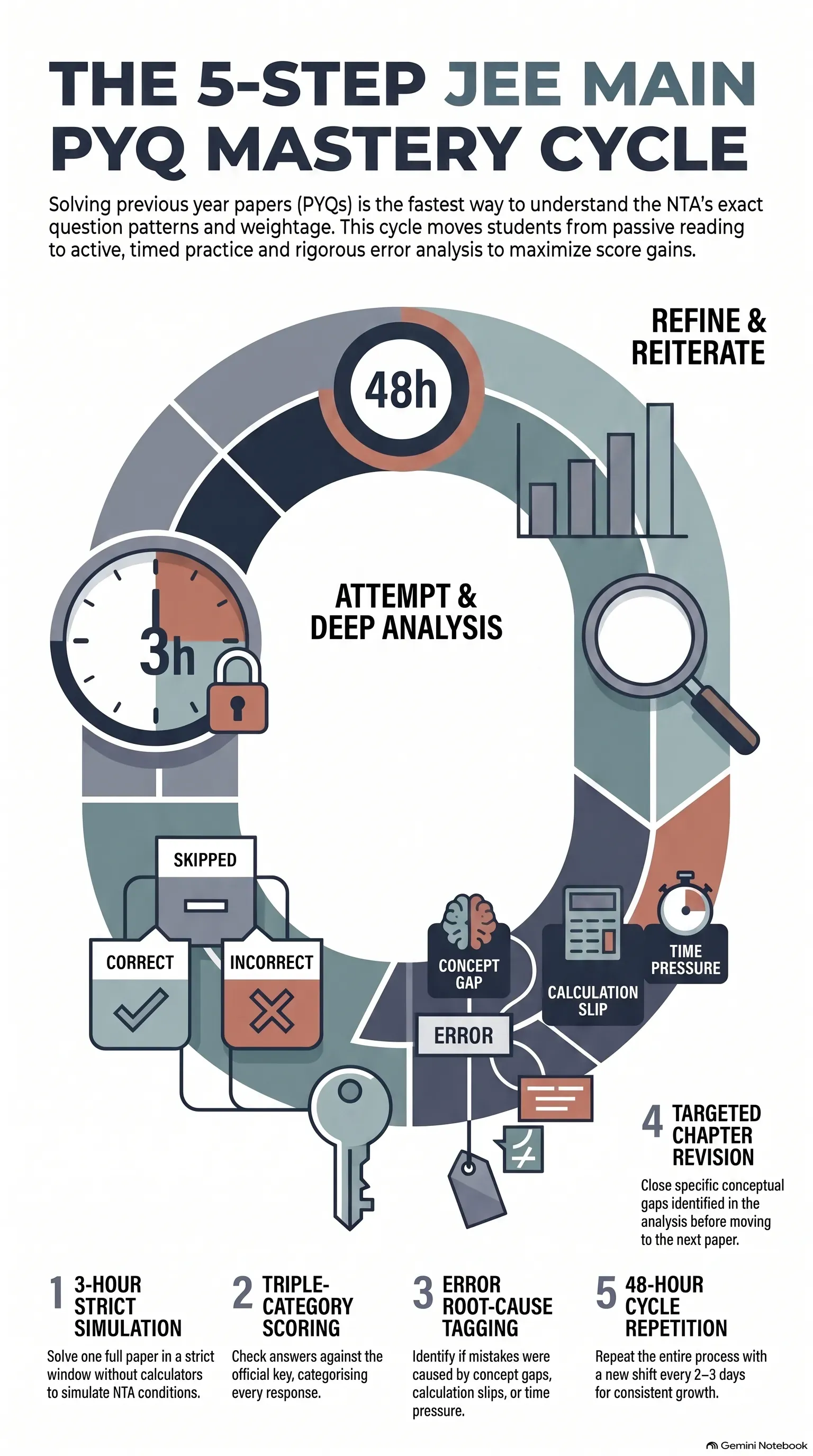
Solving papers without a structured review is just time-pass. Here's the four-step approach our JEE Main 2027 test-series toppers actually follow.
Step 1: Attempt Every Paper Under Real Exam Conditions
Set a strict 3-hour timer, no notes, no calculator — exactly as you'd face on exam day. The time pressure is the whole point of solving a JEE Main previous year question paper instead of a casual chapter revision.
Step 2: Do a Chapter-Wise Error Analysis After Every Attempt
Don't just check your score — tag every wrong or skipped question by chapter and error type (concept gap, calculation slip, or time pressure). Over 5–6 JEE Main PYQ papers, this log shows exactly which 3–4 chapters cost you the most marks.
Step 3: Revisit the Concept, Not Just the Answer
For every miss, go back to the source chapter using our JEE Main revision notes before moving to the next paper. Re-solving the same question without fixing the underlying gap wastes the attempt.
Step 4: Re-Attempt Only the Missed Questions a Week Later
Keep a running error bank from every JEE Main question paper you solve. A week later, re-attempt only the flagged questions — if you're still missing them, that chapter needs a full re-study, not just repetition.
JEE Main Previous Year Question Paper vs Mock Tests — Which Should You Prioritize?
Both matter, but they test different things.
Factor | Previous Year Question Paper | Mock Test |
|---|---|---|
Source | Actual NTA-administered exam | Simulated by coaching/edtech platforms |
Best for | Calibrating real difficulty & style | Practicing volume & speed under pressure |
Ideal frequency | 1–2 per week, deeply analyzed | 2–3 per week, for stamina |
When to start | 4–6 months before exam | Final 2–3 months before exam |
Confidence signal | How you'll score on the real JEE Main question paper | How consistent you are across repeated attempts |
For the mock-test half of this plan, see our guide on how many mock tests to attempt before JEE Main.
Chapter-Wise JEE Main PYQ or Full-Length Paper — What Should You Solve First?
If you're behind on a specific chapter, don't jump into a full-length attempt yet — you'll waste time on sections you've already mastered. Start with our Maths topic-wise previous year questions and Chemistry topic-wise PYQs to close specific gaps, then move to a full JEE Main question paper attempt once your chapter-wise accuracy crosses 75–80%.
JEE Advanced Previous Year Question Paper (For After You Clear JEE Main)
Once you've built confidence with the archive above, aspirants targeting IITs should also start on JEE Advanced previous year question papers — the format shifts from JEE Main's single-correct MCQs to JEE Advanced's multi-concept, multi-correct questions.
Ready to convert PYQ practice into a real rank jump? Join eSaral's JEE Main 2027 batch →
Want a faculty-guided study plan instead of self-tracking your weak chapters? Explore eSaral's JEE Online & Offline Courses — IIT Bombay faculty, structured video lectures, and a 5-layer doubt-solving system built around exactly this PYQ-to-mock progression.
Frequently Asked Questions
How many years of JEE Main previous year paper should I solve?
Solve at least the last 5 years — ideally 2022 to 2026 — across all shifts. NTA began major pattern changes from 2019 onward, so older papers have different structures and are less representative of what you will face. After completing 5 years, go back further for additional practice.
Should I solve the JEE Main previous year question paper shift-wise or combined?
Solve them shift-wise, one complete paper at a time, in a timed 3-hour sitting. Each shift is a separate NTA paper with different questions. Mixing shifts defeats the purpose of timed practice. Analyse your performance after each paper before moving to the next one.
Are JEE Main previous year papers enough for preparation?
Previous year papers are essential but not sufficient on their own. Use them alongside NCERT for fundamentals, eSaral's chapter-wise practice problems for topic depth, and full mock tests for exam simulation. Previous year papers tell you what to expect — structured study builds the knowledge to answer it.
How is JEE Main different from JEE Advanced?
JEE Main is a computer-based test with MCQs and numerical questions, worth 300 marks across 3 subjects. JEE Advanced has two papers, including integer-type and matrix-match questions, and tests deeper problem-solving. JEE Advanced is significantly harder and is attempted only after qualifying for JEE Main.
Is there negative marking in JEE Main numerical questions?
Yes. Since numerical value questions became compulsory for all candidates from 2025 onward, NTA also extended −1 negative marking to them, same as MCQs. Every correct numerical answer earns +4 marks, and every incorrect one costs −1. Since all 5 numerical questions per subject are now compulsory, students must attempt them carefully rather than guessing randomly — wrong guesses can pull your score down just like a wrong MCQ.
How do I use the JEE Main previous year question paper effectively?
Solve each paper under strict timed conditions — 3 hours, no breaks, no looking up answers mid-paper. After the attempt, analyse every wrong answer and every skipped question. Identify which topic cost you the most marks. Revise that topic before attempting the next paper. This loop of test, analyse, and revise is what actually improves your score.
What is the JEE Main 2027 exam pattern for the question paper?
90 questions across Physics, Chemistry and Mathematics (300 marks total) — 20 compulsory MCQs and 5-of-10 optional numerical-value questions per subject, unchanged from recent years.
Should I solve a JEE Main previous year question paper in one sitting or by chapter?
Both, at different stages. Early in prep, solve chapter-wise to build accuracy; within 3–4 months of the exam, switch to full 3-hour, full-paper attempts to build stamina and time management.
Are JEE Main previous year papers harder or easier than mock tests?
Neither — they're different. A previous year question paper reflects NTA's real calibration; a mock test is a platform's approximation. Use PYQs to calibrate difficulty and mock tests to build speed.