
JEE Main 2027 Syllabus PDF (OUT), Check Subject-Wise Detailed Syllabus, Exam Pattern, Marking Scheme - PDF Download
eSaral › JEE › JEE Main ›JEE Main 2027 Syllabus PDF (OUT)
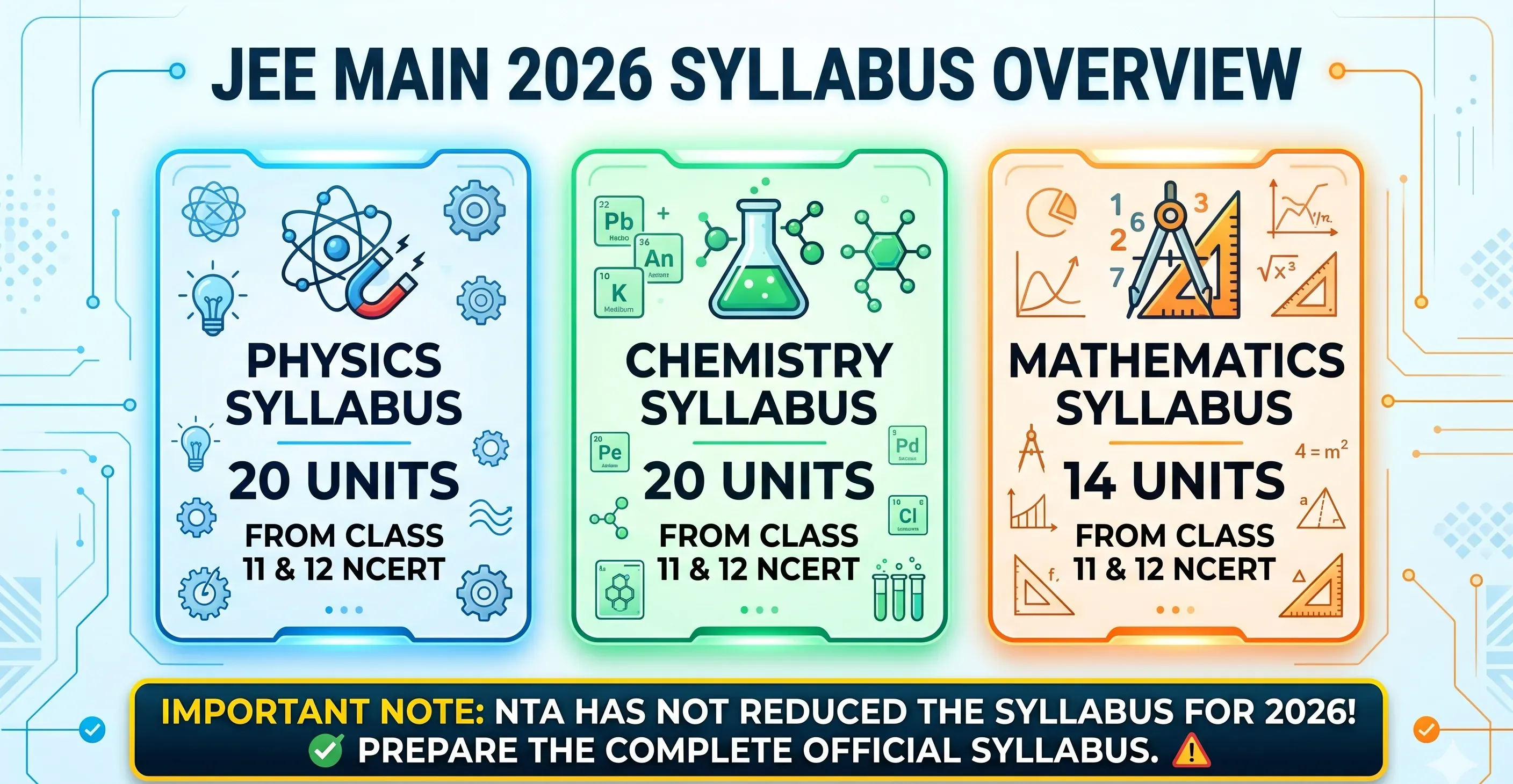
JEE Main 2027 Syllabus Overview
JEE Main is conducted by the National Testing Agency (NTA) for admission to B.E./B.Tech.Tech.Tech, B.Arch, and B.Planning programmes at NITs, IIITs, and other centrally funded institutions. For Paper 1 (B.E./B.Tech), the syllabus spans three subjects.
Subject | Topic | Units |
Physics | Mechanics, Electricity, Optics, Modern Physics and more | 20 Units |
Chemistry | Physical, Inorganic, and Organic Chemistry | 20 Units |
Mathematics | Calculus, Algebra, Coordinate Geometry, Probability | 14 Units |
JEE Main 2027: Exam Format & Marking Scheme
Particulars | Details |
|---|---|
Exam Mode | Computer-Based Test (CBT) |
Duration | 3 Hours |
Total Questions | 90 (30 per subject) |
Total Marks | 300 |
Marking Scheme | +4 correct | −1 wrong (MCQ) | No negative for numericals |
Sessions | January 2027 & April 2027 (tentative) |
Syllabus Base | Class 11 + Class 12 NCERT |
Each subject's 30 questions are split between Section A (MCQs, 20 questions) and Section B (Numerical Value, attempt any 5 out of 10). For a deeper dive into the exam structure, see the JEE Main Exam Pattern.
JEE Main Physics Syllabus 2027: All 20 Units
Physics tests your ability to apply concepts to unseen situations. Numerical problem-solving speed is as important as conceptual clarity. Below is the complete unit list from the official NTA PDF.
💡 Expert Tip — Saransh Gupta, IIT Bombay AIR-41
In JEE Main Physics, almost every question is either a direct formula application or a one-step conceptual inference. The students who score 90+ in Physics are not smarter — they have simply practised more past year questions. Spend 60% of your Physics time on Electrostatics, Current Electricity, Optics, and Modern Physics. These four areas contribute roughly 10–12 questions per session.
Unit-wise Physics Chapters
Unit No. | Chapter / Topic | Weightage |
|---|---|---|
1 | Units and Measurements | Low |
2 | Kinematics | Medium |
3 | Laws of Motion | Medium |
4 | Work, Energy and Power | Medium |
5 | Rotational Motion | High |
6 | Gravitation | Medium |
7 | Properties of Solids and Liquids | Medium |
8 | Thermodynamics | High |
9 | Kinetic Theory of Gases | Medium |
10 | Oscillations and Waves | High |
11 | Electrostatics | High |
12 | Current Electricity | High |
13 | Magnetic Effects of Current & Magnetism | High |
14 | Electromagnetic Induction & Alternating Currents | High |
15 | Electromagnetic Waves | Low |
16 | Optics | High |
17 | Dual Nature of Matter & Radiation | High |
18 | Atoms and Nuclei | High |
19 | Electronic Devices | Medium |
20 | Experimental Skills | Low |
To see how the exam pattern translates into topic-level questions, explore the JEE Mains PYQ chapter wise page and practise questions organised chapter by chapter.
How Much Does Each Physics Area Carry?
Based on analysis of multiple JEE Main sessions, here is the approximate topic-area distribution
Physics Topic | Percentage |
Electrostatics & Current Electricity | ~27% |
Optics + Modern Physics | ~23% |
Mechanics (Units 2–6) | ~22% |
Thermodynamics & Waves | ~15% |
Other units | ~13% |
Practise concept-wise using JEE Main chapter-wise previous year questions to see exactly how questions are framed in each high-weightage unit.
JEE Main Chemistry Syllabus 2027: All 20 Units
Chemistry is the most scoring subject in JEE Main when you approach it right. The syllabus divides cleanly into Physical, Inorganic, and Organic branches — each with a distinct preparation strategy.
Physical Chemistry (Units 1–8)
- Some Basic Concepts in Chemistry
- Atomic Structure
- Chemical Bonding & Molecular Structure
- Chemical Thermodynamics
- Solutions
- Equilibrium
- Redox Reactions & Electrochemistry
- Chemical Kinetics
Inorganic Chemistry (Units 9–12)
- Classification of Elements & Periodicity
- p-Block Elements
- d- and f-Block Elements
- Coordination Compounds
Organic Chemistry (Units 13–20)
- Purification & Characterisation of Organic Compounds
- Some Basic Principles of Organic Chemistry (GOC)
- Hydrocarbons
- Organic Compounds Containing Halogens
- Organic Compounds Containing Oxygen
- Organic Compounds Containing Nitrogen
- Biomolecules
- Principles Related to Practical Chemistry
💡 Expert Tip — Prateek Gupta, IIT Bombay
For Inorganic Chemistry, every single line in the NCERT textbook is a potential JEE Main question. Students who read NCERT Inorganic lazily and rely only on short notes lose 3–4 easy marks per session. Read NCERT Chemistry Part 1 and Part 2 cover-to-cover, at least three times before your exam. Reactions, exceptions, and application-based facts all come directly from NCERT.
Chemistry Branch | Approximate Weightage | Key Strategy |
|---|---|---|
Physical Chemistry | ~35–40% | Problem-solving practice; use PYQs |
Inorganic Chemistry | ~30–35% | NCERT line-by-line reading |
Organic Chemistry | ~30–35% | Reaction mechanisms + named reactions |
JEE Main Mathematics Syllabus 2027: All 14 Units
Mathematics separates top scorers from average ones in JEE Main. Speed and accuracy both matter. A student who can solve a Coordinate Geometry problem in 90 seconds instead of 3 minutes effectively gains two extra questions attempted.
Unit No. | Chapter / Topic | Weightage |
|---|---|---|
1 | Sets, Relations & Functions | Medium |
2 | Complex Numbers & Quadratic Equations | High |
3 | Matrices & Determinants | High |
4 | Permutations & Combinations | Medium |
5 | Binomial Theorem & Its Simple Applications | Medium |
6 | Sequences & Series | High |
7 | Limits, Continuity & Differentiability | High |
8 | Integral Calculus | High |
9 | Differential Equations | Medium |
10 | Coordinate Geometry | High |
11 | Three-Dimensional Geometry | High |
12 | Vector Algebra | Medium |
13 | Statistics & Probability | High |
14 | Trigonometry | Medium |
Across JEE Main sessions from 2019–2025, Integral Calculus, Coordinate Geometry, and Matrices & Determinants together contributed an average of 12–14 questions out of 30 in the Mathematics section. These three alone can lift your Mathematics score by 48–56 marks if mastered well.
For chapter-wise practice, visit eSaral's JEE Main Important Questions section, curated by topic and difficulty level.
JEE Main Syllabus 2027 — Paper 2 (B.Arch & B.Planning)
Paper 2 has two variants. Paper 2A is for B.Arch admissions, and Paper 2B is for B.Planning. Both share the same Mathematics syllabus as Paper 1, but add specialised components.
Component | Paper 2A (B.Arch) | Paper 2B (B.Planning) |
|---|---|---|
Mathematics | ✅ Same as Paper 1 | ✅ Same as Paper 1 |
Aptitude Test | ✅ 3D Visualisation, Spatial Reasoning | ✅ 3D Visualisation, Spatial Reasoning |
Drawing Test | ✅ Sketching from memory (urbanscape, landscape, rural life) | ❌ Not applicable |
Planning Section | ❌ Not applicable | ✅ Social Sciences, General Awareness, Thinking Skills |
Total Marks | 400 | 400 |
For B.Arch aspirants, the Drawing Test requires pencils, a geometry box, erasers, and colour pencils/crayons — candidates must bring their own materials to the exam centre.
How Should You Prepare for the JEE Main 2027 Syllabus?
Having the syllabus is step one. Using it strategically is what separates toppers from the rest. Here is a battle-tested preparation framework based on how eSaral students have improved by an average of 15+ percentile points in recent batches.
Phase-wise Study Plan Based on JEE Main Syllabus
Phase | Timeline | Focus | Target |
|---|---|---|---|
Phase 1 — Foundation | 4 months | Complete syllabus coverage, NCERT mastery | All chapters are done once |
Phase 2 — Reinforcement | 3 months | Chapter-wise PYQs, formula sheets, and weak areas | 60%+ in mock tests |
Phase 3 — Simulation | 6 weeks | Full-length mock tests, time management drills | 75%+ in mock tests |
Phase 4 — Revision | 2 weeks | Quick notes, important formulas, mind maps | Confidence and speed |
Subject-wise Preparation Tips from IIT Faculty
Physics: Master the theory from NCERT, then immediately practice 20+ numericals per chapter. Physics numerical patterns repeat across sessions. JEE Main ke liye Physics mein formula application hi sab kuch hai — concepts clear hone ke baad practice hi king hai.
Chemistry: Split your time 40% Physical, 35% Inorganic, 25% Organic in early phases. As the exam approaches, shift time toward Inorganic since the NCERT revision gives the fastest score gains.
Mathematics: Never skip Integral Calculus or Coordinate Geometry, even if they feel hard. These two units alone can give you 8–10 marks. Practice speed — the student who solves faster in Maths has more time for Physics and Chemistry.
💡 Resource Tip
Use eSaral's JEE Main Revision Notes and Mind Maps for Physics, Chemistry & Maths for efficient last-month revision across all three subjects.
Which Chapters Are Most Important in JEE Main 2027?
Not all chapters are equal in JEE Main. Data from multiple sessions since 2019 shows certain chapters are tested almost every year. Prioritise these without skipping others entirely.
Subject | Must-Do Chapters (High Repeatability) |
|---|---|
Physics | Electrostatics, Current Electricity, Optics (Ray + Wave), Dual Nature & Atoms & Nuclei, Rotational Motion, Thermodynamics |
Chemistry | Chemical Bonding, Thermodynamics, Equilibrium, Electrochemistry, GOC, Hydrocarbons, Coordination Compounds, p-Block Elements |
Mathematics | Integral Calculus, Coordinate Geometry (Circles, Conics), Matrices & Determinants, Probability, 3D Geometry, Sequences & Series. |
Practice these high-priority chapters using chapter-wise JEE Main previous year question papers with solutions available on eSaral.
JEE Main PYQs & Notes
Chapter-wise questions with solutions. Free to access.
Chapter-wise PYQs → Free Notes Revision Notes
Bookmark this page and revisit after jeemain.nta.ac.In NTA, release the official 2027 brochure to check for any updates. Good luck — you've got this.

Frequently Asked Questions
Has the JEE Main 2026 syllabus been reduced?
NTA has not officially announced any reduction in the JEE Main 2026 syllabus. Candidates should prepare the complete syllabus as per the official NTA PDF, covering all Class 11 and 12 NCERT topics across Physics, Chemistry, and Mathematics. Keep checking the official website for updates.
Which chapters carry the most weightage in JEE Main 2026 Physics? .
Electrostatics, Current Electricity, Optics, and Modern Physics (Atoms & Nuclei, Dual Nature) are consistently high-weightage chapters, contributing around 3–5 questions per session. Mechanics topics like Laws of Motion and Work-Energy are also frequently tested
Is NCERT enough for JEE Main Chemistry 2026?
NCERT is the foundation for JEE Main Chemistry, especially for Inorganic and Organic Chemistry,y where 60–70% of questions are directly NCERT-based. However, Physical Chemistry requires additional problem-solving practice beyond the NCERT. Always master NCERT first, then practice JEE-level questions.
How many questions are there in JEE Main 2026 Paper 1?
JEE Main 2026 Paper 1 (B.E./B.Tech) has 90 questions — 30 per subject (Physics, Chemistry, Mathematics). Each subject includes Section A (20 MCQs) and Section B (10 numerical questions, attempt any 5). Total marks: 300.
What is the difference between the JEE Main and JEE Advanced syllabi?
JEE Main syllabus is based on Class 11 and 12 NCERT. JEE Advanced has a broader and deeper syllabus with additional topics and a higher difficulty level, including advanced concepts in Organic Chemistry, Physical Chemistry, and Mathematics not fully covered in NCERT.
When will NTA release the official JEE Main 2026 syllabus? .
NTA is expected to release the official syllabus along with the information brochure around November 2025. Until then, students should follow the previous year’s syllabus, which remains largely unchanged.
Is there negative marking in JEE Main 2026?
Yes. For MCQs (Section A): +4 for correct, −1 for incorrect. For Numerical Value questions (Section B): +4 for correct and no negative marking for incorrect answers.