
JEE Main 2027 Syllabus (Updated): Subject-wise PDF, Chapter-wise Topics & Preparation Guide
eSaral › JEE › JEE Main 2027 Syllabus (Updated): Subject-wise PDF, Chapter-wise Topics & Preparation Guide

🚀 Checkout eSaral Courses
Preparing for JEE Main 2027 begins much before the official notification is released. Every year, lakhs of engineering aspirants compete for admission into India's leading engineering institutes through the Joint Entrance Examination (Main). Understanding the examination early helps students build stronger concepts, avoid preparation mistakes, and create a realistic study plan.
Whether you are currently studying in Class 11, Class 12, or planning a drop year, this guide explains everything important about JEE Main 2027 in a structured manner. Instead of collecting information from multiple websites, you can use this page as your complete reference for eligibility, exam pattern, marking scheme, syllabus overview, important dates, and preparation roadmap.
Note: Official dates and notification for JEE Main 2027 will be released by the National Testing Agency (NTA). Information on this page is based on the latest examination pattern and previous notification trends. The article will be updated whenever official announcements are released.
JEE Main 2027 Overview
Particular | Details |
|---|---|
Exam Name | Joint Entrance Examination (Main) 2027 |
Conducting Authority | National Testing Agency (NTA) |
Mode of Examination | Computer-Based Test (CBT) |
Frequency | Expected Twice a Year (January & April Sessions) |
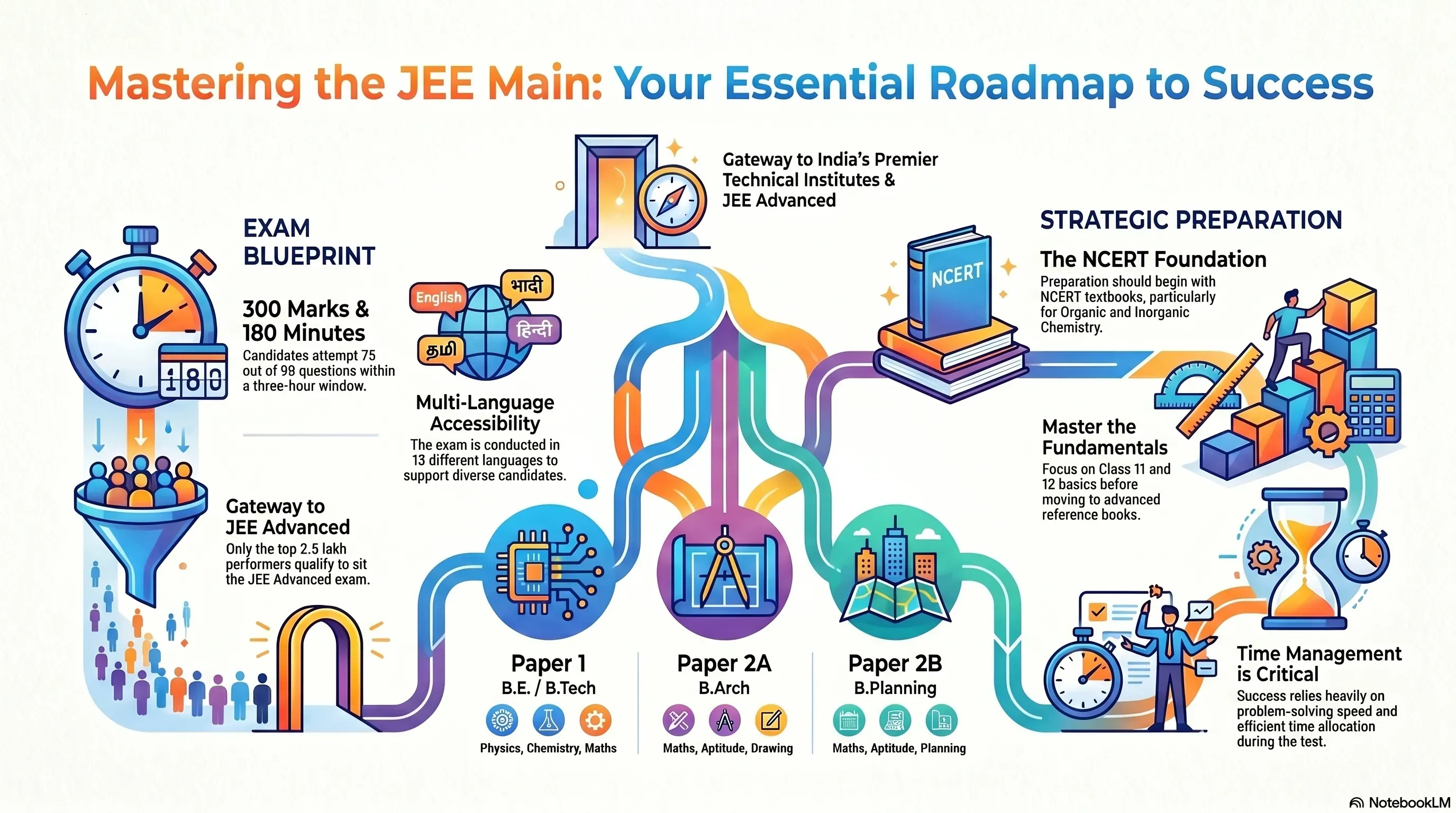
Papers | Paper 1 (B.E./B.Tech), Paper 2A (B.Arch), Paper 2B (B.Planning) |
Subjects | Physics, Chemistry, Mathematics |
Duration | 3 Hours |
Question Type | MCQs + Numerical Value Questions |
Official Website | |
Difficulty Level | Moderate to Challenging |
Purpose | Admission to NITs, IIITs, GFTIs & JEE Advanced Eligibility |
JEE Main is a standardized examination conducted in various states of India. It is conducted at the undergraduate level to provide admission to a variety of top-tier engineering and technical institutes, either funded by the Government or privately owned.
The examination is structured in three distinct categories:
- Paper 1, for those who wish to pursue Bachelor of Engineering or Bachelor of Technology courses
- Paper 2A, for those wishing to pursue Bachelor of Architecture or Bachelor of Planning courses
- Paper 2B, for those seeking to pursue a Bachelor of Planning course. The exam will be held twice a year, in January and April
The questions asked in JEE Main are typically NCERT-based. However, JEE Main exam is renowned for its challenging questions, designed to assess the candidate's comprehension of concepts and analytical abilities.
When Will JEE Main 2027 Registration Start?
The official schedule will be announced by NTA. Based on previous examination cycles, the expected timeline is as follows.
Event | Expected Timeline |
|---|---|
Notification Release | November 2026 |
Registration Begins | November 2026 |
Last Date to Apply | December 2026 |
Admit Card | January 2027 |
Session 1 Exam | January 2027 |
Session 1 Result | February 2027 |
Session 2 Registration | February 2027 |
Session 2 Exam | April 2027 |
Final Result | April 2027 |
JoSAA Counselling | June 2027 |
These dates are tentative and will be updated after the official notification.
What is the Complete JEE Main 2027 Syllabus?(Expected)
The JEE Main 2027 syllabus is expected to follow the NCERT curriculum of Classes 11 and 12, similar to previous years. The National Testing Agency (NTA) will release the official syllabus along with the JEE Main 2027 Information Bulletin. Until then, aspirants can prepare according to the latest syllabus pattern used in recent sessions.
The syllabus is divided into Physics, Chemistry, and Mathematics, covering fundamental concepts, application-based learning, and numerical problem-solving. Since JEE Main tests conceptual understanding rather than rote memorization, students should focus on building strong fundamentals before attempting advanced-level questions.
Note: This syllabus is based on the latest JEE Main pattern. Any changes announced by NTA for JEE Main 2027 will be updated here immediately.
JEE Main 2027 Syllabus Overview
Subject | Major Areas Covered |
|---|---|
Physics | Mechanics, Thermodynamics, Electricity & Magnetism, Optics, Modern Physics |
Chemistry | Physical Chemistry, Organic Chemistry, Inorganic Chemistry |
Mathematics | Algebra, Calculus, Coordinate Geometry, Trigonometry, Vectors & 3D Geometry |
JEE Main 2027 Physics Syllabus
The Physics syllabus combines theoretical concepts with numerical applications. Questions are designed to assess conceptual clarity, analytical thinking, and problem-solving ability.
Unit | Important Topics |
|---|---|
Physics & Measurement | Units, Dimensions, Errors, Significant Figures |
Kinematics | Motion in One & Two Dimensions, Relative Motion |
Laws of Motion | Newton's Laws, Friction, Circular Motion |
Work, Energy & Power | Conservation of Energy, Power, Potential Energy |
Rotational Motion | Torque, Angular Momentum, Moment of Inertia |
Gravitation | Universal Law, Satellites, Escape Velocity |
Properties of Solids & Liquids | Elasticity, Surface Tension, Viscosity |
Thermodynamics | Heat Transfer, First & Second Law |
Kinetic Theory of Gases | Ideal Gas Equation, RMS Speed |
Oscillations & Waves | SHM, Wave Motion, Sound Waves |
Electrostatics | Electric Field, Potential, Capacitors |
Current Electricity | Ohm's Law, Kirchhoff's Laws, Wheatstone Bridge |
Magnetic Effects of Current | Biot-Savart Law, Ampere's Law |
Electromagnetic Induction | Faraday's Law, Lenz's Law |
Alternating Current | AC Circuits, Transformers |
Electromagnetic Waves | Wave Spectrum, Properties |
Optics | Reflection, Refraction, Interference, Diffraction |
Dual Nature of Matter | Photoelectric Effect, Matter Waves |
Atoms & Nuclei | Bohr Model, Radioactivity |
Electronic Devices | Semiconductors, Diodes, Transistors |
JEE Main 2027 Chemistry Syllabus
Physical Chemistry | Organic Chemistry | Inorganic Chemistry |
|---|---|---|
Mole Concept | General Organic Chemistry | Classification of Elements |
Atomic Structure | Purification & Characterisation | Periodic Table |
Chemical Bonding | Hydrocarbons | Chemical Bonding |
States of Matter | Haloalkanes & Haloarenes | Hydrogen |
Thermodynamics | Alcohols, Phenols & Ethers | s-Block Elements |
Chemical Equilibrium | Aldehydes & Ketones | p-Block Elements |
Ionic Equilibrium | Carboxylic Acids | d- & f-Block Elements |
Redox Reactions | Amines | Coordination Compounds |
Solutions | Biomolecules | Environmental Chemistry |
Electrochemistry | Polymers | Metallurgy |
Chemical Kinetics | Chemistry in Everyday Life | — |
Surface Chemistry | — | — |
JEE Main 2027 Mathematics Syllabus
Mathematics focuses on conceptual understanding, logical reasoning, and speed-based problem-solving.
Unit | Topics |
|---|---|
Sets, Relations & Functions | Sets, Relations, Functions |
Complex Numbers | Complex Plane, Quadratic Equations |
Matrices & Determinants | Matrix Operations, Inverse Matrix |
Permutations & Combinations | Counting Principles |
Mathematical Induction | Principle of Induction |
Binomial Theorem | Expansion & Applications |
Sequences & Series | AP, GP, HP |
Limits & Continuity | Functions, Limits |
Differentiation | Applications of Derivatives |
Integral Calculus | Definite & Indefinite Integrals |
Differential Equations | First Order Differential Equations |
Coordinate Geometry | Straight Line, Circle, Parabola, Ellipse, Hyperbola |
Three-Dimensional Geometry | Direction Cosines, Planes |
Vector Algebra | Dot Product, Cross Product |
Statistics | Mean, Variance, Standard Deviation |
Probability | Conditional Probability, Bayes Theorem |
Trigonometry | Identities, Equations, Inverse Trigonometric Functions |
Which Chapters Have the Highest Weightage in JEE Main2027?(Based on Previous Year Trends)
While NTA does not officially publish chapter-wise weightage, analysis of previous JEE Main papers shows that some topics appear more frequently than others.
Physics | Chemistry | Mathematics |
|---|---|---|
Current Electricity | Chemical Bonding | Calculus |
Modern Physics | Organic Chemistry | Coordinate Geometry |
Electrostatics | Mole Concept | Algebra |
Thermodynamics | Electrochemistry | Vectors & 3D |
Optics | Coordination Compounds | Probability |
SHM & Waves | Periodic Table | Matrices |
Magnetism | Chemical Kinetics | Trigonometry |
Important: Do not skip low-weightage chapters. Every chapter has the potential to contribute to your final score.
JEE Main Previous Year Question Papers (FREE PDF Download)
Students checking their expected percentile can also refer to the actual JEE Mains paper to recheck their responses and better understand how their performance aligns with the expected percentile.
JEE Advanced Previous Year Question Paper (FREE PDF Download)
Chapter-wise practice is especially useful during revision, so include the JEE PYQ chapter wise page among the key preparation resources.
Who is Eligible to Appear for JEE Main 2027?
Before applying, students should carefully verify the eligibility requirements. Although the official notification will confirm the final criteria, the eligibility is generally similar to previous years. It is important for aspirants planning to appear for JEE Main 2027 to review the eligibility criteria for JEE Main and ensure they fulfill all the requirements before applying for the exam.
Educational Qualification
Candidates should have:
- Passed Class 12 or equivalent examination
OR
- Be appearing in Class 12 during the qualifying year specified by NTA.
Students from recognised boards including CBSE, ICSE, State Boards, NIOS, and equivalent qualifications are generally eligible, subject to NTA rules.
Age Limit
Currently, NTA has not prescribed any specific upper age limit for JEE Main. However, candidates must satisfy the admission eligibility requirements of the institutes they apply to.
Students should always verify institute-specific criteria during counselling.
Number of Attempts
Candidates can appear for JEE Main up to six times across three consecutive years, beginning with the year they pass their Class 12 examination. Since the exam is generally conducted in two sessions each year (January and April), students get two opportunities annually to improve their scores.
What is the Latest JEE Main 2027 Exam Pattern?
The examination primarily consists of three subjects:
- Physics
- Chemistry
- Mathematics
Paper 1 Exam Pattern (B.E./B.Tech)
Particular | Details |
|---|---|
Mode | Computer-Based Test |
Duration | 3 Hours |
Subjects | Physics, Chemistry, Mathematics |
Total Questions | 75 (Expected) |
Total Marks | 300 |
Medium | Multiple Languages |
Question Types | MCQ + Numerical Value |
JEE Main 2027 Marking Scheme
Question Type | Marks |
|---|---|
Correct Answer | +4 |
Incorrect MCQ | -1 |
Unattempted | 0 |
Mistakes That Can Reduce Your JEE Main 2027 Score
Even well-prepared students lose marks due to avoidable mistakes. Some of the most common include:
- Ignoring weak chapters until the final months.
- Practicing questions without reviewing incorrect answers.
- Avoiding mock tests due to fear of low scores.
- Switching between multiple study resources without completing any.
- Memorizing solutions instead of understanding concepts.
- Spending too much time on difficult questions during the exam.
- Neglecting revision while focusing only on new topics.
Avoiding these mistakes can improve both confidence and overall performance.
Why Mock Test Analysis Matters More Than Mock Tests
Attempting a mock test is only the first step. The real improvement comes from carefully analyzing the results after every test.
Students should review:
- Incorrect answers and their reasons.
- Questions skipped due to lack of confidence.
- Time spent on each section.
- Frequently repeated conceptual mistakes.
- Chapters requiring additional revision.
A detailed performance analysis helps convert every mock test into a learning opportunity rather than simply another score.
🚀 Checkout eSaral Courses
Frequently Asked Questions
What is the syllabus for JEE Main 2027?
JEE Main 2027 syllabus covers Physics, Chemistry, and Mathematics from the Class 11 and 12 curriculum as prescribed by NTA. The syllabus includes topics such as Mechanics, Electrostatics, Optics, Chemical Bonding, Organic Chemistry, Calculus, Vectors, and Coordinate Geometry. Always download the official NTA syllabus PDF from nta.ac.in before starting preparation, as minor changes may occur each year.
How many attempts are allowed in JEE Main?
Candidates can attempt JEE Main a maximum of three times in three consecutive years after passing Class 12. Each year, NTA conducts two sessions — January and April — so a candidate can appear in both sessions in one year, giving up to six total attempts within the three-year window.
Who is eligible for JEE Main 2027?
Students who have passed or are appearing in the qualifying Class 12 examination from a recognized board are generally eligible, subject to the official NTA notification and institute-specific admission criteria.
Is there any age limit for JEE Main 2027?
As per recent trends, NTA has not prescribed a specific upper age limit. However, participating institutes may have their own eligibility conditions.
When will JEE Main 2027 registration begin?
The official registration schedule is expected to be announced by the National Testing Agency (NTA) in late 2026. Candidates should regularly check the official website for updates.
Can I prepare for JEE Main 2027 alongside my Class 12 board exams?
Yes. Since there is significant overlap between the Class 12 syllabus and JEE Main, a well-planned schedule that balances board preparation with regular practice and revision can help students perform well in both examinations.
How should Class 11 students start preparing for JEE Main 2027?
Class 11 students should prioritize building strong concepts, completing chapters systematically, solving chapter-wise practice questions, and taking regular tests to identify areas that need improvement.