
JEE Main 2026 Question Paper, Answer Key & Solutions (Session 2 & Session 1)
eSaral › JEE › JEE Main › JEE Main 2026 Question Papers with Solutions

JEE Main 2026 Session 2 – April Attempt Question Papers
All JEE Main 2026 April session question papers with answer keys and detailed solutions are available below. Both Shift 1 (9:00 AM – 12:00 PM) and Shift 2 (3:00 PM – 6:00 PM) PDFs are uploaded after each exam. These are the most important papers for JEE Main 2026 April paper preparation and trend analysis.
For students preparing with the latest JEE Main attempt, the complete JEE Main previous year question paper provides access to papers from previous years and sessions, making it easier to practise the full range of JEE Main PYQs.
All PDFs include detailed answer keys and subject-wise solutions. Papers for April 6 & 8 will be uploaded after each shift ends.
Exam Date | Shift | PDF Download | Detailed Analysis |
|---|---|---|---|
April 02, 2026 | Shift 1 (9 AM–12 PM) | ||
April 02, 2026 | Shift 2 (3 PM–6 PM) | ||
April 04, 2026 | Shift 1 (9 AM–12 PM) | ||
April 04, 2026 | Shift 2 (3 PM–6 PM) | ||
April 05, 2026 | Shift 1 (9 AM–12 PM) | ||
April 05, 2026 | Shift 2 (3 PM–6 PM) | ||
April 06, 2026 | Shift 1 (9 AM–12 PM) | ||
April 06, 2026 | Shift 2 (3 PM–6 PM) | ||
April 08, 2026 | Shift 2 (3 PM–6 PM) |
1st Attempt not as expected? Get 99%ile in April Attempt → Click here
Compare difficulty across all April shifts: All Shift Comparison & Analysis →
Also check the official JEE Main 2026 Answer Key to verify your responses and estimate your score.
JEE Main 2026 Live Paper Analysis – Session 2 (April)
eSaral's IIT-qualified expert faculty conduct shift-wise live paper analysis on YouTube immediately after each exam. Watch topic-wise difficulty breakdown, expected cutoffs, and scoring insights.
Exam Date | Shift 1 Analysis | Shift 2 Analysis |
|---|---|---|
April 2, 2026 | ||
April 4, 2026 | ||
April 5, 2026 | ||
April 6, 2026 | ||
April 8, 2026 |
Expert Tip by eSaral IIT Faculty: Watch the live analysis within 2 hours of your exam while the paper is fresh in your mind. Cross-check your responses before the official JEE Main 2026 answer key is released — students who do this can more accurately estimate their score and plan their next steps.
JEE Main 2026 Session 1 – January Attempt Question Papers
All JEE Main 2026 January session question papers are available below as free PDFs with detailed solutions. The JEE Main 2026 question paper follows the NCERT syllabus. Both morning and evening shift papers from January 21–28 are available for download.
Exam Date | Shift | PDF Download | Complete Analysis |
|---|---|---|---|
Jan 21, 2026 | Shift 1 (9 AM–12 PM) | ||
Jan 21, 2026 | Shift 2 (3 PM–6 PM) | ||
Jan 22, 2026 | Shift 1 (9 AM–12 PM) | ||
Jan 22, 2026 | Shift 2 (3 PM–6 PM) | Detailed Analysis | |
Jan 23, 2026 | Shift 1 (9 AM–12 PM) | ||
Jan 23, 2026 | Shift 2 (3 PM–6 PM) | ||
Jan 24, 2026 | Shift 1 (9 AM–12 PM) | ||
Jan 24, 2026 | Shift 2 (3 PM–6 PM) | ||
Jan 28, 2026 | Shift 1 (9 AM–12 PM) | ||
Jan 28, 2026 | Shift 2 (3 PM–6 PM) |
Session 1 didn't go as planned? → Bounce Back for Session 2
Compare difficulty across all January shifts: All Shift Comparison
JEE Main 2026 Live Paper Analysis – Session 1 (January)
Exam Date | Shift 1 Analysis | Shift 2 Analysis |
|---|---|---|
Jan 21, 2026 | ||
Jan 22, 2026 | ||
Jan 23, 2026 | ||
Jan 24, 2026 | ||
Jan 28, 2026 |
JEE Main 2026 Answer Key (Official & Unofficial)
After each session, NTA releases the JEE Main 2026 Answer Key in two phases — provisional and final. Students can raise objections during the challenge window (₹200 fee per question). Check the answer key page to verify your responses: JEE Main 2026 Answer Key →
Stage | Session 1 (January) | Session 2 (April) |
|---|---|---|
Provisional Answer Key | 1st week of February 2026 | 2nd week of April 2026 |
Challenge Window | 2–3 days | 2–3 days |
Final Answer Key | 3rd week of February 2026 | 4th week of April 2026 |
Official answer keys are published by the National Testing Agency (NTA) at jeemain.nta.nic.in. Always verify with the official source before calculating your final score.
How to Challenge the JEE Main 2026 Answer Key
If you believe an answer in the provisional key is incorrect, follow these steps:
- Visit jeemain.nta.nic.in during the challenge window
- Log in with your JEE Main 2026 application number and password
- Select the question(s) you want to challenge
- Upload supporting evidence (NCERT reference, textbook page, solved example)
- Pay ₹200 per question challenged (refunded if the challenge is accepted)
Expert Tip by eSaral IIT Faculty: Challenges are accepted only when backed by a credible source — NCERT, NTA-recommended textbooks, or established JEE reference books. Challenge only if you are confident and have a clear reference to support your answer.
To convert your score to expected rank or percentile, use our Marks vs Percentile Tool and Percentile to Rank Calculator.
.webp?2026-09-24T08%3A06%3A56.784Z)
JEE Main 2026 Exam Pattern & Marking Scheme
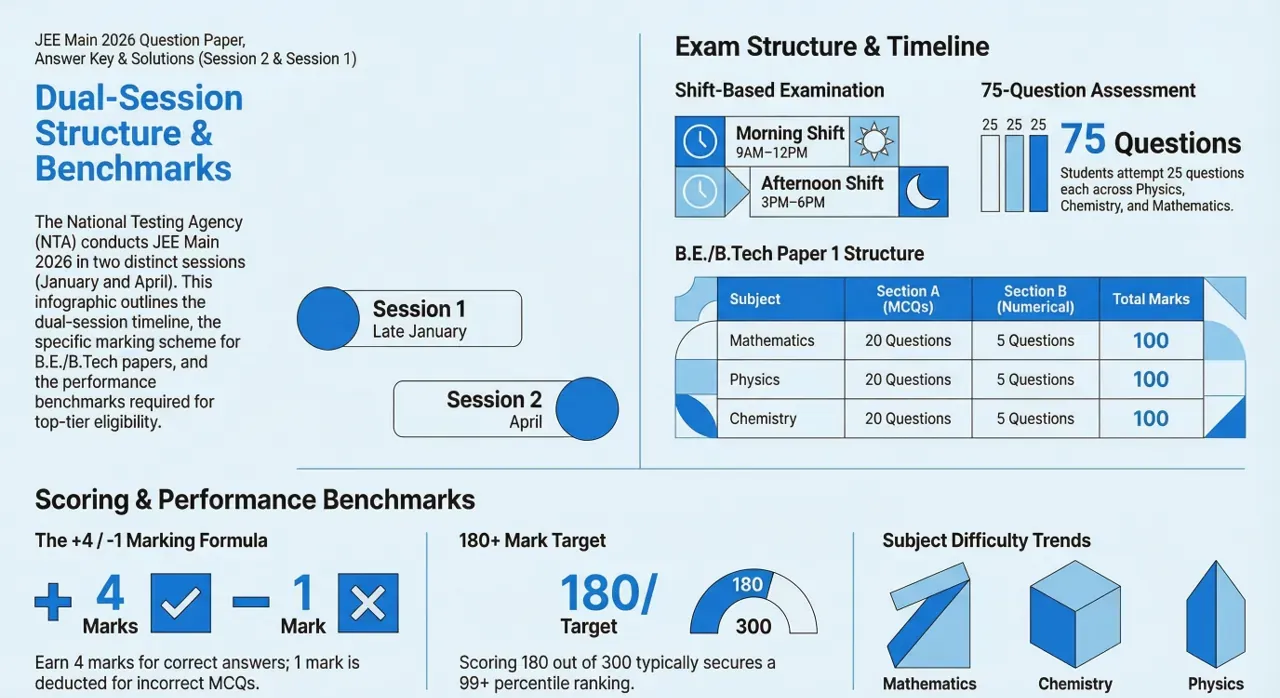
NTA follows the same JEE Main paper pattern as in previous years for 2026. Paper 1 (B.E./B.Tech) is a Computer-Based Test (CBT) of 3 hours with 75 questions.
Parameter | Details |
|---|---|
Total Questions | 75 (25 each — Physics, Chemistry, Mathematics) |
Total Marks | 300 (100 marks per subject) |
Question Types | 20 MCQs + 5 Numerical per subject |
Duration | 3 hours |
Shift 1 | 9 AM – 12 PM |
Shift 2 | 3 PM – 6 PM |
Mode | Computer-Based Test (CBT) |
Marking Scheme
Response Type | Marks |
|---|---|
✅ Correct Answer (MCQ) | +4 |
❌ Wrong Answer (MCQ) | −1 |
⬜ Unattempted | 0 |
Numerical (Integer) — Correct | +4 |
Numerical (Integer) — Wrong | 0 (No negative marking) |
Subject-wise Marks Distribution
Subject | Section A (MCQ) | Section B (Numerical) | Total |
|---|---|---|---|
Mathematics | 20 Qs × 4 = 80 | 5 Qs × 4 = 20 | 100 |
Physics | 20 Qs × 4 = 80 | 5 Qs × 4 = 20 | 100 |
Chemistry | 20 Qs × 4 = 80 | 5 Qs × 4 = 20 | 100 |
Total | 60 Questions | 15 Questions | 300 |
Score Calculator
Use this formula to calculate your JEE Main 2026 score instantly:
Score = (Correct MCQ Answers × 4) − (Wrong MCQ Answers × 1) + (Correct Numerical Answers × 4)
Scenario | Correct (MCQ) | Wrong (MCQ) | Correct (Numerical) | Estimated Score |
|---|---|---|---|---|
Strong attempt | 55 | 5 | 12 | 255 |
Average attempt | 40 | 10 | 8 | 182 |
Cautious attempt | 35 | 3 | 6 | 161 |
Weak attempt | 25 | 8 | 4 | 100 |
JEE Main 2026 Exam Dates
Session | Paper | Dates | Shifts |
|---|---|---|---|
Session 1 (January) | Paper 1 (B.E./B.Tech.) | Jan 21, 22, 23, 24, 28 – 2026 | Morning & Afternoon |
Session 1 (January) | Paper 2A (B.Arch) | Jan 29, 2026 | Afternoon |
Session 1 (January) | Paper 2B (B.Planning) | Jan 29, 2026 | Afternoon |
Session 2 (April) | Paper 1 (B.E./B.Tech.) | Apr 2, 4, 5, 6, 8 – 2026 | Morning & Afternoon |
🕘 Morning Shift: 9:00 AM – 12:00 PM | 🕒 Afternoon Shift: 3:00 PM – 6:00 PM
How to Download JEE Main 2026 Question Paper & Answer Key (PDF)
- Choose your session — scroll to Session 2 (April) or Session 1 (January) based on your exam.
- Find your exam date & shift — papers are listed date-wise with Shift 1 and Shift 2 clearly labeled.
- Click "PDF Download" — the link opens the complete question paper with answer key and detailed solutions.
- Calculate your score — use the score calculator above or the formula: Score = (Correct × 4) – (Wrong × 1)
- Check your expected percentile — use our JEE Main Marks vs Percentile tool to convert your score into expected percentile and rank.
JEE Main 2026 Subject-wise Difficulty Analysis
Based on JEE Main 2026 exam analysis from Session 1 and Session 2 shifts, here is the subject-wise breakdown of difficulty, important topics, and scoring opportunities.
Subject | Difficulty | Key Strategy | High-Weightage Topics |
|---|---|---|---|
Physics | Moderate | Conceptual + numerical focus | Modern Physics (18%), Heat & Thermodynamics, Electrostatics |
Chemistry | Easy–Moderate | NCERT-heavy — best scoring section | Organic (GOC & Hydrocarbons), Chemical Bonding, p-Block Elements |
Mathematics | Moderate–Tough | Strong calculation speed required | Integral Calculus (12%), Coordinate Geometry, Matrices & Determinants |
Physics — Difficulty: Moderate
Physics in JEE Main 2026 is conceptual and numerical in equal measure. The most frequently tested areas are:
- Modern Physics: 4–5 questions (~18% of Physics marks)
- Heat & Thermodynamics: 3–4 questions
- Electrostatics: 3–4 questions
Students from eSaral's 2025 JEE Main batch who practiced 200+ Physics numerical questions in the final 3 months improved their Physics score by an average of 12–18 marks.
Chemistry — Difficulty: Easy to Moderate
Chemistry is the highest-scoring section in JEE Main 2026 for most students. It is heavily NCERT-based. Focus areas include:
- Organic Chemistry (GOC & Hydrocarbons): 4–5 questions
- Chemical Bonding: 3–4 questions
- p-Block Elements: 3 questions
Mathematics — Difficulty: Moderate to Tough
Mathematics demands speed, calculation accuracy, and concept clarity. Key topics:
- Integral Calculus: 3–4 questions (~12% of Maths marks)
- Coordinate Geometry: 3 questions
- Matrices & Determinants: 2–3 questions
Topic-wise Distribution Summary (Session 1 + Session 2 Combined)
Topic | Approx. Questions | % of Subject Marks | Priority |
|---|---|---|---|
Modern Physics | 4–5 | 18% | High |
Electrostatics & Current Electricity | 3–4 | 14% | High |
Heat & Thermodynamics | 3–4 | 14% | High |
Integral Calculus | 3–4 | 14% | High |
Organic Chemistry (GOC) | 4–5 | 18% | High |
Chemical Bonding | 3–4 | 14% | High |
Coordinate Geometry | 3 | 12% | Medium |
p-Block Elements | 3 | 12% | Medium |
Strategy Tip: Attempt Chemistry first to build confidence and save time, then move to Physics, and tackle Mathematics last. Numerical questions in all subjects carry no negative marking — always attempt them.
Why Solving JEE Main 2026 Papers Is Important
Practicing the actual JEE Main 2026 question paper helps you:
- Understand the actual exam difficulty and question style
- Identify repeated concepts and high-weightage topics
- Improve time management across 75 questions in 3 hours
- Predict your rank and percentile range before the results
- Compare shift-wise difficulty variation for strategic planning
How Does Solving PYQs Improve JEE Main Score?
Solving JEE Main previous year question papers (PYQs) is the highest-ROI preparation activity available. NTA frequently repeats concept areas — not exact questions, but topic coverage and difficulty levels follow clear patterns. Students who solve 5+ years of PYQs before their exam score an average of 15–20 marks higher than those who rely on study material alone.
👉 To convert your score into rank, use: JEE Main Percentile to Rank Tool
👉 For counseling planning, check: JoSAA Opening & Closing Ranks
JEE Main Previous Year Question Papers with Solutions
Practicing JEE Main previous year question papers (PYQs) is the most powerful preparation strategy. Use these papers for chapter-wise practice and trend analysis:
Year | Question Paper Link |
|---|---|
JEE Main 2025 | |
JEE Main 2024 | |
JEE Main 2023 | |
JEE Main 2022 | |
JEE Main 2021 | |
JEE Main 2020 | |
JEE Main 2019 | |
Chapter-wise PYQs | All Chapters with Solutions |
For trend-based preparation, also check our JEE Main Marks vs Percentile Analysis.
Related Resources & Tools
Tool / Resource | Link |
|---|---|
🧮 Marks vs Percentile Calculator | Open Tool |
🎯 Percentile to Rank Tool | Open Tool |
🔑 JEE Main 2026 Answer Key | View Answer Key |
📊 All Shifts Paper Analysis | View Analysis |
🏛️ JoSAA Opening & Closing Ranks 2025 | View Data |
📈 JEE Main 2025 Exam Analysis | View Analysis |
📖 Best JEE Online Courses | |
🚀 IIT JEE Dropper / Bounce-Back Course |
Frequently Asked Questions
When will the JEE Main 2026 Session 2 April question papers be available?
JEE Main 2026 Session 2 question papers are uploaded on this page within a few hours after each shift ends. Papers for April 2, 4, 5, and 6 are already available. The April 8 Shift 2 paper will be added as soon as the exam concludes. All papers include complete answer keys and subject-wise solutions.
Which subject is easiest in JEE Main 2026?
Chemistry is consistently the easiest and highest-scoring section in JEE Main 2026. It is heavily NCERT-based, with strong focus on Organic Chemistry, Chemical Bonding, and p-Block Elements. Most students who attempt Chemistry first build confidence and save time for Physics and Mathematics.
Are JEE Main 2026 Shift 1 and Shift 2 question papers the same?
No. JEE Main 2026 uses completely different question papers for Shift 1 and Shift 2 on every exam date. Topic coverage and difficulty level vary across shifts. NTA normalises all scores using the percentile method to ensure fairness for students who appeared on different dates and shifts.
Where can I download JEE Main 2026 January Session 1 question papers for free?
All JEE Main 2026 Session 1 (January) question papers from January 21–28, 2026, are available on this page as free PDFs with detailed solutions. Find your specific date in the Session 1 table above, then click the PDF Download link for Shift 1 or Shift 2.
What is the difficulty level of JEE Main 2026 Mathematics?
Mathematics is the toughest section in JEE Main 2026, requiring strong calculation speed and accuracy. High-weightage topics include Integral Calculus (3–4 questions), Coordinate Geometry (3 questions), and Matrices and Determinants (2–3 questions). Attempting numerical questions here is strongly recommended since they carry no negative marking.