
Binomial Theorem Class 11 Notes with Important Questions for IIT JEE - eSaral

eSaral Academic and Editorial Team
Summary
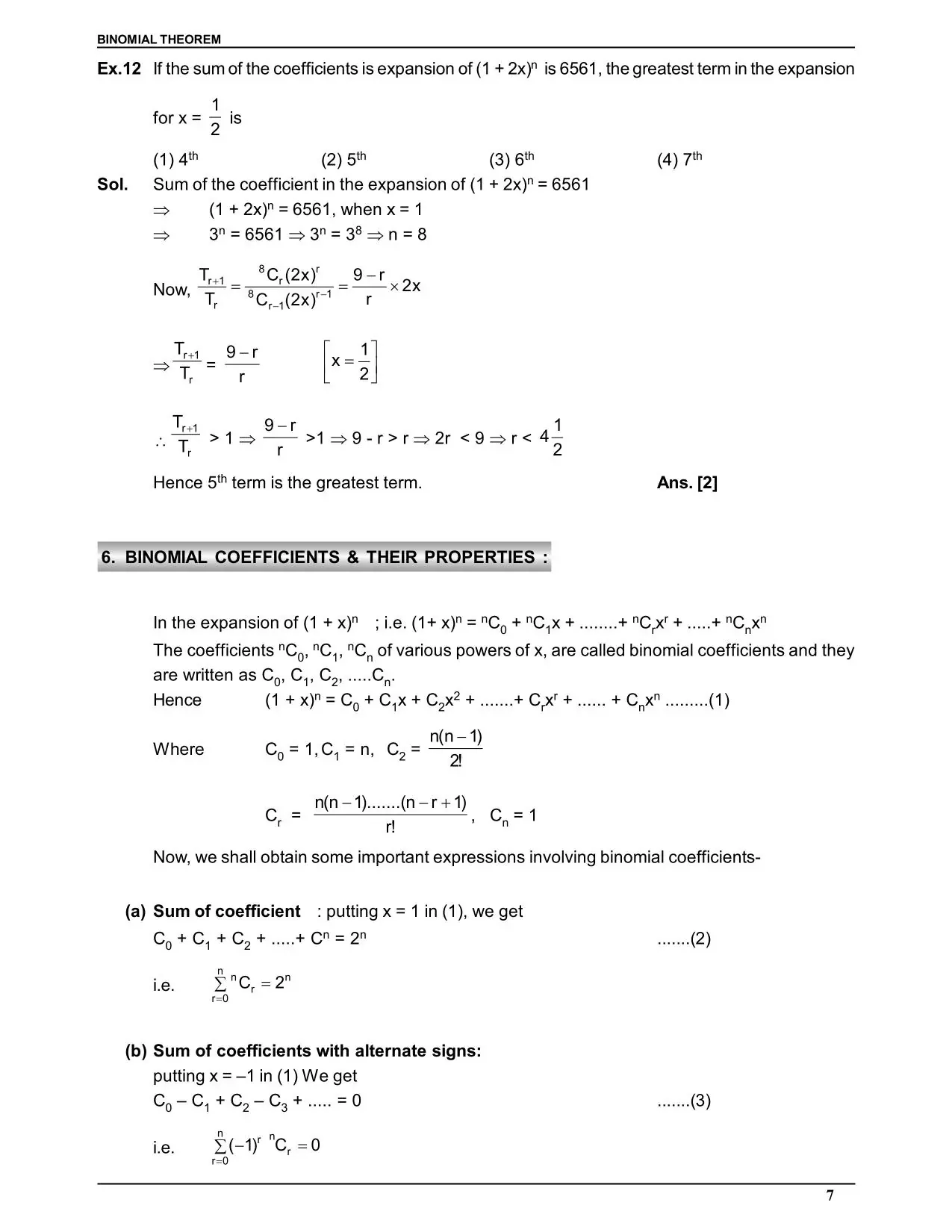
Binomial Theorem Class 11 Notes cover the binomial theorem for a positive integer n, the expansion of (a+b)^n and Pascal’s triangle, the general term, the middle term, the term independent of x, the properties of binomial coefficients, the greatest term and the simple applications (remainders and approximations).
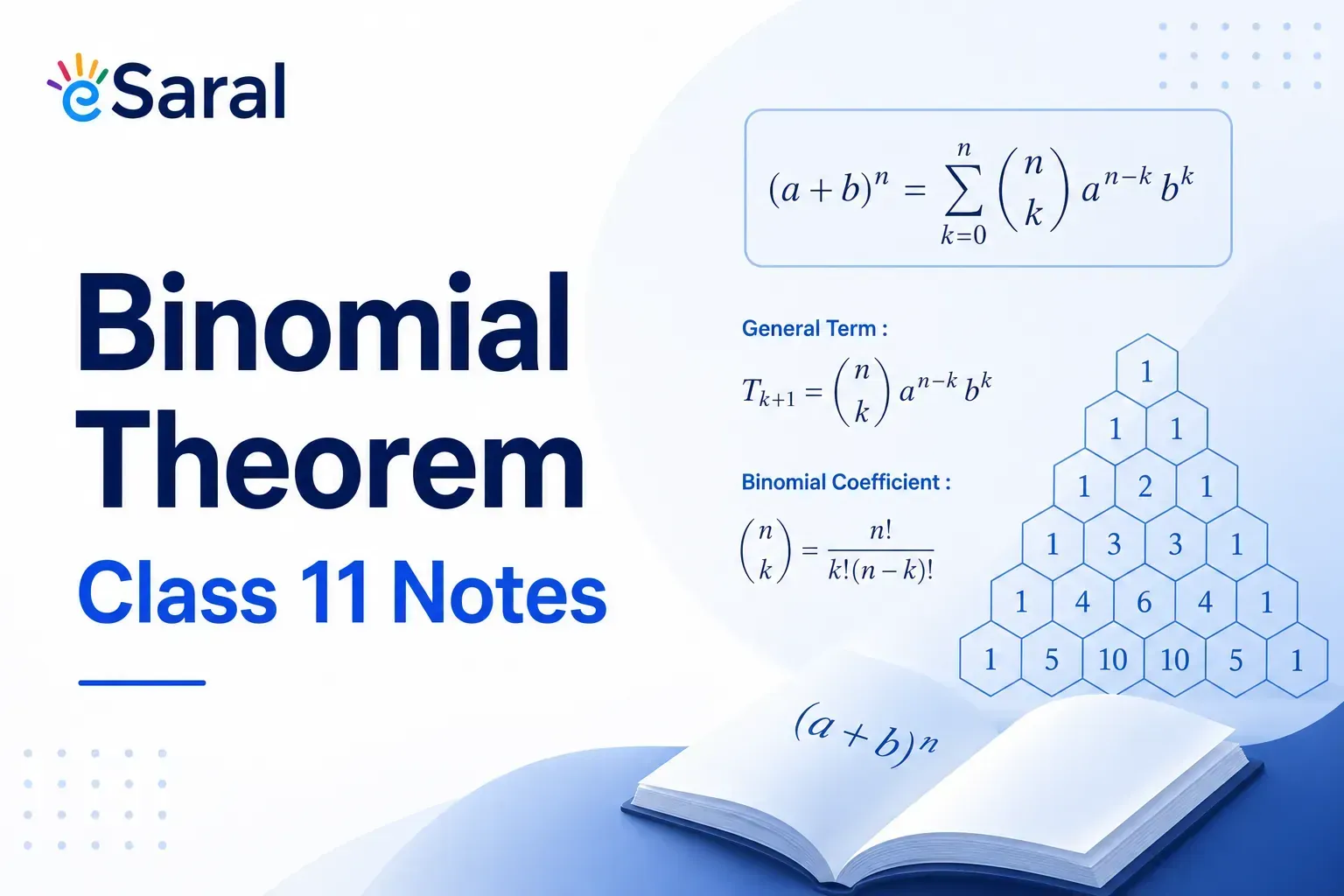
Binomial Theorem is Chapter 7 of the current NCERT Class 11 Maths book (Chapter 8 in older books). It is also a named topic in the JEE Main syllabus, “Binomial theorem and its simple applications”, and it appears in JEE Advanced as part of algebra and combinatorics. You need the factorial and the combination $\binom{n}{r}$ from Permutations and Combinations before you start. These Binomial Theorem Class 11 Notes follow the NCERT chapter and add the IIT JEE methods. For the other Class 11 Maths chapters, see eSaral’s Class 11 Maths notes.
Binomial Theorem Class 11 Notes with Important Questions
India's Best Exam Preparation for Class 11th - Download Now
India's Best Exam Preparation for Class 11th - Download Now
India's Best Exam Preparation for Class 11th - Download Now
India's Best Exam Preparation for Class 11th - Download Now
India's Best Exam Preparation for Class 11th - Download Now
Binomial Theorem Statement and Expansion in Binomial Theorem Class 11 Notes
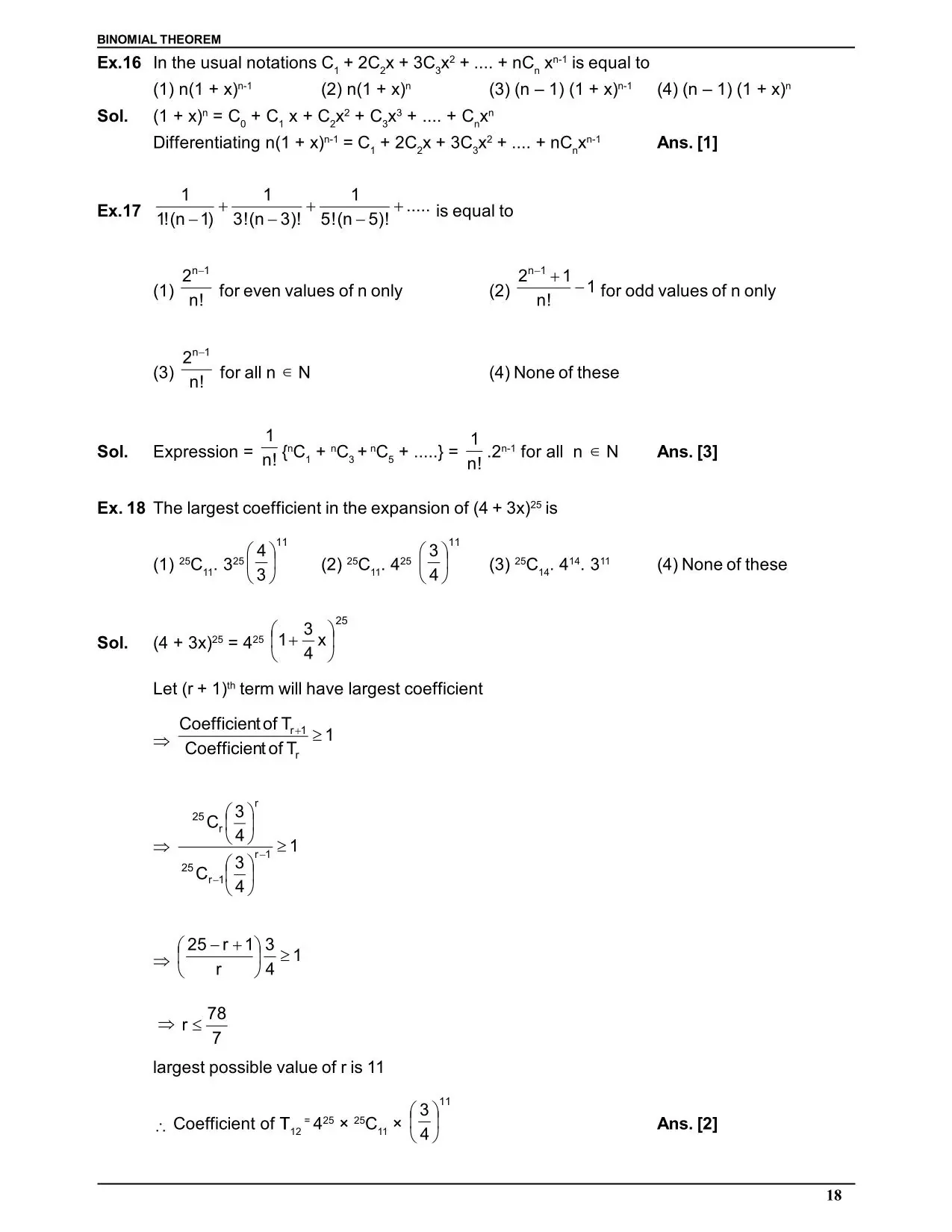
For any positive integer $n$:
$$(a + b)^{n} = \sum_{r=0}^{n}\binom{n}{r}a^{\,n-r}b^{\,r} = \binom{n}{0}a^{n} + \binom{n}{1}a^{n-1}b + \binom{n}{2}a^{n-2}b^{2} + \cdots + \binom{n}{n}b^{n}$$
where $\dbinom{n}{r} = {}^{n}C_r = \dfrac{n!}{r!\,(n-r)!}$ is the binomial coefficient. The most used special cases are:
$$(1 + x)^{n} = \sum_{r=0}^{n}\binom{n}{r}x^{r}, \qquad (1 - x)^{n} = \sum_{r=0}^{n}(-1)^{r}\binom{n}{r}x^{r}, \qquad (a - b)^{n} = \sum_{r=0}^{n}(-1)^{r}\binom{n}{r}a^{n-r}b^{r}$$
Properties of the expansion:
- The expansion of $(a + b)^n$ has $n + 1$ terms.
- The power of $a$ falls from $n$ to $0$, and the power of $b$ rises from $0$ to $n$. In every term, the sum of the powers is $n$.
- The coefficients of the terms that are at the same distance from the two ends are equal: $\binom{n}{r} = \binom{n}{n-r}$.
- In $(a - b)^n$, the signs of the terms alternate, starting with $+$.
Pascal’s triangle gives the coefficients for small $n$. Each number is the sum of the two numbers above it, because $\binom{n}{r} + \binom{n}{r-1} = \binom{n+1}{r}$.
$n$ | Coefficients |
|---|---|
0 | 1 |
1 | 1, 1 |
2 | 1, 2, 1 |
3 | 1, 3, 3, 1 |
4 | 1, 4, 6, 4, 1 |
5 | 1, 5, 10, 10, 5, 1 |
6 | 1, 6, 15, 20, 15, 6, 1 |
General Term in Binomial Theorem Class 11 Notes
The $(r+1)$-th term of $(a + b)^n$ is called the general term:
$$T_{r+1} = \binom{n}{r}a^{\,n-r}b^{\,r}, \qquad r = 0, 1, 2, \ldots, n$$
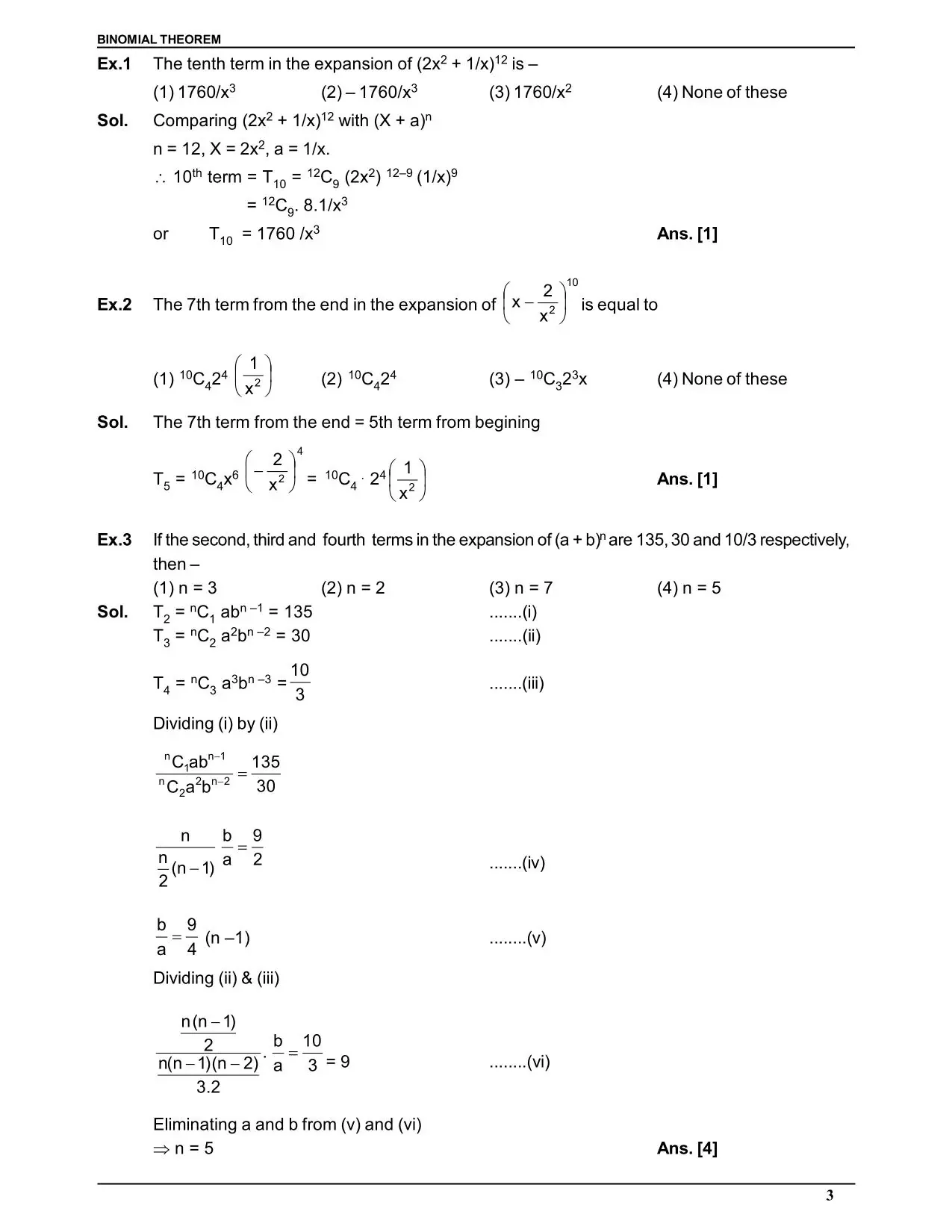
For $(1 + x)^n$, $T_{r+1} = \dbinom{n}{r}x^{r}$. The $(r+1)$-th term from the end of $(a+b)^n$ is the $(n - r + 1)$-th term from the beginning.
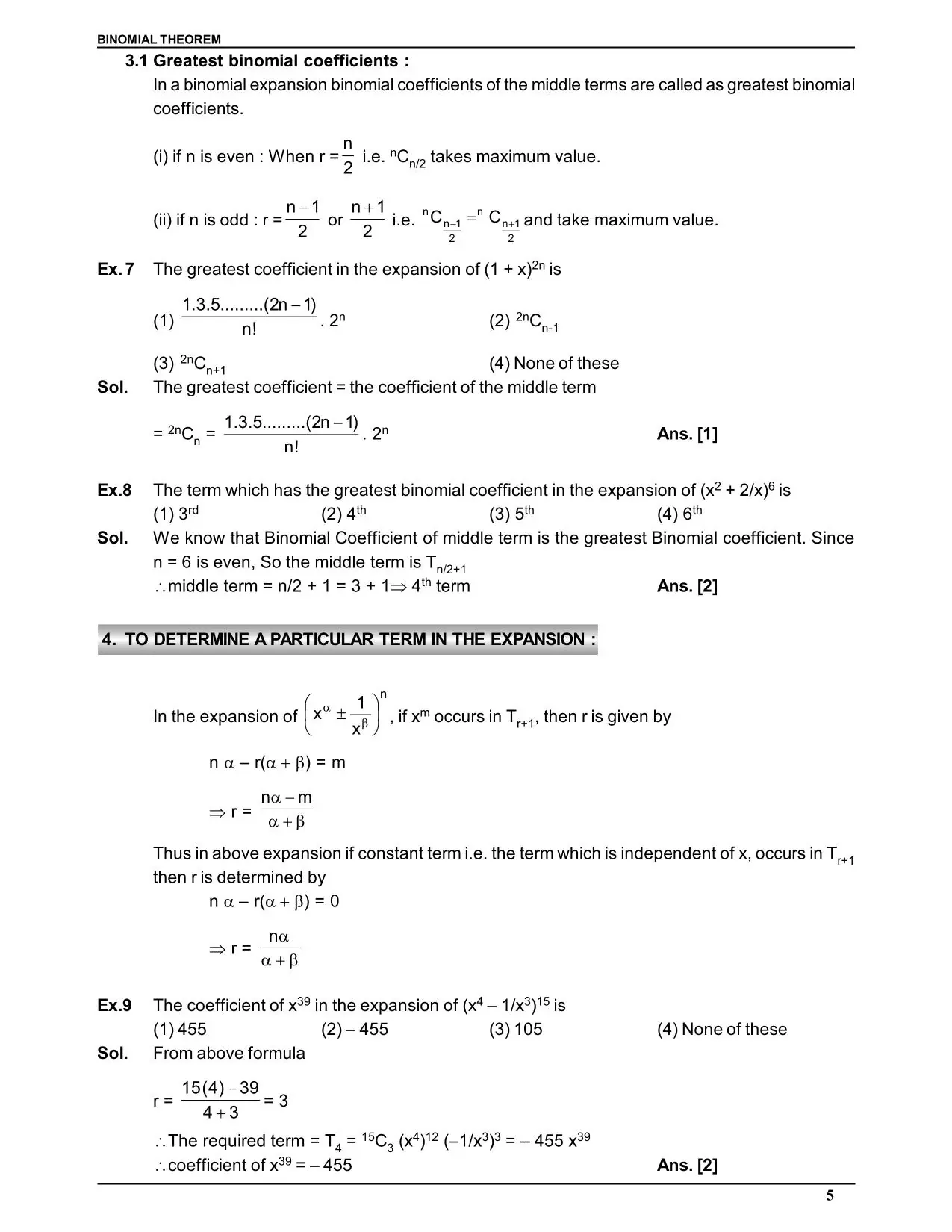
How to find a particular term: write $T_{r+1}$, simplify the power of $x$, put it equal to the power that you need, solve for $r$, and then put $r$ back into the coefficient. Check that $r$ is a whole number with $0 \le r \le n$.
- Coefficient of $x^k$: solve (power of $x$ in $T_{r+1}$) $= k$.
- Term independent of $x$: solve (power of $x$ in $T_{r+1}$) $= 0$.
Middle Term in Binomial Theorem Class 11 Notes
Value of $n$ | Number of middle terms | Middle term(s) |
|---|---|---|
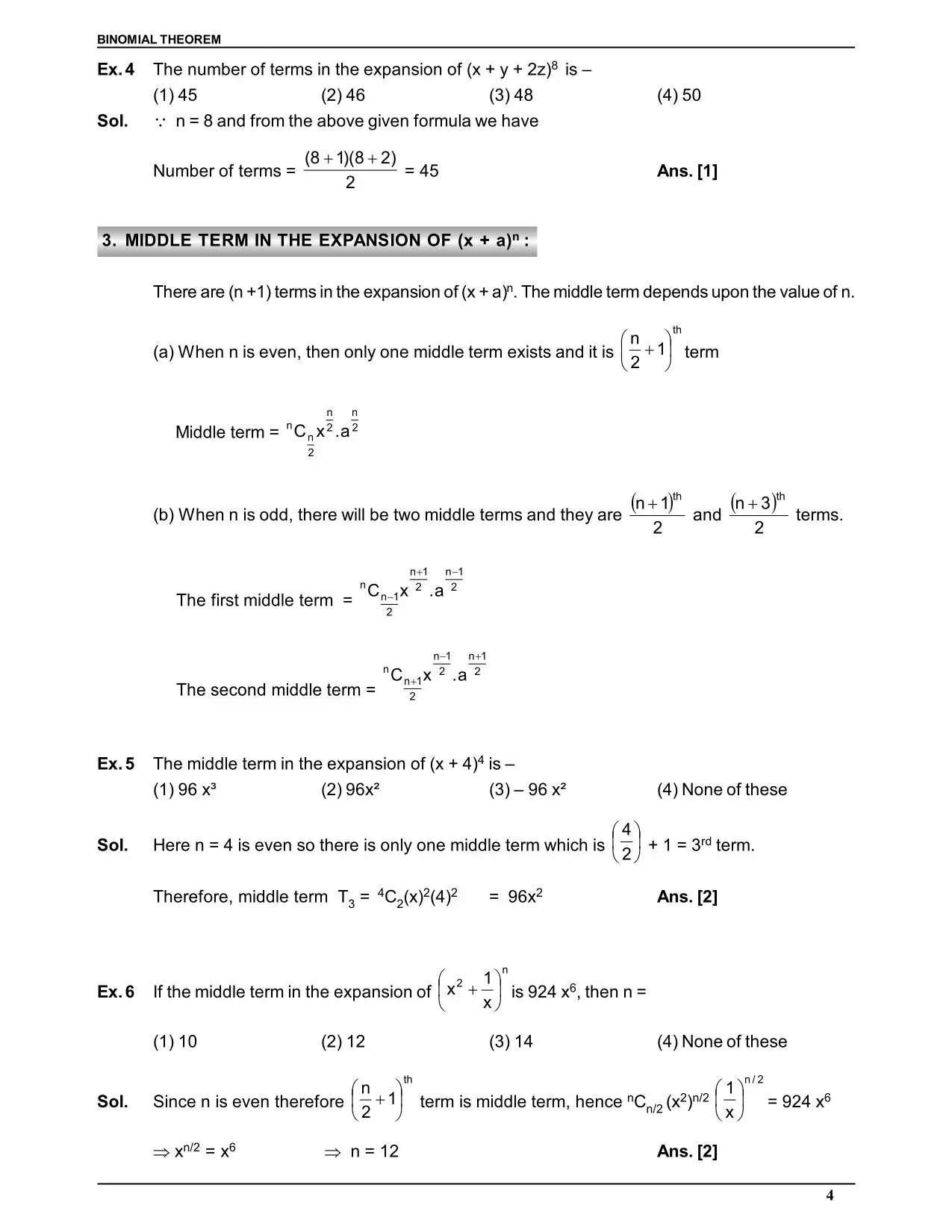
$n$ even | One | $T_{\frac{n}{2}+1}$ |
$n$ odd | Two | $T_{\frac{n+1}{2}}$ and $T_{\frac{n+3}{2}}$ |
For example, $(x + y)^{10}$ has one middle term, $T_6$, and $(x + y)^{7}$ has two middle terms, $T_4$ and $T_5$.
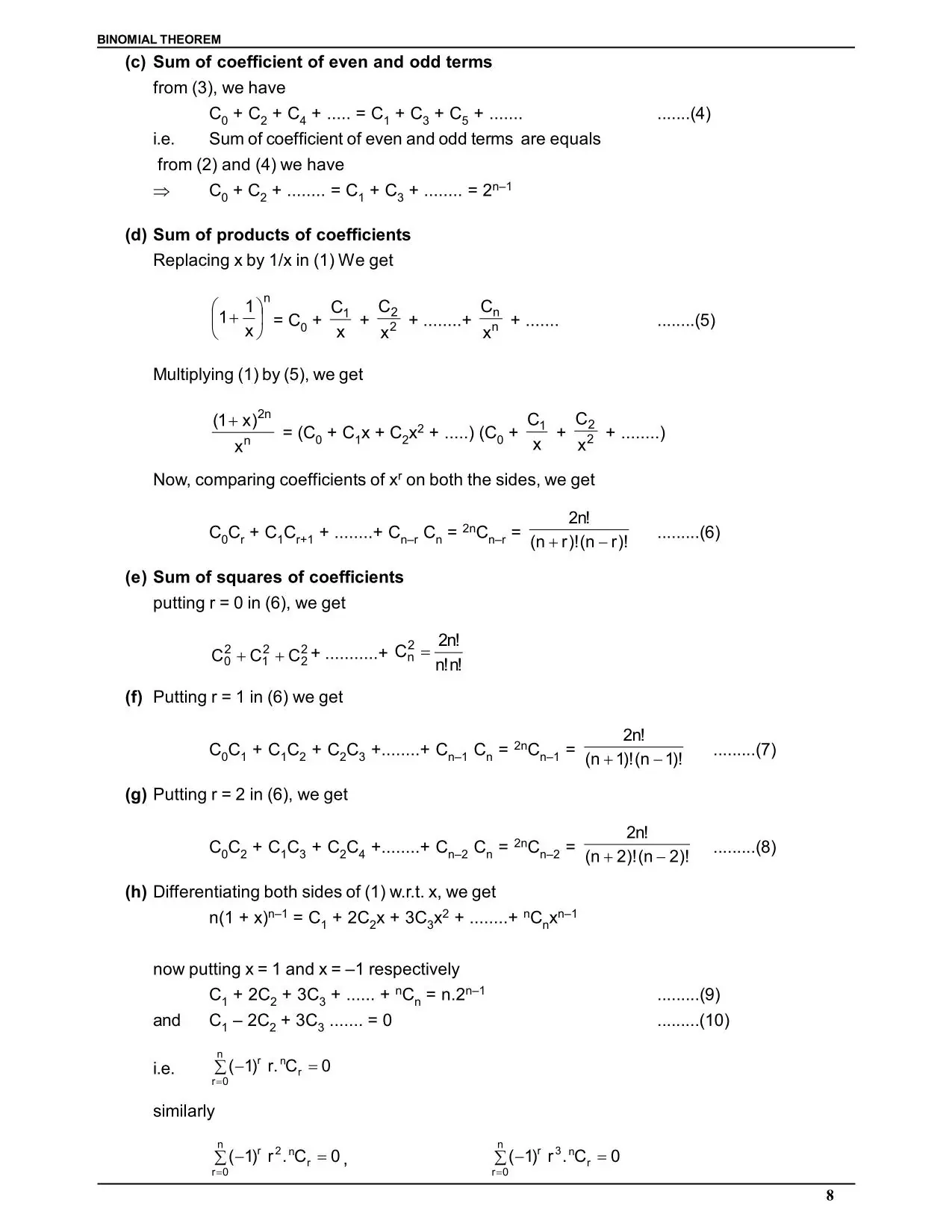
Properties of Binomial Coefficients in Binomial Theorem Class 11 Notes
Write $C_r = \dbinom{n}{r}$.
Property | Result |
|---|---|
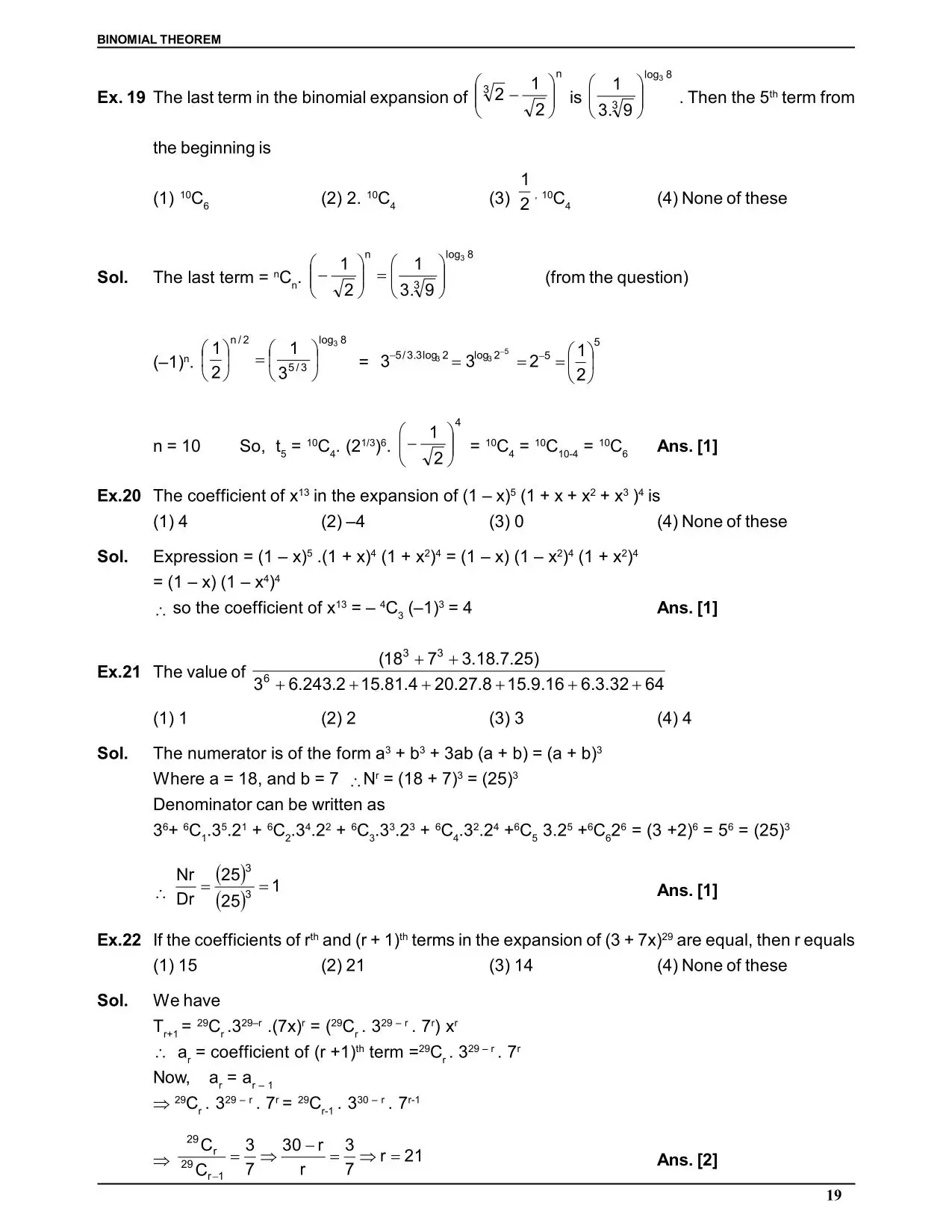
Sum of all coefficients | $C_0 + C_1 + C_2 + \cdots + C_n = 2^{n}$ |
Alternating sum | $C_0 - C_1 + C_2 - \cdots + (-1)^{n}C_n = 0$ |
Even and odd coefficients | $C_0 + C_2 + C_4 + \cdots = C_1 + C_3 + C_5 + \cdots = 2^{n-1}$ |
Symmetry | $C_r = C_{n-r}$ |
Pascal’s rule | $\dbinom{n}{r} + \dbinom{n}{r-1} = \dbinom{n+1}{r}$ |
Ratio of consecutive coefficients | $\dfrac{C_r}{C_{r-1}} = \dfrac{n - r + 1}{r}$ |
A useful identity | $r\dbinom{n}{r} = n\dbinom{n-1}{r-1}$ |
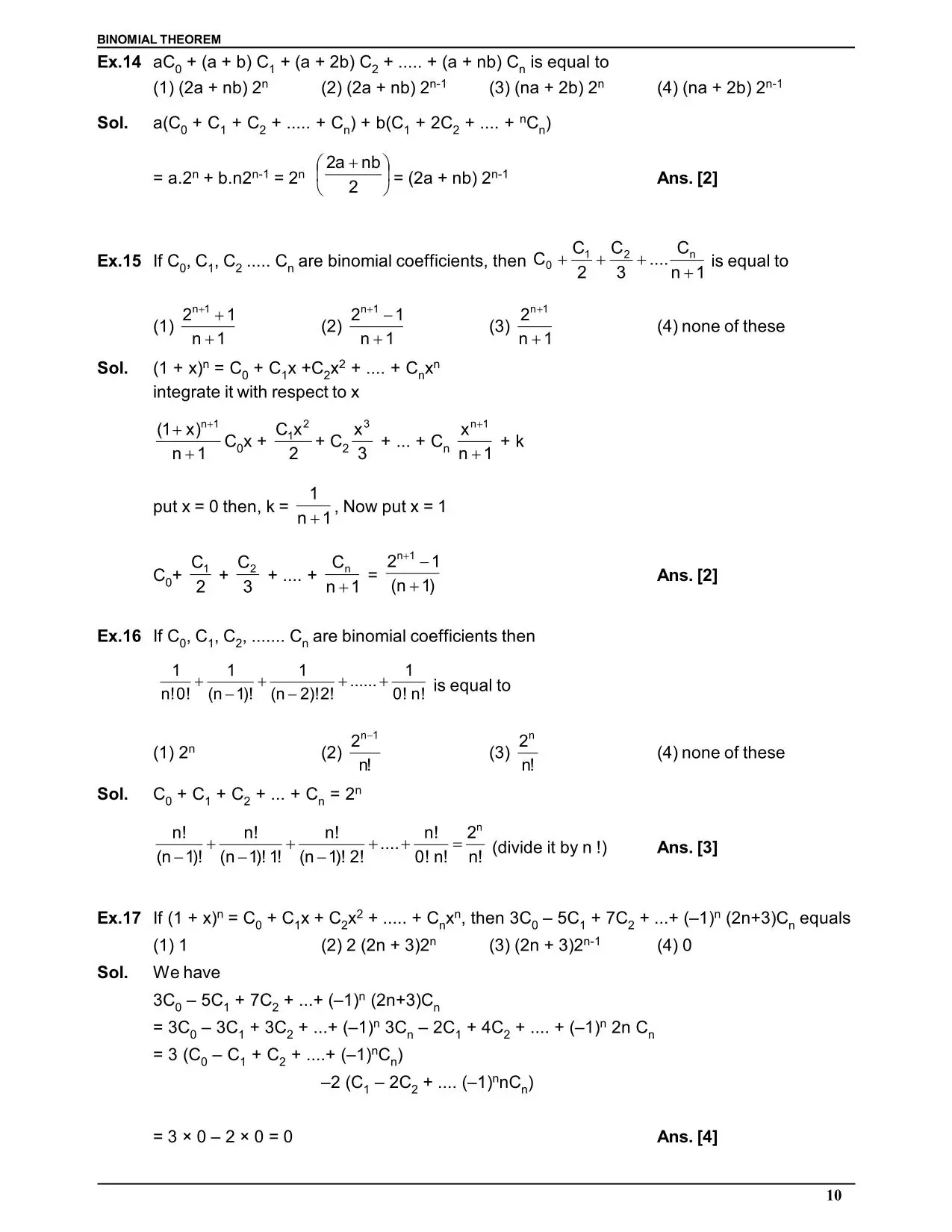
Sum of $r\,C_r$ | $\sum_{r=0}^{n} r\,C_r = n\,2^{n-1}$ |
Sum of $\dfrac{C_r}{r+1}$ | $\sum_{r=0}^{n}\dfrac{C_r}{r+1} = \dfrac{2^{n+1} - 1}{n + 1}$ |
Sum of squares | $C_0^2 + C_1^2 + \cdots + C_n^2 = \dbinom{2n}{n}$ |
Vandermonde’s identity | $\sum_{r}\dbinom{m}{r}\dbinom{n}{k-r} = \dbinom{m+n}{k}$ |
Greatest binomial coefficient: for $n$ even, it is $C_{n/2}$. For $n$ odd, the two equal greatest coefficients are $C_{(n-1)/2}$ and $C_{(n+1)/2}$.
Greatest Term in the Binomial Expansion in Binomial Theorem Class 11 Notes
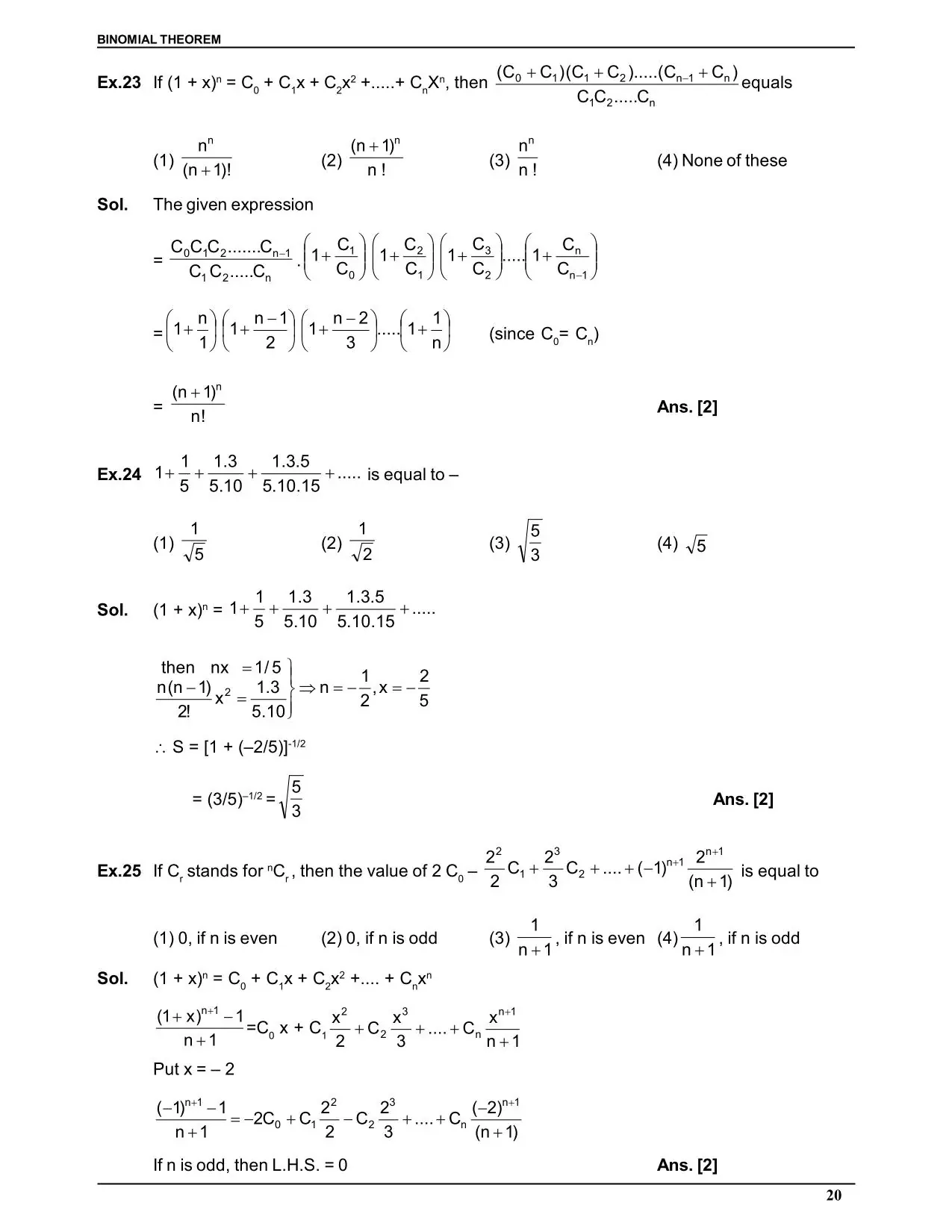
For $(1 + x)^n$ with $x \neq 0$, the ratio of consecutive terms is $\dfrac{T_{r+1}}{T_r} = \dfrac{n - r + 1}{r}\,\lvert x\rvert$. Let:
$$m = \frac{(n + 1)\lvert x\rvert}{1 + \lvert x\rvert}$$
- If $m$ is not an integer, the greatest term is $T_{\lfloor m\rfloor + 1}$.
- If $m$ is an integer, $T_m$ and $T_{m+1}$ are equal, and they are the greatest terms.
The greatest term is different from the greatest coefficient: the term depends on the value of $x$.
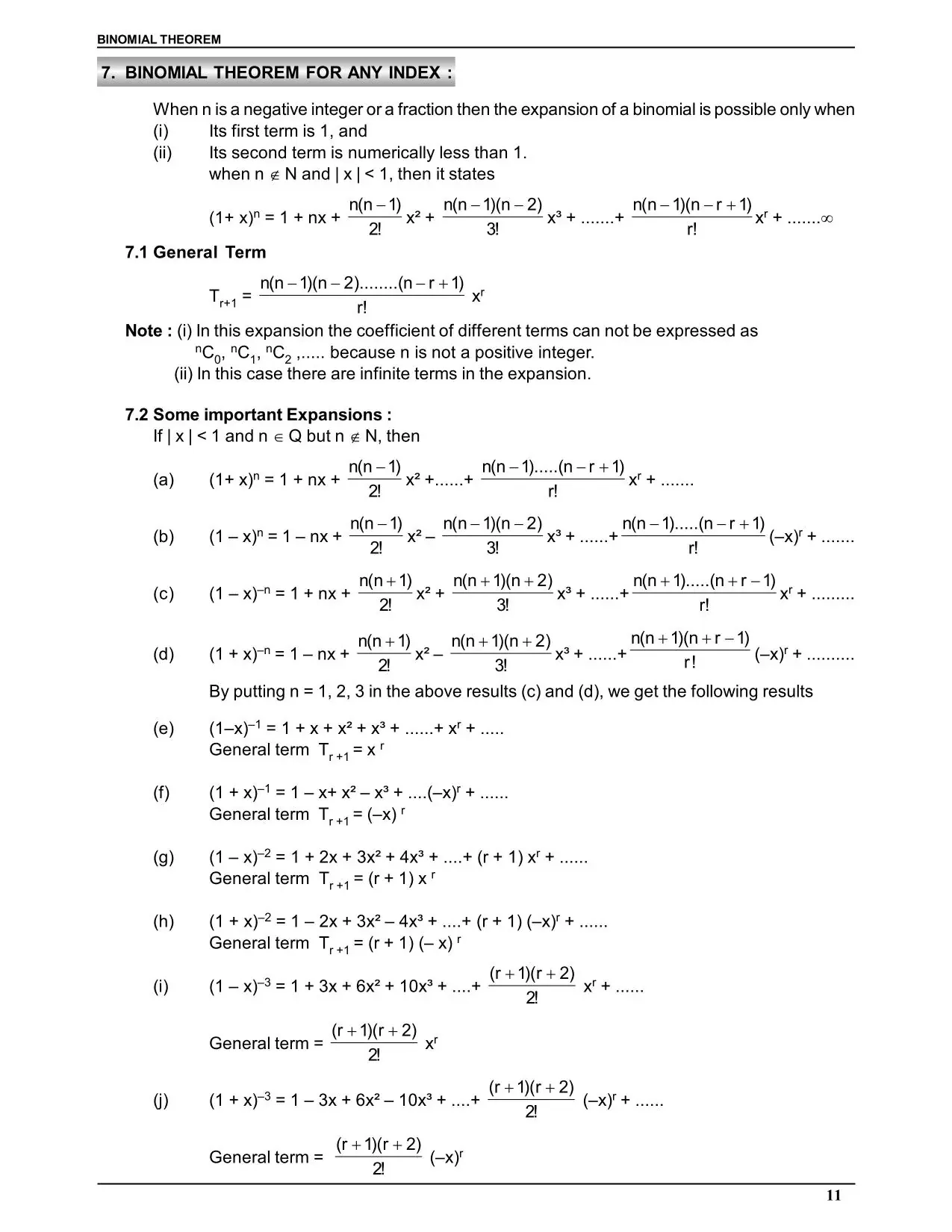
Sum and Difference Expansions and Applications in Binomial Theorem Class 11 Notes
$$(x + a)^n + (x - a)^n = 2\left[\binom{n}{0}x^{n} + \binom{n}{2}x^{n-2}a^{2} + \binom{n}{4}x^{n-4}a^{4} + \cdots\right]$$ $$(x + a)^n - (x - a)^n = 2\left[\binom{n}{1}x^{n-1}a + \binom{n}{3}x^{n-3}a^{3} + \cdots\right]$$
The sum has $\frac{n}{2} + 1$ terms if $n$ is even and $\frac{n+1}{2}$ terms if $n$ is odd. The difference has $\frac{n}{2}$ terms if $n$ is even and $\frac{n+1}{2}$ terms if $n$ is odd.
Applications:
- Remainders and divisibility: write the number as $(\text{multiple of } m \pm 1)^k$ and expand. Only the last term survives modulo $m$.
- Approximations: for a small $x$, $(1 + x)^n \approx 1 + nx + \dfrac{n(n-1)}{2}x^{2}$.
- Digits and comparisons: write the numbers as $(100 \pm 1)^n$ or $(10 \pm 1)^n$.
Key Formulas in Binomial Theorem Class 11 Notes
Concept | Formula |
|---|---|
Binomial theorem | $(a+b)^n = \sum_{r=0}^{n}\binom{n}{r}a^{n-r}b^{r}$ |
Number of terms | $n + 1$ |
General term | $T_{r+1} = \binom{n}{r}a^{n-r}b^{r}$ |
Middle term ($n$ even) | $T_{\frac{n}{2}+1}$ |
Middle terms ($n$ odd) | $T_{\frac{n+1}{2}}$ and $T_{\frac{n+3}{2}}$ |
Sum of coefficients | $2^{n}$ |
Even or odd coefficients | $2^{n-1}$ each |
Ratio of coefficients | $\dfrac{C_r}{C_{r-1}} = \dfrac{n-r+1}{r}$ |
Sum of squares | $\binom{2n}{n}$ |
IIT JEE Methods and Tips in Binomial Theorem Class 11 Notes
- Sum of coefficients: put $x = 1$ (and other variables $= 1$). For the alternating sum, put $x = -1$.
- Sums with $r$ or $\frac{1}{r+1}$: use $r\binom{n}{r} = n\binom{n-1}{r-1}$, or differentiate or integrate $(1 + x)^n$ and then put a value of $x$.
- Products of expansions: compare the coefficient of the same power on both sides of $(1+x)^m(1+x)^n = (1+x)^{m+n}$ to get identities such as Vandermonde’s identity.
- Remainder problems: reduce the base to $(\text{multiple of the divisor}) \pm 1$.
- Always check the range $0 \le r \le n$ and whether $r$ is an integer.
Solved Examples from Binomial Theorem Class 11 Notes
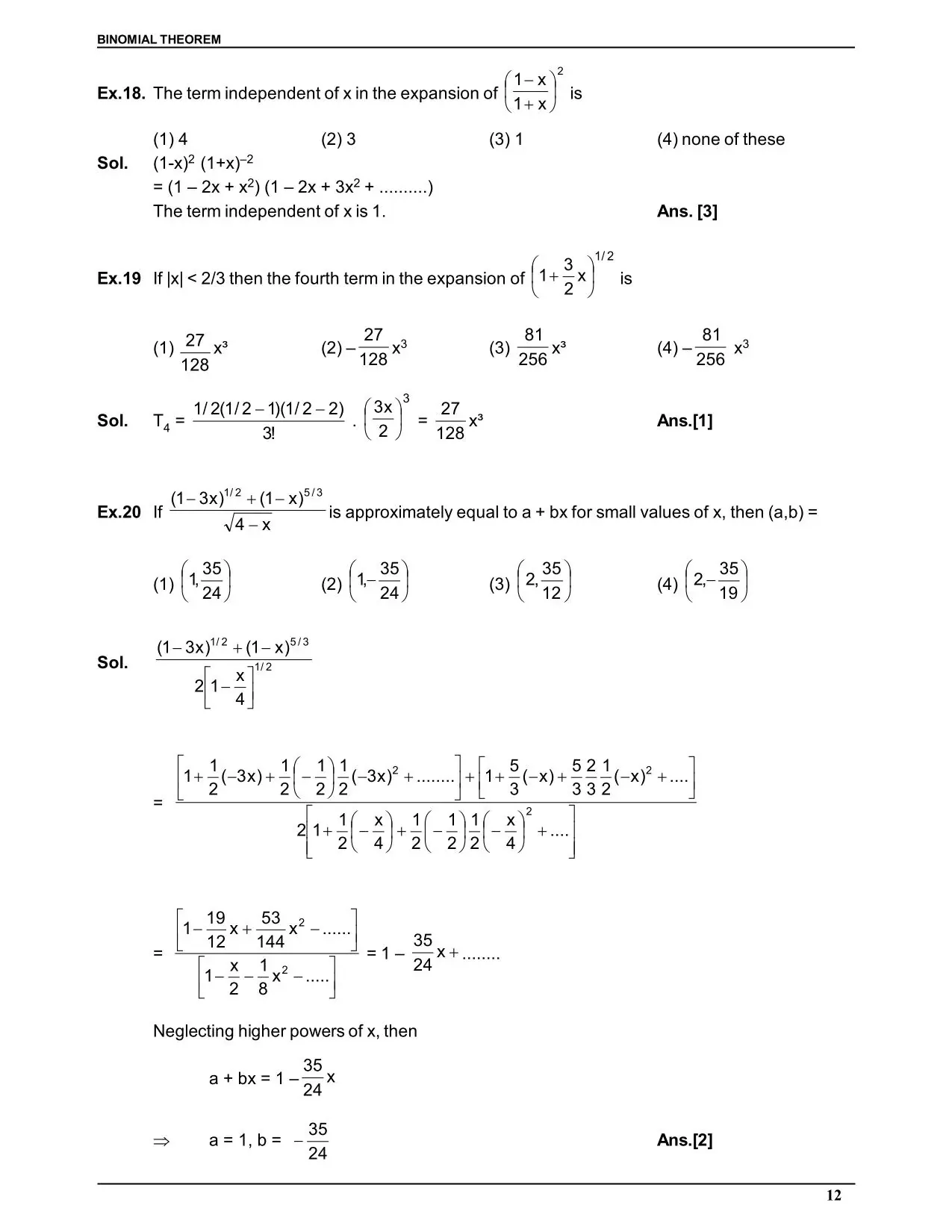
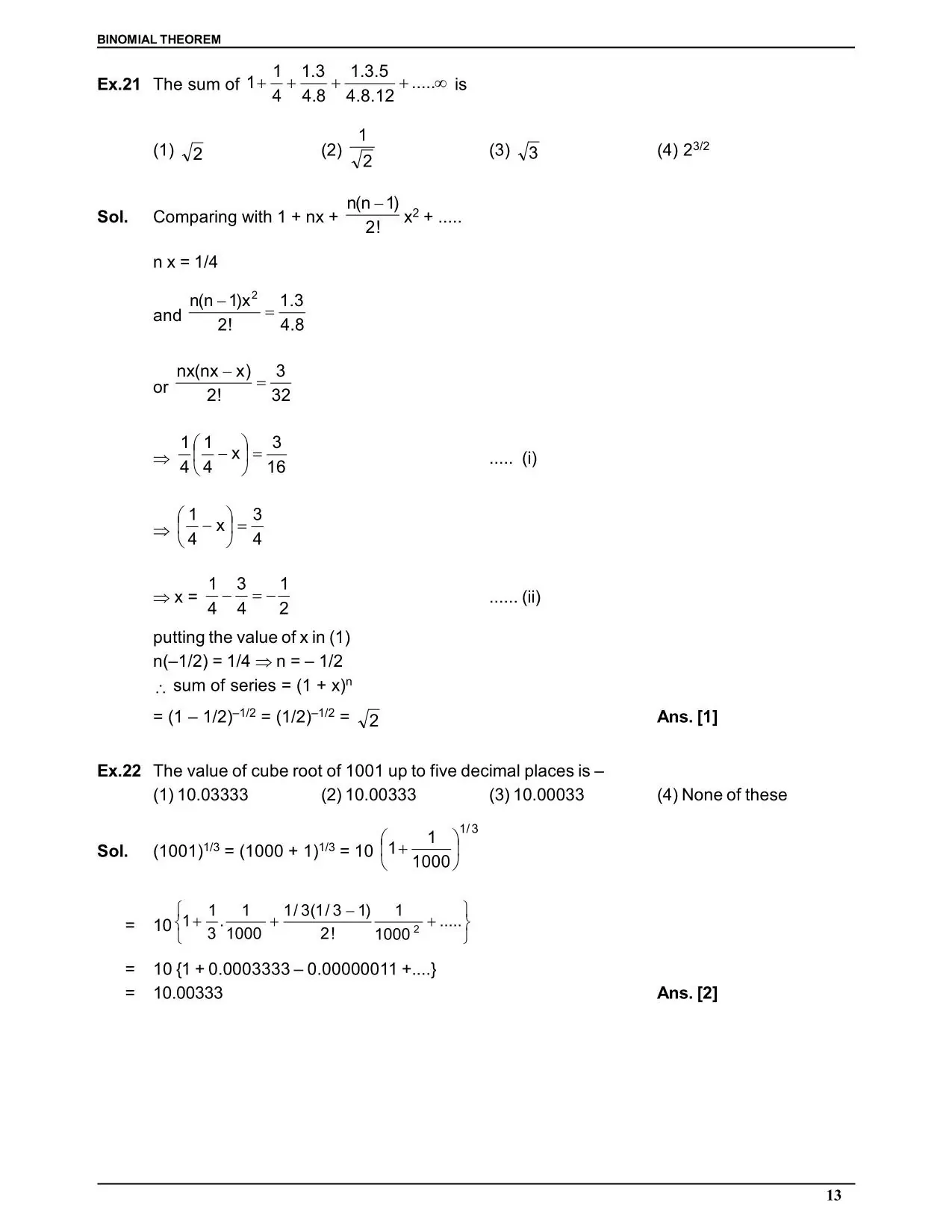
Example 1 (expansion): Expand $(x + 2y)^4$.
$(x + 2y)^4 = x^4 + 4x^3(2y) + 6x^2(2y)^2 + 4x(2y)^3 + (2y)^4 = x^4 + 8x^3y + 24x^2y^2 + 32xy^3 + 16y^4$.
Example 2 (middle term): Find the middle term of $\left(x - \dfrac{1}{x}\right)^{10}$.
$n = 10$ is even, so the middle term is $T_6 = \dbinom{10}{5}x^{5}\left(-\dfrac{1}{x}\right)^{5} = -252$.
Example 3 (coefficient of $x^k$): Find the coefficient of $x^6$ in $\left(x^2 + \dfrac{1}{x}\right)^{9}$.
$T_{r+1} = \dbinom{9}{r}(x^2)^{9-r}\left(\dfrac{1}{x}\right)^{r} = \dbinom{9}{r}x^{18-3r}$. Put $18 - 3r = 6$, so $r = 4$, and the coefficient is $\dbinom{9}{4} = 126$.
Example 4 (term independent of $x$): Find the term independent of $x$ in $\left(2x^2 - \dfrac{1}{x}\right)^{9}$.
$T_{r+1} = \dbinom{9}{r}2^{9-r}(-1)^{r}x^{18-3r}$. Put $18 - 3r = 0$, so $r = 6$, and the term is $\dbinom{9}{6}2^{3}(-1)^{6} = 84 \times 8 = 672$.
Example 5 (sum of coefficients): Find the sum of the coefficients in the expansion of $(1 + 2x)^5$.
Put $x = 1$: $(1 + 2)^5 = 3^5 = 243$.
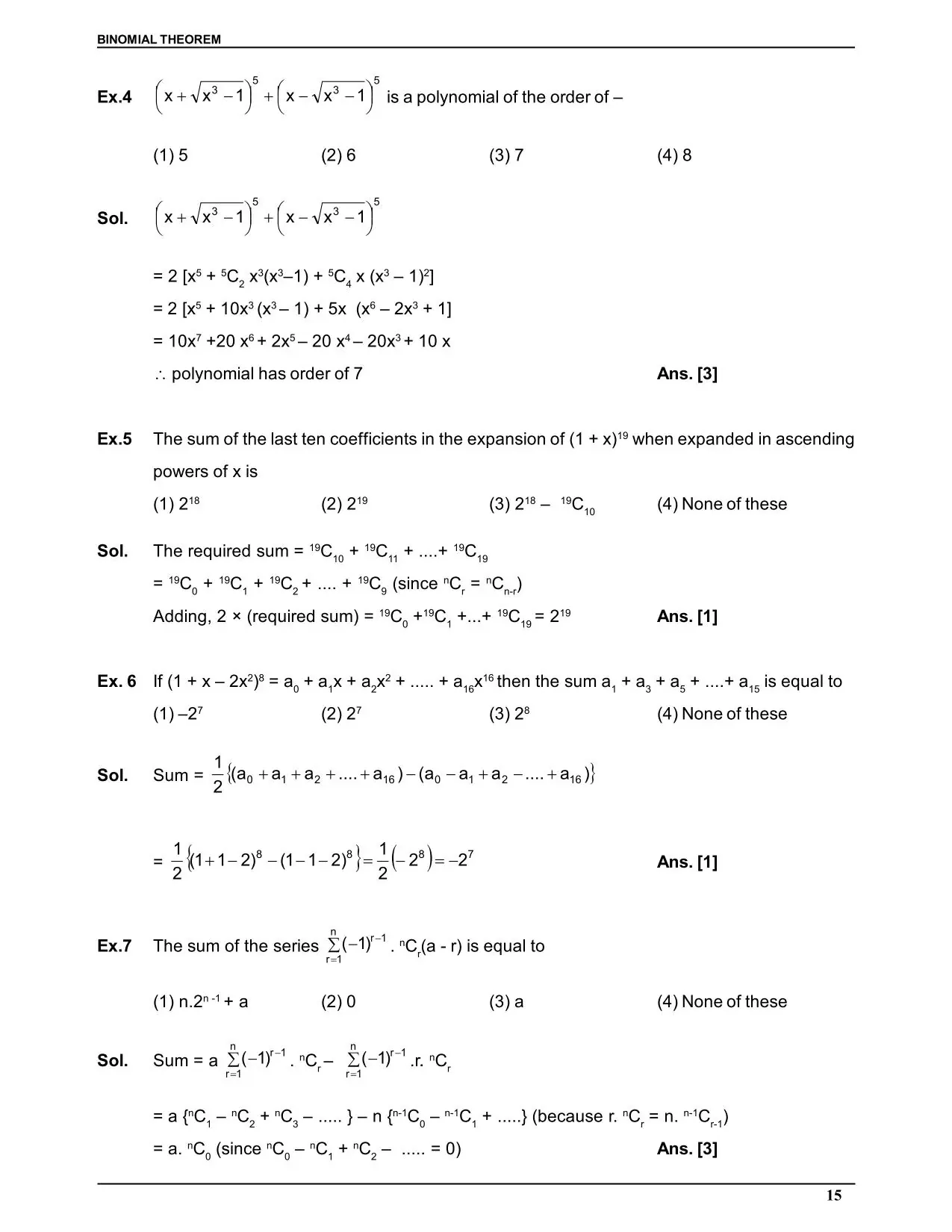
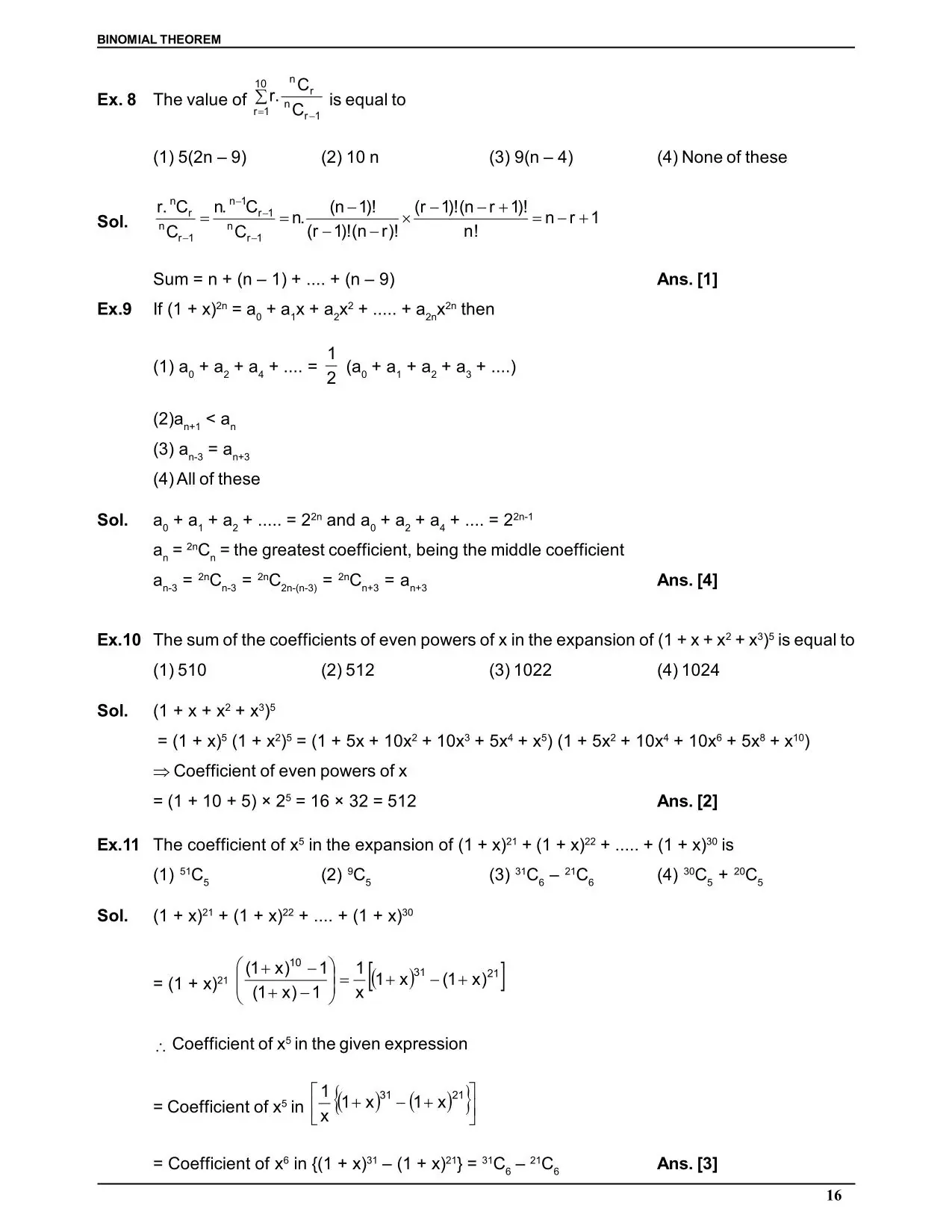
Example 6 (sums of coefficients): For $n = 10$, find $C_0 + C_1 + \cdots + C_{10}$ and $C_0 + C_2 + \cdots + C_{10}$.
The total is $2^{10} = 1024$, and the sum of the even-indexed coefficients is $2^{9} = 512$.
Example 7 (finding $n$): If $C_0 + 2C_1 + 3C_2 + \cdots + (n+1)C_n = 576$, find $n$.
The sum is $\sum rC_r + \sum C_r = n2^{n-1} + 2^{n} = 2^{n-1}(n + 2)$. Since $2^{n-1}(n+2) = 576 = 2^{6}\times 9$, we get $n = 7$.
Example 8 (greatest term): Find the greatest term in the expansion of $(1 + x)^{10}$ for $x = \dfrac{1}{2}$.
$m = \dfrac{11\times\frac{1}{2}}{1 + \frac{1}{2}} = \dfrac{11}{3} \approx 3.67$, so the greatest term is $T_4 = \dbinom{10}{3}\left(\dfrac{1}{2}\right)^{3} = \dfrac{120}{8} = 15$.
Example 9 (remainder): Find the remainder when $7^{100}$ is divided by $50$.
$7^{100} = (49)^{50} = (50 - 1)^{50}$. In the expansion, every term except the last has a factor of $50$, and the last term is $(-1)^{50} = 1$. So the remainder is $1$.
Example 10 (approximation): Find $(1.01)^{10}$ approximately.
$(1.01)^{10} \approx 1 + 10(0.01) + 45(0.01)^{2} + 120(0.01)^{3} = 1 + 0.1 + 0.0045 + 0.00012 = 1.10462$.
Example 11 (sum of squares): Find $C_0^2 + C_1^2 + C_2^2 + C_3^2 + C_4^2$ for $n = 4$.
The sum is $\dbinom{8}{4} = 70$. Check: $1 + 16 + 36 + 16 + 1 = 70$.
Example 12 (number of terms): Find the number of terms in $(x + a)^{10} + (x - a)^{10}$ and in $(x + a)^{10} - (x - a)^{10}$.
For $n = 10$ (even), the sum has $\frac{10}{2} + 1 = 6$ terms, and the difference has $\frac{10}{2} = 5$ terms.
Common Mistakes in Binomial Theorem Class 11 Notes Problems
Mistake | Correct approach |
|---|---|
Saying that $(a+b)^n$ has $n$ terms | It has $n + 1$ terms |
Using $T_r$ for the term with $\binom{n}{r}$ | $T_{r+1} = \binom{n}{r}a^{n-r}b^{r}$ |
Forgetting the sign in $(a - b)^n$ | The sign is $(-1)^{r}$ in the $(r+1)$-th term |
Taking one middle term for every $n$ | One middle term for even $n$, and two for odd $n$ |
Taking a fractional or negative $r$ | $r$ must be an integer, with $0 \le r \le n$ |
Mixing up the greatest coefficient and the greatest term | The greatest coefficient depends only on $n$, and the greatest term also depends on $x$ |
Using the sum of the coefficients with $x \ne 1$ | Put $x = 1$ to get the sum of the coefficients |
Writing $\binom{n}{r} = \dfrac{n!}{r!}$ | $\binom{n}{r} = \dfrac{n!}{r!\,(n-r)!}$ |
How to Study Binomial Theorem Class 11 Notes
- Read the NCERT chapter first, and download the textbook from eSaral’s NCERT books for Class 11 page.
- Learn the general term first, because most problems use $T_{r+1}$. Then learn the middle term, the properties of the coefficients and the greatest term.
- Practise one problem each on the coefficient of $x^k$, the term independent of $x$, the sum of coefficients, a remainder and a greatest term.
- Revise with eSaral’s JEE Main Maths revision notes, and see the trigonometry formulas for Class 11 when you need the formulas of the other chapters.
- Test yourself with eSaral’s JEE Main chapter-wise PYQs and JEE Advanced chapter-wise PYQs.
eSaral helps the students by providing them an easy way to understand concepts and attractive study material for IIT JEE, which includes the video lectures & Study Material designed by expert IITian Faculties of KOTA. eSaral provides a series of detailed chapter-wise notes for all the Subjects of class 11th and 12th. These notes will also help you in your IIT JEE preparation. We hope these Mathematics Notes for Class 11 will be helpful for you to understand the important topics and help in remembering the key points from an exam point of view. Get Complete Class 11 Mathematics Notes for free video lectures and complete Course material for Class 10, JEE, and NEET Download eSaral APP. About eSaral: At eSaral, we are offering a complete platform for IIT-JEE & NEET preparation. The main mission behind eSaral is to provide education to each and every student in India by eliminating the Geographic and Economic factors, as a nation’s progress and development depend on the availability of quality education to each and every one. With the blend of education & technology, the eSaral team made the learning personalized & adaptive for everyone. eSaral Making Learning affordable, Accessible, and thoughtful for all.
Frequently Asked Questions
What is the binomial theorem formula for Class 11?
For a positive integer $n$, $(a+b)^n = \sum_{r=0}^{n}\binom{n}{r}a^{n-r}b^{r}$, where $\binom{n}{r} = \dfrac{n!}{r!(n-r)!}$. The expansion has exactly $n+1$ terms. eSaral’s Binomial Theorem Class 11 Notes use this formula for every type of problem in the chapter.
What is the general term in the binomial theorem, and how is it used?
The general term is $T_{r+1} = \binom{n}{r}a^{n-r}b^{r}$. To find any particular term, write the power of the variable in $T_{r+1}$, put it equal to the power that you need, solve for $r$, and then find the coefficient. This is the method for every “find the coefficient of $x^k$” and “term independent of $x$” question in Binomial Theorem Class 11 Notes.
How many terms are there in a binomial expansion?
The expansion of $(a+b)^n$ has $n+1$ terms when $n$ is a positive integer. For example, $(a+b)^4$ has 5 terms, and $(a+b)^{10}$ has 11 terms. Check this before you look for the middle term.
How do you find the middle term in a binomial expansion?
If $n$ is even, there is one middle term, $T_{\frac{n}{2}+1}$. If $n$ is odd, there are two middle terms, $T_{\frac{n+1}{2}}$ and $T_{\frac{n+3}{2}}$. For $(x+y)^{7}$, the middle terms are $T_4$ and $T_5$.
What are the important properties of binomial coefficients for IIT JEE?
The most useful ones are $\sum C_r = 2^n$, the symmetry $C_r = C_{n-r}$, the sum of the even-indexed and the sum of the odd-indexed coefficients, each equal to $2^{n-1}$, and the ratio $\dfrac{C_r}{C_{r-1}} = \dfrac{n-r+1}{r}$. These Binomial Theorem Class 11 Notes list all of them in one table.
How do you find the term independent of x?
Write the general term, simplify the power of $x$, and put it equal to zero. Solve for $r$, and check that it is a whole number between $0$ and $n$. Then substitute $r$ in the coefficient. If $r$ is not a whole number, there is no term independent of $x$.
How do you find the remainder using the binomial theorem?
Write the number as a power of (a multiple of the divisor $\pm 1$). For example, $7^{100} = (50-1)^{50}$, and when it is expanded, every term except the last one is a multiple of 50, so the remainder is $(-1)^{50} = 1$.
How do you find the greatest term in a binomial expansion?
For $(1+x)^n$, find $m = \dfrac{(n+1)|x|}{1+|x|}$. If $m$ is not an integer, the greatest term is $T_{\lfloor m\rfloor+1}$. If $m$ is an integer, $T_m$ and $T_{m+1}$ are equal and greatest.
Is the Binomial Theorem in the JEE Main syllabus?
Yes. The JEE Main syllabus has the topic “Binomial theorem and its simple applications”, and JEE Advanced also covers it. The number of questions changes every year, so check previous years’ papers. These Binomial Theorem Class 11 Notes cover the general term, the middle term, the coefficient properties and the common applications.
Which chapter number is Binomial Theorem in Class 11 Maths?
In the current NCERT Class 11 Maths book, Binomial Theorem is Chapter 7 (Chapter 8 in older books). eSaral has chapter-wise Class 11 Maths notes, NCERT books and JEE Main PYQs, and all of them are linked on this page.
Team eSaral
eSaral Academic and Editorial Team
Team eSaral is the collective author profile for educational content created by eSaral’s teachers and academic contributors. The team draws on expertise from IIT graduates, doctors, experienced educators and subject specialists to develop resources for JEE, NEET and school students. Our articles aim to explain concepts clearly and help students study with confidence.
Related Posts

NCERT Physics Class 10 Book PDF in Hindi 2026-27 – भौतिक विज्ञान के 4 अध्याय (Free Download)
NCERT Physics Class 10 book PDF in Hindi 2026-27: download all 4 chapters (अध्याय 9–12) free, with topics and important formulas.

NCERT Biology Class 9 Book Anveshan PDF in Hindi - जीव विज्ञान कक्षा 9 पुस्तक अन्वेषण PDF
Download NCERT Biology Class 9 book PDF in Hindi chapterwise for 2026-27: Cell, Tissues, Reproduction and Diversity. Free PDFs.

Essay On Artificial Intelligence in English (100,150, 200, 250, 300, 500 Words)
This is in contrast to the natural intelligence of humans. With Artificial Intelligence, machines can perform

Essay on 78th India Independence Day in English for Student (100, 150, 200, 250, 300, 500 Words)
Read the best essays on India's Independence Day in English. Short & long essays (100, 150, 200, 250, 300, 500 words) perfect for school exams
NCERT Class 11 English Snapshots book - Free PDF download- Esaral
Download NCERT Class 11 English Snapshots book PDF for free. Get all 8 chapters, chapter-wise. Start your prep today!
NCERT Class 10 biology book pdf - Free PDF Download - eSaral
NCERT Class 10 Biology book PDF 2026-27: all 5 chapters (Life Processes to Our Environment) in English & Hindi, with CBSE syllabus, marks & practical

Essay on Global Warming in English (100,150, 200, 250, 300, 500 Words)
Global warming means the Earth is getting hotter. This happens because of things like pollution from cars and factories.

NCERT Class 12 English Book 2026-27: Flamingo, Vistas and Kaleidoscope PDF, Chapters and Syllabus
NCERT Class 12 English book 2026-27: Flamingo & Vistas (English Core) and Kaleidoscope (Elective) PDFs chapter-wise, with syllabus and sample papers.
NCERT Class 11 Physics Book —Part1 & Part 2 download in Hindi - NCERT भौतिकी कक्षा 11 पुस्तक
Download Class 11 Physics NCERT book PDF in Hindi – all 15 chapters, chapterwise links, JEE & NEET tips. Free PDF, no signup needed.

NCERT Class 10 Hindi Book PDF 2026-27 – क्षितिज, कृतिका, स्पर्श, संचयन (Chapterwise Free Download)
Download NCERT Class 10 Hindi Book PDF 2026-27 free, chapterwise: Kshitij, Kritika, Sparsh, Sanchayan. Includes CBSE syllabus & deleted chapters.