
Binomial Theorem - JEE Advanced Previous Year Questions with Solutions
eSaral › JEE › JEE Main ›Binomial Theorem - JEE Advanced Previous Year Questions with Solutions

🚀 Checkout eSaral Courses
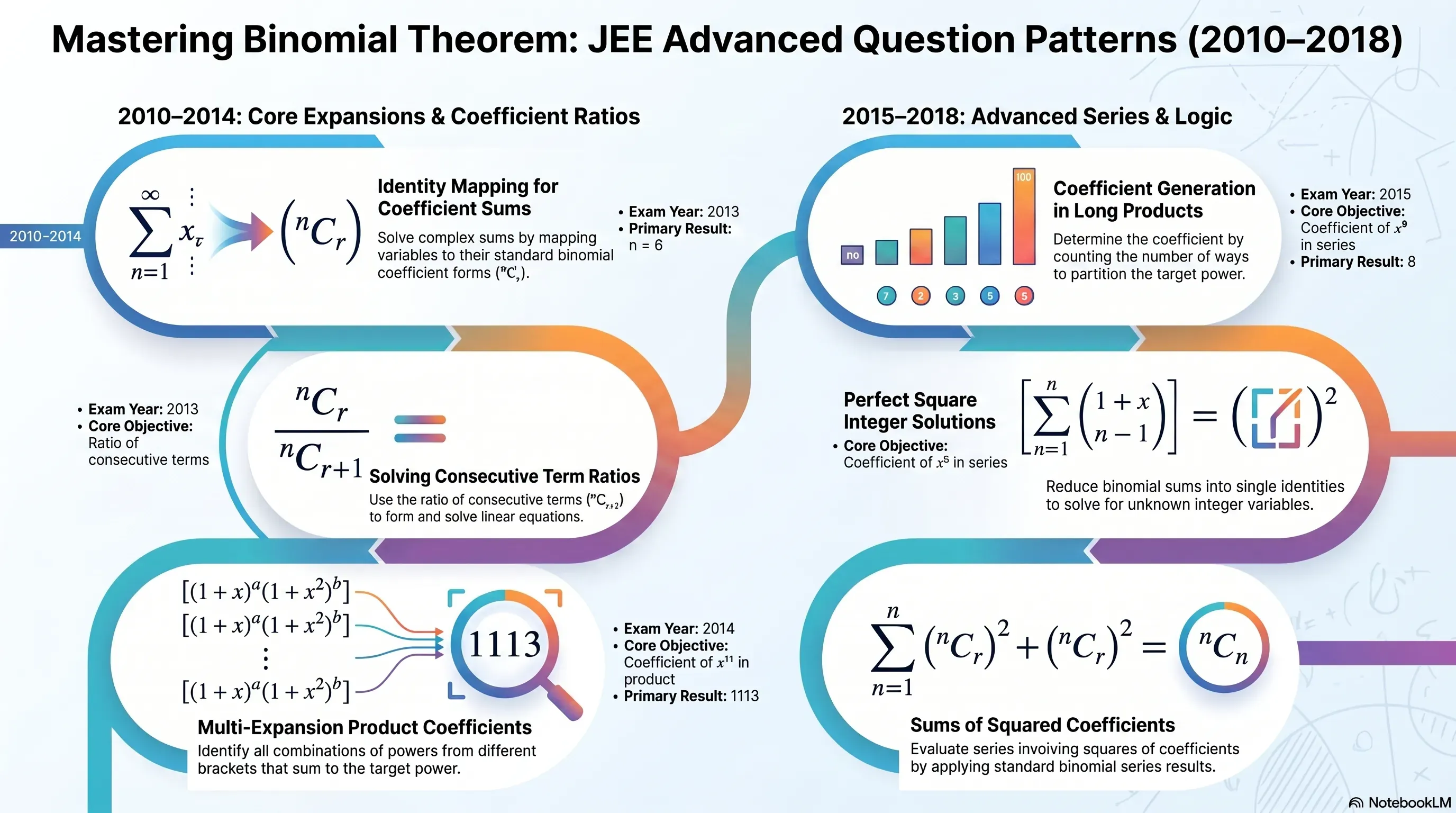
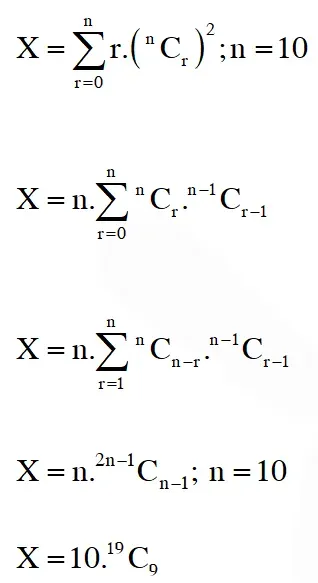
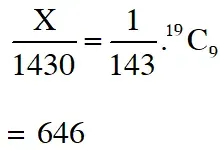
Download eSaral app for free study material and video tutorials. [esquestion] For $\mathrm{r}=0,1, \ldots, 10,$ let $\mathrm{A}_{\mathrm{r}}, \mathrm{B}_{\mathrm{r}}$ and $\mathrm{C}_{\mathrm{r}}$ denote, respectively, the coefficient of $\mathrm{x}^{\mathrm{r}}$ in the expansions of $(1+\mathrm{x})^{10},(1+\mathrm{x})^{20}$ and $(1+\mathrm{x})^{30} .$ Then $\sum_{\mathrm{r}=1}^{10} \mathrm{A}_{\mathrm{r}}\left(\mathrm{B}_{10} \mathrm{B}_{\mathrm{r}}-\mathrm{C}_{10} \mathrm{A}_{\mathrm{r}}\right)$ is equal to $-\quad (A) $\mathrm{B}_{10}-\mathrm{C}_{10}$ (B) $\mathrm{A}_{10}\left(\mathrm{B}_{10}^{2}-\mathrm{C}_{10} \mathrm{A}_{10}\right)$ (C) 0 (D) $\mathrm{C}_{10}-\mathrm{B}_{10}$ #tag# [JEE 2010, 5] #sol# (D) $\mathrm{A}_{\mathrm{r}}=^{10} \mathrm{C}_{\mathrm{r}}, \quad \mathrm{B}_{\mathrm{r}}=^{20} \mathrm{C}_{\mathrm{r}}, \mathrm{C}_{\mathrm{r}}=^{30} \mathrm{C}_{\mathrm{r}}$ $\sum_{\mathrm{r}=1}^{10}\left(^{20} \mathrm{C}_{10}^{10} \mathrm{C}_{\mathrm{r}}^{20} \mathrm{C}_{\mathrm{r}}-^{30} \mathrm{C}_{10}\left(^{10} \mathrm{C}_{\mathrm{r}}\right)^{2}\right)$ $=^{20} \mathrm{C}_{10}\left(^{10} \mathrm{C}_{1}^{20} \mathrm{C}_{1}+^{10} \mathrm{C}_{2}^{20} \mathrm{C}_{2}+\ldots .+^{10} \mathrm{C}_{10}^{20}\right)$ $=^{20} \mathrm{C}_{10}\left(^{30} \mathrm{C}_{10}^{2}+1\right)-^{30} \mathrm{C}_{10}\left(^{20} \mathrm{C}_{10}-1\right)$ $=^{20} \mathrm{C}_{10}-^{20} \mathrm{C}_{10}=\mathrm{C}_{10}-\mathrm{B}_{10}$ [/esquestion] [esquestion] The coefficients of three consecutive terms of $(1+x)^{n+5}$ are in the ratio $5: 10: 14 .$ Then $\begin{array}{lll}{\text { n }=} & {\text { [JEE (Advanced) } 2013,4 \mathrm{M},-1 \mathrm{M}}\end{array}$ #tag# [JEE (Advanced) 2013, 4M, –1M] #sol# 6 Let the three consecutive terms be $^{\mathrm{n}+5} \mathrm{C}_{\mathrm{r}-1},^{\mathrm{n}+5} \mathrm{C}_{\mathrm{r}},^{\mathrm{n}+5} \mathrm{C}_{\mathrm{r}+1}$ $\therefore \quad \frac{^{n+5} C_{r-1}}{^{n+5} C_{r}}=\frac{1}{2} \quad \Rightarrow \quad \frac{r}{n-r+6}=\frac{1}{2}$ $\Rightarrow \quad \mathrm{n}=3 \mathrm{r}-6$ ........(1) Also, $\frac{n+5 \mathrm{C}_{\mathrm{r}}}{^{\mathrm{n}+5} \mathrm{C}_{\mathrm{r}+1}}=\frac{5}{7} \Rightarrow \frac{\mathrm{r}+1}{\mathrm{n}-\mathrm{r}+5}=\frac{5}{7}$. $\Rightarrow$ 12r = 5n + 18 ........(2) Solving (1) and (2), we get n = 6 [/esquestion] [esquestion] Coefficient of $x^{11}$ in the expansion of $\left(1+x^{2}\right)^{4}\left(1+x^{3}\right)^{7}\left(1+x^{4}\right)^{12}$ is - #tag# [JEE(Advanced)-2014, 3(–1)] #sol# (C) Coefficient of $\mathrm{x}^{11}$ in $\left(1+\mathrm{x}^{2}\right)^{4}\left(1+\mathrm{x}^{3}\right)^{7}\left(1+\mathrm{x}^{4}\right)^{12}$ $=^{4} \mathrm{C}_{0} \cdot^{7} \mathrm{C}_{1}^{12} \mathrm{C}_{2}+^{4} \mathrm{C}_{1} \cdot^{7} \mathrm{C}_{3}^{12} \mathrm{C}_{0}+^{4} \mathrm{C}_{2} \cdot^{7} \mathrm{C}_{1} \cdot^{12} \mathrm{C}_{1}$ $+^{4} \mathrm{C}_{4} \cdot^{7} \mathrm{C}_{1} \cdot^{12} \mathrm{C}_{0}$ $=462+140+504+7=1113$ [/esquestion] [esquestion] The coefficient of $x^{9}$ in the expansion of $(1+x)\left(1+x^{2}\right)\left(1+x^{3}\right) \ldots\left(1+x^{100}\right)$ is #tag# [JEE 2015, 4M, –0M] #sol# 8 There are 8 product $1^{99} \mathrm{x}^{9}, 1^{98} \mathrm{x}^{8}, 1^{98} \mathrm{x}^{2} \mathrm{x}^{7}, 1^{98} \mathrm{x}^{3} \mathrm{x}^{6}, 1^{98} \mathrm{x}^{4} \mathrm{x}^{5}$ $1^{97} \mathrm{x} \mathrm{x}^{2} \mathrm{x}^{6}, 1^{97} \mathrm{x}^{3} \mathrm{x}^{5}, 1^{97} \mathrm{x}^{2} \mathrm{x}^{3} \mathrm{x}^{4}$ which generate $\mathrm{x}^{9}$ so coeff. is 8 [/esquestion] [esquestion] Let $m$ be the smallest positive integer such that the coefficient of $x^{2}$ in the expansion of $(1+x)^{2}+(1+x)^{3}+\ldots \ldots+(1+x)^{49}+(1+m x)^{50}$ is $(3 n+1)^{51} C_{3}$ for some positive integer n. Then the value of $n$ is #tag# [JEE (Advanced) 2016] #sol# 5 Coefficient of $x^{2}$ in the expansion of $(1+x)^{2}+(1+x)^{3}+\ldots \ldots(1+x)^{49}+(1+m x)^{50}$ is $^{2} C_{2}+^{3} C_{2}+\ldots \ldots^{49} C_{2}+^{50} C_{2} m^{2}=(3 n+1)^{51} C_{3}$ $^{3} C_{3}+^{3} C_{2}+\ldots \ldots^{49} C_{2}+^{50} C_{2} m^{2}=(3 n+1)^{51} C_{3}$ $\quad^{50} C_{3}+^{50} C_{2} m^{2}=(3 n+1)^{51} C_{3}$ $\frac{50.49 .48}{6}+\frac{50.49}{2} \mathrm{m}^{2}=(3 \mathrm{n}+1) \frac{51.50 .49}{6}$ $\mathrm{m}^{2}=51 \mathrm{n}+1$ must be a perfect square $\Rightarrow \mathrm{n}=5$ and $\mathrm{m}=16$ Ans. $\Rightarrow 5$ [/esquestion] [esquestion] Let $\mathrm{X}=\left(^{10} \mathrm{C}_{1}\right)^{2}+2\left(^{10} \mathrm{C}_{2}\right)^{2}+3\left(^{10} \mathrm{C}_{3}\right)^{2}+\ldots+10\left(^{10} \mathrm{C}_{10}\right)^{2},$ where $^{10} \mathrm{C}_{\mathrm{r}^{\prime}}, \mathrm{r} \in\{1,2, \ldots, 10\}$ denote binomial coefficients. Then, the value of $\frac{1}{1430} \mathrm{X}$ is #tag# [JEE(Advanced)-2018, 3(0)] #sol# 646 [/esquestion]
The Binomial Theorem - JEE Advanced PYQs (Maths) set can be followed by original papers from the JEE Advanced PYQ archive.
Frequently Asked Questions
How many questions are asked from Binomial Theorem in JEE Advanced?
Binomial Theorem typically contributes 1 question per year in JEE Advanced, carrying 3–5 marks. Over the 2010–2023 period, it has appeared in approximately 80% of papers. While not the highest-weightage topic, its questions are often doable with the right pattern recognition, making it a reliable marks-scoring chapter.
Is the Binomial Theorem important for JEE Advanced or only JEE Main?
Binomial Theorem is important for both exams, but the difficulty level differs significantly. JEE Main tests direct formula application, while JEE Advanced combines binomial identities with combinatorics and series. Students who only prepare for JEE Main-level problems are often surprised by JEE Advanced questions — dedicated PYQ practice from 2010 onwards is essential.
What are the most important identities for Binomial Theorem in JEE Advanced?
The three identities that appear most often are: (1) Vandermonde's convolution identity for coefficient products, (2) the Hockey Stick identity for telescoping sums of binomial coefficients, and (3) the r·ⁿCᵣ = n·ⁿ⁻¹Cᵣ₋₁ identity for weighted summations. Every question from 2010–2018 used at least one of these three.
How should I approach coefficient-of-xⁿ problems in JEE Advanced?
For coefficient-of-xⁿ problems in multi-factor expansions, list all distinct combinations of available powers that sum to n. Organise them in a table with one column per factor. Calculate each contribution using the relevant binomial coefficient and sum all valid cases. Never rely on guesswork — the method is purely systematic enumeration.
Which year's JEE Advanced Binomial Theorem question was the hardest?
The 2010 question (Vandermonde identity with three expansions) and the 2018 question (r-weighted sum of squared coefficients) are considered the most difficult. Both require applying non-obvious identities under time pressure. Most students who solved these correctly had practised exactly these identity types beforehand, not just the formula expansion approach.