
Chemical Bonding

eSaral Academic and Editorial Team
Summary
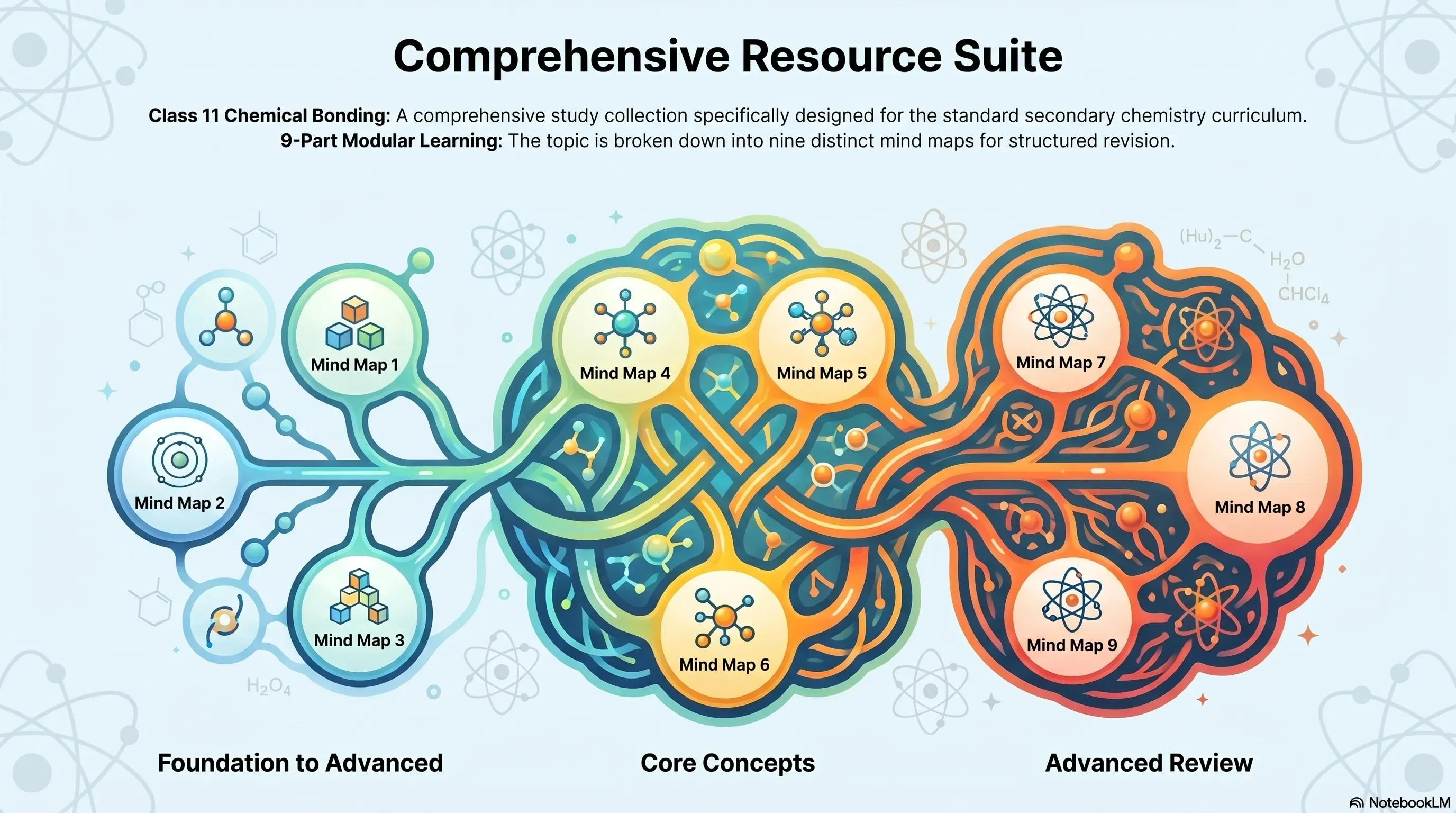
Chemical Bonding Mind Maps offer a concise visual summary of bond formation, molecular geometry, hybridization, VSEPR theory, and bonding concepts, helping Class 11 students revise key topics quickly for school exams, JEE, and NEET.
eSaral › Class 11› Chemical Bonding
This page explains why nitrogen forms exactly three bonds and keeps one lone pair — the compound that example almost always becomes is ammonia, covered here: valency of ammonia.

🚀 Checkout eSaral Courses
Mind Map - 1
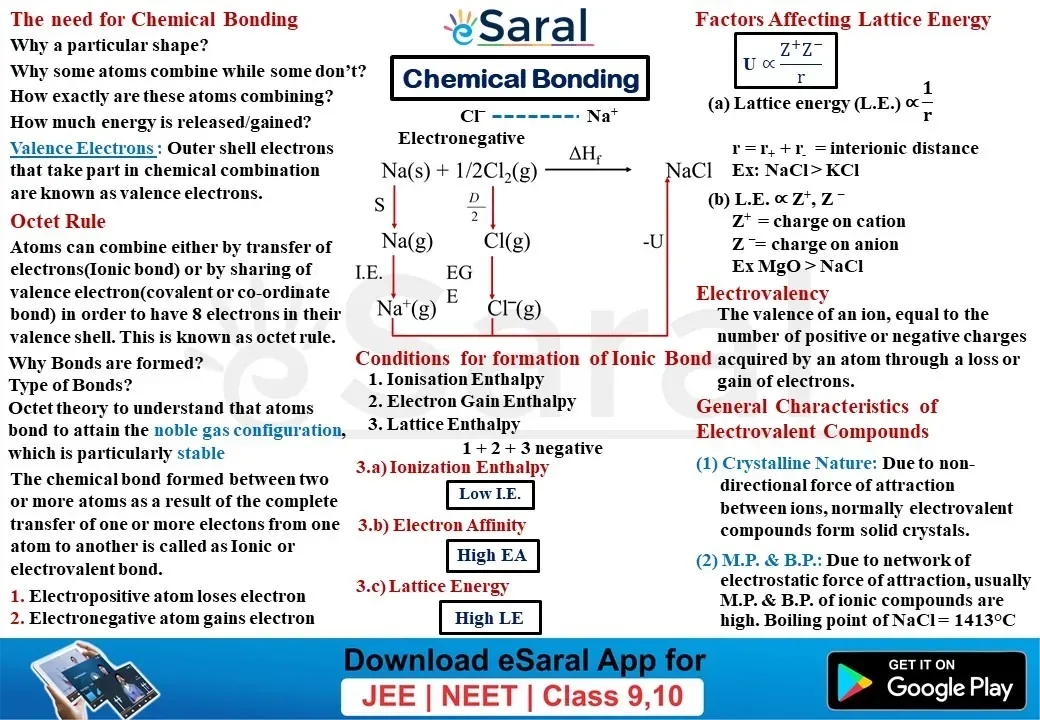
Mind Map - 2
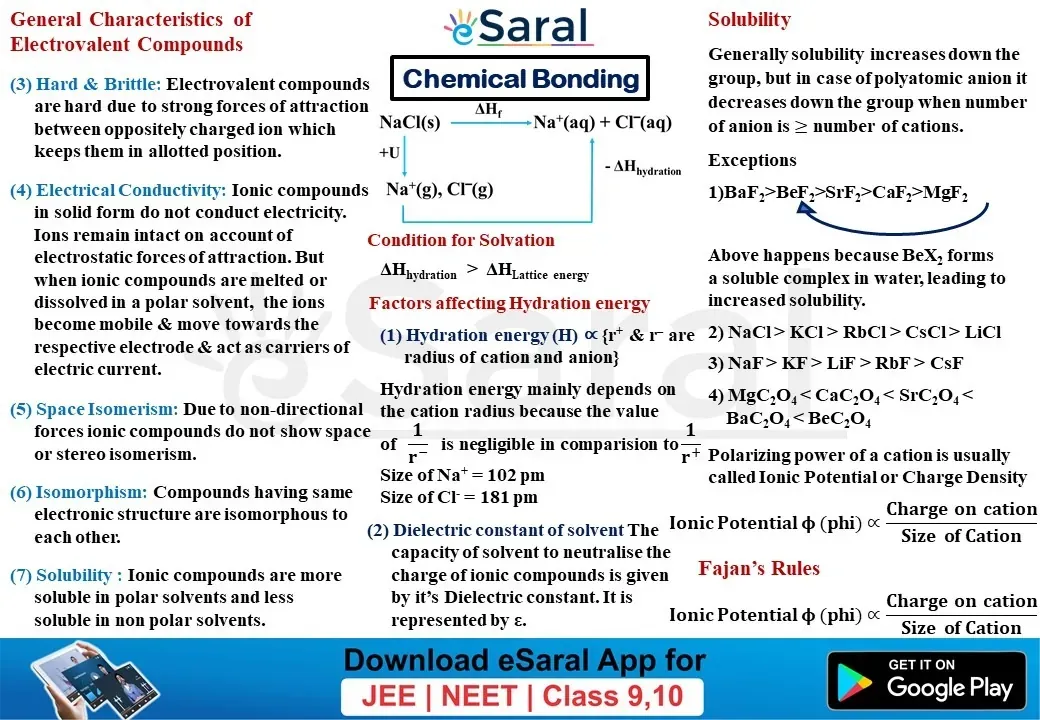
Mind Map - 3
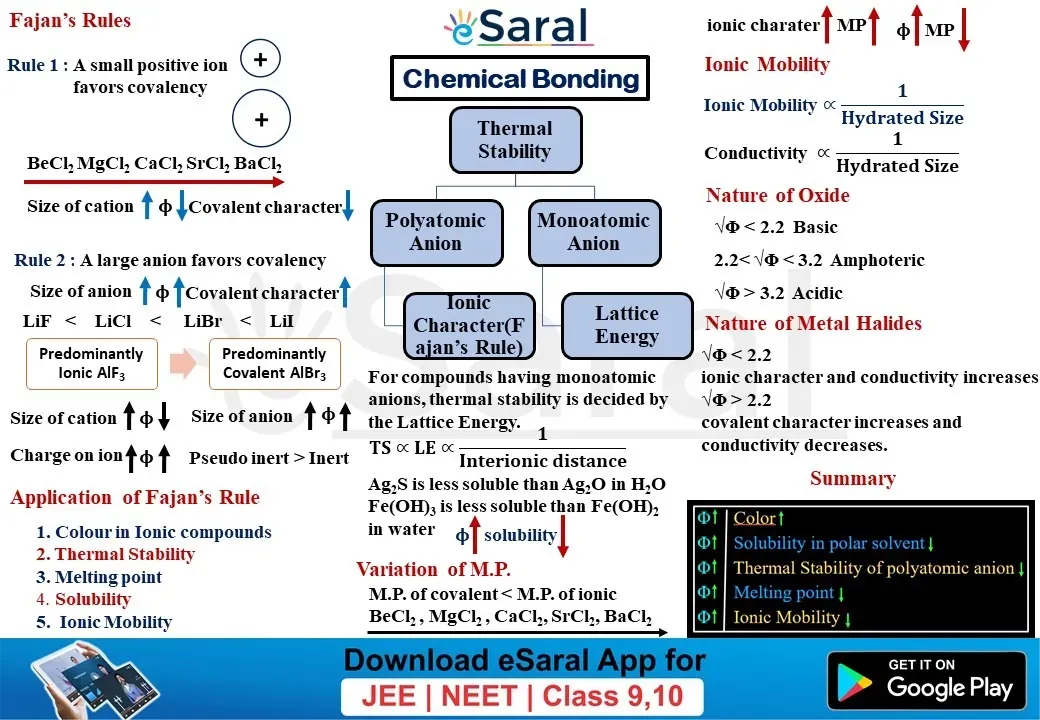
Mind Map - 4
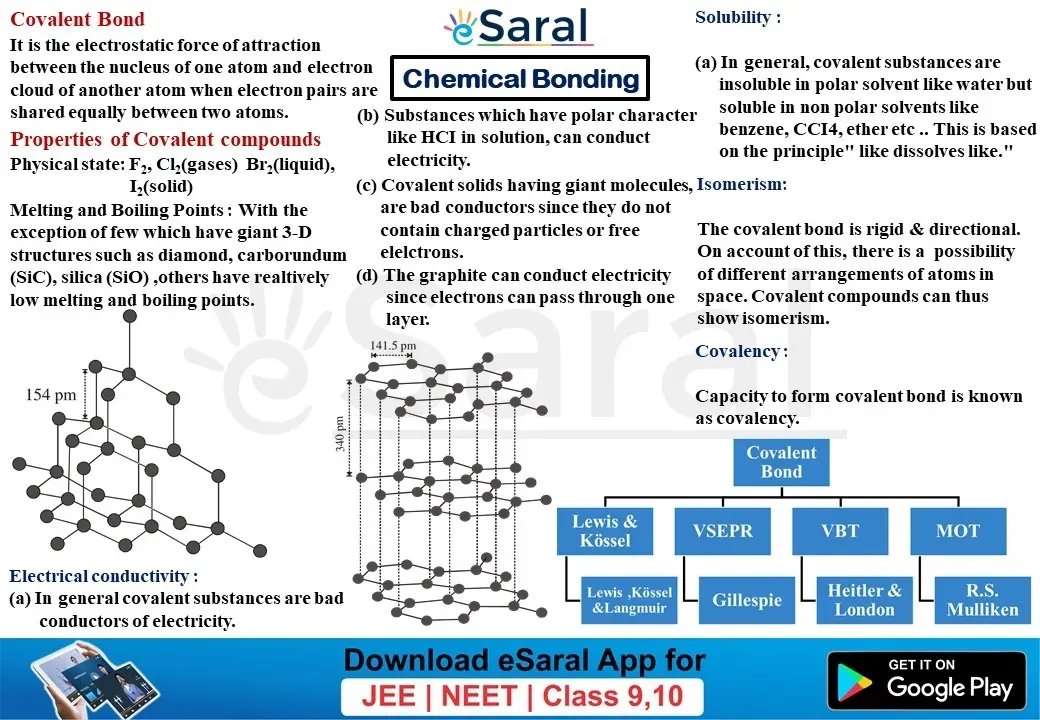
Mind Map - 5
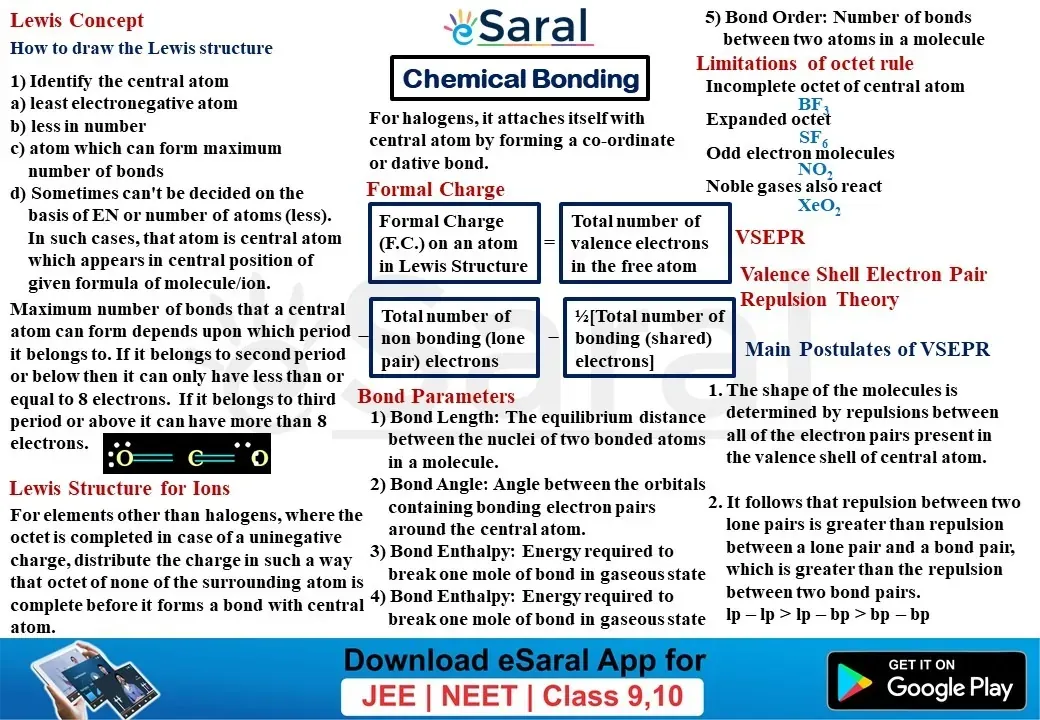
Mind Map - 6
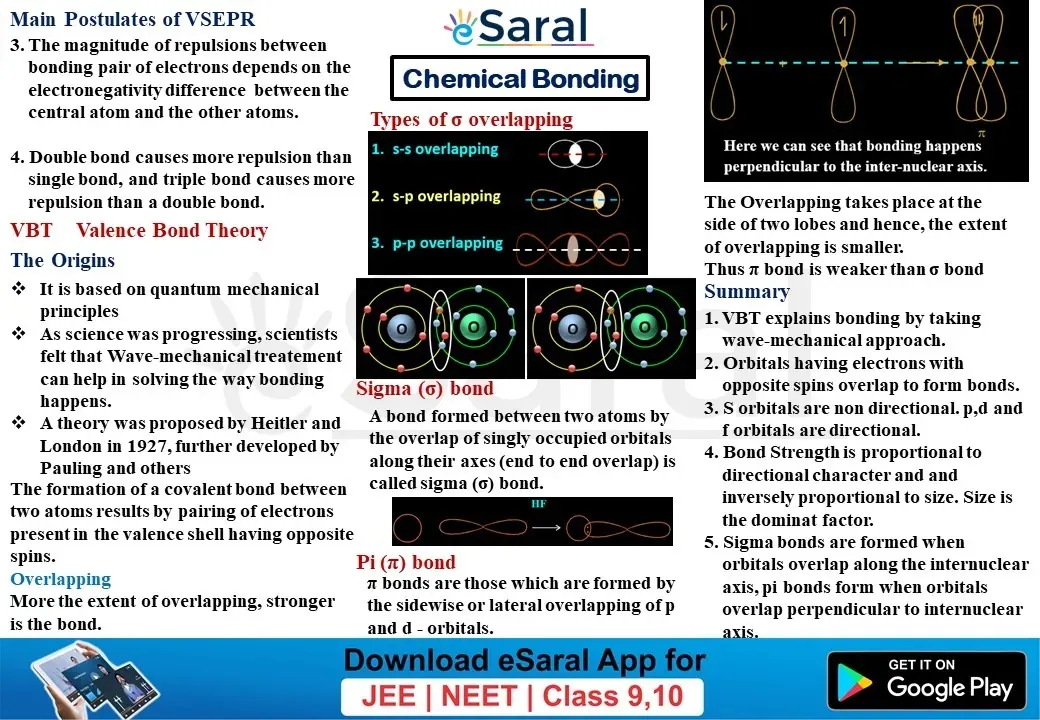
Mind Map - 7
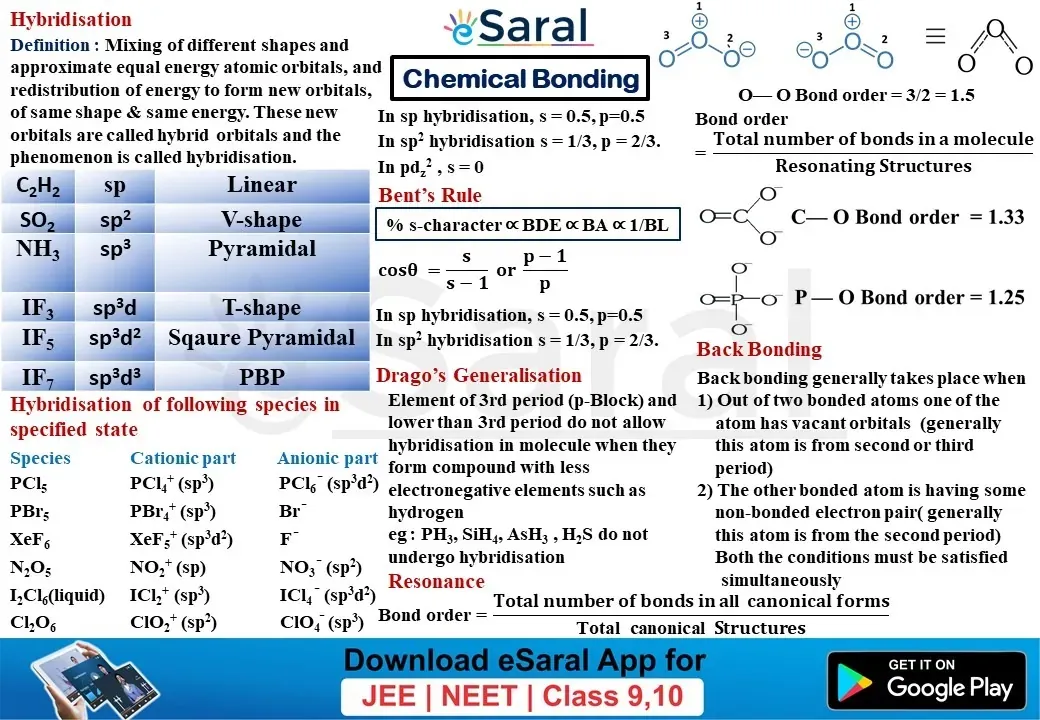
Mind Map - 8
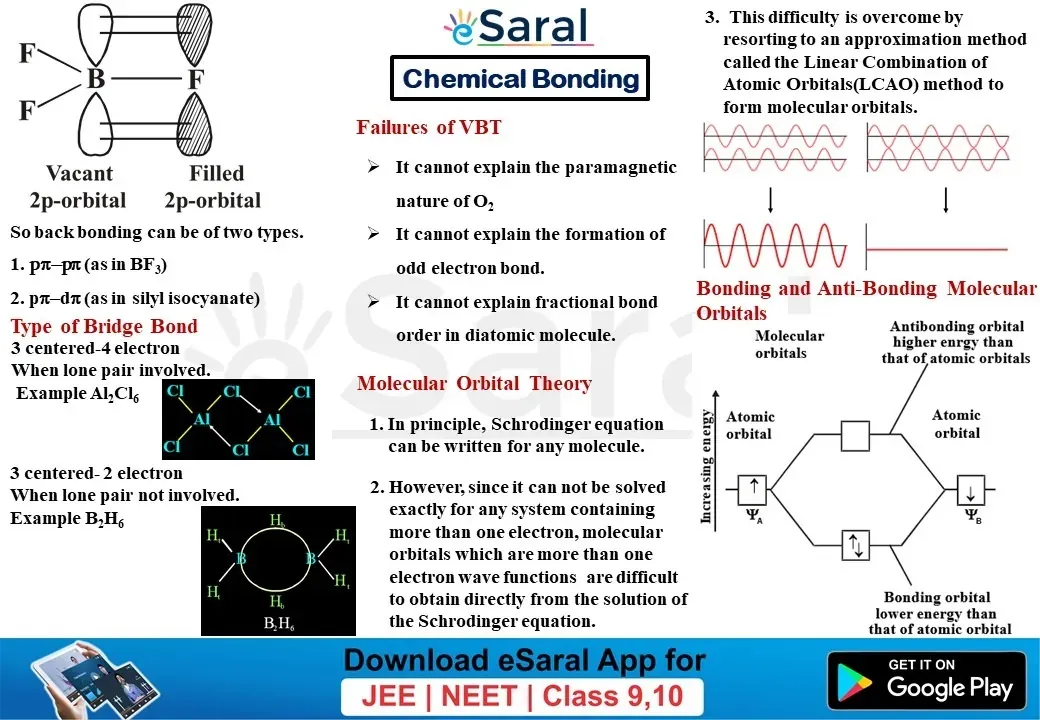
Mind Map - 9
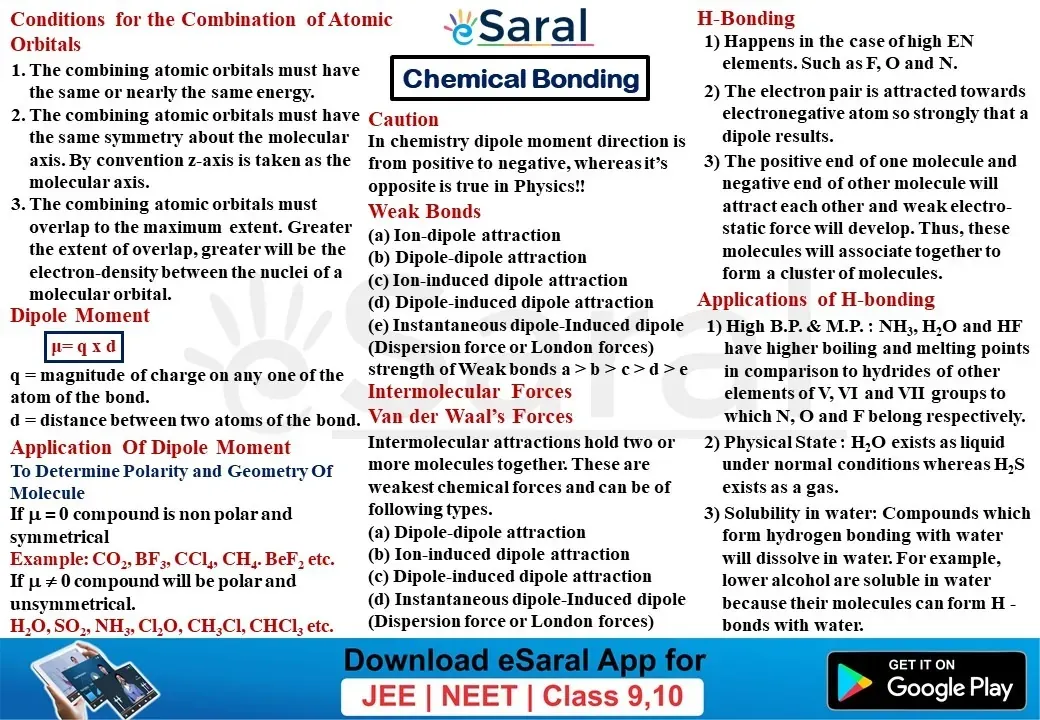
Frequently Asked Questions
What is chemical bonding in simple words?
Chemical bonding is the force that holds atoms together in a molecule or compound. Atoms form bonds because doing so lowers their total energy and gives them a more stable electron arrangement — usually a filled outer shell. Without chemical bonding, no molecules, no materials, and no living organisms would exist.
What are the 3 main types of chemical bonds?
The three main types are ionic bonds (electron transfer between metal and non-metal), covalent bonds (electron sharing between non-metals), and metallic bonds (delocalised electron sea in metals). Coordinate bonds and hydrogen bonds are additional important types tested in JEE and NEET.
What is the difference between a sigma bond and a pi bond?
A sigma (σ) bond is formed by head-on overlap of orbitals along the internuclear axis. It is the first bond in any covalent bond and is stronger and more stable. A pi (π) bond forms by lateral (side-to-side) overlap of p-orbitals above and below the axis. Double bonds contain one σ + one π; triple bonds contain one σ + two π.
Why is CO₂ non-polar despite having polar bonds?
CO₂ is linear (sp hybridised carbon), so its two C=O bond dipoles point in exactly opposite directions and cancel each other out. Net dipole moment = zero, making the molecule non-polar overall. H₂O, by contrast, is bent (due to lone pairs), so its bond dipoles do not cancel — it has a net dipole moment and is polar.
How do you calculate bond order using MOT?
Bond order = (Number of electrons in bonding MOs − Number of electrons in antibonding MOs) ÷ 2. A bond order of 1 = single bond, 2 = double bond, 3 = triple bond. Zero means the molecule is unstable and does not exist. Fractional bond orders are possible (e.g., O₂⁻ has bond order 1.5).
Team eSaral
eSaral Academic and Editorial Team
Team eSaral is the collective author profile for educational content created by eSaral’s teachers and academic contributors. The team draws on expertise from IIT graduates, doctors, experienced educators and subject specialists to develop resources for JEE, NEET and school students. Our articles aim to explain concepts clearly and help students study with confidence.
Related Posts

NCERT Physics Class 10 Book PDF in Hindi 2026-27 – भौतिक विज्ञान के 4 अध्याय (Free Download)
NCERT Physics Class 10 book PDF in Hindi 2026-27: download all 4 chapters (अध्याय 9–12) free, with topics and important formulas.

NCERT Biology Class 9 Book Anveshan PDF in Hindi - जीव विज्ञान कक्षा 9 पुस्तक अन्वेषण PDF
Download NCERT Biology Class 9 book PDF in Hindi chapterwise for 2026-27: Cell, Tissues, Reproduction and Diversity. Free PDFs.

Essay On Artificial Intelligence in English (100,150, 200, 250, 300, 500 Words)
This is in contrast to the natural intelligence of humans. With Artificial Intelligence, machines can perform

Essay on 78th India Independence Day in English for Student (100, 150, 200, 250, 300, 500 Words)
Read the best essays on India's Independence Day in English. Short & long essays (100, 150, 200, 250, 300, 500 words) perfect for school exams
NCERT Class 11 English Snapshots book - Free PDF download- Esaral
Download NCERT Class 11 English Snapshots book PDF for free. Get all 8 chapters, chapter-wise. Start your prep today!
NCERT Class 10 biology book pdf - Free PDF Download - eSaral
NCERT Class 10 Biology book PDF 2026-27: all 5 chapters (Life Processes to Our Environment) in English & Hindi, with CBSE syllabus, marks & practical

Essay on Global Warming in English (100,150, 200, 250, 300, 500 Words)
Global warming means the Earth is getting hotter. This happens because of things like pollution from cars and factories.

NCERT Class 12 English Book 2026-27: Flamingo, Vistas and Kaleidoscope PDF, Chapters and Syllabus
NCERT Class 12 English book 2026-27: Flamingo & Vistas (English Core) and Kaleidoscope (Elective) PDFs chapter-wise, with syllabus and sample papers.
NCERT Class 11 Physics Book —Part1 & Part 2 download in Hindi - NCERT भौतिकी कक्षा 11 पुस्तक
Download Class 11 Physics NCERT book PDF in Hindi – all 15 chapters, chapterwise links, JEE & NEET tips. Free PDF, no signup needed.
NCERT Class 10 Hindi Book PDF 2026-27 – क्षितिज, कृतिका, स्पर्श, संचयन (Chapterwise Free Download)
Download NCERT Class 10 Hindi Book PDF 2026-27 free, chapterwise: Kshitij, Kritika, Sparsh, Sanchayan. Includes CBSE syllabus & deleted chapters.