
Chemical Kinetics - JEE Main Previous Year Questions with Solutions

eSaral > JEE Main Chemistry PYQs > Chemical Kinetics
[jee-post-banner]
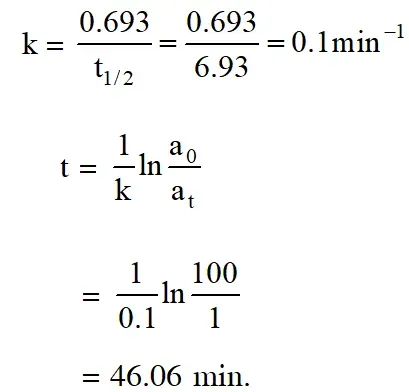
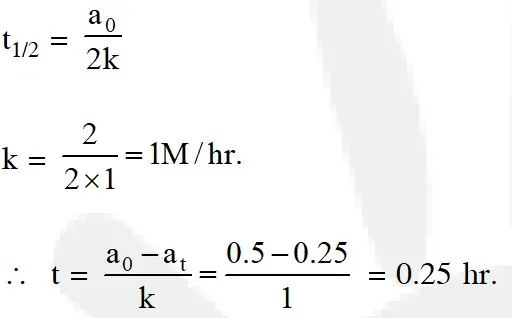
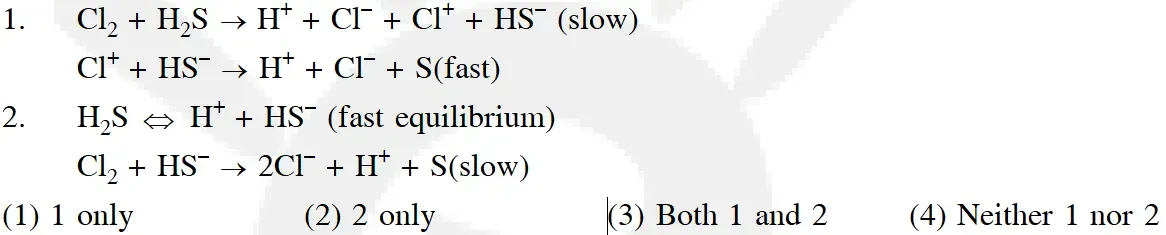
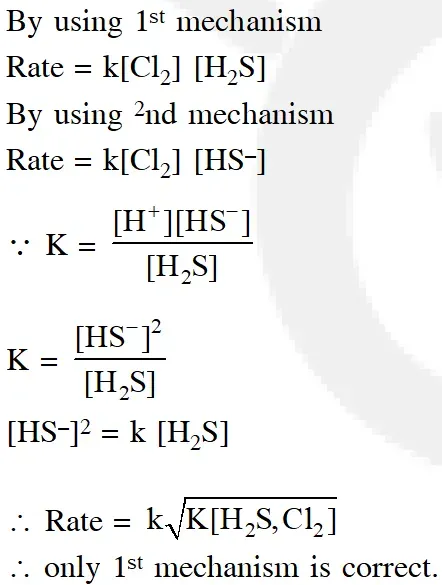
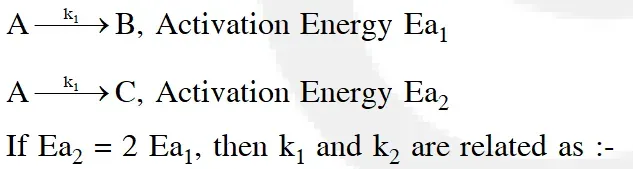
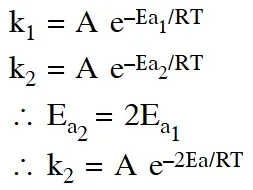
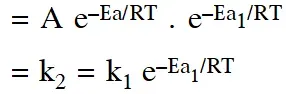
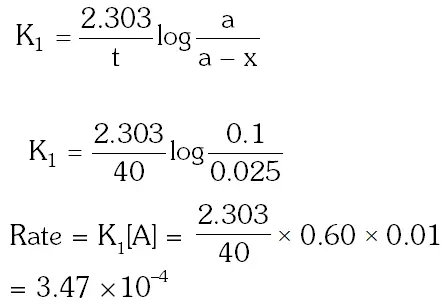
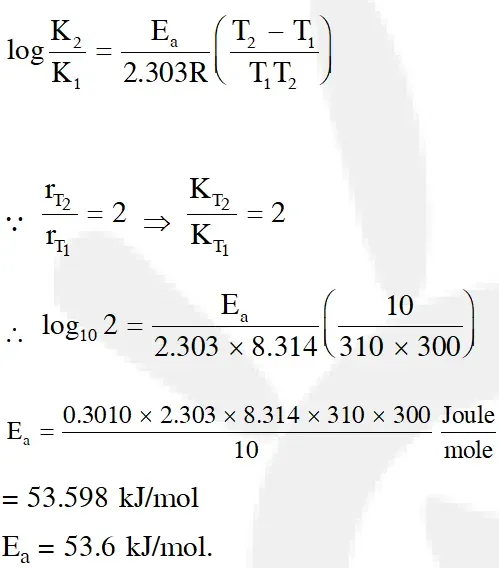
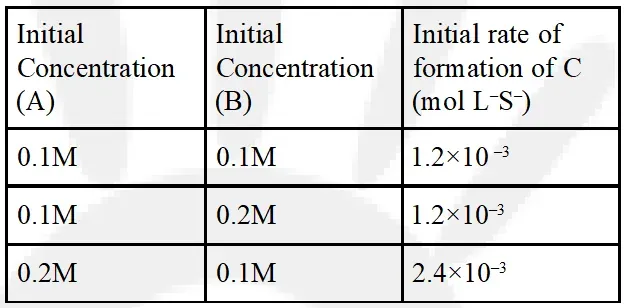
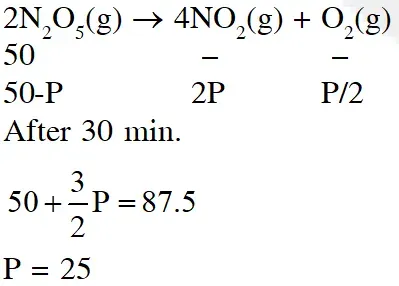
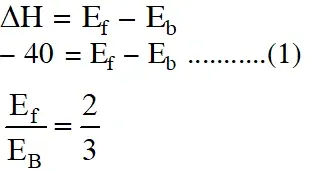
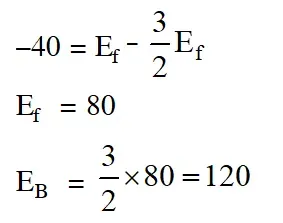
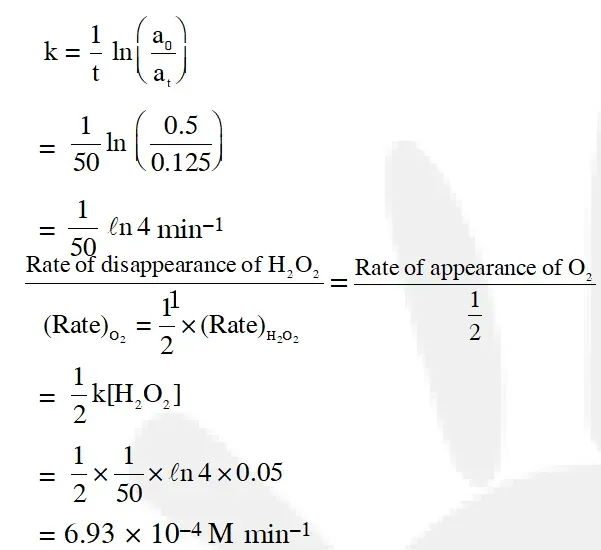
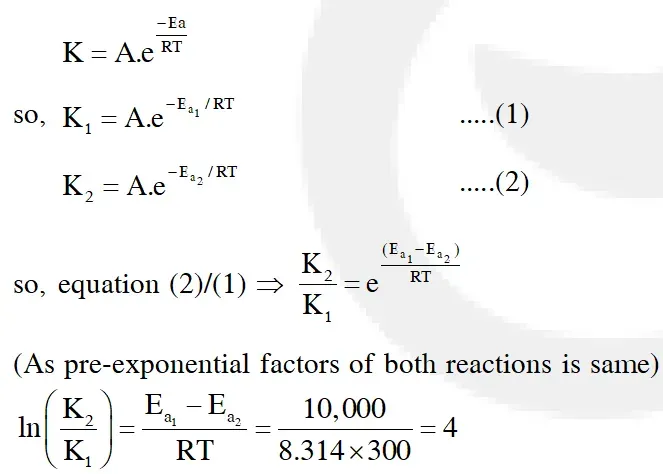
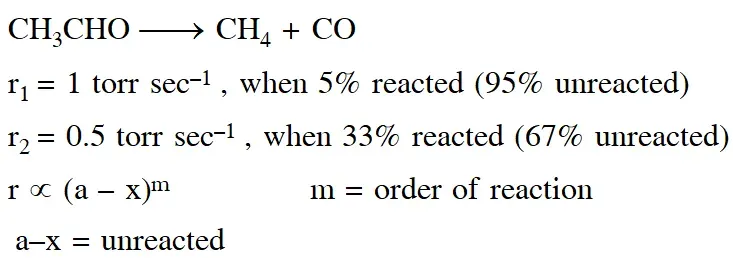
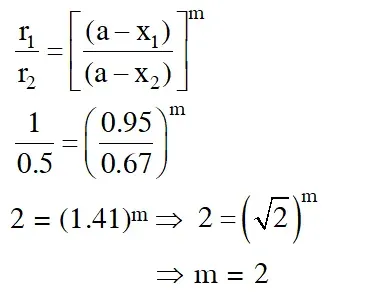
JEE Main Previous Year Papers Questions of Chemistry with Solutions are available at eSaral. Practicing JEE Mains chapter-wise questions of Chemistry will help the JEE aspirants in realizing the question pattern, as well as help in analyzing weak & strong areas. Simulator Previous Years AIEEE/JEE Mains Questions [esquestion] The half-life period of a first-order chemical reaction is 6.93 minutes. The time required for the completion of 99% of the chemical reaction will be (log 2 = 0.301) :- (1) 46.06 minutes (2) 460.6 minutes (3) 230.3 minutes (4) 23.03 minutes #tag# [aieee-2009] #sol# (1) [/esquestion] [esquestion] The time for half life period of a certain reaction A Products is 1 hour, when the initial concentration of the reactant 'A' is 2.0 mol L–1, How much time does it take for its concentration to come from 0.50 to 0.25 mol L–1 if it is a zero order reaction? (1) 1 h (2) 4 h (3) 0.5 h (4) 0.29. #tag# [aieee-2010] #sol# (4) For zero order reaction [/esquestion] [esquestion] Consider the reaction: $\mathrm{Cl}_{2}(\mathrm{aq})+\mathrm{H}_{2} \mathrm{S}(\mathrm{aq}) \rightarrow \mathrm{S}(\mathrm{s})+2 \mathrm{H}^{+}(\mathrm{aq})+2 \mathrm{Cl}^{-}(\mathrm{aq})$ The rate equation for this reaction is rate = $\mathrm{k}\left[\mathrm{Cl}_{2}\right]\left[\mathrm{H}_{2} \mathrm{S}\right]$ Which of these mechanisms is/are consistent with this rate equation? #tag# [aieee-2010] #sol# (1) [/esquestion] [esquestion] A reactant (A) forms two products : (1) $\mathrm{k}_{1}=2 \mathrm{k}_{2} \mathrm{e}^{\mathrm{E}_{2} / \mathrm{RT}}$ (2) $\mathrm{k}_{1}=\mathrm{k}_{2} \mathrm{e}^{\mathrm{Ea}_{1} / \mathrm{RT}}$ (3) $\mathrm{k}_{2}=\mathrm{k}_{1} \mathrm{e}^{\mathrm{Ea}_{2} / \mathrm{RT}}$ (4) $\mathrm{k}_{1}=\mathrm{A} \mathrm{k}_{2} \mathrm{e}^{\mathrm{Ea}_{1} / \mathrm{RT}}$ #tag# [aieee-2011] #sol# (2) [/esquestion] [esquestion] The rate of a chemical reaction doubles for every $10^{\circ} \mathrm{C}$ rise of temperature. If the temperature is raised by $50^{\circ} \mathrm{C}, \mathrm$ the rate of the reaction increases by about :- (1) 32 times (2) 64 times (3) 10 times (4) 24 times #tag# [aieee-2011] #sol# (1) $\mathrm{k}_{2}=\mathrm{k}_{1}(2)^{5}=32 \mathrm{k}_{1}$ [/esquestion] [esquestion] For a first order reaction, (A) products, the concentration of A changes from 0.1M to 0.025M in 40 minutes. The rate of reaction when the concentration of A is 0.01 M is : (1) $1.73 \times 10^{-4} \mathrm{M} / \mathrm{min}$ (2) $1.73 \times 10^{-5} \mathrm{M} / \mathrm{min}$ (3) $3.47 \times 10^{-4} \mathrm{M} / \mathrm{min}$ (4) $3.47 \times 10^{-5} \mathrm{M} / \mathrm{m}$ #tag# [aieee-2012] #sol# (3) [/esquestion] [esquestion] The rate of a reaction doubles when its temperature changes from 300 K to 310 K. Activation energy of such a reaction will be $\left(\mathrm{R}=8.314 \mathrm{JK}^{-1} \mathrm{mol}^{-1} \text { and } \log 2=0.301\right)$ (1) $53.6 \mathrm{kJ} \mathrm{mol}^{-1}$ (2) $48.6 \mathrm{kJ} \mathrm{mol}^{-1}$ (3) $58.5 \mathrm{kJ} \mathrm{mol}^{-1}$ (4) $60.5 \mathrm{kJ} \mathrm{mol}^{-1}$ #tag# [J-main 2013] #sol# (1) [/esquestion] [esquestion] For the non-stoichiometre reaction 2A + B C + D, the following kinetic data were obtained in three separate experiments, all at 298 K. (1) $\frac{\mathrm{dc}}{\mathrm{dt}}=\mathrm{k}[\mathrm{A}][\mathrm{B}]^{2}$ (2) $\frac{\mathrm{dc}}{\mathrm{dt}}=\mathrm{k}[\mathrm{A}]$ (3) $\frac{\mathrm{dc}}{\mathrm{dt}}=\mathrm{k}[\mathrm{A}][\mathrm{B}]$ (4) $\frac{\mathrm{dc}}{\mathrm{dt}}=\mathrm{k}[\mathrm{A}]^{2}[\mathrm{B}]$ #tag# [J-main 2014] #sol# (2) [/esquestion] [esquestion] Higher order (>3) reactions are rare due to :- (1) shifting of equilibrium towards reactants due to elastic collision (2) loss of active species on collision (3) low probability of simultaneous collision of all the reacting species (4) increase in entropy and activation energy as more molecules are involved. #tag# [JEE-MAIN-(Offline) 2015] #sol# (3) Higher order (>3) reactions are rare due to the low probability of simultaneous collision of more than three molecules. [/esquestion] [esquestion] The reaction $2 \mathrm{N}_{2} \mathrm{O}_{5}(\mathrm{g}) \rightarrow 4 \mathrm{NO}_{2}(\mathrm{g})+\mathrm{O}_{2}(\mathrm{g})$ follows first order kinetics. The pressure of a vessel containing only $\mathrm{N}_{2} \mathrm{O}_{5}$ was found to increase from 50 mm Hg to 87.5 mm Hg in 30 min. The pressure exerted by the gases after 60 min. will be (Assume temperature remains constant) (1) 106.25 nm Hg (2) 116.25 nm Hg (3) 125 mm Hg (4) 150 mm Hg #tag# [JEE-MAIN (Online)2015] #sol# (2) [/esquestion] [esquestion] For the equilibrium, $\mathrm{A}(\mathrm{g}) \square \mathrm{B}(\mathrm{g}), \Delta \mathrm{H}$ is is –40 kJ/mol. If the ratio of the activation energies of the forward $\left(\mathrm{E}_{\mathrm{f}}\right)$ and reverse $\left(\mathrm{E}_{\mathrm{b}}\right)$ reactions is $\frac{2}{3}$ then :- (1) $\mathrm{E}_{\mathrm{f}}=60 \mathrm{kJ} / \mathrm{mol} ; \mathrm{E}_{\mathrm{b}}=100 \mathrm{kJ} / \mathrm{mol}$ $|(2) \mathrm{E}_{\mathrm{f}}=30 \mathrm{kJ} / \mathrm{mol} ; \mathrm{E}_{\mathrm{b}}=70 \mathrm{kJ} / \mathrm{mol}$ (3) $\mathrm{E}_{\mathrm{f}}=80 \mathrm{kJ} / \mathrm{mol} ; \mathrm{E}_{\mathrm{b}}=120 \mathrm{kJ} / \mathrm{mol}$ (4) $\mathrm{E}_{\mathrm{f}}=70 \mathrm{kJ} / \mathrm{mol} ; \mathrm{E}_{\mathrm{b}}=30 \mathrm{kJ} / \mathrm{mol}$ #tag# [JEE-MAIN (Online)2015] #sol# (3) [/esquestion] [esquestion] Decomposition of $\mathrm{H}_{2} \mathrm{O}_{2}$ follows a first order reaction. In fifty minutes the concentration of $\mathrm{H}_{2} \mathrm{O}_{2}$ decreases from 0.5 to 0.125 M in one such decomposition. When the concentration of $\mathrm{H}_{2} \mathrm{O}_{2}$ reaches 0.05 M, the rate of formation of $\mathrm{O}_{2}$ will be :- #tag# [JEE - Main 2016] #sol# (3) $\mathrm{H}_{2} \mathrm{O}_{2(\mathrm{aq})} \longrightarrow \mathrm{H}_{2} \mathrm{O}_{(\mathrm{aq})}+\frac{1}{2} \mathrm{O}_{2}(\mathrm{g})$ [/esquestion] [esquestion] Two reactions R1 and R2 have identical pre-exponential factors. Activation energy of $\mathrm{R}_{1}$ exceeds that of $\mathrm{R}_{2}$ by 10 kJ $\mathrm{mol}^{-1}$. If k1 and k2 are rate constants for reactions $\mathrm{R}_{1}$ and $\mathrm{R}_{2}$ respectively at 300 K, then ln $\left(\mathrm{k}_{2} / \mathrm{k}_{1}\right)$ is equal to :- (1) 8 (2) 12 (3) 6 (4) 4 #tag# [JEE - Main 2017] #sol# (4) From arrhenius equation, [/esquestion] [esquestion] At $518^{\circ} \mathrm{C}$, the rate of decomposition of a sample of gaseous acetaldehyde, initially at a pressure of 363 Torr, was 1.00 Torr $\mathrm{s}^{-1}$ when 5% had reacted and 0.5 Torr s–1 when 33% had reacted. The order of the reaction is : (1)3 (2) 1 (3) 0 (4) 2 #tag# [JEE - Main 2018] #sol# (4) [/esquestion]

Once Chemical Kinetics is complete, move through the remaining Chemistry chapters using the JEE Mains PYQs chapter wise archive.
For a true exam simulation, pair this Chemical Kinetics practice with our JEE Main previous year question paper, which has complete papers from past sessions.
Frequently Asked Questions
What are the most important topics in Chemical Kinetics for JEE Main?
The three highest-yield topics are: (1) First order integrated rate law and half-life, (2) Arrhenius equation and activation energy, and (3) Determination of rate law order from experimental data. These three sub-topics together covered over 70% of all Chemical Kinetics marks in JEE Main papers from 2009 to 2018.
Is Chemical Kinetics difficult for JEE Main?
Chemical Kinetics is rated medium difficulty. The numerical problems — half-life, activation energy, order determination — follow predictable patterns. If you have clear concepts from NCERT and have solved 10–15 PYQs with worked solutions, this chapter becomes one of the more scoring areas in Physical Chemistry
What is the weightage of Chemical Kinetics in JEE Main?
Chemical Kinetics typically contributes 1–2 questions (4–8 marks) per JEE Main session. Over the past decade, it has appeared in every paper. The chapter is part of the Physical Chemistry section, which carries approximately 35–40% of the total Chemistry marks according to the NTA JEE Main syllabus.
Can I solve Chemical Kinetics JEE Main questions without calculus?
Yes. JEE Main Chemical Kinetics questions use pre-derived integrated rate law formulas — you do not need to derive them during the exam. Memorise the four key formulas (first order, zero order, Arrhenius, half-life relations) and practise substituting numbers accurately. Calculus understanding helps conceptually but is not required for calculation steps in the MCQ format.
What is the difference between order and molecularity?
Order of reaction is determined experimentally from the rate law and can be zero, fractional, or any integer. Molecularity refers to the number of molecules involved in an elementary step of a reaction mechanism and is always a positive integer (1, 2, or 3). For overall reactions with multiple steps, only order (not molecularity) is meaningful.
How do you determine the order of a reaction in JEE Main problems?
Determine order by comparing initial rate data from two experiments where only one reactant concentration changes. Set up the ratio $r_1/r_2 = (c_1/c_2)^n$ and solve for n. If rate data is given as a function of time (not initial rates), use integrated rate laws — plot ln[A] vs t (linear = first order) or 1/[A] vs t (linear = second order).