
Circle - JEE Advanced Previous Year Questions with Solutions

eSaral Academic and Editorial Team
Summary
Circle questions in JEE Advanced typically test tangents, chords of contact, locus of midpoints, orthogonal circles, and radical axes. The topic appeared in nearly every paper with 3–4 marks per question. Practising these previous year questions with solutions is the fastest way to identify your weak areas and build exam-ready speed.

Home > JEE Advanced Previous Year Questions > Circle JEE Advanced Previous Year Questions

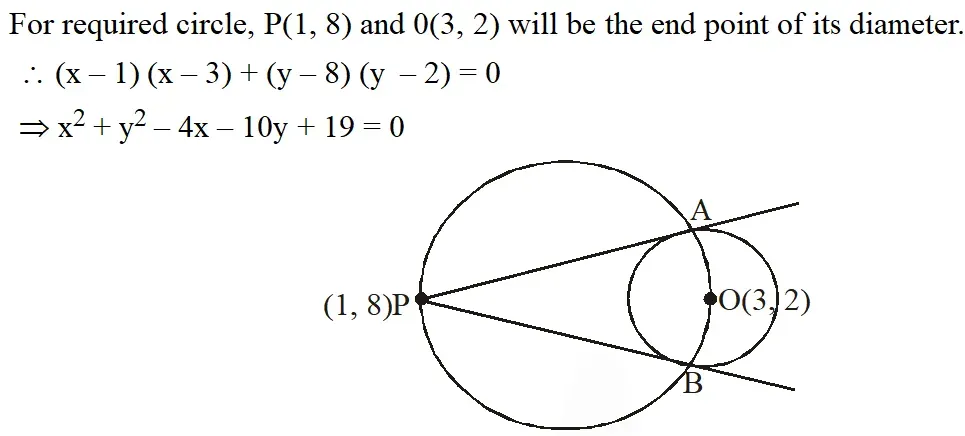
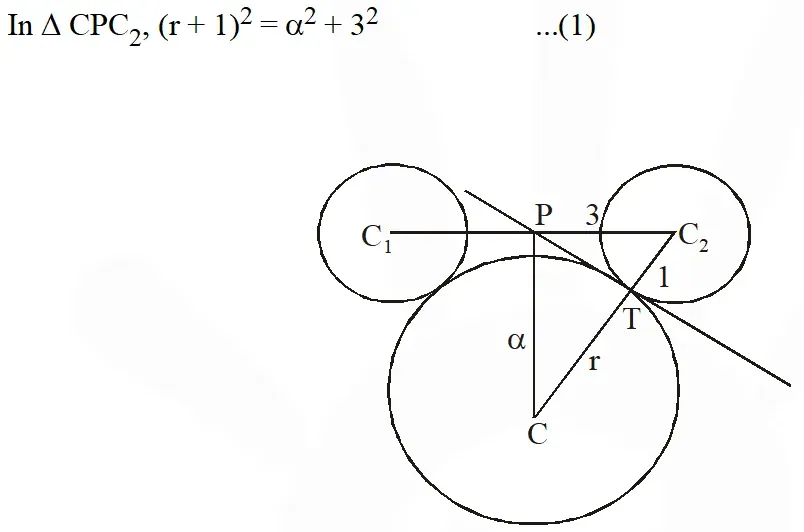
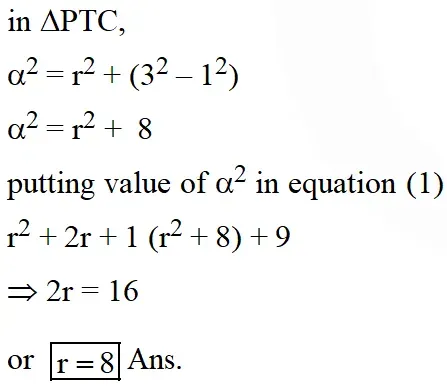
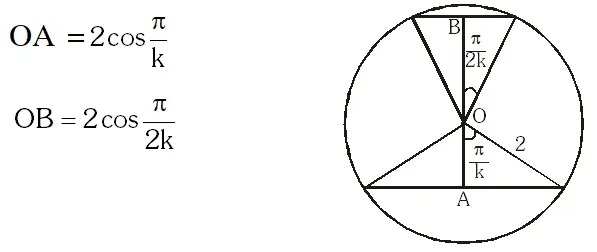
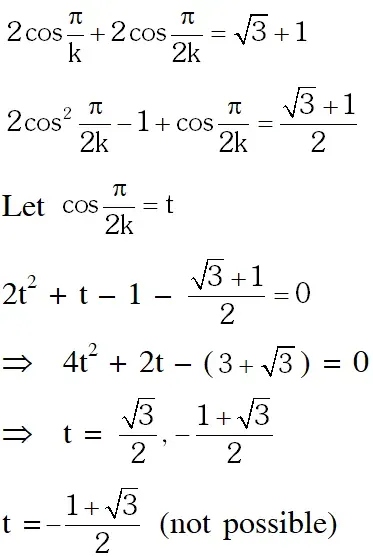
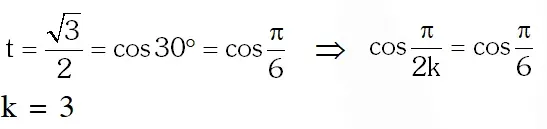
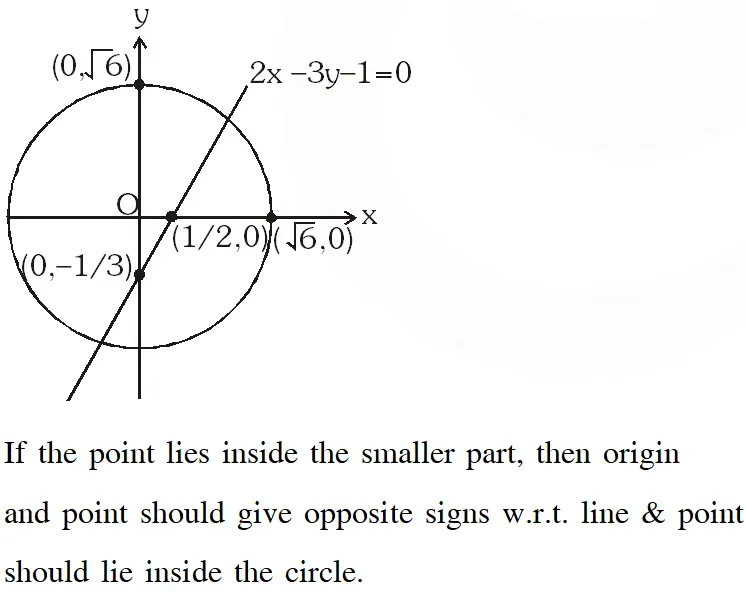
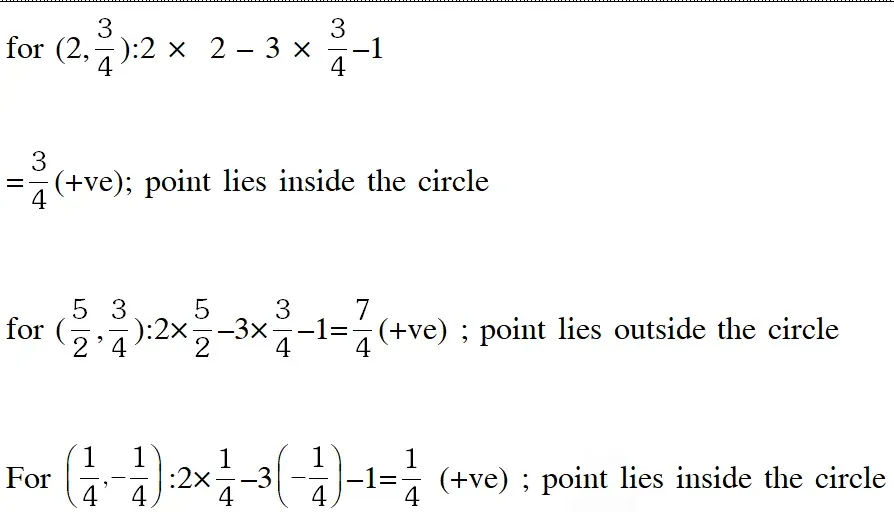
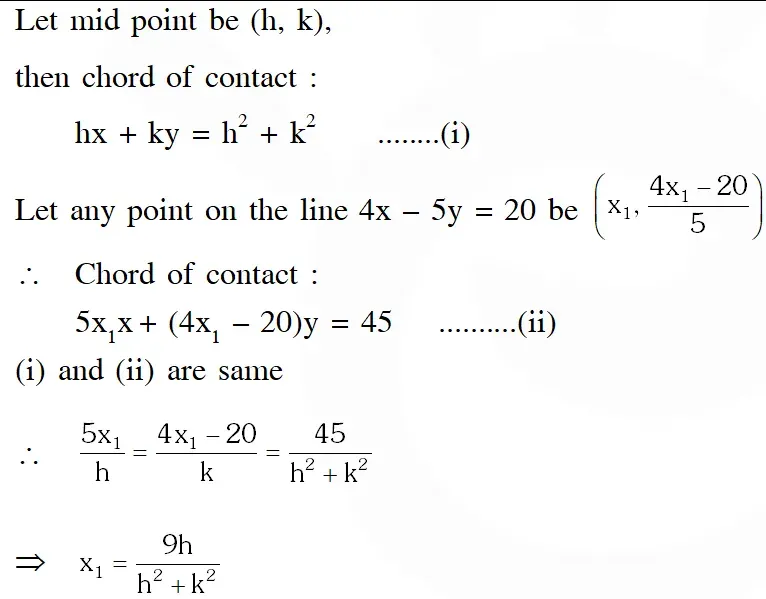
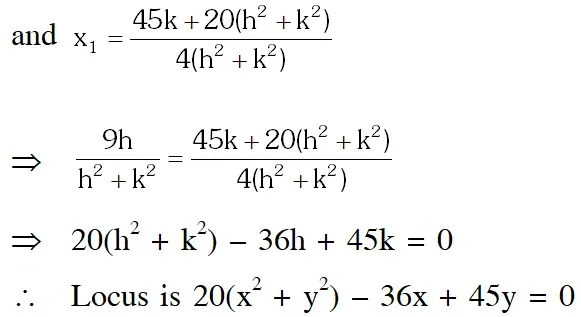
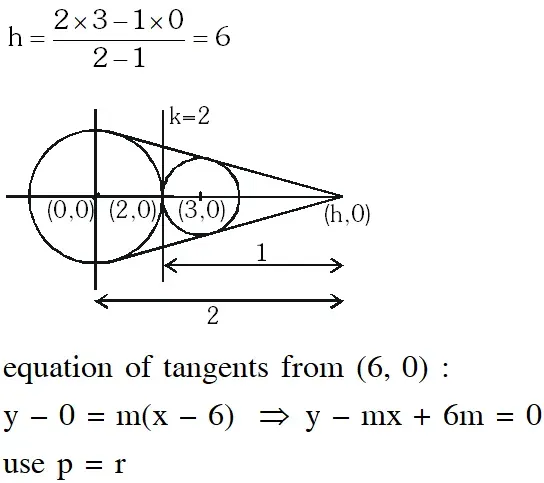
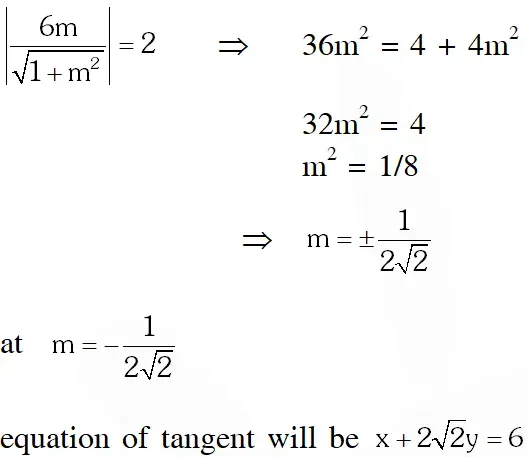
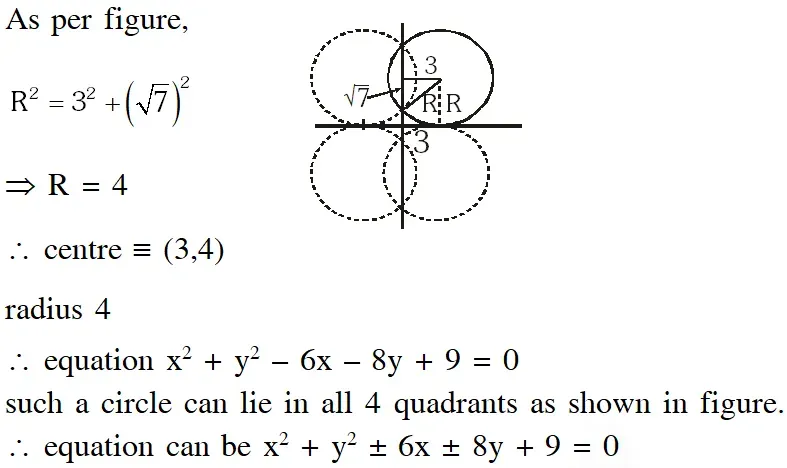
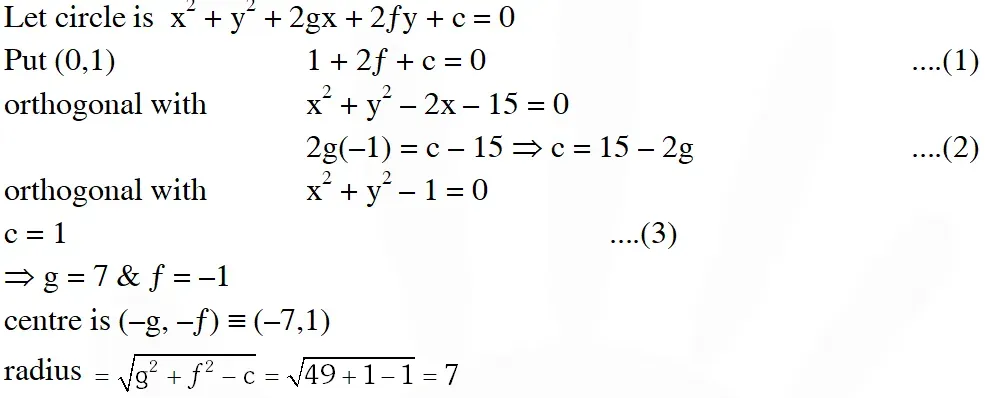
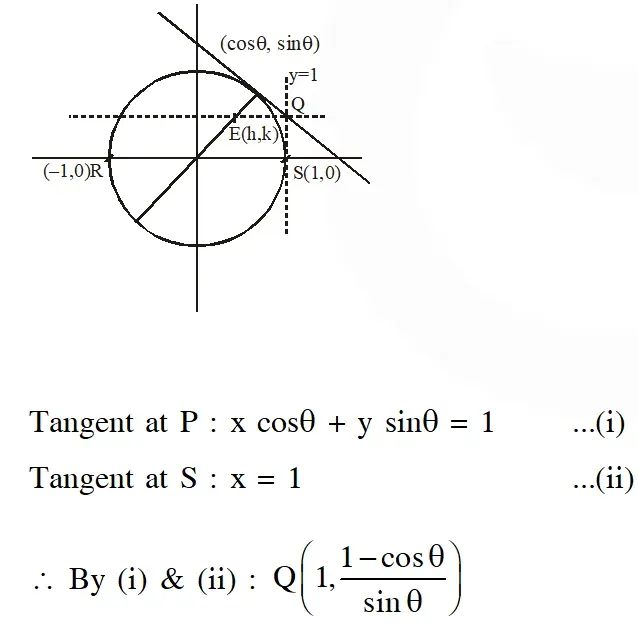
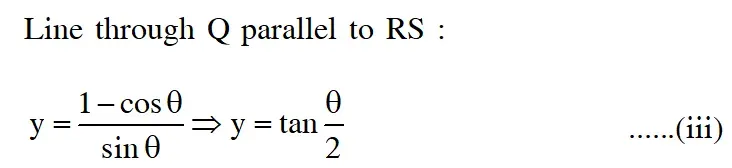
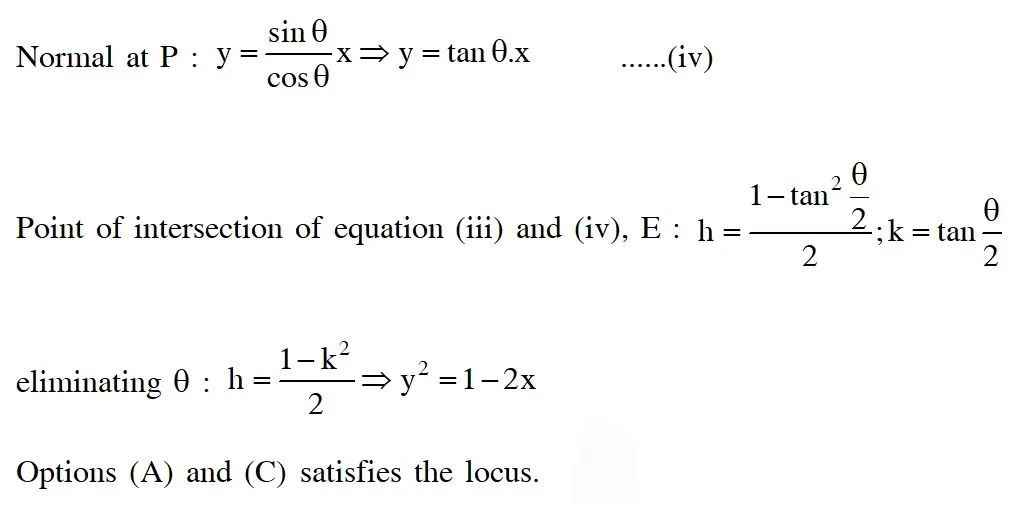
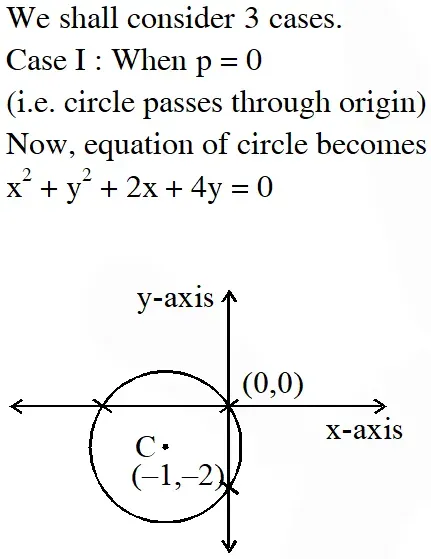
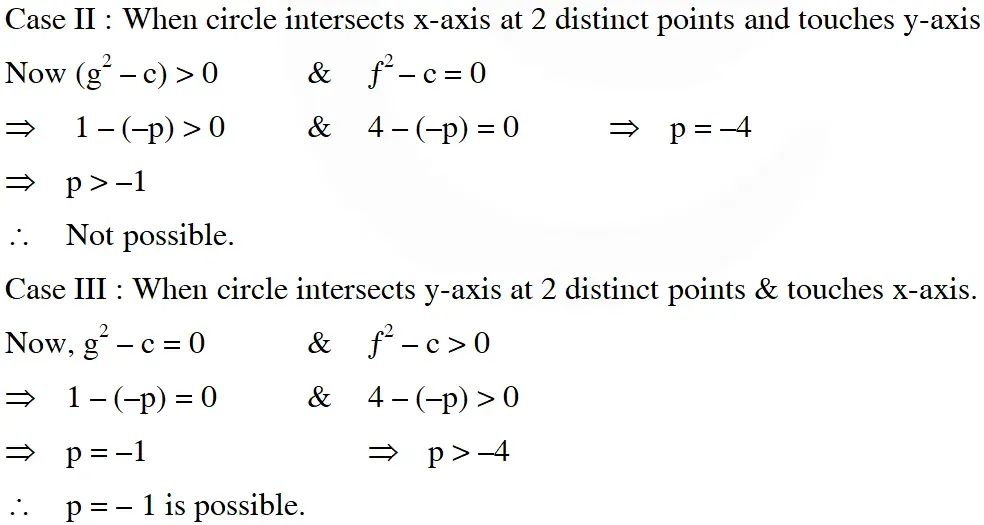
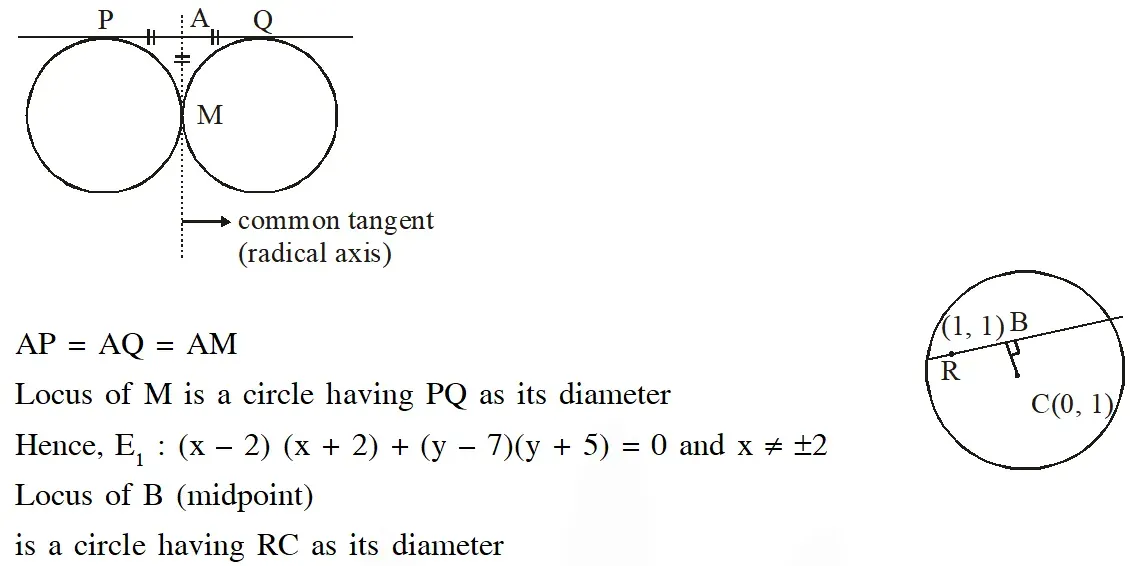
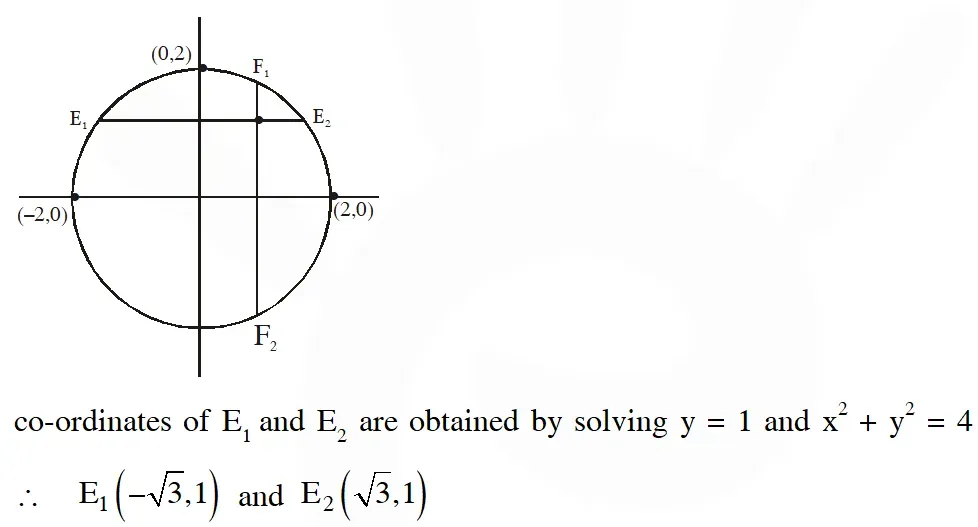
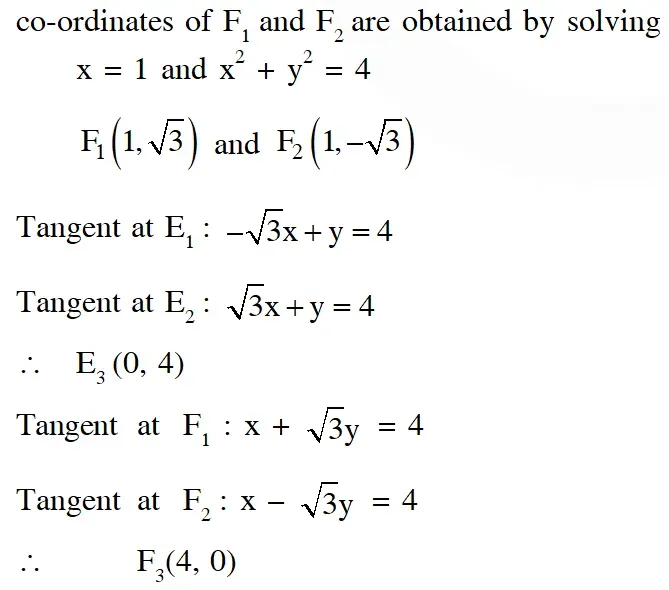
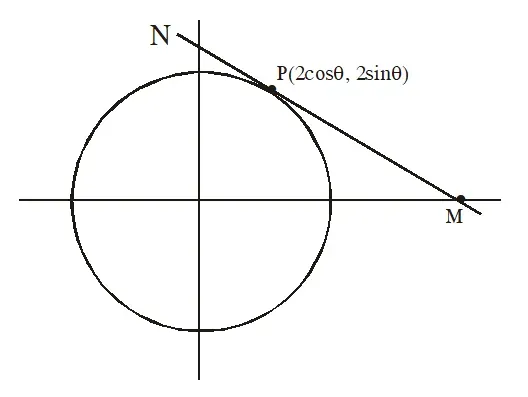
JEE Advanced Previous Year Questions of Math with Solutions are available at eSaral. Practicing JEE Advanced Previous Year Papers Questions of mathematics will help the JEE aspirants in realizing the question pattern as well as help in analyzing weak & strong areas. eSaral helps the students in clearing and understanding each topic in a better way. eSaral also provides complete chapter-wise notes of Class 11th and 12th both for all subjects. Besides this, eSaral also offers NCERT Solutions, Previous year questions for JEE Main and Advance, Practice questions, Test Series for JEE Main, JEE Advanced and NEET, Important questions of Physics, Chemistry, Math, and Biology and many more. Download eSaral app for free study material and video tutorials. [esquestion] Tangents drawn from the point $\mathrm{P}(1,8)$ to the circle $\mathrm{x}^{2}+\mathrm{y}^{2}-6 \mathrm{x}-4 \mathrm{y}-11=0$ touch the circle at the points $\mathrm{A}$ and $\mathrm{B}$. The equation of the circumcircle of the triangle $\mathrm{PAB}$ is (A) $\mathrm{x}^{2}+\mathrm{y}^{2}+4 \mathrm{x}-6 \mathrm{y}+19=0$ (B) $\mathrm{x}^{2}+\mathrm{y}^{2}-4 \mathrm{x}-10 \mathrm{y}+19=0$ (C) $x^{2}+y^{2}-2 x+6 y-29=0$ (D) $x^{2}+y^{2}-6 x-4 y+19=0$ #tag# [JEE 2009, 3] #sol# (B) [/esquestion] [esquestion] The centres of two circles $\mathrm{C}_{1}$ and $\mathrm{C}_{2}$ each of unit radius are at a distance of 6 units from eachother. Let $\mathrm{P}$ be the mid point of the line segment joining the centres of $\mathrm{C}_{1}$ and $\mathrm{C}_{2}$ and $\mathrm{C}$ be a circle touching circles $\mathrm{C}_{1}$ and $\mathrm{C}_{2}$ externally. If a common tangent to $\mathrm{C}_{1}$ and $\mathrm{C}$ passing through $\mathrm{P}$ is also a common tangent to $\mathrm{C}_{2}$ and $\mathrm{C}$, then the radius of the circle $\mathrm{C}$ is #tag# [JEE 2009, 4] #sol# 8 [/esquestion] [esquestion] Two parallel chords of a circle of radius 2 are at a distance $\sqrt{3}+1$ apart. If the chords subtend at the center, angles of $\frac{\pi}{\mathrm{k}}$ and $\frac{2 \pi}{\mathrm{k}},$ where $\mathrm{k}>0,$ then the value of $[\mathrm{k}]$ is [Note : [k] denotes the largest integer less than or equal to k] #tag# [JEE 10, 3M] #sol# 3 [/esquestion] [esquestion] The circle passing through the point (–1,0) and touching the y-axis at (0,2) also passes through the point – (A) $\left(-\frac{3}{2}, 0\right)$ (B) $\left(-\frac{5}{2}, 2\right)$ (C) $\left(-\frac{3}{2}, \frac{5}{2}\right)$ (D) (–4,0) #tag# [JEE 2011, 3M, –1M] #sol# (D) Family of circle which touches $y$ -axis at $(0,2)$ is $x^{2}+(y-2)^{2}+\lambda x=0$ Passing through $(-1,0)$ $\Rightarrow 1+4-\lambda=0 \quad \Rightarrow \quad \lambda=5$ $\therefore \quad x^{2}+y^{2}+5 x-4 y+4=0$ $\quad$ which satisfy the point $(-4,0)$ [/esquestion] [esquestion] The straight line $2 \mathrm{x}-3 \mathrm{y}=1$ divides the circular region $\mathrm{x}^{2}+\mathrm{y}^{2} \leq 6$ into two parts. If $S=\left\{\left(2, \frac{3}{4}\right),\left(\frac{5}{2}, \frac{3}{4}\right),\left(\frac{1}{4},-\frac{1}{4}\right),\left(\frac{1}{8}, \frac{1}{4}\right)\right\},$ then the number of point(s) in Slying inside the smaller part is #tag# [JEE 2011, 4M] #sol# 2 for origin : 2 × 0 – 3 × 0 – 1 = – 1 (–ve) [/esquestion] [esquestion] The locus of the mid-point of the chord of contact of tangents drawn from points lying on the straight line $4 \mathrm{x}-5 \mathrm{y}=20$ to the circle $\mathrm{x}^{2}+\mathrm{y}^{2}=9 \mathrm{is}-$ (A) $20\left(\mathrm{x}^{2}+\mathrm{y}^{2}\right)-36 \mathrm{x}+45 \mathrm{y}=0$ (B) $20\left(\mathrm{x}^{2}+\mathrm{y}^{2}\right)+36 \mathrm{x}-45 \mathrm{y}=0$ (C) $36\left(x^{2}+y^{2}\right)-20 x+45 y=0$ (D) $36\left(x^{2}+y^{2}\right)+20 x-45 y=0$ #tag# [JEE 2012, 3M, –1M] #sol# (A) [/esquestion] Paragraph for Question 7 and 8 A tangent PT is drawn to the circle $x^{2}+y^{2}=4$ at the point $P(\sqrt{3}, 1) .$ A straight line L, perpendicular to PT is a tangent to the circle $(x-3)^{2}+y^{2}=1$ [esquestion] A common tangent of the two circles is (A) x = 4 (B) y = 2 (C) $x+\sqrt{3} y=4$ (D) $x+2 \sqrt{2} y=6$ #tag# [JEE 2012, 3M, –1M] #sol# (D) [/esquestion] [esquestion] A possible equation of L is (A) $x-\sqrt{3} y=1$ (B) $x+\sqrt{3} y=1$ (C) $x-\sqrt{3} y=-1$ (D) $x+\sqrt{3} y=5$ #tag# [JEE 2012, 3M, –1M] #sol# (A) Equation of tangent at $P$ will be $\sqrt{3} x+y=4$ Slope of line L will be $\frac{1}{\sqrt{3}}$ Let equation of $\mathrm{L}$ be $: y=\frac{\mathrm{x}}{\sqrt{3}}+\mathrm{c}$ $\Rightarrow \quad x-\sqrt{3} y+\sqrt{3} c=0$ Now this $L$ is tangent to $2^{\text {nd }}$ circle So $\frac{3+\sqrt{3} c}{2}=\pm 1 \quad \Rightarrow \quad c=-\frac{1}{\sqrt{3}}$ or $c=-\frac{5}{\sqrt{3}}$ using $\quad c=-\frac{1}{\sqrt{3}}$ $y=\frac{x}{\sqrt{3}}-\frac{1}{\sqrt{3}} \Rightarrow x-\sqrt{3} y=1 .$ Hence $(\mathrm{A})$ [/esquestion] [esquestion] Circle(s) touching x-axis at a distance 3 from the origin and having an intercept of length $2 \sqrt{7}$ or y-axis is (are) (A) $x^{2}+y^{2}-6 x+8 y+9=0$ (B) $x^{2}+y^{2}-6 x+7 y+9=0$ (C) $\mathrm{x}^{2}+\mathrm{y}^{2}-6 \mathrm{x}-8 \mathrm{y}+9=0$ (D) $x^{2}+y^{2}-6 x-7 y+9=0$ #tag# [JEE(Advanced) 2013, 3, (–1)] #sol# (A,C) [/esquestion] [esquestion] A circle S passes through the point $(0,1)$ and is orthogonal to the circles $(x-1)^{2}+y^{2}=16$ and $x^{2}+y^{2}=1 .$ Then $:-$ (1) radius of S is 8 (B) radius of S is 7 (3) centre of S is (–7, 1) (D) centre is S is (–8, 1) #tag# [JEE(Advanced)-2014, 3] #sol# (B) [/esquestion] [esquestion] Let RS be the diameter of the circle x^{2}+y^{2}=1, where S is the point (1,0). Let P be a variable point (other than R and S) on the circle and tangents to the circle at S and P meet at the point Q. The normal to the circle at P intersects a line drawn through Q parallel to RS at point E. then the locus of E passes through the point(s)- (A) $\left(\frac{1}{3}, \frac{1}{\sqrt{3}}\right)$ (B) $\left(\frac{1}{4}, \frac{1}{2}\right)$ (C) $\left(\frac{1}{3},-\frac{1}{\sqrt{3}}\right)$ (D) $\left(\frac{1}{4},-\frac{1}{2}\right)$ (D) $\left(\frac{1}{4},-\frac{1}{2}\right)$ #tag# [JEE(Advanced)-2016] #sol# (A,C) [/esquestion] [esquestion] For how many values of p, the circle $x^{2}+y^{2}+2 x+4 y-p=0$ and the coordinate axes have exactly three common points ? #tag# [JEE(Advanced)-2017] #sol# (2) [/esquestion] [esquestion] Let T be the line passing through the points P(–2, 7) and Q(2, –5). Let $\mathrm{F}_{2}$ be the set of all pairs of circles $\left(\mathrm{S}_{1}, \mathrm{S}_{2}\right)$ such that T is tangents to $\mathrm{S}_{1}$ at P and tangent to $\mathrm{S}_{2}$ at Q, and also such that $\mathrm{S}_{1}$ and $\mathrm{S}_{2}$ touch each other at a point, say, M. Let $\mathrm{E}_{1}$ be the set representing the locus of M as the pair $\left(\mathrm{S}_{1}, \mathrm{S}_{2}\right)$ varies in $\mathrm{F}_{1}$. Let the set of all straight line segments joining a pair of distinct points of $E_{1}$ and passing through the point R(1, 1) be $\mathrm{F}_{2}$. Let $E_{2}$ be the set of the mid-points of the line segments in the set $\mathrm{F}_{2}$. Then, which of the following statement(s) is (are) TRUE ? (A) The point $(-2,7)$ lies in $\mathrm{E}_{1}$ (B) The point $\left(\frac{4}{5}, \frac{7}{5}\right)$ does NOT lie in $\mathrm{E}_{2}$ (C) The point $\left(\frac{1}{2}, 1\right)$ lies in $\mathrm{E}_{2}$ (D) The point $\left(0, \frac{3}{2}\right)$ does NOT lie in $\mathrm{E}_{1}$ #tag# [JEE(Advanced)-2018] #sol# (D) [/esquestion] Paragraph "X" Let S be the circle in the xy-plane defined by the equation $x^{2}+y^{2}=4$. (There are two question based on Paragraph "X", the question given below is one of them) [esquestion] Let $\mathrm{E}_{1} \mathrm{E}_{2}$ and $\mathrm{F}_{1} \mathrm{F}_{2}$ be the chord of S passing through the point $\mathrm{P}_{0}(1,1)$ and parallel to the $\mathrm{x}-$ axis and the $\mathrm{y}$ -axis, respectively. Let $\mathrm{G}_{1} \mathrm{G}_{2}$ be the chord of S passing through $\mathrm{P}_{0}$ and having slop $-1 .$ Let the tangents to $\mathrm{S}$ at $\mathrm{E}_{1}$ and $\mathrm{E}_{2}$ meet at $\mathrm{E}_{3}$, the tangents of $\mathrm{S}$ at $\mathrm{F}_{1}$ and $\mathrm{F}_{2}$ meet at $\mathrm{F}_{3},$ and the tangents to $\mathrm{S}$ at $\mathrm{G}_{1}$ and $\mathrm{G}_{2}$ meet at $\mathrm{G}_{3} .$ Then, the points $\mathrm{E}_{3}, \mathrm{F}_{3}$ and $\mathrm{G}_{3}$ lie on the curve (A) x + y = 4 (B) $(\mathrm{x}-4)^{2}+(\mathrm{y}-4)^{2}=16$ (C) (x – 4) (y – 4) = 4 (D) xy = 4 #tag# [JEE(Advanced)-2018] #sol# (A ) [/esquestion] Paragraph "X" Let S be the circle in the xy-plane defined by the equation $x^{2}+y^{2}=4$ (There are two questions based on Paragraph "X", the question given below is one of them) [esquestion] Let P be a point on the circle S with both coordinates being positive. Let the tangent to S at P intersect the coordinate axes at the points M and N. Then, the mid-point of the line segment MN must lie on the curve – (A) $(\mathrm{x}+\mathrm{y})^{2}=3 \mathrm{xy}$ (B) $\mathrm{x}^{2 / 3}+\mathrm{y}^{2 / 3}=2^{4 / 3}$ (C) $x^{2}+y^{2}=2 x y$ (D) $x^{2}+y^{2}=x^{2} y^{2}$ #tag# [JEE(Advanced)-2018] #sol# 15 Tangent at $\mathrm{P}(2 \cos \theta, 2 \sin \theta)$ is $\mathrm{xcos} \theta+\mathrm{y} \sin \theta=2$ $\mathrm{M}(2 \sec \theta, 0)$ and $\mathrm{N}(0,2 \csc \theta)$ Let midpoint be $(\mathrm{h}, \mathrm{k})$ $\mathrm{h}=\sec \theta, \quad \mathrm{k}=\csc \theta$ $\frac{1}{\mathrm{h}^{2}}+\frac{1}{\mathrm{k}^{2}}=1$ $\frac{1}{\mathrm{x}^{2}}+\frac{1}{\mathrm{y}^{2}}=1$ [/esquestion]



For year-wise practice after Circle - JEE Advanced PYQs (Maths), use the JEE Advanced PYQ collection
Frequently Asked Questions
Is Circle difficult in JEE Advanced compared to JEE Main?
Yes. JEE Advanced Circle questions involve multi-step reasoning — for example, combining locus derivation with a paragraph-format sub-question. JEE Main typically tests direct formula application. The shift from formula recall to logical construction is where most students lose marks, which is why practising PYQs with full solutions matters.
Which sub-topics of Circle are most important for JEE Advanced?
Tangents from external points, chord of contact, family of circles, orthogonal circles, and locus of midpoints are the most frequently tested. Questions on common tangents and the radical axis appear less often but carry high marks when they do appear. Focus on these five areas first
How many questions from Circle appear in JEE Advanced each year?
Typically 1–3 questions per year, contributing 3–9 marks. Between 2009 and 2018, Circle appeared in every single paper. The topic is most often tested alongside straight lines and conics in the same question or paragraph, so knowing all three together gives a compounding advantage.
Are NCERT examples enough preparation for Circle in JEE Advanced?
NCERT builds the foundation — definitions, standard results, basic tangent and chord problems — but it is not sufficient for JEE Advanced. You need to extend to pole-polar, radical axis, and locus derivations. Use Class 12 Maths NCERT Solutions to master NCERT, then move to JEE Advanced PYQs like the ones on this page
What is the chord of contact and why does it appear so often?
The chord of contact is the line joining the two points where tangents from an external point touch a circle. Its equation is T = 0. It appears frequently because it connects the idea of tangency, locus, and pole-polar relationships — all of which JEE Advanced examiners like to combine in a single question
How should I use these previous year questions in my study plan?
Solve each question unseen first, note whether you got stuck on the method or the algebra, then study the solution. Group your errors by type (wrong approach vs. calculation error). Spend one revision session per week re-solving questions you got wrong. eSaral's 5-layer doubt solving system helps you get personalised feedback on exactly these stuck points
Team eSaral
eSaral Academic and Editorial Team
Team eSaral is the collective author profile for educational content created by eSaral’s teachers and academic contributors. The team draws on expertise from IIT graduates, doctors, experienced educators and subject specialists to develop resources for JEE, NEET and school students. Our articles aim to explain concepts clearly and help students study with confidence.
Related Posts

BITSAT 2027: Registration Date, Exam Date, Syllabus, Eligibility, Pattern & Fees
BITSAT 2027 exam dates, registration timeline, eligibility criteria, exam pattern, marking scheme, syllabus and fees in one page.

BITSAT Previous Year Question Paper PDF (2017-2026)
Download BITSAT previous year question papers PDF from 2017 to 2026,session-wise. Memory-based papers,exam pattern, paper analysis and how to practise

CBSE Class 10 Date Sheet 2027: Expected Exam Dates, Release Date, Admit Card & Result Timeline
CBSE Class 10 date sheet 2027 is awaited. See the expected exam dates, release window, how to download the PDF, admit card and result timelines.

NCERT Physics Class 10 Book PDF in Hindi 2026-27 – भौतिक विज्ञान के 4 अध्याय (Free Download)
NCERT Physics Class 10 book PDF in Hindi 2026-27: download all 4 chapters (अध्याय 9–12) free, with topics and important formulas.

NCERT Biology Class 9 Book Anveshan PDF in Hindi - जीव विज्ञान कक्षा 9 पुस्तक अन्वेषण PDF
Download NCERT Biology Class 9 book PDF in Hindi chapterwise for 2026-27: Cell, Tissues, Reproduction and Diversity. Free PDFs.

Essay On Artificial Intelligence in English (100,150, 200, 250, 300, 500 Words)
This is in contrast to the natural intelligence of humans. With Artificial Intelligence, machines can perform

Essay on 78th India Independence Day in English for Student (100, 150, 200, 250, 300, 500 Words)
Read the best essays on India's Independence Day in English. Short & long essays (100, 150, 200, 250, 300, 500 words) perfect for school exams
NCERT Class 11 English Snapshots book - Free PDF download- Esaral
Download NCERT Class 11 English Snapshots book PDF for free. Get all 8 chapters, chapter-wise. Start your prep today!
NCERT Class 10 biology book pdf - Free PDF Download - eSaral
NCERT Class 10 Biology book PDF 2026-27: all 5 chapters (Life Processes to Our Environment) in English & Hindi, with CBSE syllabus, marks & practical

Essay on Global Warming in English (100,150, 200, 250, 300, 500 Words)
Global warming means the Earth is getting hotter. This happens because of things like pollution from cars and factories.