
Circular Motion Notes Class 11 for CBSE, JEE and NEET: Formulas, Banking, Vertical Circle and Solved Examples

eSaral Academic and Editorial Team
Summary
Circular motion notes Class 11 cover uniform and non-uniform circular motion, angular velocity, centripetal acceleration and force, motion on a level and banked road, and motion in a vertical circle. This page gives the key formulas, a centripetal vs centrifugal comparison, solved examples and handwritten notes for CBSE, JEE and NEET.
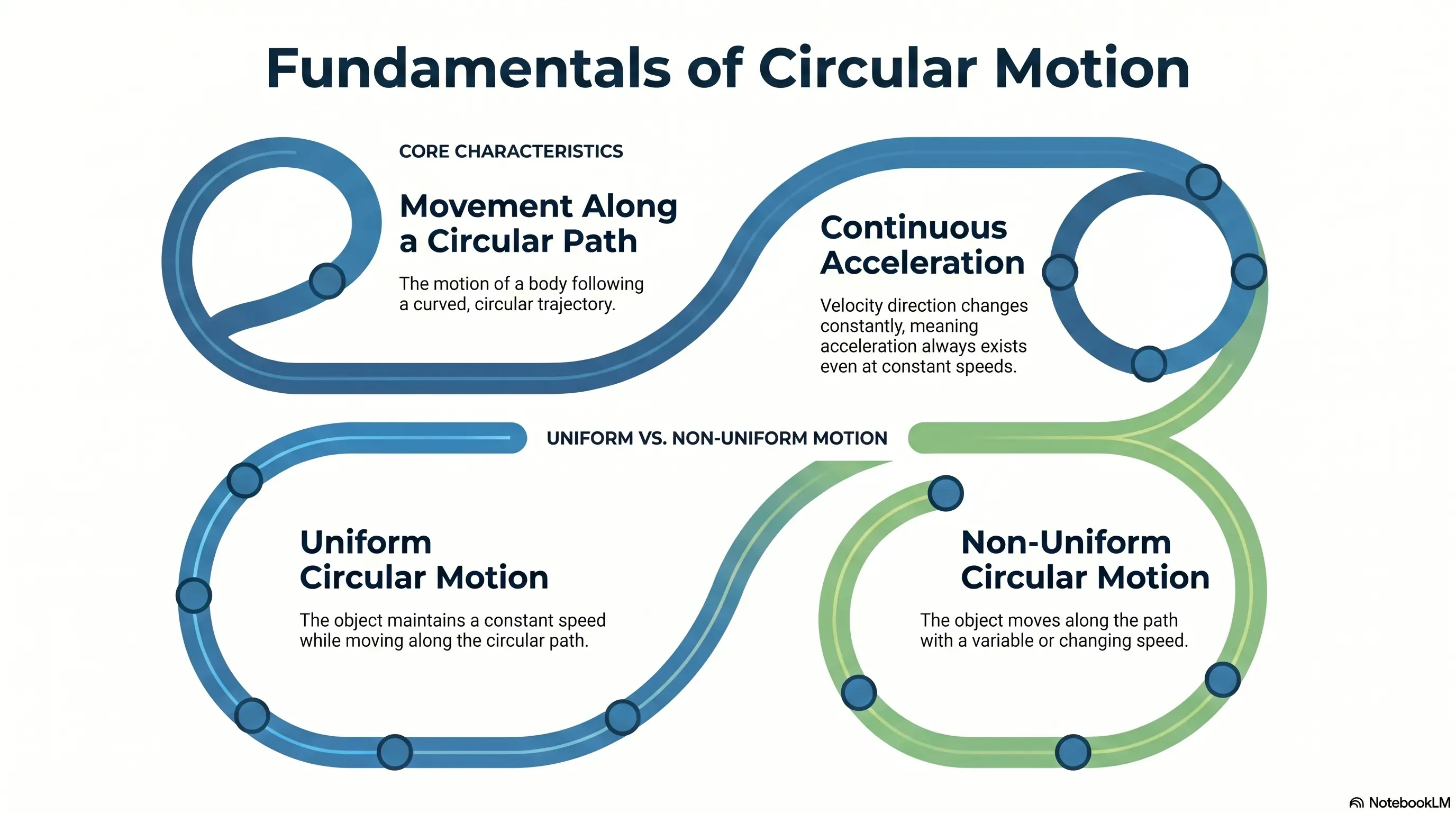
Circular motion is a topic that is spread over three chapters of Class 11 Physics, so students often miss a part of it. These circular motion notes Class 11 put the whole topic in one place, from definitions to the vertical circle, and they follow the current NCERT chapter order.
Circular Motion Notes Class 11: Where Does It Fit in the Syllabus?
Part of circular motion | NCERT Class 11 Physics chapter |
|---|---|
Uniform circular motion, angular velocity, centripetal acceleration | Chapter 3: Motion in a Plane |
Dynamics of circular motion, centripetal force, motion of a vehicle on a level and a banked road | Chapter 4: Laws of Motion |
Motion in a vertical circle | Chapter 5: Work, Energy and Power |
Non-uniform circular motion (with tangential acceleration) goes beyond the NCERT text, but it is useful for JEE.
What Is Circular Motion? Core Definitions in Circular Motion Notes Class 11
Circular motion is the motion of a body along a circular path. The speed may be constant (uniform circular motion) or may change (non-uniform circular motion). In both cases, the direction of the velocity changes continuously, so there is always an acceleration, even when the speed is constant.
The changing direction of velocity is easier to understand after you review vectors in plane motion, where both magnitude and direction are treated explicitly.
Uniform and Non-Uniform Circular Motion
Feature | Uniform circular motion | Non-uniform circular motion |
|---|---|---|
Speed | Constant | Changes with time |
Tangential acceleration | Zero | Not zero (a_t = dv/dt) |
Centripetal acceleration | v²/r, constant in magnitude | v²/r, changes with speed |
Net acceleration | Towards the centre | Has a centripetal and a tangential part |
Angular velocity | Constant | Changes (angular acceleration α ≠ 0) |
Key Formulas in Circular Motion Notes Class 11
Quantity | Formula | Notes |
|---|---|---|
Angular displacement | θ = s/r | In radians |
Angular velocity | ω = dθ/dt | In rad/s |
Relation between speed and angular velocity | v = rω | |
Time period and frequency | T = 2π/ω = 2πr/v, f = 1/T | ω = 2πf |
Centripetal acceleration | a_c = v²/r = ω²r | Directed towards the centre |
Centripetal force | F_c = mv²/r = mω²r | Not a new force. It is the net force towards the centre. |
Angular acceleration | α = dω/dt | |
Tangential acceleration | a_t = dv/dt = rα | Along the tangent |
Net acceleration | a = √(a_c² + a_t²) | For non-uniform circular motion |
Centripetal Force vs Centrifugal Force in Circular Motion Notes Class 11
Feature | Centripetal force | Centrifugal force |
|---|---|---|
Nature | A real net force | A pseudo-force |
Direction | Towards the centre | Away from the centre |
Frame of reference | Inertial (ground) frame | Rotating (non-inertial) frame |
Provided by | Tension, gravity, friction, normal force or a combination | Appears only because the frame is accelerating |
When you solve a problem from the ground frame, do not add a centrifugal force. Write F_net towards the centre = mv²/r.
Circular Motion on a Horizontal Plane: Circular Motion Notes Class 11
Vehicle on a Level Circular Road
Friction provides the centripetal force. The maximum safe speed is v_max = √(μrg), where μ is the coefficient of friction and r is the radius of the turn.
Banking of Roads
On a road banked at angle θ, a component of the normal force also provides the centripetal force. For a vehicle that needs no friction (the ideal speed), tan θ = v²/(rg). With friction, the maximum safe speed is v² = rg (tan θ + μ)/(1 − μ tan θ).
Conical Pendulum
A bob of mass m moves in a horizontal circle with the string making angle θ with the vertical. The conditions are tan θ = v²/(rg), and the time period is T = 2π√(L cos θ / g), where L is the string length.
Motion in a Vertical Circle: Circular Motion Notes Class 11
In a vertical circle, the speed changes because gravity does work, so the motion is non-uniform. Use energy conservation between two points, and Newton’s second law towards the centre at each point.
Case | Minimum speed at the top | Minimum speed at the bottom |
|---|---|---|
Mass on a string (the string must stay taut) | √(gr) | √(5gr) |
Mass on a light rod or inside a tube | 0 | √(4gr) |
For a mass on a string:
- Tension at the top: T_top = mv²/r − mg
- Tension at the bottom: T_bottom = mv²/r + mg
- The difference in tension between the bottom and the top, for a complete circle, is 6mg.
For a vehicle on the top of a convex bridge, N = mg − mv²/r, so the vehicle loses contact with the road when v = √(gr). To go deeper into the energy method, read eSaral’s Work, Energy and Power Class 11 notes.
Solved Examples from Circular Motion Notes Class 11
Example 1 (level road): A car goes round a level circular road of radius 50 m. The coefficient of friction is 0.5. Find the maximum speed (g = 10 m/s²).
v_max = √(μrg) = √(0.5 × 50 × 10) = √250 ≈ 15.8 m/s, which is about 57 km/h.
Example 2 (banking): A road of radius 100 m is to be banked so that a vehicle can take a turn at 20 m/s without friction. Find the angle of banking (g = 10 m/s²).
tan θ = v²/(rg) = 400/(100 × 10) = 0.4, so θ ≈ 21.8°.
Example 3 (vertical circle): A stone of mass 0.1 kg is tied to a 0.4 m string and whirled in a vertical circle. Find the minimum speed at the bottom to complete the circle, and the difference in tension between the bottom and the top (g = 10 m/s²).
v_bottom = √(5gr) = √(5 × 10 × 0.4) = √20 ≈ 4.5 m/s. The tension difference is 6mg = 6 × 0.1 × 10 = 6 N.
Example 4 (centripetal acceleration): A point on a wheel of radius 0.5 m rotates at 120 revolutions per minute. Find its centripetal acceleration.
ω = 2π × 120/60 = 4π rad/s ≈ 12.57 rad/s. a_c = ω²r = (12.57)² × 0.5 ≈ 79 m/s².
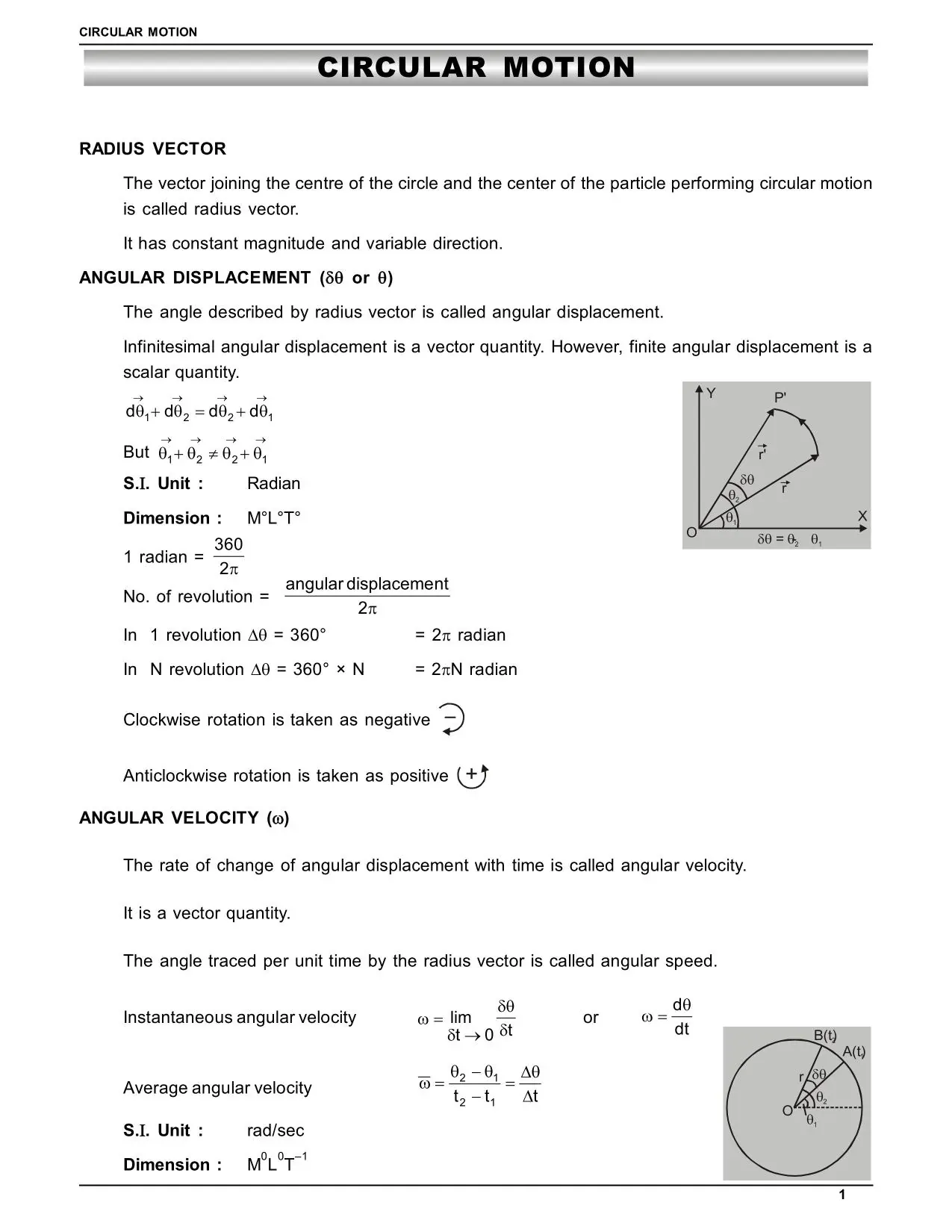
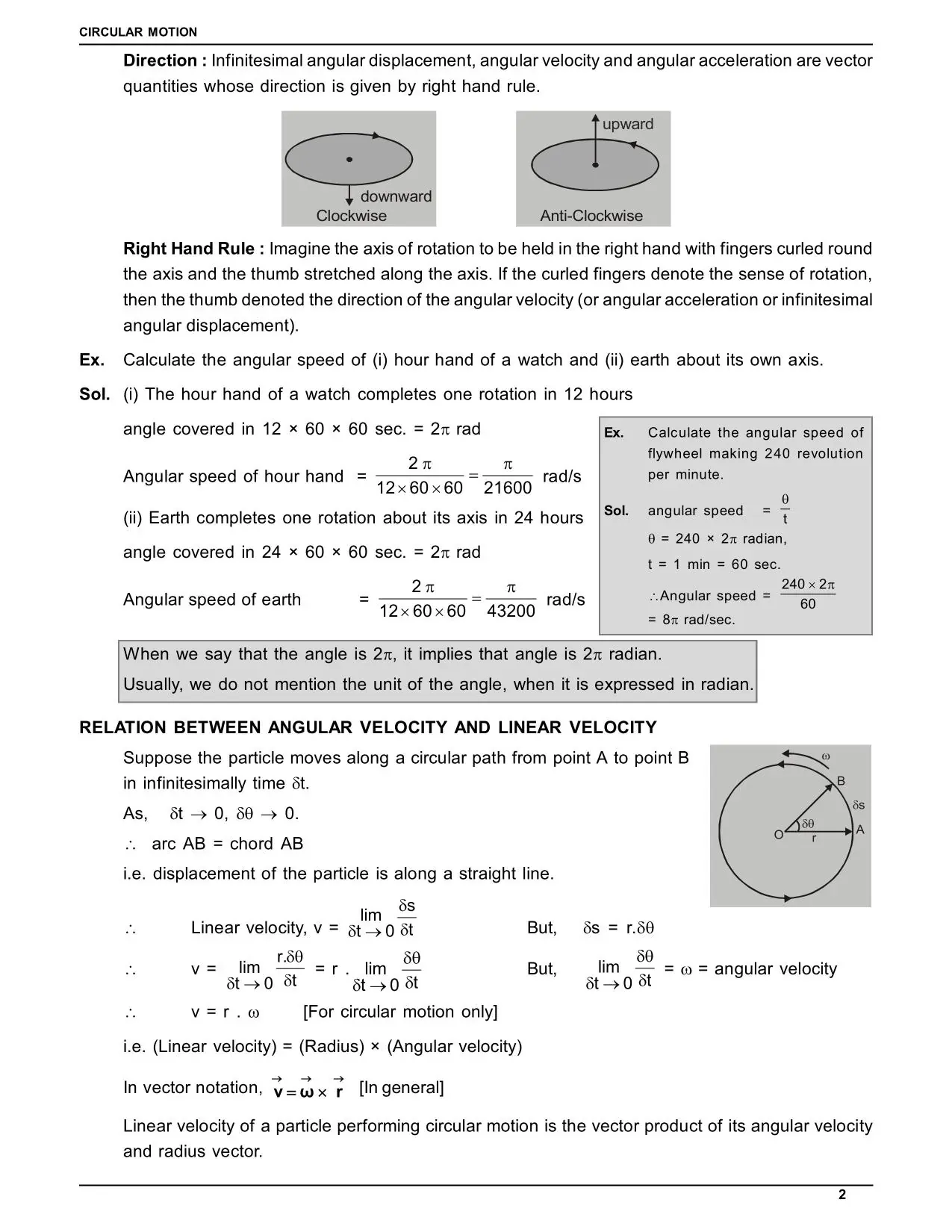
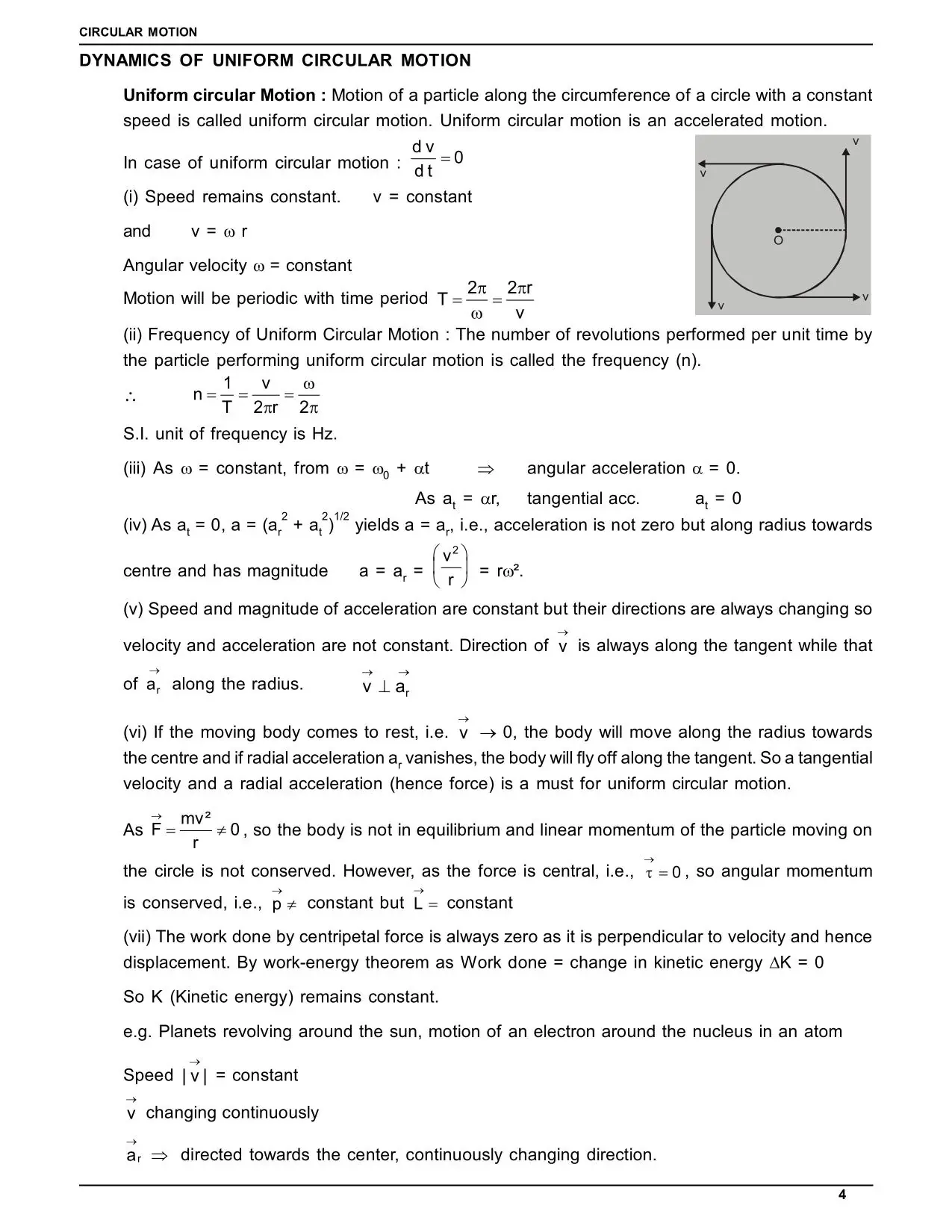
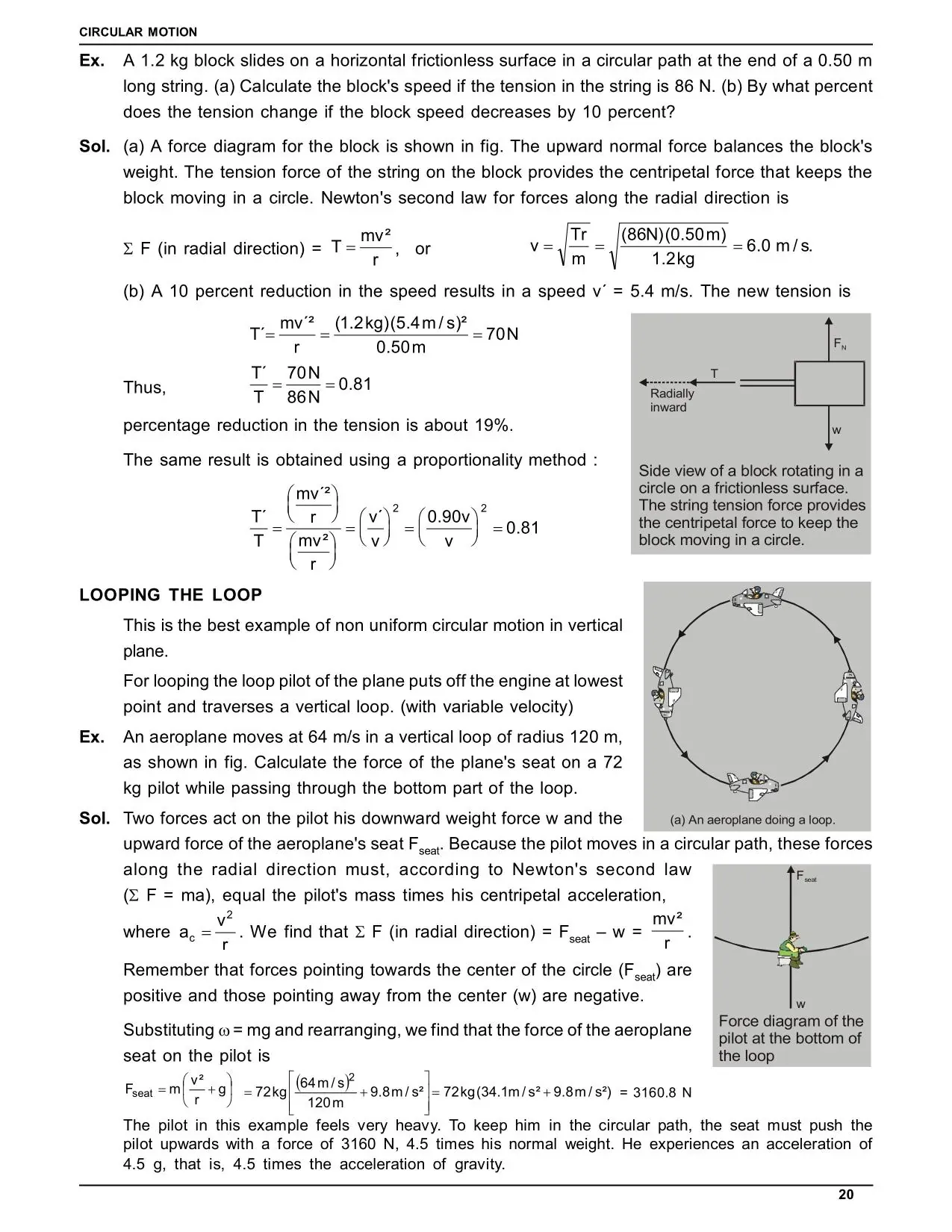
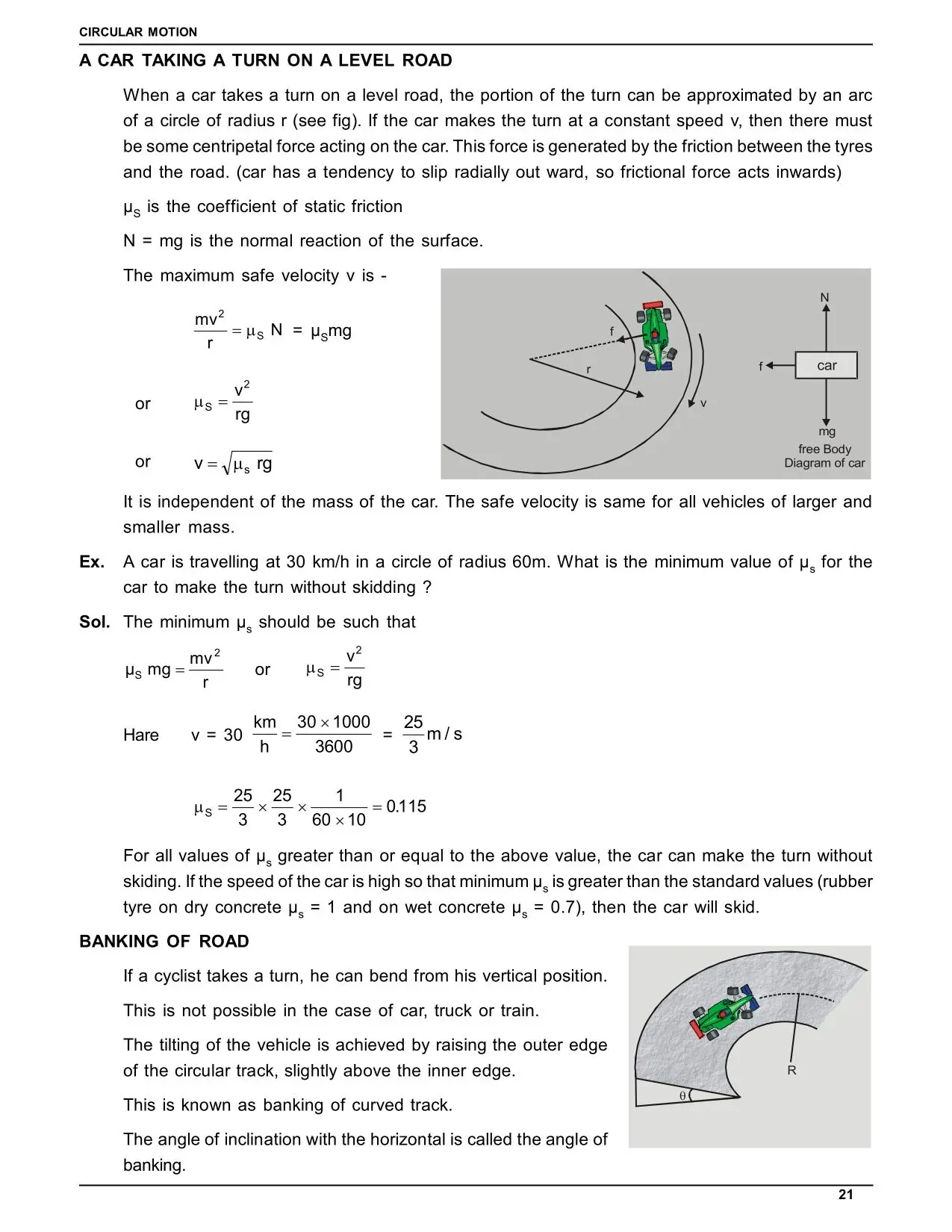
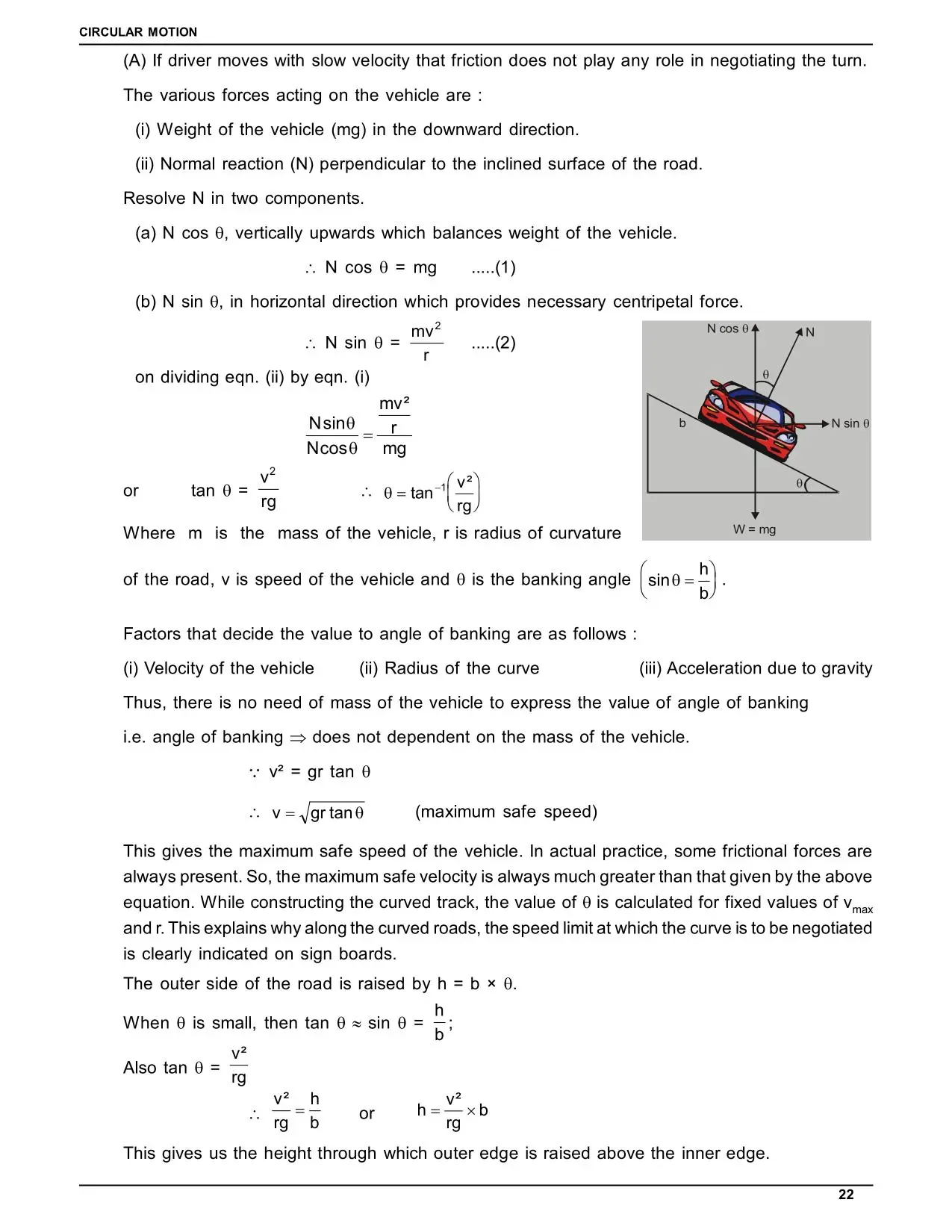
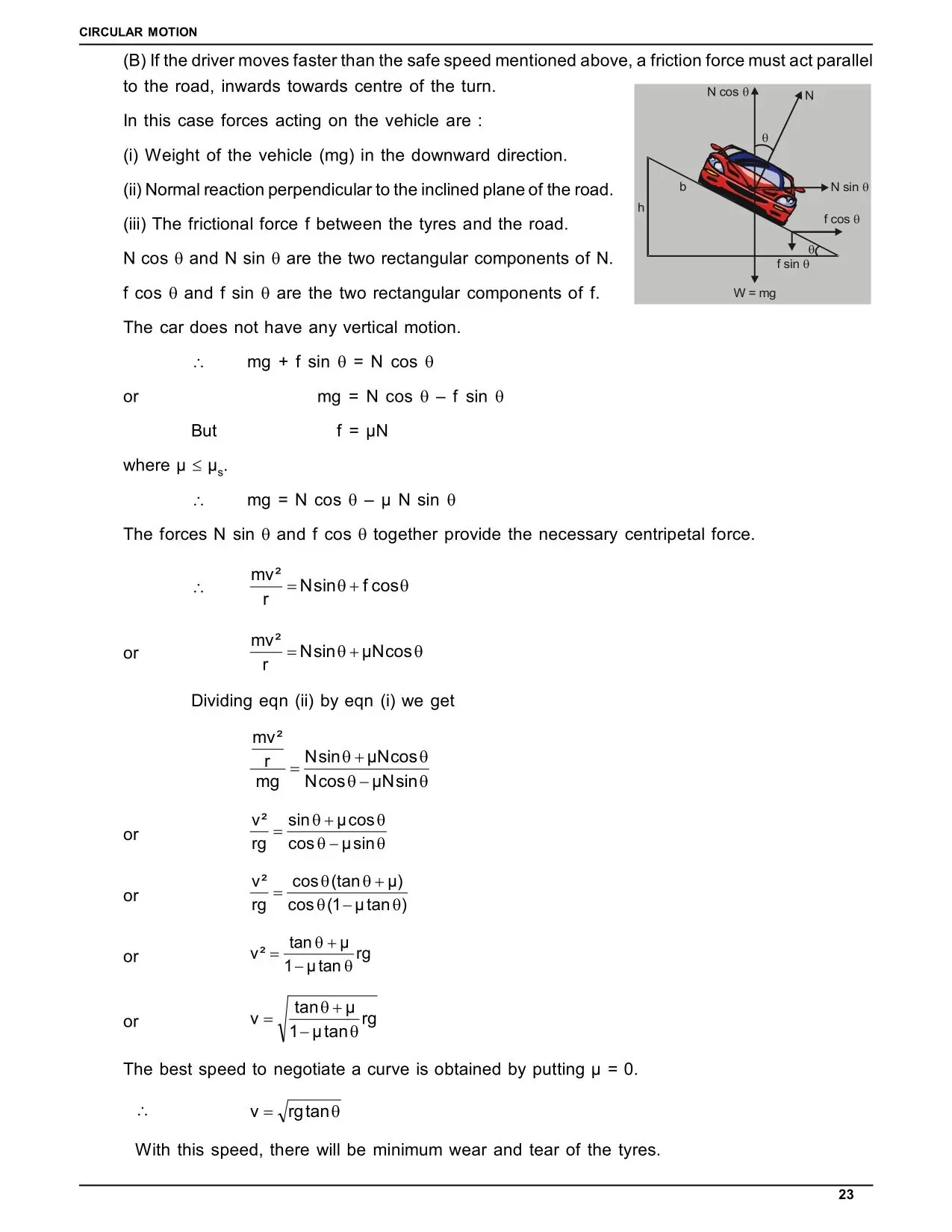
Circular Motion Notes Class 11: Handwritten Notes
India's Best Exam Preparation for Class 11th - Download Now
India's Best Exam Preparation for Class 11th - Download Now
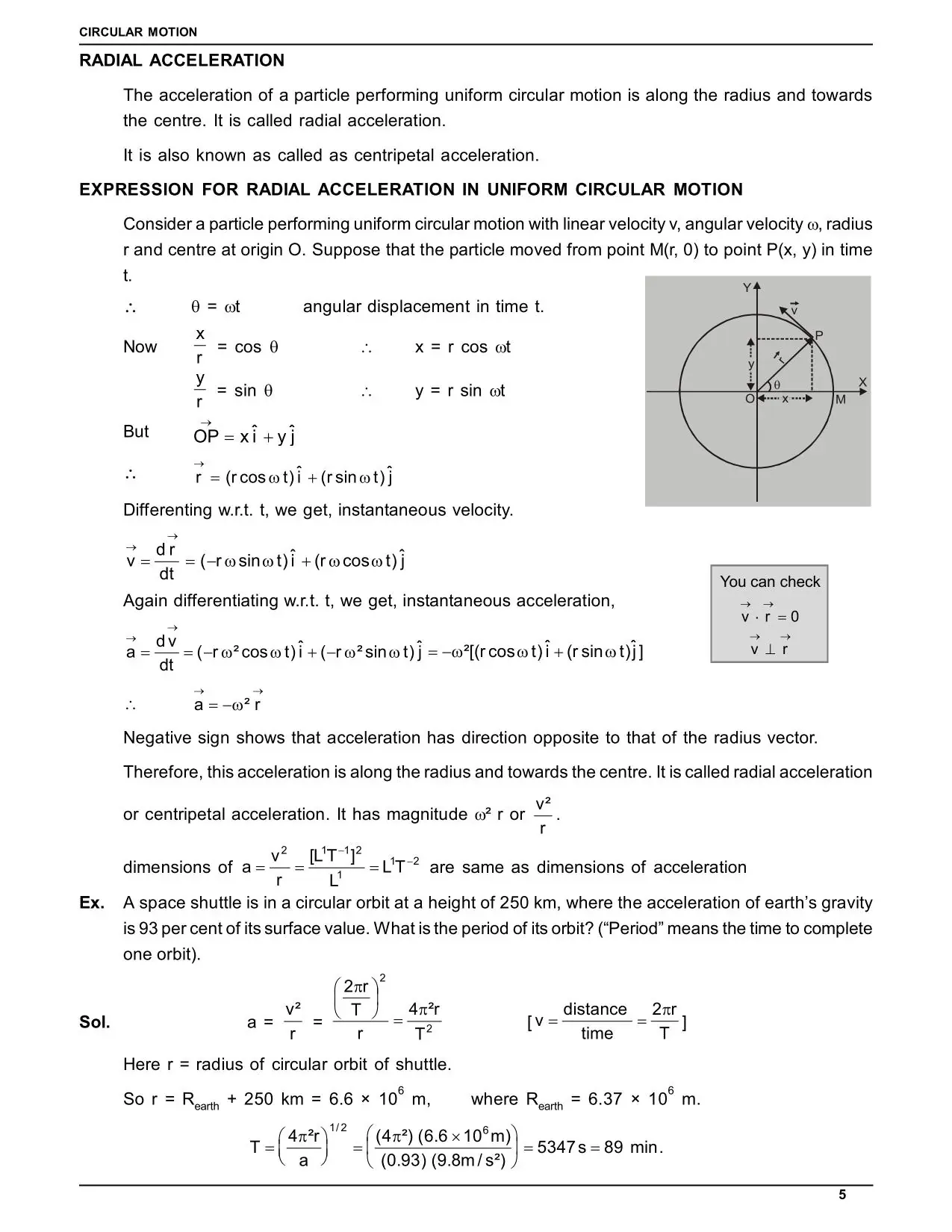
India's Best Exam Preparation for Class 11th - Download Now
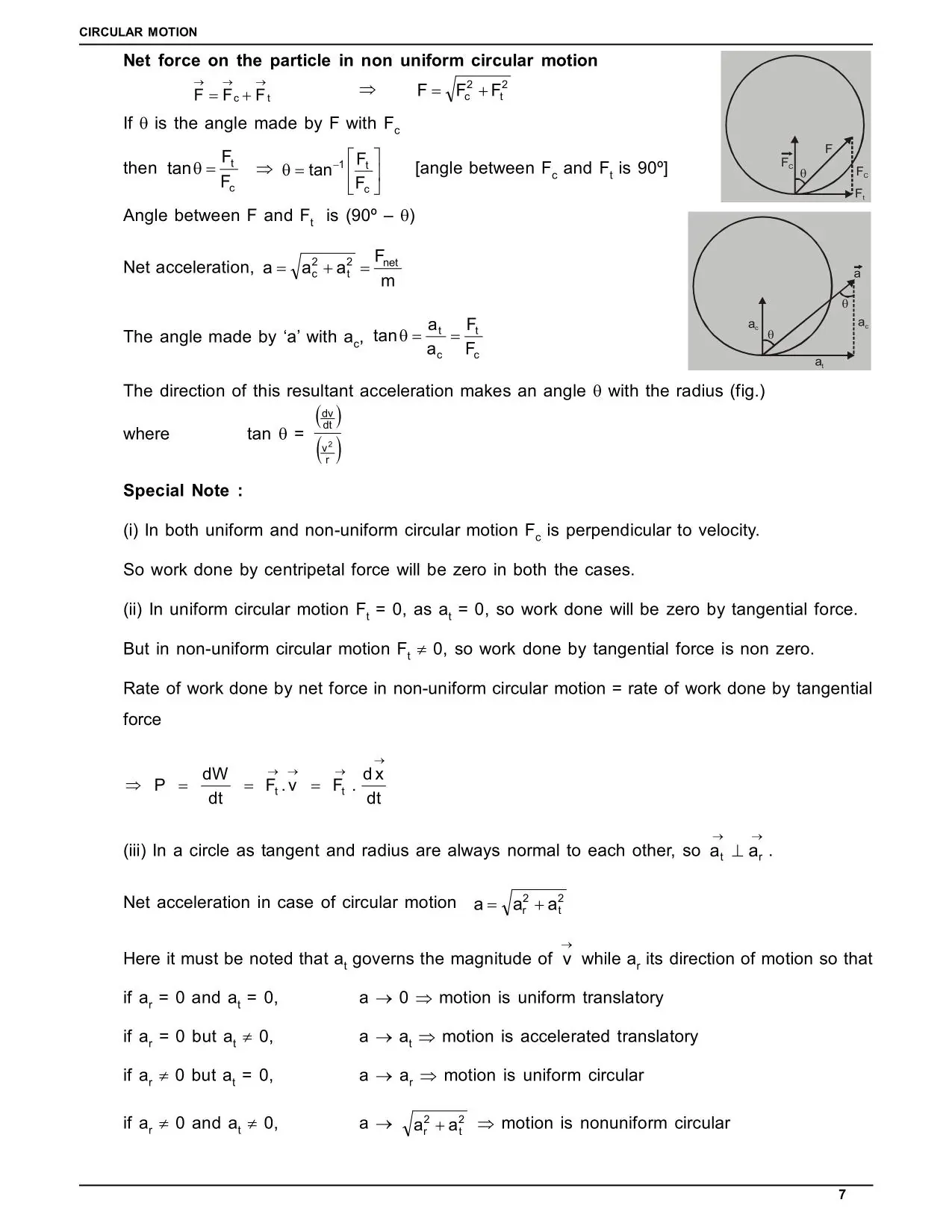
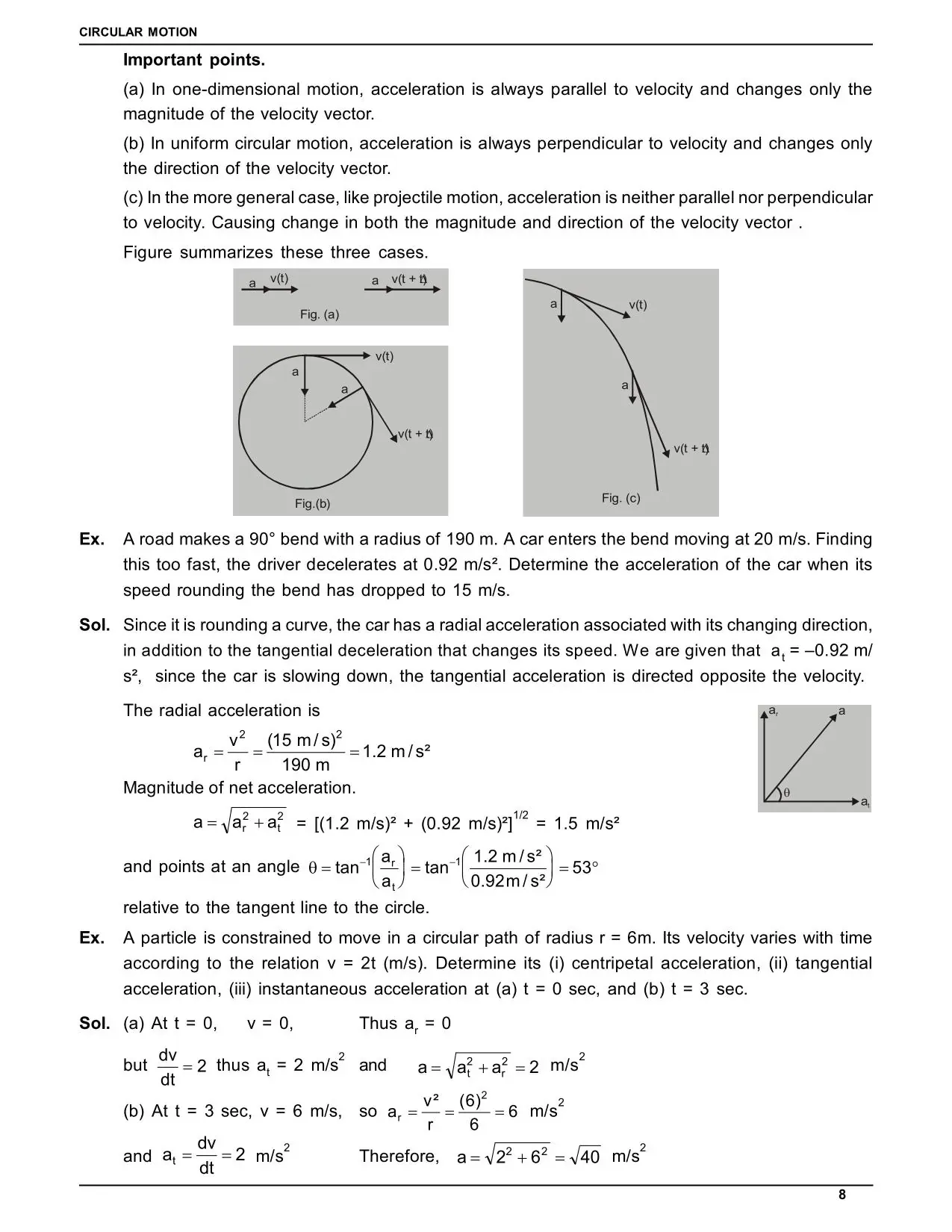
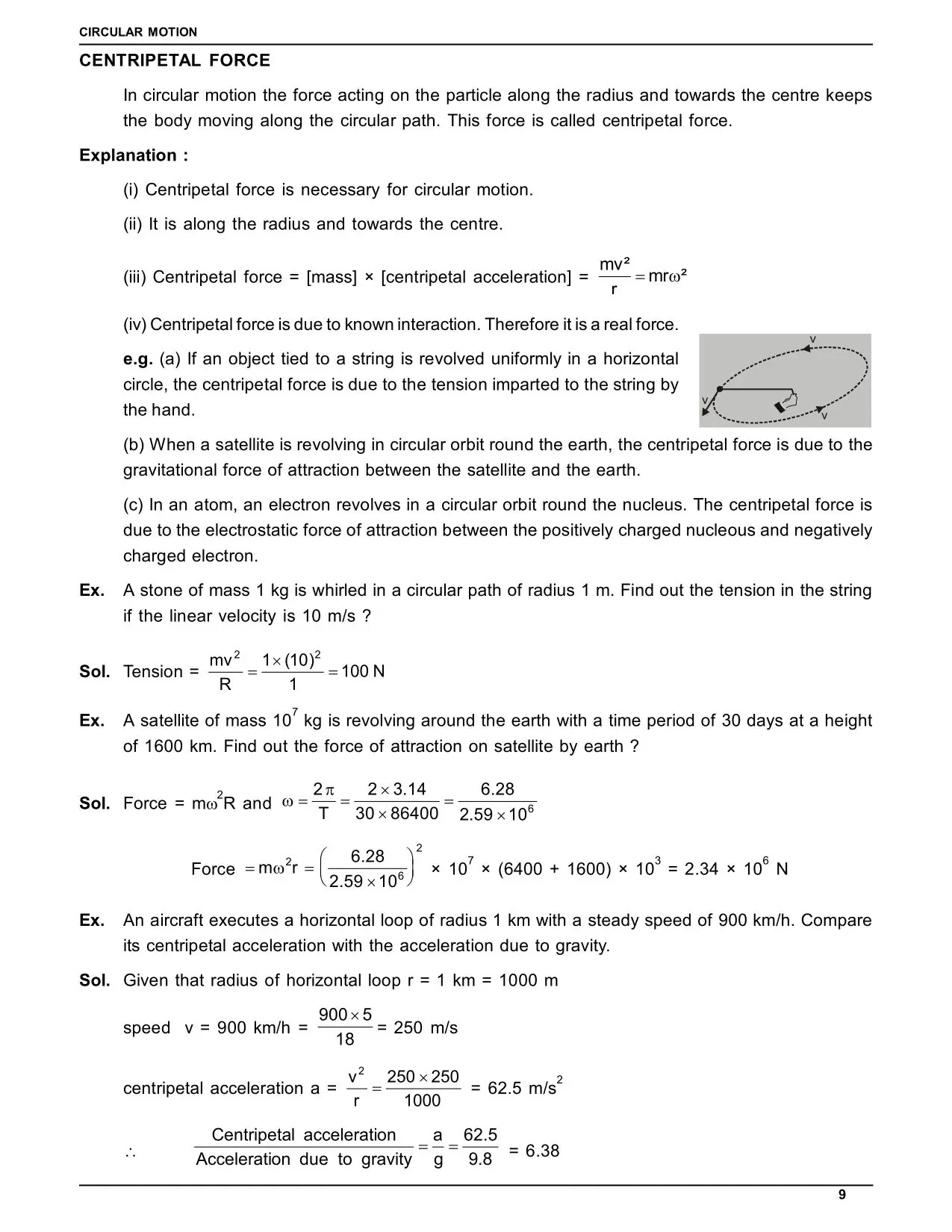
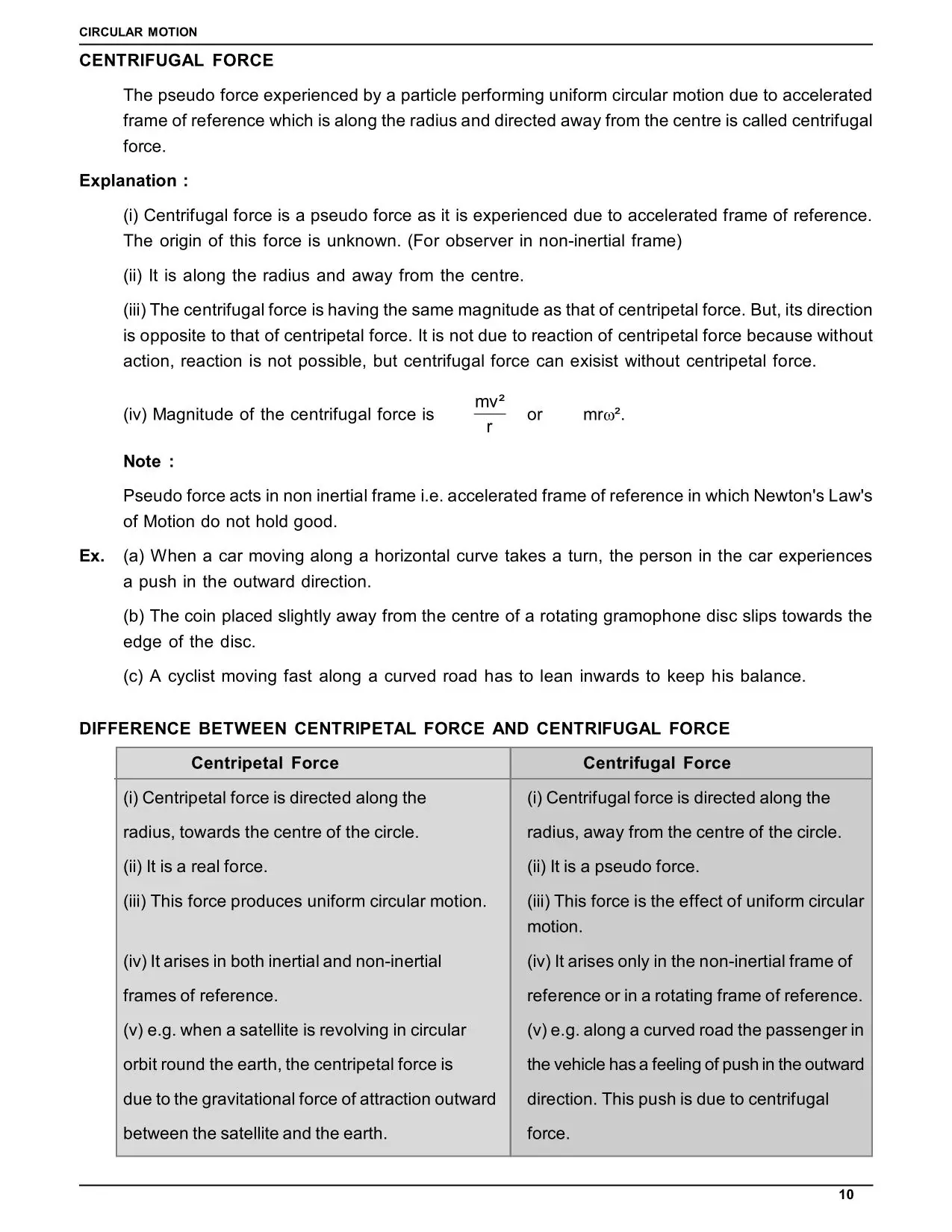
India's Best Exam Preparation for Class 11th - Download Now
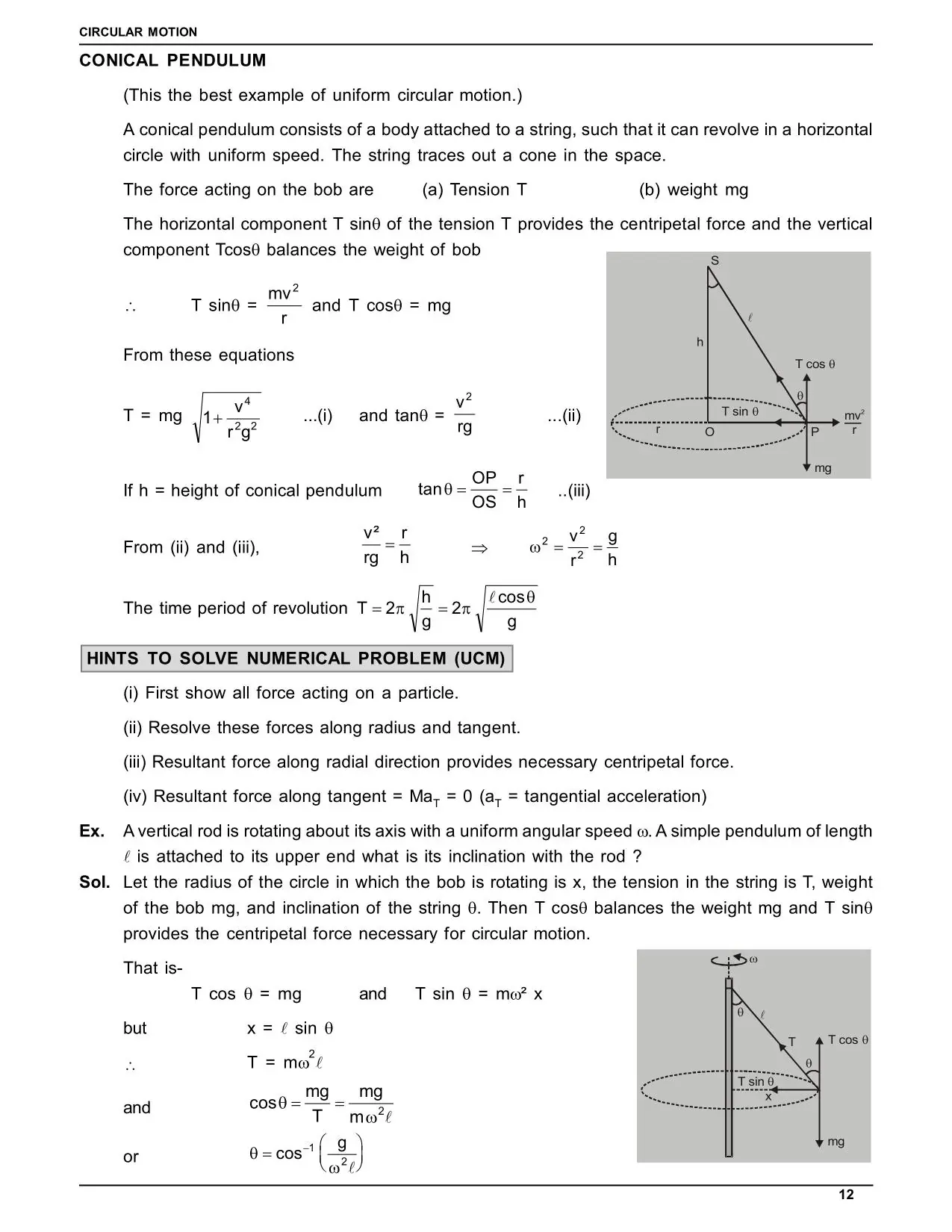
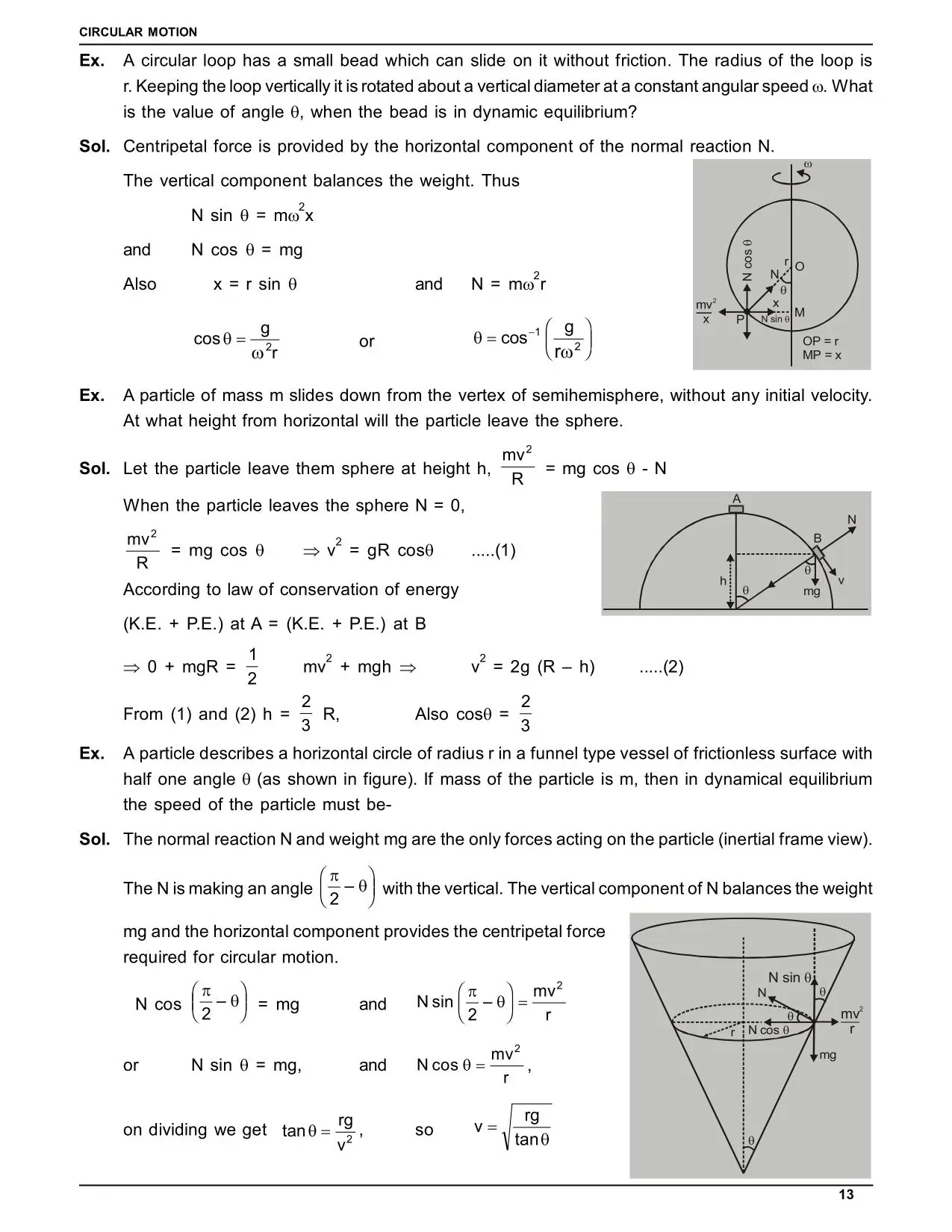
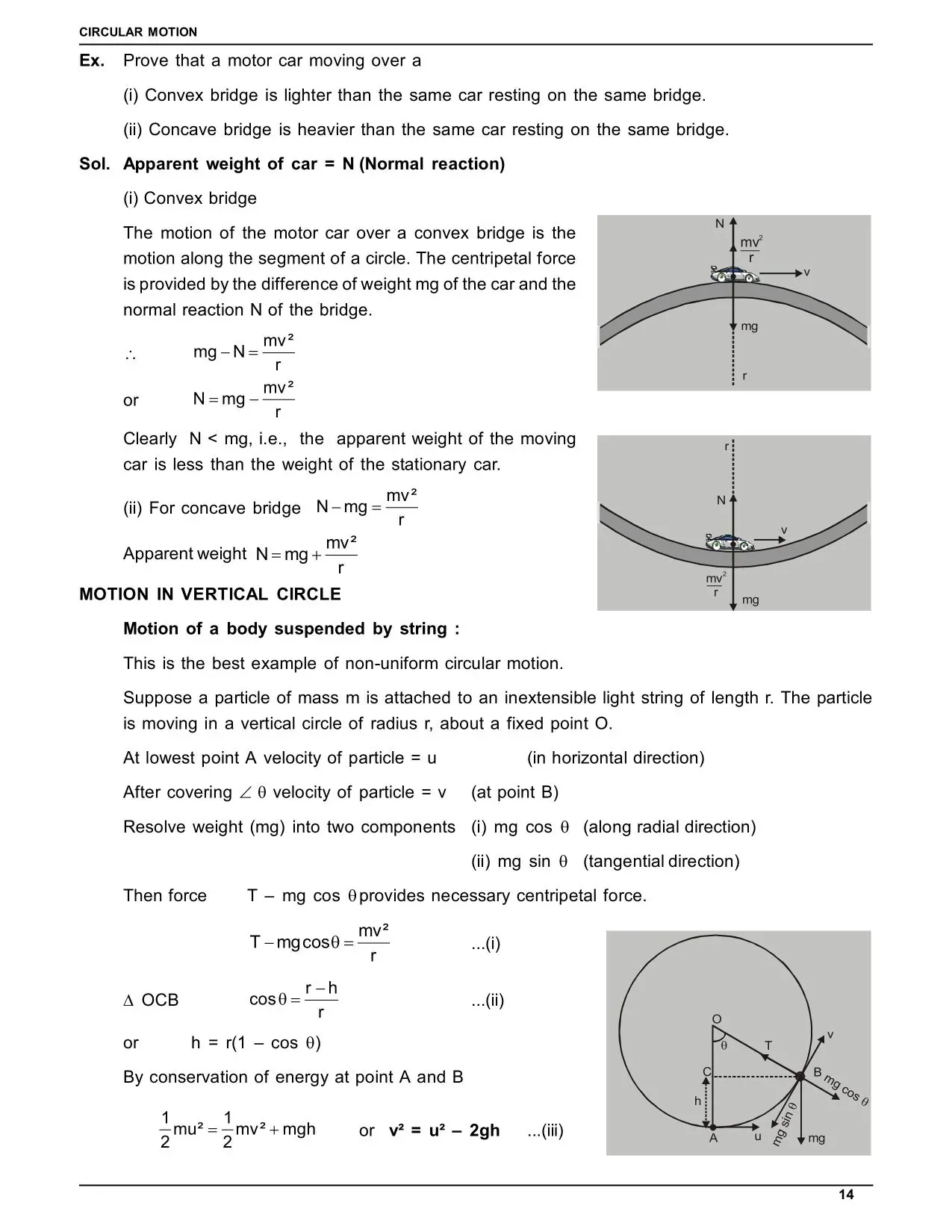
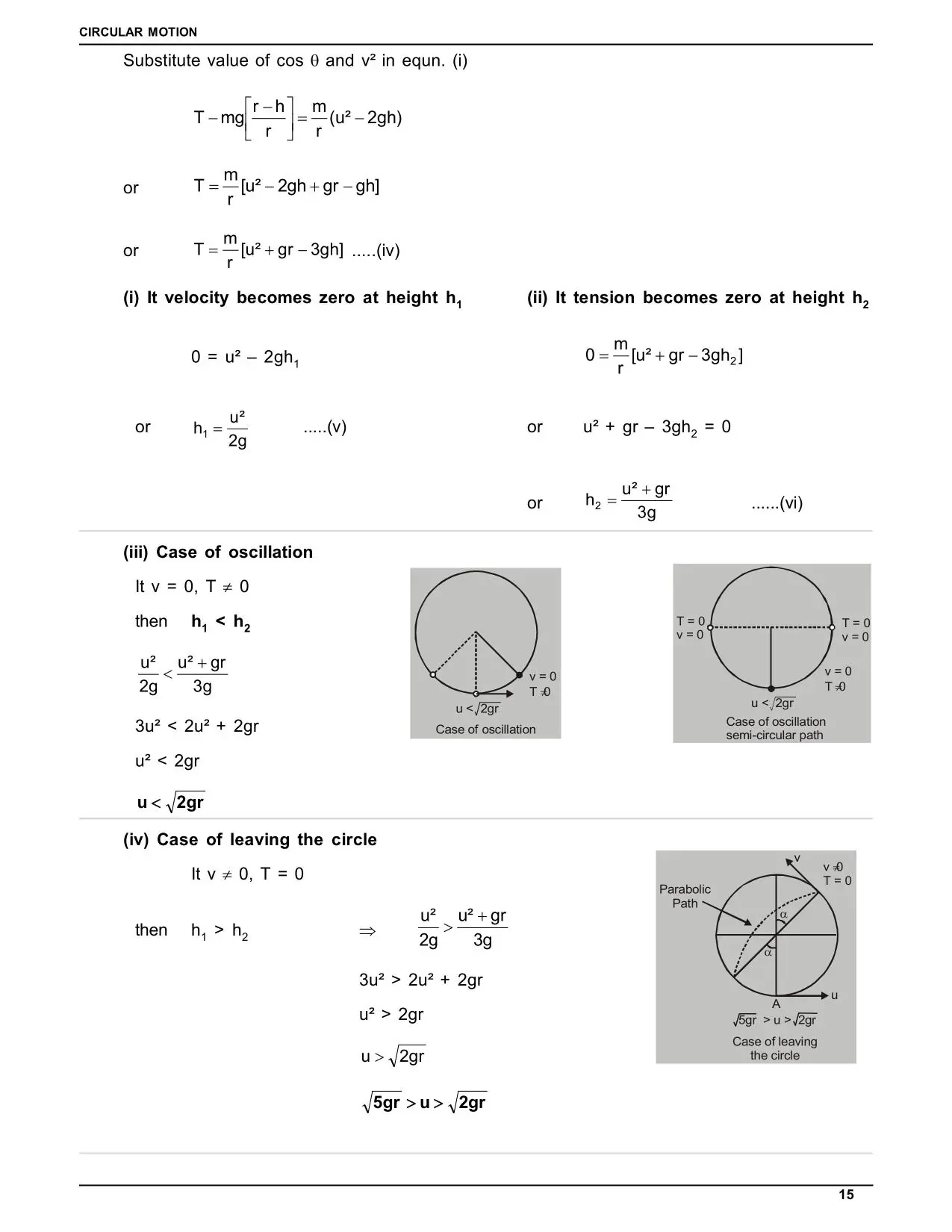
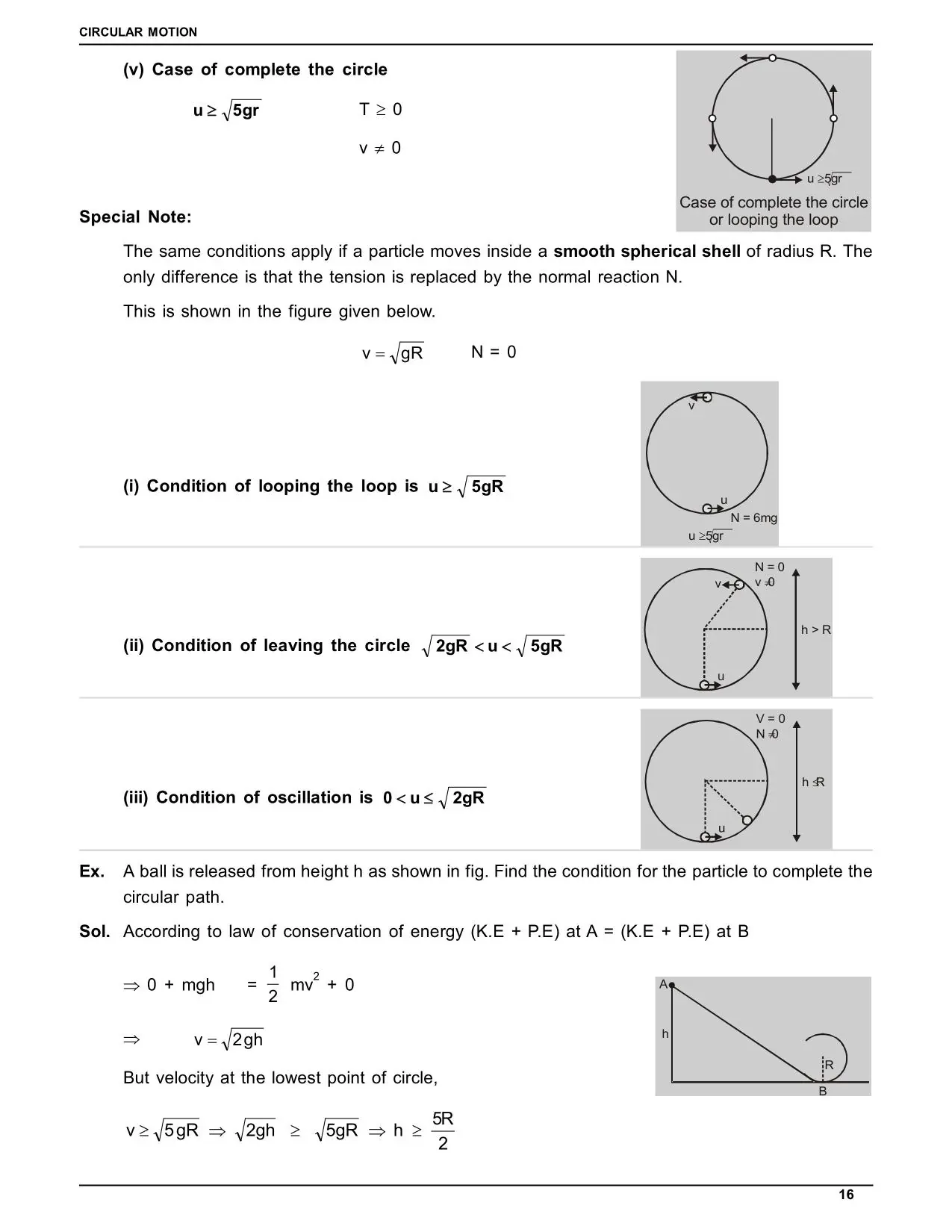
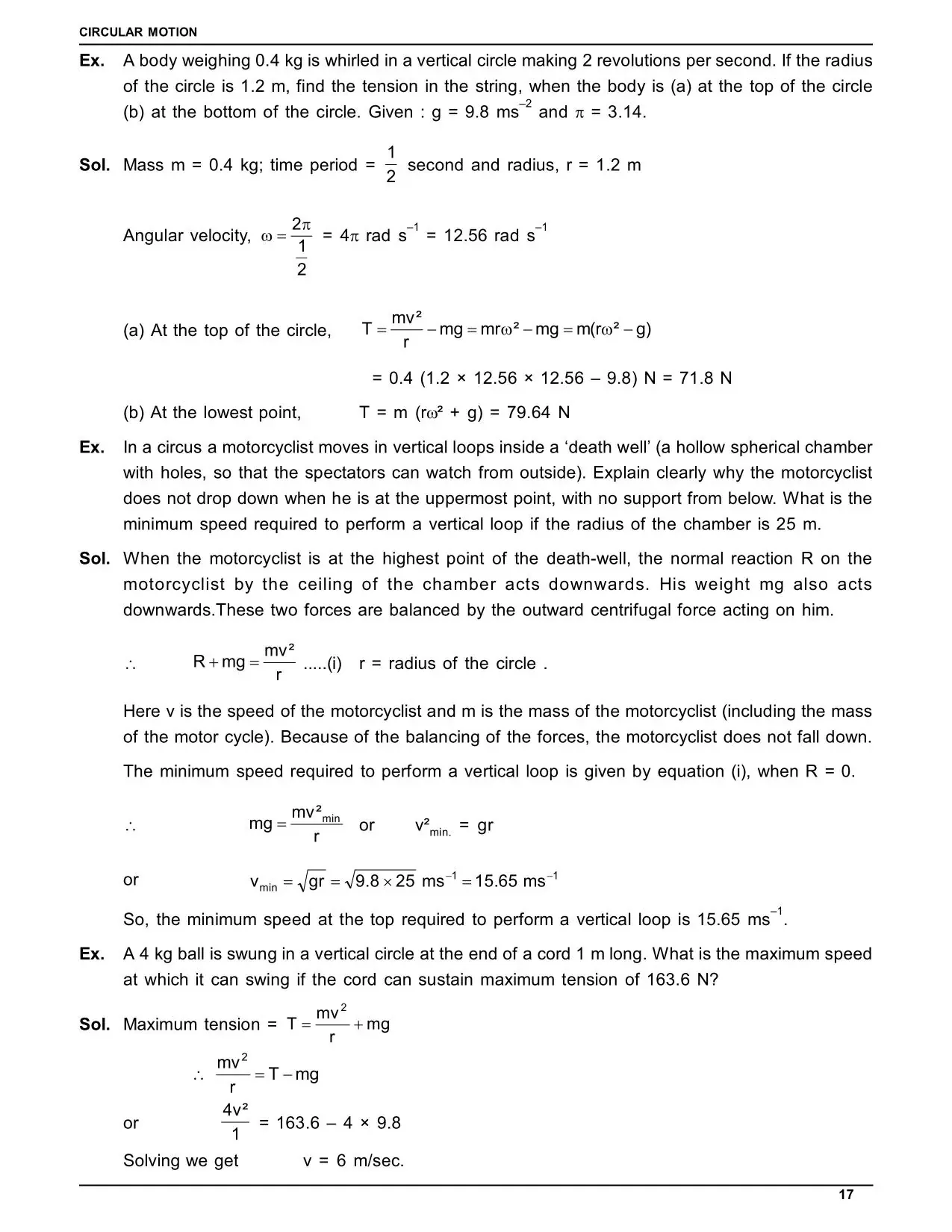
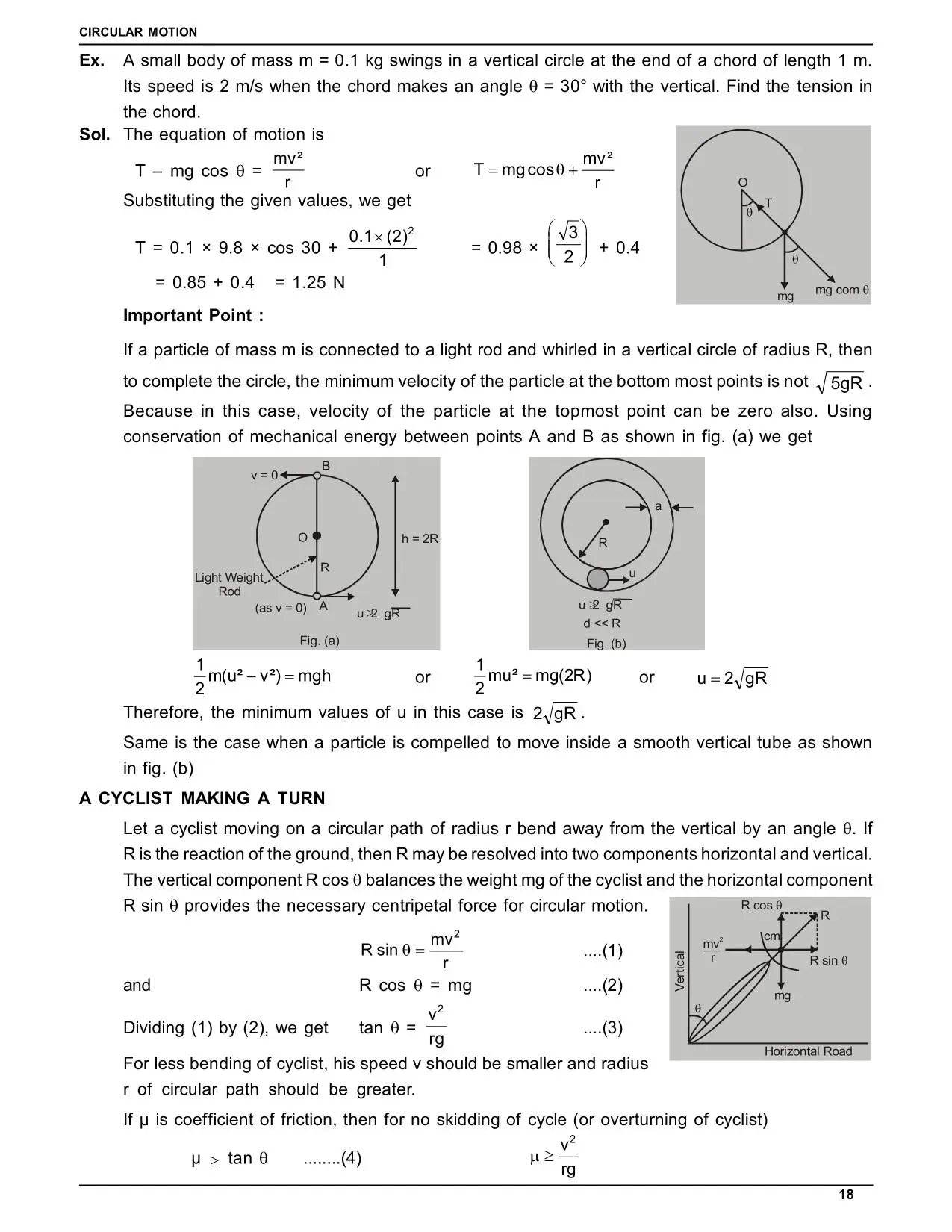
India's Best Exam Preparation for Class 11th - Download Now
Common Mistakes in Circular Motion Notes Class 11 Problems
Mistake | Correct approach |
|---|---|
Treating centripetal force as an extra force on the free-body diagram | Draw only real forces, and then write that their net force towards the centre equals mv²/r |
Adding centrifugal force in a ground-frame solution | Use centrifugal force only if you solve in the rotating frame |
Using √(gr) at the bottom of a vertical circle | √(gr) is the minimum speed at the top. At the bottom it is √(5gr) for a string. |
Using the string condition for a rod | For a rod or tube, the minimum speed at the top is zero, and at the bottom it is √(4gr) |
Forgetting tangential acceleration in non-uniform motion | The net acceleration has both a centripetal and a tangential part |
What Do CBSE, JEE and NEET Ask from Circular Motion Notes Class 11 Topics?
- CBSE: definitions, a_c and F_c formulas, banking of roads and simple numericals.
- JEE Main and JEE Advanced: vertical circle conditions, conical pendulum, banking with friction and non-uniform circular motion.
- NEET: uniform circular motion, centripetal force, banking and the vertical circle, in numerical form.
The number of questions varies each year, so use previous year questions to see the trend.
Frequently Asked Questions
What are the most important topics in circular motion notes Class 11 for JEE Main?
In the circular motion notes Class 11, centripetal force and acceleration, motion in a vertical circle (minimum speed conditions), banking of roads, and the conical pendulum are the most important topics. Master the force diagrams and the energy conservation approach for each, and practise previous year questions.
What is the difference between centripetal and centrifugal force?
Centripetal force is a real net force directed towards the centre of the path, and it is provided by tension, gravity, friction or the normal force. Centrifugal force is a pseudo-force that appears only in a rotating (non-inertial) frame and acts away from the centre. When you solve from the ground frame, you do not use it.
What is the minimum speed required to complete a vertical circle?
In circular motion notes Class 11, for a mass on a string, the minimum speed at the top is √(gr), and the minimum speed at the bottom is √(5gr). For a mass on a light rod or in a tube, the speed at the top can be zero, and the minimum speed at the bottom is √(4gr).
How is banking of roads related to circular motion?
In circular motion notes Class 11, banking tilts the road so that a component of the normal force provides part of the centripetal force, which reduces the friction needed to take a turn. For no friction at the ideal speed, tan θ = v²/(rg), where v is the speed and r is the radius of the turn.
Where does circular motion come in the Class 11 Physics NCERT book?
The topic is spread across three chapters: uniform circular motion in Chapter 3 (Motion in a Plane), centripetal force and banking in Chapter 4 (Laws of Motion), and the vertical circle in Chapter 5 (Work, Energy and Power). These circular motion notes Class 11 on eSaral bring them together.
Is circular motion in Class 11 Physics important for NEET?
Yes. NEET Physics includes questions on uniform circular motion, centripetal force and banking. The number of questions changes from year to year, so check previous years’ NEET papers. The same circular motion notes Class 11 serve JEE and NEET.
What is the formula for centripetal acceleration?
In circular motion notes Class 11, centripetal acceleration is a_c = v²/r = ω²r, and it is directed towards the centre of the circle. For uniform circular motion, it is the only acceleration.
Can there be acceleration in uniform circular motion?
Yes. The speed is constant, but the direction of the velocity changes continuously, so the velocity changes, and this gives a centripetal acceleration towards the centre.
What is the difference between uniform and non-uniform circular motion?
In uniform circular motion, the speed is constant and the only acceleration is centripetal. In non-uniform circular motion, the speed changes, so there is also a tangential acceleration, and the net acceleration is √(a_c² + a_t²).
Team eSaral
eSaral Academic and Editorial Team
Team eSaral is the collective author profile for educational content created by eSaral’s teachers and academic contributors. The team draws on expertise from IIT graduates, doctors, experienced educators and subject specialists to develop resources for JEE, NEET and school students. Our articles aim to explain concepts clearly and help students study with confidence.
Related Posts

BITSAT 2027: Registration Date, Exam Date, Syllabus, Eligibility, Pattern & Fees
BITSAT 2027 exam dates, registration timeline, eligibility criteria, exam pattern, marking scheme, syllabus and fees in one page.

BITSAT Previous Year Question Paper PDF (2017-2026)
Download BITSAT previous year question papers PDF from 2017 to 2026,session-wise. Memory-based papers,exam pattern, paper analysis and how to practise

CBSE Class 10 Date Sheet 2027: Expected Exam Dates, Release Date, Admit Card & Result Timeline
CBSE Class 10 date sheet 2027 is awaited. See the expected exam dates, release window, how to download the PDF, admit card and result timelines.

NCERT Physics Class 10 Book PDF in Hindi 2026-27 – भौतिक विज्ञान के 4 अध्याय (Free Download)
NCERT Physics Class 10 book PDF in Hindi 2026-27: download all 4 chapters (अध्याय 9–12) free, with topics and important formulas.

NCERT Biology Class 9 Book Anveshan PDF in Hindi - जीव विज्ञान कक्षा 9 पुस्तक अन्वेषण PDF
Download NCERT Biology Class 9 book PDF in Hindi chapterwise for 2026-27: Cell, Tissues, Reproduction and Diversity. Free PDFs.

Essay On Artificial Intelligence in English (100,150, 200, 250, 300, 500 Words)
This is in contrast to the natural intelligence of humans. With Artificial Intelligence, machines can perform

Essay on 78th India Independence Day in English for Student (100, 150, 200, 250, 300, 500 Words)
Read the best essays on India's Independence Day in English. Short & long essays (100, 150, 200, 250, 300, 500 words) perfect for school exams
NCERT Class 11 English Snapshots book - Free PDF download- Esaral
Download NCERT Class 11 English Snapshots book PDF for free. Get all 8 chapters, chapter-wise. Start your prep today!
NCERT Class 10 biology book pdf - Free PDF Download - eSaral
NCERT Class 10 Biology book PDF 2026-27: all 5 chapters (Life Processes to Our Environment) in English & Hindi, with CBSE syllabus, marks & practical

Essay on Global Warming in English (100,150, 200, 250, 300, 500 Words)
Global warming means the Earth is getting hotter. This happens because of things like pollution from cars and factories.