
Class 11 Laws of Motion Notes for CBSE, JEE and NEET: Newton’s Laws, Friction, Momentum and Circular Motion

eSaral Academic and Editorial Team
Summary
Laws of Motion Class 11 notes cover Newton's three laws of motion, linear momentum, impulse, friction (static and kinetic), free body diagrams, and dynamics of circular motion. These topics carry 6–8% weightage in JEE Main and 4–5% in NEET, making them essential for scoring well in both exams.
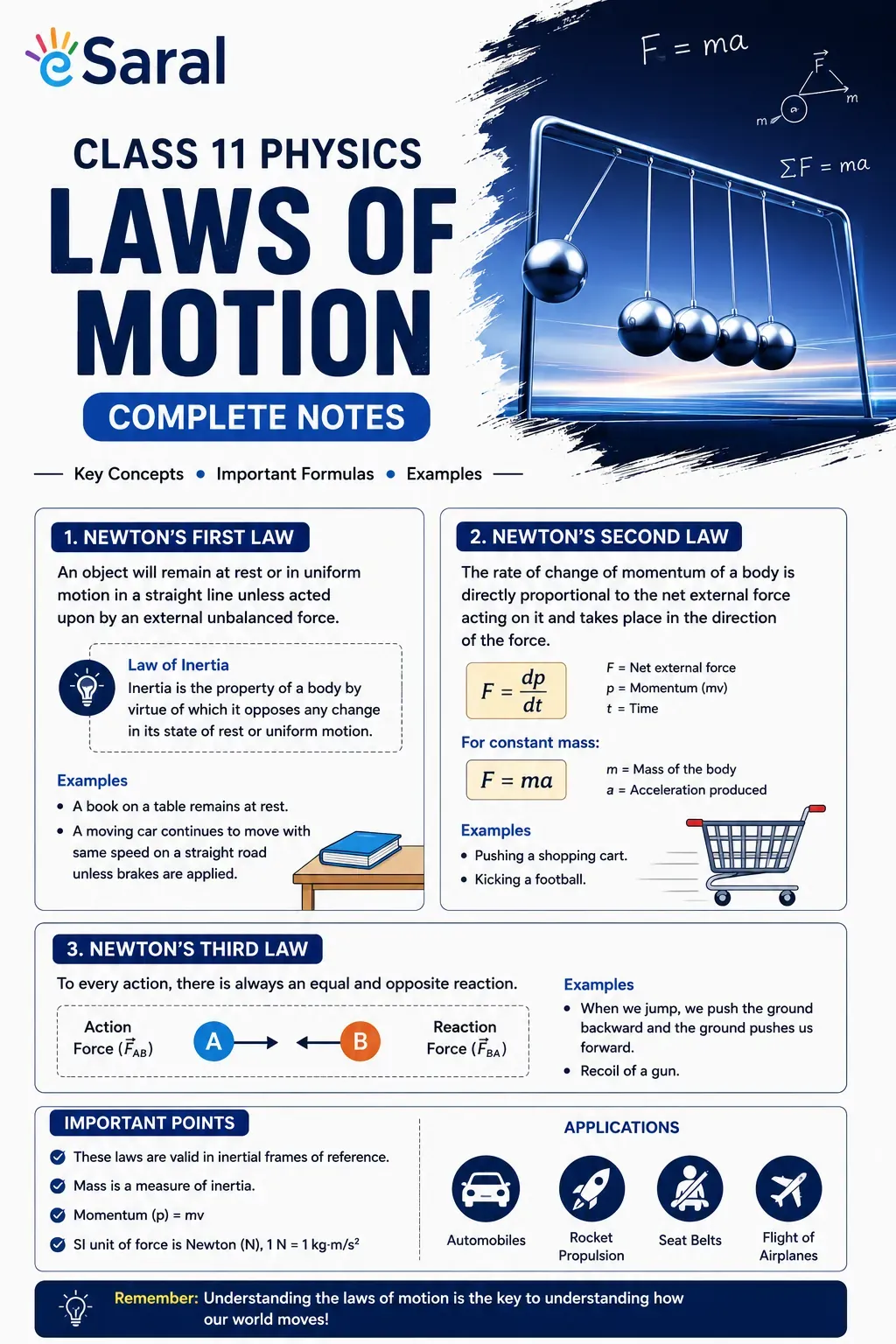
In the current NCERT Class 11 Physics book, Laws of Motion is Chapter 4 (it was Chapter 5 in older books). It explains how forces change the motion of a body, and it is used again in Work, Energy and Power, Rotational Motion and many Class 12 chapters. These Class 11 Laws of Motion Notes follow the topics listed in the CBSE and JEE Main syllabi, and they include the problem types that exams ask.
Class 11 Laws of Motion Notes
India's Best Exam Preparation for Class 11th - Download Now
India's Best Exam Preparation for Class 11th - Download Now
India's Best Exam Preparation for Class 11th - Download Now
India's Best Exam Preparation for Class 11th - Download Now
India's Best Exam Preparation for Class 11th - Download Now
India's Best Exam Preparation for Class 11th - Download Now
Class 11 Laws of Motion Notes: Chapter Overview and Syllabus
The JEE Main 2026 syllabus (Unit 3) lists these topics, and they match the NCERT chapter closely:
- Force and inertia, Newton’s first law
- Momentum, Newton’s second law and impulse
- Newton’s third law
- Conservation of linear momentum and its applications
- Equilibrium of concurrent forces
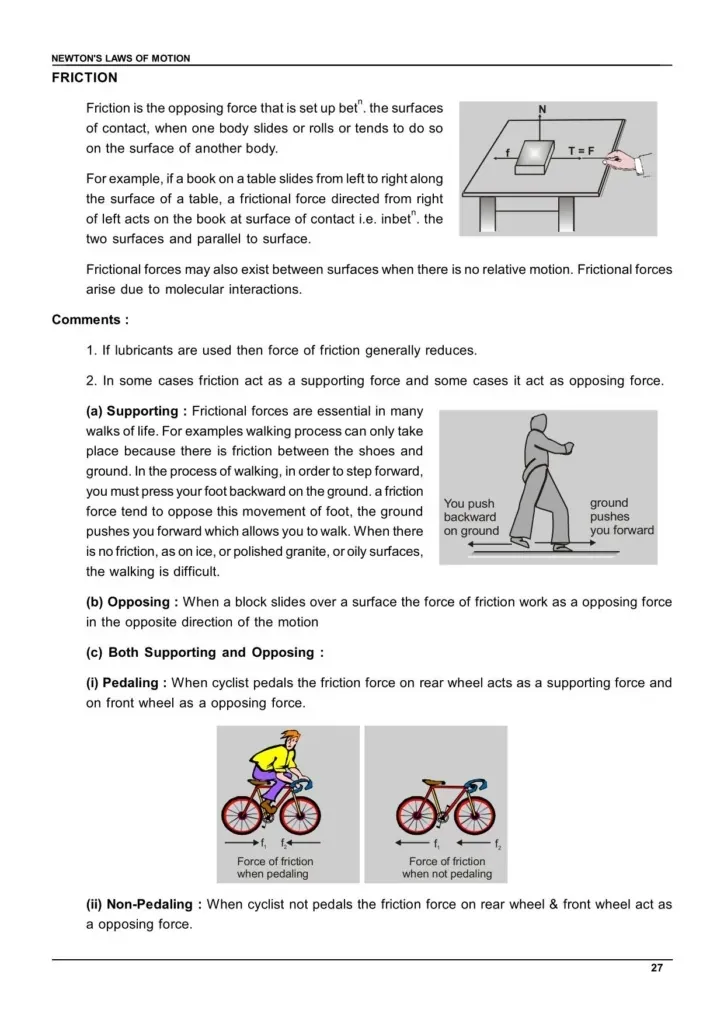
- Static and kinetic friction, laws of friction and rolling friction
- Dynamics of uniform circular motion, centripetal force, and a vehicle on a level or a banked road
Check the NMC syllabus for NEET. Pseudo forces and elevator problems are not listed separately, but they are common applications of Newton’s second law.
Tip from the eSaral Physics team: Draw a free body diagram for every problem, and write the equation of motion along each axis before you substitute any numbers. Most mistakes in this chapter come from a missing force or a wrong direction.
Newton’s Three Laws of Motion in Class 11 Laws of Motion Notes
Law | Statement | Key point |
|---|---|---|
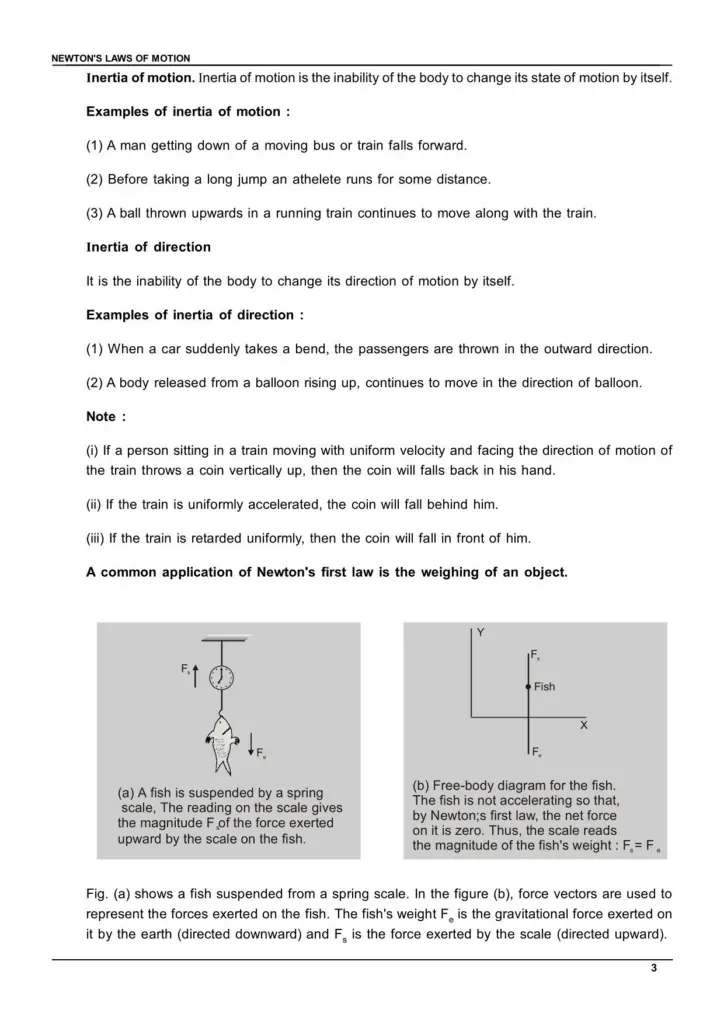
First law | A body stays at rest or in uniform motion in a straight line unless a net external force acts on it | Defines inertia and inertial frames |
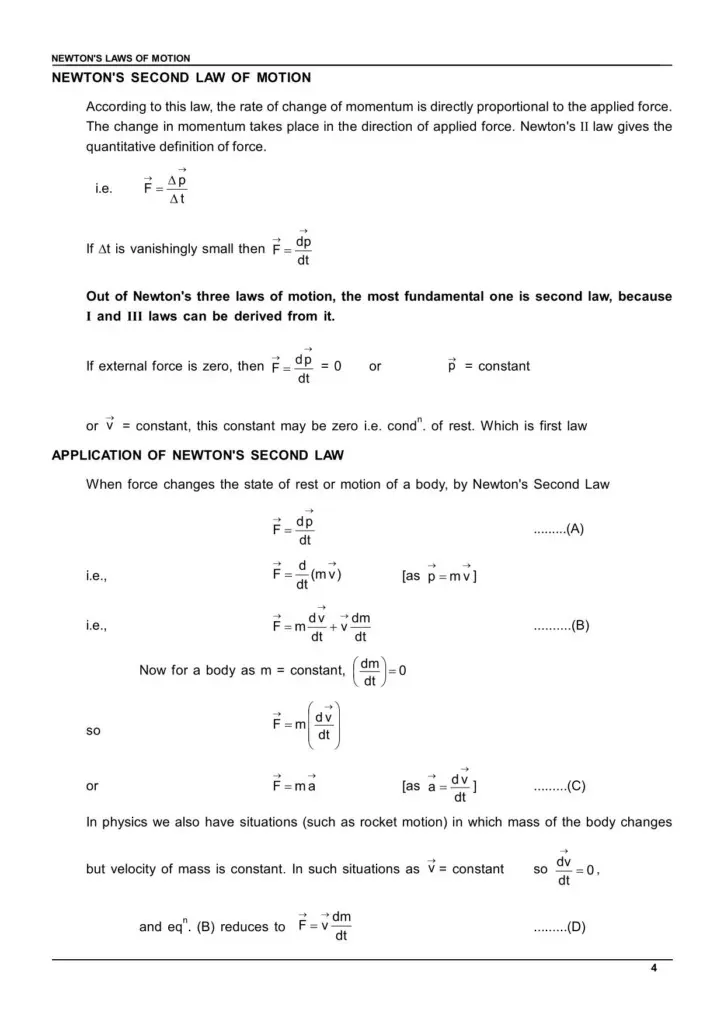
Second law | The net force equals the rate of change of momentum: F = dp/dt | For constant mass, F = ma |
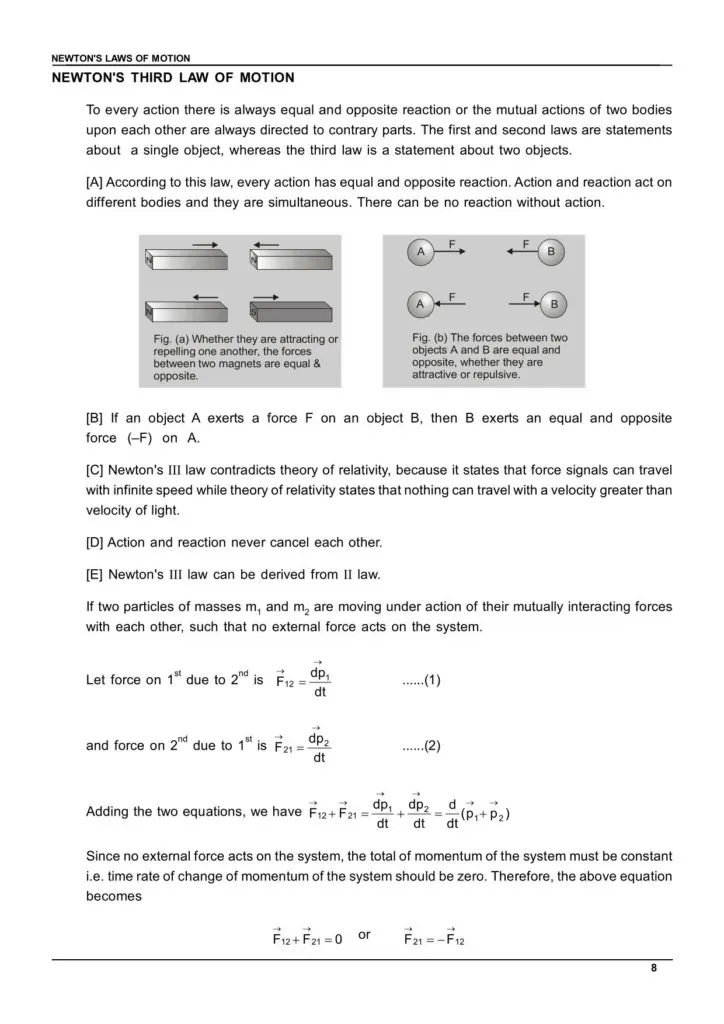
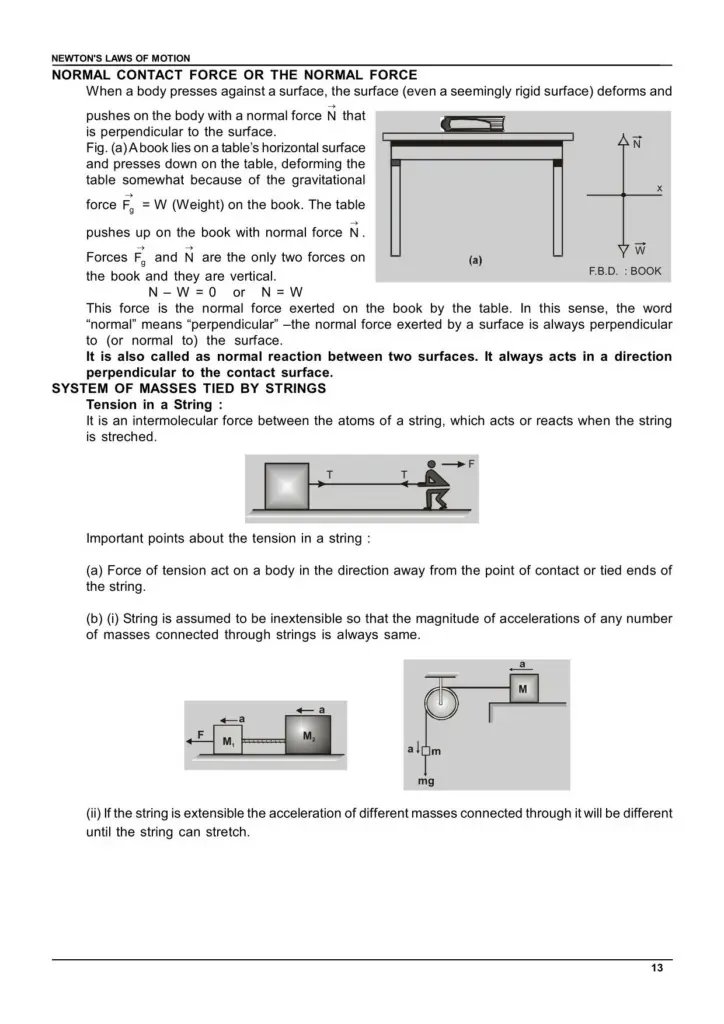
Third law | For every action, there is an equal and opposite reaction | The two forces act on different bodies, so they never cancel each other |
Inertia is the property of a body to resist a change in its state of motion. It is measured by mass. There are three kinds: inertia of rest, inertia of motion and inertia of direction.
Momentum, Impulse and Conservation of Momentum in Class 11 Laws of Motion Notes
- Linear momentum: p = mv, a vector.
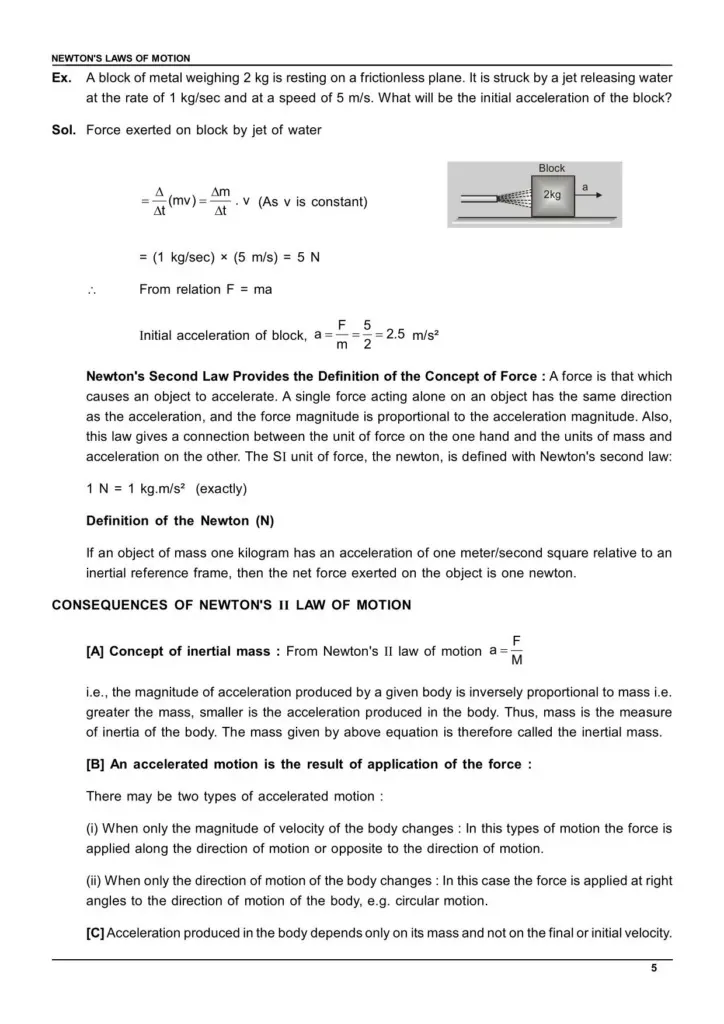
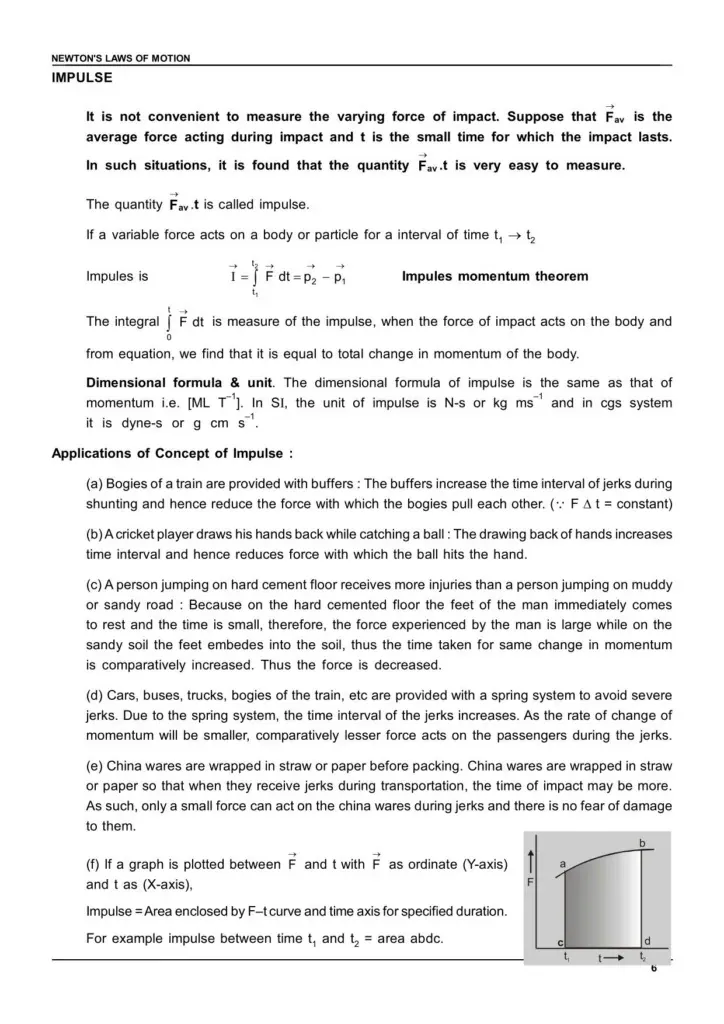
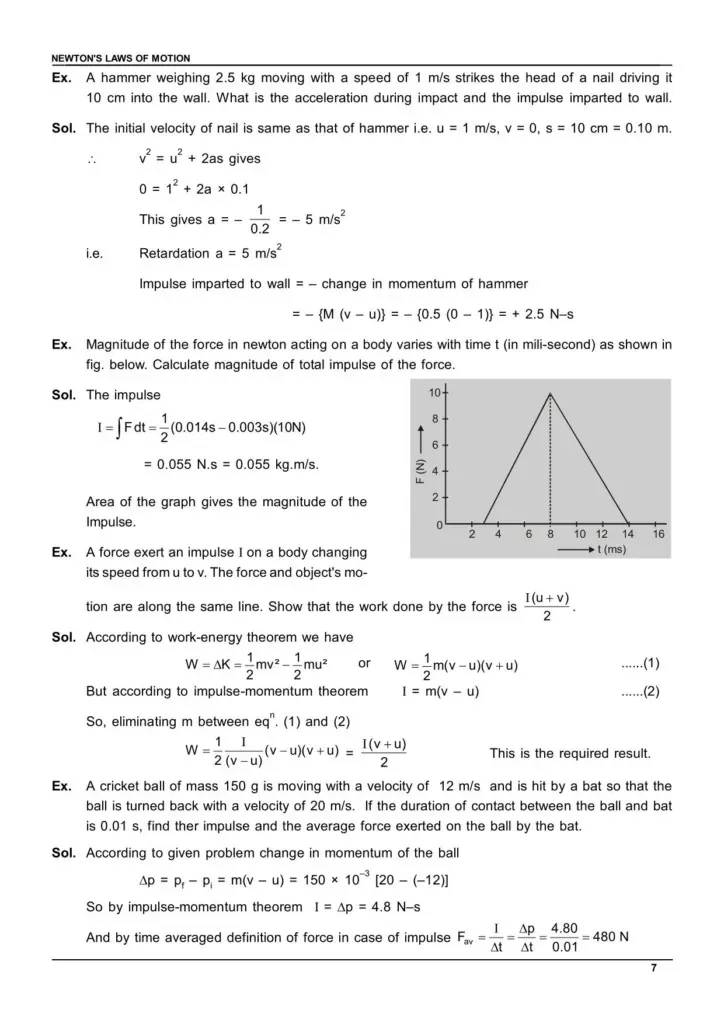
- Impulse: J = F × Δt = Δp (the change in momentum). On a force–time graph, the impulse is the area under the graph.
- Conservation of linear momentum: if no net external force acts on a system, its total momentum remains constant.
- Recoil: when a gun of mass M fires a bullet of mass m with velocity v, the gun recoils with velocity V = −(m/M)v.
Equilibrium of Concurrent Forces in Class 11 Laws of Motion Notes
A body is in equilibrium if the vector sum of the forces on it is zero. For three concurrent forces in equilibrium, Lami’s theorem says F₁/sin α = F₂/sin β = F₃/sin γ, where α, β and γ are the angles opposite to F₁, F₂ and F₃.
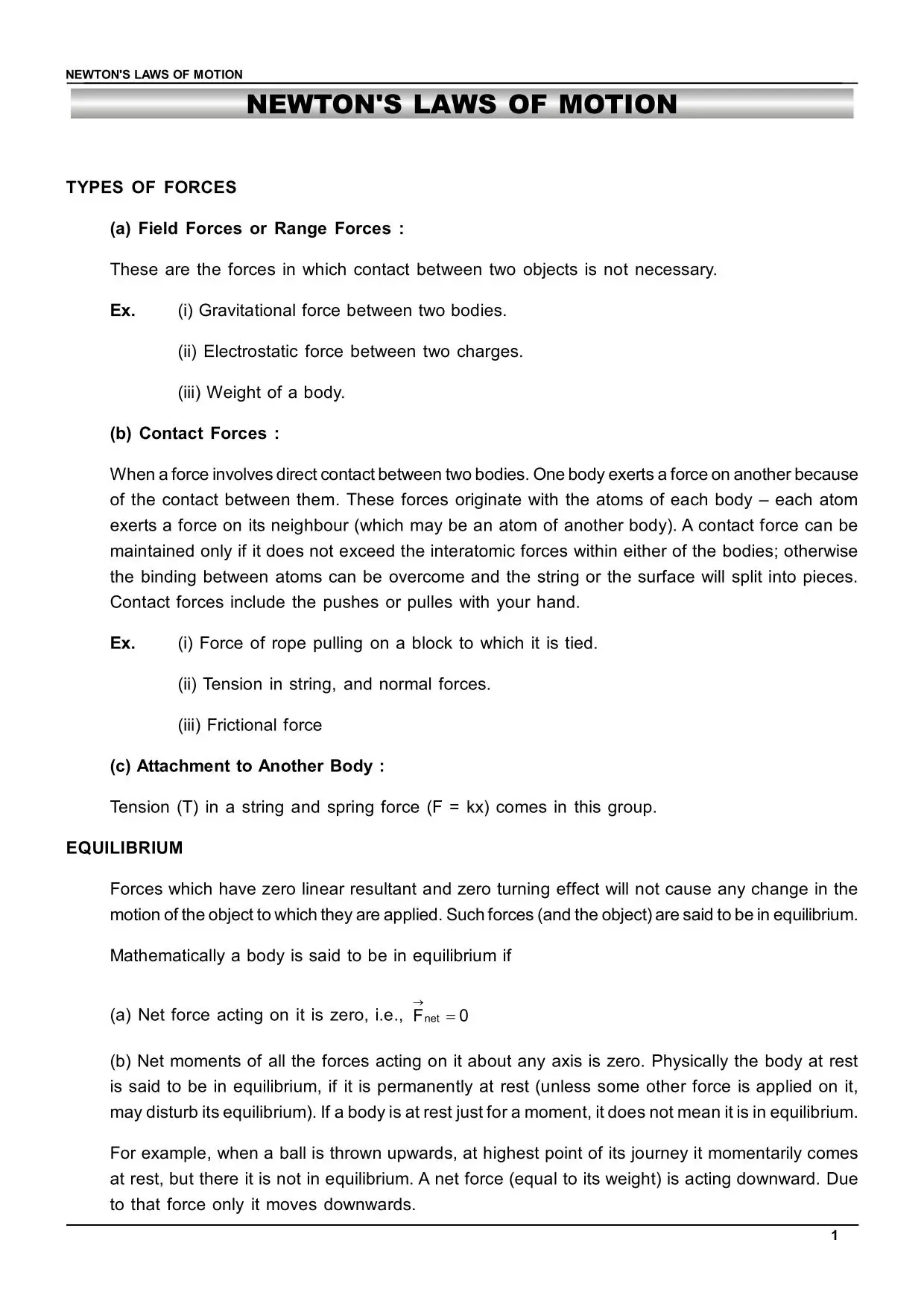
Friction in Class 11 Laws of Motion Notes
Type | Formula and notes |
|---|---|
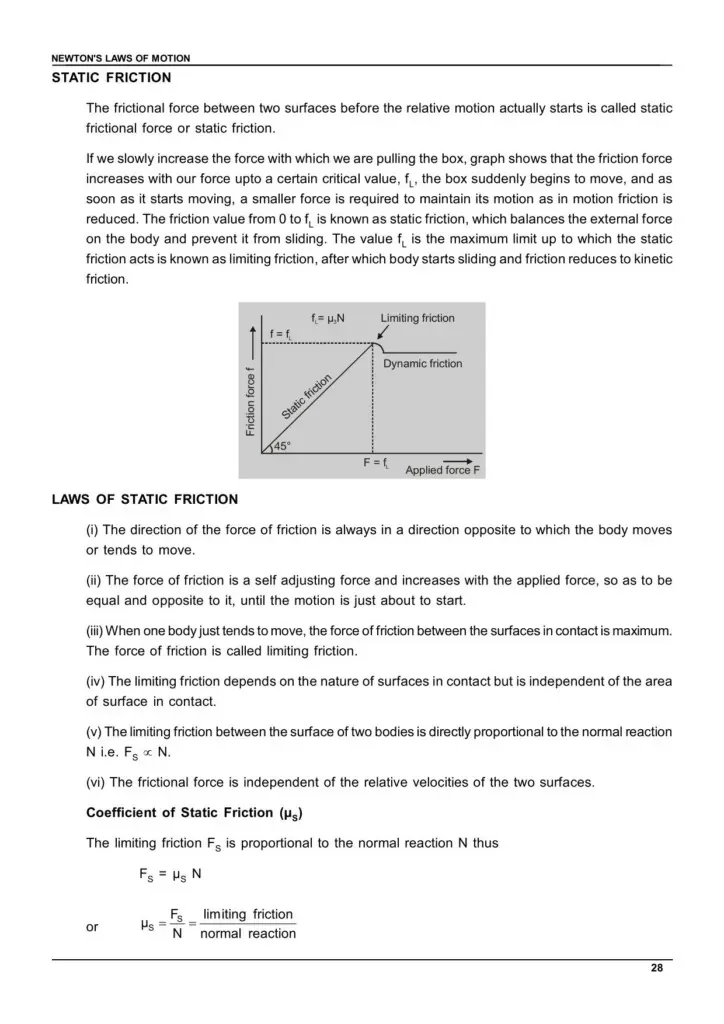
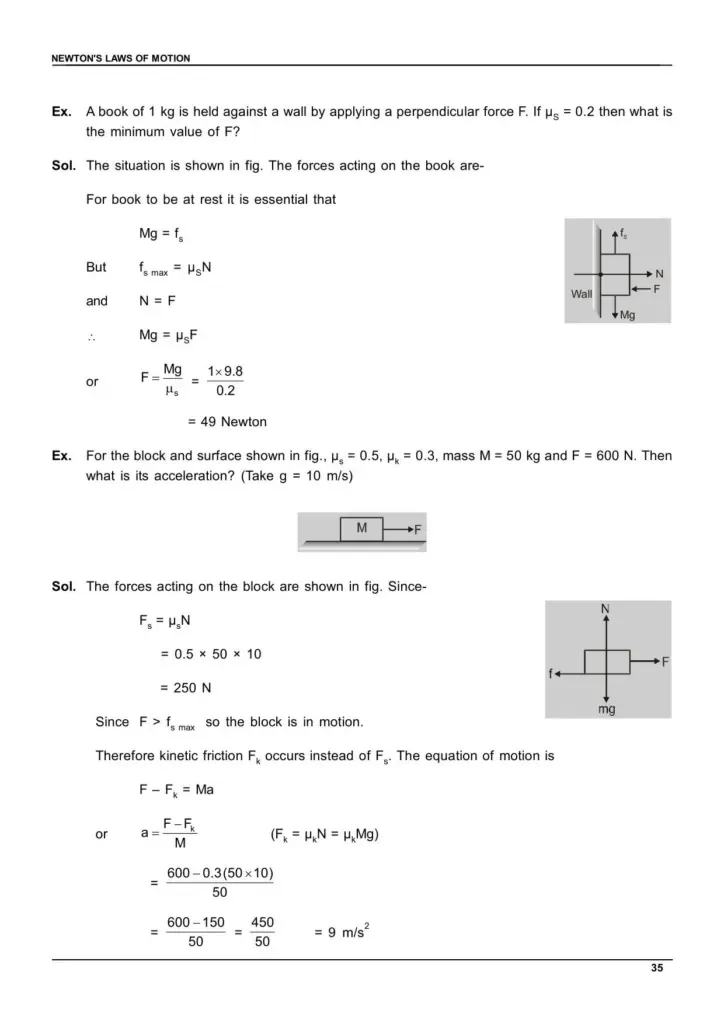
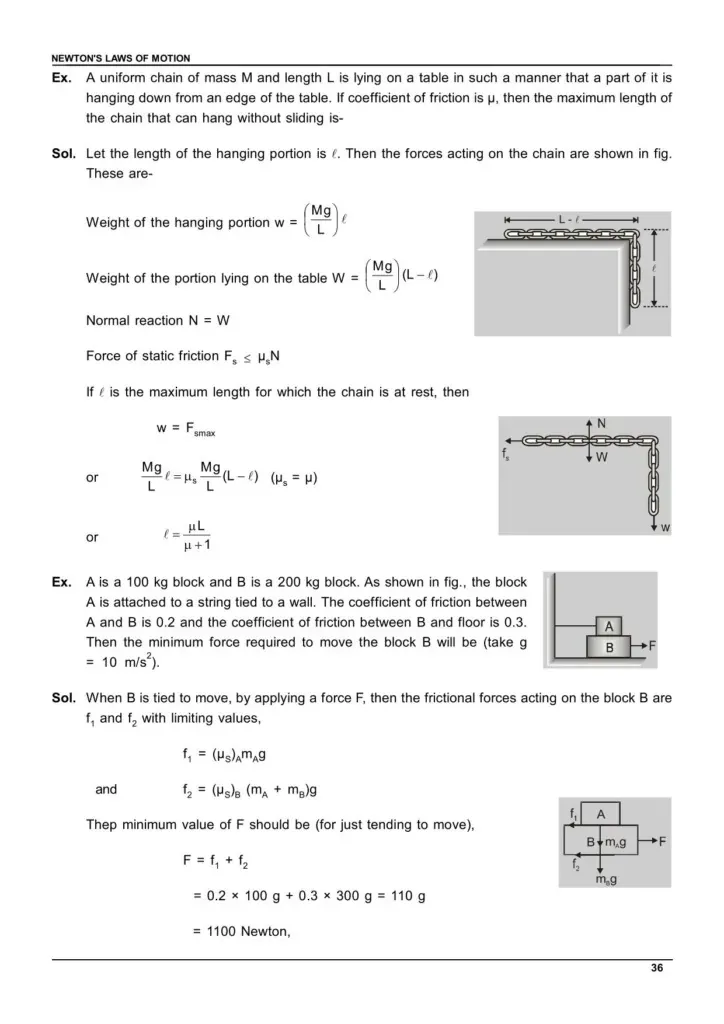
Static friction | f_s ≤ μ_s N. It adjusts itself up to the limiting value μ_s N |
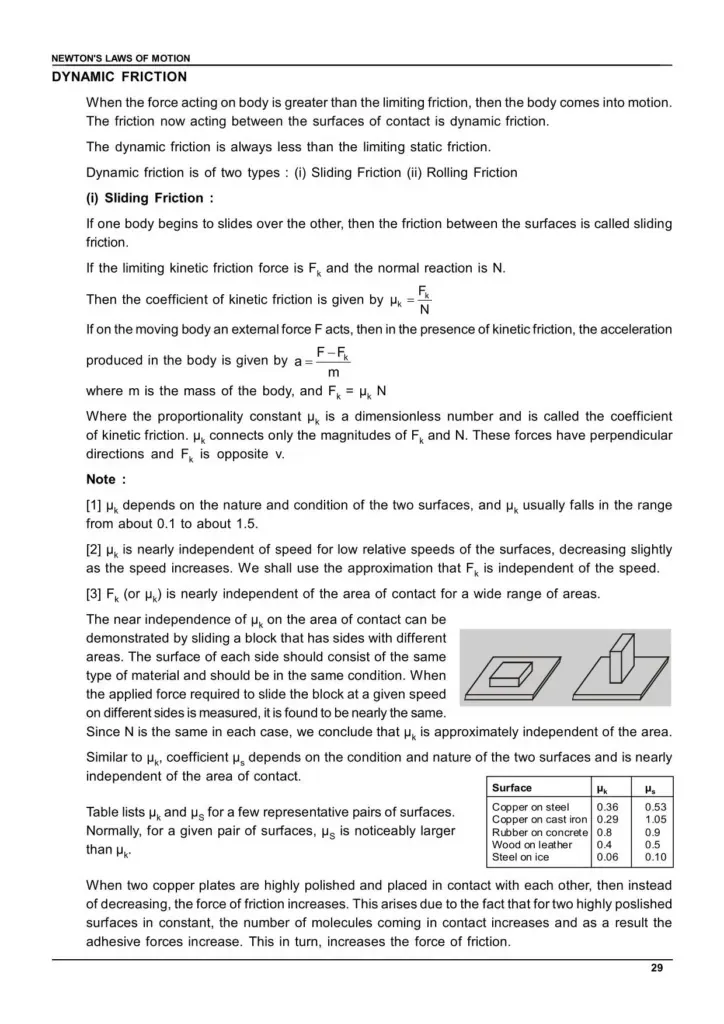
Kinetic friction | f_k = μ_k N. It is constant while the surfaces slide |
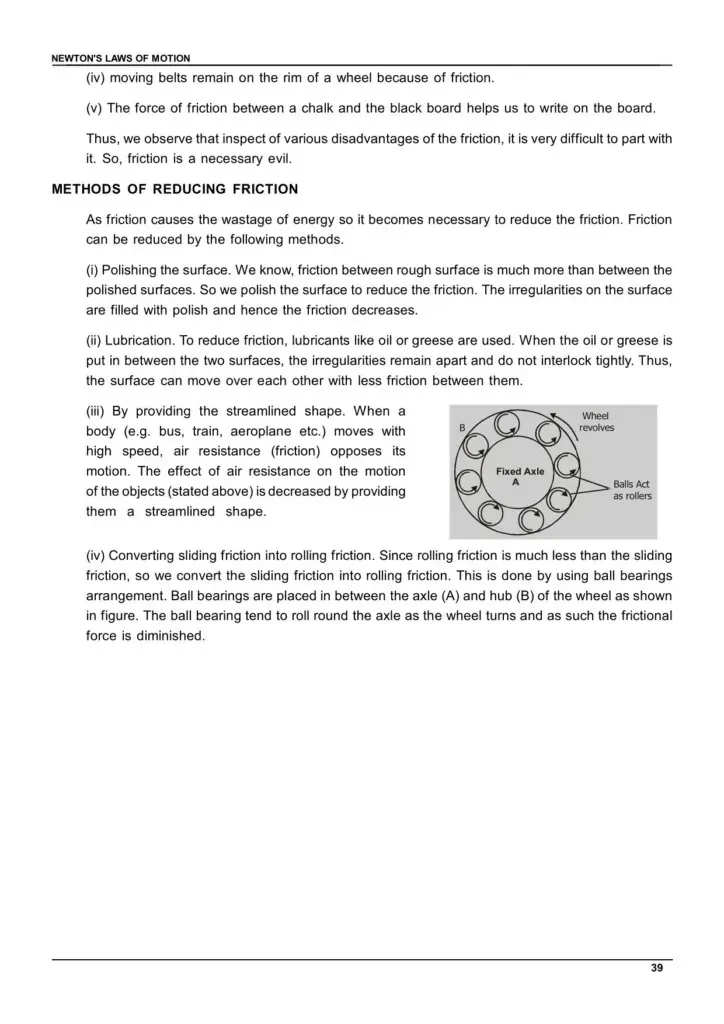
Rolling friction | Much smaller than sliding friction |
For most surface pairs, μ_k is less than μ_s, so it is easier to keep a body moving than to start it moving.
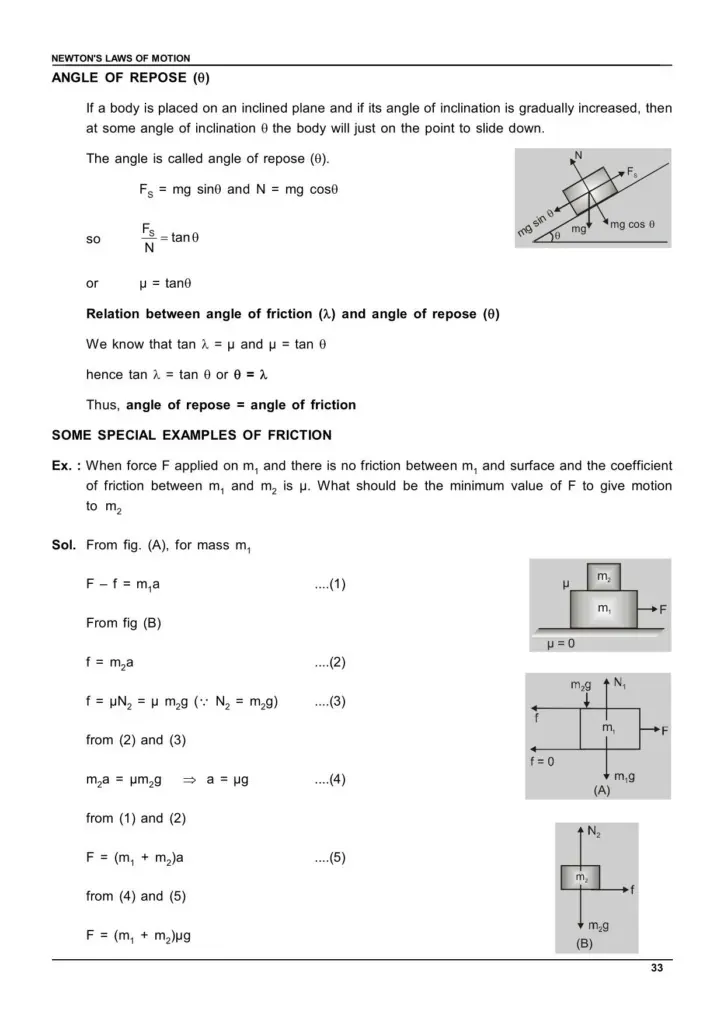
Angle of friction (λ): tan λ = μ. Angle of repose (θ): tan θ = μ_s, the angle of the incline at which a body just starts to slide.
Block on an Inclined Plane
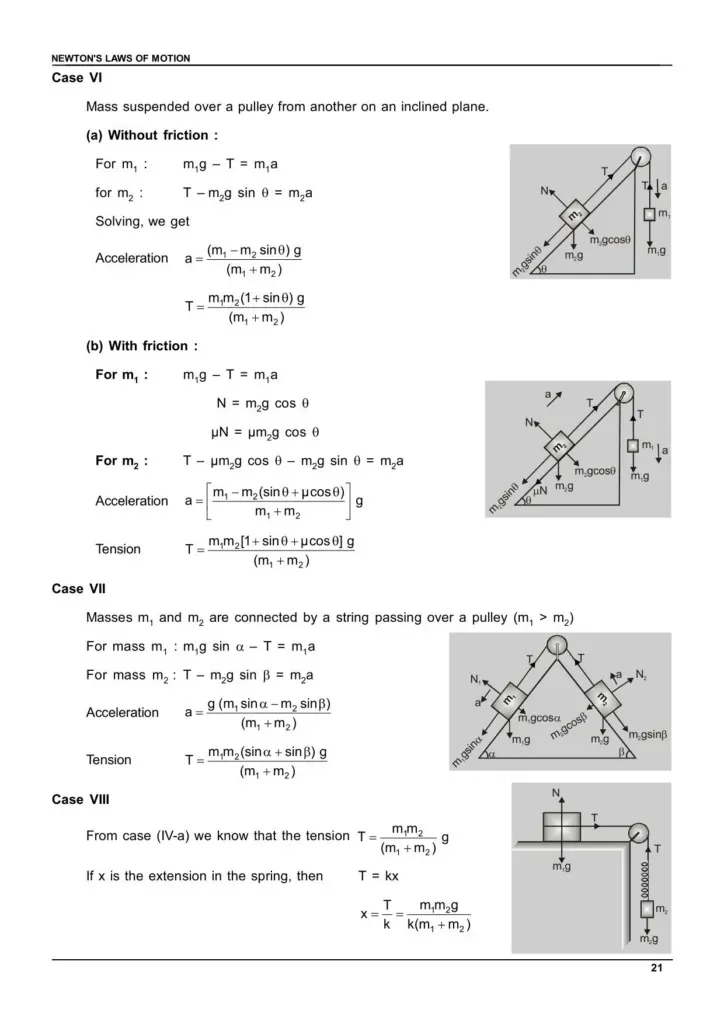
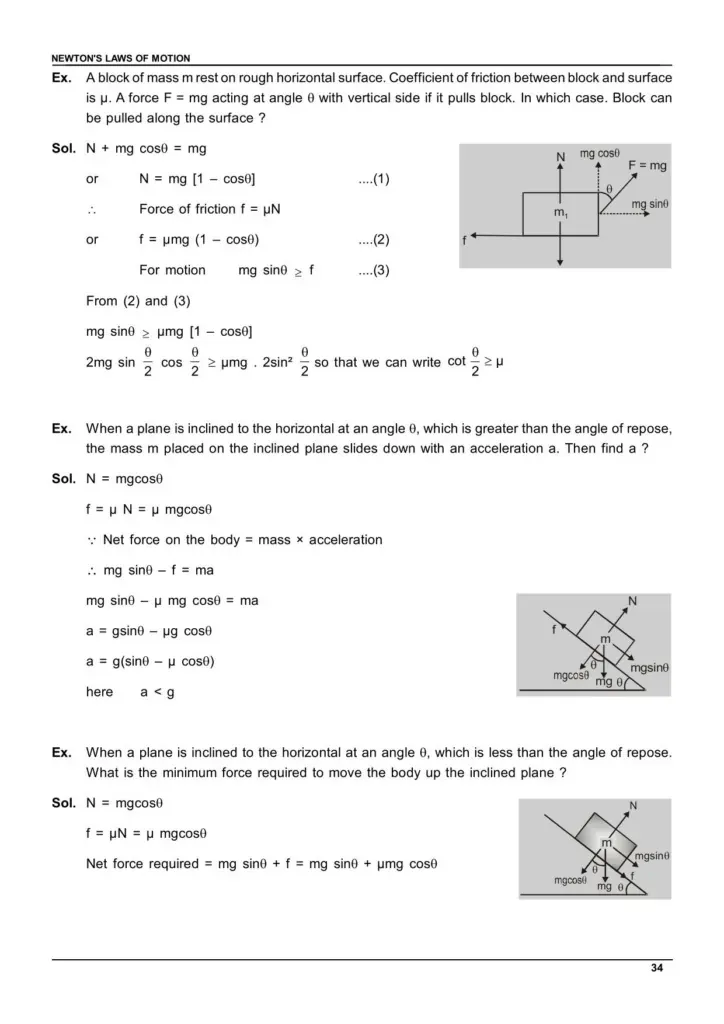
- Sliding down a rough incline: a = g(sin θ − μ cos θ)
- Sliding down a smooth incline: a = g sin θ
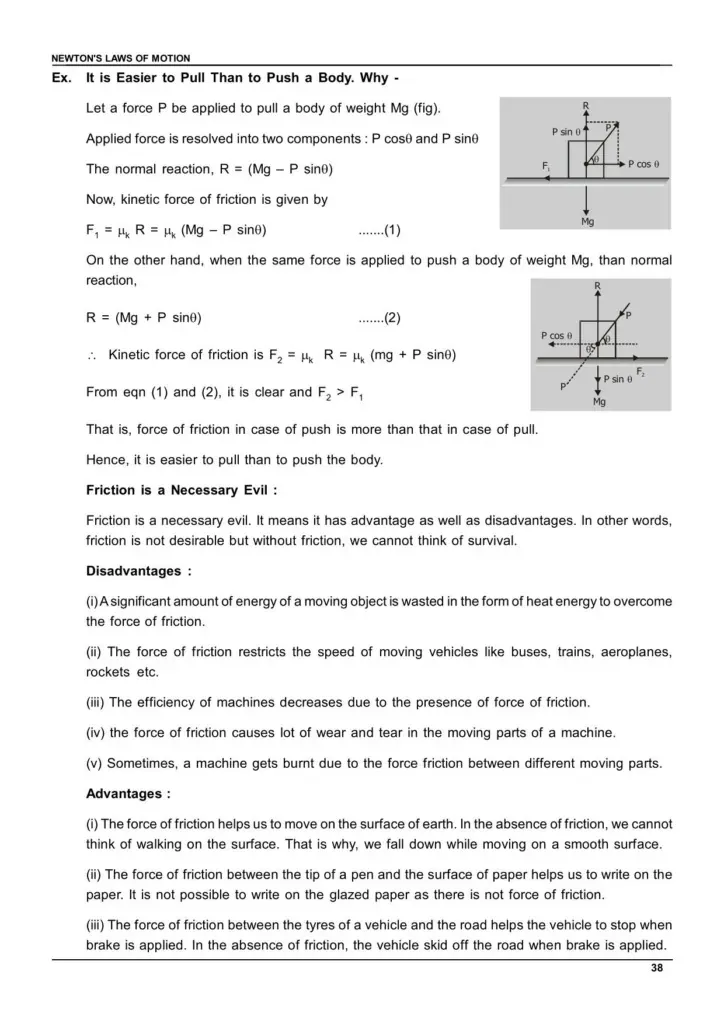
- To pull a block along a rough horizontal surface with the least force, pull at the angle θ = tan⁻¹ μ above the horizontal, and the least force is F_min = μmg/√(1 + μ²).
Connected Bodies and Elevator Problems in Class 11 Laws of Motion Notes
Situation | Result |
|---|---|
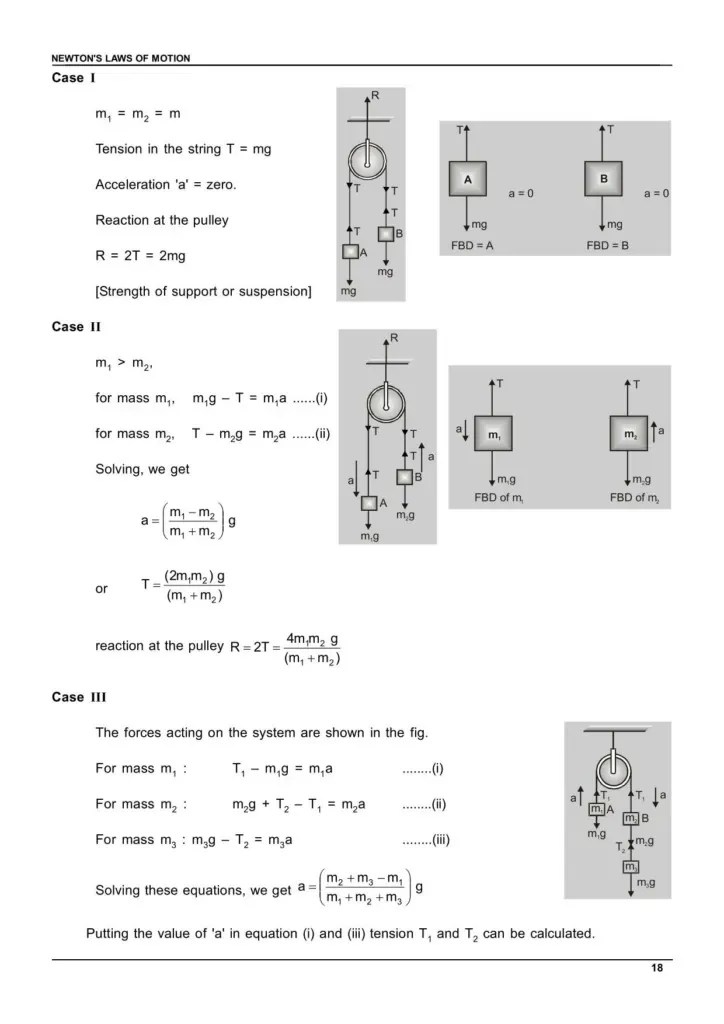
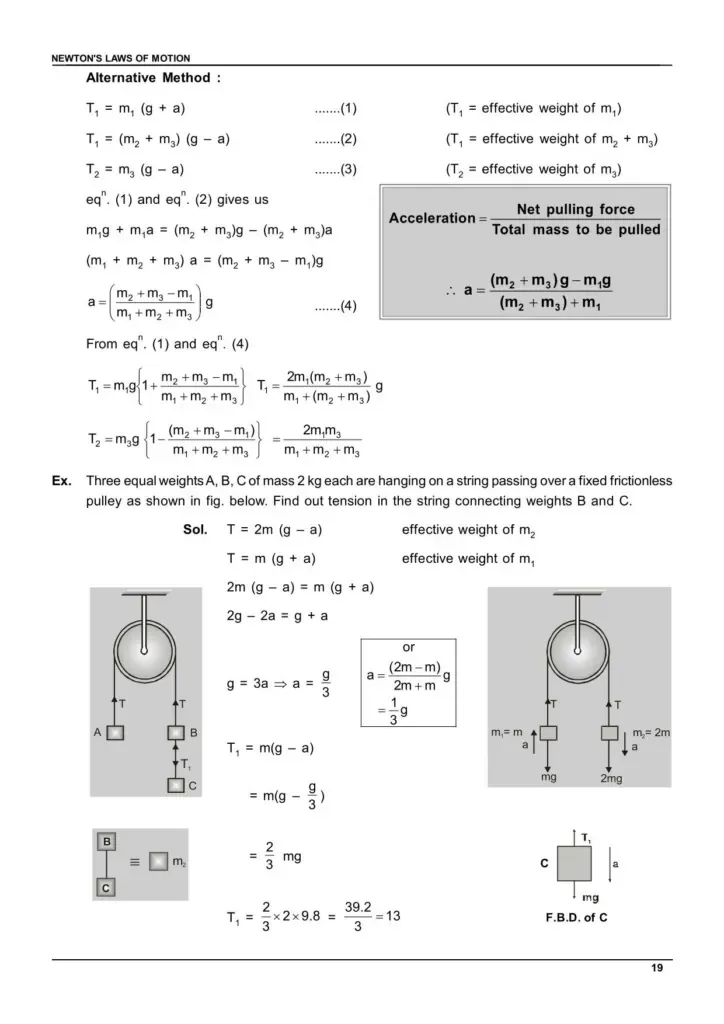
Atwood machine (m₁ > m₂) | a = (m₁ − m₂)g/(m₁ + m₂), T = 2m₁m₂g/(m₁ + m₂) |
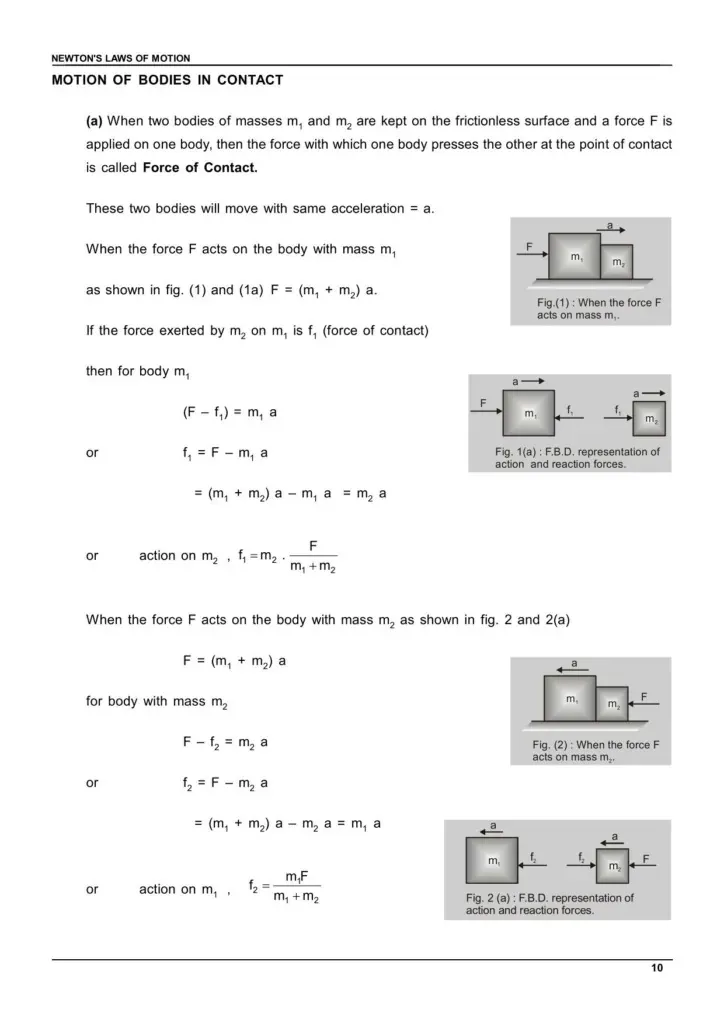
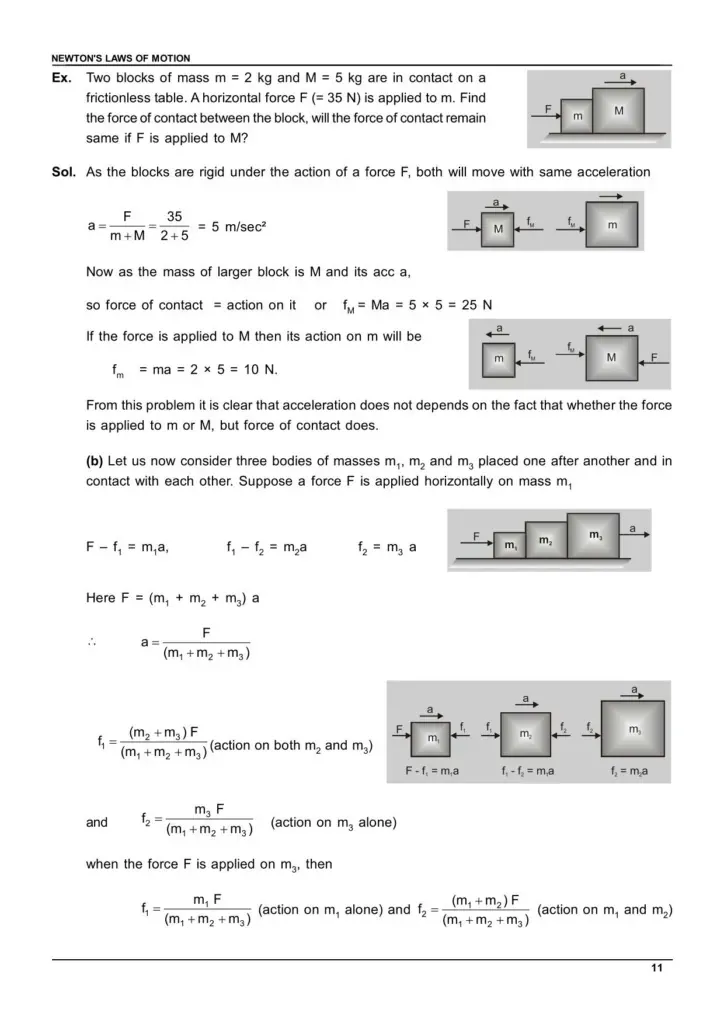
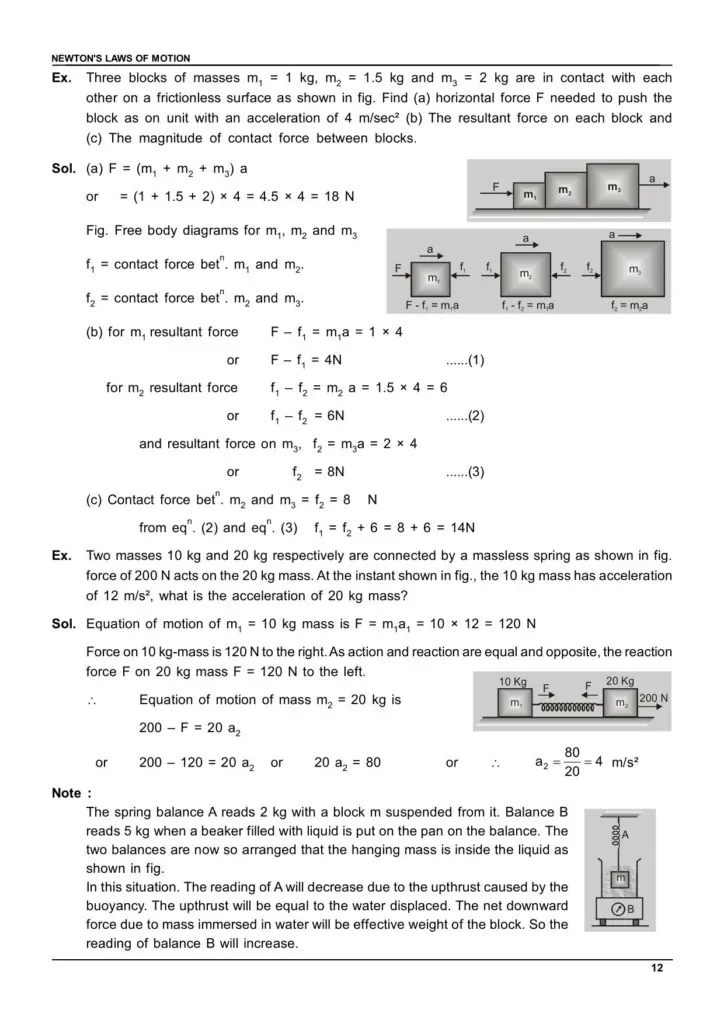
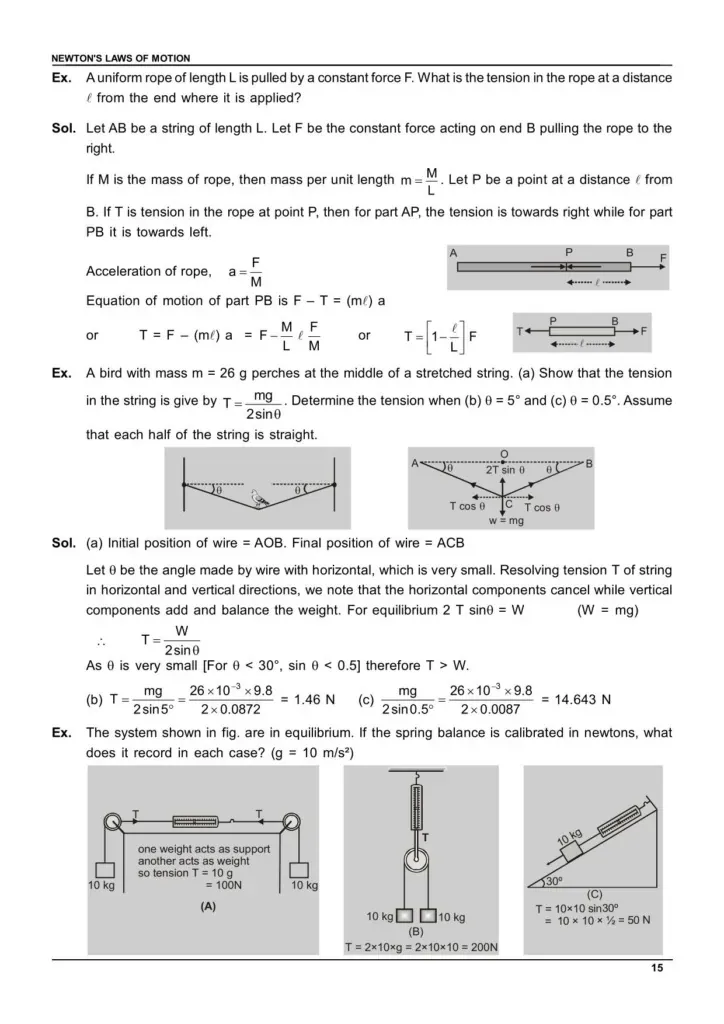
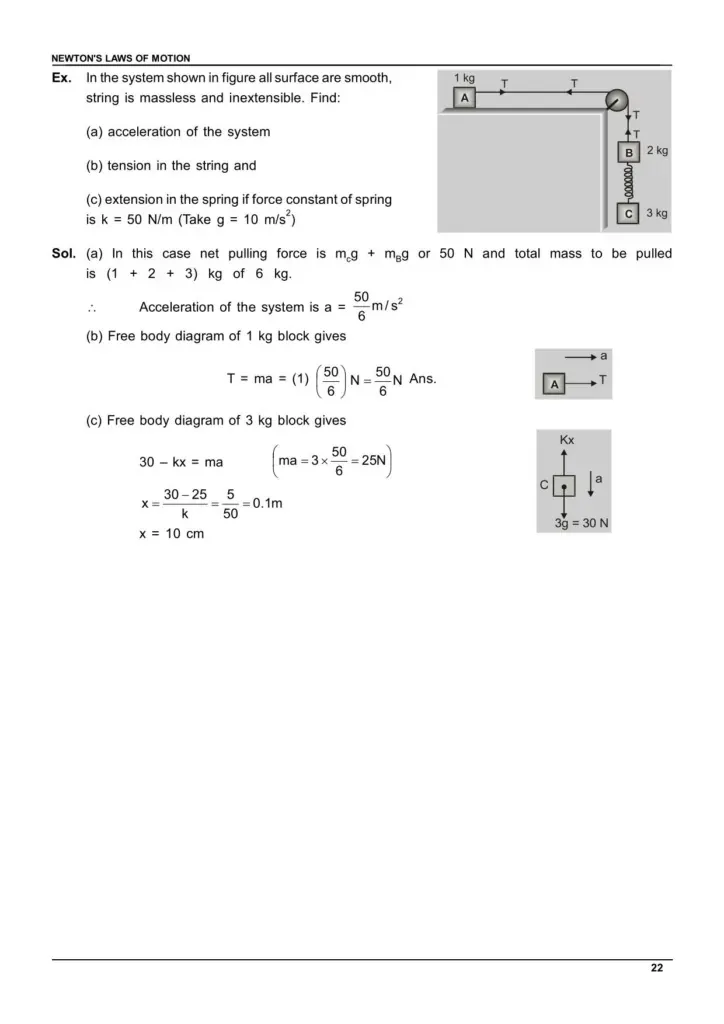
Two blocks m₁ and m₂ on a smooth surface, pushed by F on m₁ | a = F/(m₁ + m₂), and the contact force on m₂ is m₂F/(m₁ + m₂) |
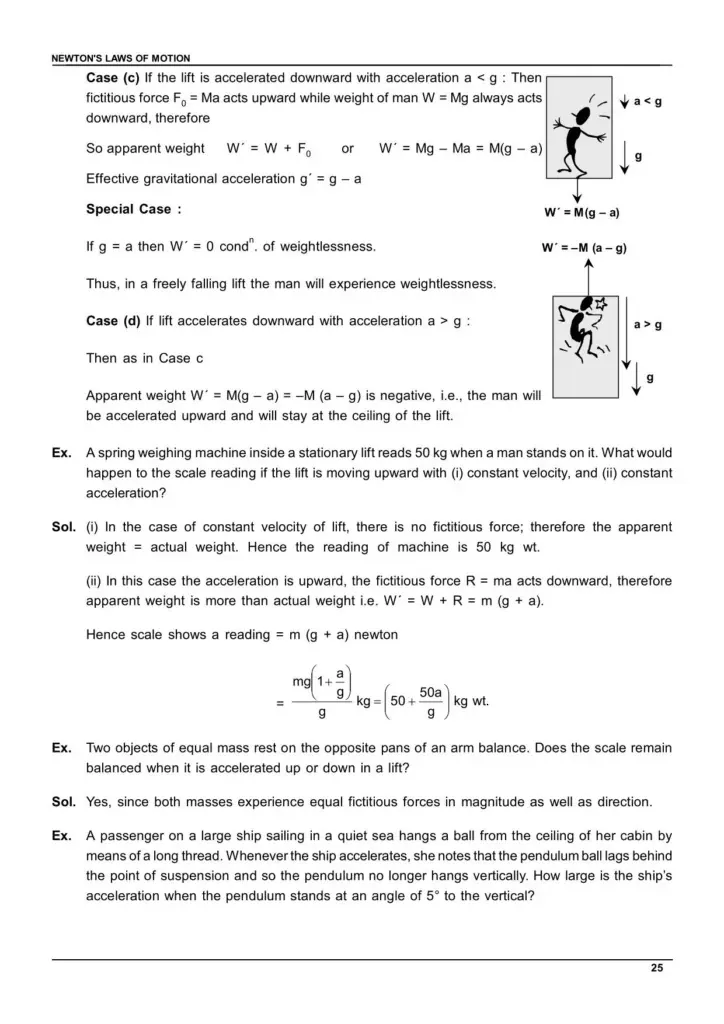
Elevator accelerating upward at a | Apparent weight N = m(g + a) |
Elevator accelerating downward at a | Apparent weight N = m(g − a) |
Freely falling elevator | N = 0 (weightlessness) |
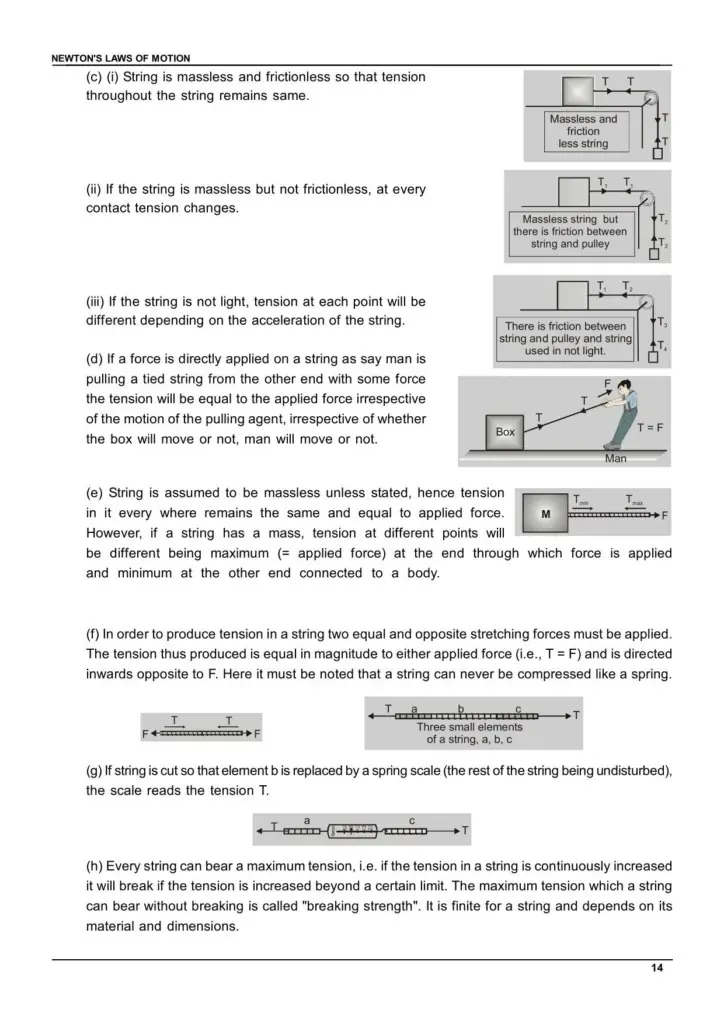
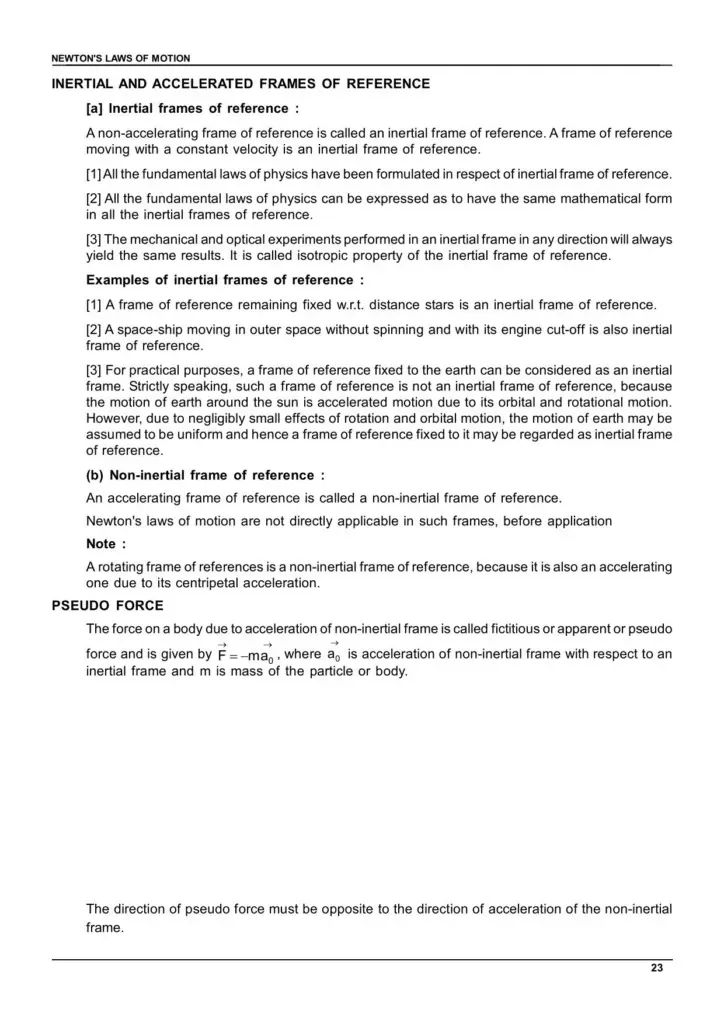
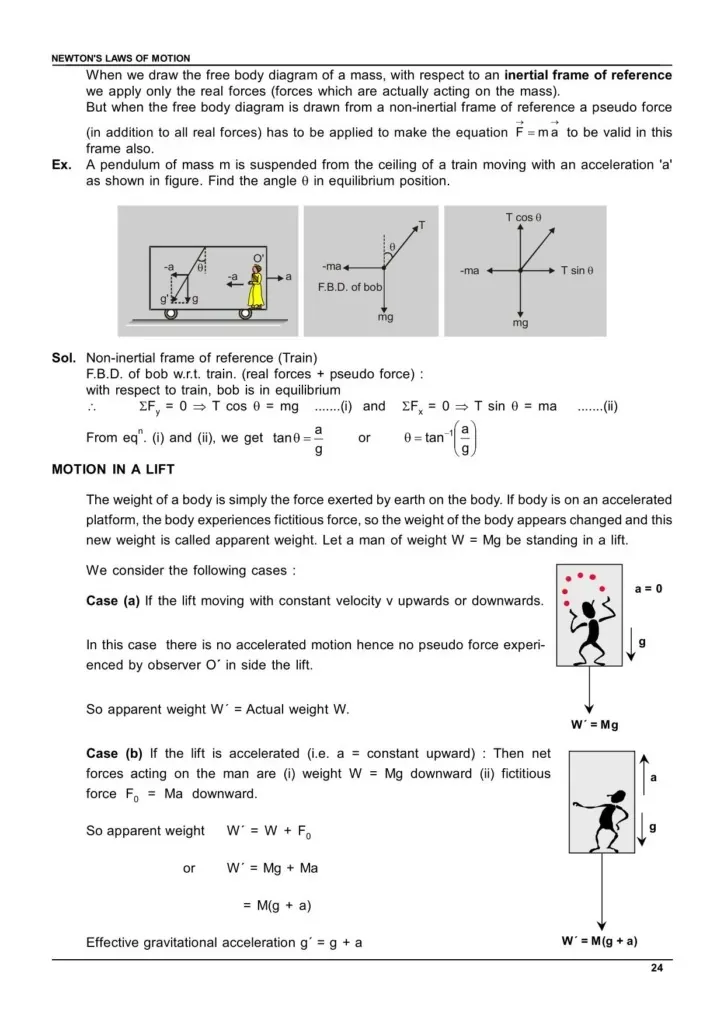
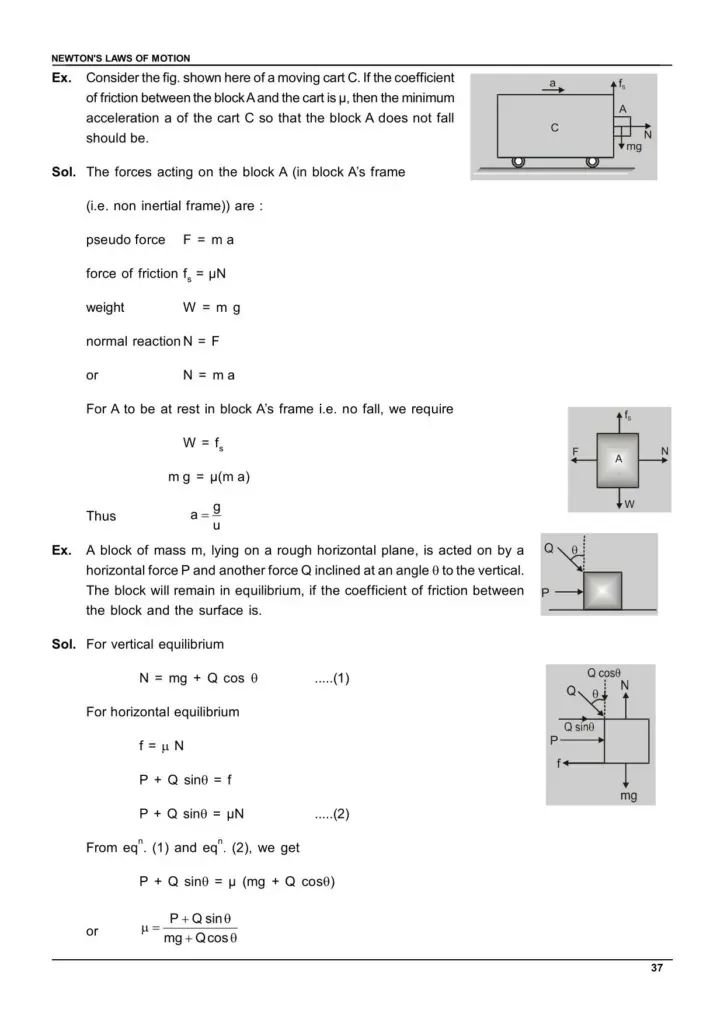
In a non-inertial frame, such as an accelerating lift, you add a pseudo force of magnitude ma in the direction opposite to the acceleration of the frame.
Dynamics of Circular Motion in Class 11 Laws of Motion Notes
Centripetal force is not a new force. It is the net force towards the centre, so write F_net towards the centre = mv²/r.
- Vehicle on a level road: the friction provides the centripetal force, so v_max = √(μrg).
- Vehicle on a banked road (no friction needed): tan θ = v²/(rg).
- Vertical circle (string): the minimum speed at the top is √(rg), and at the bottom it is √(5rg).
For a full treatment of banking, the conical pendulum and the vertical circle, see eSaral’s circular motion notes for Class 11.
Key Formulas in Class 11 Laws of Motion Notes
Formula | Description |
|---|---|
F = dp/dt = ma | Newton’s second law |
p = mv | Linear momentum |
J = FΔt = Δp | Impulse |
m₁u₁ + m₂u₂ = m₁v₁ + m₂v₂ | Conservation of momentum |
f_s(max) = μ_s N, f_k = μ_k N | Friction |
tan θ = μ_s | Angle of repose |
a = g(sin θ − μ cos θ) | Sliding down a rough incline |
a = (m₁ − m₂)g/(m₁ + m₂) | Atwood machine |
N = m(g ± a) | Apparent weight in a lift |
v_max = √(μrg), tan θ = v²/(rg) | Level and banked roads |
Solved Examples from Class 11 Laws of Motion Notes
Example 1 (impulse): A force of 20 N acts on a 2 kg body at rest for 0.5 s. Find the impulse and the final speed.
J = FΔt = 20 × 0.5 = 10 N·s. v = J/m = 10/2 = 5 m/s.
Example 2 (recoil): A bullet of mass 10 g leaves a gun of mass 4 kg at 400 m/s. Find the recoil speed of the gun.
V = −(m/M)v = −(0.01/4) × 400 = −1 m/s. The gun recoils at 1 m/s.
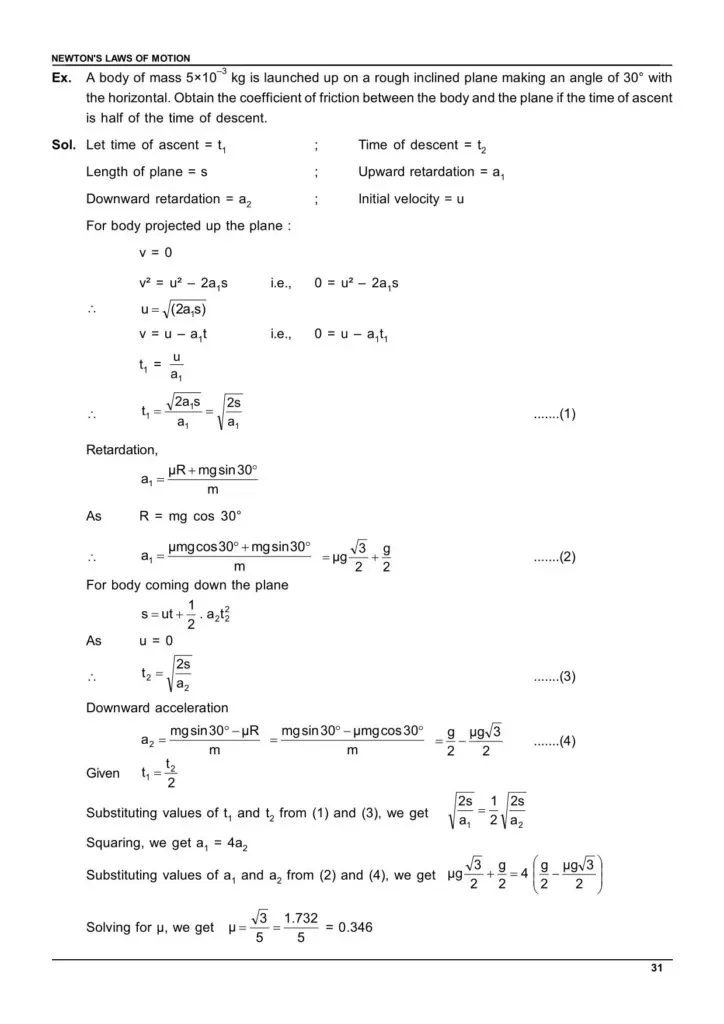
Example 3 (incline with friction): A 5 kg block slides down a 30° incline with μ = 0.2. Find its acceleration (g = 10 m/s²).
a = g(sin θ − μ cos θ) = 10(0.5 − 0.2 × 0.866) ≈ 3.3 m/s².
Example 4 (Atwood machine): Masses of 3 kg and 2 kg hang over a light pulley. Find the acceleration and the tension (g = 10 m/s²).
a = (3 − 2) × 10/5 = 2 m/s². T = 2 × 3 × 2 × 10/5 = 24 N.
Example 5 (lift): A 60 kg man stands in a lift. Find the apparent weight when the lift accelerates upward at 2 m/s² and downward at 2 m/s² (g = 10 m/s²).
Upward: N = 60(10 + 2) = 720 N. Downward: N = 60(10 − 2) = 480 N.
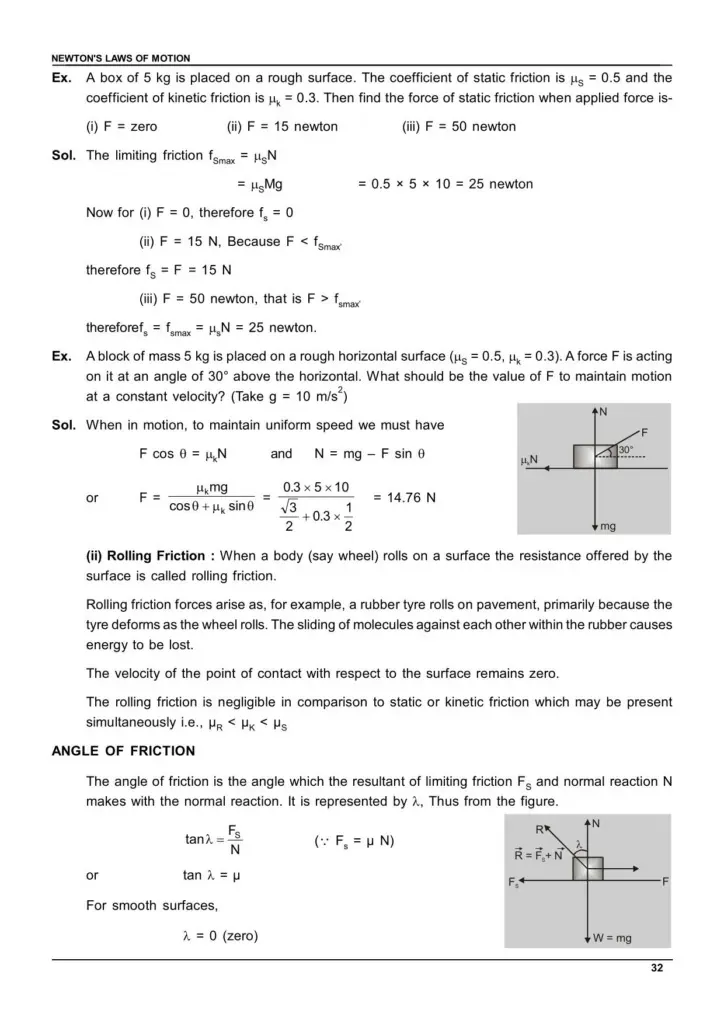
Example 6 (static and kinetic friction): A 10 kg block lies on a surface with μ_s = 0.4 and μ_k = 0.3. Find the friction and the acceleration when a horizontal force of (a) 35 N and (b) 50 N is applied (g = 10 m/s²).
The limiting friction is 0.4 × 100 = 40 N. (a) 35 N < 40 N, so the block stays at rest, and the friction is 35 N. (b) 50 N > 40 N, so the block slides. Kinetic friction = 0.3 × 100 = 30 N, and a = (50 − 30)/10 = 2 m/s².
Common Mistakes in Class 11 Laws of Motion Notes Problems
Mistake | Correct approach |
|---|---|
Showing action and reaction on the same free body diagram as if they cancel | They act on different bodies |
Adding “centripetal force” as an extra force | Draw only real forces, and write that their net force towards the centre is mv²/r |
Using f = μN for static friction at rest | Static friction equals the applied force until it reaches μ_s N |
Forgetting the normal force changes on an incline or with a vertical push or pull | Resolve the forces perpendicular to the surface to find N |
Using the wrong sign in the lift formula | Upward acceleration: N = m(g + a). Downward: N = m(g − a) |
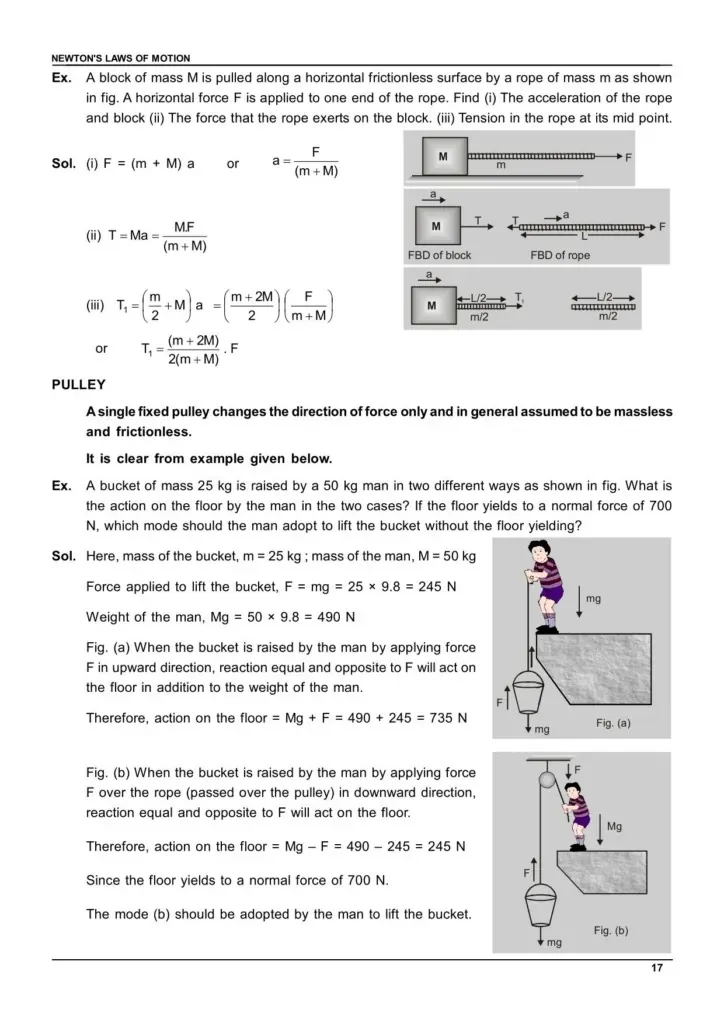
Treating tension as the same in a rope with a massive pulley | The tension is the same only in a light rope over a light, smooth pulley |
How to Study Class 11 Laws of Motion Notes
- Read the NCERT chapter first, and solve the examples and exercises. eSaral’s NCERT Solutions for Class 11 Physics Chapter 4 can help you check your answers.
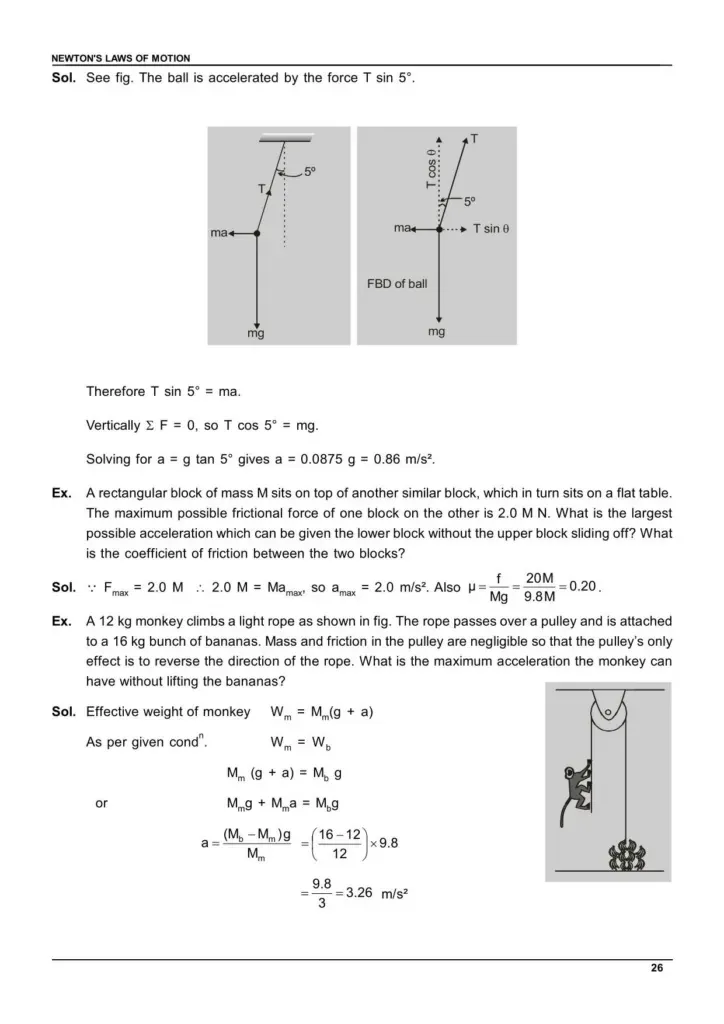
- Free body diagrams often need forces resolved along perpendicular axes, so revise vector components and two-dimensional motion before you solve problems.
- Practise problems in this order: single block, incline, connected bodies, friction and then circular motion.
- For quick revision of formulas, use eSaral’s free Physics revision series on YouTube.
- Revise with eSaral’s Class 11 Physics notes, and then solve previous year questions.
eSaral has already come up with an amazing revision series of Physics where you can easily revise your chapter within minutes with all the important formulae and key points. This revision series is free for all. Click Here for Complete Physics Revision Series by Saransh Gupta Sir (AIR-41). About Saransh Gupta Sir: Computer Science Graduate from IIT Bombay. Cracked IIT-JEE with AIR-41 and AIEEE (JM) with AIR-71 in 2006. He is the author of the JEE Mentorship Book “StrateJEE”. He taught Physics for 5 years at Allen and was loved immensely by all the students. Many of his students bagged success with flying colours in JEE & NEET Exams. eSaral brings you detailed Class 11th Physics study material. eSaral provides a series of detailed chapter-wise notes for all the Subjects of class 11th and 12th.
India's Best Exam Preparation for Class 11th - Download Now
These notes will also help you in your IIT JEE & NEET preparations. We hope these Physics Notes for Class 11 will help you understand the important topics and remember the key points from an exam point of view. Get Complete Physics Notes for Physics Class 11 for easy learning and understanding. For free video lectures and complete study material, download the eSaral APP. About eSaral: At eSaral, we are offering a complete platform for IIT-JEE & NEET preparation. The main mission behind eSaral is to provide education to every student in India by eliminating the Geographic and Economic factors, as a nation’s progress and development depends on the availability of quality education to everyone. With the blend of education & technology, the eSaral team made the learning personalized & adaptive for everyone.
Free-body diagrams often require forces to be resolved along perpendicular axes, so a quick revision of vector components and two-dimensional motion is useful before solving NLM problems.
Frequently Asked Questions
What are Newton’s three laws of motion in simple words?
The first law says that a body stays at rest or keeps moving in a straight line at constant speed unless a net force acts on it. The second law says that the net force equals the rate of change of momentum, which is F = ma for a constant mass. The third law says that the forces between two bodies are equal and opposite, and they act on different bodies. These Class 11 Laws of Motion Notes on eSaral explain each with examples.
Is Laws of Motion important for NEET?
Yes. In Class 11 Laws of Motion notes, the NEET focus is clear: NEET includes questions from this chapter, mostly on Newton’s laws, friction and circular motion basics, and the number varies from year to year. Check the NMC syllabus and previous years’ papers. The chapter also supports later topics such as Work, Energy and Power.
What topics from Laws of Motion are in the JEE Main syllabus?
In the Class 11 Laws of Motion Notes, the topics are Newton’s laws, momentum and impulse, conservation of linear momentum, equilibrium of concurrent forces, static and kinetic friction, rolling friction, and the dynamics of uniform circular motion with a vehicle on a level or banked road. They are listed in Unit 3 of the JEE Main 2026 syllabus.
What is the difference between static and kinetic friction?
Static friction prevents a body from starting to move, and it adjusts itself up to a maximum value of μ_s N. Kinetic friction acts when the surfaces are sliding, and its value is μ_k N. For most surface pairs, μ_k is less than μ_s, so it is easier to keep a body moving than to start it.
What is an inertial frame of reference?
In Class 11 Laws of Motion notes, an inertial frame is a frame that is at rest or moves with constant velocity, and in it Newton’s laws hold without extra forces. A non-inertial frame, such as an accelerating car, needs a pseudo force of magnitude ma in the direction opposite to the acceleration of the frame.
How do you solve a circular motion problem in the Laws of Motion chapter?
Find which real force provides the centripetal force (tension, normal force, gravity or friction), and draw the free body diagram. Then write the net force towards the centre as mv²/r. For a vertical circle on a string, the minimum speed at the top is √(rg). Never add centripetal force as a separate force.
Which chapter number is Laws of Motion in Class 11 Physics?
In the current NCERT Class 11 Physics book, it is Chapter 4. Older books call it Chapter 5. These Class 11 Laws of Motion notes follow the chapter name.
What is impulse, and how is it related to momentum?
In Class 11 Laws of Motion notes, impulse is the product of force and the time for which it acts, J = FΔt. It equals the change in momentum, J = Δp. For a force that changes with time, the impulse is the area under the force–time graph.
Where can I find more Class 11 Physics notes on eSaral?
eSaral has chapter-wise Class 11 Physics notes, NCERT solutions and handwritten notes, linked with these Class 11 Laws of Motion Notes on this page, so you can study the chapter and revise it in one place.
Team eSaral
eSaral Academic and Editorial Team
Team eSaral is the collective author profile for educational content created by eSaral’s teachers and academic contributors. The team draws on expertise from IIT graduates, doctors, experienced educators and subject specialists to develop resources for JEE, NEET and school students. Our articles aim to explain concepts clearly and help students study with confidence.
Related Posts

BITSAT 2027: Registration Date, Exam Date, Syllabus, Eligibility, Pattern & Fees
BITSAT 2027 exam dates, registration timeline, eligibility criteria, exam pattern, marking scheme, syllabus and fees in one page.

BITSAT Previous Year Question Paper PDF (2017-2026)
Download BITSAT previous year question papers PDF from 2017 to 2026,session-wise. Memory-based papers,exam pattern, paper analysis and how to practise

CBSE Class 10 Date Sheet 2027: Expected Exam Dates, Release Date, Admit Card & Result Timeline
CBSE Class 10 date sheet 2027 is awaited. See the expected exam dates, release window, how to download the PDF, admit card and result timelines.

NCERT Physics Class 10 Book PDF in Hindi 2026-27 – भौतिक विज्ञान के 4 अध्याय (Free Download)
NCERT Physics Class 10 book PDF in Hindi 2026-27: download all 4 chapters (अध्याय 9–12) free, with topics and important formulas.

NCERT Biology Class 9 Book Anveshan PDF in Hindi - जीव विज्ञान कक्षा 9 पुस्तक अन्वेषण PDF
Download NCERT Biology Class 9 book PDF in Hindi chapterwise for 2026-27: Cell, Tissues, Reproduction and Diversity. Free PDFs.

Essay On Artificial Intelligence in English (100,150, 200, 250, 300, 500 Words)
This is in contrast to the natural intelligence of humans. With Artificial Intelligence, machines can perform

Essay on 78th India Independence Day in English for Student (100, 150, 200, 250, 300, 500 Words)
Read the best essays on India's Independence Day in English. Short & long essays (100, 150, 200, 250, 300, 500 words) perfect for school exams
NCERT Class 11 English Snapshots book - Free PDF download- Esaral
Download NCERT Class 11 English Snapshots book PDF for free. Get all 8 chapters, chapter-wise. Start your prep today!
NCERT Class 10 biology book pdf - Free PDF Download - eSaral
NCERT Class 10 Biology book PDF 2026-27: all 5 chapters (Life Processes to Our Environment) in English & Hindi, with CBSE syllabus, marks & practical

Essay on Global Warming in English (100,150, 200, 250, 300, 500 Words)
Global warming means the Earth is getting hotter. This happens because of things like pollution from cars and factories.