
Definite integration - JEE Advanced Previous Year Questions with Solutions

eSaral Academic and Editorial Team
Summary
Definite Integration questions in JEE Advanced carry 3–4 marks each and have appeared every year since 2009. Key topics tested include properties of definite integrals, limit-sum form, Leibniz rule, and integration using substitution. Mastering these 15+ solved PYQs from 2009–2015 — with step-by-step solutions — is one of the fastest ways to secure marks in JEE Advanced Mathematics.

Home > JEE Advanced PYQs > Definite Integration JEE Advanced Previous Year Questions

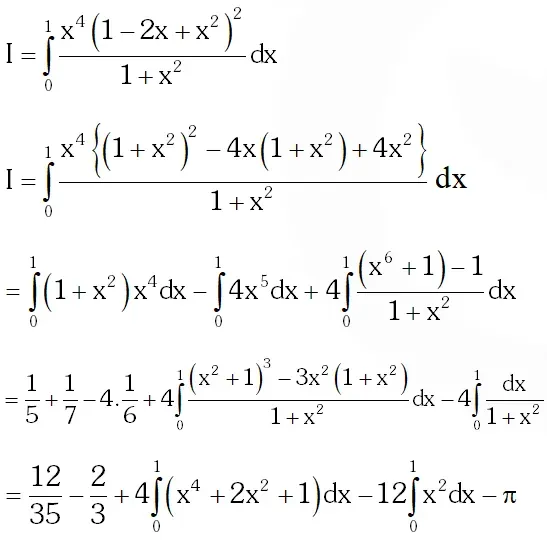
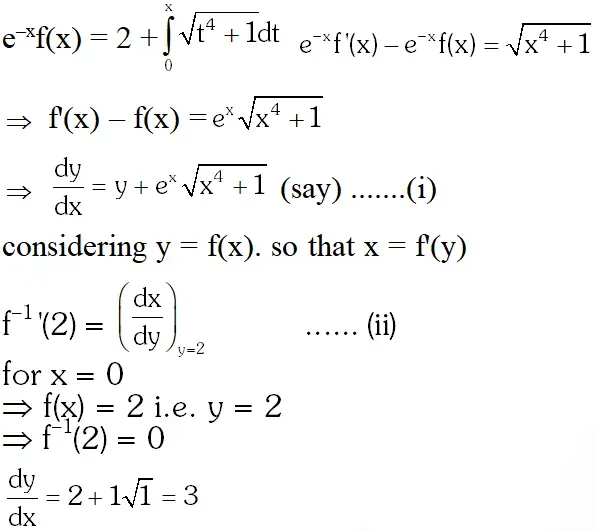
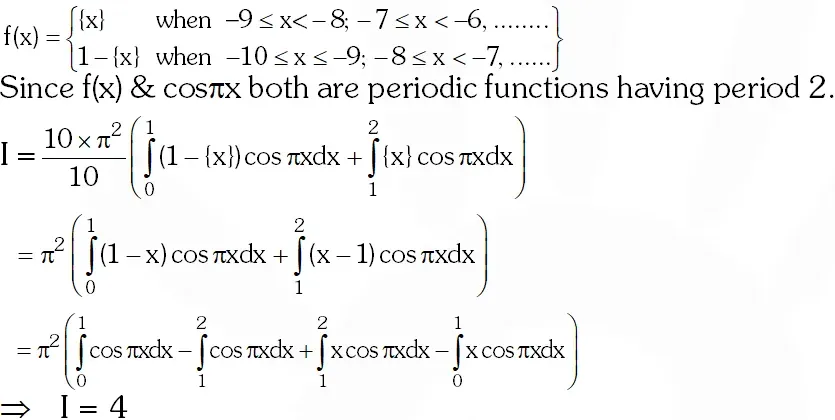
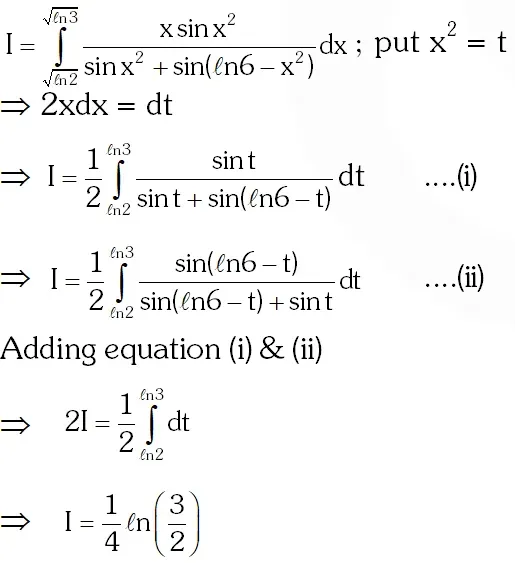
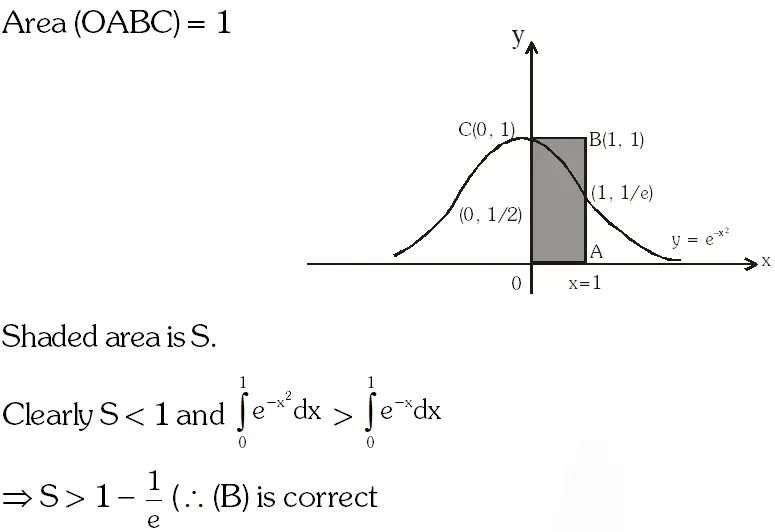
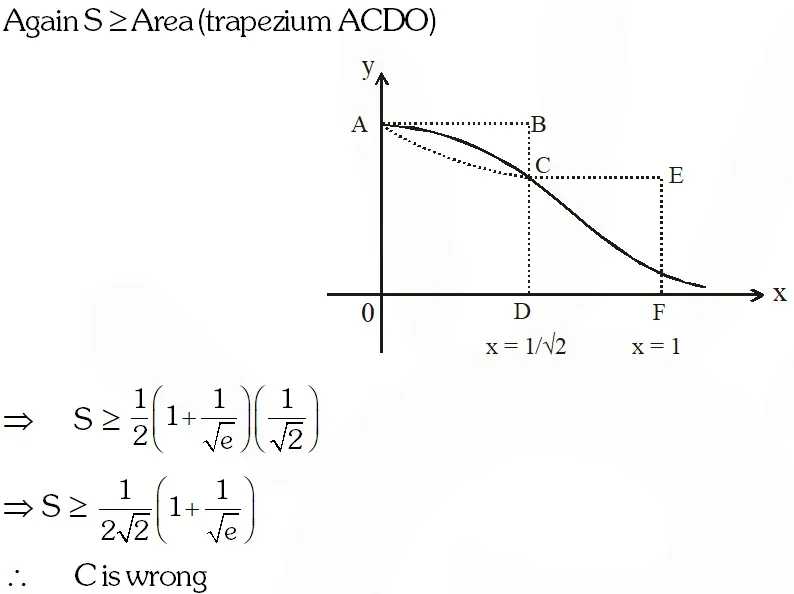
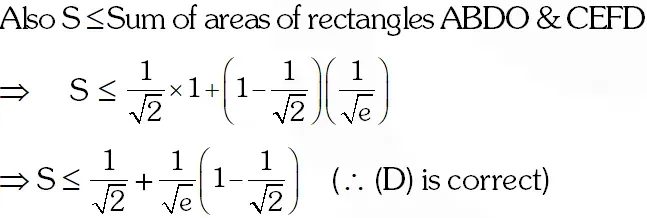
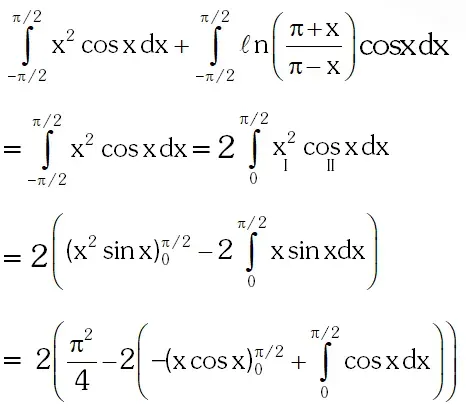
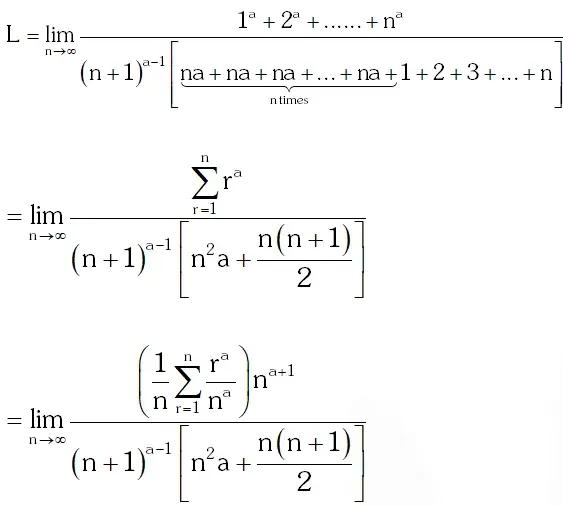
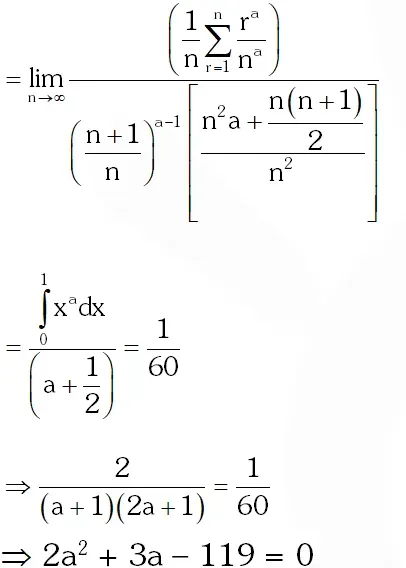
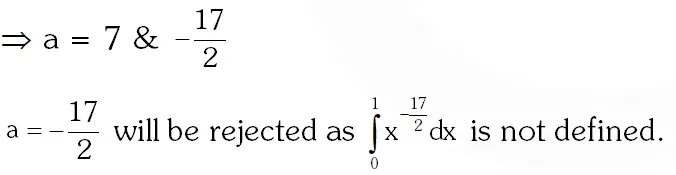
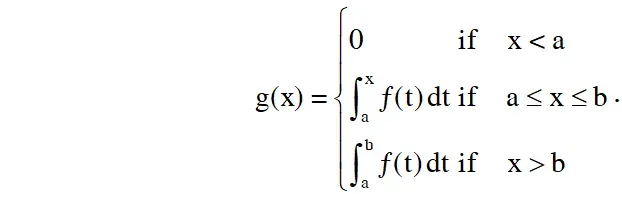
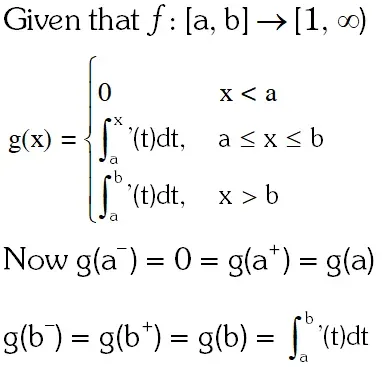
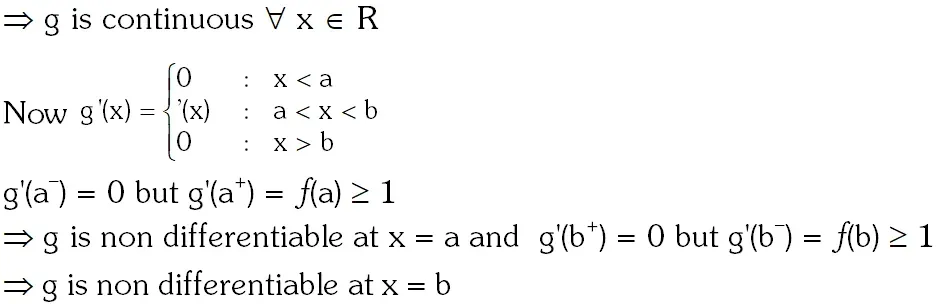
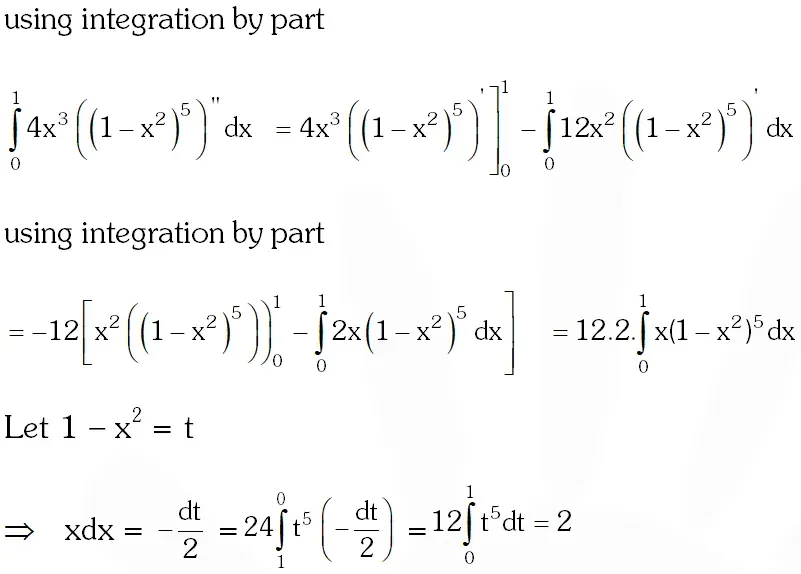
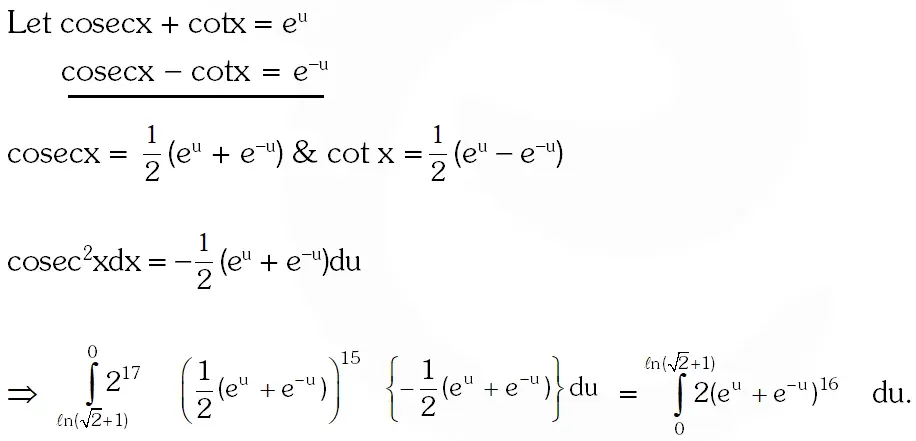
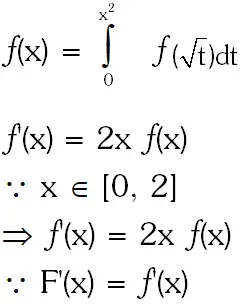
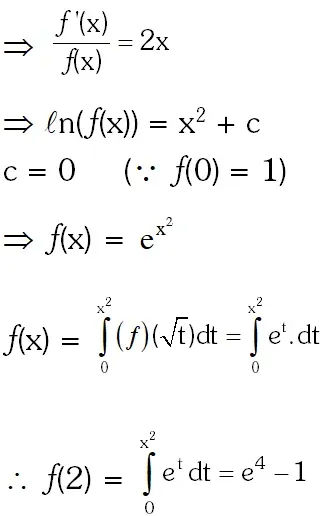
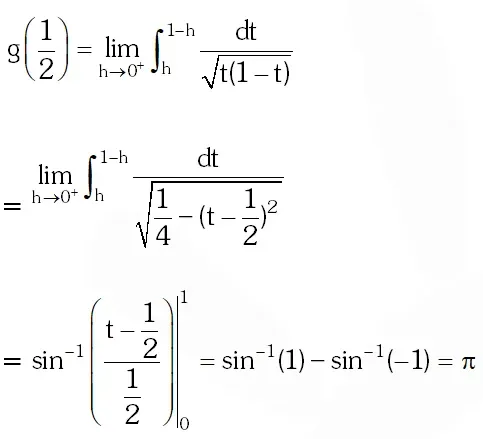
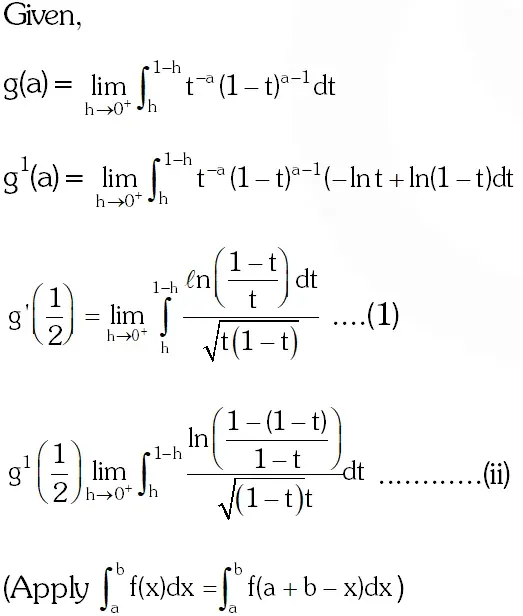
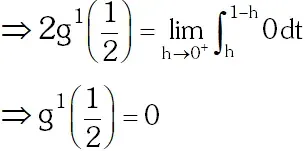
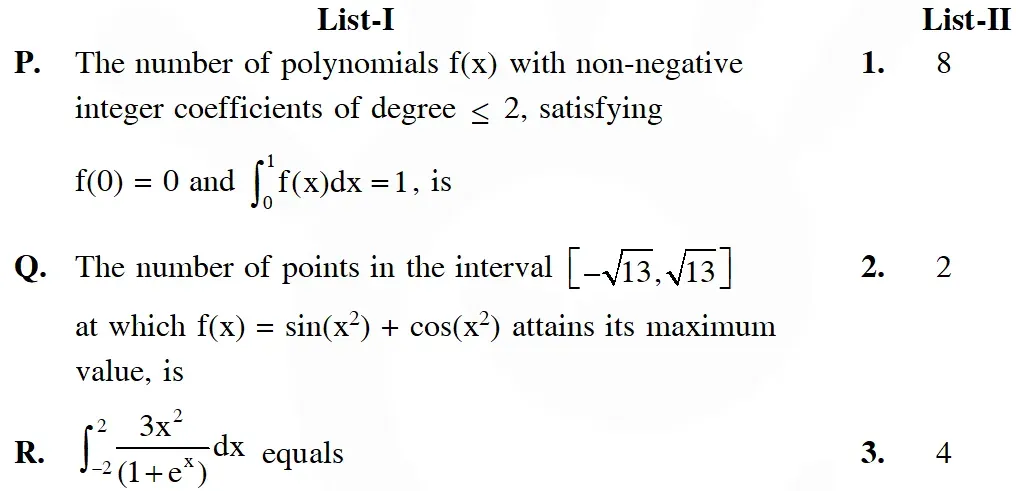
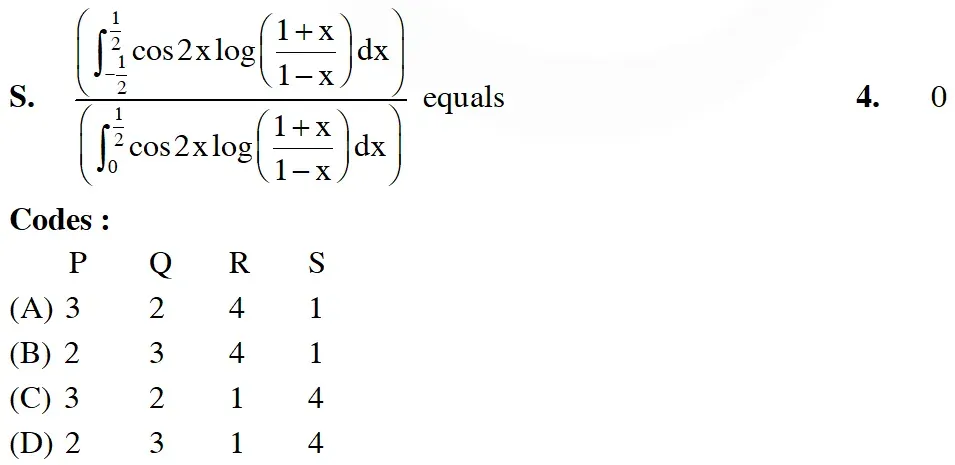
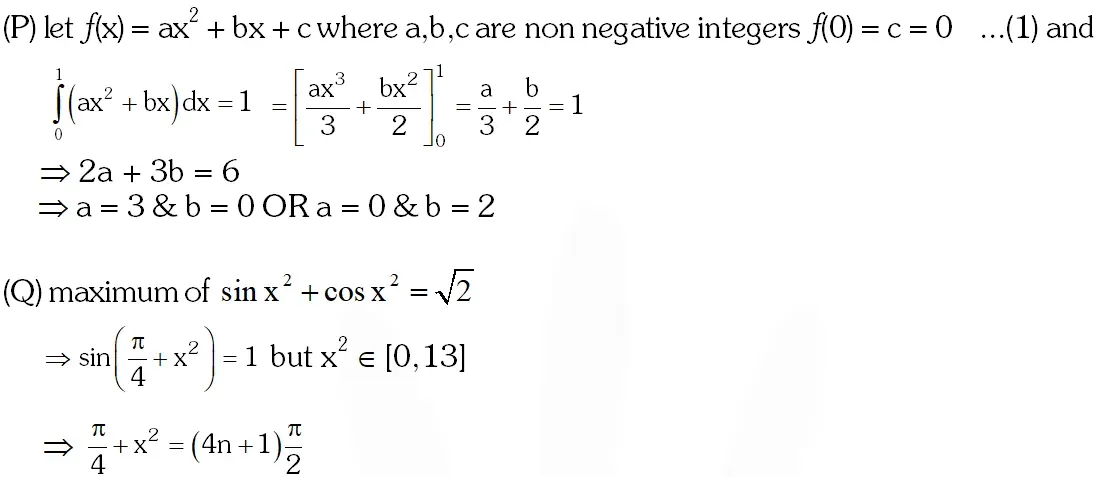
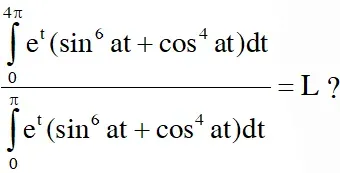
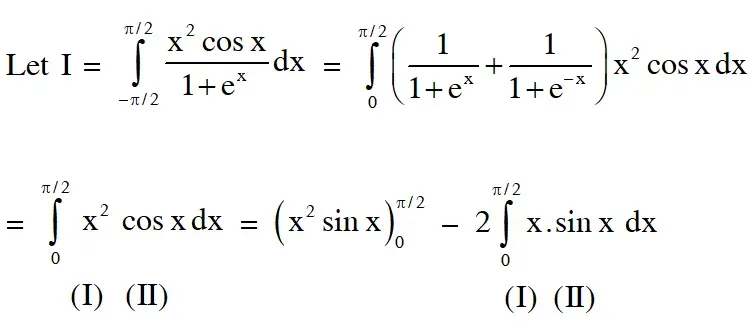
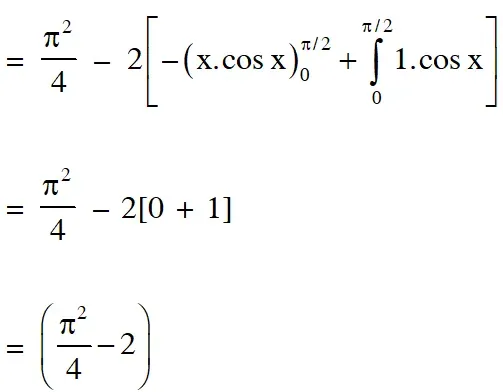
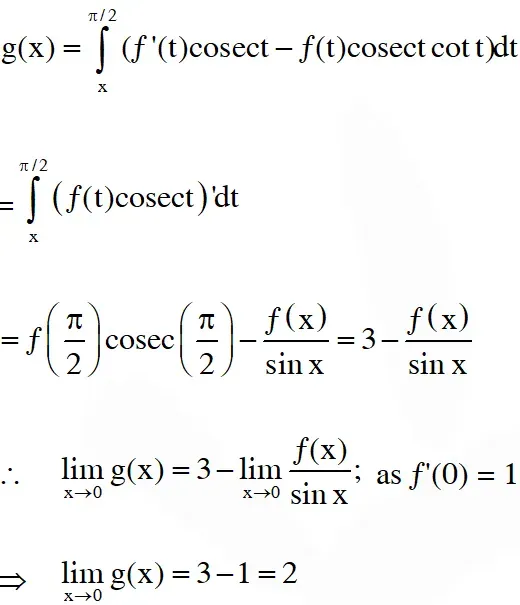
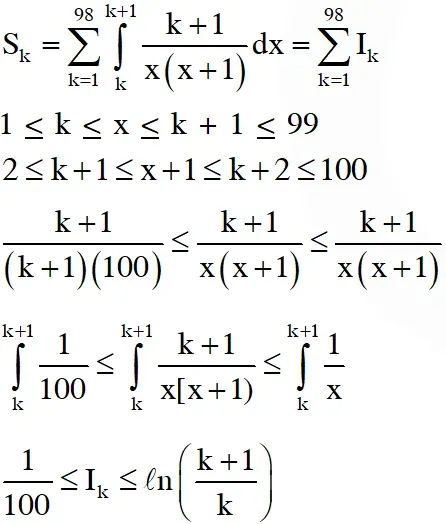
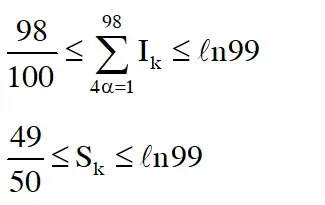
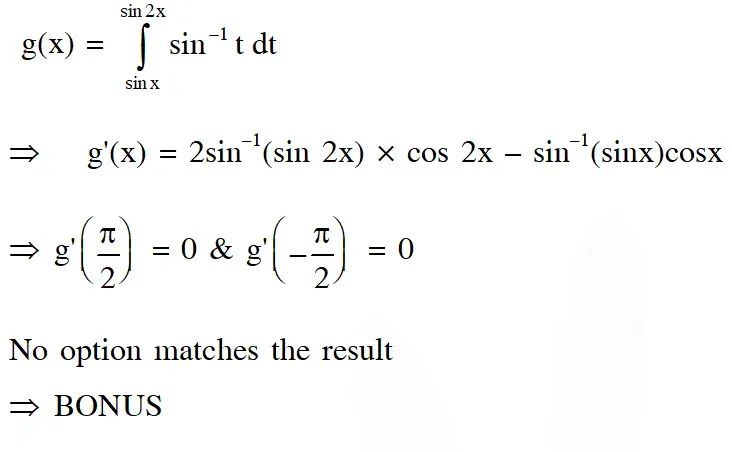
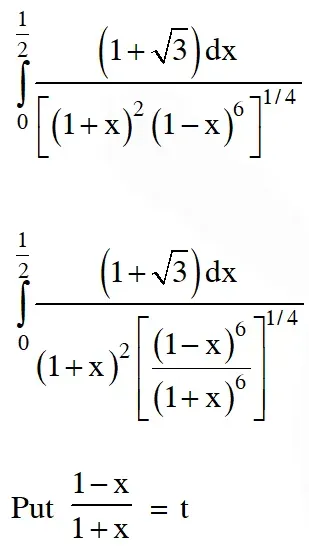
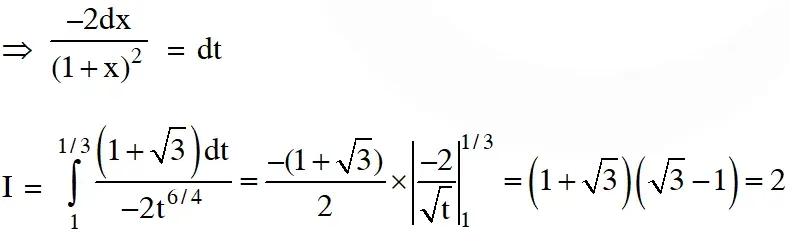
JEE Advanced Previous Year Questions of Math with Solutions are available at eSaral. Practicing JEE Advanced Previous Year Papers Questions of mathematics will help the JEE aspirants in realizing the question pattern as well as help in analyzing weak & strong areas. eSaral helps the students in clearing and understanding each topic in a better way. eSaral also provides complete chapter-wise notes of Class 11th and 12th both for all subjects. Besides this, eSaral also offers NCERT Solutions, Previous year questions for JEE Main and Advance, Practice questions, Test Series for JEE Main, JEE Advanced and NEET, Important questions of Physics, Chemistry, Math, and Biology and many more. Download eSaral app for free study material and video tutorials. [esquestion] Let ƒ be a non-negative function defined on the interval $[0,1] .$ If $\int_{0}^{x} \sqrt{1-\left(f^{\prime}(t)\right)^{2}} d t=\int_{0}^{x} f(t) d t$ $0 \leq \mathrm{x} \leq 1,$ and $f(0)=0,$ then $-$ (A) $f\left(\frac{1}{2}\right)<\frac{1}{2}$ and $f\left(\frac{1}{3}\right)>\frac{1}{3}$ (B) $f\left(\frac{1}{2}\right)>\frac{1}{2}$ and $f\left(\frac{1}{3}\right)>\frac{1}{3}$ (C) $f\left(\frac{1}{2}\right)<\frac{1}{2}$ and $f\left(\frac{1}{3}\right)<\frac{1}{3}$ (D) $f\left(\frac{1}{2}\right)>\frac{1}{2}$ and $f\left(\frac{1}{3}\right)<\frac{1}{3}$ #tag# [JEE 2009, 3] #sol# (C) $\int_{0}^{x} \sqrt{1-\left(f^{\prime}(t)\right)^{2}} \mathrm{d} t=\int_{0}^{x} f(t) d t, 0 \leq x \leq 1$ differentiating both the sides & squreing $\Rightarrow 1-\left(f^{\prime}(\mathrm{x})\right)^{2}=f^{2}(\mathrm{x})$ $\Rightarrow \frac{f^{\prime}(x)}{\sqrt{1-f^{2}(x)}}=1$ $\Rightarrow \sin ^{-1} f(\mathrm{x})=\mathrm{x}+\mathrm{c}$ $f(0)=0$ $\Rightarrow f(\mathrm{x})=\sin \mathrm{x}$ $\Rightarrow \because \sin \mathrm{x} \leq \mathrm{x}$ for $\mathrm{x} \in[0,1]$ $\Rightarrow f\left(\frac{1}{2}\right)<\frac{1}{2}$ and $f\left(\frac{1}{3}\right)<\frac{1}{3}$ [/esquestion] [esquestion] If $\mathrm{I}_{\mathrm{n}}=\int_{-\pi}^{\pi} \frac{\sin \mathrm{nx}}{\left(1+\pi^{\mathrm{x}}\right) \sin \mathrm{x}} \mathrm{d} \mathrm{x}, \mathrm{n}=0,1,2, \ldots, \mathrm{then}-$ (A) $\mathrm{I}_{\mathrm{n}}=\mathrm{I}_{\mathrm{n}+2}$ (B) $\sum_{\mathrm{m}=1}^{10} \mathrm{I}_{2 \mathrm{m}+1}=10 \pi$ (C) $\sum_{\mathrm{m}=1}^{10} \mathrm{I}_{2 \mathrm{m}}=0$ (D) $\mathrm{I}_{\mathrm{n}}=\mathrm{I}_{\mathrm{n}+1}$ #tag# [JEE 2009, 4] #sol# (A,B,D) $\mathrm{I}_{\mathrm{n}}=\int_{-\pi}^{\pi} \frac{\sin \mathrm{nx}}{\left(1+\pi^{\mathrm{x}}\right) \sin \mathrm{x}} \mathrm{dx}$ $\mathrm{I}_{\mathrm{n}}=\int_{-\pi}^{\pi} \frac{\pi^{\mathrm{x}} \sin \mathrm{nx}}{\left(1+\pi^{\mathrm{x}}\right) \sin \mathrm{x}} \mathrm{dx}$ $2 \mathrm{I}_{\mathrm{n}}=\int_{-\pi}^{\pi} \frac{\sin \mathrm{nx}}{\sin \mathrm{x}} \mathrm{dx}$ ..(i) $2 \mathrm{I}_{\mathrm{n}+2}=\int_{-\pi}^{\pi} \frac{\sin (\mathrm{n}+2) \mathrm{x}}{\sin \mathrm{x}} \mathrm{dx} \quad \ldots(\mathrm{i})$ (ii) – (i) $\Rightarrow 2\left(\ln _{+2}-\mathrm{I}_{\mathrm{n}}\right)=\int_{-\pi}^{\pi} \cos (\mathrm{n}+1) \mathrm{x}=0$ $\Rightarrow \quad \mathrm{I}_{\mathrm{n}+2}=\mathrm{I}_{\mathrm{n}}$ $\sum_{m=1}^{10} \mathrm{I}_{2 \mathrm{m}}=10 \sum_{\mathrm{m}=1}^{10} \mathrm{I}_{2}=\frac{10}{2} \int_{-\pi}^{\pi} \frac{\sin 2 \mathrm{x}}{\sin \mathrm{x}} \mathrm{d} \mathrm{x}=0$ Put n = 1 in equation (i) $2 \mathrm{I}_{1}=\int_{-\pi}^{\pi} \frac{\sin \mathrm{x} \mathrm{d} \mathrm{x}}{\sin \mathrm{x}}=2 \pi$ $\mathrm{I}_{1}=\pi$ $\sum_{m=1}^{10} I_{2 m+1}=10 \pi$ [/esquestion] [esquestion] Let $\mathrm{f}: \mathrm{R} \rightarrow \mathrm{R}$ be a continuous function which satisfies $\mathrm{f}(\mathrm{x})=\int_{0}^{\mathrm{x}} \mathrm{f}(\mathrm{t}) \mathrm{d} \mathrm{t}$ Then the value of f(ln 5) is........ #tag# [JEE 2009, 4] #sol# 0 $\mathrm{f}(\mathrm{x})=\int_{0}^{\mathrm{x}} \mathrm{f}(\mathrm{t}) \mathrm{dt}$ $\mathrm{f}^{\mathrm{l}}(\mathrm{x})=\mathrm{f}(\mathrm{x})$ $\frac{\mathrm{dy}}{\mathrm{dx}}=\mathrm{y}$ $\Rightarrow \int \frac{d y}{y}=\int d x$ $\Rightarrow \ln y=x+c$ $\Rightarrow y=e^{x+c}$ $\Rightarrow y=0$ $\left(\begin{array}{c}{\text { at } x=0, y=0} \\ {c \rightarrow-\infty}\end{array}\right)$ $f(x)=0$ $f(\ell n 5)=0$ [/esquestion] [esquestion] The value of $\lim _{x \rightarrow 0} \frac{1}{x^{3}} \int_{0}^{x} \frac{t \ell n(1+t)}{t^{4}+4} d t$ is (A) 0 (B) $\frac{1}{12}$ (C) $\frac{1}{24}$ (D) $\frac{1}{64}$ #tag# [JEE 2010, 3 (–1)] #sol# (B) Applying L-Hospital rule, [/esquestion] [esquestion] The value(s) of $\int_{0}^{1} \frac{\mathrm{x}^{4}(1-\mathrm{x})^{4}}{1+\mathrm{x}^{2}} \mathrm{dx}$ is (are) (A) $\frac{22}{7}-\pi$ (B) $\frac{2}{105}$ (C) 0 (D) $\frac{71}{15}-\frac{3 \pi}{2}$ #tag# [JEE 2010, 3] #sol# (A) [/esquestion] [esquestion] Let $f$ be a real-valued function defined on the interval $(-1,1)$ such that $e^{-x} f(x)=2+\int_{0}^{x} \sqrt{t^{4}+1} d t,$ for all $x \in(-1,1),$ and let $f^{-1}$ be the inverse function of $f$ Then $\left(f^{-1}\right)^{\prime}(2)$ is equal to- (A) 1 (B) $\frac{1}{3}$ (C) $\frac{1}{2}$ (D) $\frac{1}{\mathrm{e}}$ #tag# [JEE2010, 5 (–2)] #sol# (B) from $(2), f^{-1}(2)=\frac{1}{3}$ [/esquestion] [esquestion] For any real number x, let [x] denote the largest integer less than or equal to x. Let f be a real valued function defined on the interval [–10, 10] by $\mathrm{f}(\mathrm{x})=\left\{\begin{aligned} \mathrm{x}-[\mathrm{x}] & \text { if }[\mathrm{x}] \text { is odd } \\ 1+[\mathrm{x}]-\mathrm{x} & \text { if }[\mathrm{x}] \text { is even } \end{aligned}\right.$ Then the value of $\frac{\pi^{2}}{10} \int_{-10}^{10} \mathrm{f}(\mathrm{x}) \cos \pi \mathrm{x} \mathrm{d} \mathrm{x}$ is #tag# [JEE 2010, 3] #sol# 4 [/esquestion] [esquestion] The value of $\int_{\sqrt{\mathrm{in} 2}}^{\sqrt{\mathrm{n} 3}} \frac{\mathrm{x} \sin \mathrm{x}^{2}}{\sin \mathrm{x}^{2}+\sin \left(\mathrm{ln} 6-\mathrm{x}^{2}\right)} \mathrm{dx}$ is (A) $\frac{1}{4} \ln \frac{3}{2}$ (B) $\frac{1}{2} \ln \frac{3}{2}$ (C) $\ln \frac{3}{2}$ (D) $\frac{1}{6} \ln \frac{3}{2}$ #tag# [JEE 2011, 3 (–1)] #sol# (A) [/esquestion] [esquestion] Let $S$ be the area of the region enclosed by $y=e^{-x^{2}}, y=0, x=0,$ and $x=1 .$ Then (A) $\mathrm{S} \geq \frac{1}{\mathrm{e}}$ (B) $\mathrm{S} \geq 1-\frac{1}{\mathrm{e}}$ (C) $S \leq \frac{1}{4}\left(1+\frac{1}{\sqrt{\mathrm{e}}}\right)$ (D) $S \leq \frac{1}{\sqrt{2}}+\frac{1}{\sqrt{\mathrm{e}}}\left(1-\frac{1}{\sqrt{2}}\right)$ #tag# [JEE 2012, 4M] #sol# (A,B,D) [/esquestion] [esquestion] The value of the integral $\int_{-\pi / 2}^{\pi / 2}\left(\mathrm{x}^{2}+\ln \frac{\pi+\mathrm{x}}{\pi-\mathrm{x}}\right) \cos \mathrm{xd} \mathrm{x}$ is (A) 0 (B) $\frac{\pi^{2}}{2}-4$ (C) $\frac{\pi^{2}}{2}+4$ (D) $\frac{\pi^{2}}{2}$c #tag# [JEE 2012, 3M, –1M] #sol# (B) [/esquestion] [esquestion] For a $\in \mathrm{R}$ (the set of all real numbers), a\neq-1. $\lim _{n \rightarrow \infty} \frac{\left(1^{a}+2^{a}+\ldots \ldots+n^{a}\right)}{(n+1)^{a-1}[(n a+1)+(n a+2)+\ldots \ldots+(n a+n)]}=\frac{1}{60}$ Then $a=$ (A) 5 (B) 7 (C) $\frac{-15}{2}$ (D) $\frac{-17}{2}$ #tag# [JEE(Advanced) 2013, 3, (–1)] #sol# (B) [/esquestion] [esquestion] Let $f:[\mathrm{a}, \mathrm{b}] \rightarrow[1, \infty)$ be a continuous function and let $\mathrm{g}: \square \rightarrow \square$ be defined as Then (A) g(x) is continuous but not differentiable at a (B) g(x) is differentiable on (C) g(x) is continuous but not differentiable at b (D) g(x) is continuous and differentiable at either a or b but not both. #tag# [JEE(Advanced)-2014, 3] #sol# (A,C) [/esquestion] [esquestion] The value of $\int_{0}^{1} 4 x^{3}\left\{\frac{d^{2}}{d x^{2}}\left(1-x^{2}\right)^{5}\right\} d x$ is #tag# [JEE(Advanced)-2014, 3] #sol# 2 [/esquestion] [esquestion] The following integral $\int_{\frac{\pi}{4}}^{\frac{\pi}{2}}(2 \csc x)^{17} d x$ is equal to (A) $\int_{0}^{\log (1+\sqrt{2})} 2\left(e^{\mathfrak{u}}+e^{-\mathfrak{u}}\right)^{16} \mathrm{d} \mathfrak{u}$ (B) $\int_{0}^{\log (1+\sqrt{2})}\left(\mathrm{e}^{\mathrm{u}}+\mathrm{e}^{-\mathrm{u}}\right)^{17} \mathrm{du}$ (C) $\int_{0}^{\log (1+\sqrt{2})}\left(e^{\mathfrak{u}}-e^{-\mathfrak{u}}\right)^{17} \mathrm{d} \mathfrak{u}$ (D) $\int_{0}^{\log (1+\sqrt{2})} 2\left(e^{\mathfrak{u}}-e^{-\mathfrak{u}}\right)^{16} d \mathfrak{u}$ #tag# [JEE(Advanced)-2014, 3(–1)] #sol# (A) [/esquestion] [esquestion] Let $f:[0,2] \rightarrow \square$ be a function which is continuous on $[0,2]$ and is differentiable on $(0,2)$ with $f(0)=1 .$ Let $F(x)=\int_{0}^{x^{2}} f(\sqrt{t}) d t$ for $x \in[0,2] .$ If $F^{\prime}(x)=f^{\prime}(x)$ for all $x \in(0,2)$ then $F(2)$ equals $-$ (A) $\mathrm{e}^{2}-1$ (B) $\mathrm{e}^{4}-1$ (C) e – 1 (D) e $^{4}$ #tag# [JEE(Advanced)-2014, 3(–1)] #sol# (B) [/esquestion] Given that for each a $\in(0,1)$, $\lim _{\mathrm{h} \rightarrow 0^{+}} \int_{\mathrm{h}}^{1-\mathrm{h}} \mathrm{t}^{-\mathrm{a}}(1-\mathrm{t})^{\mathrm{a}-1}$ $\mathrm{dt}$ exists. Let this limit be g(a). In addition, it is given that the function g(a) is differentiable on (0,1). [esquestion] The value of $\mathrm{g}\left(\frac{1}{2}\right)$ is – (A) $\pi$ (B) $2 \pi$ (C) $\frac{\pi}{2}$ (D) $\frac{\pi}{4}$ #tag# [JEE(Advanced)-2014, 3(–1)] #sol# (A) [/esquestion] [esquestion] The value of $\mathrm{g}^{\prime}\left(\frac{1}{2}\right)$ is- (A) $\frac{\pi}{2}$ (B) $\pi$ (C) $-\frac{\pi}{2}$ (D) 0 #tag# [JEE(Advanced)-2014, 3(–1)] #sol# (D) [/esquestion] [esquestion] #tag# [JEE(Advanced)-2014, 3(–1)] #sol# (C) [/esquestion] [esquestion] Let $f: \square \rightarrow \square$ be a function defined by $f(x)$ $=\left\{\begin{array}{ccc}{[\mathrm{x}]} & {,} & {\mathrm{x} \leq 2} \\ {0} & {,} & {\mathrm{x}>2}\end{array}\right.$ where [x] is the greatest integer less than or equal to x. If $\mathrm{I}=\int_{-1}^{2} \frac{\mathrm{x} f\left(\mathrm{x}^{2}\right)}{2+f(\mathrm{x}+1)} \mathrm{dx}$ , then the value of (4I – 1) is #tag# [JEE 2015, 4M, –0M] #sol# (A) [/esquestion] [esquestion] If $\alpha=\int_{0}^{1}\left(\mathrm{e}^{9 \mathrm{x}+3 \tan ^{-1} \mathrm{x}}\right)\left(\frac{12+9 \mathrm{x}^{2}}{1+\mathrm{x}^{2}}\right) \mathrm{d} \mathrm{x}$ where $\tan ^{-1} \mathrm{x}$ takes only principal values, then the value of $\left(\log _{\mathrm{e}}|1+\alpha|-\frac{3 \pi}{4}\right)$ is #tag# [JEE 2015, 4M, –0M] #sol# 0 [/esquestion] [esquestion] Let $f: \mathbb{U} \rightarrow \square$ be a continuous odd function, which vanishes exactly at one point and $f(1)=\frac{1}{2}$ Suppose that $\mathrm{F}(\mathrm{x})=\int_{-1}^{\mathrm{x}} f(\mathrm{t}) \mathrm{dt}$ for all $\mathrm{x} \in[-1,2]$ and $\mathrm{G}(\mathrm{x})$ $=\int_{-1}^{x} \mathfrak{t}|f(f(\mathfrak{t}))| d \mathfrak{t}$ for all $x \in[-1,2]$. If $\lim _{x \rightarrow 1} \frac{F(x)}{G(x)}=\frac{1}{14},$ then the value of $f\left(\frac{1}{2}\right)$ is #tag# [JEE 2015, 4M, –0M] #sol# 9 [/esquestion] [esquestion] The option(s) with the values of a and L that satisfy the following equation is(are) (A) $a=2, L=\frac{e^{4 \pi}-1}{e^{\pi}-1}$ (B) $a=2, L=\frac{e^{4 \pi}+1}{e^{\pi}+1}$c (C) $a=4, L=\frac{e^{4 \pi}-1}{e^{\pi}-1}$ (D) $a=4, L=\frac{e^{4 \pi}+1}{e^{\pi}+1}$ #tag# [JEE 2015, 4M, –0M] #sol# 7 [/esquestion] [esquestion] Let $f(\mathrm{x})=7 \tan ^{8} \mathrm{x}+7 \tan ^{6} \mathrm{x}-3 \tan ^{4} \mathrm{x}-3 \tan ^{2} \mathrm{x}$ for all $\mathrm{x} \in\left(-\frac{\pi}{2}, \frac{\pi}{2}\right) .$ Then the correct expression(s)is(are) (A) $\int_{0}^{\pi / 4} \mathrm{x} f(\mathrm{x}) \mathrm{d} \mathrm{x}=\frac{1}{12}$ (B) $\int_{0}^{\pi / 4} f(\mathrm{x}) \mathrm{d} \mathrm{x}=0$ (C) $\int_{0}^{\pi / 4} \mathrm{x} f(\mathrm{x}) \mathrm{d} \mathrm{x}=\frac{1}{6}$ (D) $\int_{0}^{\pi / 4} f(\mathrm{x}) \mathrm{d} \mathrm{x}=1$ #tag# [JEE 2015, 4M, –0M] #sol# (A,C) [/esquestion] [esquestion] Let $f^{\prime}(x)=\frac{192 x^{3}}{2+\sin ^{4} \pi x}$ for all $\mathrm{x} \in \square$ with $f$ $\left(\frac{1}{2}\right)$ $=0 .$ If $\mathrm{m} \leq \int_{1 / 2}^{1} f(\mathrm{x}) \mathrm{d} \mathrm{x} \leq \mathrm{M}$ then the possible values of m and M are (A) m = 13, M = 24 (B) $\quad \mathrm{m}=\frac{1}{4}, \mathrm{M}=\frac{1}{2}$ (C) m = –11, M = 0 (D) m = 1, M = 12 #tag# [JEE 2015, 4M, –0M] #sol# (A,B) [/esquestion] Let $\mathrm{F}: \mathbb{U} \rightarrow \square$ be a thrice differentiable function. Suppose that $\mathrm{F}(1)=0, \mathrm{F}(3)=-4 \mathrm{F}^{\prime}(\mathrm{x})<$ 0 for all $\mathrm{x} \in(1 / 2,3) .$ Let $f(\mathrm{x})=\mathrm{xF}(\mathrm{x})$ for all $\mathrm{x} \in \mathbb{D}$. [esquestion] The correct statement(s) is(are) (A) $f^{\prime}(1)<0$ (B) $f(2)<0$ (C) $f^{\prime}(\mathrm{x}) \neq 0$ for any $\mathrm{x} \in(1,3)$ (D) $f^{\prime}(x)=0$ for some $x \in(1,3)$ #tag# [JEE 2015, 4M, –0M] #sol# (D) [/esquestion] [esquestion] If $\int_{1}^{3} \mathrm{x}^{2} \mathrm{F}^{\prime}(\mathrm{x}) \mathrm{d} \mathrm{x}=-12$ and $\int_{1}^{3} \mathrm{x}^{3} \mathrm{F}^{\prime \prime}(\mathrm{x}) \mathrm{d} \mathrm{x}=40,$ then the correct expression(s) is (are) (A) 9ƒ'(3) + ƒ'(1) – 32 = 0 (B) $\int_{1}^{3} f(\mathrm{x}) \mathrm{d} \mathrm{x}=12$ (C) 9ƒ'(3) – ƒ'(1) + 32 = 0 (D) $\left.\int_{1}^{3} f(x) d x=-12\right]$ #tag# [JEE 2015, 4M, –0M] #sol# (A,B,C) [/esquestion] [esquestion] The value of $\int_{-\frac{\pi}{2}}^{\frac{\pi}{2}} \frac{x^{2} \cos x}{1+e^{x}} d x$ is equal to (A) $\frac{\pi^{2}}{4}-2$ (B) $\frac{\pi^{2}}{4}+2$ (C) $\pi^{2}-\mathrm{e}^{\frac{\pi}{2}}$ (D) $\pi^{2}+\mathrm{e}^{\frac{\pi}{2}}$ #tag# [JEE(Advanced)2016] #sol# (C,D) [/esquestion] [esquestion] Let $\mathrm{f}: \mathrm{R} \rightarrow \mathrm{R}$ be a differentiable function such that $\mathrm{f}(0)=0, \mathrm{f}\left(\frac{\pi}{2}\right)=3$ and $\mathrm{f}^{\prime}(0)=1$ If $\mathrm{g}(\mathrm{x})=\int_{\mathrm{x}}^{\frac{\pi}{2}}\left[\mathrm{f}^{\prime}(\mathrm{t}) \csc \mathrm{t}-\cot t \csc \mathrm{t} \mathrm{f}(\mathrm{t})\right] \mathrm{d} \mathrm{t}$ for $\mathrm{x} \in\left(0, \frac{\pi}{2}\right],$ then $\lim _{\mathrm{x} \rightarrow 0} \mathrm{g}(\mathrm{x})=$ #tag# [JEE(Advanced)-2017] #sol# 2 [/esquestion] [esquestion] If $\mathrm{I}=\sum_{\mathrm{k}=1}^{98} \int_{\mathrm{k}}^{\mathrm{k}+1} \frac{\mathrm{k}+1}{\mathrm{x}(\mathrm{x}+1)} \mathrm{d} \mathrm{x},$ then (A) $\mathrm{I}<\frac{49}{50}$ (B) $\mathrm{I}<\log _{\mathrm{e}} 99$ (C) $\mathrm{I}>\frac{49}{50}$ (D) $\mathrm{I}>\log _{\mathrm{e}} 99$ #tag# [JEE(Advanced)-2017] #sol# (B,C) [/esquestion] [esquestion] If $\mathrm{g}(\mathrm{x})=\int_{\sin \mathrm{x}}^{\sin (2 \mathrm{x})} \sin ^{-1}(\mathrm{t}) \mathrm{dt},$ then (A) $\mathrm{g}^{\prime}\left(\frac{\pi}{2}\right)=-2 \pi$ (B) $\mathrm{g}^{\prime}\left(-\frac{\pi}{2}\right)=2 \pi$ (C) $\mathrm{g}^{\prime}\left(\frac{\pi}{2}\right)=2 \pi$ (D) $\mathrm{g}^{\prime}\left(-\frac{\pi}{2}\right)=-2 \pi$ #tag# [JEE(Advanced)-2017] #sol# (Bonus) [/esquestion] [esquestion] The value of the integral $\int_{0}^{\frac{1}{2}} \frac{1+\sqrt{3}}{\left((x+1)^{2}(1-x)^{6}\right)^{\frac{1}{4}}} d x$ is #tag# [JEE(Advanced)-2018] #sol# 2 [/esquestion]



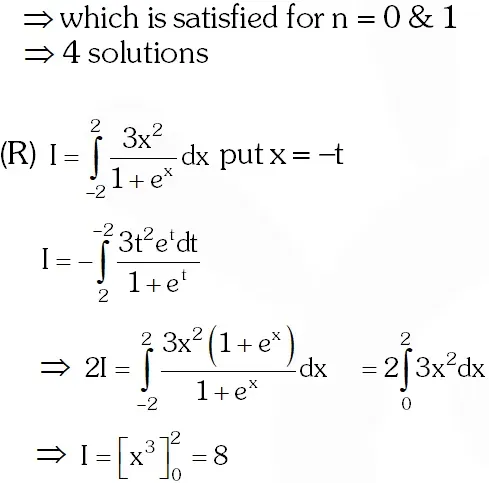
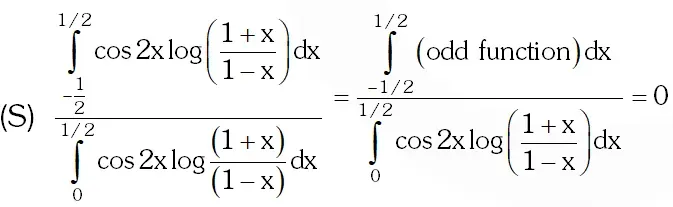
Definite Integration - JEE Advanced PYQs (Maths) is one part of the full paper, so explore the wider question mix in the JEE Advanced PYQ archive.
Frequently Asked Questions
What is the Leibniz rule and how is it tested in JEE Advanced?
The Leibniz rule states: $\frac{d}{dx}\int_{a(x)}^{b(x)} f(t,x)\,dt = f(b(x),x)\cdot b'(x) - f(a(x),x)\cdot a'(x) + \int_{a(x)}^{b(x)} \frac{\partial f}{\partial x}\,dt$. In JEE Advanced, it most commonly appears in its simpler form — differentiating an integral with a variable upper limit — as seen in Q1 (2009), Q6 (2010), and Q15 (2014). Practice identifying when to apply it immediately after reading a question.
Is the King's property (symmetric substitution) important for JEE Advanced?
Yes, King's property — $\int_a^b f(x)\,dx = \int_a^b f(a+b-x)\,dx$ — is one of the most tested techniques in JEE Advanced Definite Integration. It appeared directly in the 2011 question ($\int_{\sqrt{\ln 2}}^{\sqrt{\ln 3}}$) and implicitly in multiple 2009 and 2014 questions. Mastering this single property can unlock 2–3 questions per exam.
How many questions from Definite Integration appear in JEE Advanced each year?
Typically 2–4 questions appear in JEE Advanced from Definite Integration each year, carrying 3–5 marks each. The exact count varies, but Calculus as a whole — including definite and indefinite integration — contributes roughly 30–35% of the Mathematics paper. You can verify the official syllabus on the JEE Advanced official website.
How are Definite Integration questions different in JEE Advanced vs JEE Main?
JEE Main questions test primarily computation — applying standard formulas and properties with straightforward functions. JEE Advanced questions test multi-step reasoning: a single problem may require you to apply a property, derive a differential equation, solve it, and then use the result to answer an inequality. JEE Advanced also uses multi-correct and paragraph-based formats that have no equivalent in JEE Main.
What is the most difficult type of Definite Integration question in JEE Advanced?
Integer-type and multi-correct questions involving both Leibniz differentiation and ODE-solving (as in Q1, 2009 and Q15, 2014) are consistently rated the hardest by students. These require identifying the right technique, executing the derivative, solving the resulting ODE, applying initial conditions, and then comparing values — five distinct sub-steps where an error at any point costs the full mark.
Can I solve JEE Advanced Definite Integration questions without knowing Indefinite Integration well?
No. Definite Integration builds directly on Indefinite Integration — you need to evaluate antiderivatives to apply the Fundamental Theorem of Calculus. However, many JEE Advanced questions are designed so that properties (odd/even, symmetry, limit-sum) allow you to avoid computing an antiderivative entirely. Both skill sets are necessary. Start with NCERT Solutions for Class 12 Maths if your fundamentals need reinforcement
Team eSaral
eSaral Academic and Editorial Team
Team eSaral is the collective author profile for educational content created by eSaral’s teachers and academic contributors. The team draws on expertise from IIT graduates, doctors, experienced educators and subject specialists to develop resources for JEE, NEET and school students. Our articles aim to explain concepts clearly and help students study with confidence.
Related Posts

BITSAT 2027: Registration Date, Exam Date, Syllabus, Eligibility, Pattern & Fees
BITSAT 2027 exam dates, registration timeline, eligibility criteria, exam pattern, marking scheme, syllabus and fees in one page.

BITSAT Previous Year Question Paper PDF (2017-2026)
Download BITSAT previous year question papers PDF from 2017 to 2026,session-wise. Memory-based papers,exam pattern, paper analysis and how to practise

CBSE Class 10 Date Sheet 2027: Expected Exam Dates, Release Date, Admit Card & Result Timeline
CBSE Class 10 date sheet 2027 is awaited. See the expected exam dates, release window, how to download the PDF, admit card and result timelines.

NCERT Physics Class 10 Book PDF in Hindi 2026-27 – भौतिक विज्ञान के 4 अध्याय (Free Download)
NCERT Physics Class 10 book PDF in Hindi 2026-27: download all 4 chapters (अध्याय 9–12) free, with topics and important formulas.

NCERT Biology Class 9 Book Anveshan PDF in Hindi - जीव विज्ञान कक्षा 9 पुस्तक अन्वेषण PDF
Download NCERT Biology Class 9 book PDF in Hindi chapterwise for 2026-27: Cell, Tissues, Reproduction and Diversity. Free PDFs.

Essay On Artificial Intelligence in English (100,150, 200, 250, 300, 500 Words)
This is in contrast to the natural intelligence of humans. With Artificial Intelligence, machines can perform

Essay on 78th India Independence Day in English for Student (100, 150, 200, 250, 300, 500 Words)
Read the best essays on India's Independence Day in English. Short & long essays (100, 150, 200, 250, 300, 500 words) perfect for school exams
NCERT Class 11 English Snapshots book - Free PDF download- Esaral
Download NCERT Class 11 English Snapshots book PDF for free. Get all 8 chapters, chapter-wise. Start your prep today!
NCERT Class 10 biology book pdf - Free PDF Download - eSaral
NCERT Class 10 Biology book PDF 2026-27: all 5 chapters (Life Processes to Our Environment) in English & Hindi, with CBSE syllabus, marks & practical

Essay on Global Warming in English (100,150, 200, 250, 300, 500 Words)
Global warming means the Earth is getting hotter. This happens because of things like pollution from cars and factories.