
Electrochemistry Notes for Class 12, JEE and NEET: Nernst Equation, Conductance, Electrolysis and Batteries

eSaral Academic and Editorial Team
Summary
Electrochemistry Notes for Class 12 cover electrochemical cells, standard electrode potentials, the Nernst equation, the link between EMF and Gibbs energy, conductance and Kohlrausch’s law, electrolysis and Faraday’s laws, batteries, fuel cells and corrosion. This page gives key formulas, solved examples and handwritten notes for CBSE boards, JEE Main and NEET.

Electrochemistry connects chemical reactions with electricity. In the current NCERT Class 12 Chemistry book, it is Unit 2 of 10 (it was Chapter 3 in older books), and it needs the mole concept and the ideas of oxidation and reduction. These Electrochemistry Notes for Class 12 start with the cell basics and then move to the calculations that exams ask.

India's Best Exam Preparation for Class 12th - Download Now
Electrochemistry Notes for Class 12: Chapter Overview and Syllabus
The chapter covers:
- Redox reactions, galvanic cells and electrolytic cells
- Electrode potential, standard electrode potential and the electrochemical series
- EMF of a cell, the Nernst equation, and the relation of EMF with Gibbs energy and the equilibrium constant
- Conductance, conductivity, molar conductivity and Kohlrausch’s law
- Electrolysis, Faraday’s laws and the products of electrolysis
- Batteries (dry cell and lead accumulator), fuel cells and corrosion
Check the latest CBSE syllabus for the exact list of topics for boards, and the NTA and NMC syllabi for JEE Main and NEET.
What Do Boards, JEE and NEET Ask from Electrochemistry Notes for Class 12?
Exam | Typical focus |
|---|---|
CBSE boards | Cell notation, Nernst equation numericals, ΔG and EMF, conductivity, Kohlrausch’s law, Faraday’s laws, batteries, corrosion |
JEE Main | Standard potentials, EMF and the Nernst equation, ΔG–EMF relation, conductance and Kohlrausch’s law, electrolysis numericals |
NEET | Concept-based questions on galvanic and electrolytic cells, Faraday’s laws, conductivity and batteries, with some numericals |
The number of questions varies each year, so check previous years’ papers.
Tip from the eSaral Chemistry team: Learn the sign rules for E°cell and ΔG once, and then write them at the top of your rough work. Most mistakes in Electrochemistry numericals come from the sign of the electrode potential or from using the wrong n.
Electrochemistry Notes for Class 12
India's Best Exam Preparation for Class 12th - Download Now
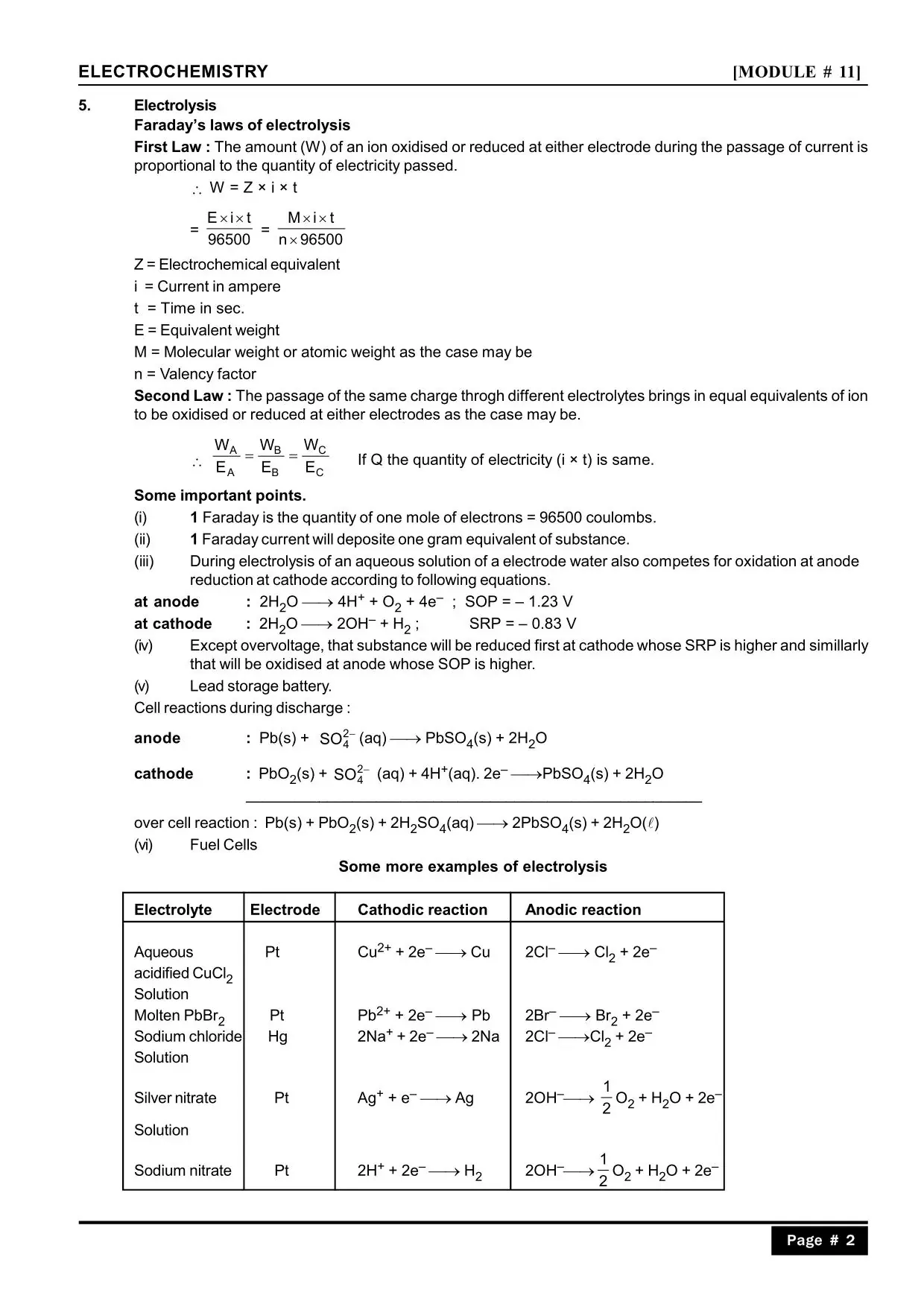
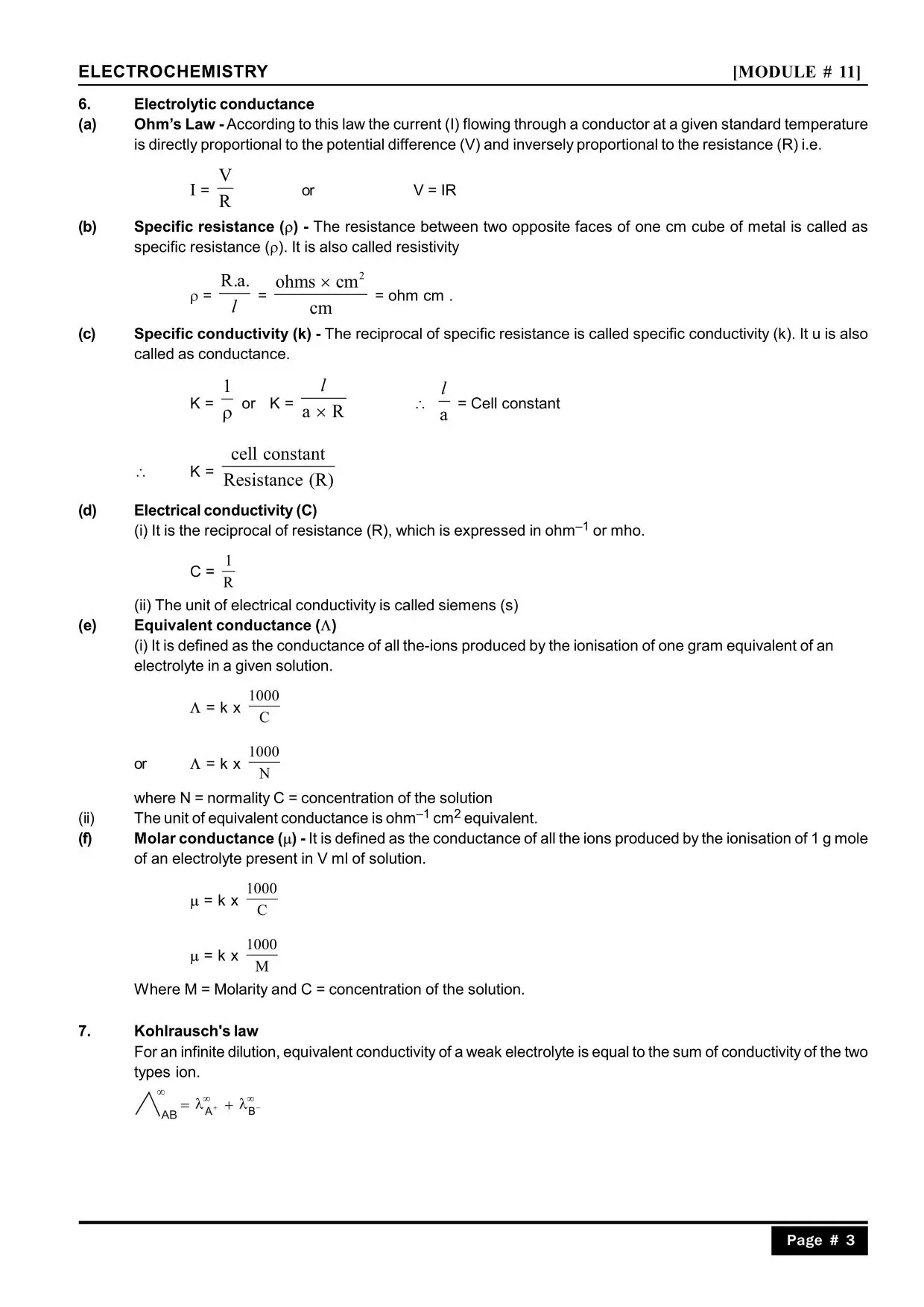
India's Best Exam Preparation for Class 12th - Download Now
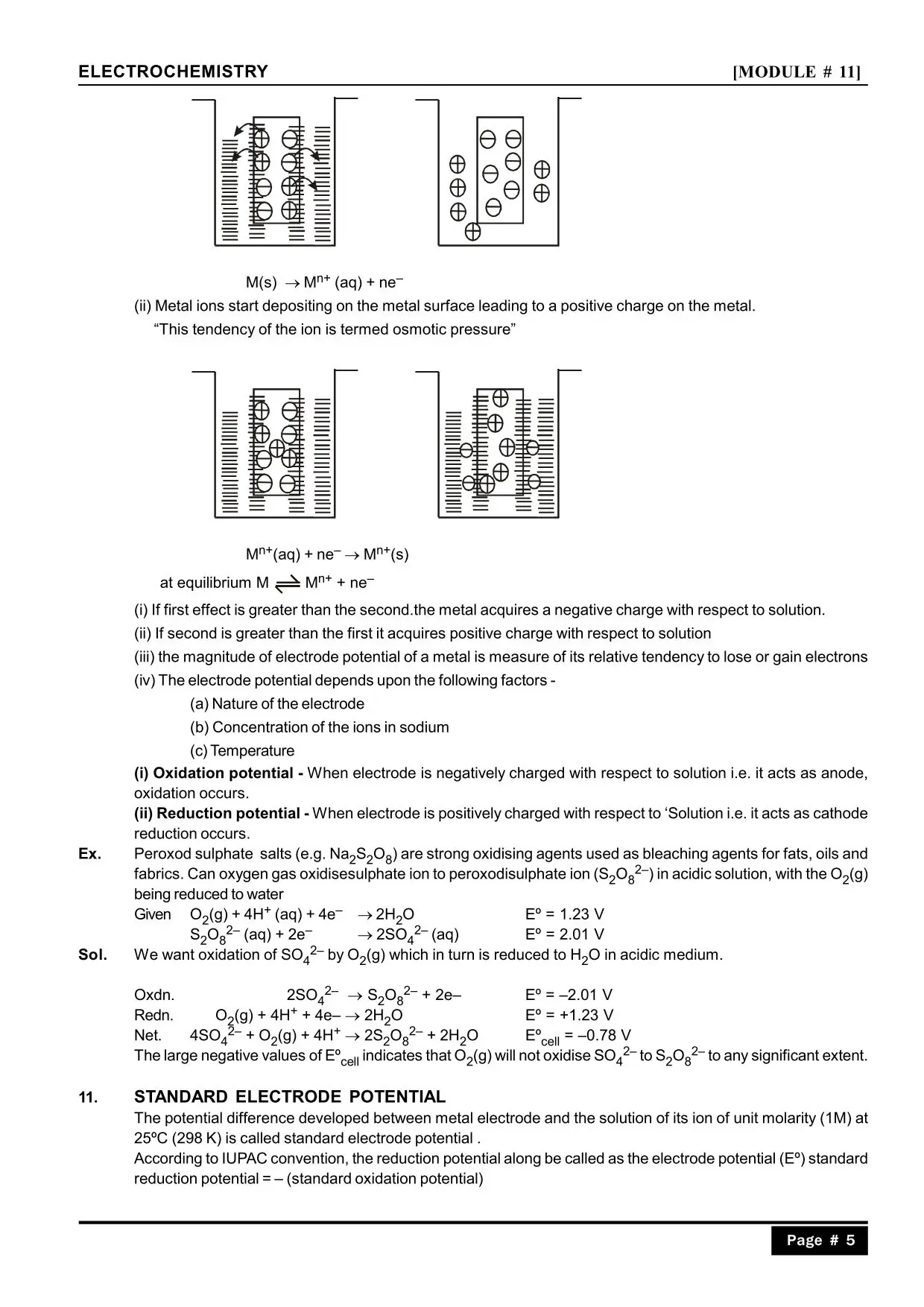
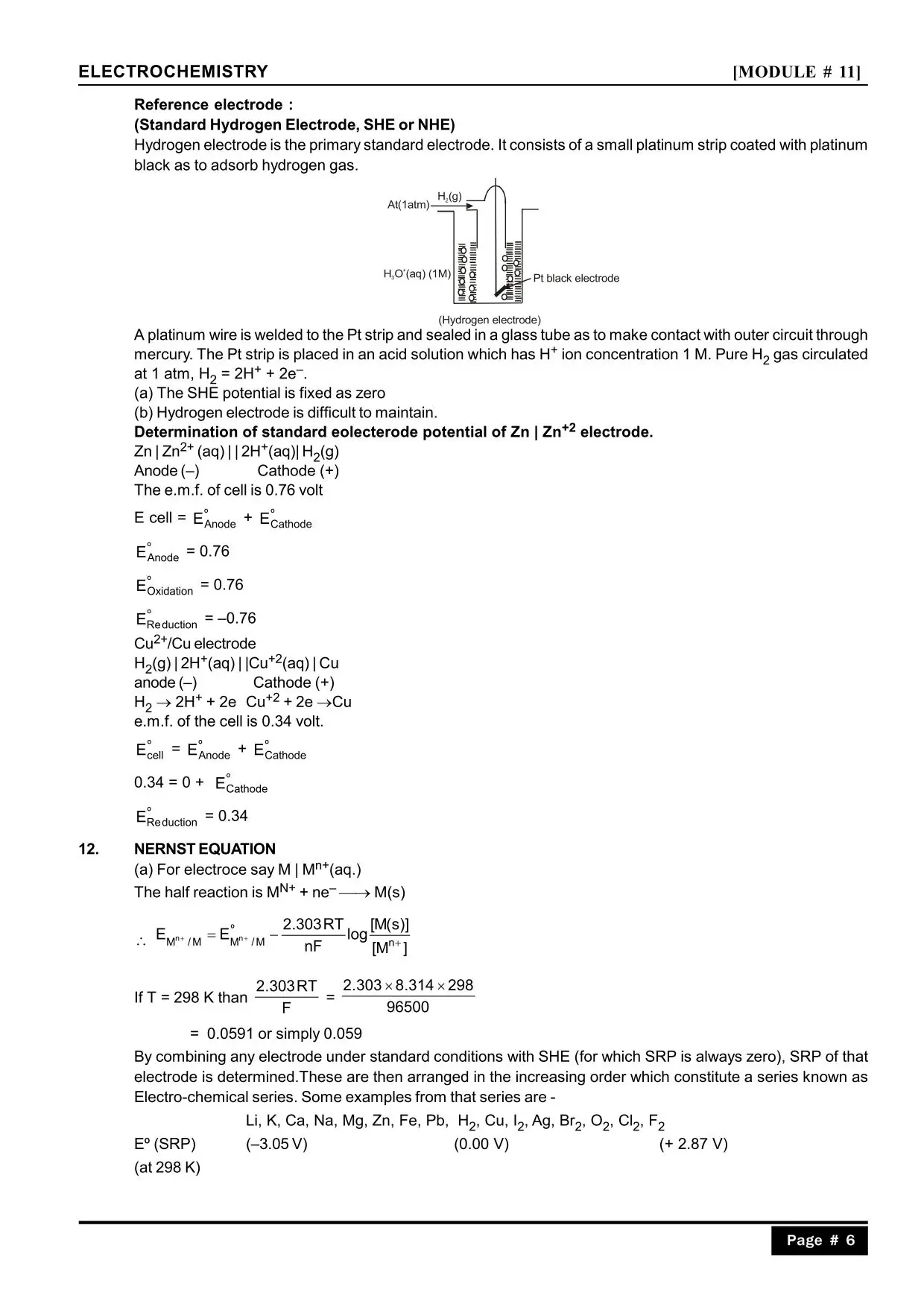
India's Best Exam Preparation for Class 12th - Download Now
India's Best Exam Preparation for Class 12th - Download Now
Galvanic and Electrolytic Cells in Electrochemistry Notes for Class 12
Feature | Galvanic (voltaic) cell | Electrolytic cell |
|---|---|---|
Energy change | Chemical energy → electrical energy | Electrical energy → chemical energy |
Reaction | Spontaneous | Non-spontaneous (driven by an external source) |
Anode | Negative, where oxidation occurs | Positive, where oxidation occurs |
Cathode | Positive, where reduction occurs | Negative, where reduction occurs |
Example | Daniell cell | Electrolysis of molten NaCl |
In both cells, oxidation occurs at the anode and reduction at the cathode. In a galvanic cell, electrons flow from the anode to the cathode through the external wire.
Cell notation (Daniell cell): Zn(s) | Zn²⁺(aq) || Cu²⁺(aq) | Cu(s). The anode is written on the left, and the cathode on the right.
Standard Electrode Potentials and the Electrochemical Series in Electrochemistry Notes for Class 12
The standard electrode potential (E°) is measured against the standard hydrogen electrode (SHE, E° = 0 V) at 298 K, with 1 M concentration and 1 bar pressure. The values below are reduction potentials.
Half-reaction | E° (V) |
|---|---|
Li⁺ + e⁻ → Li | −3.05 |
K⁺ + e⁻ → K | −2.93 |
Ca²⁺ + 2e⁻ → Ca | −2.87 |
Na⁺ + e⁻ → Na | −2.71 |
Mg²⁺ + 2e⁻ → Mg | −2.36 |
Al³⁺ + 3e⁻ → Al | −1.66 |
Zn²⁺ + 2e⁻ → Zn | −0.76 |
Fe²⁺ + 2e⁻ → Fe | −0.44 |
2H⁺ + 2e⁻ → H₂ | 0.00 |
Cu²⁺ + 2e⁻ → Cu | +0.34 |
Ag⁺ + e⁻ → Ag | +0.80 |
Cl₂ + 2e⁻ → 2Cl⁻ | +1.36 |
F₂ + 2e⁻ → 2F⁻ | +2.87 |
A metal with a more negative E° is a stronger reducing agent, and a species with a more positive E° is a stronger oxidising agent. A reaction is spontaneous when E°cell is positive.
EMF, Gibbs Energy and the Nernst Equation in Electrochemistry Notes for Class 12
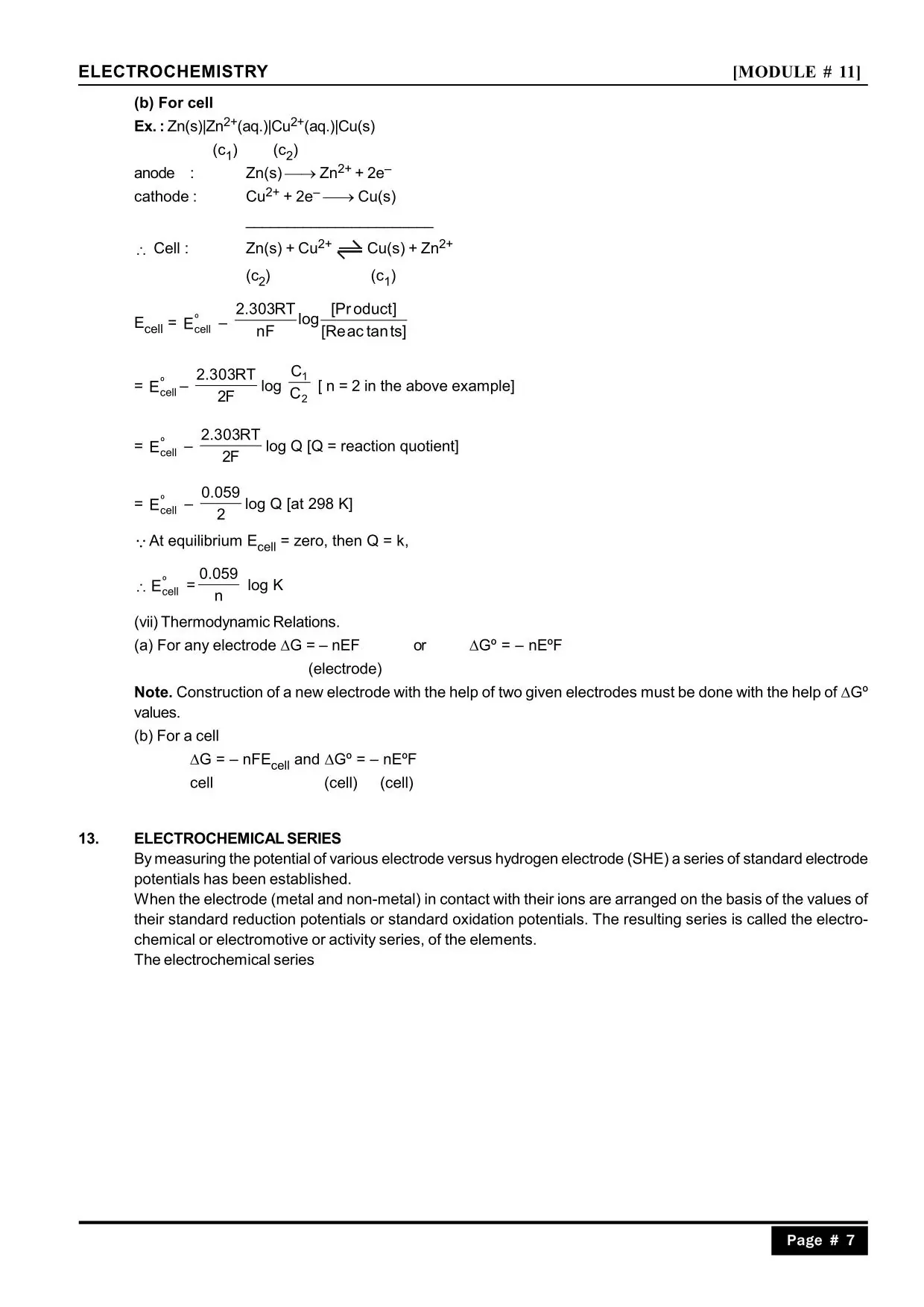
- EMF of a cell: E°cell = E°cathode − E°anode.
- Gibbs energy: ΔG° = −nFE°cell, and ΔG = −nFE.
- Equilibrium constant: E°cell = (0.0592/n) log K at 298 K.
- Nernst equation: E = E° − (0.0592/n) log Q at 298 K, where Q is the reaction quotient. At equilibrium, Q = K and E = 0.
Use n as the number of electrons that are transferred in the balanced cell reaction, and F = 96,500 C/mol.
Conductance and Kohlrausch’s Law in Electrochemistry Notes for Class 12
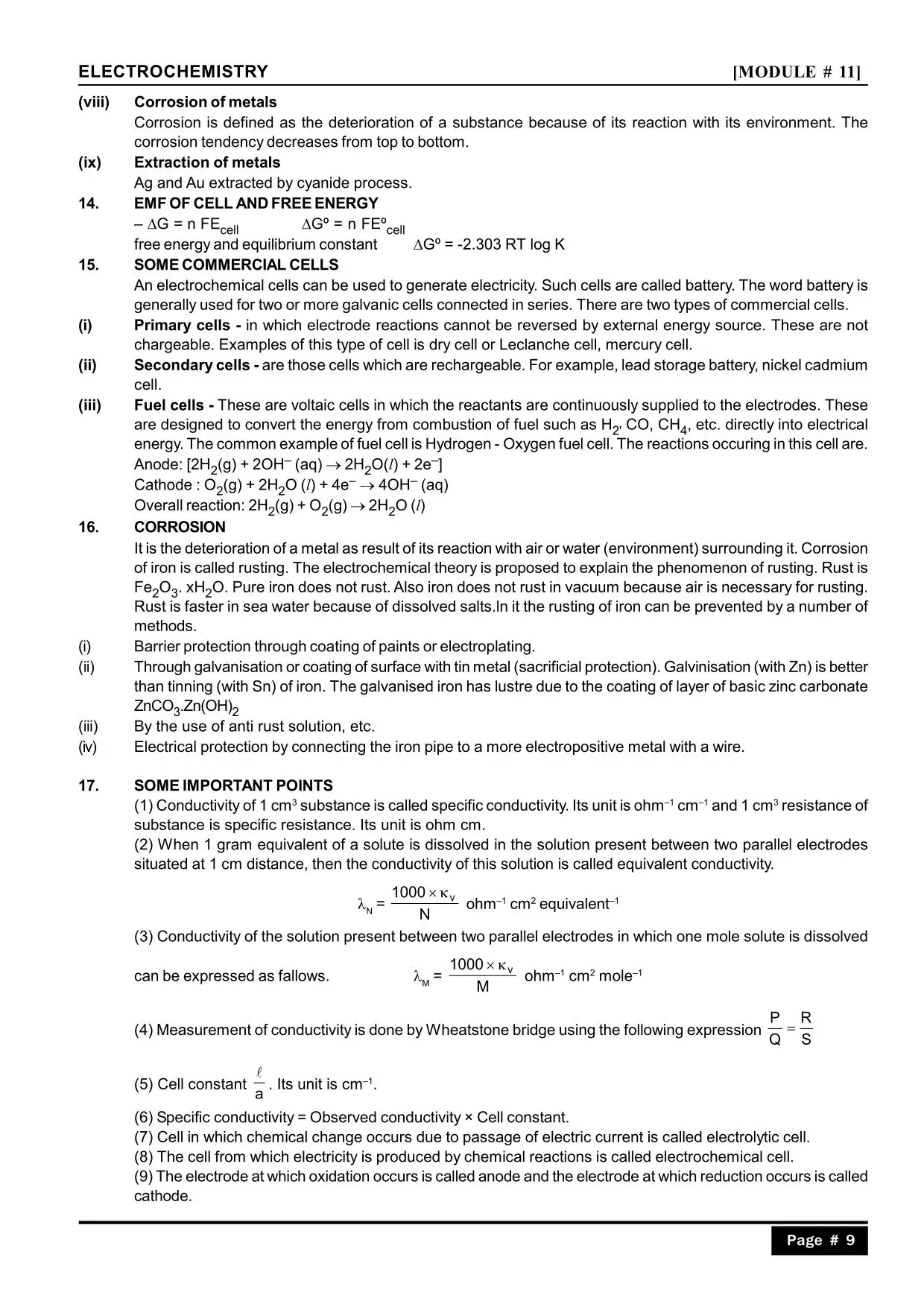
- Conductance: G = 1/R, with the unit siemens (S).
- Conductivity (κ): κ = G × (l/A), where l/A is the cell constant.
- Molar conductivity: Λm = κ × 1000/M, where κ is in S cm⁻¹, M is the molarity in mol/L and Λm is in S cm² mol⁻¹.
- Variation with dilution: conductivity decreases on dilution, but molar conductivity increases, because the number of ions per mole rises (and, for a weak electrolyte, the degree of dissociation increases).
- Strong electrolytes: Λm = Λ°m − A√c, and Λ°m can be found by extrapolation.
- Kohlrausch’s law: at infinite dilution, each ion contributes independently, so Λ°m = ν₊λ°₊ + ν₋λ°₋.
- Weak electrolytes: Λ°m comes from Kohlrausch’s law, and the degree of dissociation is α = Λm/Λ°m.
Electrolysis and Faraday’s Laws in Electrochemistry Notes for Class 12
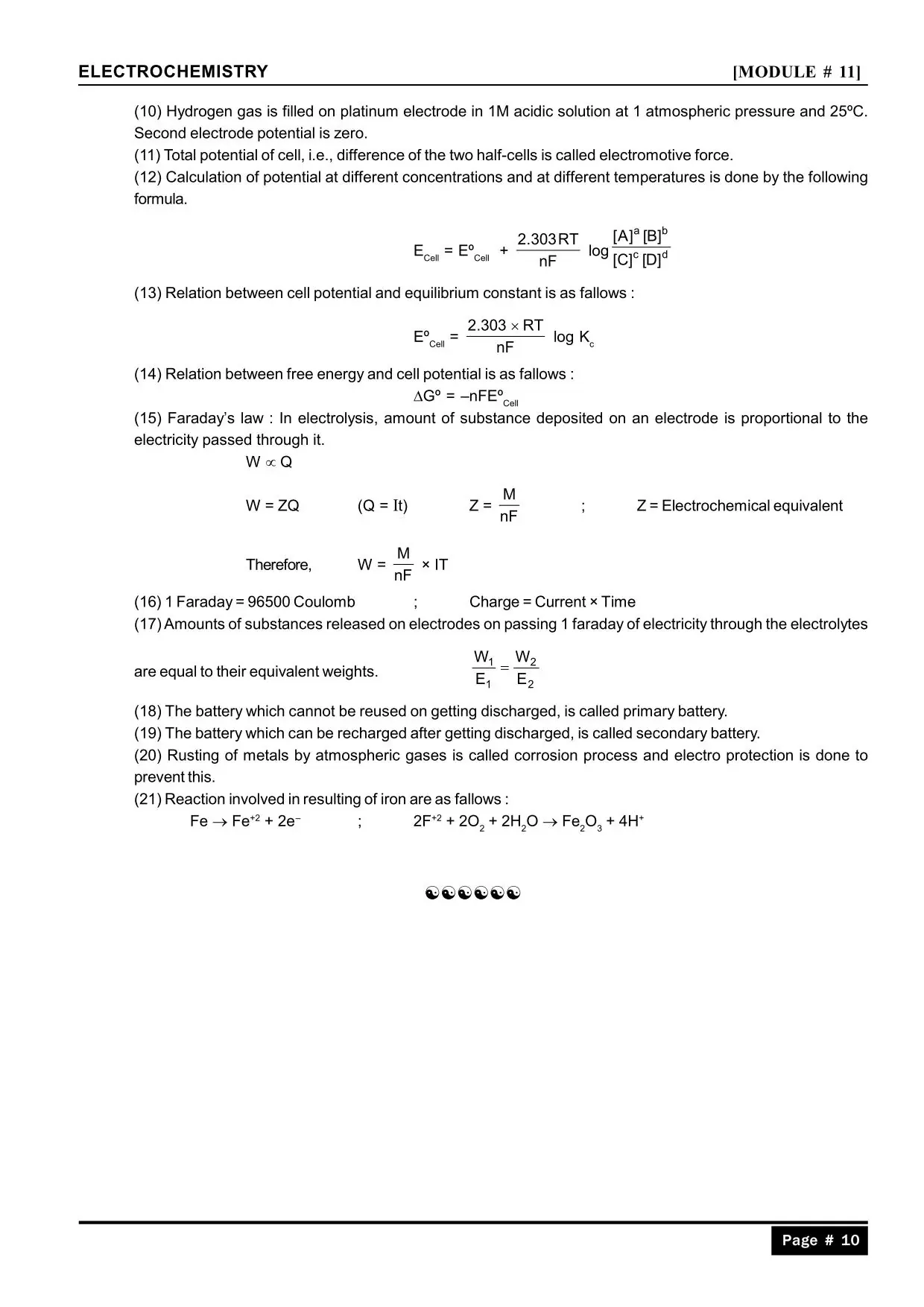
- First law: the mass deposited is proportional to the quantity of charge passed: m = Z × I × t.
- Second law: for the same charge, the masses deposited are proportional to the equivalent masses.
- Combined form: m = (M × I × t)/(n × F), where M is the molar mass, I is the current in amperes, t is the time in seconds and n is the number of electrons per ion.
When more than one species can be discharged, the one with the more favourable potential is discharged at each electrode. For example, in the electrolysis of aqueous NaCl, H₂ forms at the cathode and Cl₂ forms at the anode (under standard conditions, in a concentrated solution).
Batteries, Fuel Cells and Corrosion in Electrochemistry Notes for Class 12
Device | Key details |
|---|---|
Dry cell (primary) | Zn container as the anode, graphite rod as the cathode, MnO₂ and NH₄Cl paste. It cannot be recharged |
Lead accumulator (secondary) | Pb anode, PbO₂ cathode, about 38% H₂SO₄. It can be recharged |
H₂–O₂ fuel cell | Anode: H₂ + 2OH⁻ → 2H₂O + 2e⁻. Cathode: O₂ + 2H₂O + 4e⁻ → 4OH⁻. Reactants are supplied continuously |
Corrosion (rusting) | Fe → Fe²⁺ + 2e⁻ at the anode, and O₂ is reduced at the cathode. It is prevented by galvanisation, painting and sacrificial anodes |
Key Formulas in Electrochemistry Notes for Class 12
Formula | Description |
|---|---|
E°cell = E°cathode − E°anode | EMF of a cell |
ΔG° = −nFE°cell | Gibbs energy and EMF |
E°cell = (0.0592/n) log K | Equilibrium constant (298 K) |
E = E° − (0.0592/n) log Q | Nernst equation (298 K) |
κ = G × (l/A) | Conductivity |
Λm = κ × 1000/M | Molar conductivity (S cm² mol⁻¹) |
Λ°m = ν₊λ°₊ + ν₋λ°₋ | Kohlrausch’s law |
α = Λm/Λ°m | Degree of dissociation (weak electrolyte) |
m = (M × I × t)/(n × F) | Faraday’s law |
F = 96,500 C/mol | Faraday constant |
Solved Examples from Electrochemistry Notes for Class 12
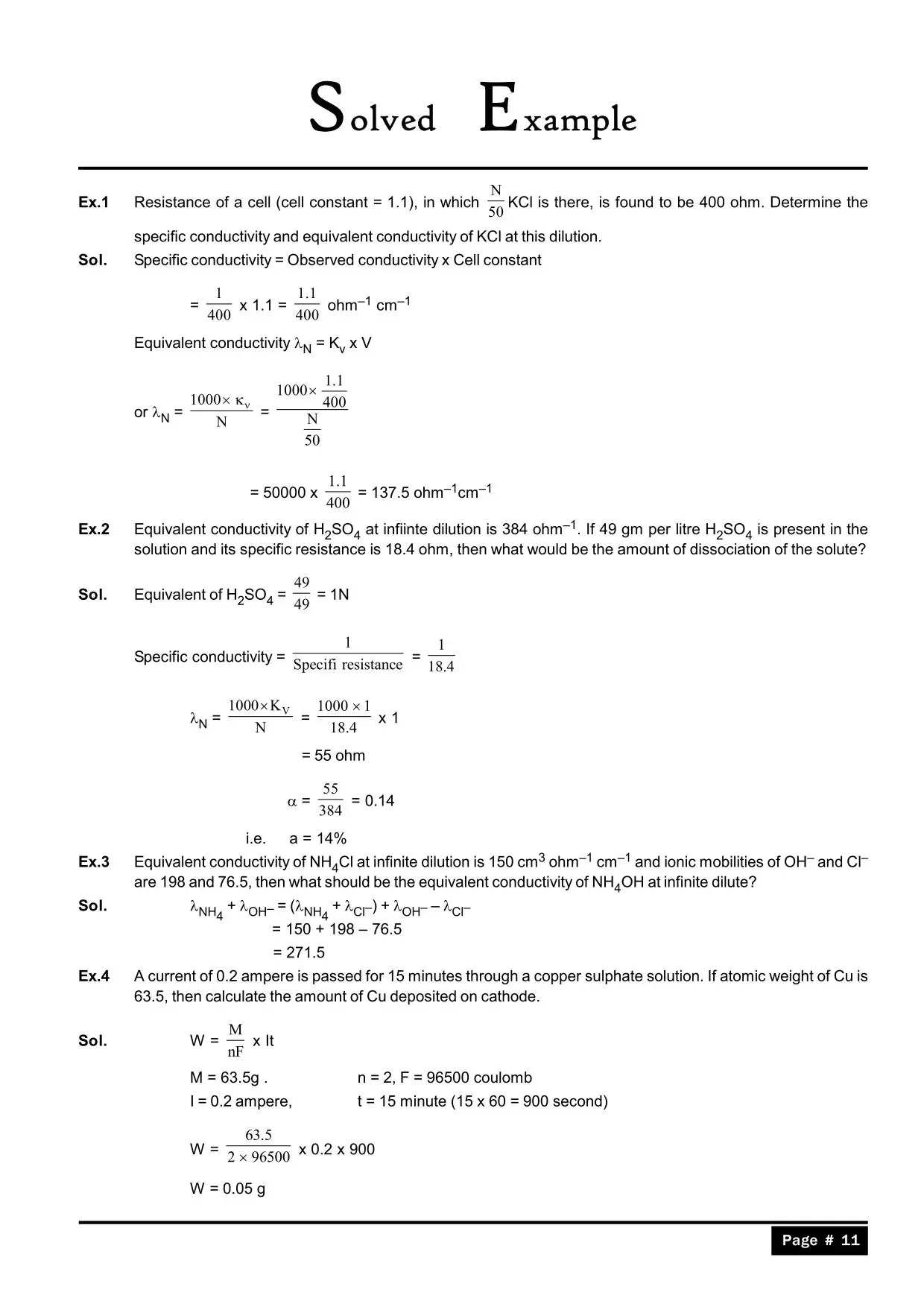
Example 1 (EMF): Find E°cell for the cell Zn | Zn²⁺ || Cu²⁺ | Cu.
E°cell = E°cathode − E°anode = 0.34 − (−0.76) = 1.10 V.
Example 2 (Nernst equation): Find the EMF of the Zn–Cu cell when [Zn²⁺] = 0.1 M and [Cu²⁺] = 0.01 M.
Q = [Zn²⁺]/[Cu²⁺] = 10, and n = 2. E = 1.10 − (0.0592/2) log 10 = 1.10 − 0.0296 ≈ 1.07 V.
Example 3 (Gibbs energy): Find ΔG° for the Zn–Cu cell.
ΔG° = −nFE° = −2 × 96500 × 1.10 = −212,300 J/mol ≈ −212.3 kJ/mol.
Example 4 (Faraday’s law): How much aluminium is deposited by 9650 C of charge? (Al = 27)
Al³⁺ + 3e⁻ → Al, so n = 3. m = (27 × 9650)/(3 × 96500) = 0.9 g.
Example 5 (molar conductivity): A 0.1 M solution has a conductivity of 0.02 S cm⁻¹. Find Λm.
Λm = κ × 1000/M = 0.02 × 1000/0.1 = 200 S cm² mol⁻¹.
Example 6 (Kohlrausch’s law): Λ°m for NaCl, HCl and CH₃COONa are 126.4, 426.2 and 91.0 S cm² mol⁻¹. Find Λ°m for CH₃COOH.
Λ°m(CH₃COOH) = Λ°m(CH₃COONa) + Λ°m(HCl) − Λ°m(NaCl) = 91.0 + 426.2 − 126.4 = 390.8 S cm² mol⁻¹.
Common Mistakes in Electrochemistry Notes for Class 12 Problems
Mistake | Correct approach |
|---|---|
Changing E° when the half-reaction is multiplied by a number | E° is an intensive property, so it does not change. ΔG° changes. |
Using the oxidation potential as E°cathode | E°cell = E°cathode − E°anode, with both as reduction potentials |
Writing Q with the wrong terms | Products over reactants, with pure solids and liquids as 1 |
Using the wrong n in the Nernst equation | n is the number of electrons in the balanced cell reaction |
Mixing units in Λm = κ × 1000/M | Use κ in S cm⁻¹ and M in mol/L |
Forgetting to convert minutes to seconds in Faraday’s law | Use t in seconds |
How to Study Electrochemistry Notes for Class 12
- Read the NCERT chapter first, and learn the sign rules. Download the book from eSaral’s NCERT Class 12 books page.
- Revise the mole concept first if Faraday’s law numericals feel hard. See eSaral’s mole concept notes for Class 11.
- Practise Nernst equation, ΔG and Faraday’s law numericals daily for a week.
- Revise the chapter with eSaral’s Class 12 Chemistry notes, and then solve previous year questions.
Frequently Asked Questions
What is the Nernst equation, and when is it used?
The Nernst equation, E = E° − (0.0592/n) log Q at 298 K, gives the EMF of a cell when the concentrations differ from the standard 1 M. It is used when a question gives non-standard concentrations, or asks for the EMF at some stage of the reaction. At equilibrium, Q = K and the EMF is zero, which means the cell has run down. eSaral’s Electrochemistry Notes for Class 12 include worked examples of it.
Is electrochemistry important for NEET?
Yes. NEET asks questions from this chapter, mostly on galvanic and electrolytic cells, Faraday’s laws, conductivity, Kohlrausch’s law and batteries. The number of questions varies by year, so check previous years’ NEET papers. Study NCERT thoroughly, and practise numericals as well.
What are the most important topics in Electrochemistry Notes for Class 12 for JEE Main?
In the Electrochemistry Notes for Class 12, the Nernst equation, standard electrode potential and the electrochemical series, the ΔG–EMF relation, conductance and Kohlrausch’s law, and Faraday’s laws are the topics that carry numerical questions. Master these first, then revise batteries, fuel cells and corrosion.
How do you calculate the mass deposited using Faraday’s law?
Use m = (M × I × t)/(n × F), where M is the molar mass in g/mol, I is the current in amperes, t is the time in seconds, n is the number of electrons per ion and F is 96,500 C/mol. For example, 2 A passed for 965 s deposits (64 × 2 × 965)/(2 × 96500) = 0.64 g of copper (Cu²⁺, n = 2).
What is the difference between a galvanic cell and an electrolytic cell?
A galvanic cell converts chemical energy into electrical energy through a spontaneous reaction, and its anode is negative. An electrolytic cell uses electrical energy to drive a non-spontaneous reaction, and its anode is positive. In both, oxidation takes place at the anode and reduction at the cathode.
What is Kohlrausch’s law, and what is its main application?
Kohlrausch’s law states that at infinite dilution each ion contributes a fixed, independent value to the molar conductivity, whatever the other ion is. It is used to find the limiting molar conductivity (Λ°m) of weak electrolytes, such as acetic acid, which cannot be found by extrapolation, and then to find their degree of dissociation.
Why does molar conductivity increase on dilution?
On dilution, the attraction between the ions decreases and the ions move more freely, so the molar conductivity increases. For a weak electrolyte, dilution also increases the degree of dissociation, which gives more ions. The conductivity (κ) itself decreases on dilution, because the number of ions per unit volume falls.
Which chapter number is Electrochemistry in Class 12 Chemistry?
In the current NCERT Class 12 Chemistry book, it is Unit 2 of 10. Older books call it Chapter 3. These Electrochemistry Notes for Class 12 on eSaral use the current numbering, so follow the chapter name.
Where can I find more Class 12 Chemistry notes on eSaral?
eSaral has Electrochemistry Notes for Class 12 on this page, the NCERT book for Class 12, NCERT solutions and the complete Class 12 Chemistry notes hub, all linked on this page.
Team eSaral
eSaral Academic and Editorial Team
Team eSaral is the collective author profile for educational content created by eSaral’s teachers and academic contributors. The team draws on expertise from IIT graduates, doctors, experienced educators and subject specialists to develop resources for JEE, NEET and school students. Our articles aim to explain concepts clearly and help students study with confidence.
Related Posts

BITSAT 2027: Registration Date, Exam Date, Syllabus, Eligibility, Pattern & Fees
BITSAT 2027 exam dates, registration timeline, eligibility criteria, exam pattern, marking scheme, syllabus and fees in one page.

BITSAT Previous Year Question Paper PDF (2017-2026)
Download BITSAT previous year question papers PDF from 2017 to 2026,session-wise. Memory-based papers,exam pattern, paper analysis and how to practise

CBSE Class 10 Date Sheet 2027: Expected Exam Dates, Release Date, Admit Card & Result Timeline
CBSE Class 10 date sheet 2027 is awaited. See the expected exam dates, release window, how to download the PDF, admit card and result timelines.

NCERT Physics Class 10 Book PDF in Hindi 2026-27 – भौतिक विज्ञान के 4 अध्याय (Free Download)
NCERT Physics Class 10 book PDF in Hindi 2026-27: download all 4 chapters (अध्याय 9–12) free, with topics and important formulas.

NCERT Biology Class 9 Book Anveshan PDF in Hindi - जीव विज्ञान कक्षा 9 पुस्तक अन्वेषण PDF
Download NCERT Biology Class 9 book PDF in Hindi chapterwise for 2026-27: Cell, Tissues, Reproduction and Diversity. Free PDFs.

Essay On Artificial Intelligence in English (100,150, 200, 250, 300, 500 Words)
This is in contrast to the natural intelligence of humans. With Artificial Intelligence, machines can perform

Essay on 78th India Independence Day in English for Student (100, 150, 200, 250, 300, 500 Words)
Read the best essays on India's Independence Day in English. Short & long essays (100, 150, 200, 250, 300, 500 words) perfect for school exams
NCERT Class 11 English Snapshots book - Free PDF download- Esaral
Download NCERT Class 11 English Snapshots book PDF for free. Get all 8 chapters, chapter-wise. Start your prep today!
NCERT Class 10 biology book pdf - Free PDF Download - eSaral
NCERT Class 10 Biology book PDF 2026-27: all 5 chapters (Life Processes to Our Environment) in English & Hindi, with CBSE syllabus, marks & practical

Essay on Global Warming in English (100,150, 200, 250, 300, 500 Words)
Global warming means the Earth is getting hotter. This happens because of things like pollution from cars and factories.