
Mole Concept Notes for Class 11, JEE and NEET: Formulas, Stoichiometry, Limiting Reagent and Concentration

eSaral Academic and Editorial Team
Summary
Mole Concept is the foundation of Physical Chemistry for JEE & NEET, covering moles, molar mass, Avogadro’s number, stoichiometry, limiting reagent, empirical formula, and concentration formulas essential for solving numerical problems across Chemistry chapters.
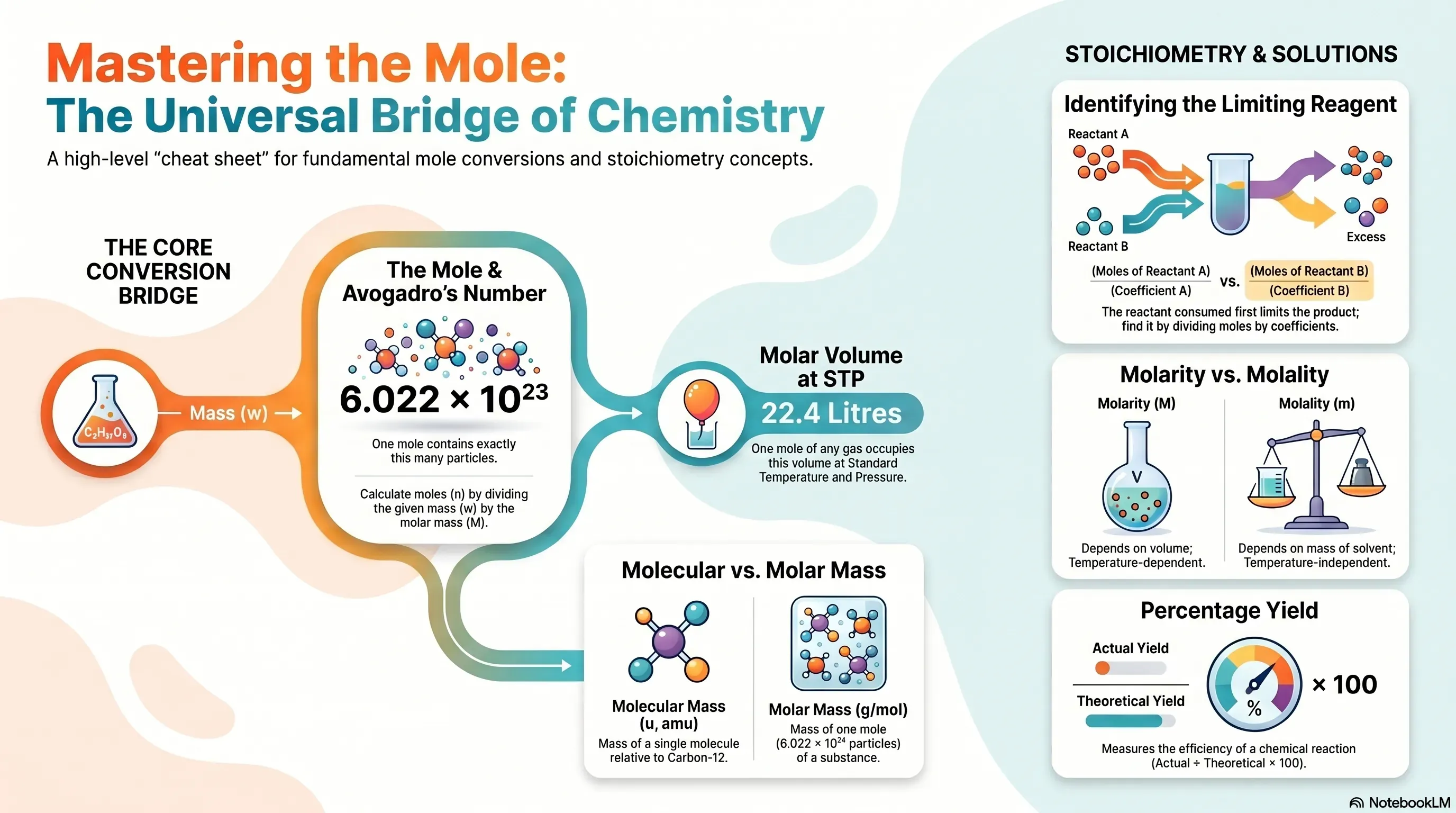
The mole concept is the base of chemical calculations. It is part of NCERT Class 11 Chemistry Chapter 1, Some Basic Concepts of Chemistry, and it is used again in the chapters on solutions, equilibrium, electrochemistry and kinetics. These mole concept notes for Class 11 are written so that you can learn the ideas once and then use them in every numerical problem.
Where Mole Concept Notes for Class 11 Are Used Again
Topic | Where it appears again |
|---|---|
Mole-mass conversion | Every stoichiometry problem |
Limiting reagent | Yield calculations |
Concentration (molarity, molality) | Solutions chapter in Class 12 |
Empirical and molecular formula | Organic analysis |
Stoichiometry | Electrochemistry, chemical kinetics |
Avogadro’s number | Gas laws, atomic structure |
Tip from the eSaral Chemistry team: Mole concept questions appear on their own and inside other Physical Chemistry chapters. If the mole-mass-number conversions are automatic, you will make fewer arithmetic errors in Solutions, Electrochemistry and Equilibrium.
India's Best Exam Preparation for Class 11th - Download Now
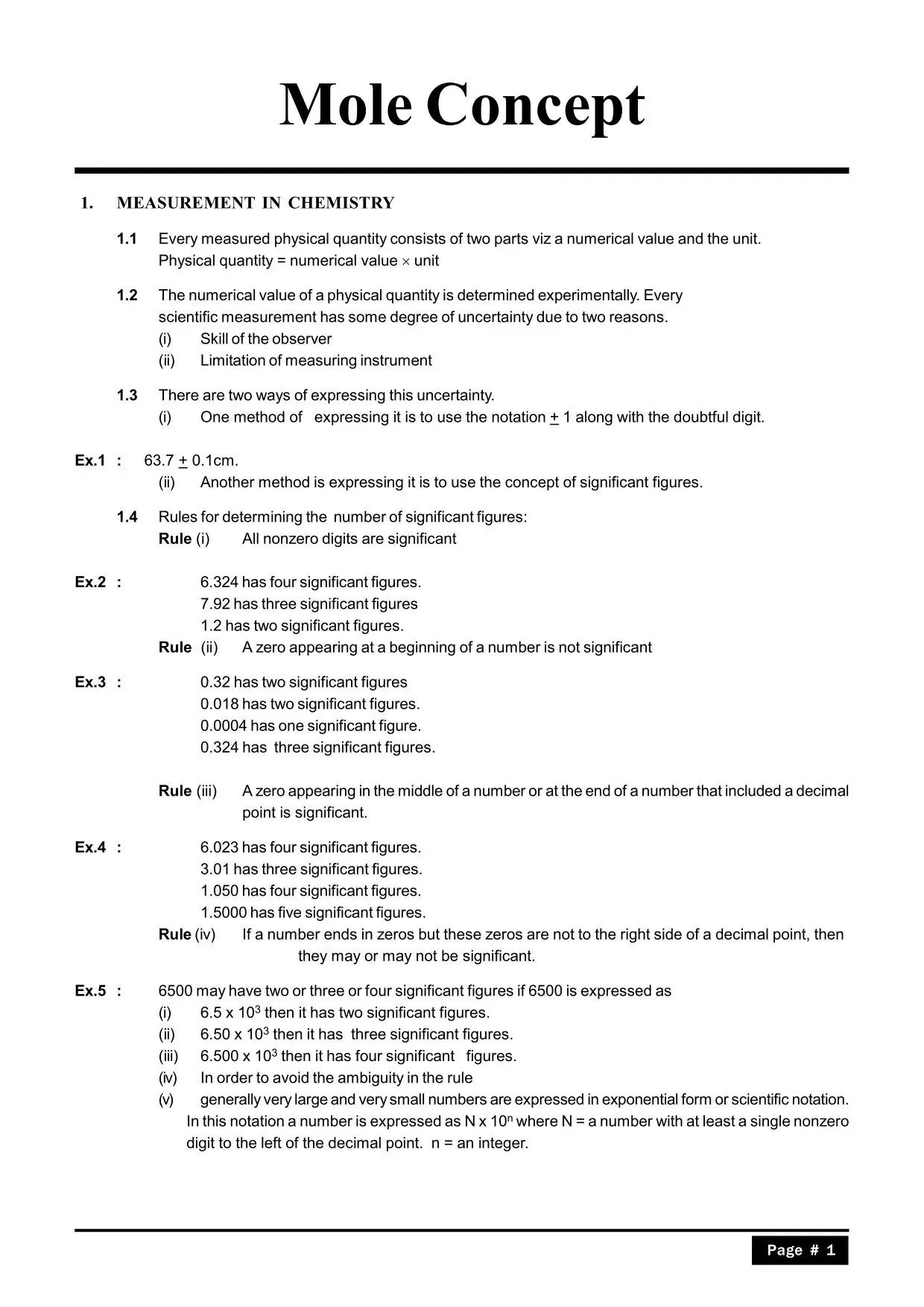
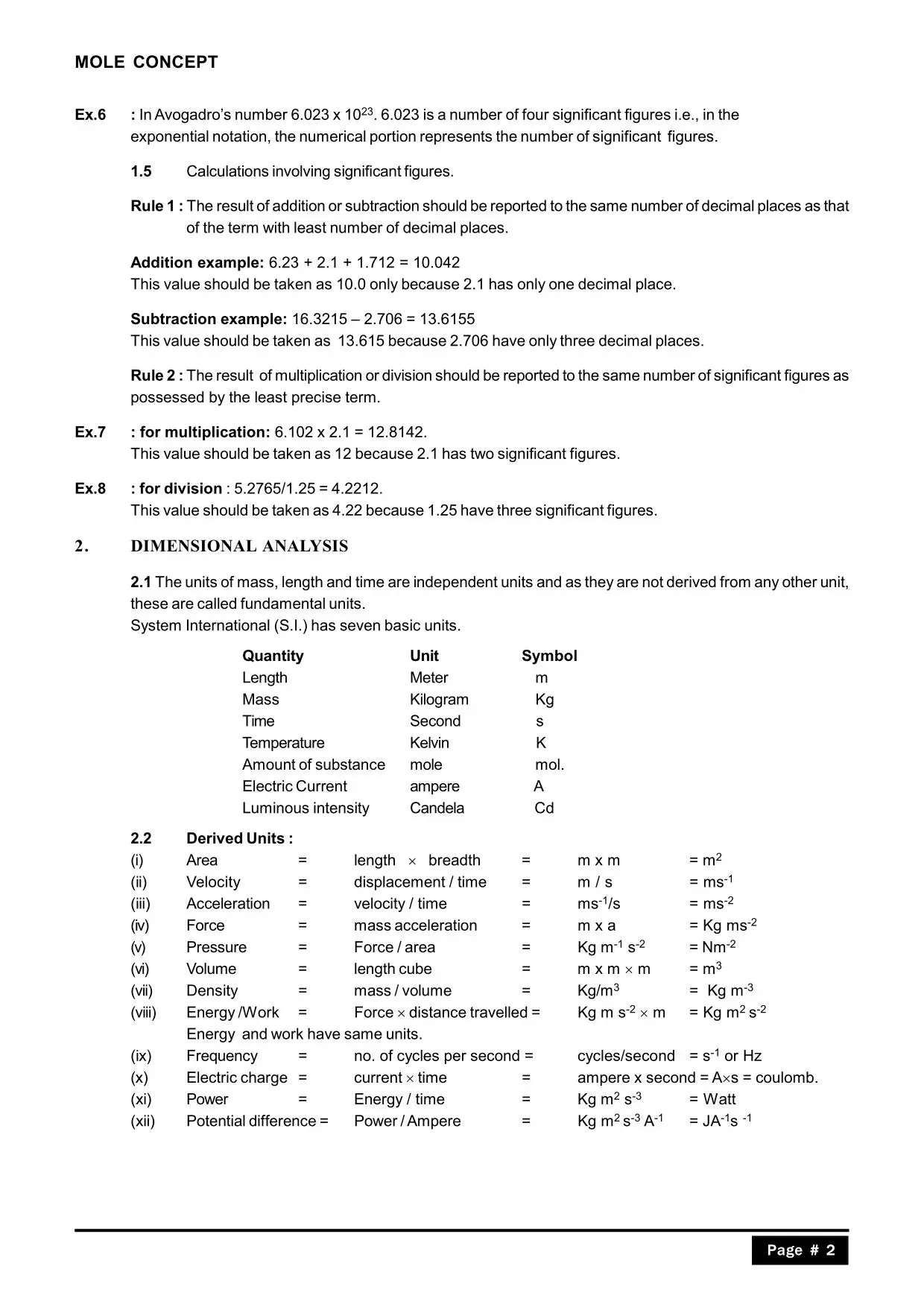
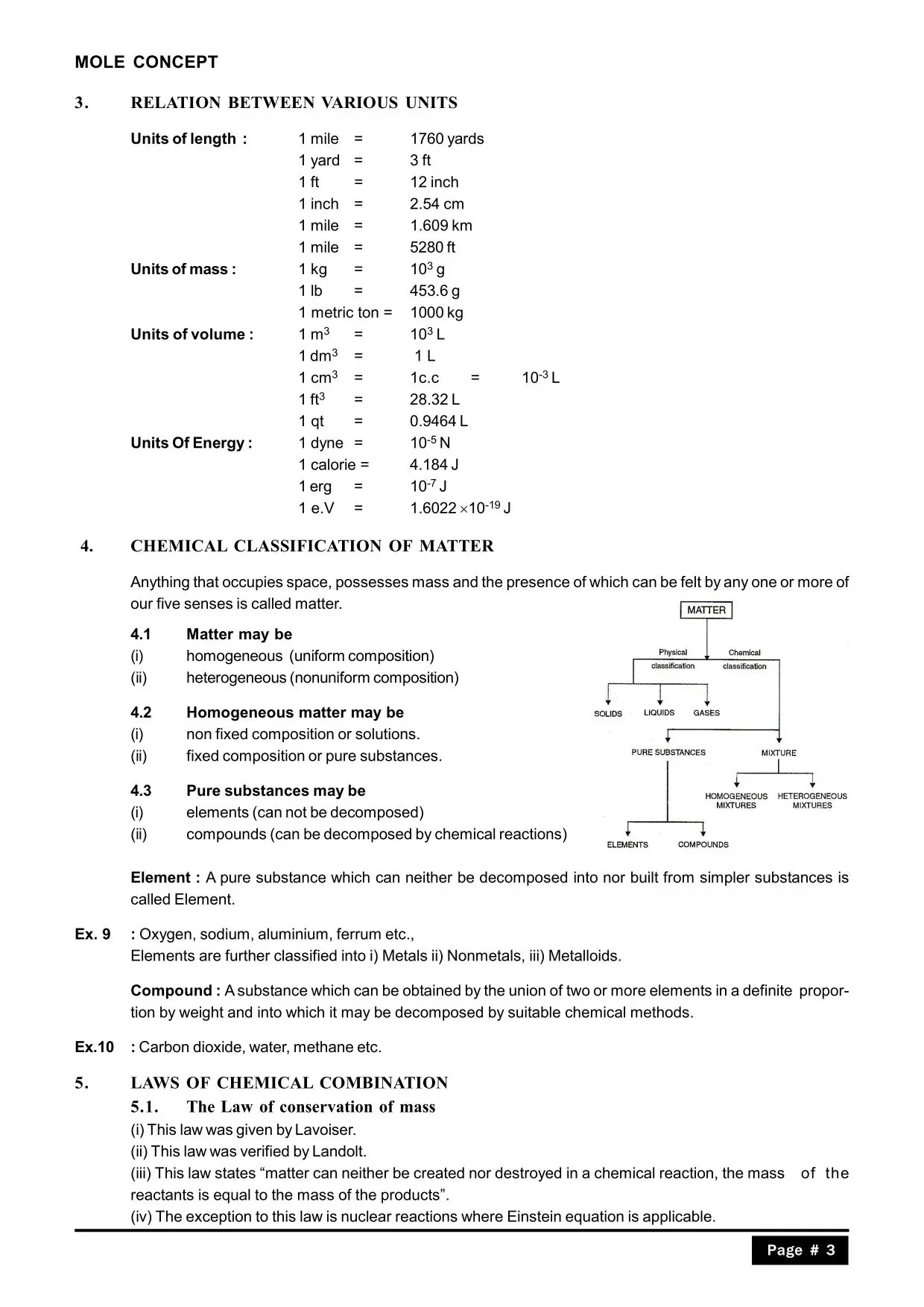
Mole Concept Notes
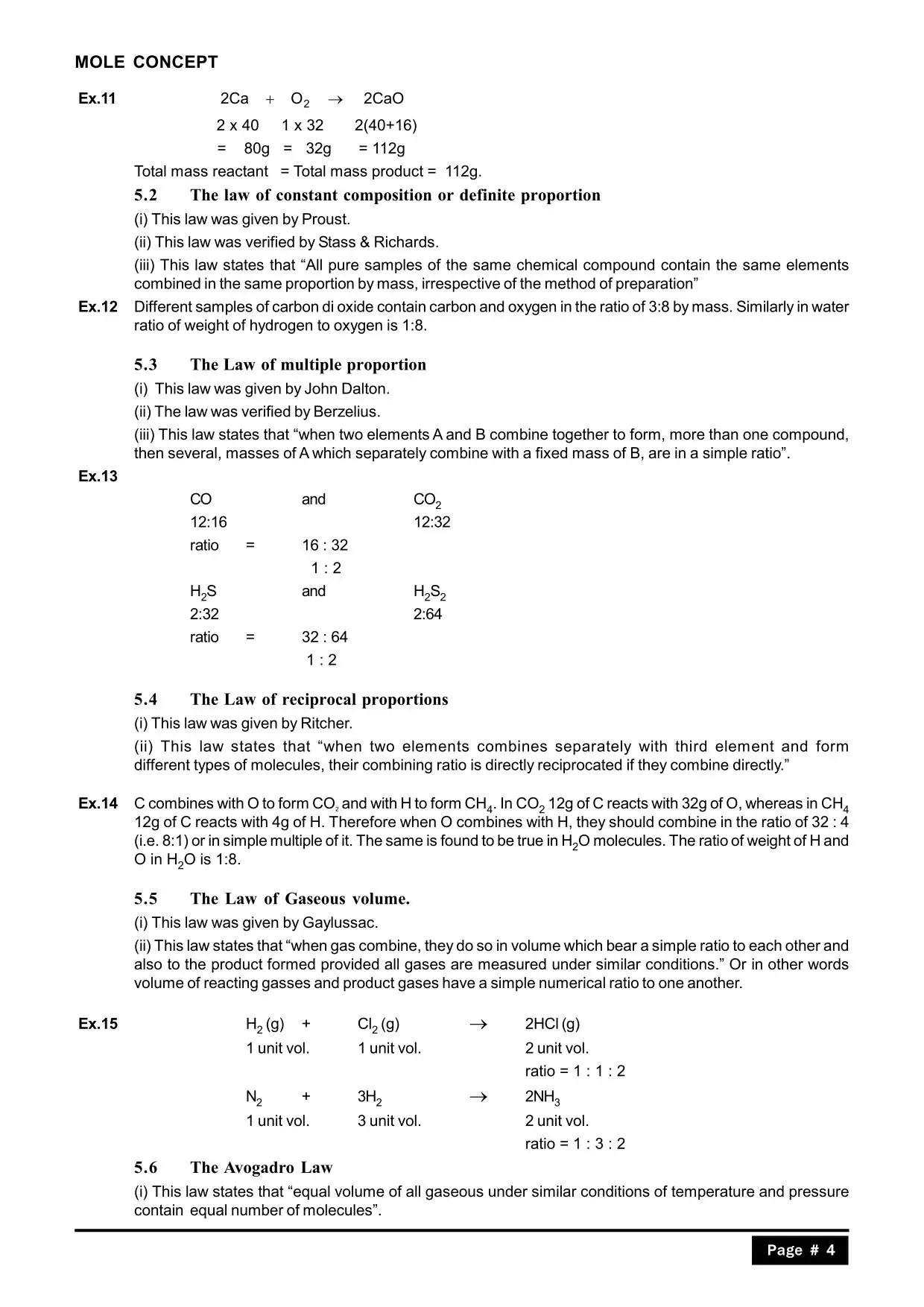
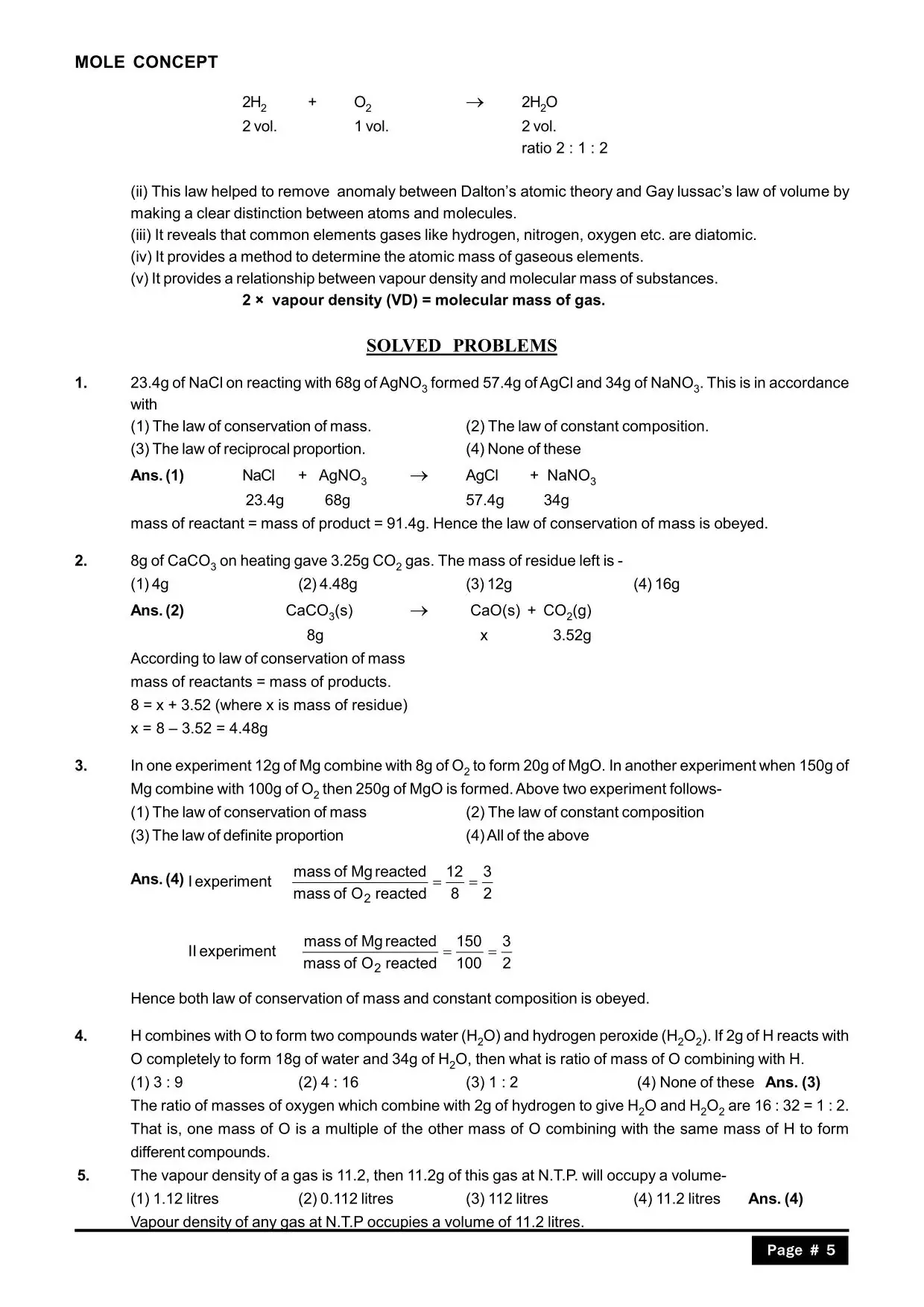
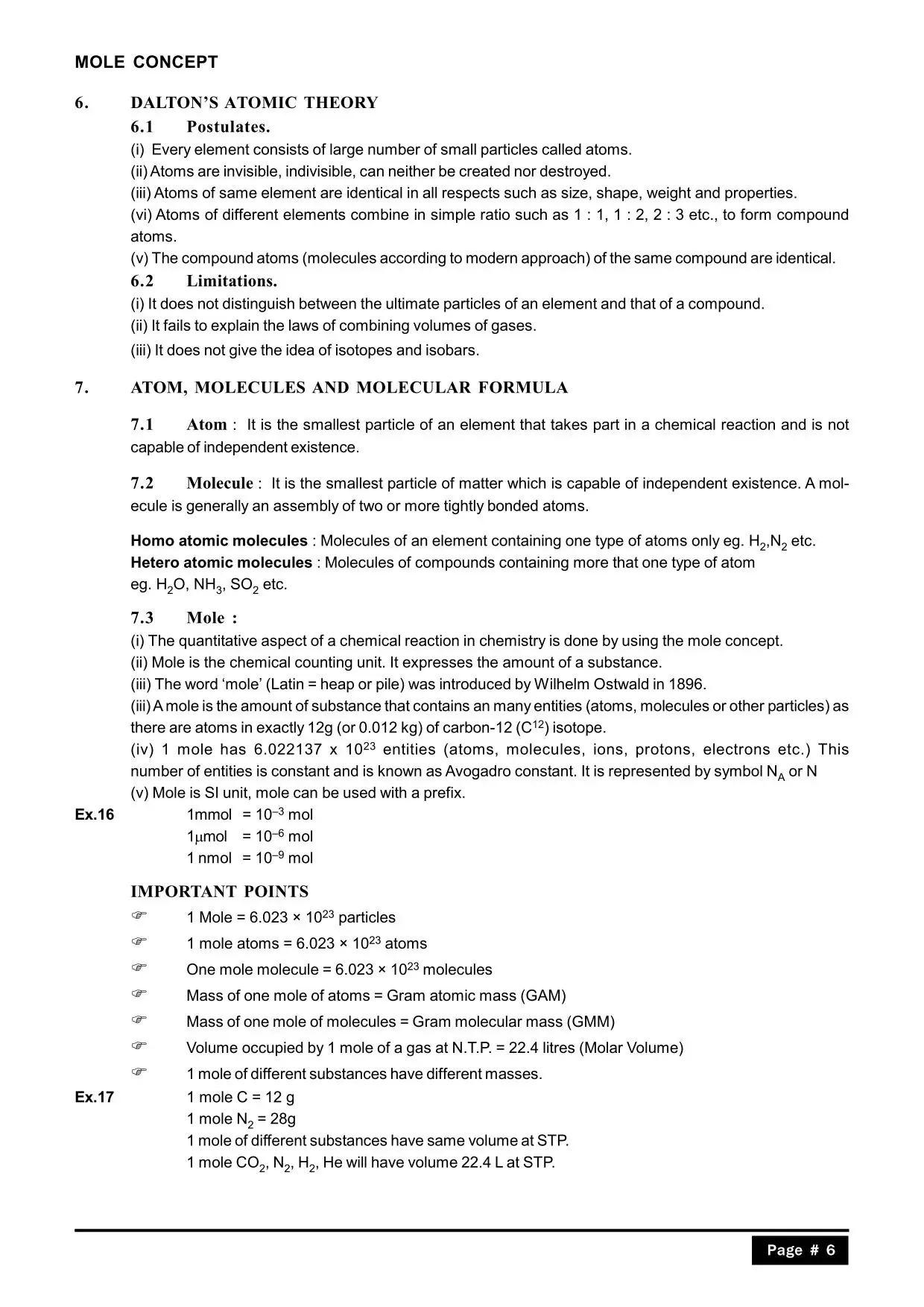
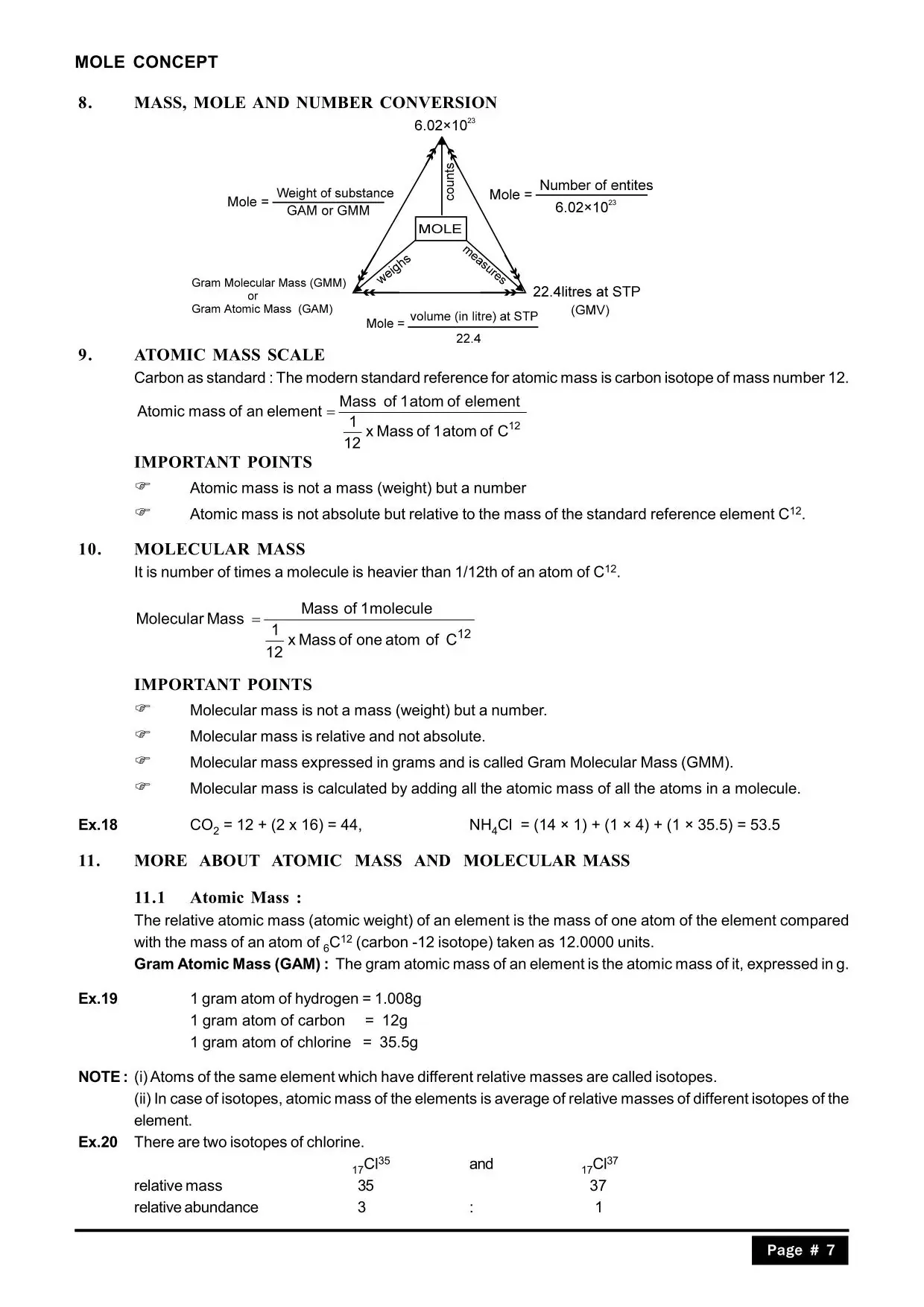
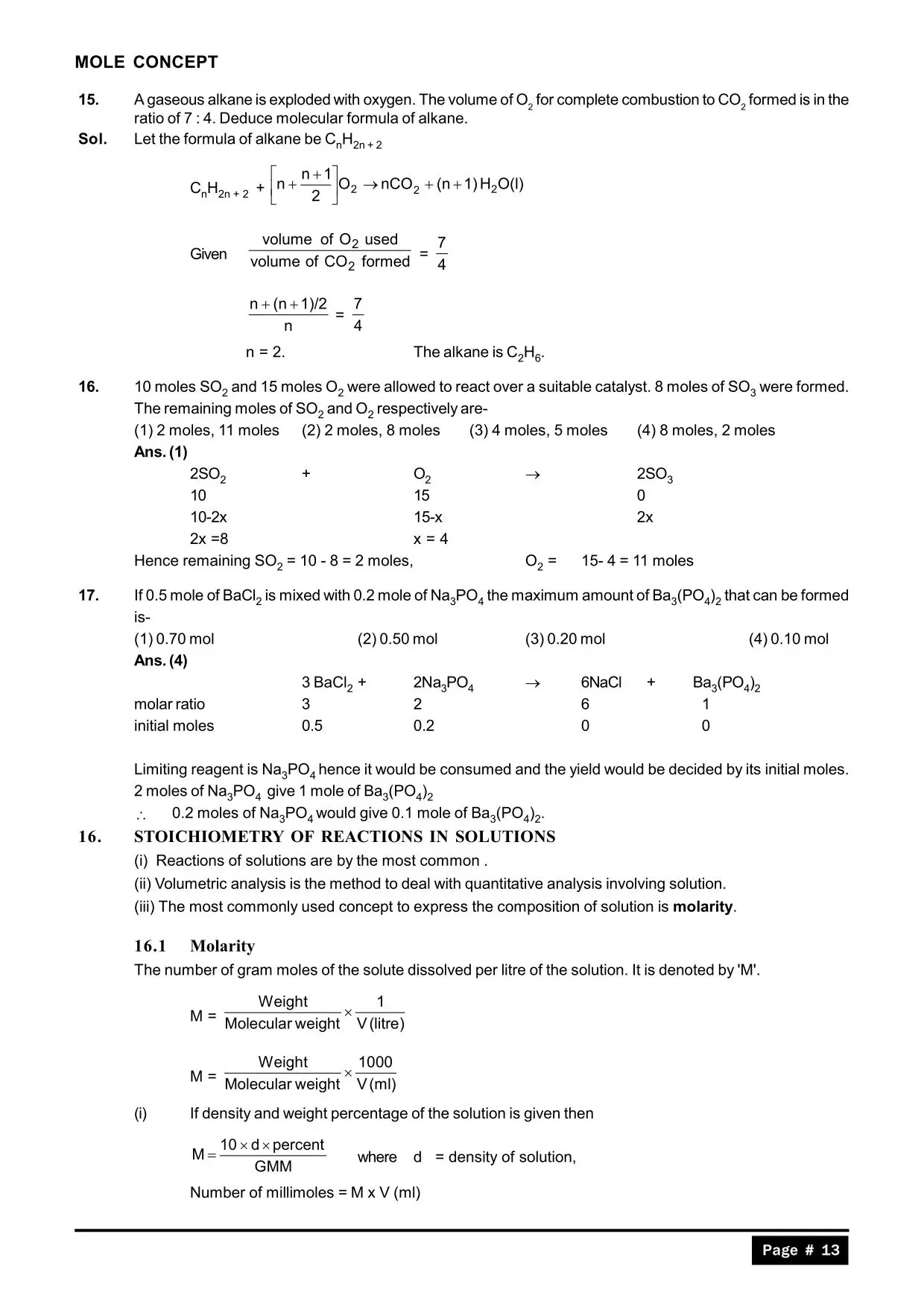
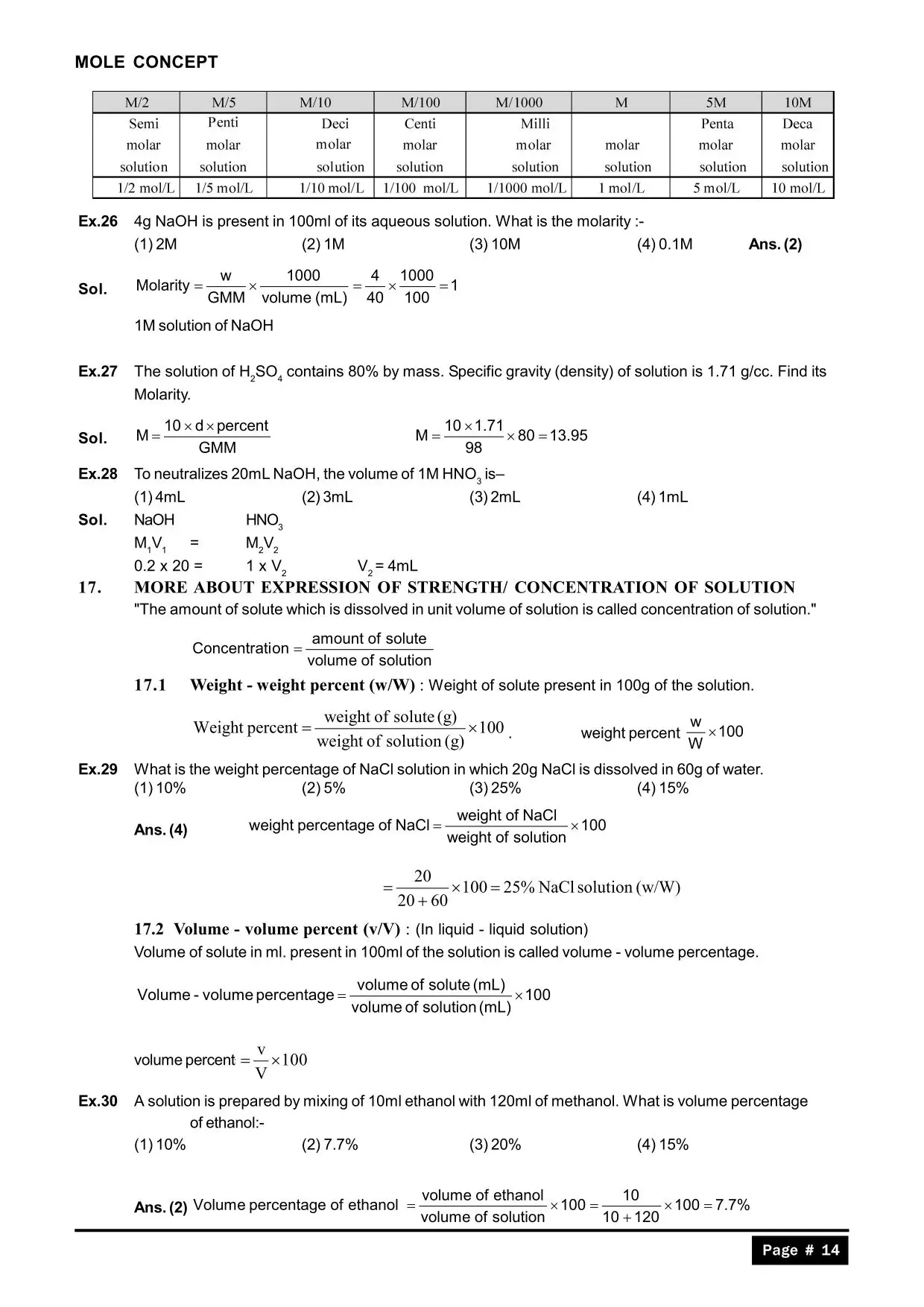
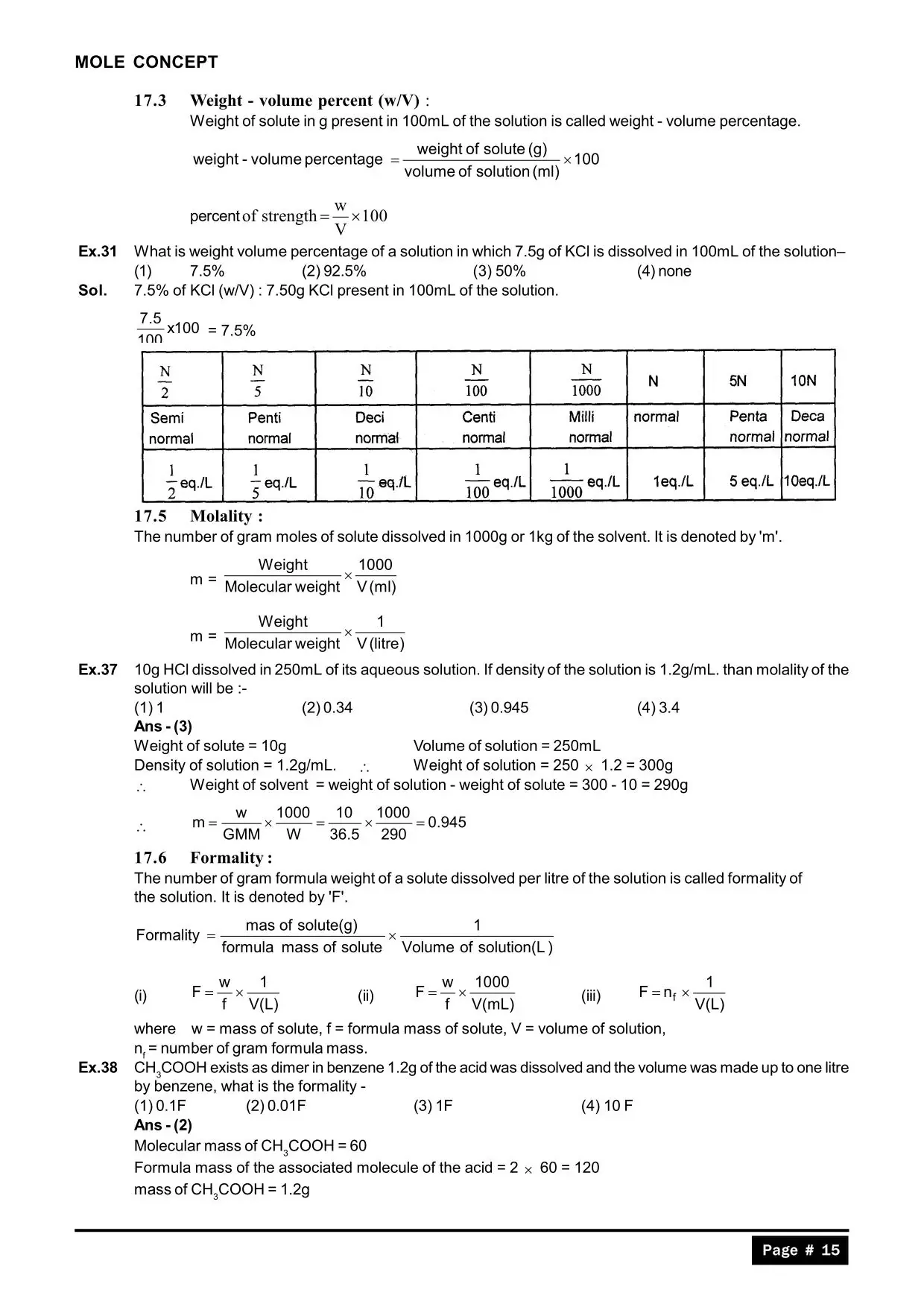
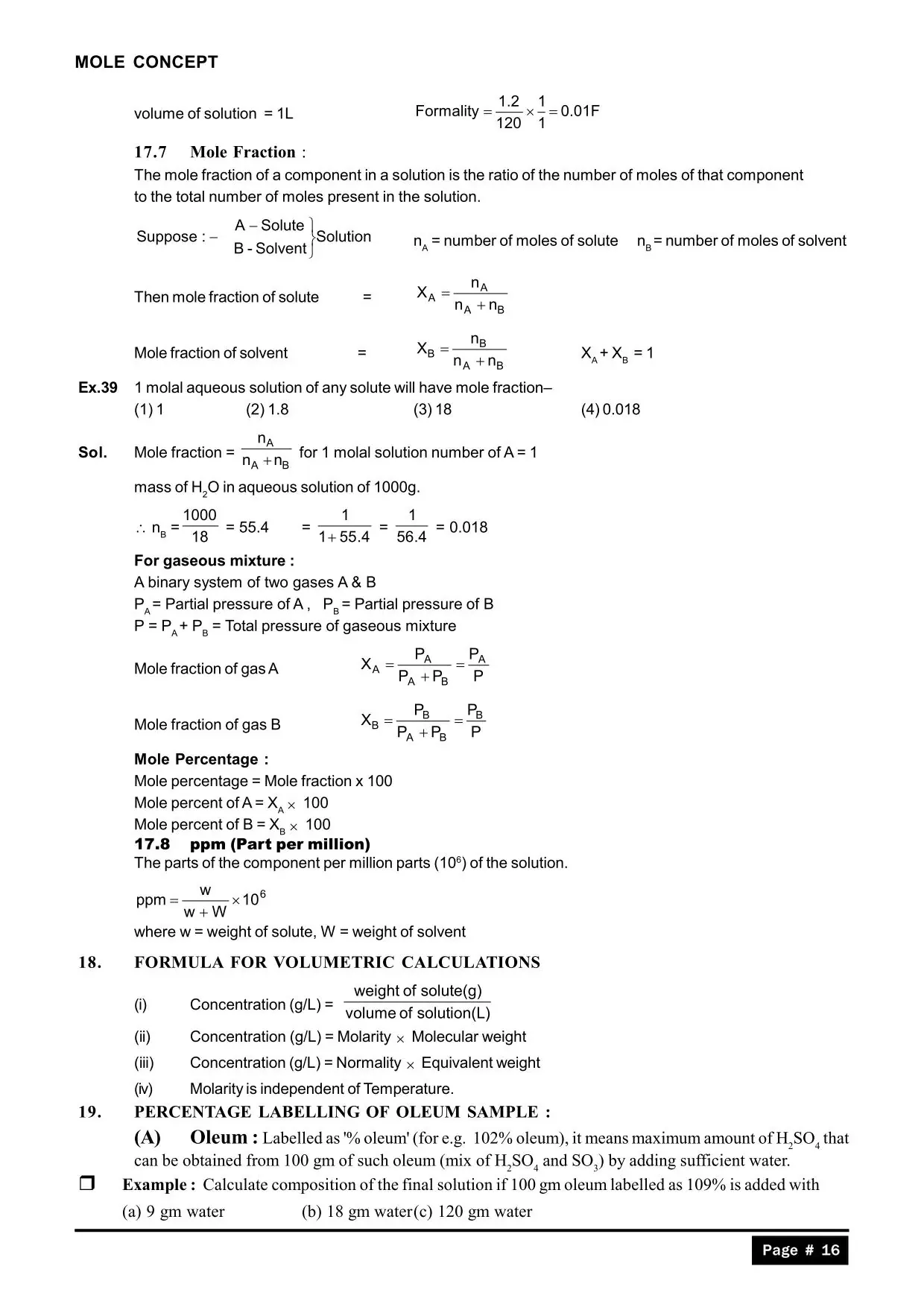
India's Best Exam Preparation for Class 11th - Download Now
Atomic Mass, Molecular Mass and Molar Mass in Mole Concept Notes for Class 11
Atomic Mass
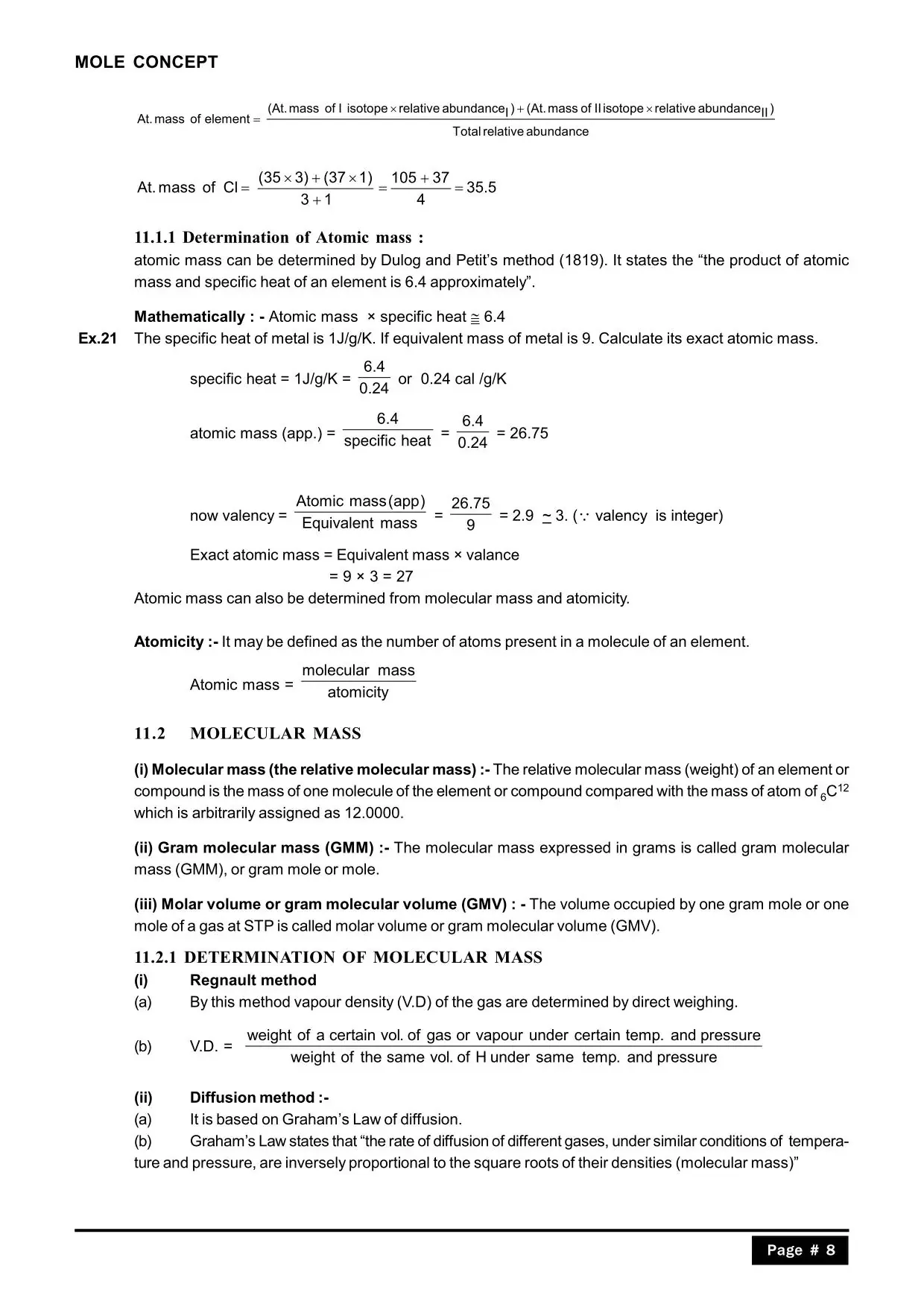
The atomic mass of an element is the mass of one atom of the element, measured relative to 1/12th the mass of a carbon-12 atom. It is expressed in atomic mass units (u). 1 u = 1.66 × 10⁻²⁷ kg. The atomic mass of hydrogen is about 1 u, of carbon 12 u and of oxygen 16 u.
Average Atomic Mass
Most elements are mixtures of isotopes, so the atomic mass on the periodic table is an average, weighted by abundance. For chlorine (35Cl, 75%; 37Cl, 25%): average atomic mass = (35 × 0.75) + (37 × 0.25) = 35.5 u.
Molecular Mass
The molecular mass of a compound is the sum of the atomic masses of all the atoms in one molecule.
- H₂SO₄: 2(1) + 32 + 4(16) = 98 u
- Ca(OH)₂: 40 + 2(16 + 1) = 74 u
Molar Mass
The molar mass is the mass of one mole of a substance. It is numerically equal to the molecular mass but has the unit g/mol. For example, the molar mass of H₂O is 18 g/mol, of CO₂ is 44 g/mol and of NaCl is 58.5 g/mol. Atomic and molecular masses are in u, and molar mass is in g/mol.
The Mole and Avogadro’s Number in Mole Concept Notes for Class 11
Definition of the Mole
NCERT defines one mole as the amount of a substance that contains as many elementary entities as there are atoms in exactly 12 g of carbon-12. Since the 2019 revision of the SI, the mole is defined by fixing the number of entities: one mole contains exactly 6.02214076 × 10²³ elementary entities. In calculations, we use the rounded value:
Avogadro’s number: Nₐ = 6.022 × 10²³ mol⁻¹
Substance | One mole contains |
|---|---|
Any element (for example Fe) | 6.022 × 10²³ atoms |
Any molecular substance (for example H₂O) | 6.022 × 10²³ molecules |
Any ionic compound (for example NaCl) | 6.022 × 10²³ formula units |
Electrons | 6.022 × 10²³ electrons |
Mole-Mass-Number-Volume Relationships in Mole Concept Notes for Class 11
1. Moles from mass: n = w/M, where w is the mass in grams and M is the molar mass in g/mol.
2. Number of particles: N = n × Nₐ, so N = (w/M) × Nₐ.
3. Moles of a gas from volume: at 273 K and 1 atm, one mole of an ideal gas occupies 22.4 L, so n = V/22.4 (V in litres). Under the IUPAC standard conditions of 273.15 K and 1 bar, the molar volume is 22.7 L. Many JEE and NEET problems use 22.4 L, so use the value that the question gives, or assumes. For other conditions, use PV = nRT.
Example: What is the volume of 4 g of O₂ at 273 K and 1 atm? n = 4/32 = 0.125 mol, so V = 0.125 × 22.4 = 2.8 L.
Empirical Formula and Molecular Formula in Mole Concept Notes for Class 11
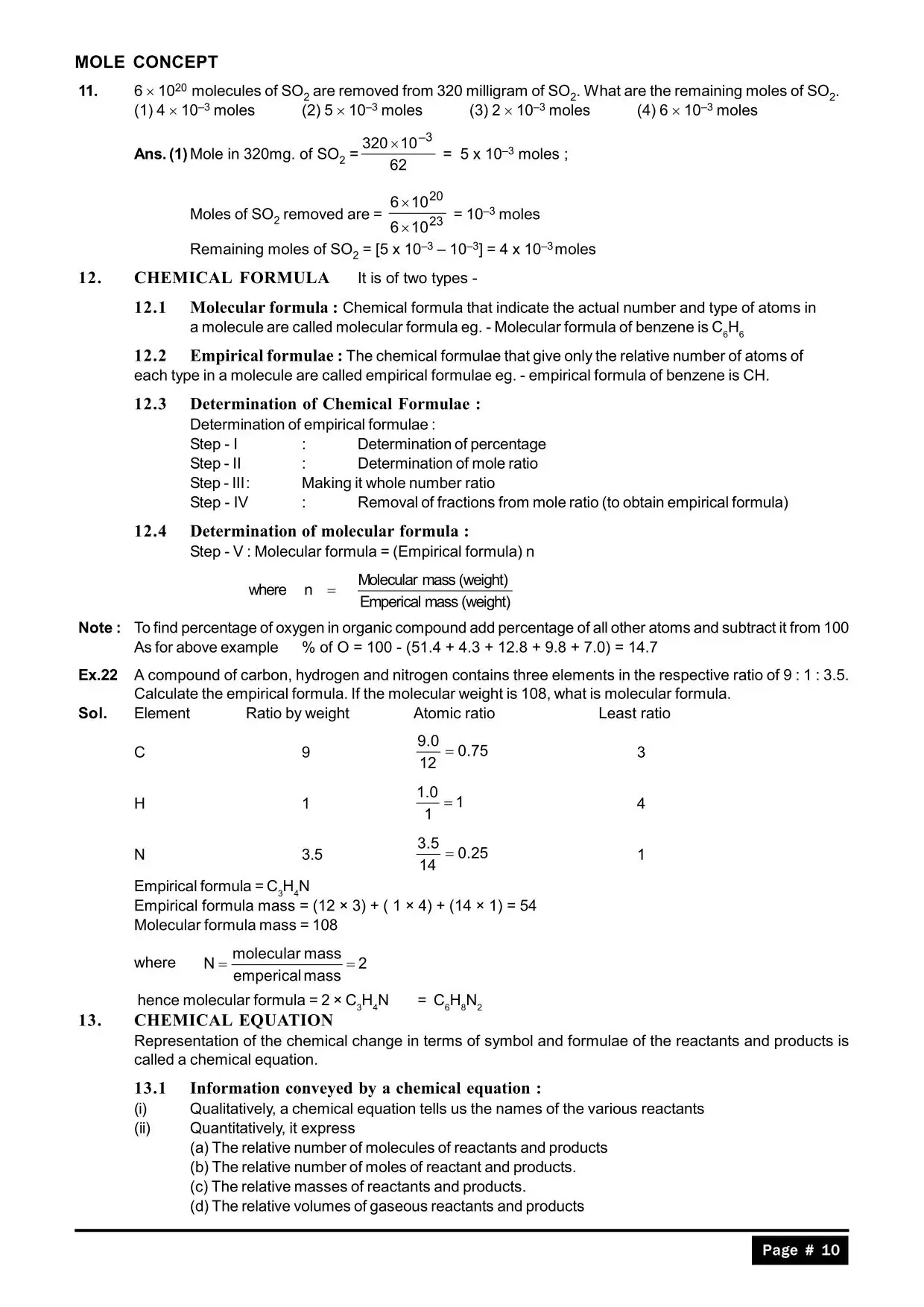
The empirical formula gives the simplest whole-number ratio of atoms in a compound. The molecular formula gives the actual number of atoms in a molecule: molecular formula = n × empirical formula, where n = molecular mass/empirical formula mass.
Steps to Find the Empirical Formula from Percentage Composition
- Treat the percentages as grams in a 100 g sample.
- Divide each mass by the atomic mass to get the moles.
- Divide all the mole values by the smallest one.
- If the ratios are not whole numbers, multiply by a small integer (2, 3 and so on).
- Write the formula.
Example: A compound contains 40% C, 6.67% H and 53.33% O. The moles are C: 40/12 = 3.33, H: 6.67/1 = 6.67 and O: 53.33/16 = 3.33. The ratio is 1 : 2 : 1, so the empirical formula is CH₂O. If the molecular mass is 180, n = 180/30 = 6, so the molecular formula is C₆H₁₂O₆.
Percentage Composition and Stoichiometry in Mole Concept Notes for Class 11
% of an element = (mass of the element in one mole of the compound ÷ molar mass of the compound) × 100. For example, the percentage of oxygen in H₂SO₄ is (64/98) × 100 = 65.3%.
Stoichiometry from a Balanced Equation
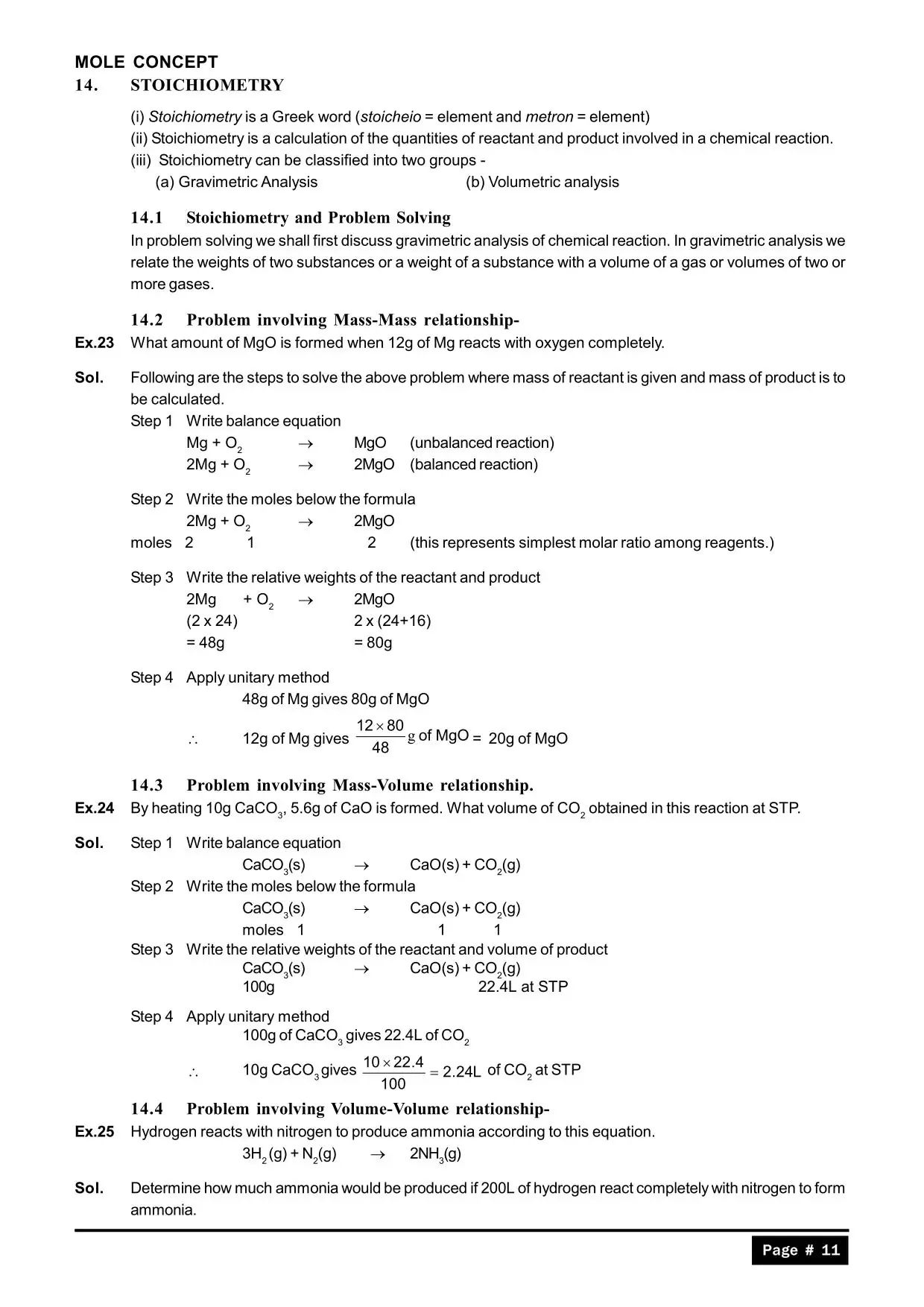
A balanced equation gives the mole ratios of the reactants and the products. Convert the mass to moles, use the mole ratio, and convert back to mass.
Example: For N₂ + 3H₂ → 2NH₃, 28 g of N₂ is 1 mol, which gives 2 mol of NH₃ = 34 g. The mass of H₂ needed is 3 mol × 2 g/mol = 6 g.
Limiting Reagent and Percentage Yield in Mole Concept Notes for Class 11
How to Find the Limiting Reagent
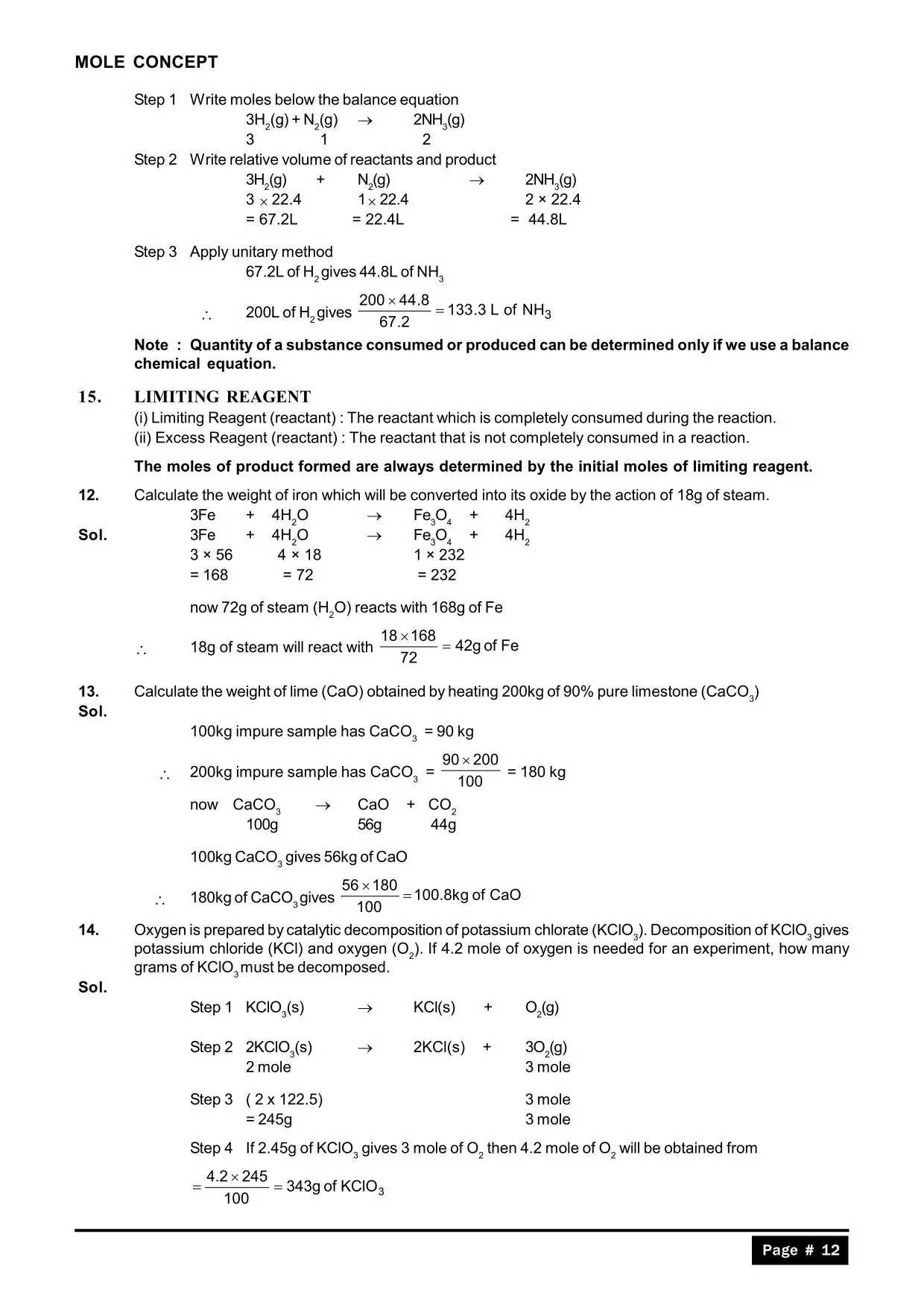
The limiting reagent is the reactant that is used up first. To find it:
- Calculate the moles of each reactant.
- Divide each by its stoichiometric coefficient.
- The reactant with the smaller value is the limiting reagent.
Example: 2 g of H₂ reacts with 32 g of O₂ in 2H₂ + O₂ → 2H₂O. Moles of H₂ = 1, and 1/2 = 0.5. Moles of O₂ = 1, and 1/1 = 1. H₂ gives the smaller value, so H₂ is the limiting reagent. It forms 1 mol of H₂O = 18 g, and 0.5 mol (16 g) of O₂ is left over. If both ratios are equal, the reactants are used up together.
Percentage Yield
% yield = (actual yield ÷ theoretical yield) × 100. The theoretical yield is calculated from the limiting reagent, and the actual yield is never more than the theoretical yield. For example, a theoretical yield of 20 g and an actual yield of 15 g gives a yield of 75%.
Concentration Terms in Mole Concept Notes for Class 11
Term | Formula | Note |
|---|---|---|
Molarity (M) | moles of solute ÷ volume of solution in litres | Changes with temperature |
Molality (m) | moles of solute ÷ mass of solvent in kg | Does not change with temperature |
Mole fraction (χ) | χ_A = n_A/(n_A + n_B) | The sum of all mole fractions is 1 |
Parts per million | (mass of solute ÷ mass of solution) × 10⁶ | For very dilute solutions |
Dilution | M₁V₁ = M₂V₂ | The moles of solute stay the same |
Mixing the same solute | M = (M₁V₁ + M₂V₂)/(V₁ + V₂) | Assumes that the volumes add |
Molality from molarity | m = 1000 M/(1000 d − M × M_solute) | d is the density in g/mL |
Molality is preferred for colligative properties, because it does not depend on temperature.
Solved Examples from Mole Concept Notes for Class 11
Example 1 (moles and particles): How many molecules and atoms are there in 11 g of CO₂?
n = 11/44 = 0.25 mol. Molecules = 0.25 × 6.022 × 10²³ ≈ 1.51 × 10²³. Each molecule has 3 atoms, so atoms ≈ 4.52 × 10²³.
Example 2 (empirical formula): An oxide of iron has 69.9% Fe and 30.1% O by mass. Find its empirical formula (Fe = 55.85, O = 16).
Fe: 69.9/55.85 = 1.25. O: 30.1/16 = 1.88. The ratio O/Fe = 1.5, so multiply by 2 to get 2 : 3. The empirical formula is Fe₂O₃.
Example 3 (limiting reagent): 5 mol of N₂ and 9 mol of H₂ react to form NH₃. Find the limiting reagent and the moles of NH₃ formed.
N₂: 5/1 = 5. H₂: 9/3 = 3. H₂ is the limiting reagent, and it gives 9 × (2/3) = 6 mol of NH₃.
Example 4 (molarity): 4 g of NaOH is dissolved in water to make 250 mL of solution. Find the molarity.
n = 4/40 = 0.1 mol. M = 0.1/0.25 = 0.4 M.
Example 5 (dilution): 100 mL of a 2 M solution is diluted to 500 mL. Find the new molarity.
M₂ = (2 × 100)/500 = 0.4 M.
Key Formulas in Mole Concept Notes for Class 11
Formula | Description |
|---|---|
n = w/M | Moles from mass |
N = n × Nₐ | Number of particles |
n = V/22.4 | Moles of a gas (273 K, 1 atm) |
% element = (mass in 1 mol ÷ M) × 100 | Percentage composition |
n(formula) = molecular mass ÷ empirical mass | Molecular and empirical formula |
% yield = (actual ÷ theoretical) × 100 | Percentage yield |
M = n/V (in litres) | Molarity |
m = n/mass of solvent (kg) | Molality |
M₁V₁ = M₂V₂ | Dilution |
Common Mistakes in Mole Concept Notes for Class 11 Problems
Mistake | Correct approach |
|---|---|
Using 22.4 L at any temperature and pressure | The value is for 273 K and 1 atm. Use PV = nRT for other conditions. |
Mixing mass in grams and kilograms | Convert to the unit required by the formula (g for n = w/M, kg for molality) |
Choosing the limiting reagent by the smaller number of moles | Divide the moles by the coefficient first |
Writing the unit of molar mass as u | The unit of molar mass is g/mol |
Using volume of the solvent instead of the solution | Molarity uses the volume of the solution |
Rounding Avogadro’s number too early | Keep 6.022 × 10²³ until the final step |
How to Study Mole Concept Notes for Class 11
- Read the NCERT chapter first. Download the textbook from eSaral’s NCERT books for Class 11 page.
- Solve the textbook questions with eSaral’s NCERT Solutions for Class 11 Chemistry Chapter 1.
- Practise the three conversions (mass, moles, particles) until each takes under 30 seconds.
- Test yourself with eSaral’s mole concept NEET previous year questions.
Frequently Asked Questions
What is the mole concept in Class 11 Chemistry?
The mole is the SI unit of the amount of a substance. One mole contains 6.022 × 10²³ particles (Avogadro’s number), and the molar mass in g/mol is numerically equal to the molecular mass in u. The mole concept lets you convert between a mass that you can weigh in the lab and the number of atoms or molecules, which are too small to count.
What is Avogadro’s number, and why is it important?
Avogadro’s number is 6.022 × 10²³ mol⁻¹, the number of particles in one mole. Under the 2019 SI definition, the exact value is 6.02214076 × 10²³. It links the atomic scale to the scale of grams and litres, so every mole concept numerical uses it directly or through n = w/M.
What are the important formulas in mole concept notes for Class 11?
The key formulas are n = w/M, N = n × Nₐ, n = V/22.4 for a gas at 273 K and 1 atm, percentage composition, molecular formula = n × empirical formula, percentage yield, and the concentration terms molarity, molality, mole fraction and ppm. They are all in the key formulas table of these mole concept notes for Class 11.
How do you find the limiting reagent?
Convert the mass of each reactant into moles, divide each by its coefficient in the balanced equation, and choose the reactant with the smaller value. That reactant decides how much product forms. eSaral’s mole concept notes for Class 11 give a worked example.
What is the molar volume of a gas?
In mole concept notes for Class 11, at 273 K and 1 atm, one mole of an ideal gas occupies 22.4 L. Under the IUPAC standard conditions (273.15 K and 1 bar), it occupies about 22.7 L. Use the value given in your question, and use PV = nRT at other temperatures and pressures.
What is the difference between empirical formula and molecular formula?
In mole concept notes for Class 11, the empirical formula is the simplest whole-number ratio of atoms. The molecular formula is the actual number of atoms in a molecule. For glucose, the empirical formula is CH₂O and the molecular formula is C₆H₁₂O₆.
What is the difference between molarity and molality?
Molarity is moles of solute per litre of solution, and it changes with temperature because volume changes. Molality is moles of solute per kg of solvent, and it does not change with temperature, so it is used for colligative properties.
In which chapter of Class 11 Chemistry is the mole concept?
It is in Chapter 1, Some Basic Concepts of Chemistry, of the NCERT Class 11 Chemistry book. The concentration terms are used again in the Solutions chapter of Class 12. These mole concept notes for Class 11 cover both parts.
Where can I find notes and practice questions for the mole concept on eSaral?
eSaral has handwritten mole concept notes for Class 11 on this page, NCERT solutions and NCERT books for the chapter, and a page of NEET previous year questions on the mole concept, all linked on this page.
Team eSaral
eSaral Academic and Editorial Team
Team eSaral is the collective author profile for educational content created by eSaral’s teachers and academic contributors. The team draws on expertise from IIT graduates, doctors, experienced educators and subject specialists to develop resources for JEE, NEET and school students. Our articles aim to explain concepts clearly and help students study with confidence.
Related Posts

BITSAT 2027: Registration Date, Exam Date, Syllabus, Eligibility, Pattern & Fees
BITSAT 2027 exam dates, registration timeline, eligibility criteria, exam pattern, marking scheme, syllabus and fees in one page.

BITSAT Previous Year Question Paper PDF (2017-2026)
Download BITSAT previous year question papers PDF from 2017 to 2026,session-wise. Memory-based papers,exam pattern, paper analysis and how to practise

CBSE Class 10 Date Sheet 2027: Expected Exam Dates, Release Date, Admit Card & Result Timeline
CBSE Class 10 date sheet 2027 is awaited. See the expected exam dates, release window, how to download the PDF, admit card and result timelines.

NCERT Physics Class 10 Book PDF in Hindi 2026-27 – भौतिक विज्ञान के 4 अध्याय (Free Download)
NCERT Physics Class 10 book PDF in Hindi 2026-27: download all 4 chapters (अध्याय 9–12) free, with topics and important formulas.

NCERT Biology Class 9 Book Anveshan PDF in Hindi - जीव विज्ञान कक्षा 9 पुस्तक अन्वेषण PDF
Download NCERT Biology Class 9 book PDF in Hindi chapterwise for 2026-27: Cell, Tissues, Reproduction and Diversity. Free PDFs.

Essay On Artificial Intelligence in English (100,150, 200, 250, 300, 500 Words)
This is in contrast to the natural intelligence of humans. With Artificial Intelligence, machines can perform

Essay on 78th India Independence Day in English for Student (100, 150, 200, 250, 300, 500 Words)
Read the best essays on India's Independence Day in English. Short & long essays (100, 150, 200, 250, 300, 500 words) perfect for school exams
NCERT Class 11 English Snapshots book - Free PDF download- Esaral
Download NCERT Class 11 English Snapshots book PDF for free. Get all 8 chapters, chapter-wise. Start your prep today!
NCERT Class 10 biology book pdf - Free PDF Download - eSaral
NCERT Class 10 Biology book PDF 2026-27: all 5 chapters (Life Processes to Our Environment) in English & Hindi, with CBSE syllabus, marks & practical

Essay on Global Warming in English (100,150, 200, 250, 300, 500 Words)
Global warming means the Earth is getting hotter. This happens because of things like pollution from cars and factories.