
Electrostatic Potential and Capacitance Class 12 Notes: All Formulas, Key Points & Free PDF

eSaral Academic and Editorial Team
Summary
Electrostatic Potential and Capacitance Class 12 Notes cover electric potential and potential energy, the potential of point charges, systems of charges, shells and dipoles, equipotential surfaces, the relation E = −∇V, conductors and dielectrics, the capacitance of different capacitors, series and parallel combinations, charge sharing, the energy stored in a capacitor and the force between the plates.
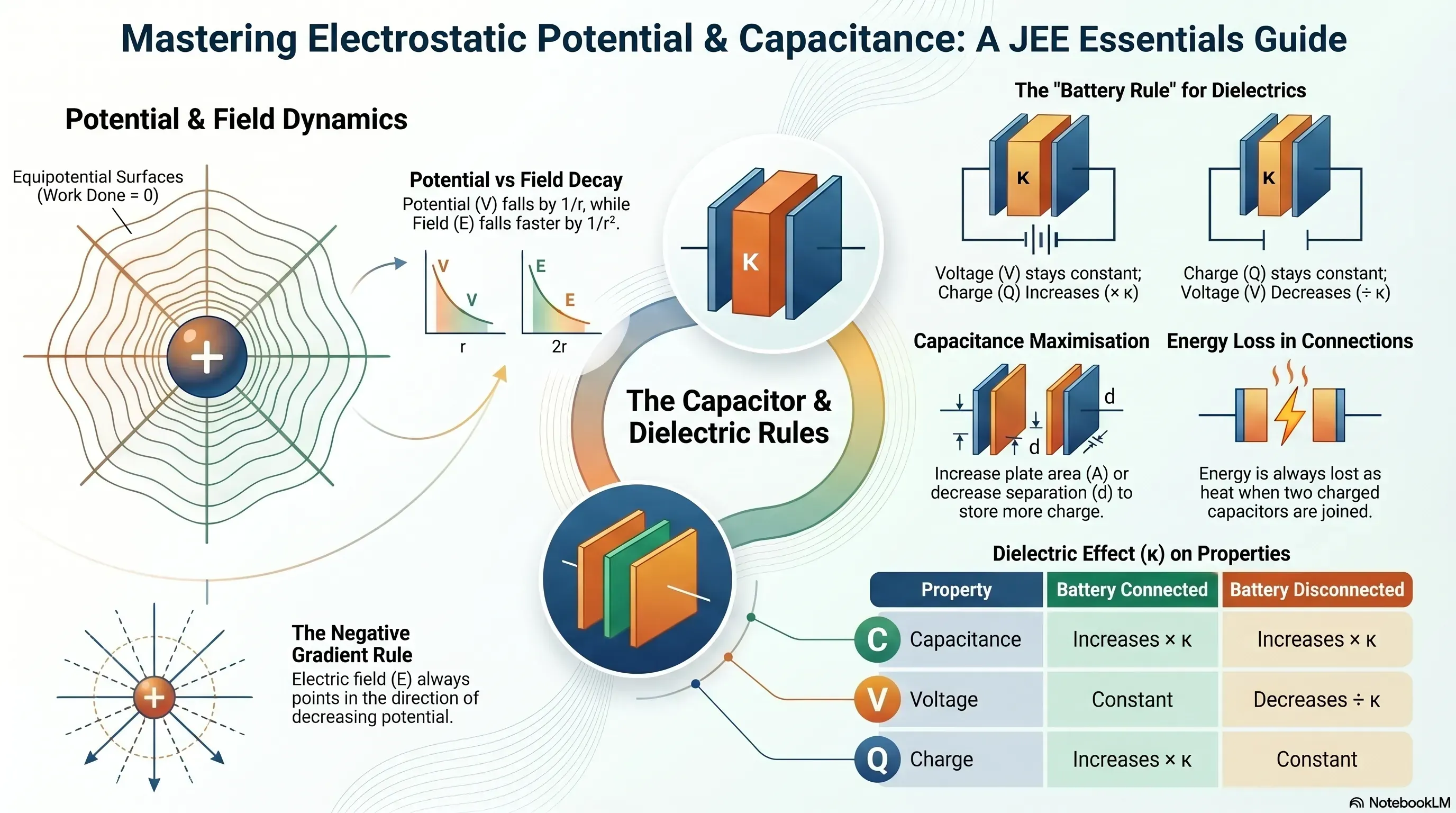
Electrostatic Potential and Capacitance is Chapter 2 of the NCERT Class 12 Physics book, and it follows Chapter 1, Electric Charges and Fields. Chapter 1 tells you the force and the field of a charge, and Chapter 2 tells you the energy and the potential. The JEE Main syllabus lists these topics in its Electrostatics unit: the potential of a point charge, a dipole and a system of charges, equipotential surfaces, the potential energy of charges and of a dipole, conductors and insulators, dielectrics and polarisation, capacitors in series and in parallel, the parallel plate capacitor with and without a dielectric, and the energy stored in a capacitor. These Electrostatic Potential and Capacitance Class 12 Notes follow the NCERT chapter and add the problem types of IIT JEE.
Electric Potential and Potential Energy in Electrostatic Potential and Capacitance Class 12 Notes
The electric potential at a point is the work done by an external agent in bringing a unit positive charge from infinity to that point without acceleration:
$$V = \frac{W}{q_0}, \qquad 1\ \text{volt} = 1\ \text{J C}^{-1}$$
- Potential is a scalar, so potentials of many charges are added with their signs.
- The potential difference between $A$ and $B$ is $V_B - V_A = \dfrac{W_{A\to B}}{q}$, where $W$ is the work done by the external agent in moving the charge $q$ from $A$ to $B$.
- The potential energy of a charge $q$ at a point of potential $V$ is $U = qV$.
- Electron volt: $1\ \text{eV} = 1.6\times10^{-19}\ \text{J}$, the energy that an electron gains in a potential difference of 1 V.
- The electrostatic force is conservative, so the work done in a closed loop is zero.
Potential of Charges and Charge Distributions in Electrostatic Potential and Capacitance Class 12 Notes
Source | Potential |
|---|---|
Point charge $q$ at the distance $r$ | $V = \dfrac{1}{4\pi\varepsilon_0}\dfrac{q}{r}$ |
System of point charges | $V = \dfrac{1}{4\pi\varepsilon_0}\displaystyle\sum_i\dfrac{q_i}{r_i}$ |
Uniformly charged ring, on its axis at the distance $x$ | $V = \dfrac{1}{4\pi\varepsilon_0}\dfrac{Q}{\sqrt{R^2 + x^2}}$ |
Charged spherical shell (conducting or thin), outside ($r \ge R$) | $V = \dfrac{1}{4\pi\varepsilon_0}\dfrac{Q}{r}$ |
Charged spherical shell, inside ($r \le R$) | $V = \dfrac{1}{4\pi\varepsilon_0}\dfrac{Q}{R}$ (constant) |
Uniformly charged solid non-conducting sphere, inside ($r \le R$) | $V = \dfrac{1}{4\pi\varepsilon_0}\dfrac{Q(3R^2 - r^2)}{2R^3}$ |
For a point charge, $V \propto \dfrac{1}{r}$ and $E \propto \dfrac{1}{r^2}$. At the centre of a charged solid sphere, the potential is $\dfrac{3}{2}$ times its value at the surface.
Potential energy of a system of charges (the work done to assemble them):
$$U = \frac{1}{4\pi\varepsilon_0}\left(\frac{q_1q_2}{r_{12}} + \frac{q_2q_3}{r_{23}} + \frac{q_1q_3}{r_{13}}\right)$$
Electric Dipole: Potential, Energy and Torque in Electrostatic Potential and Capacitance Class 12 Notes
A dipole has the charges $+q$ and $-q$ at the distance $2a$, and its dipole moment is $p = q\times 2a$, directed from $-q$ to $+q$. At a point far from the dipole ($r \gg a$), at the angle $\theta$ from the dipole axis:
$$V = \frac{1}{4\pi\varepsilon_0}\frac{p\cos\theta}{r^2}$$
Position | Potential | Field |
|---|---|---|
Axial point ($\theta = 0^\circ$ or $180^\circ$) | $\pm\dfrac{p}{4\pi\varepsilon_0 r^2}$ | $\dfrac{2p}{4\pi\varepsilon_0 r^3}$ |
Equatorial point ($\theta = 90^\circ$) | $0$ | $\dfrac{p}{4\pi\varepsilon_0 r^3}$, so $E \neq 0$ |
In a uniform field $\vec{E}$:
$$\tau = pE\sin\theta, \qquad U = -\vec{p}\cdot\vec{E} = -pE\cos\theta, \qquad W_{\theta_1\to\theta_2} = pE(\cos\theta_1 - \cos\theta_2)$$
The dipole is in stable equilibrium at $\theta = 0^\circ$ (minimum energy $-pE$) and in unstable equilibrium at $\theta = 180^\circ$ (maximum energy $+pE$). In a uniform field, the net force on a dipole is zero.
Equipotential Surfaces and the Relation Between E and V in Electrostatic Potential and Capacitance Class 12 Notes
An equipotential surface has the same potential at every point.
- No work is done in moving a charge along it, and the field is perpendicular to it at every point.
- Two equipotential surfaces never intersect, because a point cannot have two potentials.
- If the surfaces are drawn at equal steps of potential, they are closer together where the field is stronger.
- The surfaces are concentric spheres for a point charge, and parallel planes for a uniform field.
$$E = -\frac{dV}{dr}, \qquad \vec{E} = -\nabla V = -\left(\frac{\partial V}{\partial x}\hat{i} + \frac{\partial V}{\partial y}\hat{j} + \frac{\partial V}{\partial z}\hat{k}\right), \qquad V_A - V_B = \int_A^B \vec{E}\cdot d\vec{l}$$
$\vec{E}$ points in the direction in which the potential falls most quickly. For a uniform field, $E = \dfrac{\Delta V}{d}$, where $d$ is the distance between two equipotential planes.
Conductors in Electrostatics in Electrostatic Potential and Capacitance Class 12 Notes
- The field inside a conductor is zero, and the whole conductor (with its surface) is at one potential. The potential is constant, but not necessarily zero.
- The excess charge is on the outer surface, and the field just outside is $\dfrac{\sigma}{\varepsilon_0}$, perpendicular to the surface.
- The charge density is higher at sharp points, and this is the principle of lightning conductors and of corona discharge.
- Electrostatic shielding: the inside of a hollow conductor is not affected by an external field.
- Two connected spheres reach the same potential: $\dfrac{q_1}{R_1} = \dfrac{q_2}{R_2}$, so the charge density is $\dfrac{\sigma_1}{\sigma_2} = \dfrac{R_2}{R_1}$ (the smaller sphere has the larger density).
Dielectrics and Polarisation in Electrostatic Potential and Capacitance Class 12 Notes
A dielectric is an insulator that gets polarised in an electric field. The polarisation $P$ is the dipole moment per unit volume (unit: C m$^{-2}$).
Type of polarisation | Mechanism | Example |
|---|---|---|
Electronic | The electron cloud shifts relative to the nucleus | Non-polar atoms and molecules |
Ionic | The positive and negative ions shift in opposite directions | NaCl |
Orientational | Permanent dipoles line up with the field | Water, HCl |
The induced (bound) charges on the surfaces of the dielectric make a field that opposes the applied field, so the net field falls. The dielectric constant is $\kappa = \dfrac{E_0}{E} \ge 1$, and for the same free charge:
$$E = \frac{E_0}{\kappa}, \qquad \sigma_{bound} = \sigma\left(1 - \frac{1}{\kappa}\right)$$
Capacitors and Capacitance in Electrostatic Potential and Capacitance Class 12 Notes
A capacitor stores charge and energy, and its capacitance is $C = \dfrac{Q}{V}$ (unit: farad, $1\ \text{F} = 1\ \text{C V}^{-1}$). It depends only on the geometry and the medium, and not on $Q$ or $V$.
Capacitor | Capacitance |
|---|---|
Isolated conducting sphere of radius $R$ | $C = 4\pi\varepsilon_0 R$ |
Parallel plate (area $A$, separation $d$) | $C = \dfrac{\varepsilon_0 A}{d}$, and with a dielectric that fills the gap, $C = \dfrac{\kappa\varepsilon_0 A}{d}$ |
Parallel plate with a dielectric slab of thickness $t$ | $C = \dfrac{\varepsilon_0 A}{d - t + \frac{t}{\kappa}}$ |
Parallel plate with a conducting slab of thickness $t$ | $C = \dfrac{\varepsilon_0 A}{d - t}$ |
Dielectric covers a part $A_2$ of the area (and $A_1$ is air) | $C = \dfrac{\varepsilon_0(A_1 + \kappa A_2)}{d}$ |
Two dielectric layers ($d_1, \kappa_1$ and $d_2, \kappa_2$) | $C = \dfrac{\varepsilon_0 A}{\frac{d_1}{\kappa_1} + \frac{d_2}{\kappa_2}}$ |
Spherical capacitor (radii $a < b$) | $C = 4\pi\varepsilon_0\dfrac{ab}{b - a}$ |
Cylindrical capacitor (length $L$, radii $a < b$) | $C = \dfrac{2\pi\varepsilon_0 L}{\ln(b/a)}$ |
The capacitance of a parallel plate capacitor rises with a larger area $A$, a smaller separation $d$ and a larger $\kappa$.
Effect of Inserting a Dielectric Slab in Electrostatic Potential and Capacitance Class 12 Notes
Here the slab fills the whole gap of a parallel plate capacitor. Always decide first whether the battery is connected.
Quantity | Battery connected ($V$ constant) | Battery disconnected ($Q$ constant) |
|---|---|---|
Capacitance $C$ | $\times\kappa$ | $\times\kappa$ |
Charge $Q$ | $\times\kappa$ | Same |
Potential difference $V$ | Same | $\div\kappa$ |
Field $E$ between the plates | Same | $\div\kappa$ |
Energy $U$ | $\times\kappa$ | $\div\kappa$ |
With the battery connected, the battery supplies the extra energy. In the disconnected case, the energy falls, because the field does work in pulling the slab in.
Combination of Capacitors and Charge Sharing in Electrostatic Potential and Capacitance Class 12 Notes
Combination | Rule |
|---|---|
Series | $\dfrac{1}{C} = \dfrac{1}{C_1} + \dfrac{1}{C_2} + \cdots$. The charge $Q$ is the same, the voltages add, and $C$ is less than the smallest. For two capacitors, $C = \dfrac{C_1C_2}{C_1 + C_2}$ |
Parallel | $C = C_1 + C_2 + \cdots$. The voltage $V$ is the same, the charges add, and $C$ is more than the largest |
Balanced bridge of four capacitors | If $\dfrac{C_1}{C_2} = \dfrac{C_3}{C_4}$, the capacitor between the two middle points carries no charge |
Charge sharing: two capacitors $C_1$ and $C_2$, charged to $V_1$ and $V_2$, are joined with like plates connected. Charge is conserved, and the common potential and the loss of energy are:
$$V = \frac{C_1V_1 + C_2V_2}{C_1 + C_2}, \qquad \Delta U = \frac{1}{2}\frac{C_1C_2}{C_1 + C_2}(V_1 - V_2)^2$$
The loss $\Delta U$ is zero if $V_1 = V_2$. Otherwise, it is lost as heat (and radiation) in the connecting wires. If the plates are joined with unlike polarity, put $V_2$ as a negative number.
Energy Stored in a Capacitor and Force Between the Plates in Electrostatic Potential and Capacitance Class 12 Notes
$$U = \frac{1}{2}CV^2 = \frac{Q^2}{2C} = \frac{1}{2}QV, \qquad u = \frac{1}{2}\varepsilon_0E^2 \ \ (\text{vacuum}), \qquad u = \frac{1}{2}\kappa\varepsilon_0E^2 \ \ (\text{dielectric})$$
The energy is stored in the field, with the energy density $u$ (energy per unit volume). The force between the plates of a parallel plate capacitor is the charge on one plate times the field due to the other plate ($E/2$):
$$F = \frac{Q^2}{2\varepsilon_0 A} = \frac{1}{2}\varepsilon_0E^2A$$
To pull the plates apart by a small distance $\Delta d$ with $Q$ constant, the work done is $F\,\Delta d$, which equals the increase in the stored energy.
Key Formulas in Electrostatic Potential and Capacitance Class 12 Notes
Concept | Formula |
|---|---|
Potential of a point charge | $V = \dfrac{kq}{r}$, $k = 9\times10^9\ \text{N m}^2\text{C}^{-2}$ |
Potential of a dipole | $V = \dfrac{kp\cos\theta}{r^2}$ |
Energy of a dipole | $U = -pE\cos\theta$ |
$E$ from $V$ | $\vec{E} = -\nabla V$ |
Capacitance | $C = Q/V$, $\ C = \kappa\varepsilon_0 A/d$ |
Series, parallel | $\frac{1}{C} = \sum\frac{1}{C_i}$, $\ C = \sum C_i$ |
Energy | $U = \tfrac{1}{2}CV^2 = Q^2/2C$ |
Energy density | $u = \tfrac{1}{2}\varepsilon_0E^2$ |
Loss in charge sharing | $\tfrac{1}{2}\frac{C_1C_2}{C_1+C_2}(V_1 - V_2)^2$ |
Force between the plates | $Q^2/(2\varepsilon_0A)$ |
IIT JEE Tips for Electrostatic Potential and Capacitance Class 12 Notes
- The battery rule: write “connected, $V$ constant” or “disconnected, $Q$ constant” before every dielectric problem.
- Choose the energy formula that uses the given quantities: $\tfrac{1}{2}CV^2$ if $C$ and $V$ are given, $Q^2/2C$ if $Q$ and $C$ are given.
- Use potentials, not fields, for a sum over charges, because potentials add as scalars.
- For a field from $V(x, y, z)$, take the negative partial derivatives, and then the magnitude.
- Redraw the circuit of a capacitor network and find the series and parallel groups step by step. Look for a balanced bridge.
- In a series combination, the smallest capacitor has the largest voltage, so it is the first to be in danger of breakdown (compare the voltage with its rated value).
- For a slab that is not full or has a different position, use the formulas for the series or the parallel layers.
Common Mistakes in Electrostatic Potential and Capacitance Class 12 Problems
Mistake | Correct approach |
|---|---|
Saying that $E = 0$ means $V = 0$ (or the other way round) | $E = 0$ inside a conductor, but $V$ is constant and not zero. On the equator of a dipole, $V = 0$ but $E \neq 0$ |
Using $V = kp\cos\theta/r^2$ for a point close to the dipole | It holds for $r \gg a$ |
Using $C = \kappa\varepsilon_0A/d$ for a slab that does not fill the gap | Use the formula with the thickness $t$, or the series and parallel layers |
Keeping $V$ constant after the battery is removed | Then $Q$ is constant |
Saying that energy is always lost when capacitors are joined | The loss is $\tfrac{1}{2}\frac{C_1C_2}{C_1+C_2}(V_1 - V_2)^2$, and it is zero if $V_1 = V_2$ |
Adding capacitances in series | Add the reciprocals |
Using $\tfrac{1}{2}QV$ with $Q$ and $V$ of different capacitors | Use the charge and the voltage of the same capacitor |
Solved Examples from Electrostatic Potential and Capacitance Class 12 Notes
Example 1 (potential of two charges): Charges $+2\ \mu\text{C}$ and $-3\ \mu\text{C}$ are at 0.3 m and 0.6 m from a point $P$. Find the potential at $P$.
$V = 9\times10^{9}\left(\dfrac{2\times10^{-6}}{0.3} - \dfrac{3\times10^{-6}}{0.6}\right) = 9\times10^{9}\times1.667\times10^{-6} = 1.5\times10^{4}$ V.
Example 2 (work and potential): Find the work done in bringing a $2\ \mu\text{C}$ charge from infinity to a point at the potential 500 V.
$W = qV = 2\times10^{-6}\times500 = 1\times10^{-3}$ J.
Example 3 (dipole potential): A dipole of the moment $4\times10^{-9}$ C m is far from a point on its axis at $r = 0.5$ m. Find the potential.
$V = \dfrac{kp}{r^2} = \dfrac{9\times10^{9}\times4\times10^{-9}}{0.25} = 144$ V.
Example 4 (the field from the potential): $V = 3x^2 + 2y - z$ (in volts, with $x, y, z$ in metres). Find $\vec{E}$ at $(1, 1, 1)$ and $|\vec{E}|$.
$\vec{E} = -(6x\,\hat{i} + 2\,\hat{j} - \hat{k})$, so at $(1, 1, 1)$ it is $(-6, -2, 1)$ V/m, and $|\vec{E}| = \sqrt{36 + 4 + 1} = \sqrt{41} \approx 6.4$ V/m.
Example 5 (energy of three charges): Three charges of $1\ \mu\text{C}$ are at the corners of an equilateral triangle of side 0.1 m. Find the energy of the system.
$U = 3\times\dfrac{kq^2}{a} = 3\times\dfrac{9\times10^{9}\times10^{-12}}{0.1} = 0.27$ J.
Example 6 (energy of four charges): Find the work needed to assemble four equal charges $q$ at the corners of a square of side $a$.
There are 4 pairs at the distance $a$ and 2 pairs at the distance $a\sqrt{2}$: $U = \dfrac{kq^2}{a}\left(4 + \dfrac{2}{\sqrt{2}}\right) = (4 + \sqrt{2})\dfrac{kq^2}{a}$.
Example 7 (capacitors in series): Capacitors of $2$, $4$ and $6\ \mu\text{F}$ are in series across 24 V. Find the equivalent capacitance, the charge and the voltage across each.
$\dfrac{1}{C} = \dfrac{1}{2} + \dfrac{1}{4} + \dfrac{1}{6} = \dfrac{11}{12}$, so $C = \dfrac{12}{11} \approx 1.09\ \mu\text{F}$. The charge on each is $Q = CV = \dfrac{12}{11}\times24 \approx 26.2\ \mu\text{C}$. The voltages are $\dfrac{Q}{2} \approx 13.1$ V, $\dfrac{Q}{4} \approx 6.5$ V and $\dfrac{Q}{6} \approx 4.4$ V (the sum is 24 V).
Example 8 (a parallel plate capacitor): The plates have the area $100\ \text{cm}^2$ and the separation 1 mm. Find $C$, and $C$ with a dielectric of $\kappa = 5$ in the gap.
$C = \dfrac{\varepsilon_0A}{d} = \dfrac{8.85\times10^{-12}\times10^{-2}}{10^{-3}} = 88.5$ pF. With the dielectric, $C = 5\times88.5 = 442.5$ pF.
Example 9 (charge sharing): A 200 pF capacitor is charged to 300 V and disconnected. It is joined to an uncharged 100 pF capacitor. Find the common potential and the energy lost.
$Q = 200\times10^{-12}\times300 = 6\times10^{-8}$ C. $V = \dfrac{Q}{C_1 + C_2} = \dfrac{6\times10^{-8}}{300\times10^{-12}} = 200$ V. The initial energy is $\tfrac{1}{2}(200\ \text{pF})(300)^2 = 9\ \mu\text{J}$, and the final energy is $\tfrac{1}{2}(300\ \text{pF})(200)^2 = 6\ \mu\text{J}$. The energy lost is $3\ \mu\text{J}$.
Example 10 (a dielectric slab): A $10\ \mu\text{F}$ capacitor is charged to 100 V. A slab of $\kappa = 4$ fills the gap. Find $V$ and $U$ if (a) the battery is disconnected, and (b) it stays connected.
(a) $Q = 10^{-3}$ C is constant, $C' = 40\ \mu\text{F}$, so $V' = 25$ V. $U_i = \tfrac{1}{2}CV^2 = 0.05$ J and $U_f = \dfrac{U_i}{4} = 0.0125$ J. (b) $V = 100$ V, $Q' = 4$ mC, and $U_f = 4\times0.05 = 0.2$ J.
Example 11 (a conducting slab): A parallel plate capacitor has $A = 0.01\ \text{m}^2$ and $d = 2$ mm. A conducting slab of thickness 1 mm is inserted. Find the new capacitance.
Originally, $C = \dfrac{\varepsilon_0A}{d} = 44.25$ pF. Now $C = \dfrac{\varepsilon_0A}{d - t} = \dfrac{8.85\times10^{-12}\times10^{-2}}{10^{-3}} = 88.5$ pF, which is double.
Example 12 (the force between the plates): The plates of a capacitor carry $\pm2\ \mu\text{C}$, and the area is $0.01\ \text{m}^2$. Find the force between them.
$F = \dfrac{Q^2}{2\varepsilon_0A} = \dfrac{(2\times10^{-6})^2}{2\times8.85\times10^{-12}\times0.01} = \dfrac{4\times10^{-12}}{1.77\times10^{-13}} \approx 22.6$ N.
How to Study Electrostatic Potential and Capacitance Class 12 Notes
- Read the NCERT chapter first, and download the textbook from eSaral’s NCERT books for Class 12 page.
- Learn the potential formulas and the dipole results, and then the table for a dielectric with and without the battery. Practise the capacitor networks by redrawing them.
- Solve one problem each on the potential of a charge system, the field from $V$, charge sharing, a dielectric or a conducting slab, and the force between the plates.
- Check your answers to the NCERT exercises with eSaral’s NCERT Solutions for Class 12 Physics, and revise with eSaral’s Class 12 Physics notes.
- Test yourself with eSaral’s JEE Main chapter-wise PYQs and JEE Advanced chapter-wise PYQs.
Frequently Asked Questions
What is the difference between electric potential and electric potential energy?
Electric potential $V$ belongs to a point in space. It is the work done per unit positive charge in bringing a charge from infinity to that point, and it does not depend on the test charge. Electric potential energy $U = qV$ belongs to a given charge at that point, and it depends on the charge. eSaral’s Electrostatic Potential and Capacitance Class 12 Notes show both with solved examples.
Why is the electric field inside a conductor zero?
In Electrostatic Potential and Capacitance Class 12 Notes, the free charges of a conductor move until the net force on them is zero. The induced charges on the surface make a field inside that exactly cancels any external field, so $E = 0$ inside, and the whole conductor is at one potential.
What happens to the capacitance when a dielectric is inserted?
If the dielectric of constant $\kappa$ fills the gap, the capacitance is multiplied by $\kappa$: $C = \kappa C_0$. The dielectric reduces the field between the plates, so for the same charge, the potential difference falls. In Electrostatic Potential and Capacitance Class 12 Notes, the other quantities depend on whether the battery is connected.
What changes when a dielectric is inserted in a charged capacitor, with the battery connected or disconnected?
In Electrostatic Potential and Capacitance Class 12 Notes, with the battery connected, $V$ is constant, and $C$, $Q$ and $U$ are multiplied by $\kappa$, while $E$ is the same. With the battery disconnected, $Q$ is constant, $C$ is multiplied by $\kappa$, and $V$, $E$ and $U$ are divided by $\kappa$.
Why is the potential zero on the equatorial line of a dipole, although the field is not?
For the equatorial point, $\theta = 90^\circ$, so $\cos\theta = 0$ and $V = 0$. The field is $\dfrac{p}{4\pi\varepsilon_0 r^3}$, which is not zero, because the field is a vector and its two components add up along the dipole axis.
Why do equipotential surfaces never intersect?
In Electrostatic Potential and Capacitance Class 12 Notes, a point has one value of the potential. If two surfaces of different potentials crossed, the crossing point would have two potentials at the same time, which is impossible.
How do you find the energy lost when two capacitors are joined?
Find the common potential by conservation of charge, $V = \dfrac{C_1V_1 + C_2V_2}{C_1 + C_2}$, and the energy lost is $\tfrac{1}{2}\dfrac{C_1C_2}{C_1 + C_2}(V_1 - V_2)^2$. It is zero if the two capacitors are already at the same potential. These Electrostatic Potential and Capacitance Class 12 Notes work out this case in Example 9.
How does the energy stored in a capacitor relate to the field between the plates?
In Electrostatic Potential and Capacitance Class 12 Notes, the energy is stored in the field with the density $u = \tfrac{1}{2}\varepsilon_0E^2$ (or $\tfrac{1}{2}\kappa\varepsilon_0E^2$ in a dielectric). Multiplying by the volume $Ad$ gives $U = \tfrac{1}{2}CV^2$ for a parallel plate capacitor.
Is Electrostatic Potential and Capacitance important for IIT JEE and NEET?
Yes, it is a part of the Electrostatics unit of the JEE Main syllabus, and it also appears in JEE Advanced and NEET. The number of questions changes every year, so check previous years’ papers. The common topics are capacitor networks, a dielectric with and without the battery, charge sharing and the field from $V$.
Where can I find more Class 12 Physics notes on eSaral?
eSaral has chapter-wise Class 12 Physics notes, NCERT solutions for Class 12 Physics, NCERT books, JEE Main and JEE Advanced chapter-wise PYQs, and these Electrostatic Potential and Capacitance Class 12 Notes, all linked on this page.
Team eSaral
eSaral Academic and Editorial Team
Team eSaral is the collective author profile for educational content created by eSaral’s teachers and academic contributors. The team draws on expertise from IIT graduates, doctors, experienced educators and subject specialists to develop resources for JEE, NEET and school students. Our articles aim to explain concepts clearly and help students study with confidence.
Related Posts

NCERT Physics Class 10 Book PDF in Hindi 2026-27 – भौतिक विज्ञान के 4 अध्याय (Free Download)
NCERT Physics Class 10 book PDF in Hindi 2026-27: download all 4 chapters (अध्याय 9–12) free, with topics and important formulas.

NCERT Biology Class 9 Book Anveshan PDF in Hindi - जीव विज्ञान कक्षा 9 पुस्तक अन्वेषण PDF
Download NCERT Biology Class 9 book PDF in Hindi chapterwise for 2026-27: Cell, Tissues, Reproduction and Diversity. Free PDFs.

Essay On Artificial Intelligence in English (100,150, 200, 250, 300, 500 Words)
This is in contrast to the natural intelligence of humans. With Artificial Intelligence, machines can perform

Essay on 78th India Independence Day in English for Student (100, 150, 200, 250, 300, 500 Words)
Read the best essays on India's Independence Day in English. Short & long essays (100, 150, 200, 250, 300, 500 words) perfect for school exams
NCERT Class 11 English Snapshots book - Free PDF download- Esaral
Download NCERT Class 11 English Snapshots book PDF for free. Get all 8 chapters, chapter-wise. Start your prep today!
NCERT Class 10 biology book pdf - Free PDF Download - eSaral
NCERT Class 10 Biology book PDF 2026-27: all 5 chapters (Life Processes to Our Environment) in English & Hindi, with CBSE syllabus, marks & practical

Essay on Global Warming in English (100,150, 200, 250, 300, 500 Words)
Global warming means the Earth is getting hotter. This happens because of things like pollution from cars and factories.

NCERT Class 12 English Book 2026-27: Flamingo, Vistas and Kaleidoscope PDF, Chapters and Syllabus
NCERT Class 12 English book 2026-27: Flamingo & Vistas (English Core) and Kaleidoscope (Elective) PDFs chapter-wise, with syllabus and sample papers.

NCERT Class 11 Physics Book —Part1 & Part 2 download in Hindi - NCERT भौतिकी कक्षा 11 पुस्तक
Download Class 11 Physics NCERT book PDF in Hindi – all 15 chapters, chapterwise links, JEE & NEET tips. Free PDF, no signup needed.

NCERT Class 10 Hindi Book PDF 2026-27 – क्षितिज, कृतिका, स्पर्श, संचयन (Chapterwise Free Download)
Download NCERT Class 10 Hindi Book PDF 2026-27 free, chapterwise: Kshitij, Kritika, Sparsh, Sanchayan. Includes CBSE syllabus & deleted chapters.