
Functions and Limits Notes for Class 12 & IIT JEE

eSaral Academic and Editorial Team
Summary
Functions and Limits Notes for IIT JEE cover the properties of functions (domain, range, types, composite and inverse functions, even, odd and periodic functions, and graph transformations), the meaning and existence of a limit, the standard limits, the series method, L’Hôpital’s rule, the indeterminate forms, limits at infinity, and continuity with its types of discontinuity.
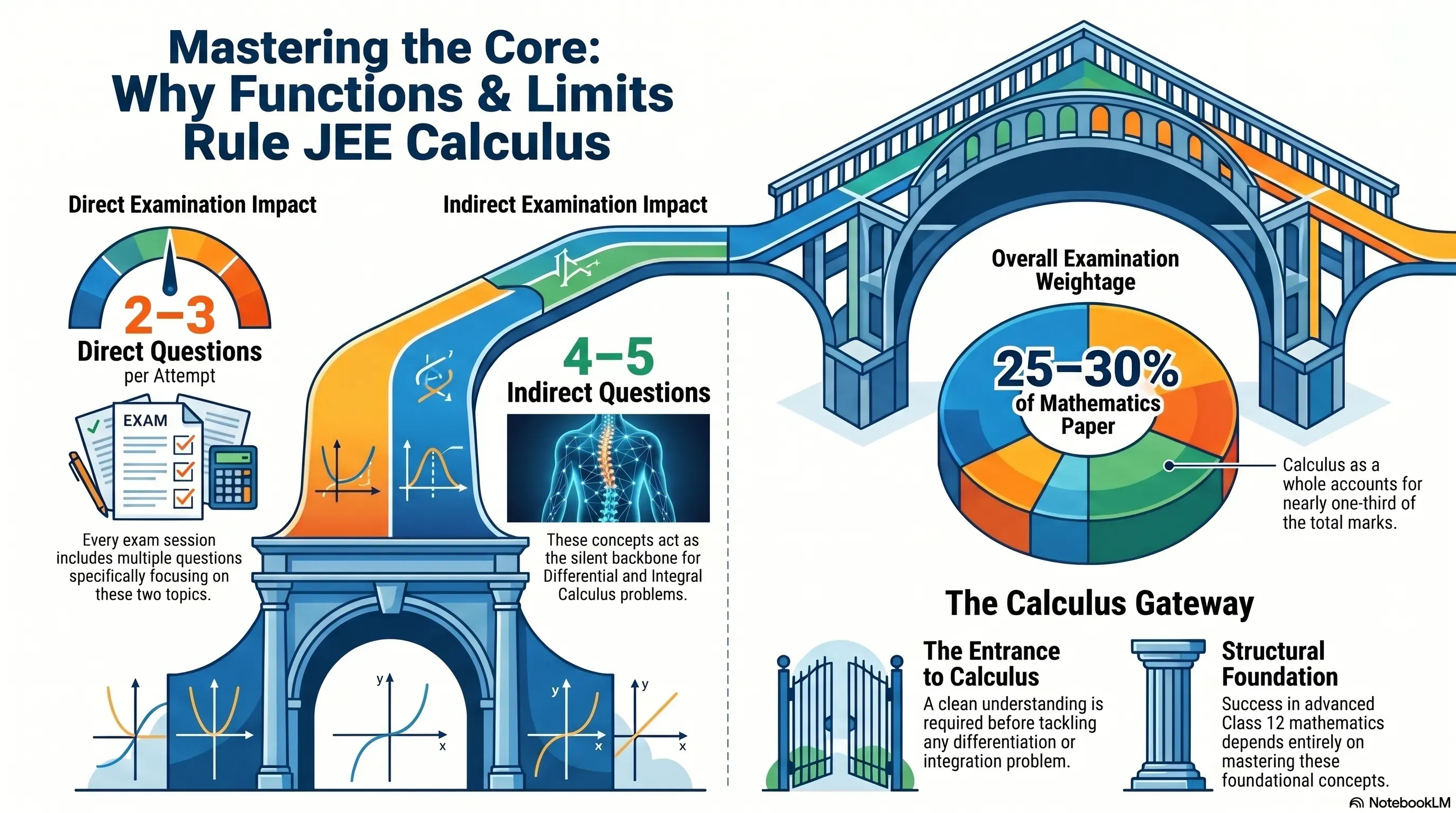
Functions and limits are the entrance to calculus, and these Functions and Limits Notes are written for IIT JEE. In the NCERT books, functions are in Class 11 (Chapter 2, Relations and Functions) and Class 12 (Chapter 1, Relations and Functions), limits are in Class 11 (Chapter 12, Limits and Derivatives; Chapter 13 in older books), and continuity is in Class 12 (Chapter 5, Continuity and Differentiability). IIT JEE joins them in one unit. These Functions and Limits Notes follow that order, so you can use them with any of the books.
Functions and Limits Notes: Chapter Overview and Syllabus
Topic | NCERT | IIT JEE (Main and Advanced) |
|---|---|---|
Real functions, domain and range, algebra of functions | Class 11 Ch 2, Class 12 Ch 1 | Yes |
One-one, onto, composite and inverse functions | Class 12 Ch 1 | Yes (listed for JEE Advanced) |
Even, odd and periodic functions, graphs of simple functions | Class 11 | Yes |
Limits, standard limits, indeterminate forms | Class 11 Ch 12 | Yes |
Continuity, types of discontinuity, intermediate value property | Class 12 Ch 5 | Yes |
L’Hôpital’s rule, series expansion of limits | Not in NCERT | Used widely in JEE problems |
Check the latest NTA (JEE Main) syllabus and the JEE Advanced syllabus for the exact lists. The weightage of the unit is not published, so use previous years’ papers to judge how often it is asked.
Tip from the eSaral Maths team: Do every limit problem in the same order: substitute first, then simplify, then use a standard limit, then a series, and use L’Hôpital’s rule last. Most mistakes come from using the rule before checking the form.
Functions and Limits Notes
India's Best Exam Preparation for Class 12th - Download Now
India's Best Exam Preparation for Class 12th - Download Now
India's Best Exam Preparation for Class 12th - Download Now
India's Best Exam Preparation for Class 12th - Download Now
India's Best Exam Preparation for Class 12th - Download Now
Functions for IIT JEE in Functions and Limits Notes
A function $f : A \to B$ gives exactly one output in $B$ for every input in $A$. The domain is the set of inputs, and the range is the set of outputs. For the full basics, with the domain rules and the standard functions, see eSaral’s Functions Class 11 notes.
Concept | Meaning and result |
|---|---|
One-one (injective) | Different inputs give different outputs. A horizontal line meets the graph at most once. |
Onto (surjective) | The range equals the co-domain. |
Composite function | $(f \circ g)(x) = f\big(g(x)\big)$. It exists when the range of $g$ is inside the domain of $f$, and in general $f \circ g \neq g \circ f$. |
Inverse function | $f^{-1}$ exists only if $f$ is bijective. Its graph is the mirror image of the graph of $f$ in the line $y = x$, and $f^{-1}\big(f(x)\big) = x$. |
Even function | $f(-x) = f(x)$, and the graph is symmetric about the $y$-axis. |
Odd function | $f(-x) = -f(x)$, and the graph is symmetric about the origin. |
Periodic function | $f(x + T) = f(x)$. The period of $f + g$ is the LCM of the periods. |
Special functions: the greatest integer function $[x]$, the fractional part $\{x\} = x - [x]$, the modulus $\lvert x\rvert$ and the signum function. They are the main source of limit and continuity problems, because they jump or change form at some points.
Graph Transformations
Transformation | Effect on the graph of $y = f(x)$ |
|---|---|
$y = f(x) + k$ | Shift up by $k$ |
$y = f(x + k)$ | Shift left by $k$ |
$y = -f(x)$ | Reflection in the $x$-axis |
$y = f(-x)$ | Reflection in the $y$-axis |
$y = \lvert f(x)\rvert$ | The part below the $x$-axis is reflected above it |
$y = f(\lvert x\rvert)$ | The part for $x \geq 0$ is kept, and it is reflected in the $y$-axis |
$y = a f(x)$ | Vertical stretch by the factor $a$ |
$y = f(ax)$ | Horizontal compression by the factor $a$ |
Limit of a Function: Meaning and Existence in Functions and Limits Notes
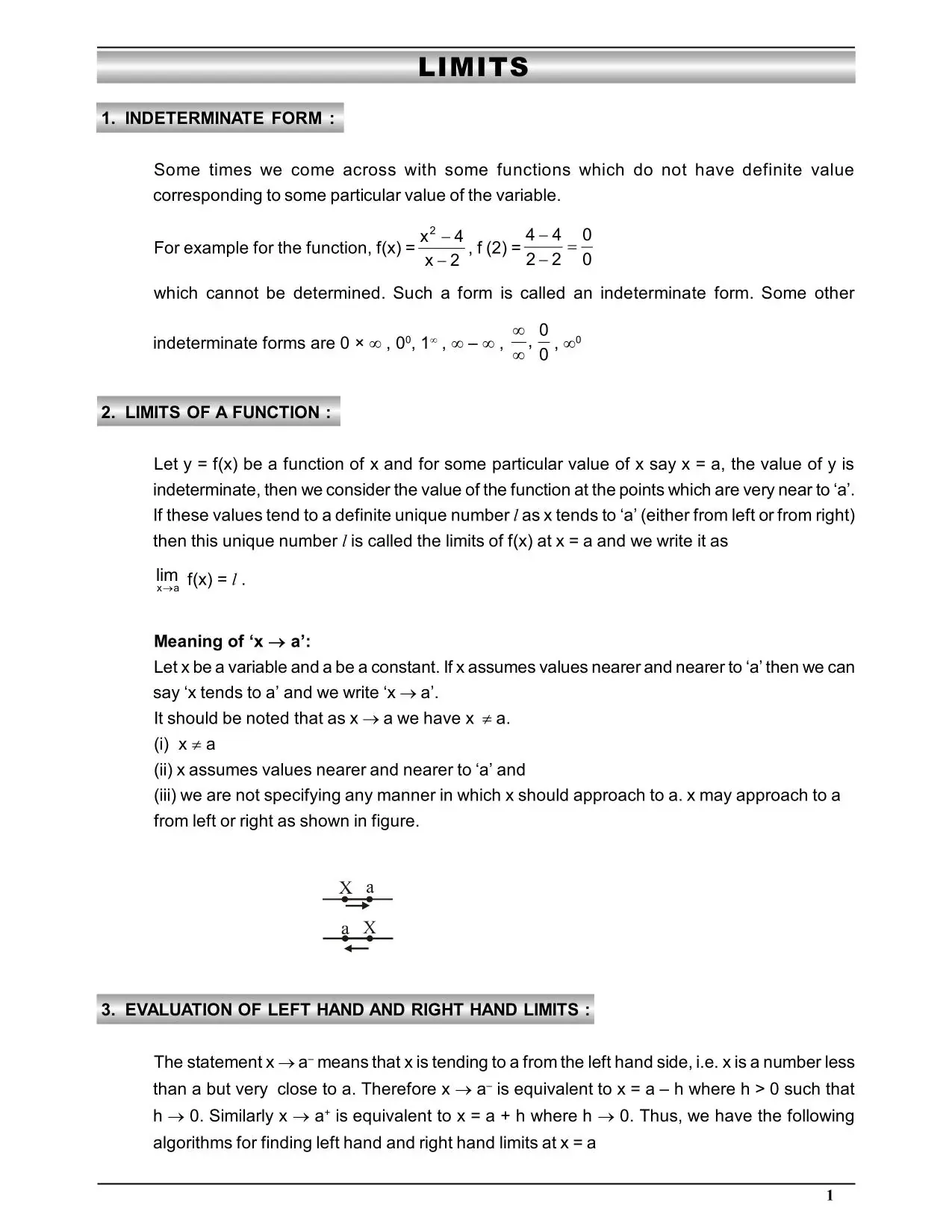
$$\lim_{x \to a} f(x) = L$$
means that $f(x)$ gets as close as we like to $L$ when $x$ gets close to $a$ (but $x \neq a$). The value $f(a)$ does not matter, and $f(a)$ may not even be defined.
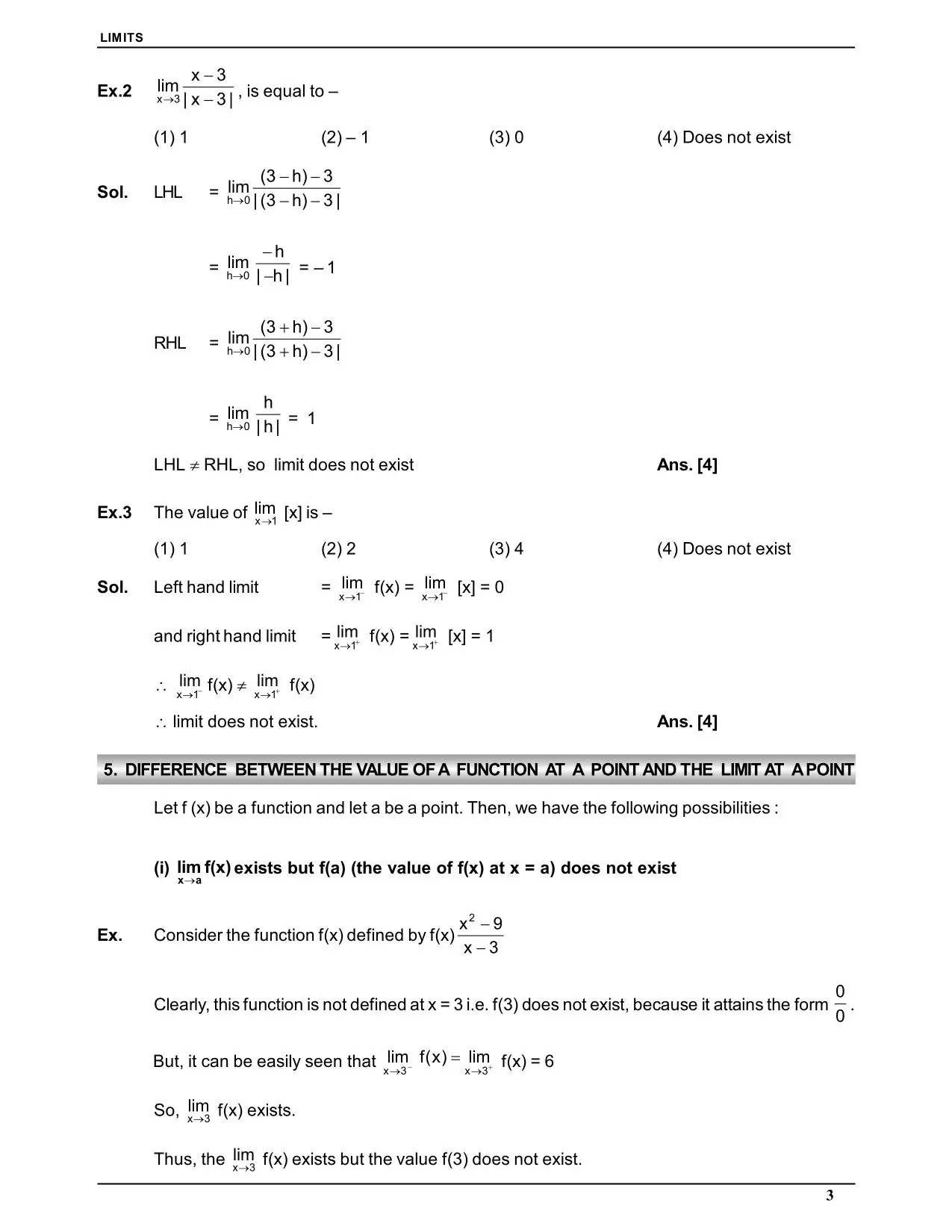
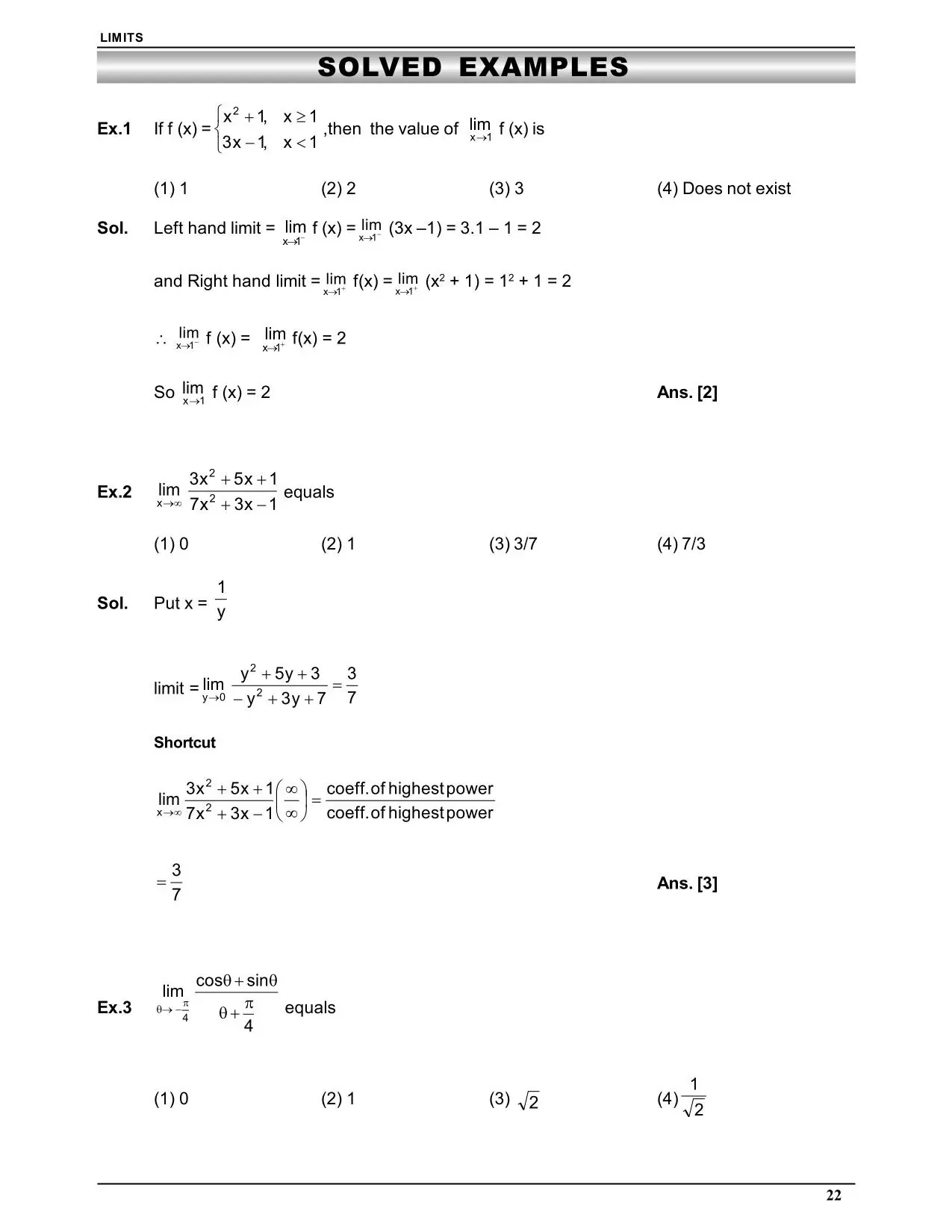
- Left-hand limit (LHL): $\displaystyle\lim_{x \to a^-} f(x)$, with $x < a$. Right-hand limit (RHL): $\displaystyle\lim_{x \to a^+} f(x)$, with $x > a$.
- The limit exists if and only if the LHL and the RHL both exist, are finite and are equal.
- For $[x]$ and $\lvert x\rvert/x$, and for any function that changes its rule at $a$, always check both sides.
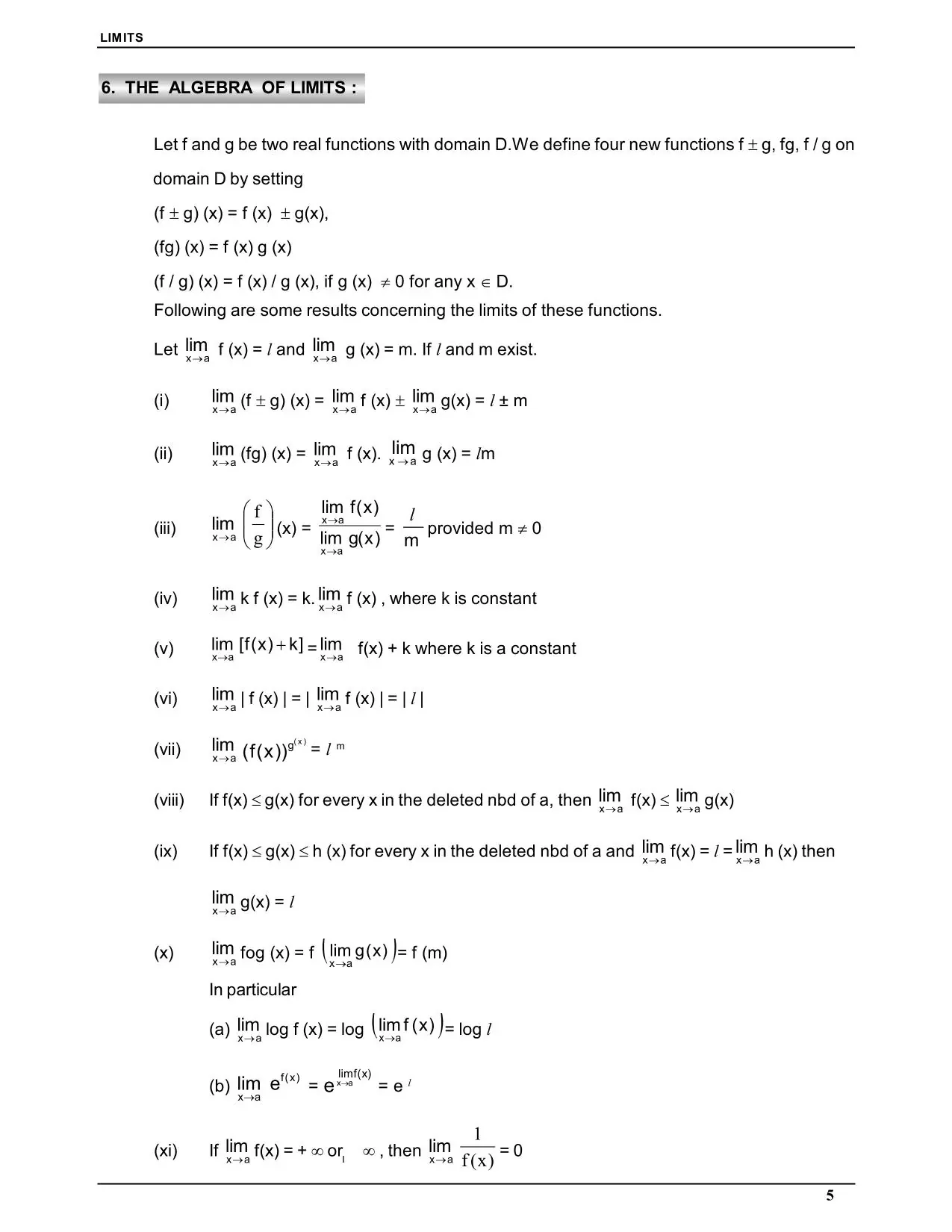
Algebra of limits: if $\lim f = L$ and $\lim g = M$, then:
$$\lim (f \pm g) = L \pm M, \qquad \lim (fg) = LM, \qquad \lim \frac{f}{g} = \frac{L}{M}\ (M \neq 0), \qquad \lim \big(c\,f\big) = cL$$
Sandwich (squeeze) theorem: if $g(x) \leq f(x) \leq h(x)$ near $a$, and $\lim g = \lim h = L$, then $\lim f = L$. For example, $\displaystyle\lim_{x \to 0} x^{2}\sin\frac{1}{x} = 0$.
Standard Limits for IIT JEE in Functions and Limits Notes
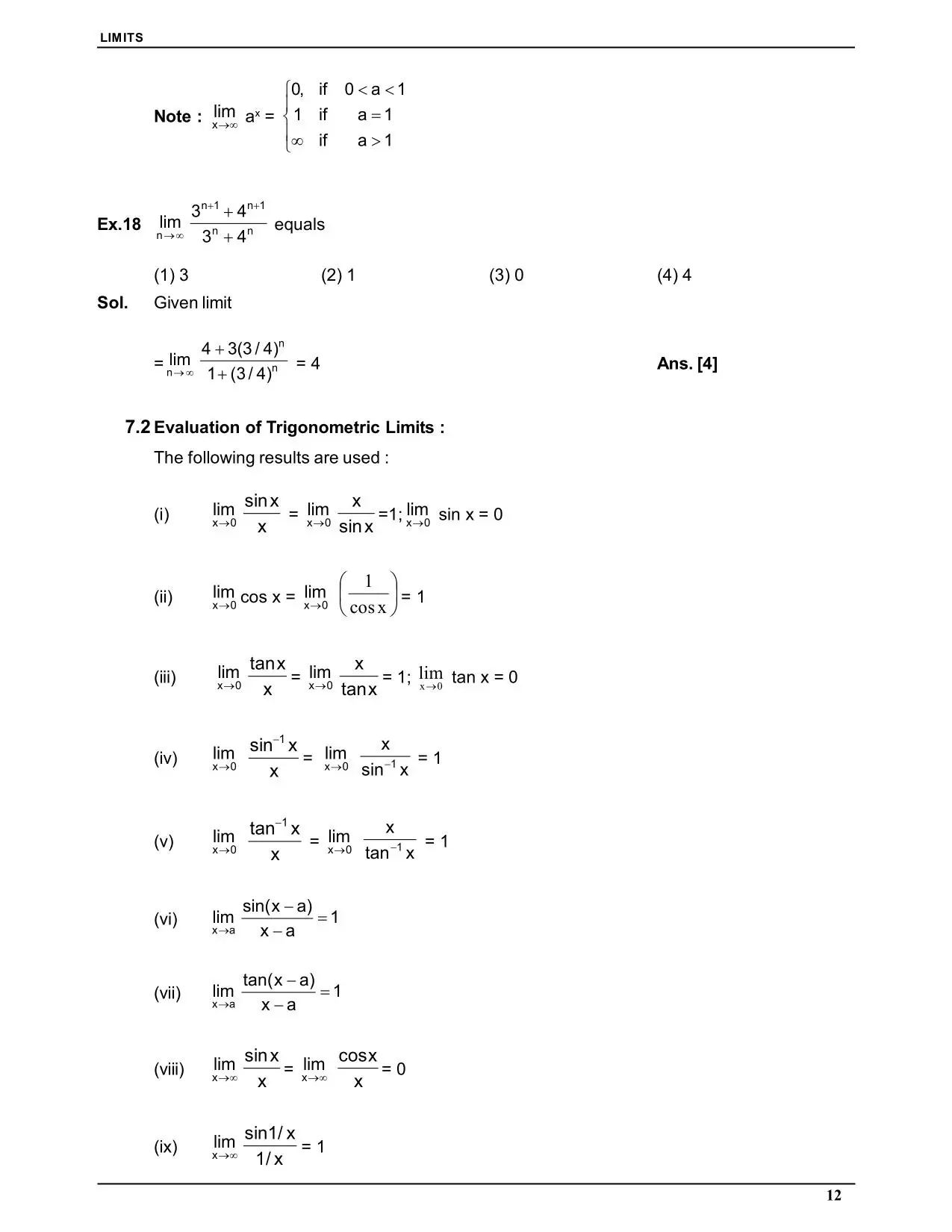
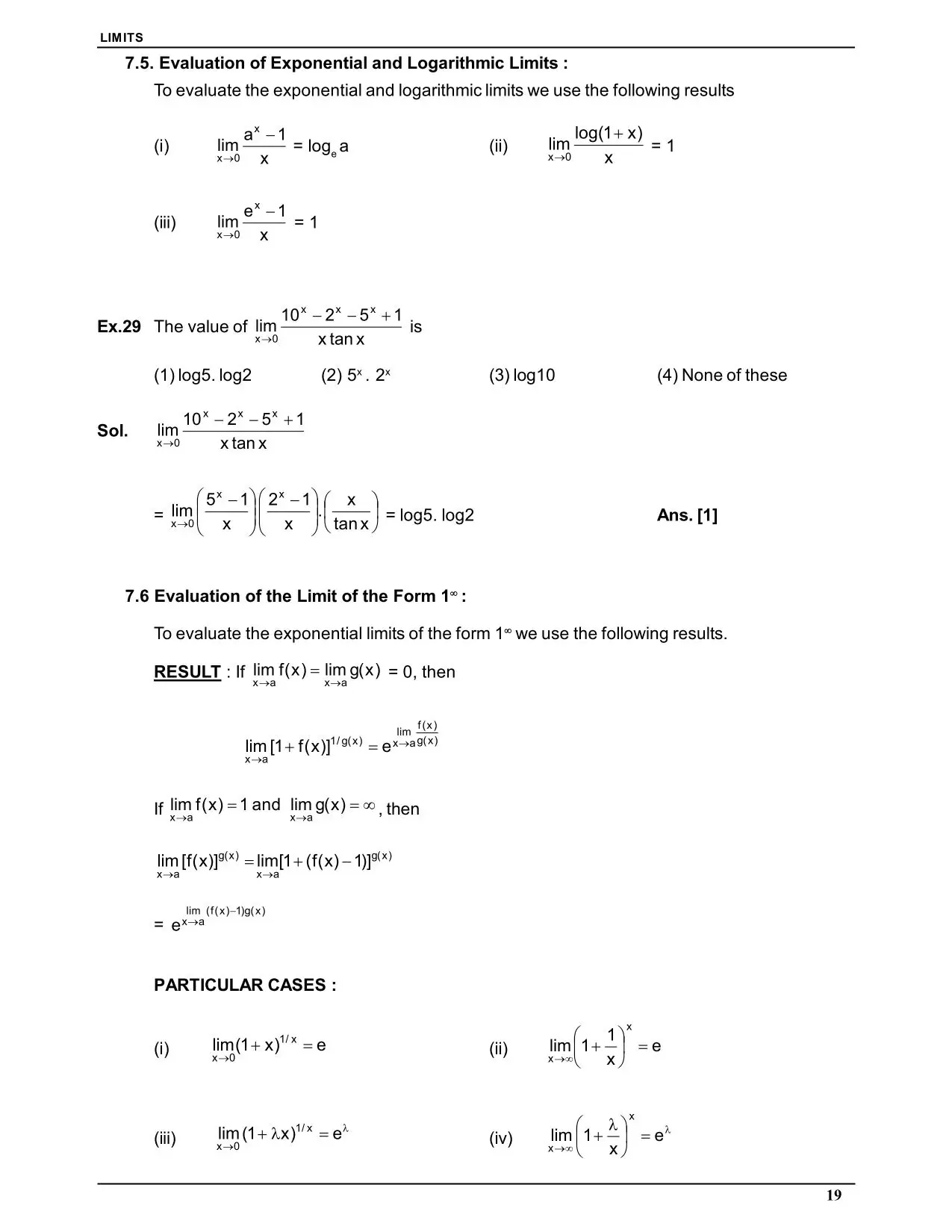
$$\lim_{x \to 0}\frac{\sin x}{x} = 1, \quad \lim_{x \to 0}\frac{\tan x}{x} = 1, \quad \lim_{x \to 0}\frac{\sin^{-1} x}{x} = 1, \quad \lim_{x \to 0}\frac{\tan^{-1} x}{x} = 1$$
(the angle is in radians)
Standard limit | Value |
|---|---|
$\displaystyle\lim_{x \to 0}\frac{1 - \cos x}{x^{2}}$ | $\dfrac{1}{2}$ |
$\displaystyle\lim_{x \to 0}\frac{e^{x} - 1}{x}$ | $1$ |
$\displaystyle\lim_{x \to 0}\frac{a^{x} - 1}{x}$ | $\ln a$ |
$\displaystyle\lim_{x \to 0}\frac{\ln(1 + x)}{x}$ | $1$ |
$\displaystyle\lim_{x \to 0}(1 + x)^{1/x}$ | $e$ |
$\displaystyle\lim_{x \to \infty}\left(1 + \frac{1}{x}\right)^{x}$ | $e$ |
$\displaystyle\lim_{x \to 0}\frac{(1 + x)^{n} - 1}{x}$ | $n$ |
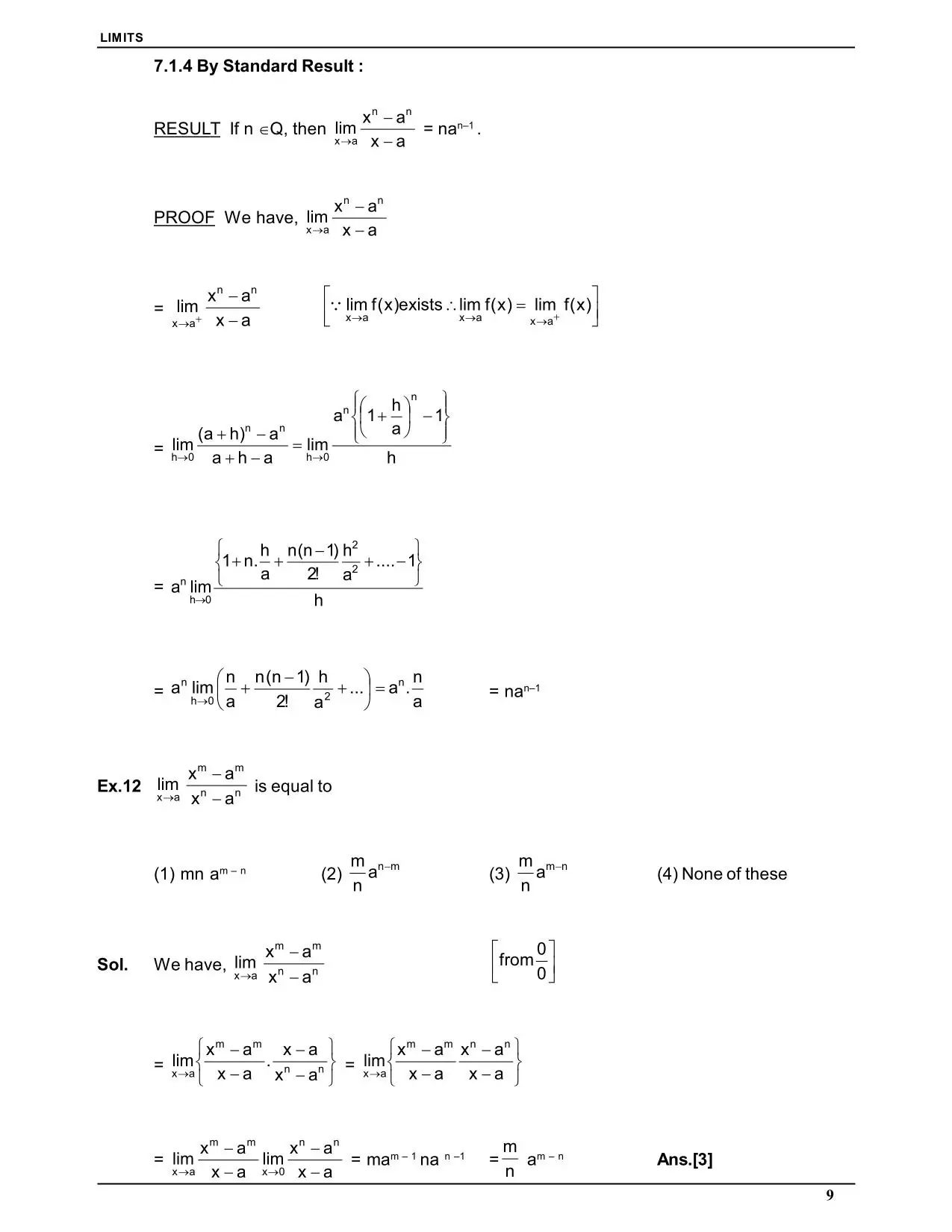
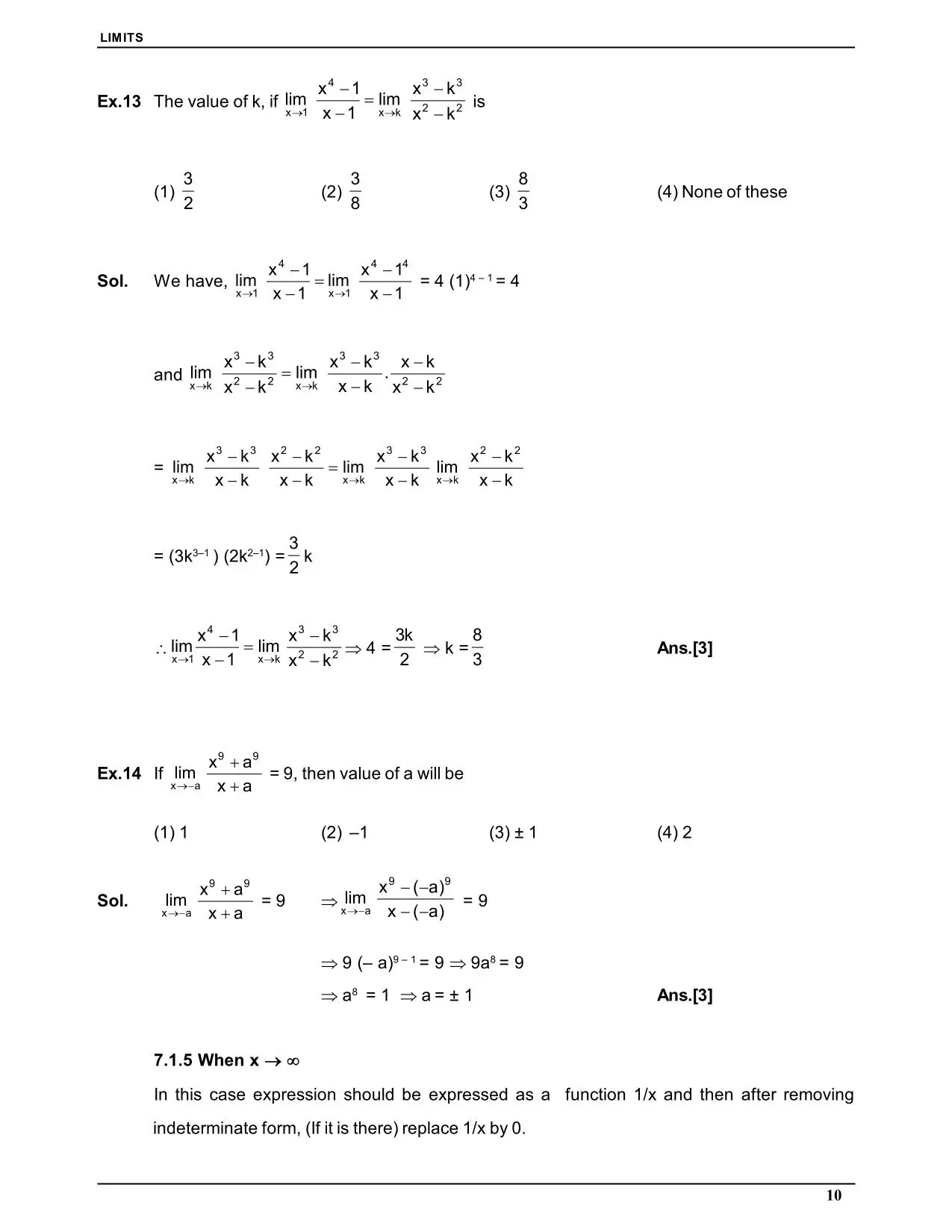
$\displaystyle\lim_{x \to a}\frac{x^{n} - a^{n}}{x - a}$ | $n\,a^{n-1}$ |
Methods to Evaluate Limits in Functions and Limits Notes
A limit of the form $\dfrac{0}{0}$, $\dfrac{\infty}{\infty}$, $0 \cdot \infty$, $\infty - \infty$, $1^{\infty}$, $0^{0}$ or $\infty^{0}$ is an indeterminate form, and it needs work.
Method | When to use it |
|---|---|
Direct substitution | When $f(a)$ is defined and the form is not indeterminate |
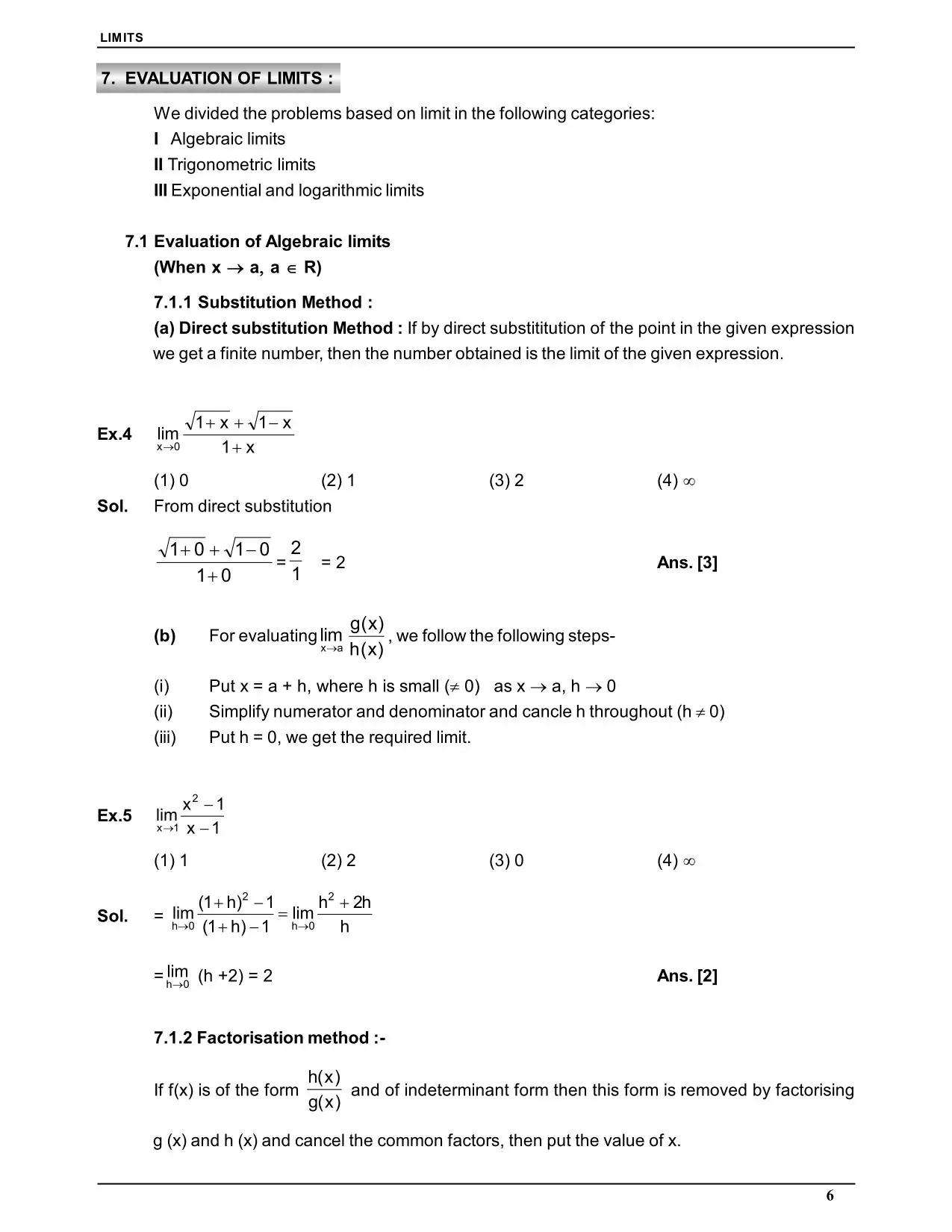
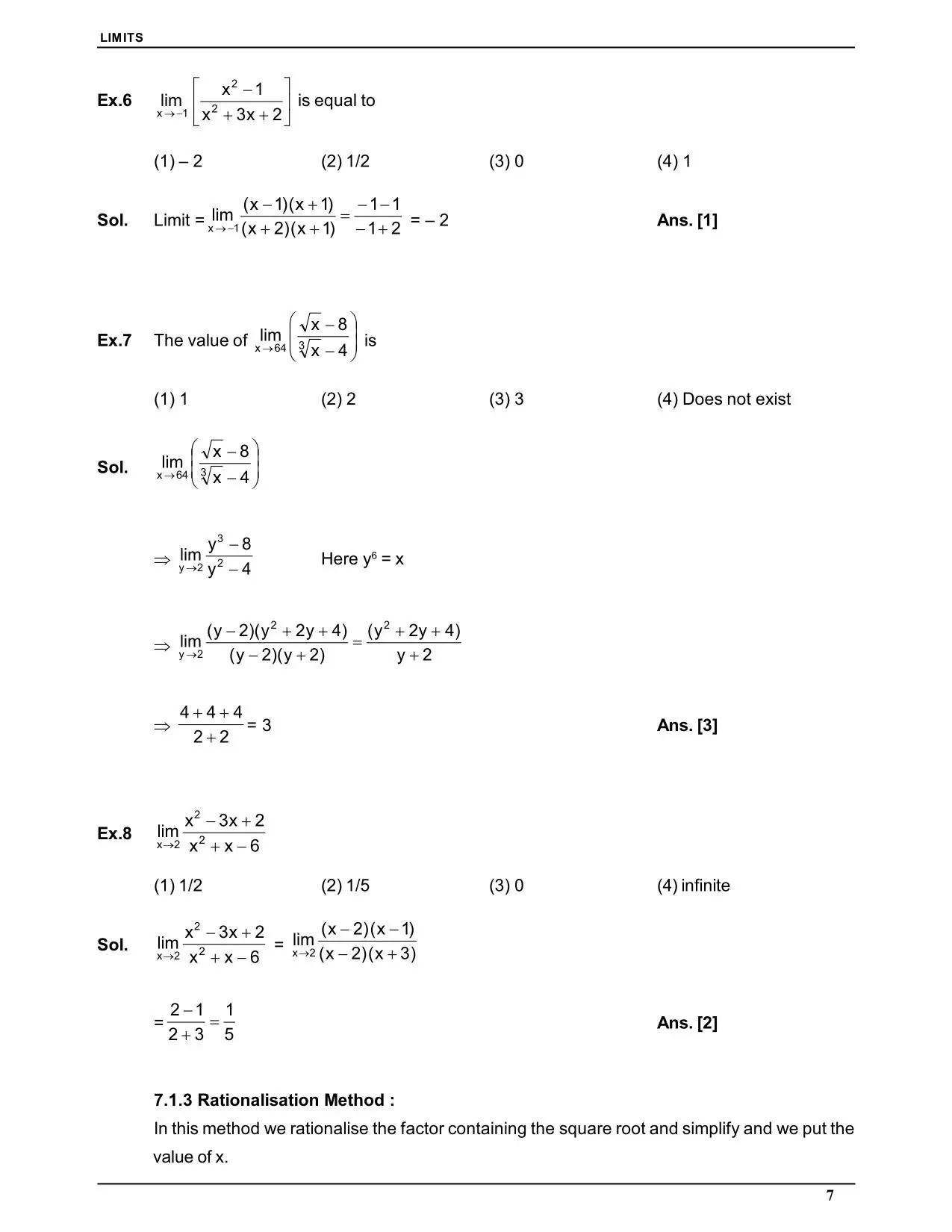
Factorisation and cancellation | Polynomial ratios of the form $0/0$ |
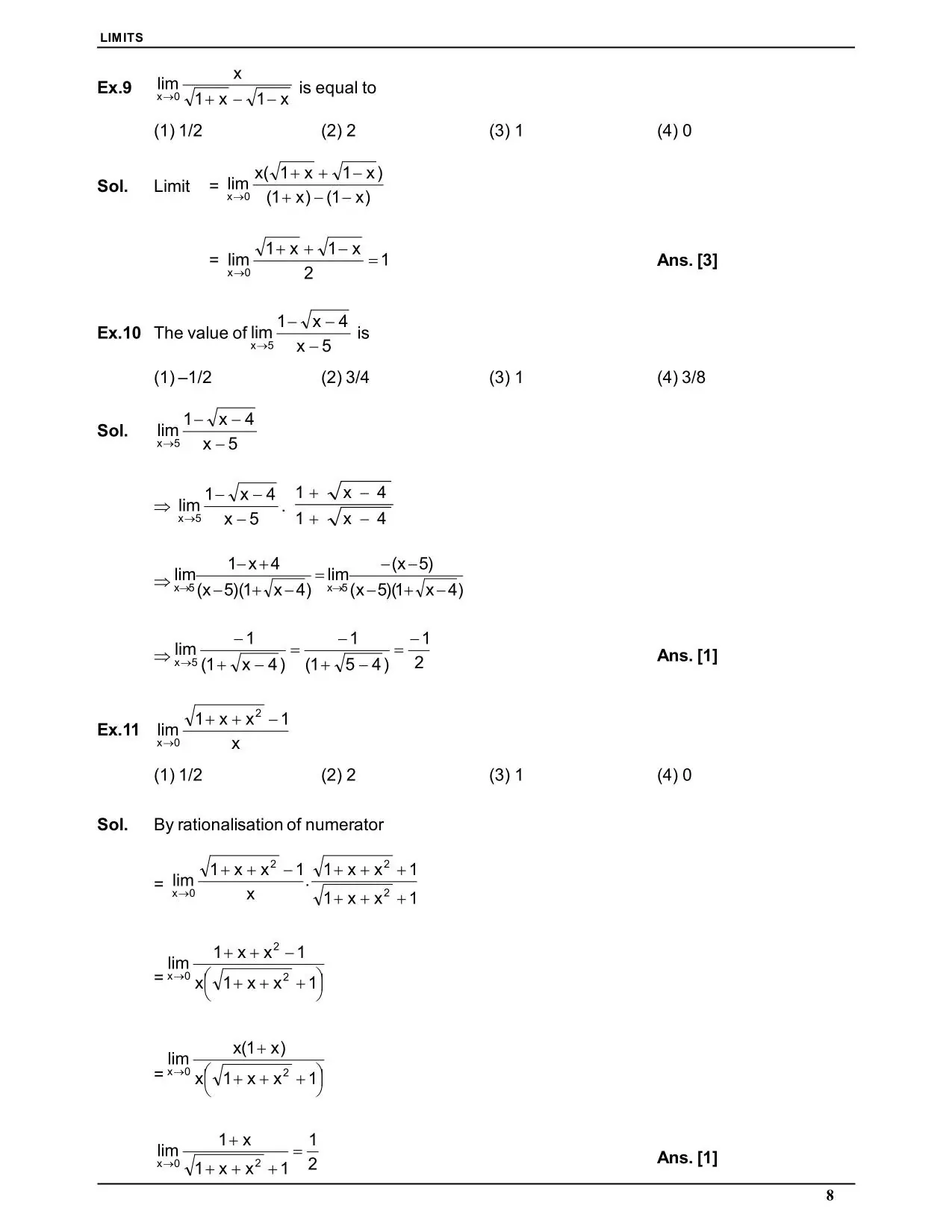
Rationalisation | Expressions with square roots, for example $\sqrt{x + 1} - 1$ |
Standard limits and substitution | Trigonometric, exponential and logarithmic forms |
Series expansion | Forms such as $\dfrac{\sin x - x}{x^{3}}$, which need higher terms |
L’Hôpital’s rule | Forms $0/0$ or $\infty/\infty$ |
Sandwich theorem | A bounded oscillating factor, for example $x\sin(1/x)$ |
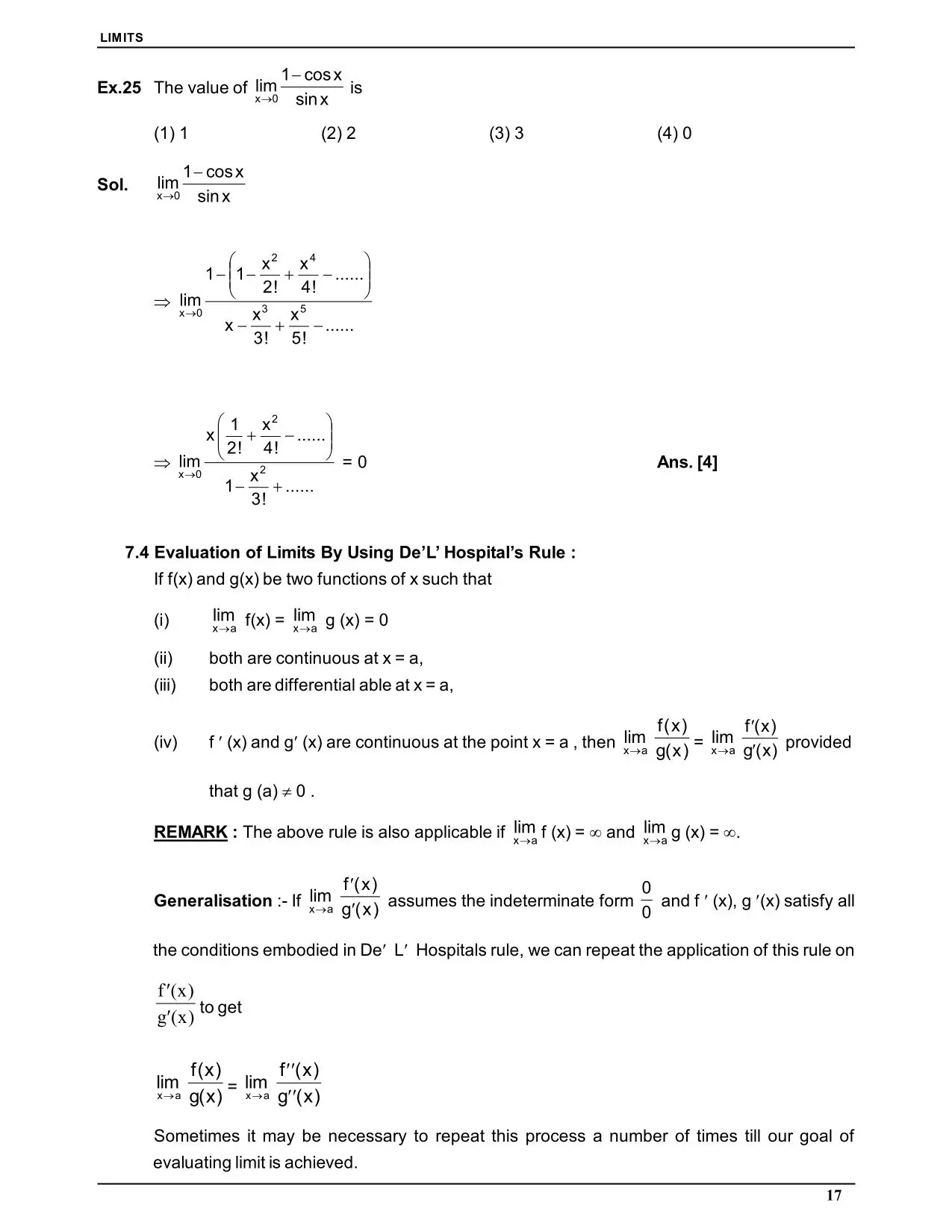
L’Hôpital’s rule: if $f$ and $g$ are differentiable, and $\dfrac{f(x)}{g(x)}$ is of the form $\dfrac{0}{0}$ or $\dfrac{\infty}{\infty}$ at $x = a$, then
$$\lim_{x \to a}\frac{f(x)}{g(x)} = \lim_{x \to a}\frac{f'(x)}{g'(x)}$$
provided the limit on the right exists. You can apply it again if the new form is still indeterminate. Other forms must first be changed into $0/0$ or $\infty/\infty$: write $0 \cdot \infty$ as $\dfrac{0}{1/\infty}$, and combine $\infty - \infty$ into one fraction.
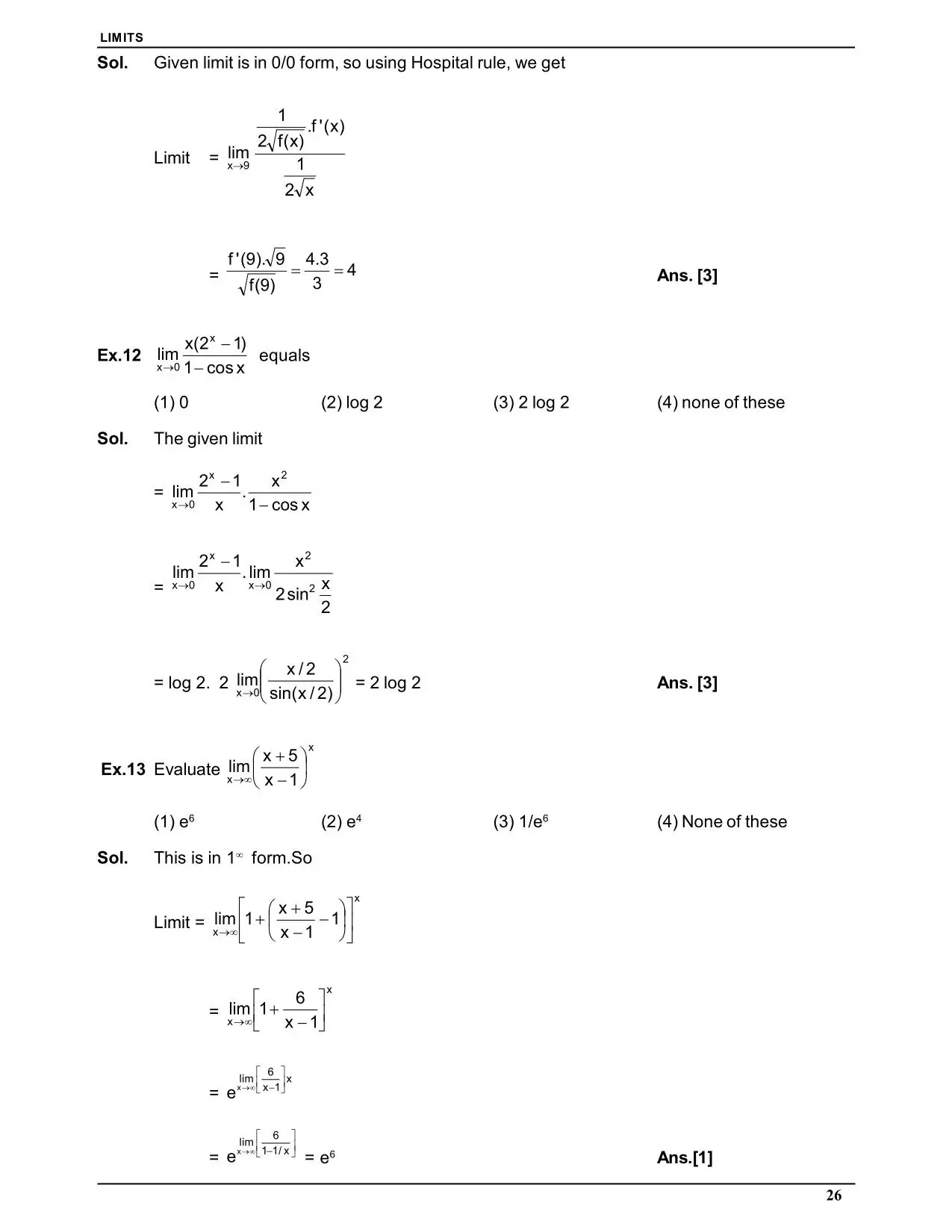
The form $1^{\infty}$: if $f(x) \to 1$ and $g(x) \to \infty$ as $x \to a$, then
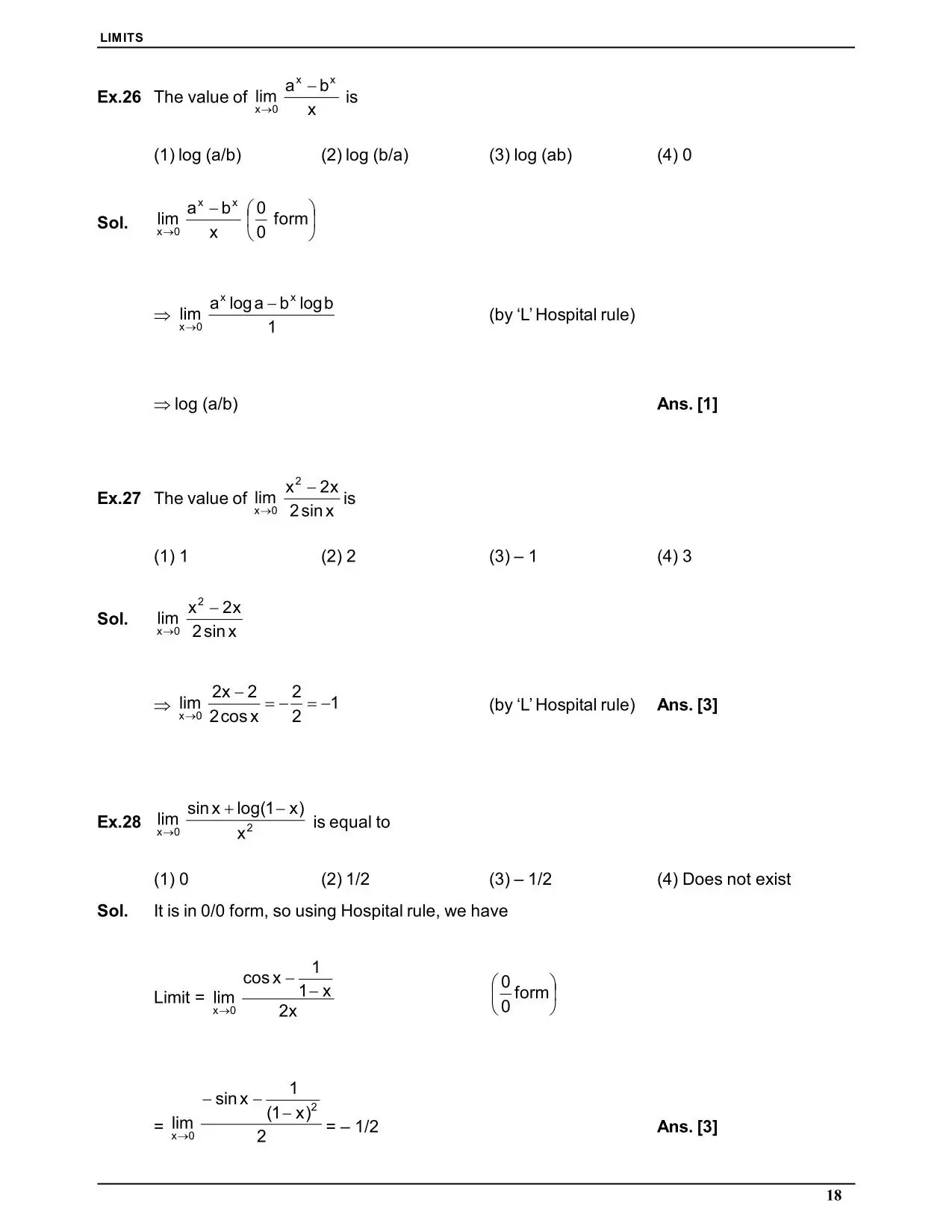
$$\lim_{x \to a}\big[f(x)\big]^{g(x)} = e^{\lim_{x \to a} g(x)\,[\,f(x) - 1\,]}$$
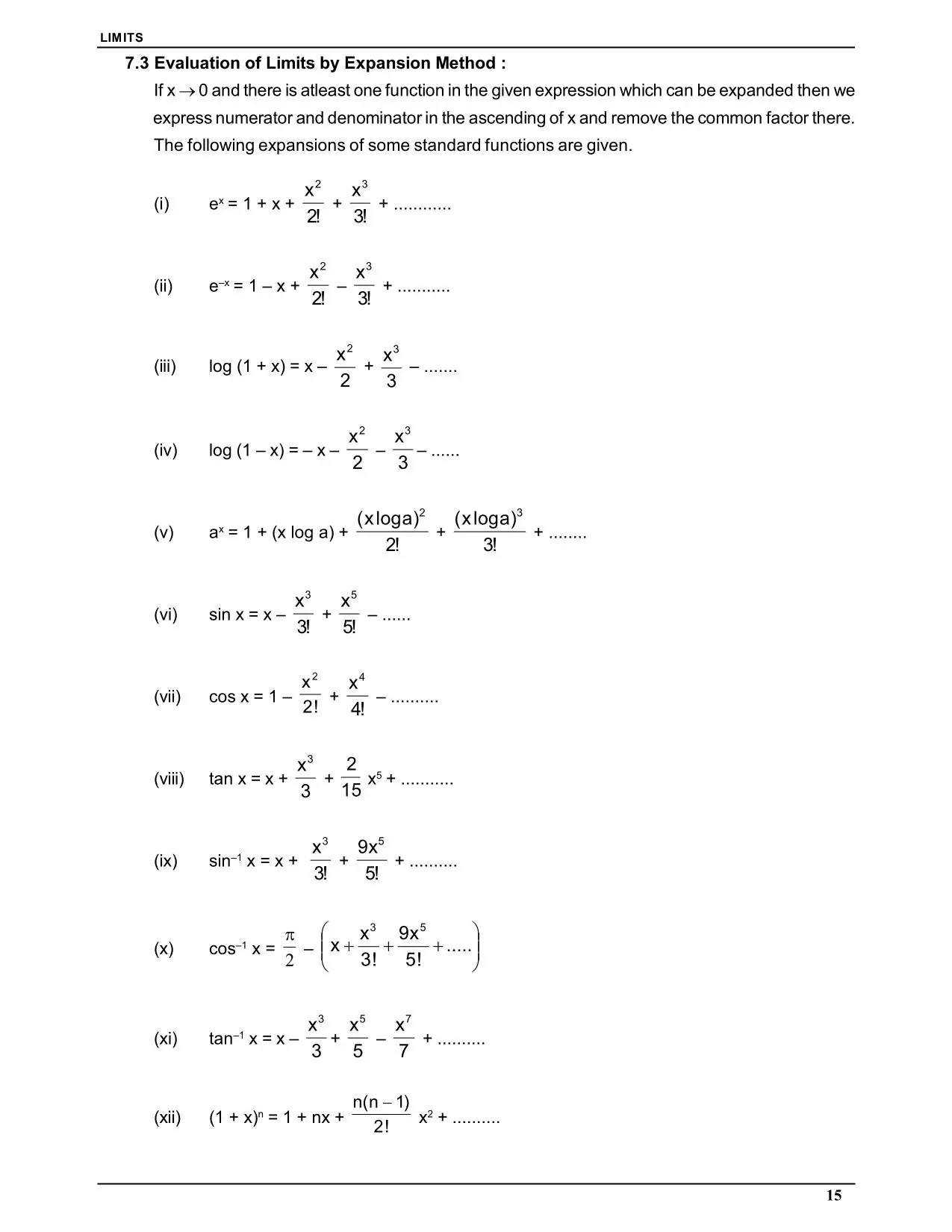
Series expansions (for $x$ near $0$):
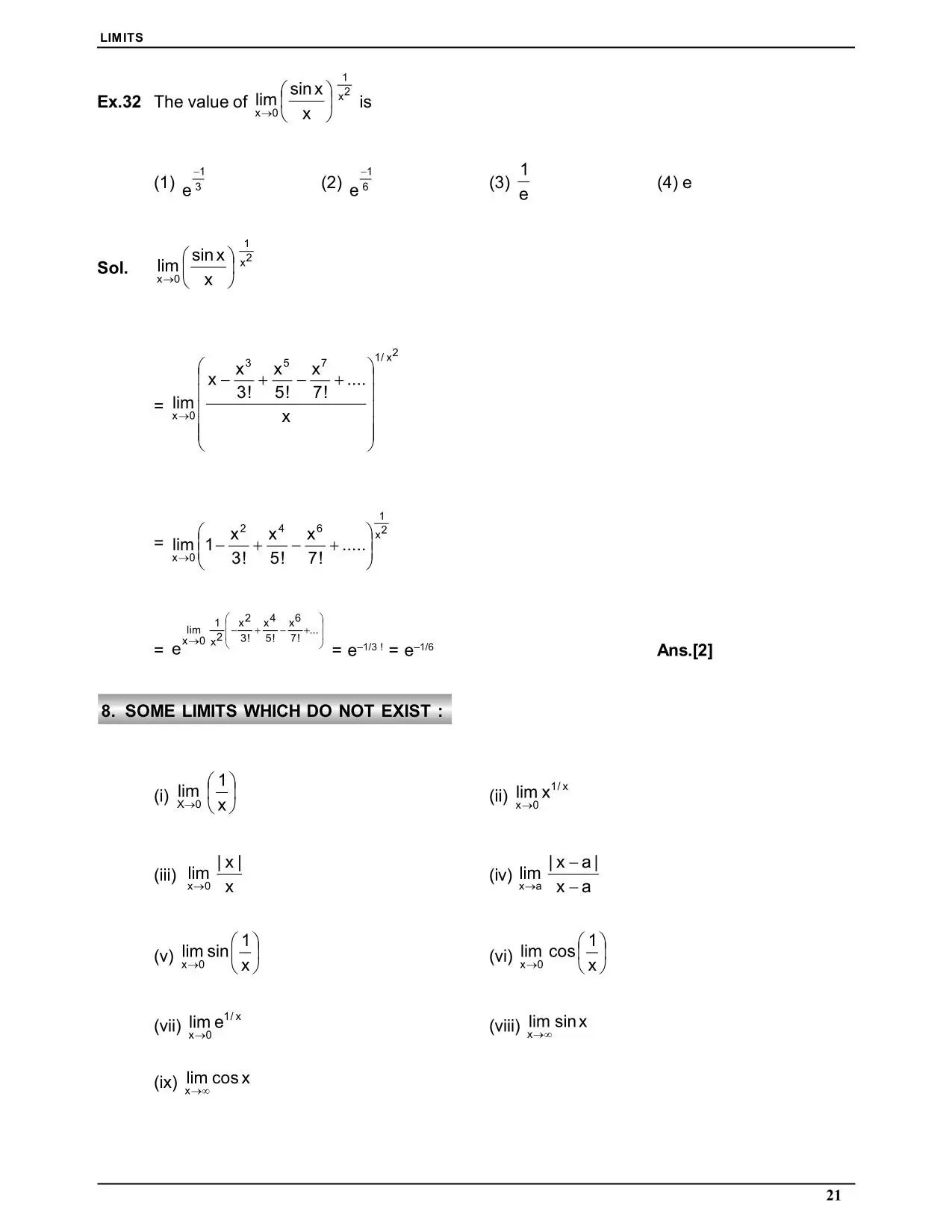
$$\sin x = x - \frac{x^{3}}{3!} + \frac{x^{5}}{5!} - \cdots, \qquad \cos x = 1 - \frac{x^{2}}{2!} + \frac{x^{4}}{4!} - \cdots, \qquad \tan x = x + \frac{x^{3}}{3} + \cdots$$ $$e^{x} = 1 + x + \frac{x^{2}}{2!} + \cdots, \qquad \ln(1 + x) = x - \frac{x^{2}}{2} + \frac{x^{3}}{3} - \cdots, \qquad (1 + x)^{n} = 1 + nx + \frac{n(n-1)}{2!}x^{2} + \cdots$$
Limits at Infinity in Functions and Limits Notes
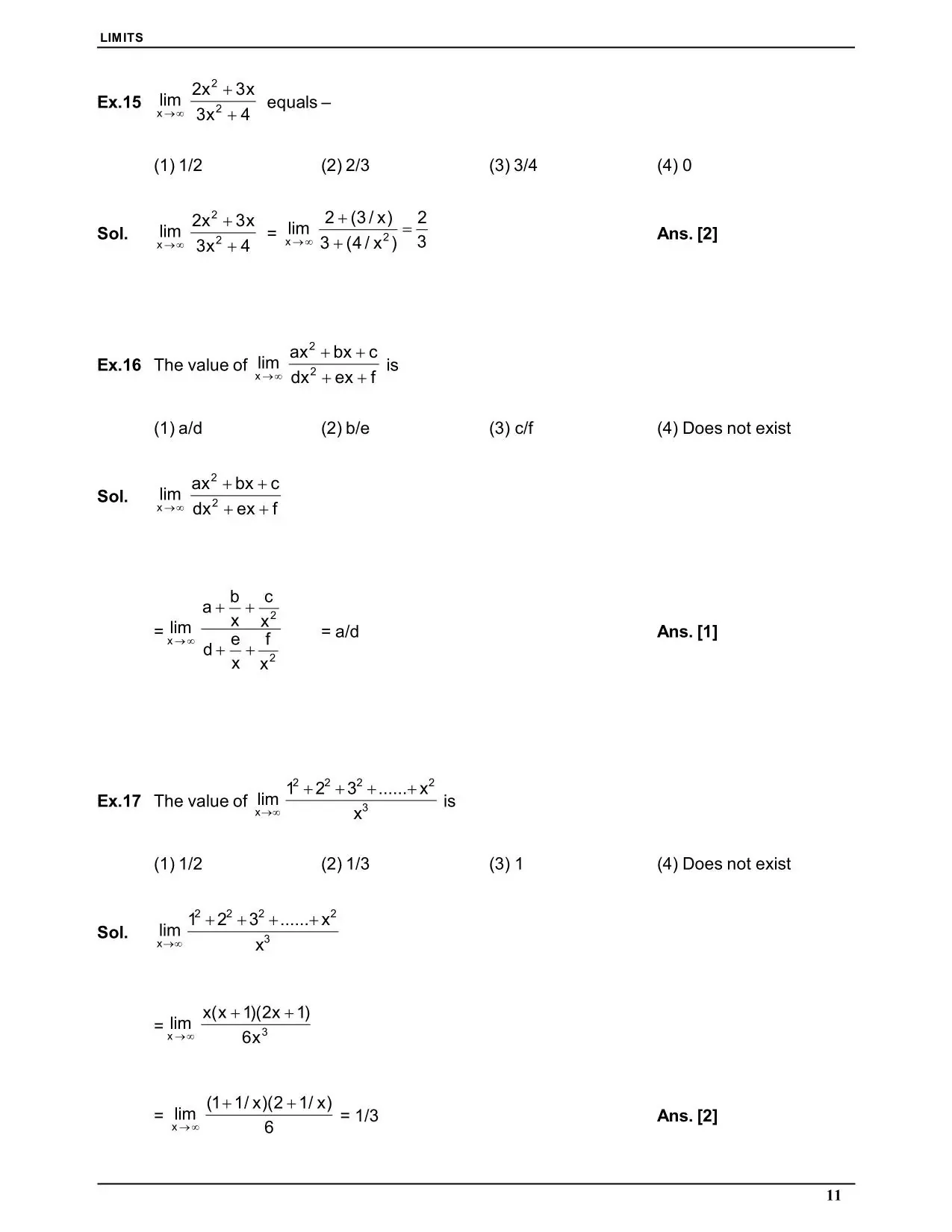
For a rational function $\dfrac{P(x)}{Q(x)}$ with the degrees $p$ and $q$, as $x \to \infty$:
Condition | Limit |
|---|---|
$p < q$ | $0$ |
$p = q$ | The ratio of the leading coefficients |
$p > q$ | $\pm\infty$ |
For an expression with a square root, such as $\sqrt{x^{2} + x} - x$, multiply and divide by the conjugate. A horizontal asymptote $y = L$ comes from $\displaystyle\lim_{x \to \pm\infty} f(x) = L$, and a vertical asymptote $x = a$ comes from an infinite limit at $a$.
Continuity and Discontinuity in Functions and Limits Notes
A function $f$ is continuous at $x = a$ if
$$\lim_{x \to a^-} f(x) = \lim_{x \to a^+} f(x) = f(a)$$
Type of discontinuity | Condition | Example |
|---|---|---|
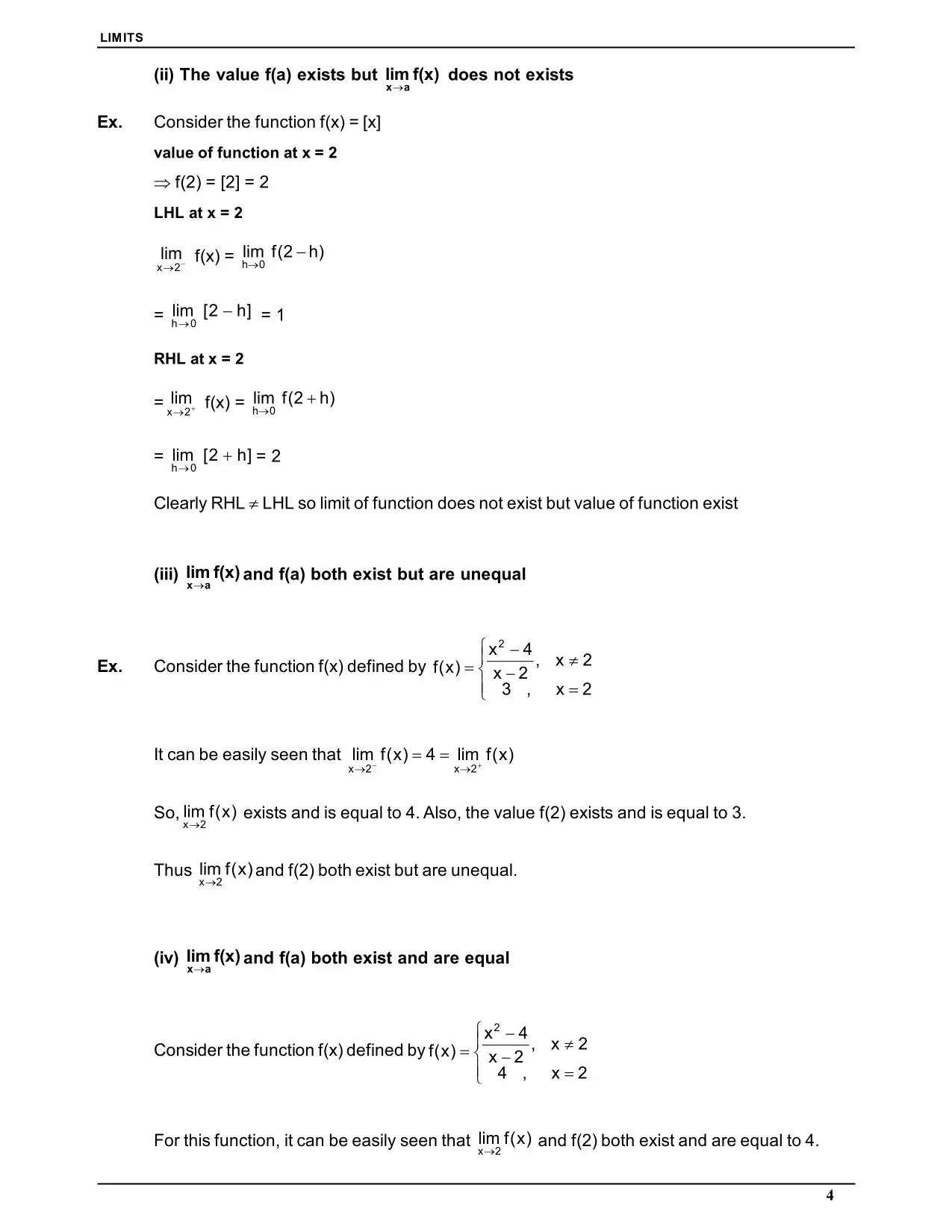
Removable | The limit exists, but $f(a)$ is undefined or not equal to it | $\dfrac{\sin x}{x}$ at $x = 0$ |
Jump | LHL and RHL are finite but not equal | $[x]$ at an integer |
Infinite | The limit is $\pm\infty$ | $\dfrac{1}{x}$ at $x = 0$ |
Oscillating | The limit does not exist because of oscillation | $\sin\dfrac{1}{x}$ at $x = 0$ |
Useful facts:
- Sums, differences, products and composites of continuous functions are continuous, and a quotient is continuous where the denominator is not zero.
- Polynomials, $\sin x$, $\cos x$, $e^{x}$ and $\lvert x\rvert$ are continuous everywhere. $[x]$ is discontinuous at every integer.
- Intermediate value property: if $f$ is continuous on $[a, b]$, it takes every value between $f(a)$ and $f(b)$. If $f(a)\,f(b) < 0$, then $f(x) = 0$ has a root in $(a, b)$.
- A function that is differentiable at a point is continuous there, but a continuous function need not be differentiable (for example, $\lvert x\rvert$ at $0$).
Key Formulas in Functions and Limits Notes
Concept | Formula |
|---|---|
Existence of a limit | LHL $=$ RHL (finite) |
Basic standard limit | $\displaystyle\lim_{x \to 0}\frac{\sin x}{x} = 1$ |
Exponential limit | $\displaystyle\lim_{x \to 0}(1 + x)^{1/x} = e$ |
Power limit | $\displaystyle\lim_{x \to a}\frac{x^{n} - a^{n}}{x - a} = na^{n-1}$ |
L’Hôpital’s rule | $\displaystyle\lim\frac{f}{g} = \lim\frac{f'}{g'}$ for $\frac{0}{0}$ or $\frac{\infty}{\infty}$ |
Form $1^{\infty}$ | $e^{\lim g(f - 1)}$ |
Continuity at $a$ | $\displaystyle\lim_{x \to a} f(x) = f(a)$ |
Inverse function | $f^{-1}\big(f(x)\big) = x$, and $f$ must be bijective |
Solved Examples from Functions and Limits Notes
Example 1 (domain): Find the domain of $f(x) = \sqrt{x^{2} - 5x + 6} + \dfrac{1}{\sqrt{4 - x}}$.
We need $x^{2} - 5x + 6 = (x - 2)(x - 3) \geq 0$, so $x \leq 2$ or $x \geq 3$. We also need $4 - x > 0$, so $x < 4$. The domain is $(-\infty, 2] \cup [3, 4)$.
Example 2 (inverse function): Find the inverse of $f(x) = \dfrac{2x + 1}{x - 3}$.
Put $y = \dfrac{2x + 1}{x - 3}$. Then $y(x - 3) = 2x + 1$, so $x(y - 2) = 3y + 1$ and $x = \dfrac{3y + 1}{y - 2}$. Hence $f^{-1}(x) = \dfrac{3x + 1}{x - 2}$, with $x \neq 2$.
Example 3 (period): Find the period of $f(x) = \lvert\sin x\rvert + \lvert\cos x\rvert$.
Each term has the period $\pi$, but $f\left(x + \dfrac{\pi}{2}\right) = \lvert\cos x\rvert + \lvert\sin x\rvert = f(x)$, so the period is $\dfrac{\pi}{2}$.
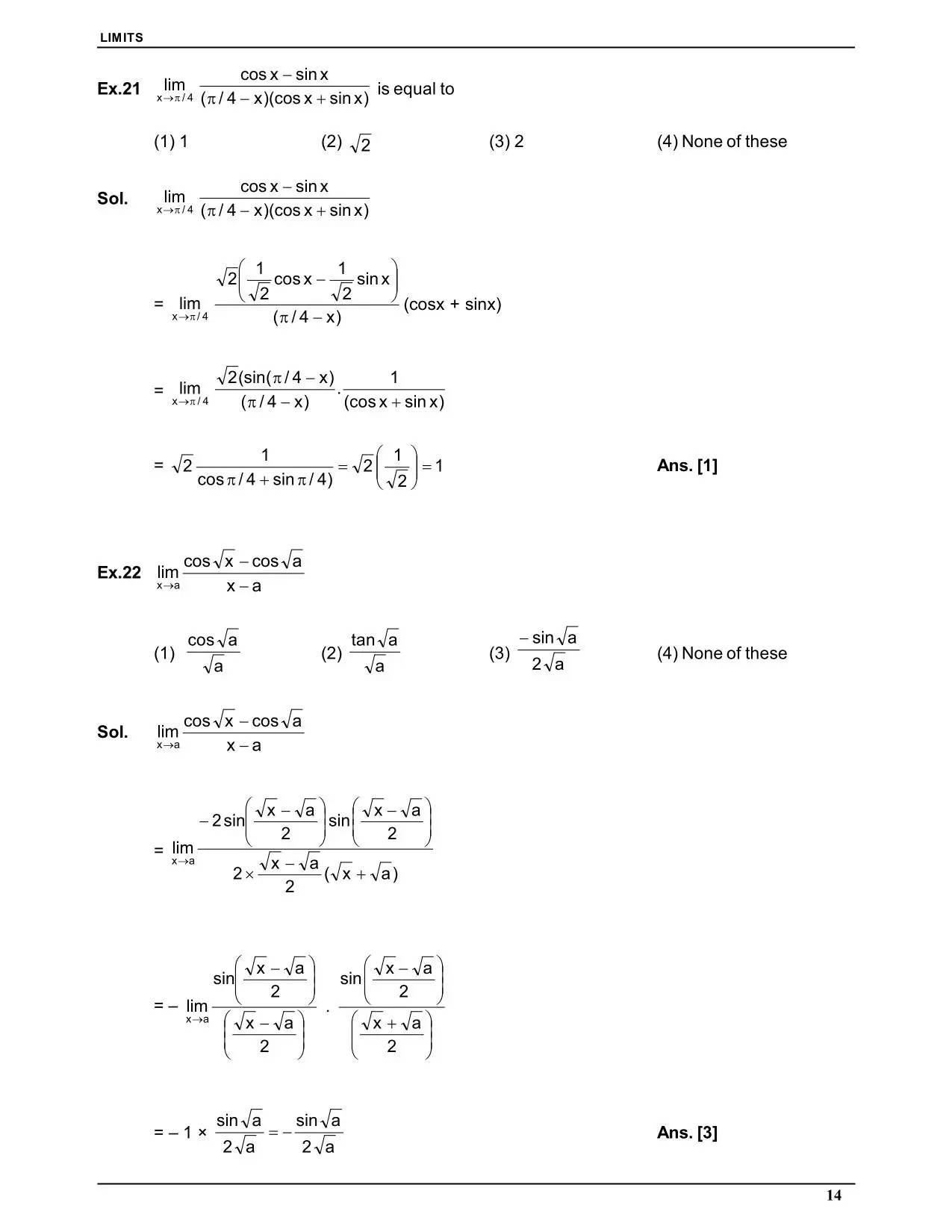
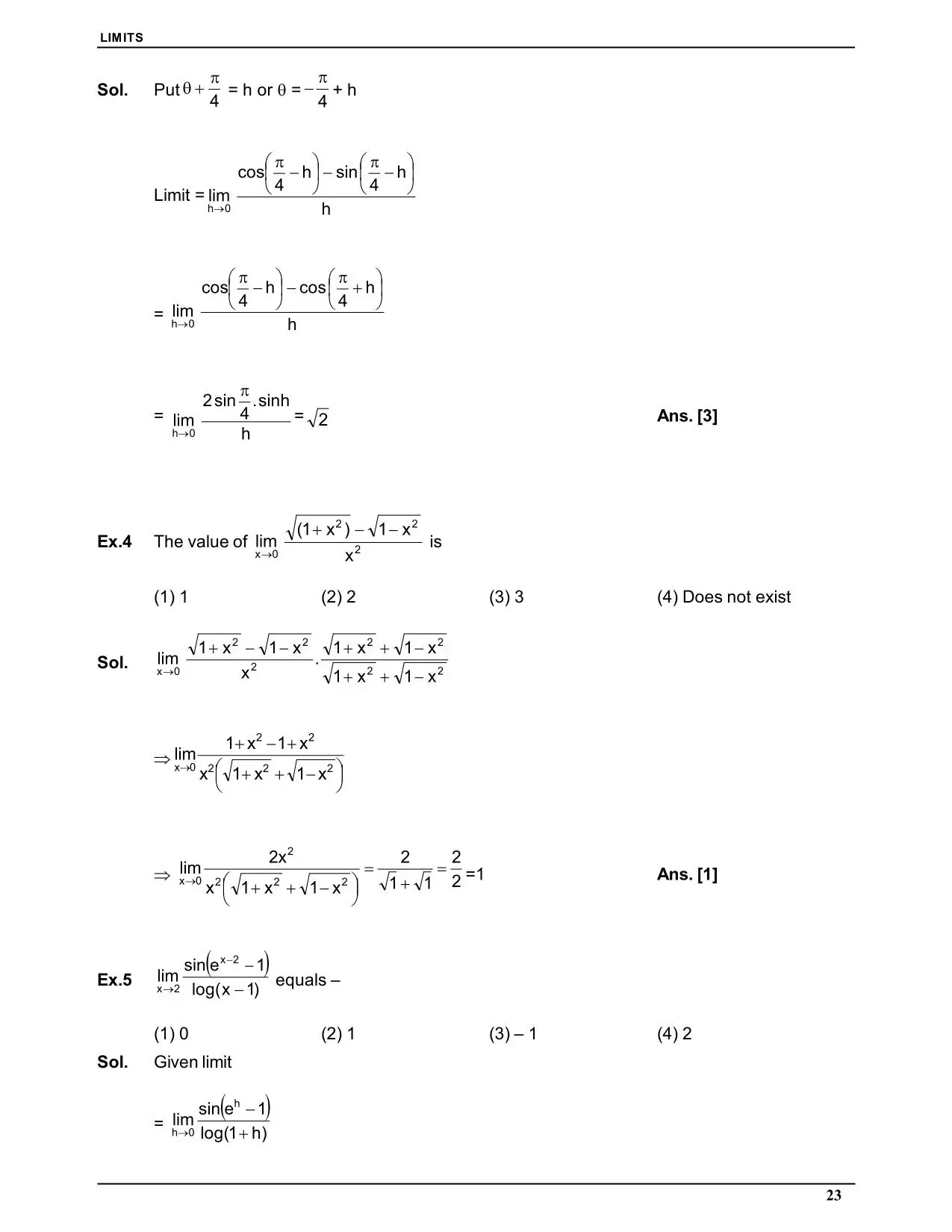
Example 4 (factorisation): Find $\displaystyle\lim_{x \to 2}\frac{x^{2} - 4}{x - 2}$.
$\dfrac{(x - 2)(x + 2)}{x - 2} = x + 2$, so the limit is $4$.
Example 5 (standard limit): Find $\displaystyle\lim_{x \to 0}\frac{\sin 5x}{3x}$.
$\dfrac{\sin 5x}{3x} = \dfrac{5}{3}\cdot\dfrac{\sin 5x}{5x} \to \dfrac{5}{3}$.
Example 6 (power limit): Find $\displaystyle\lim_{x \to 1}\frac{x^{5} - 1}{x^{3} - 1}$.
$\dfrac{x^{5} - 1}{x - 1} \to 5$ and $\dfrac{x^{3} - 1}{x - 1} \to 3$, so the limit is $\dfrac{5}{3}$.
Example 7 (limit at infinity): Find $\displaystyle\lim_{x \to \infty}\left(\sqrt{x^{2} + x} - x\right)$.
Multiply and divide by the conjugate: $\dfrac{x}{\sqrt{x^{2} + x} + x} = \dfrac{1}{\sqrt{1 + 1/x} + 1} \to \dfrac{1}{2}$.
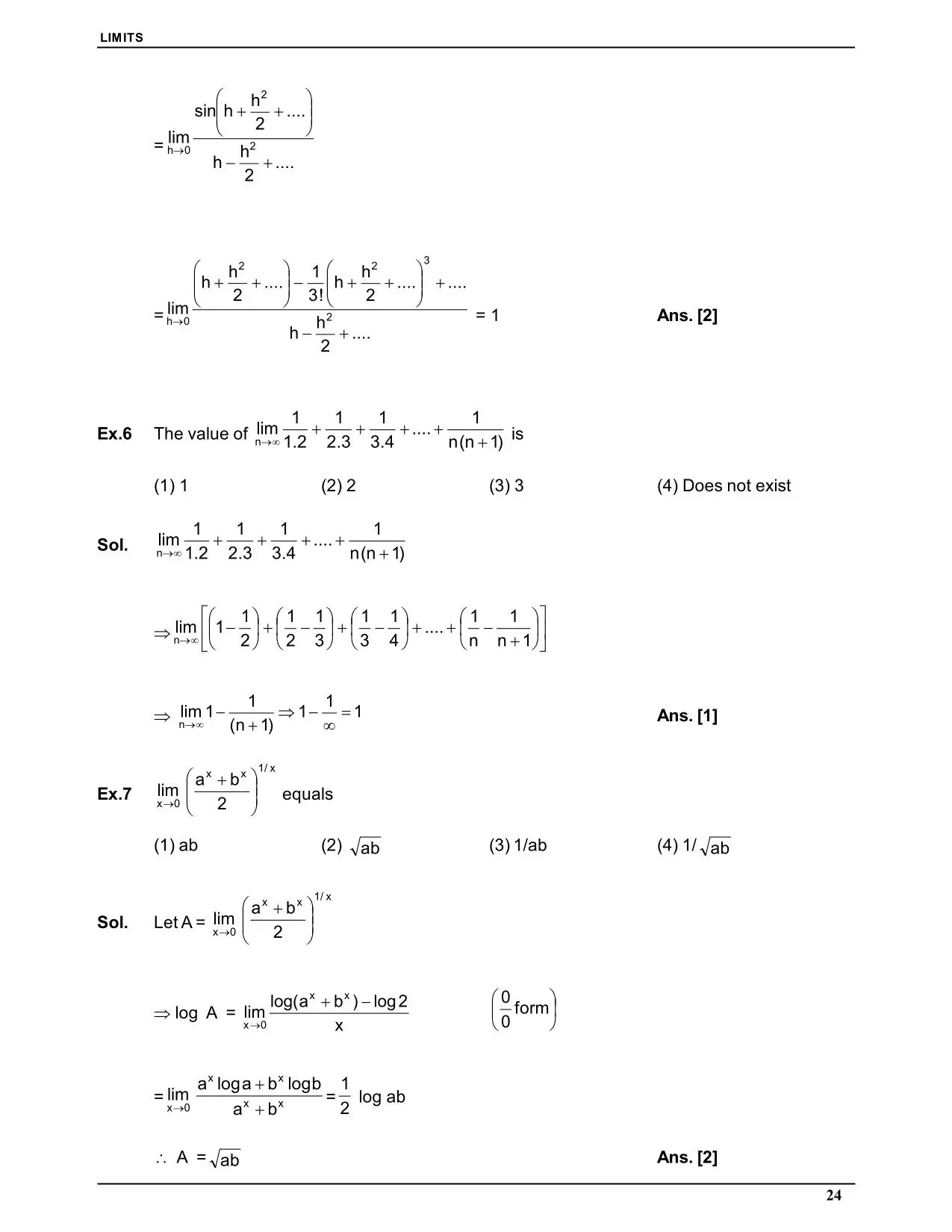
Example 8 (the form $1^{\infty}$): Find $\displaystyle\lim_{x \to 0}(1 + 2x)^{1/x}$.
Here $f - 1 = 2x$ and $g = \dfrac{1}{x}$, so $\lim g(f - 1) = 2$ and the limit is $e^{2}$.
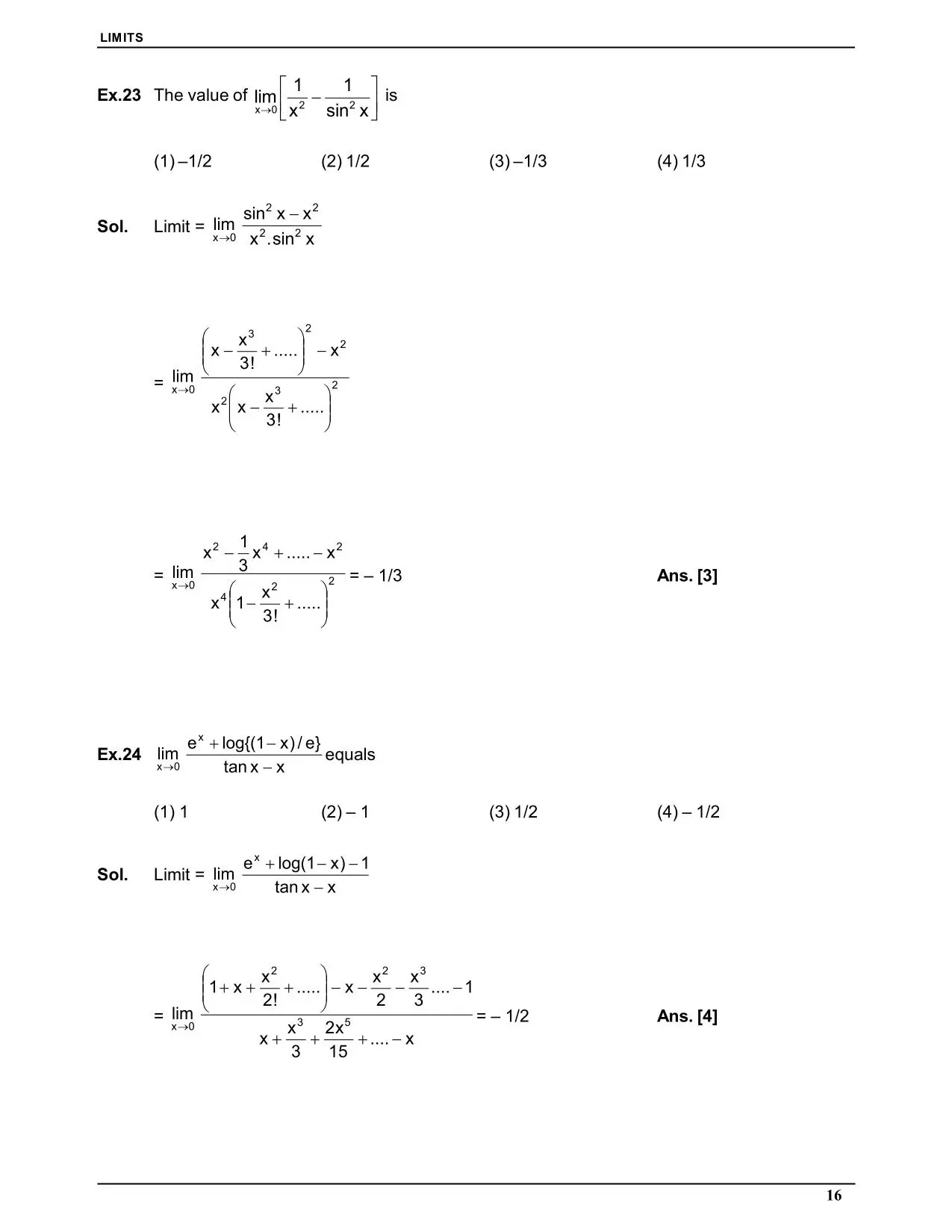
Example 9 (series method): Find $\displaystyle\lim_{x \to 0}\frac{\sin x - x}{x^{3}}$.
$\sin x - x = -\dfrac{x^{3}}{6} + \cdots$, so the limit is $-\dfrac{1}{6}$.
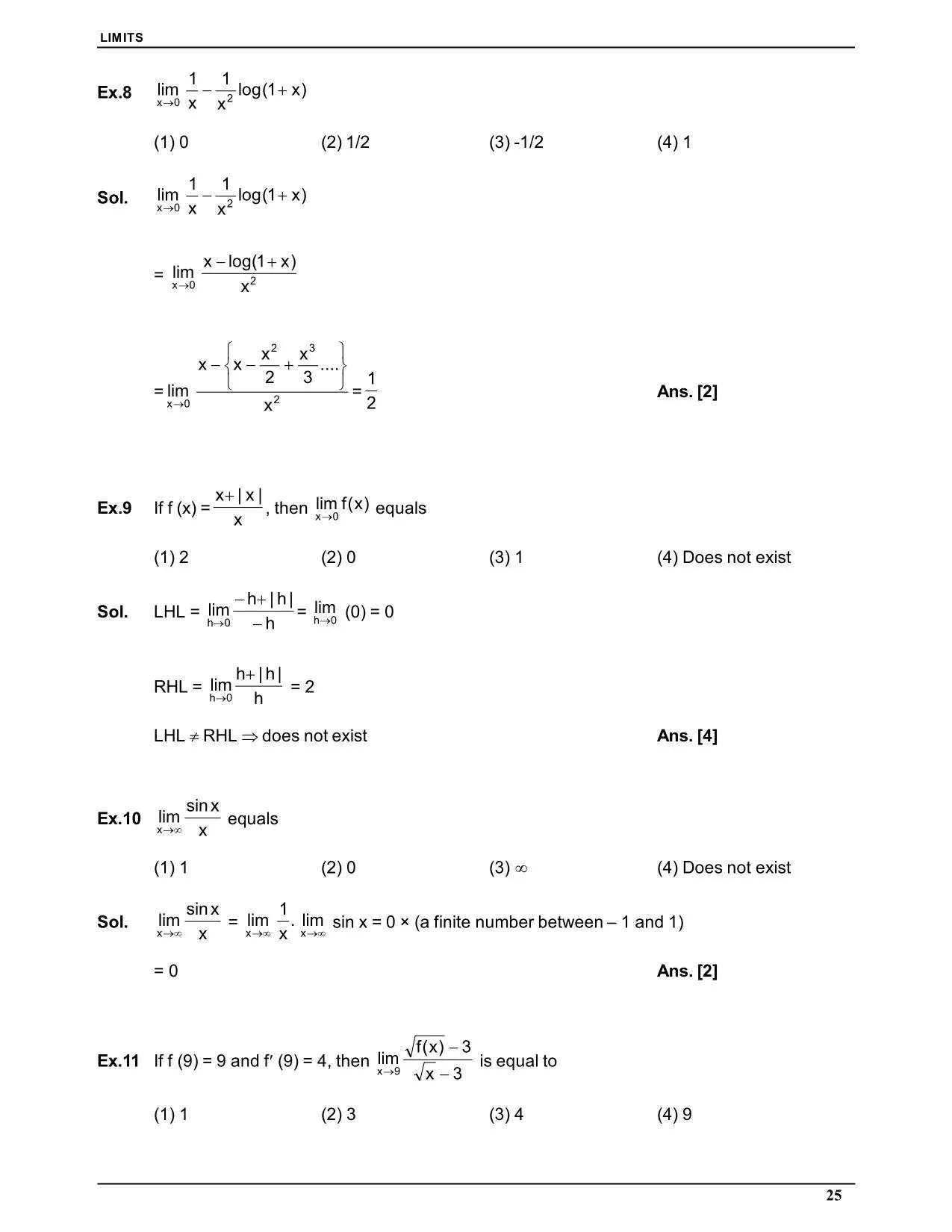
Example 10 (L’Hôpital’s rule): Find $\displaystyle\lim_{x \to 0}\frac{e^{x} - 1 - x}{x^{2}}$.
The form is $\dfrac{0}{0}$. Differentiate: $\dfrac{e^{x} - 1}{2x}$ is again $\dfrac{0}{0}$. Differentiate again: $\dfrac{e^{x}}{2} \to \dfrac{1}{2}$.
Example 11 (the form $0 \cdot \infty$): Find $\displaystyle\lim_{x \to 0^+} x\ln x$.
Write it as $\dfrac{\ln x}{1/x}$, which is $\dfrac{\infty}{\infty}$. Then $\dfrac{1/x}{-1/x^{2}} = -x \to 0$.
Example 12 (left and right limits): Does $\displaystyle\lim_{x \to 2}[x]$ exist?
LHL $= 1$ and RHL $= 2$. They are not equal, so the limit does not exist, and $[x]$ has a jump discontinuity at $x = 2$.
Example 13 (finding a constant for continuity): Find $k$ so that $f(x) = \dfrac{\sin 3x}{x}$ for $x \neq 0$ and $f(0) = k$ is continuous at $0$.
$\displaystyle\lim_{x \to 0}\frac{\sin 3x}{x} = 3$, so $k = 3$.
Example 14 (a trigonometric limit): Find $\displaystyle\lim_{x \to 0}\frac{\tan x - \sin x}{x^{3}}$.
$\tan x - \sin x = \tan x\,(1 - \cos x) \approx x \cdot \dfrac{x^{2}}{2}$, so the limit is $\dfrac{1}{2}$.
Example 15 (the number $e$): Find $\displaystyle\lim_{x \to \infty}\left(1 + \frac{3}{x}\right)^{x}$.
$\lim g(f - 1) = \lim x \cdot \dfrac{3}{x} = 3$, so the limit is $e^{3}$.
Common Mistakes in Functions and Limits Notes Problems
Mistake | Correct approach |
|---|---|
Using $\sin x/x \to 1$ when $x$ is in degrees | The standard limit holds only for radians |
Using L’Hôpital’s rule when the form is not $0/0$ or $\infty/\infty$ | Check the form first, because the rule gives a wrong answer for other forms |
Cancelling without a check, and writing $\dfrac{x^2 - 4}{x - 2} = x + 2$ at $x = 2$ | The limit is 4, but the function is not defined at 2 |
Treating $\infty$ as a number, for example $\infty - \infty = 0$ | It is an indeterminate form, so simplify first |
Calculating $1^{\infty}$ as 1 | Use $e^{\lim g(f - 1)}$ |
Forgetting both sides at a point where the rule changes ($[x]$, $\lvert x\rvert$) | Find the LHL and the RHL separately |
Saying that $\lim_{x \to 0}\sin(1/x)$ is 0 | It does not exist, because the function oscillates |
Saying that a continuous function is always differentiable | $\lvert x\rvert$ is continuous at 0 but not differentiable |
How to Study Functions and Limits Notes
- Learn the functions first from eSaral’s Functions Class 11 notes, and download the NCERT books from eSaral’s NCERT books for Class 11 page (limits are in Class 11) and the NCERT books for Class 12 page (continuity is in Class 12).
- Memorise the standard limits and the series, and practise the order of methods: substitute, simplify, standard limit, series, and L’Hôpital’s rule.
- Practise one problem each on the forms $\dfrac{0}{0}$, $\dfrac{\infty}{\infty}$, $1^{\infty}$, $0\cdot\infty$ and $\infty - \infty$, then on limits with $[x]$ and $\lvert x\rvert$, and then on continuity with a constant.
- Test yourself with eSaral’s JEE Main chapter-wise PYQs and JEE Advanced chapter-wise PYQs.
Frequently Asked Questions
What is the difference between a limit and the value of a function?
The limit of $f(x)$ as $x \to a$ is the value that $f(x)$ approaches. It does not need $f(a)$ to be defined. The value of the function is simply $f(a)$. A function can have a limit at a point where it is not defined, and the limit and the function value can differ even when both exist. eSaral’s Functions and Limits Notes show this with $\dfrac{\sin x}{x}$ at $0$.
What are the most important topics in Functions and Limits Notes for IIT JEE?
The standard limits and the series method, L’Hôpital’s rule and the indeterminate forms (especially $1^{\infty}$), limits at infinity, left and right limits for $[x]$ and $\lvert x\rvert$, continuity with a constant, and the properties of functions (inverse, composite and periodic). The number of questions changes every year, so check previous years’ papers.
Is L’Hôpital’s rule enough for all limit problems in JEE?
No. The rule applies only to the forms $\dfrac{0}{0}$ and $\dfrac{\infty}{\infty}$. The forms $1^{\infty}$, $0 \cdot \infty$, $\infty - \infty$, $0^{0}$ and $\infty^{0}$ must be converted first, or solved with standard limits or series. Applying the rule without checking the form is a common reason for a wrong answer. In Functions and Limits Notes, the order of methods is substitute, simplify, standard limits, series and then the rule.
What is a removable discontinuity?
A removable discontinuity occurs when $\displaystyle\lim_{x \to a} f(x)$ exists, but $f(a)$ is undefined or not equal to the limit. It is called removable because defining $f(a)$ equal to the limit makes the function continuous. JEE problems ask for the constant that removes the discontinuity, and the Functions and Limits Notes on eSaral list it with the other types.
How do you find the limit of the form $1^{\infty}$?
Use $\displaystyle\lim_{x \to a}[f(x)]^{g(x)} = e^{\lim g(x)[f(x) - 1]}$ when $f(x) \to 1$ and $g(x) \to \infty$. For example, $\displaystyle\lim_{x \to 0}(1 + 2x)^{1/x} = e^{2}$. These Functions and Limits Notes show it in Examples 8 and 15.
How do you know whether a limit exists?
A limit exists if the left-hand limit and the right-hand limit both exist, are finite and are equal. For functions with $[x]$, $\lvert x\rvert$ or a changing rule, find both limits separately. In Functions and Limits Notes, the standard example is $[x]$ at $x = 2$: the LHL is 1 and the RHL is 2, so the limit does not exist.
Should I study functions and limits from Class 11 or Class 12 notes for JEE?
Both. Functions are in Class 11 (Chapter 2) and Class 12 (Chapter 1), limits are in Class 11 (Chapter 12, Limits and Derivatives), and continuity is in Class 12 (Chapter 5). IIT JEE joins them, so start with the functions, then the limits, and then continuity. These Functions and Limits Notes follow that order.
Which chapter number are limits in Class 11 and Class 12 Maths?
In the current NCERT Class 11 Mathematics book, Limits and Derivatives is Chapter 12 (Chapter 13 in older books). In Class 12, Continuity and Differentiability is Chapter 5. These Functions and Limits Notes cover both for IIT JEE.
Where can I find more Class 11 and Class 12 Maths notes on eSaral?
eSaral has chapter-wise Maths notes, notes on Functions for Class 11, NCERT books, and JEE Main and JEE Advanced chapter-wise PYQs, all linked with these Functions and Limits Notes on this page.
Team eSaral
eSaral Academic and Editorial Team
Team eSaral is the collective author profile for educational content created by eSaral’s teachers and academic contributors. The team draws on expertise from IIT graduates, doctors, experienced educators and subject specialists to develop resources for JEE, NEET and school students. Our articles aim to explain concepts clearly and help students study with confidence.
Related Posts

BITSAT 2027: Registration Date, Exam Date, Syllabus, Eligibility, Pattern & Fees
BITSAT 2027 exam dates, registration timeline, eligibility criteria, exam pattern, marking scheme, syllabus and fees in one page.

BITSAT Previous Year Question Paper PDF (2017-2026)
Download BITSAT previous year question papers PDF from 2017 to 2026,session-wise. Memory-based papers,exam pattern, paper analysis and how to practise

CBSE Class 10 Date Sheet 2027: Expected Exam Dates, Release Date, Admit Card & Result Timeline
CBSE Class 10 date sheet 2027 is awaited. See the expected exam dates, release window, how to download the PDF, admit card and result timelines.

NCERT Physics Class 10 Book PDF in Hindi 2026-27 – भौतिक विज्ञान के 4 अध्याय (Free Download)
NCERT Physics Class 10 book PDF in Hindi 2026-27: download all 4 chapters (अध्याय 9–12) free, with topics and important formulas.

NCERT Biology Class 9 Book Anveshan PDF in Hindi - जीव विज्ञान कक्षा 9 पुस्तक अन्वेषण PDF
Download NCERT Biology Class 9 book PDF in Hindi chapterwise for 2026-27: Cell, Tissues, Reproduction and Diversity. Free PDFs.

Essay On Artificial Intelligence in English (100,150, 200, 250, 300, 500 Words)
This is in contrast to the natural intelligence of humans. With Artificial Intelligence, machines can perform

Essay on 78th India Independence Day in English for Student (100, 150, 200, 250, 300, 500 Words)
Read the best essays on India's Independence Day in English. Short & long essays (100, 150, 200, 250, 300, 500 words) perfect for school exams
NCERT Class 11 English Snapshots book - Free PDF download- Esaral
Download NCERT Class 11 English Snapshots book PDF for free. Get all 8 chapters, chapter-wise. Start your prep today!
NCERT Class 10 biology book pdf - Free PDF Download - eSaral
NCERT Class 10 Biology book PDF 2026-27: all 5 chapters (Life Processes to Our Environment) in English & Hindi, with CBSE syllabus, marks & practical

Essay on Global Warming in English (100,150, 200, 250, 300, 500 Words)
Global warming means the Earth is getting hotter. This happens because of things like pollution from cars and factories.