
Ionic Equilibrium- JEE Advanced Previous Year Questions with Solutions

eSaral Academic and Editorial Team
Summary
Ionic Equilibrium – JEE Advanced PYQs: These JEE Advanced previous-year questions cover key ionic equilibrium concepts including pH calculations, buffer solutions, hydrolysis, solubility product (Ksp), common ion effect, weak acid-base equilibria, and dilution effects, helping students strengthen problem-solving skills for competitive exams.
eSaral › JEE › JEE Main ›Ionic Equilibrium- JEE Advanced Previous Year Questions with Solutions

🚀 Checkout eSaral Courses
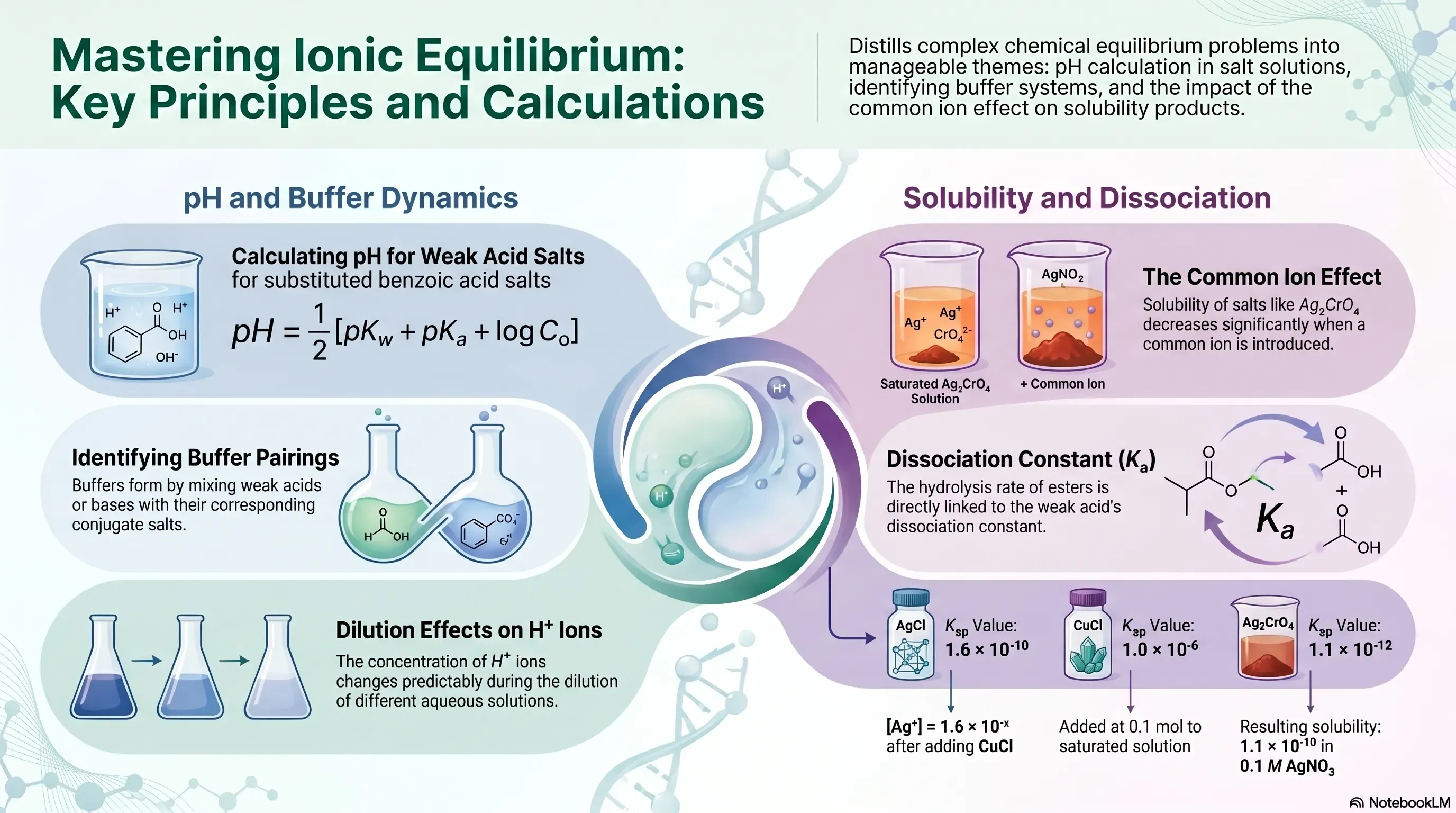
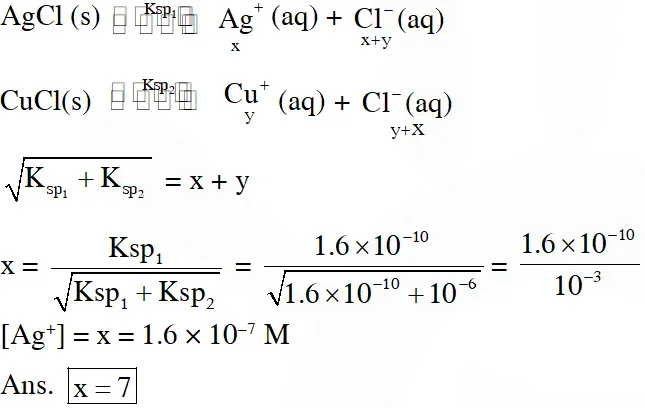
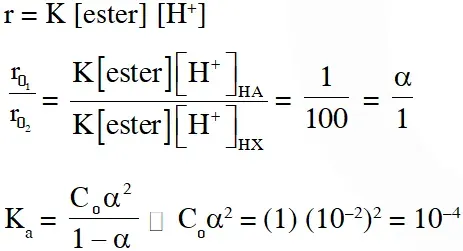
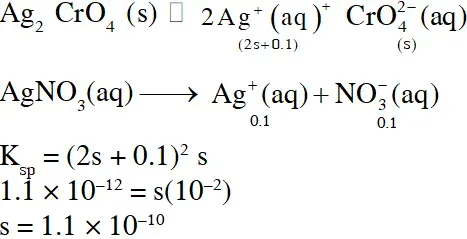
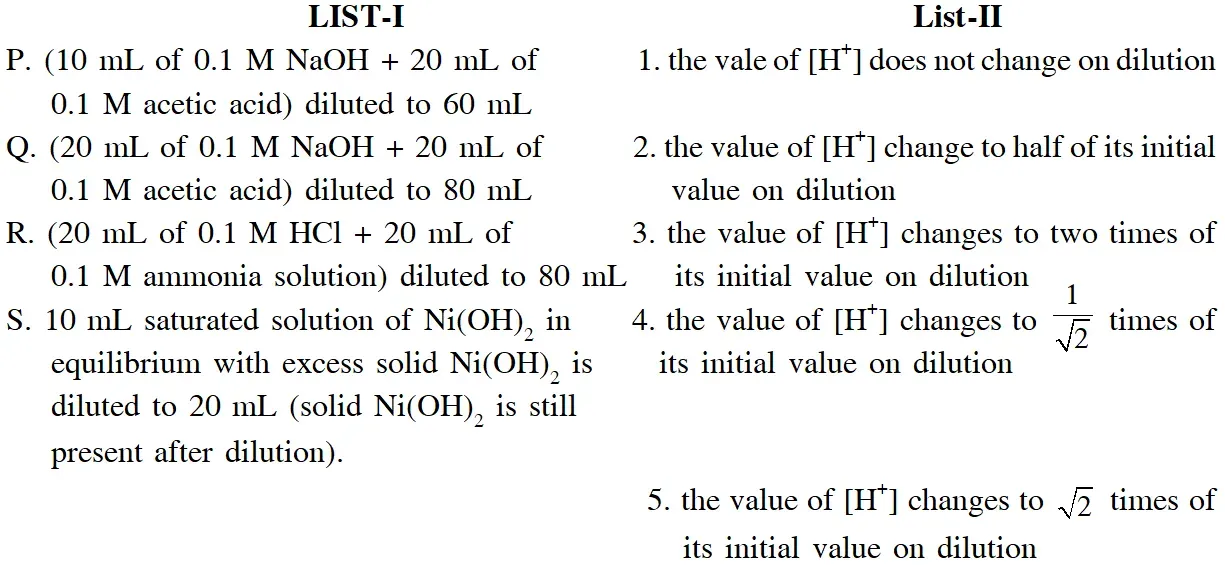
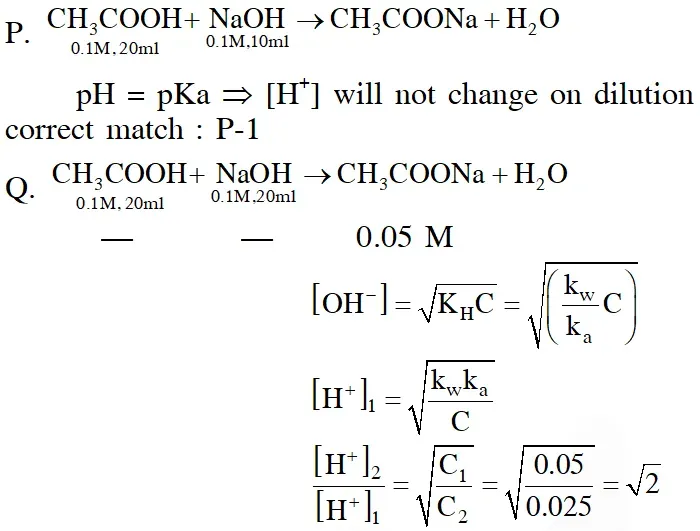
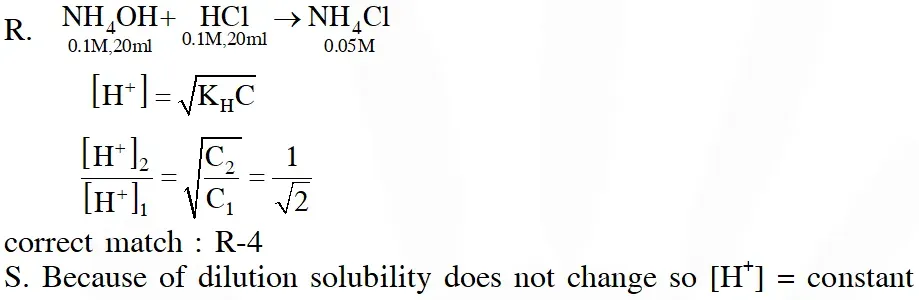
Simulator Previous Years JEE Advance Questions [esquestion] The dissociation constant of a substituted benzoic acid at $25^{\circ} \mathrm{C}$ is $1.0 \times 10^{-4}$ . The pH of a 0.01 M solution of its sodium salt is #tag# [JEE 2009] #sol# 8 $\mathrm{K}_{\mathrm{h}}=\frac{\mathrm{K}_{\mathrm{w}}}{\mathrm{K}_{\mathrm{a}}}=\frac{10^{-14}}{10^{-4}}=10^{-10}$ $\mathrm{h}=\sqrt{\frac{\mathrm{K}_{\mathrm{h}}}{\mathrm{C}_{0}}}=\sqrt{\frac{10^{-10}}{10^{-2}}}=10^{-4}$ $\mathrm{pH}=\frac{1}{2}[\mathrm{pKw}+\mathrm{pKa}+\log \mathrm{Co}]$ $\mathrm{pH}=\frac{1}{2}\left[14+4+\log 10^{-2}\right]$ $\mathrm{pH}=\frac{1}{2}[16]=8$ [/esquestion] [esquestion] Aqueous solutions of $\mathrm{HNO}_{3}, \mathrm{KOH}, \mathrm{CH}_{3} \mathrm{COOH}$ and $\mathrm{CH}_{3} \mathrm{COONa}$ of identical concentrations are provided. The pair(s) of solutions which form a buffer upon mixing is(are) (A) $\mathrm{HNO}_{3}$ and $\mathrm{CH}_{3} \mathrm{COOH}$ (B) $\mathrm{KOH}$ and $\mathrm{CH}_{3} \mathrm{COONa}$ (C) $\mathrm{HNO}_{3}$ and $\mathrm{CH}_{3} \mathrm{COONa}$ (D) $\mathrm{CH}_{3} \mathrm{COOH}$ and $\mathrm{CH}_{3} \mathrm{COONa}$ #tag# #sol# (C,D) [/esquestion] [esquestion] In 1 L saturated solution of AgCl $\left[\mathrm{K}_{\mathrm{sp}}(\mathrm{AgCl})=1.6 \times 10^{-10}\right], 0.1 \mathrm{mol}$ of $\mathrm{CuCl}$ $\left[\mathrm{K}_{\mathrm{sp}}(\mathrm{CuCl})=1.0 \times 10^{-6}\right]$ is added. The resultant concentration of $\mathrm{Ag}^{+}$ in the solution is 1.6 × $10^{-x}$. The value of ‘x’ is. #tag# [JEE -2011] #sol# 7 [/esquestion] [esquestion] The initial rate of hydrolysis of methyl acetate (1M) by a weak acid (HA, 1M) is $1 / 100^{\text {th }}$ of that of a strong acid (HX, 1M), at $25^{\circ} \mathrm{C}$. The $\mathrm{K}_{\mathrm{a}}$ of HA is (A) $1 \times 10^{-4}$ (B) $1 \times 10^{-5}$ (C) $1 \times 10^{-6}$ (D) $1 \times 10^{-3}$ #tag# [JEE 2013] #sol# (A) [/esquestion] [esquestion] The $\mathrm{K}_{\mathrm{sp}}$ of $\mathrm{Ag}_{2} \mathrm{CrO}_{4}$ is $1.1 \times 10^{-12}$ at 298 K. The solubility (in mol/L) of $\mathrm{Ag}_{2} \mathrm{CrO}_{4}$ in a $0.1 \mathrm{M} \mathrm{AgNO}_{3}$solution is (A) $1.1 \times 10^{-11}$ (B) $1.1 \times 10^{-10}$ (C) $1.1 \times 10^{-12}$ (D) $1.1 \times 10^{-9}$ #tag# [JEE 2013] #sol# (B) [/esquestion] [esquestion] Dilution process of different aqueous solutions; with water, are given in LIST-I. The effects of dilution of the solutions on $\left[\mathrm{H}^{+}\right]$ are given in LIST II. (Note : Degree of dissociation () of weak acid and weak base is << 1; degree of hydrolysis of salt <<1; $\left[\mathrm{H}^{+}\right]$ represents the concentration of $\mathrm{H}^{+}$ ions) Match each process given in LIST-I with one or more effect(s) in LIST-II. The correct option is $(\mathrm{A}) \mathrm{P} \rightarrow 4 ; \mathrm{Q} \rightarrow 2 ; \mathrm{R} \rightarrow 3 ; \mathrm{S} \rightarrow 1$ (B) $\mathrm{P} \rightarrow 4 ; \mathrm{Q} \rightarrow 3 ; \mathrm{R} \rightarrow 2 ; \mathrm{S} \rightarrow 3$ (C) $\mathrm{P} \rightarrow 1 ; \mathrm{Q} \rightarrow 4 ; \mathrm{R} \rightarrow 5 ; \mathrm{S} \rightarrow 3$ $(\mathrm{D}) \mathrm{P} \rightarrow 1 ; \mathrm{Q} \rightarrow 5 ; \mathrm{R} \rightarrow 4 ; \mathrm{S} \rightarrow 1$ #tag# [JEE- Adv. - 2018] #sol# (D) correct match : Q-5 [/esquestion]
After solving Ionic Equilibrium - JEE Advanced PYQs (Chemistry), check how the topic appears alongside others in the JEE Advanced exam paper.
Frequently Asked Questions
How many questions from Ionic Equilibrium appear in JEE Advanced each year?
Typically 1–2 questions appear from Ionic Equilibrium in JEE Advanced per year, contributing 3–8 marks depending on the question type. The topic is part of the broader Physical Chemistry section, which accounts for approximately 35% of the Chemistry paper according to the official JEE Advanced syllabus published by IIT.
What is the best way to prepare Ionic Equilibrium for JEE Advanced?
Start with NCERT Class 11 Chapter 7 (Equilibrium) to build your base, then move to JEE-level problems on pH, Ksp, and buffers. Solve previous year questions topic-by-topic before attempting full-length mocks. The NCERT Solutions for Class 12 Chemistry provide a solid conceptual bridge between board-level and JEE Advanced difficulty.
Is the Henderson–Hasselbalch equation directly applicable in JEE Advanced?
Yes. The Henderson–Hasselbalch equation (pH = pKa + log [A⁻]/[HA]) is directly used in buffer pH questions. However, JEE Advanced sometimes tests whether a buffer is even formed first — as in Q2 above — before you can apply the formula. Always verify the buffer condition before plugging in numbers.
What is the difference between Kh (hydrolysis constant) and Ka?
Kh is the equilibrium constant for the hydrolysis of a salt ion in water. For the anion of a weak acid: Kh = Kw / Ka. A smaller Ka (weaker acid) means a larger Kh, meaning the salt undergoes more hydrolysis and the solution is more basic. This relationship appears directly in Q1 of this set.
How does dilution affect the pH of a buffer solution?
Diluting a buffer solution causes a very small change in pH because the ratio [salt]/[acid] remains nearly constant. The Henderson–Hasselbalch equation shows that pH depends on the logarithm of this ratio, not on absolute concentrations. This is why buffers resist pH change on dilution — a key concept tested in the 2018 JEE Advanced match question.
Team eSaral
eSaral Academic and Editorial Team
Team eSaral is the collective author profile for educational content created by eSaral’s teachers and academic contributors. The team draws on expertise from IIT graduates, doctors, experienced educators and subject specialists to develop resources for JEE, NEET and school students. Our articles aim to explain concepts clearly and help students study with confidence.
Related Posts

BITSAT 2027: Registration Date, Exam Date, Syllabus, Eligibility, Pattern & Fees
BITSAT 2027 exam dates, registration timeline, eligibility criteria, exam pattern, marking scheme, syllabus and fees in one page.

BITSAT Previous Year Question Paper PDF (2017-2026)
Download BITSAT previous year question papers PDF from 2017 to 2026,session-wise. Memory-based papers,exam pattern, paper analysis and how to practise

CBSE Class 10 Date Sheet 2027: Expected Exam Dates, Release Date, Admit Card & Result Timeline
CBSE Class 10 date sheet 2027 is awaited. See the expected exam dates, release window, how to download the PDF, admit card and result timelines.

NCERT Physics Class 10 Book PDF in Hindi 2026-27 – भौतिक विज्ञान के 4 अध्याय (Free Download)
NCERT Physics Class 10 book PDF in Hindi 2026-27: download all 4 chapters (अध्याय 9–12) free, with topics and important formulas.

NCERT Biology Class 9 Book Anveshan PDF in Hindi - जीव विज्ञान कक्षा 9 पुस्तक अन्वेषण PDF
Download NCERT Biology Class 9 book PDF in Hindi chapterwise for 2026-27: Cell, Tissues, Reproduction and Diversity. Free PDFs.

Essay On Artificial Intelligence in English (100,150, 200, 250, 300, 500 Words)
This is in contrast to the natural intelligence of humans. With Artificial Intelligence, machines can perform

Essay on 78th India Independence Day in English for Student (100, 150, 200, 250, 300, 500 Words)
Read the best essays on India's Independence Day in English. Short & long essays (100, 150, 200, 250, 300, 500 words) perfect for school exams
NCERT Class 11 English Snapshots book - Free PDF download- Esaral
Download NCERT Class 11 English Snapshots book PDF for free. Get all 8 chapters, chapter-wise. Start your prep today!
NCERT Class 10 biology book pdf - Free PDF Download - eSaral
NCERT Class 10 Biology book PDF 2026-27: all 5 chapters (Life Processes to Our Environment) in English & Hindi, with CBSE syllabus, marks & practical

Essay on Global Warming in English (100,150, 200, 250, 300, 500 Words)
Global warming means the Earth is getting hotter. This happens because of things like pollution from cars and factories.