
Ionic Equilibrium - NEET Previous Year Questions with Complete Solutions

eSaral Academic and Editorial Team
Summary
Ionic Equilibrium NEET Previous Year Questions cover approximately 2–3 questions per year in NEET Chemistry, drawn from topics like pH calculation, buffer solutions, Ka/Kb, ionic product of water, hydrolysis of salts, and solubility product (Ksp). Solving these PYQs with detailed solutions is one of the fastest ways to identify high-yield patterns and score full marks in Physical Chemistry.
eSaral › NEET Chemistry › Ionic Equilibrium Previous Year Questions with Complete Solutions

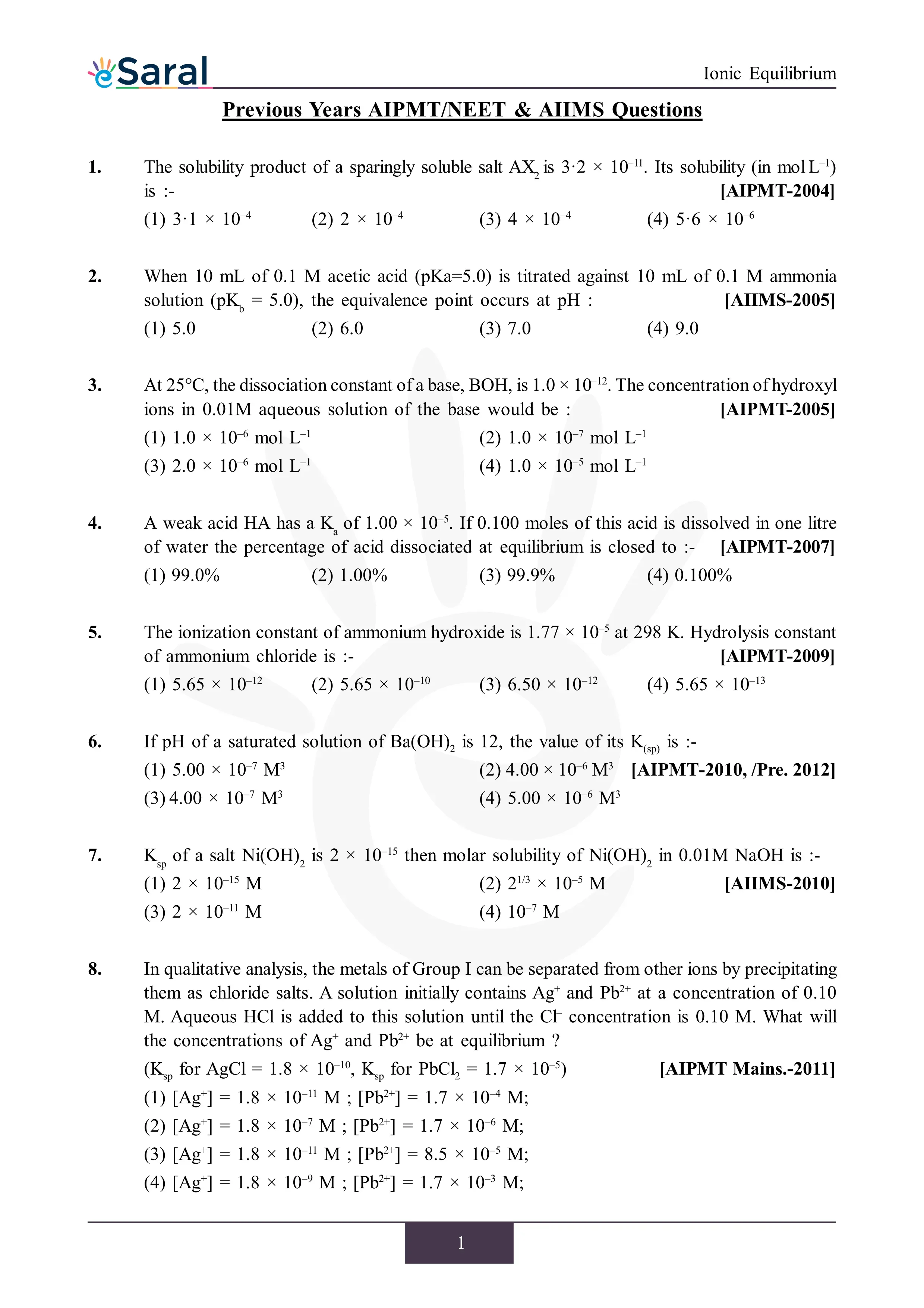
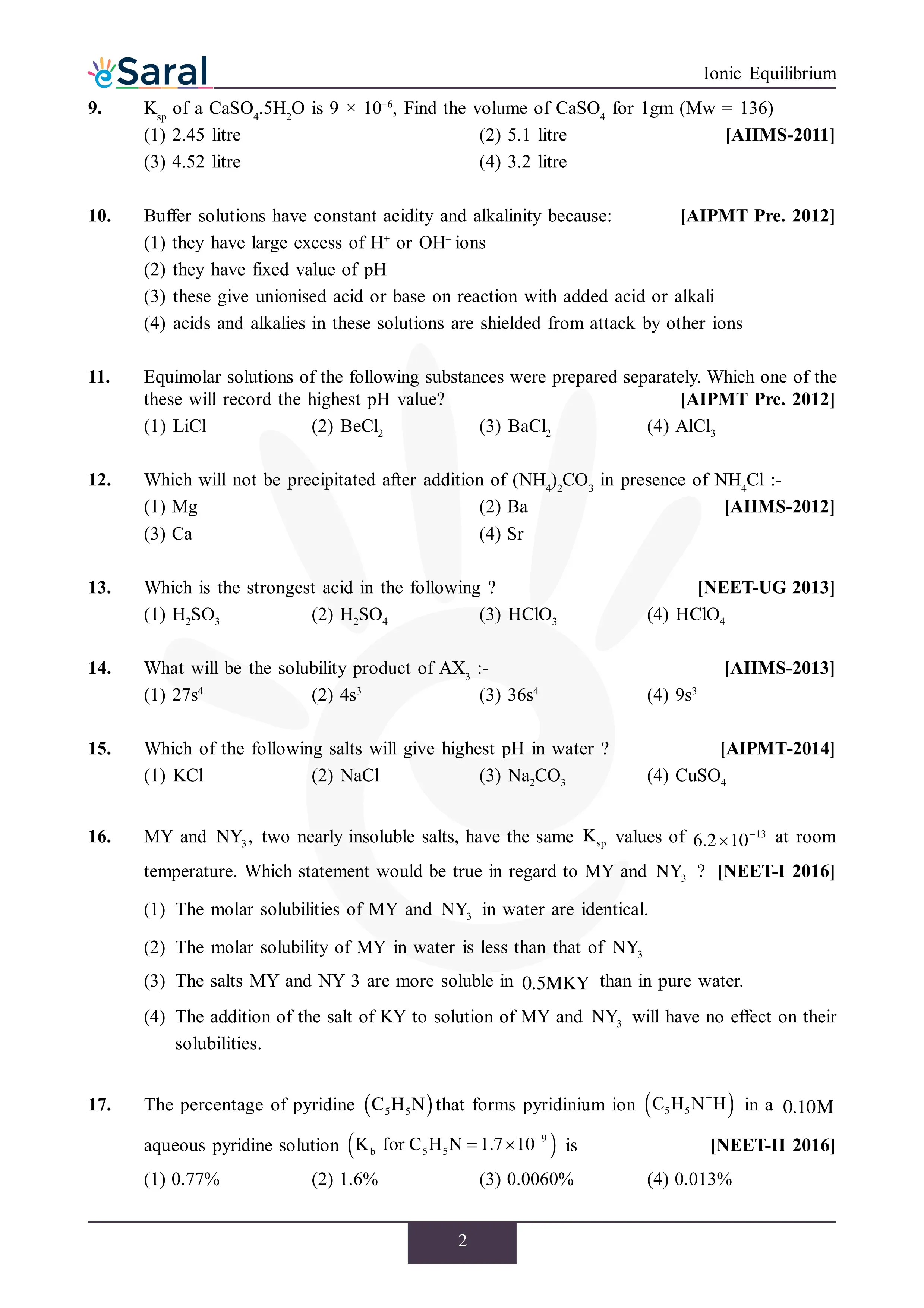
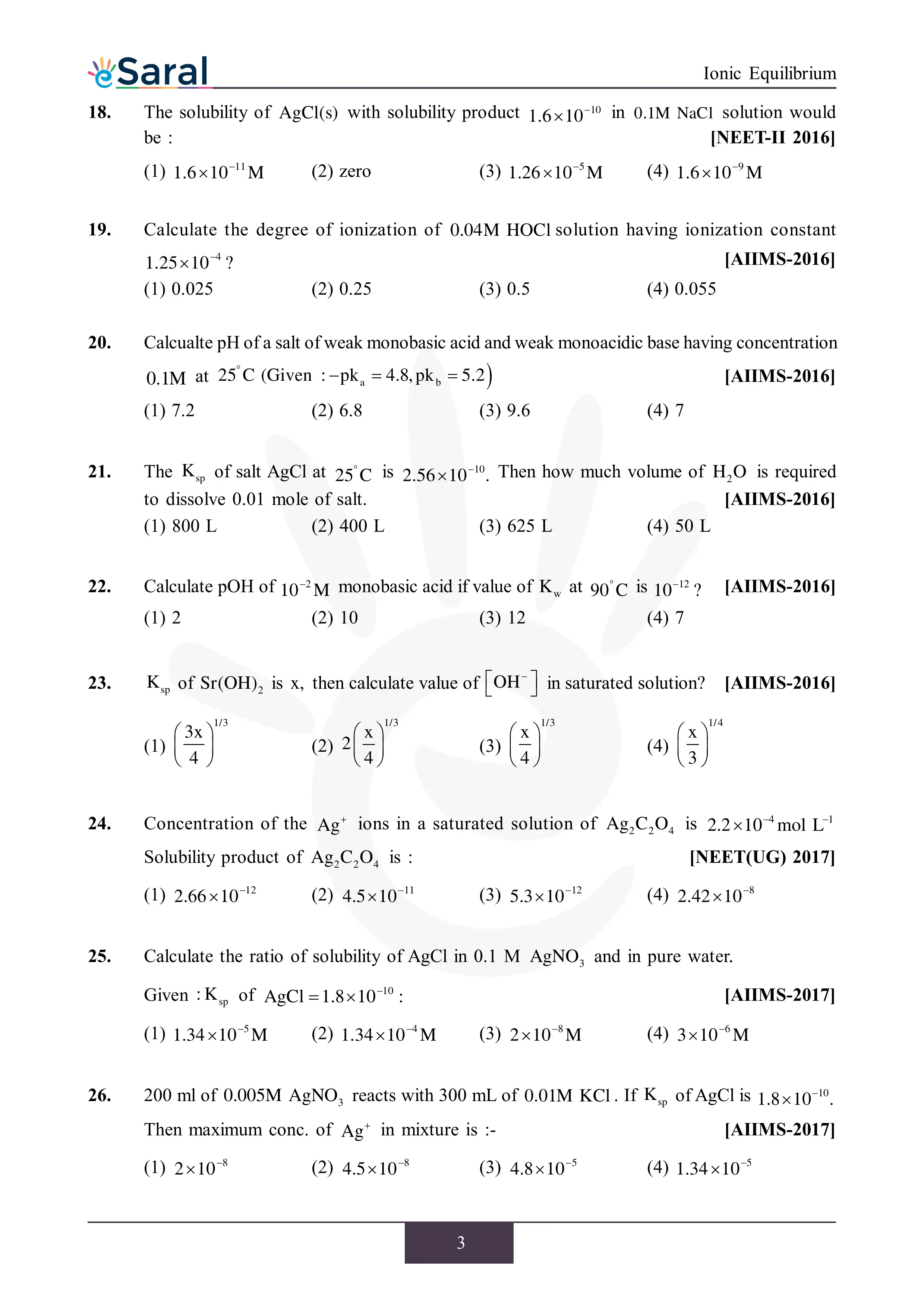
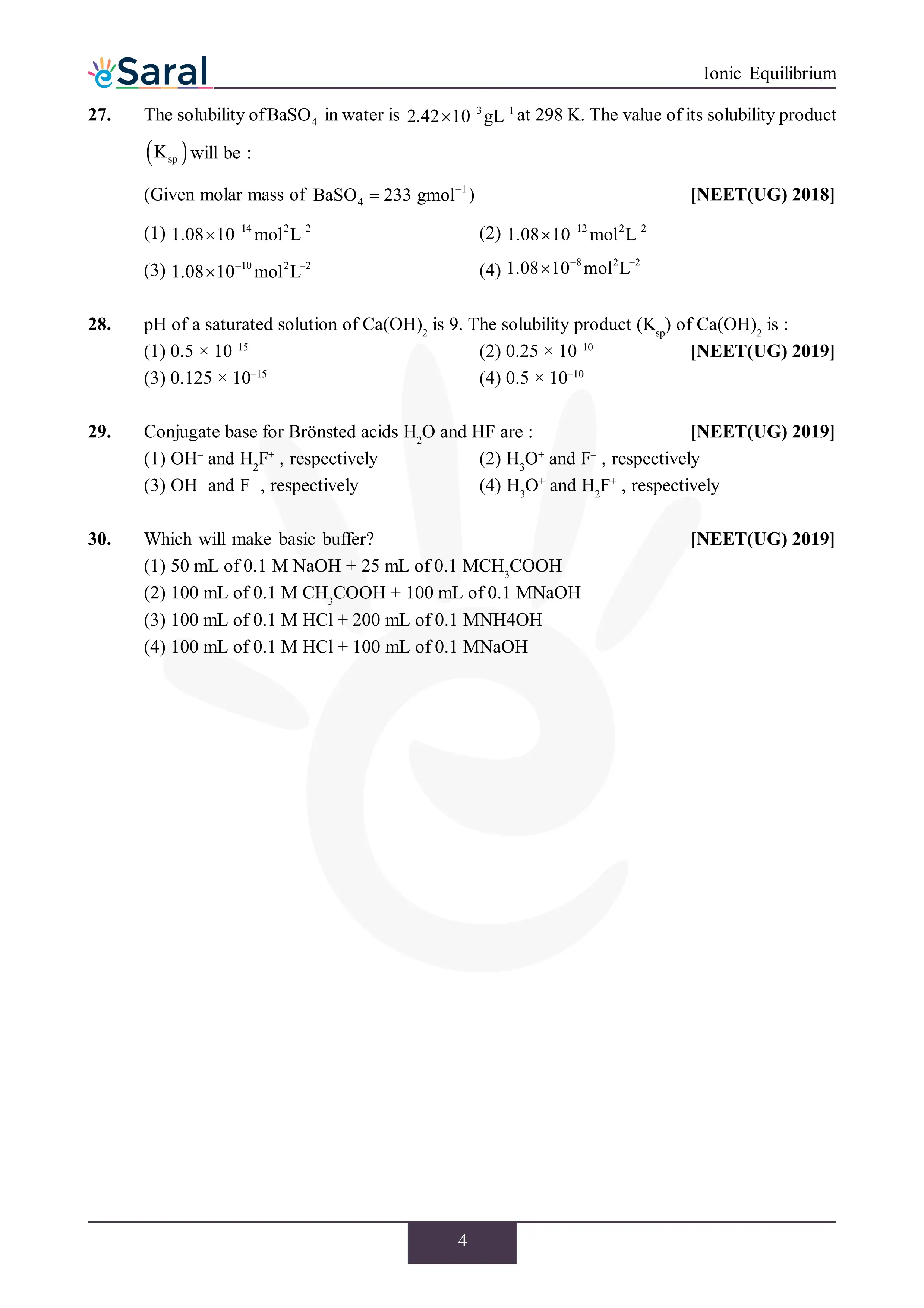
Here you will find Complete Ionic Equilibrium NEET Previous Year Questions with detailed solutions.
Get complete NEET previous-year questions for Physics, Chemistry, and Biology.
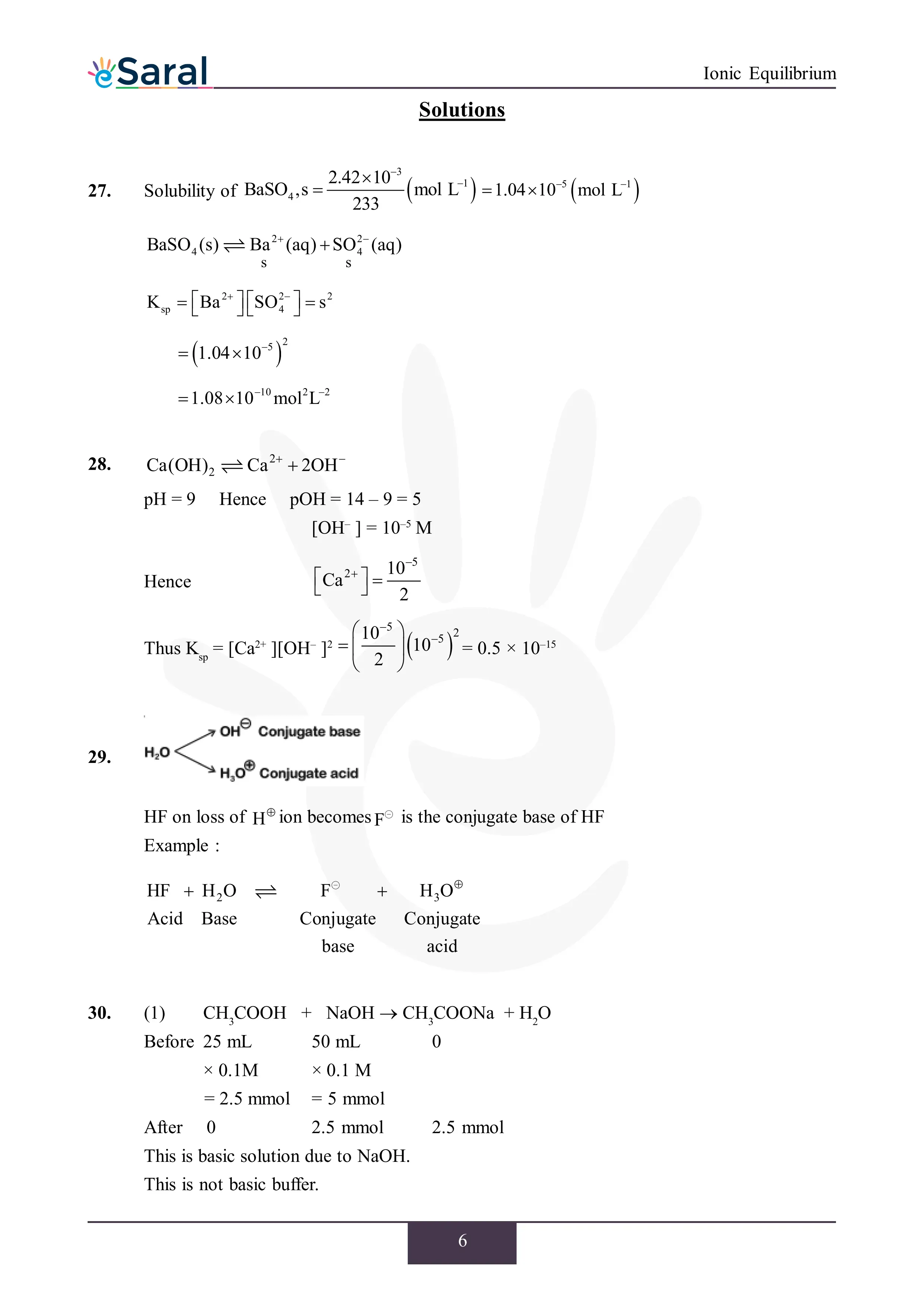
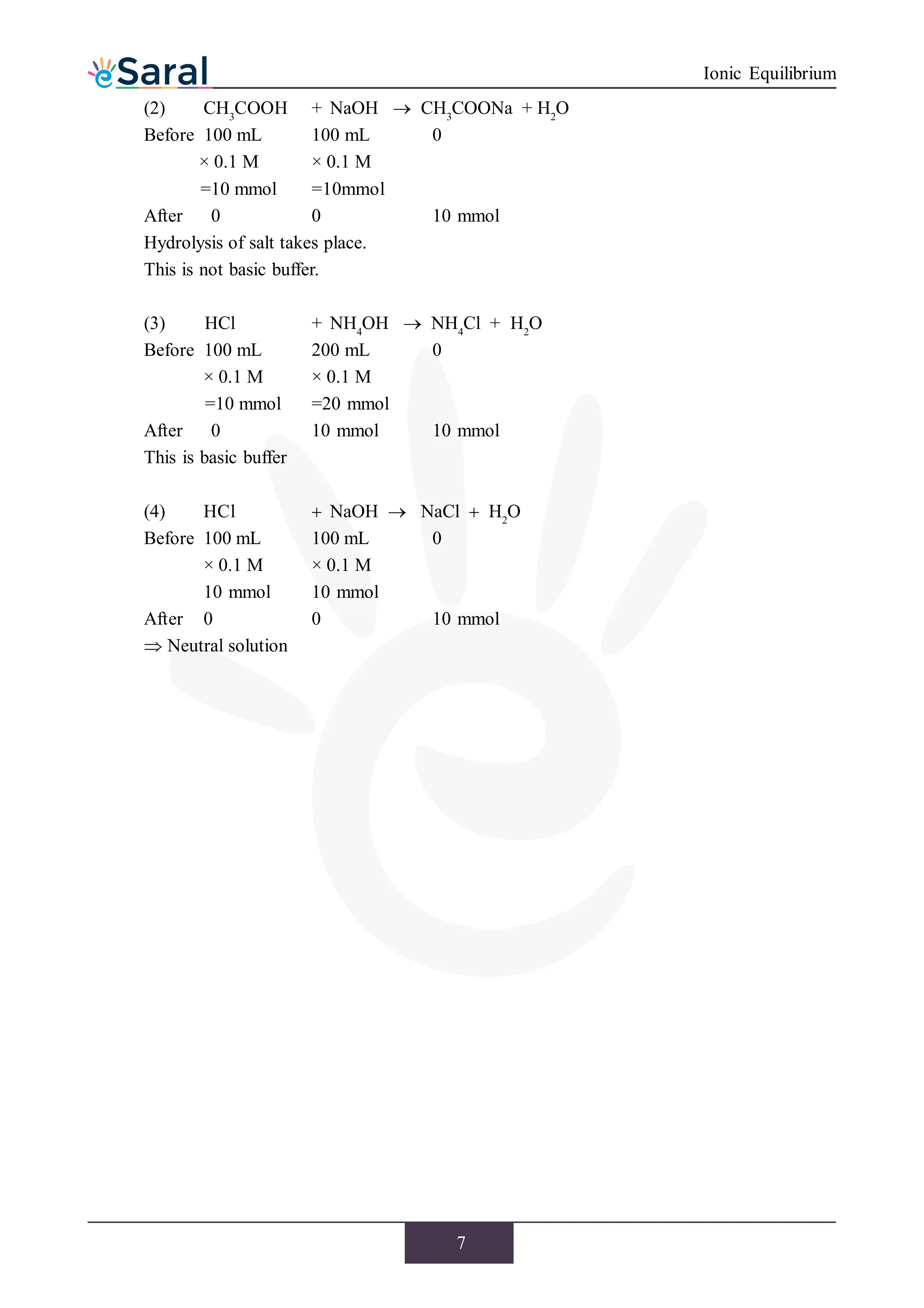
You will find all the solutions at the end of this page:

Frequently Asked Questions
Is Ionic Equilibrium from Class 11 or Class 12 for NEET?
Ionic Equilibrium is a Class 11 topic, covered in NCERT Chemistry Part 1, Chapter 7 ("Equilibrium"). However, it connects directly with Class 12 topics like electrochemistry (Kw temperature dependence) and coordination chemistry (complex ion equilibria). NEET questions draw entirely from the Class 11 NCERT scope for this chapter.
Which sub-topics of Ionic Equilibrium are most important for NEET?
The five highest-yield sub-topics are: pH and pOH calculations, dissociation constants (Ka, Kb, Kw), buffer solutions and the Henderson–Hasselbalch equation, hydrolysis of salts, and solubility product (Ksp) with common ion effect. Among these, pH calculations and Ksp-based problems appear most frequently in recent NEET papers.
How many questions come from Ionic Equilibrium in NEET every year?
NEET typically has 2 to 3 questions from Ionic Equilibrium each year, contributing 8–12 marks. The chapter has featured in every NEET paper since 2013 without exception. Given the predictable question types (pH, Ka/Kb, buffer, Ksp), it offers one of the best returns on study time in the entire Chemistry syllabus.
Can I skip Ionic Equilibrium and still score well in NEET Chemistry?
Skipping Ionic Equilibrium is not advisable. It contributes 8–12 marks annually and its questions are among the most formula-predictable in Chemistry. Missing it means surrendering easy marks that competitors — especially students trained by IIT Bombay faculty with structured PYQ practice — will pick up. The chapter takes roughly 10–15 hours of focused study to master fully.
How do I calculate the pH of a buffer solution for NEET?
Use the Henderson–Hasselbalch equation: pH = pKa + log([A⁻]/[HA]), where [A⁻] is the concentration of the conjugate base (salt) and [HA] is the concentration of the weak acid. For NEET, the ratio is usually a simple number (1:1, 1:10, 10:1), so the log term becomes 0, +1, or −1, making mental calculation fast.
What is the difference between Ka and Kb in Ionic Equilibrium?
Ka is the acid dissociation constant — a measure of how strongly a weak acid donates a proton. Kb is the base dissociation constant — a measure of how strongly a weak base accepts a proton. For a conjugate acid-base pair at 25°C, Ka × Kb = Kw = 1 × 10⁻¹⁴. A higher Ka means a stronger acid; a higher Kb means a stronger base.
Team eSaral
eSaral Academic and Editorial Team
Team eSaral is the collective author profile for educational content created by eSaral’s teachers and academic contributors. The team draws on expertise from IIT graduates, doctors, experienced educators and subject specialists to develop resources for JEE, NEET and school students. Our articles aim to explain concepts clearly and help students study with confidence.
Related Posts

BITSAT 2027: Registration Date, Exam Date, Syllabus, Eligibility, Pattern & Fees
BITSAT 2027 exam dates, registration timeline, eligibility criteria, exam pattern, marking scheme, syllabus and fees in one page.

BITSAT Previous Year Question Paper PDF (2017-2026)
Download BITSAT previous year question papers PDF from 2017 to 2026,session-wise. Memory-based papers,exam pattern, paper analysis and how to practise

CBSE Class 10 Date Sheet 2027: Expected Exam Dates, Release Date, Admit Card & Result Timeline
CBSE Class 10 date sheet 2027 is awaited. See the expected exam dates, release window, how to download the PDF, admit card and result timelines.

NCERT Physics Class 10 Book PDF in Hindi 2026-27 – भौतिक विज्ञान के 4 अध्याय (Free Download)
NCERT Physics Class 10 book PDF in Hindi 2026-27: download all 4 chapters (अध्याय 9–12) free, with topics and important formulas.

NCERT Biology Class 9 Book Anveshan PDF in Hindi - जीव विज्ञान कक्षा 9 पुस्तक अन्वेषण PDF
Download NCERT Biology Class 9 book PDF in Hindi chapterwise for 2026-27: Cell, Tissues, Reproduction and Diversity. Free PDFs.

Essay On Artificial Intelligence in English (100,150, 200, 250, 300, 500 Words)
This is in contrast to the natural intelligence of humans. With Artificial Intelligence, machines can perform

Essay on 78th India Independence Day in English for Student (100, 150, 200, 250, 300, 500 Words)
Read the best essays on India's Independence Day in English. Short & long essays (100, 150, 200, 250, 300, 500 words) perfect for school exams
NCERT Class 11 English Snapshots book - Free PDF download- Esaral
Download NCERT Class 11 English Snapshots book PDF for free. Get all 8 chapters, chapter-wise. Start your prep today!
NCERT Class 10 biology book pdf - Free PDF Download - eSaral
NCERT Class 10 Biology book PDF 2026-27: all 5 chapters (Life Processes to Our Environment) in English & Hindi, with CBSE syllabus, marks & practical

Essay on Global Warming in English (100,150, 200, 250, 300, 500 Words)
Global warming means the Earth is getting hotter. This happens because of things like pollution from cars and factories.