
Ionic Equilibrium Class 11 Notes for IIT JEE & NEET

eSaral Academic and Editorial Team
Summary
Ionic equilibrium refers to the equilibrium established between ions and unionised molecules when a weak electrolyte partially dissociates in solution. Key concepts include Arrhenius, Brønsted-Lowry, and Lewis theories; ionisation constants (Ka, Kb); pH calculations; buffer solutions; salt hydrolysis; and solubility product (Ksp) — all high-weightage topics in IIT JEE and NEET.

Ionic equilibrium is the second half of the NCERT chapter Equilibrium, which is Chapter 6 of the current Class 11 Chemistry book (Chapter 7 in older books). The first half, on Kc, Kp and Le Chatelier’s principle, is in eSaral’s Chemical Equilibrium Class 11 notes. In the JEE Main syllabus, both halves are one unit, Equilibrium. These Ionic Equilibrium Class 11 Notes follow the NCERT chapter and add the IIT JEE and NEET problem types.
Ionic Equilibrium Class 11 Notes: Chapter Overview and Syllabus
Topic | NCERT and CBSE | IIT JEE and NEET |
|---|---|---|
Strong and weak electrolytes, degree of ionisation | Yes | Yes |
Acid–base concepts (Arrhenius, Brønsted–Lowry, Lewis) | Yes | Yes |
Ionisation constants $K_a$ and $K_b$, ionisation of water, pH scale | Yes | Yes |
Polyprotic acids, acid strength | Yes | Yes (multistage ionisation) |
Common ion effect | Yes | Yes |
Hydrolysis of salts and the pH of their solutions | Yes (elementary idea) | Yes, with calculations |
Buffer solutions, Henderson equation | Yes | Yes |
Solubility of sparingly soluble salts and solubility product | Yes | Yes |
Indicators and titration curves | Partly | Common in problems |
Check the latest CBSE, NTA (JEE Main), JEE Advanced and NMC (NEET) syllabi for the exact lists. The number of questions changes every year, so use previous years’ papers to see the trend.
Tip from the eSaral Chemistry team: In every numerical, first decide which species controls the pH: a strong acid or base, a weak acid or base, a buffer or a salt. Each case has one formula, and most mistakes come from using the wrong one.
Ionic Equilibrium Class 11 Notes for IIT JEE and NEET
India's Best Exam Preparation for Class 11th - Download Now
India's Best Exam Preparation for Class 11th - Download Now
India's Best Exam Preparation for Class 11th - Download Now
India's Best Exam Preparation for Class 11th - Download Now
India's Best Exam Preparation for Class 11th - Download Now
India's Best Exam Preparation for Class 11th - Download Now
India's Best Exam Preparation for Class 11th - Download Now
India's Best Exam Preparation for Class 11th - Download Now
Electrolytes and the Degree of Ionisation in Ionic Equilibrium Class 11 Notes
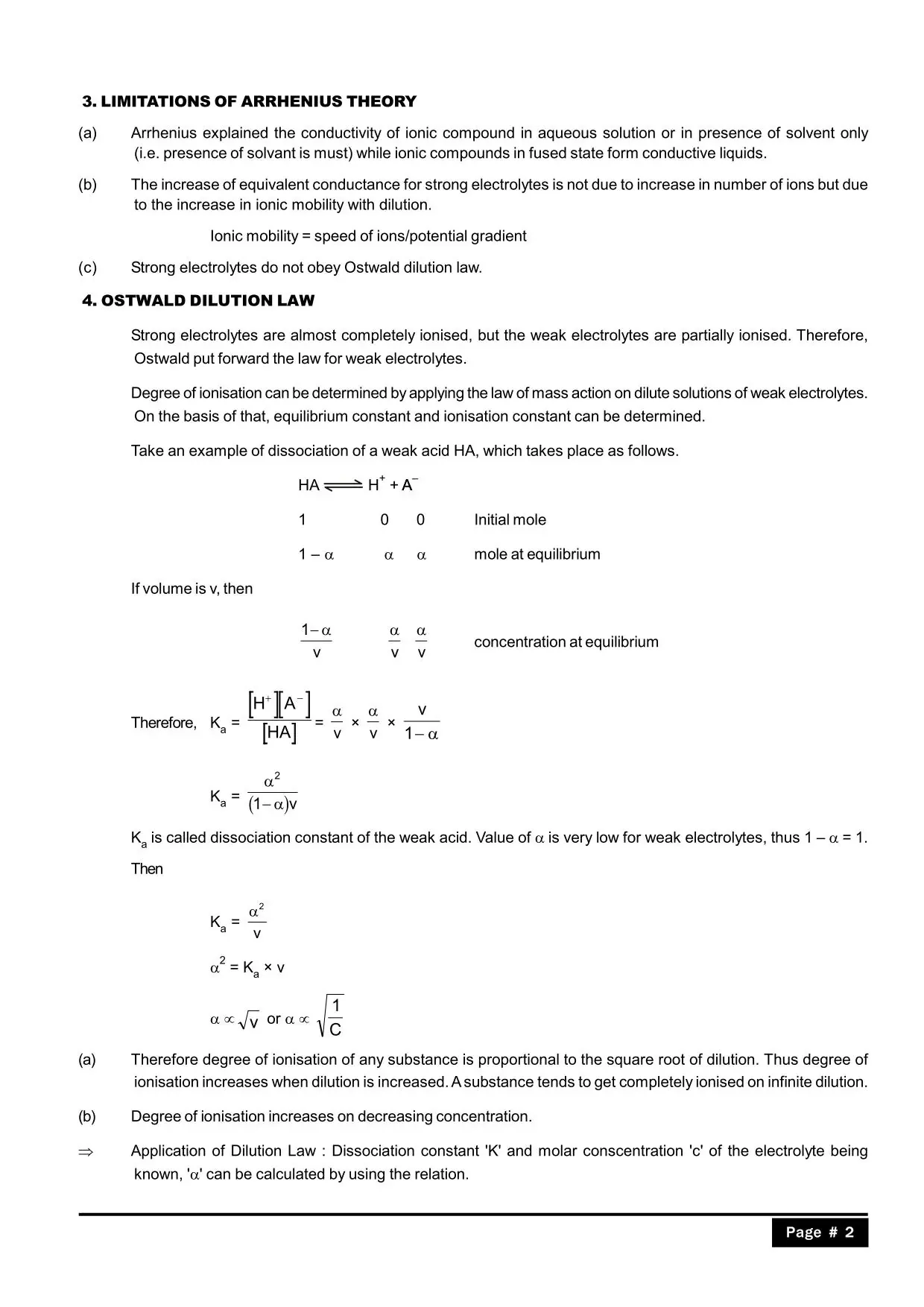
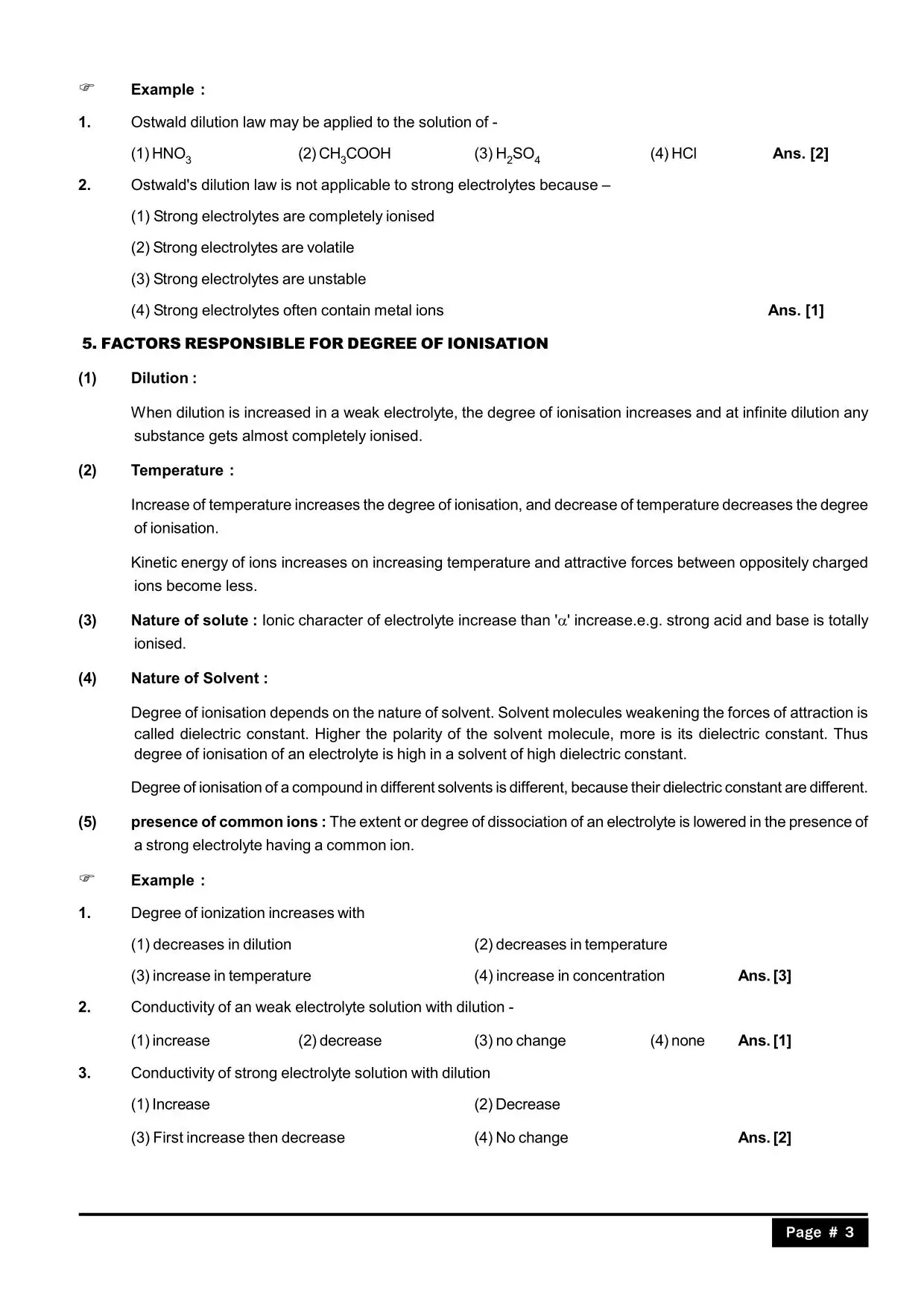
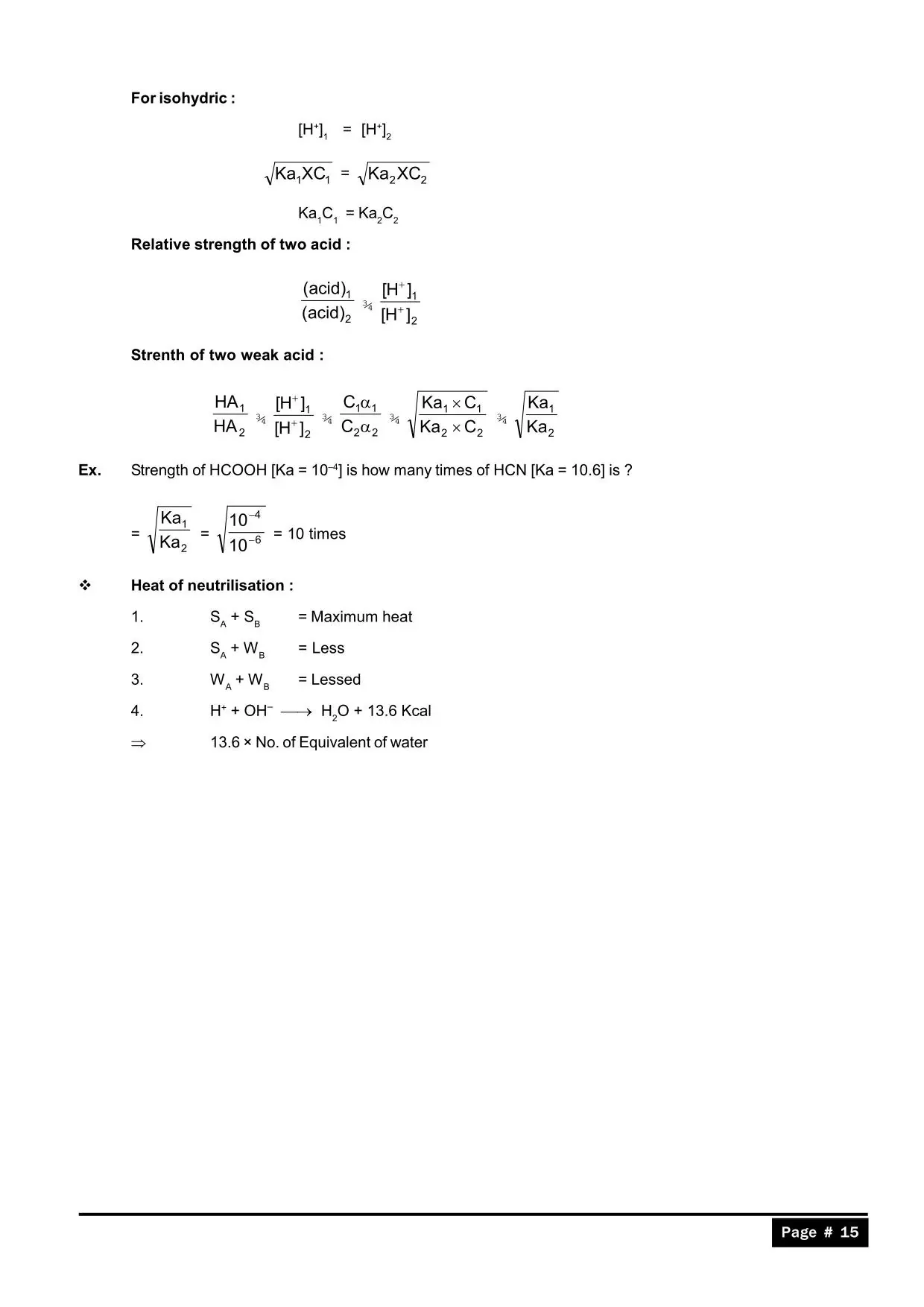
A strong electrolyte ionises completely in water (HCl, NaOH, NaCl), and a weak electrolyte ionises only partly (CH$_3$COOH, NH$_3$). The degree of ionisation is $\alpha = \dfrac{\text{amount ionised}}{\text{amount dissolved}}$.
For a weak acid HA of concentration $C$:
$$K_a = \frac{C\alpha^{2}}{1 - \alpha} \approx C\alpha^{2} \quad (\alpha \ll 1), \qquad \alpha = \sqrt{\frac{K_a}{C}}$$
This is Ostwald’s dilution law: $\alpha$ increases as the solution is diluted, and $[\mathrm{H^+}] = C\alpha = \sqrt{K_aC}$. The ionisation constant $K_a$ changes only with the temperature.
Acid–Base Theories in Ionic Equilibrium Class 11 Notes
Theory | Acid | Base |
|---|---|---|
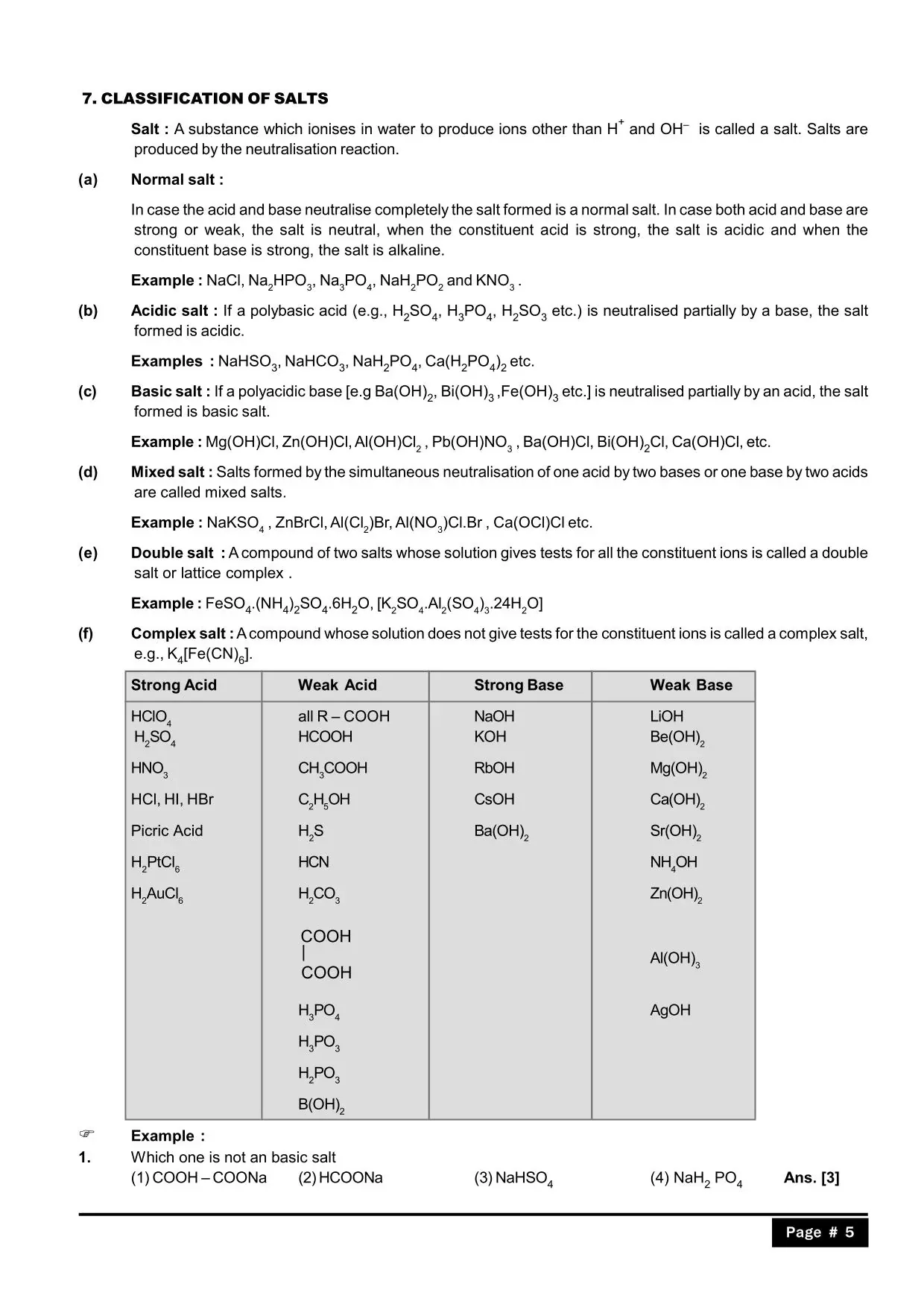
Arrhenius | Gives $\mathrm{H^+}$ in water | Gives $\mathrm{OH^-}$ in water |
Brønsted–Lowry | Donates a proton | Accepts a proton |
Lewis | Accepts an electron pair (e.g. $\mathrm{BF_3}$, $\mathrm{AlCl_3}$) | Donates an electron pair (e.g. $\mathrm{NH_3}$) |
- Conjugate pairs: HA and $\mathrm{A^-}$ differ by one proton. A strong acid has a very weak conjugate base, and a weak acid has a stronger conjugate base. For a conjugate pair, $K_a \times K_b = K_w$.
- Amphiprotic species (water, $\mathrm{HCO_3^-}$, $\mathrm{HS^-}$) can act as an acid and as a base.
- The acid strength depends on $\mathrm{p}K_a = -\log K_a$: the smaller the pK$_a$, the stronger the acid.
Ionisation of Water and the pH Scale in Ionic Equilibrium Class 11 Notes
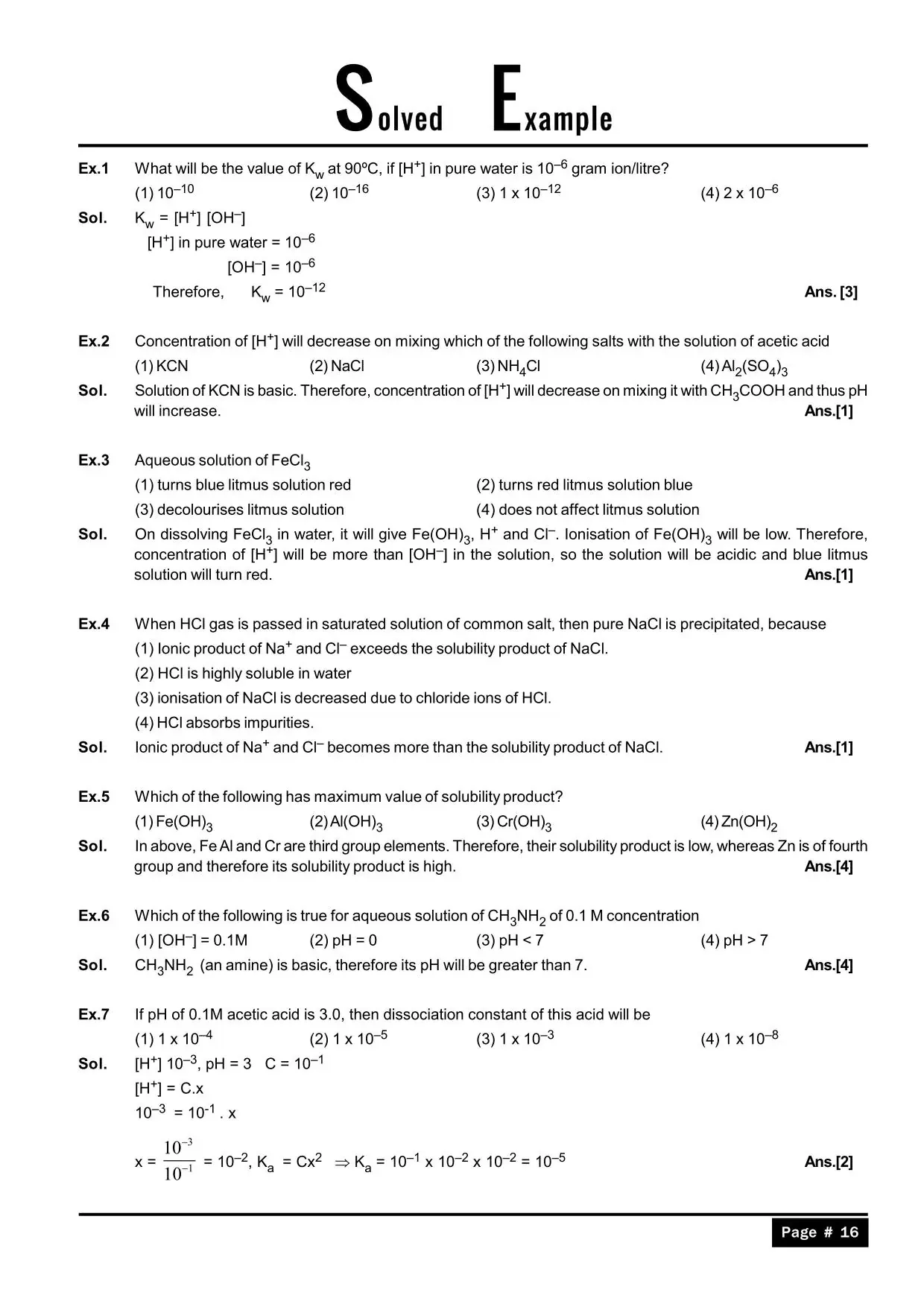
$$\mathrm{H_2O \rightleftharpoons H^+ + OH^-}, \qquad K_w = [\mathrm{H^+}][\mathrm{OH^-}] = 1.0\times10^{-14}\ \text{at } 298\ \text{K}$$ $$\mathrm{pH} = -\log[\mathrm{H^+}], \qquad \mathrm{pOH} = -\log[\mathrm{OH^-}], \qquad \mathrm{pH} + \mathrm{pOH} = \mathrm{p}K_w = 14\ \text{at } 298\ \text{K}$$
- $K_w$ rises with temperature, so at a higher temperature, pure water has $\mathrm{pH} < 7$, but it is still neutral because $[\mathrm{H^+}] = [\mathrm{OH^-}]$.
- A strong acid of concentration $C$ has $\mathrm{pH} = -\log C$, and a strong base has $\mathrm{pOH} = -\log C$.
- Very dilute solutions (around $10^{-7}$ M or less): the $\mathrm{H^+}$ of water cannot be ignored. For $10^{-8}$ M HCl, solve $[\mathrm{H^+}]^{2} - 10^{-8}[\mathrm{H^+}] - 10^{-14} = 0$, which gives $\mathrm{pH} \approx 6.98$, and not 8.
Weak Acids, Weak Bases and Polyprotic Acids in Ionic Equilibrium Class 11 Notes
Case | $[\mathrm{H^+}]$ or $[\mathrm{OH^-}]$ | pH |
|---|---|---|
Weak acid, concentration $C$ | $[\mathrm{H^+}] = \sqrt{K_aC}$ | $\mathrm{pH} = \tfrac{1}{2}\left(\mathrm{p}K_a - \log C\right)$ |
Weak base, concentration $C$ | $[\mathrm{OH^-}] = \sqrt{K_bC}$ | $\mathrm{pOH} = \tfrac{1}{2}\left(\mathrm{p}K_b - \log C\right)$ |
Polyprotic acids (H$_2$S, H$_2$CO$_3$, H$_3$PO$_4$) ionise in steps, and $K_{a1} \gg K_{a2} \gg K_{a3}$. The first step gives almost all the $\mathrm{H^+}$, so the pH is found from $K_{a1}$. For a solution of H$_2$A with no other source of $\mathrm{A^{2-}}$, $[\mathrm{A^{2-}}] \approx K_{a2}$.
Common Ion Effect in Ionic Equilibrium Class 11 Notes
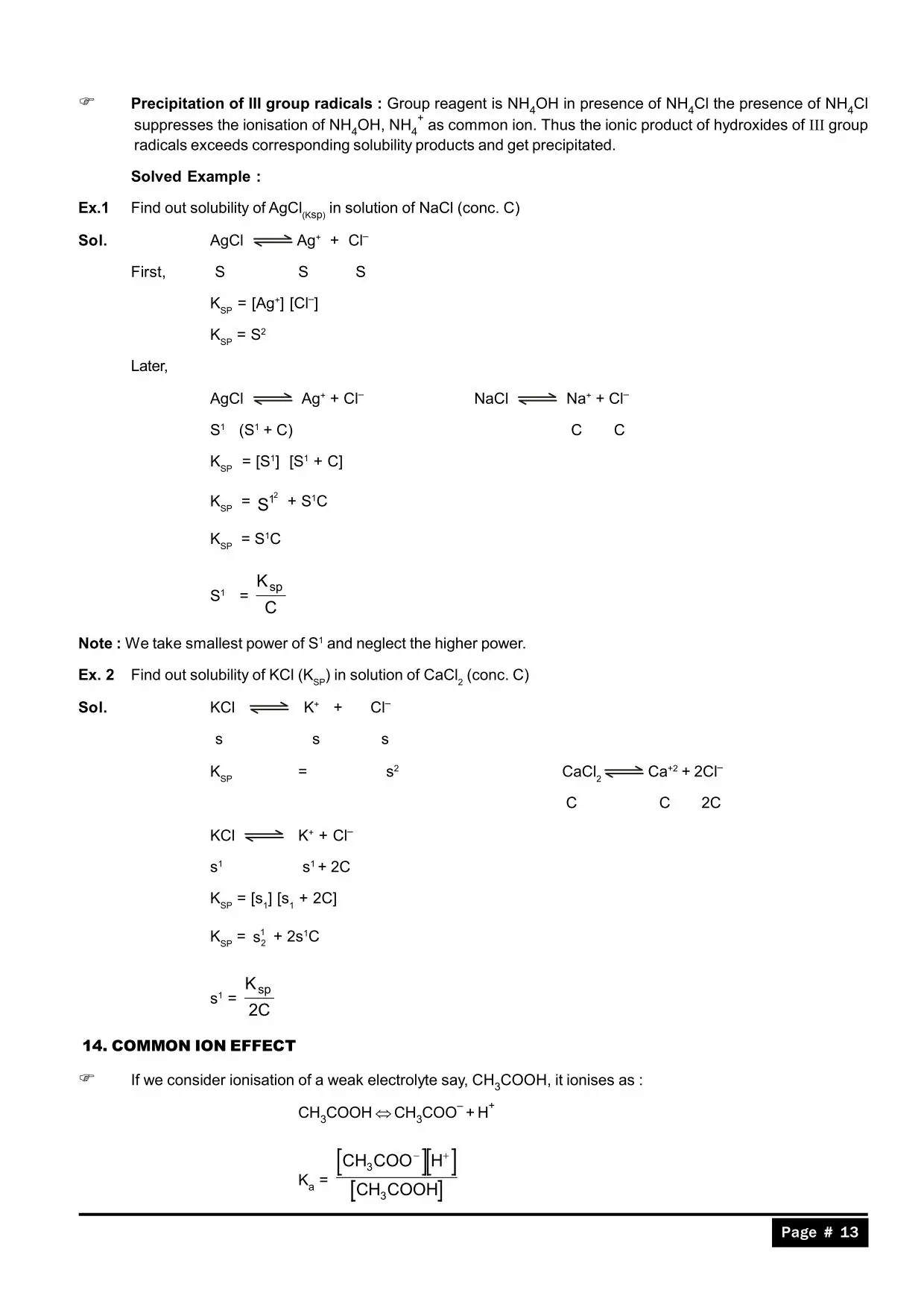
The ionisation of a weak electrolyte falls when a strong electrolyte with a common ion is added (Le Chatelier’s principle). For a weak acid HA with its salt NaA added:
$$[\mathrm{H^+}] = K_a\,\frac{[\mathrm{HA}]}{[\mathrm{A^-}]}$$
For example, sodium acetate suppresses the ionisation of acetic acid, and sodium chloride lowers the solubility of silver chloride.
Buffer Solutions and the Henderson Equation in Ionic Equilibrium Class 11 Notes
A buffer resists a change in pH on the addition of a small amount of an acid or a base. An acidic buffer is a weak acid with its salt (CH$_3$COOH and CH$_3$COONa), and a basic buffer is a weak base with its salt (NH$_4$OH and NH$_4$Cl).
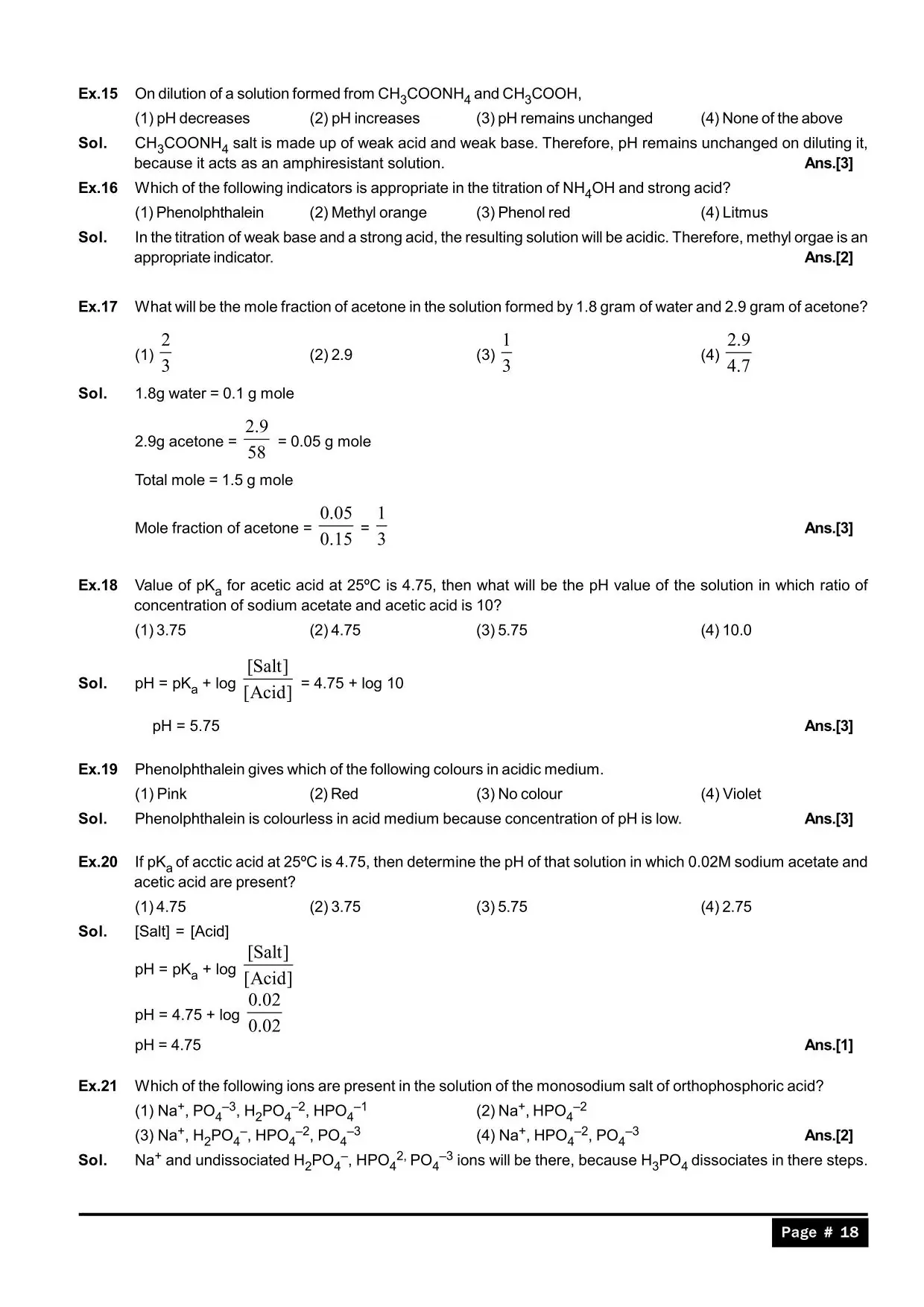
$$\mathrm{pH} = \mathrm{p}K_a + \log\frac{[\text{salt}]}{[\text{acid}]}, \qquad \mathrm{pOH} = \mathrm{p}K_b + \log\frac{[\text{salt}]}{[\text{base}]}$$
- The buffer capacity is maximum when $[\text{salt}] = [\text{acid}]$, so that $\mathrm{pH} = \mathrm{p}K_a$.
- An effective buffer works in the range $\mathrm{pH} = \mathrm{p}K_a \pm 1$, which is for a ratio $[\text{salt}]/[\text{acid}]$ between $0.1$ and $10$.
- When a strong acid or base is added, find the new moles of the acid and the salt first (the strong acid converts the salt into the weak acid), and then use the equation.
- Blood is buffered by $\mathrm{H_2CO_3}/\mathrm{HCO_3^-}$.
Hydrolysis of Salts in Ionic Equilibrium Class 11 Notes
Salt of | Example | Hydrolysis | $K_h$ | pH |
|---|---|---|---|---|
Strong acid + strong base | NaCl | None | – | $7$ |
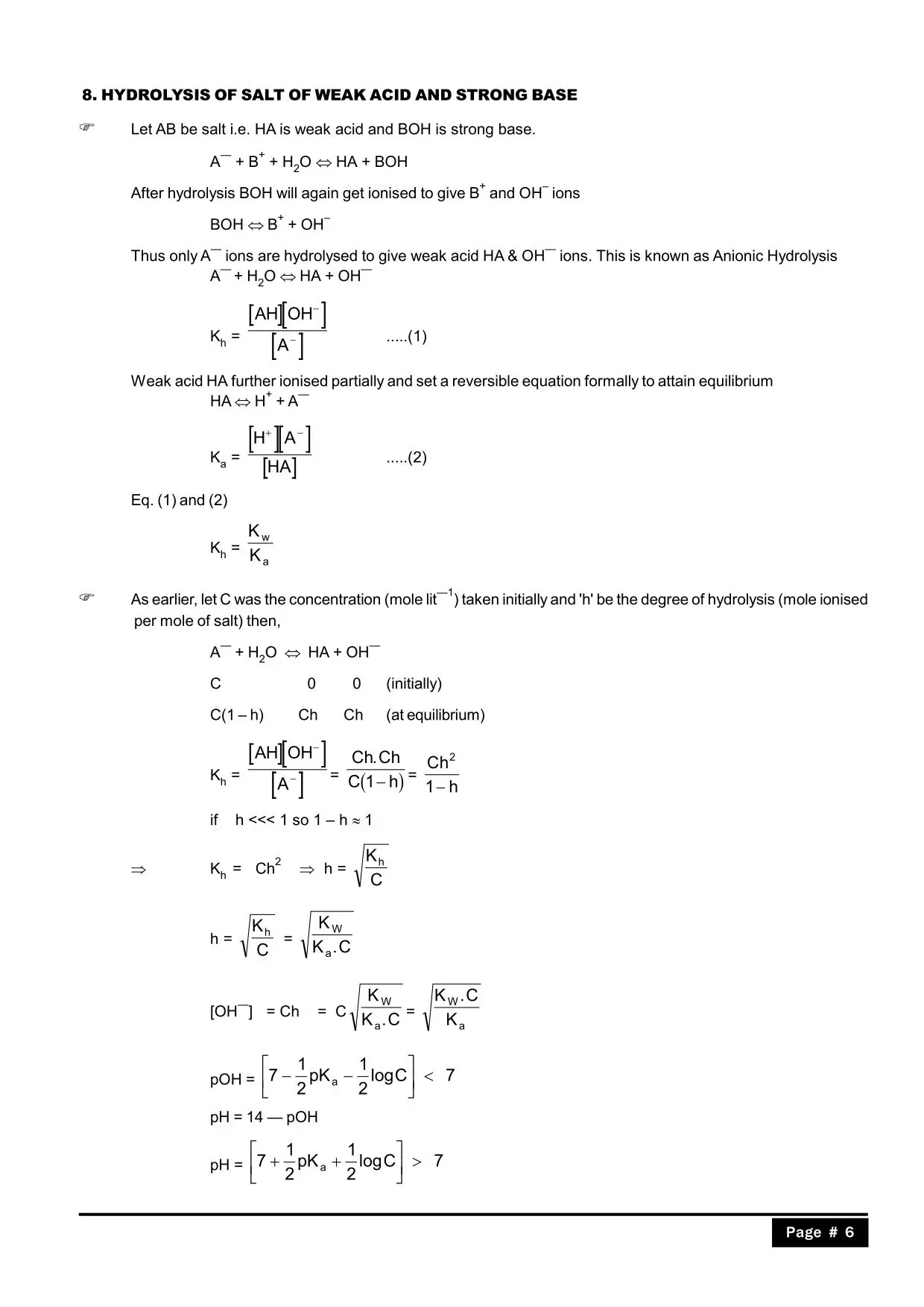
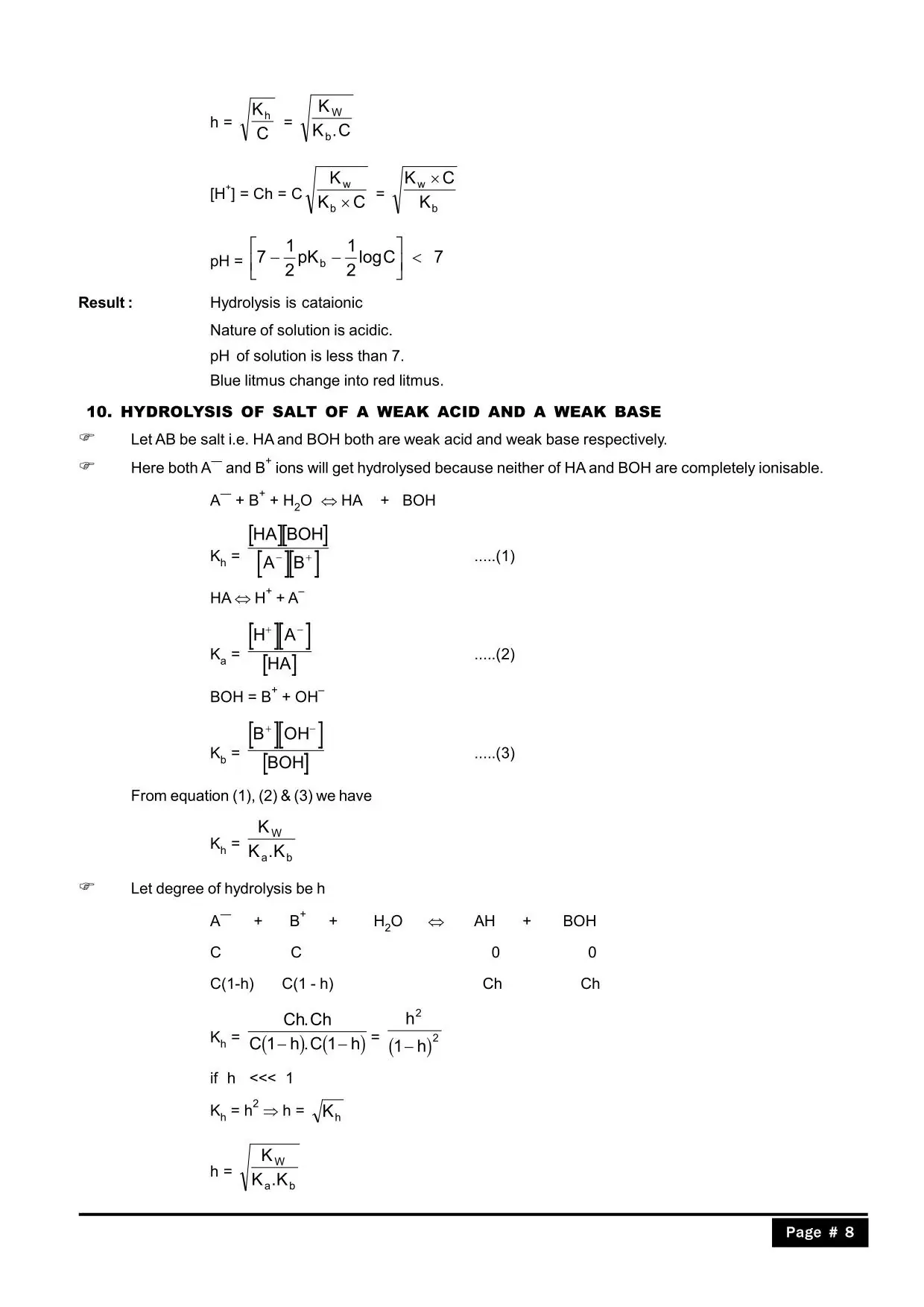
Weak acid + strong base | CH$_3$COONa | Anion | $\dfrac{K_w}{K_a}$ | $\mathrm{pH} = \tfrac{1}{2}\left(\mathrm{p}K_w + \mathrm{p}K_a + \log C\right) > 7$ |
Strong acid + weak base | NH$_4$Cl | Cation | $\dfrac{K_w}{K_b}$ | $\mathrm{pH} = \tfrac{1}{2}\left(\mathrm{p}K_w - \mathrm{p}K_b - \log C\right) < 7$ |
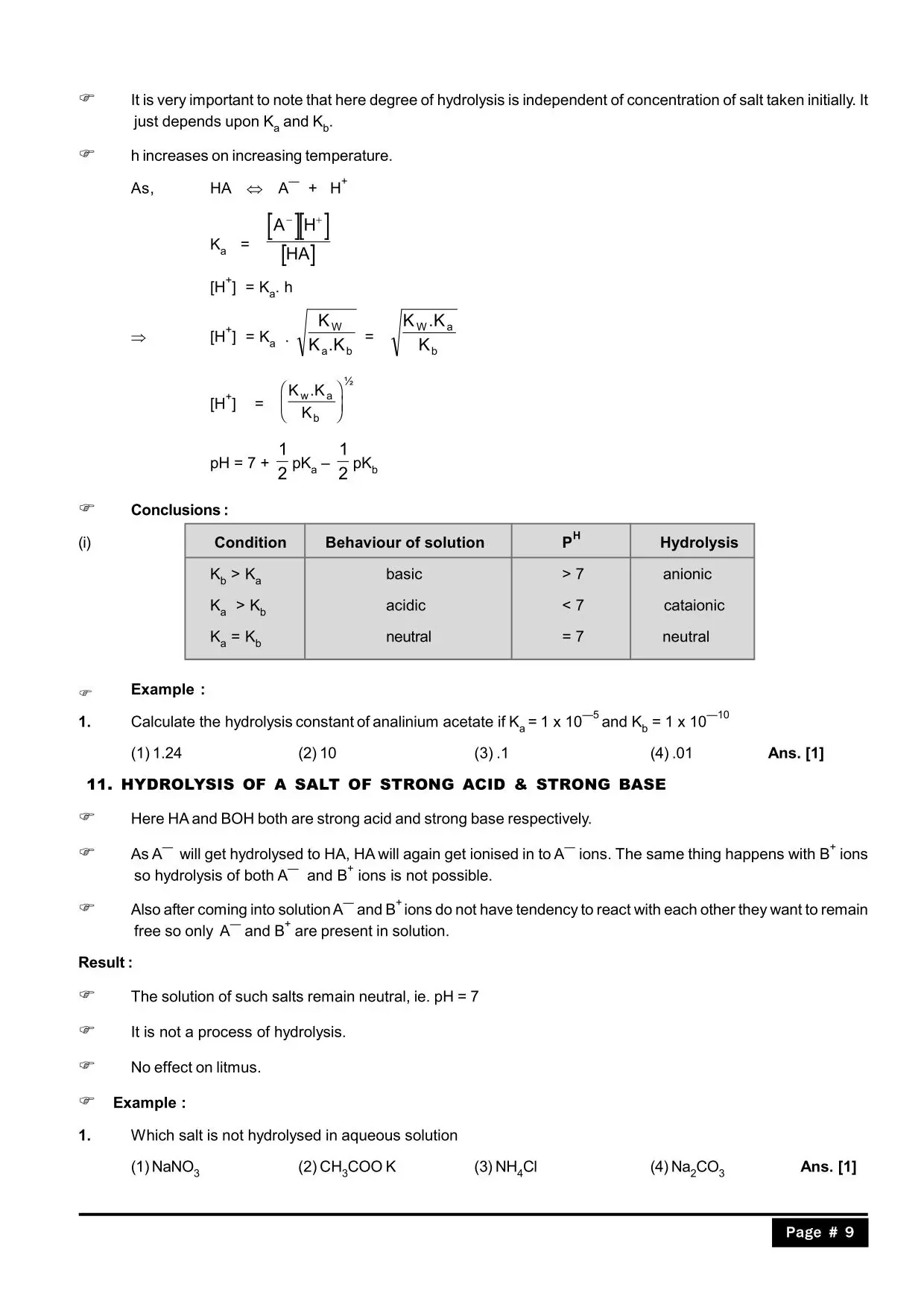
Weak acid + weak base | CH$_3$COONH$_4$ | Both | $\dfrac{K_w}{K_aK_b}$ | $\mathrm{pH} = \tfrac{1}{2}\left(\mathrm{p}K_w + \mathrm{p}K_a - \mathrm{p}K_b\right)$ |
The degree of hydrolysis is $h = \sqrt{\dfrac{K_h}{C}}$ for the first two cases. For a salt of a weak acid and a weak base, $h = \sqrt{K_h}$, so it does not depend on the concentration, and the pH is independent of the concentration.
Indicators and Titration in Ionic Equilibrium Class 11 Notes
An acid–base indicator is a weak acid or base whose acid and base forms have different colours. It changes colour in a range of about $\mathrm{p}K_{In} \pm 1$.
Indicator | pH range | Colour change |
|---|---|---|
Methyl orange | $3.1$ to $4.4$ | Red to yellow |
Methyl red | $4.4$ to $6.2$ | Red to yellow |
Phenolphthalein | $8.2$ to $10.0$ | Colourless to pink |
The pH at the equivalence point is $7$ for a strong acid with a strong base, above $7$ for a weak acid with a strong base (use phenolphthalein), and below $7$ for a strong acid with a weak base (use methyl orange).
Solubility Product and Precipitation in Ionic Equilibrium Class 11 Notes
For a sparingly soluble salt $\mathrm{A}_x\mathrm{B}_y$ in a saturated solution:
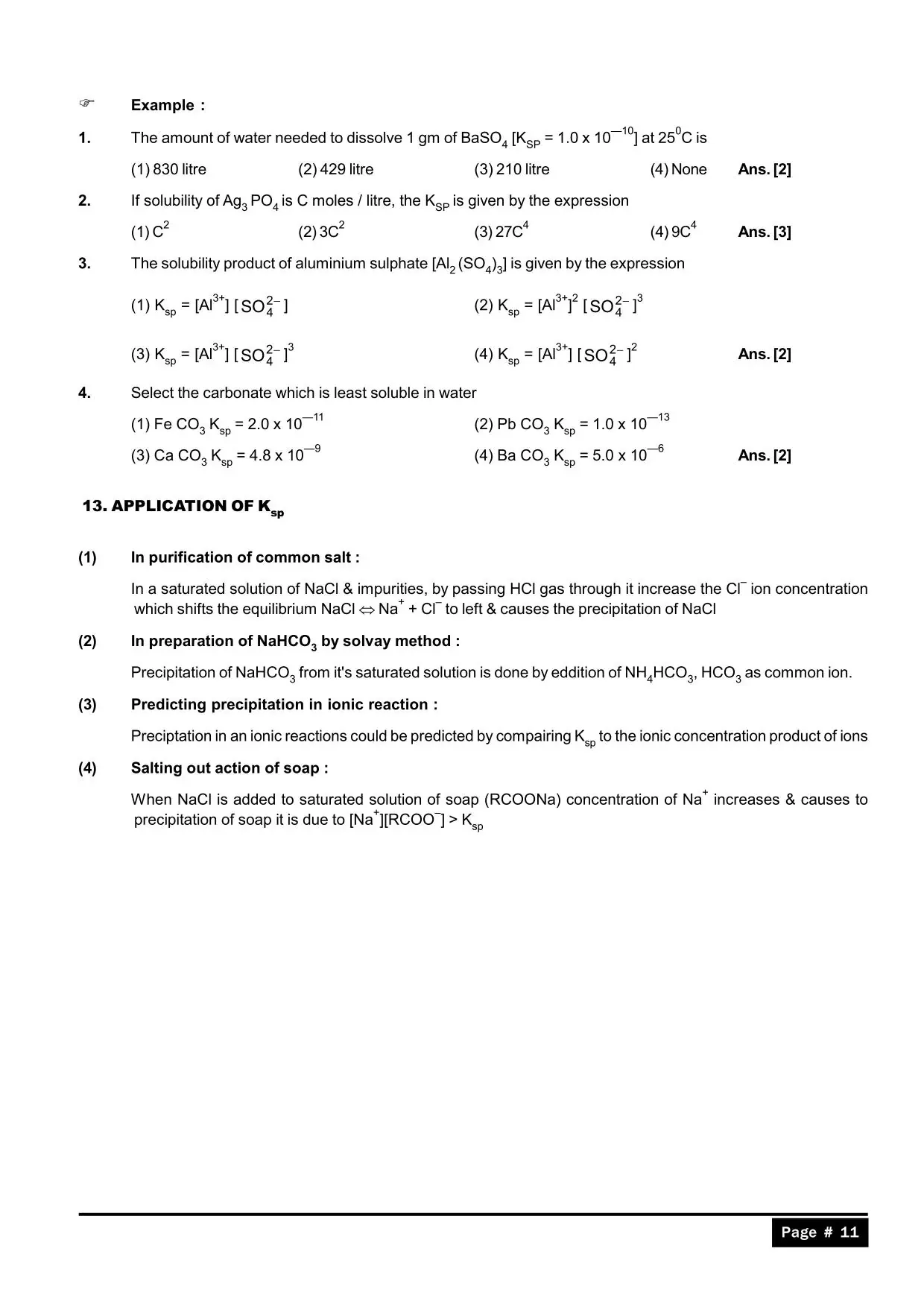
$$\mathrm{A}_x\mathrm{B}_y(s) \rightleftharpoons x\,\mathrm{A}^{y+} + y\,\mathrm{B}^{x-}, \qquad K_{sp} = [\mathrm{A}^{y+}]^{x}[\mathrm{B}^{x-}]^{y} = x^{x}y^{y}s^{x+y}$$
Salt type | Example | $K_{sp}$ in terms of the solubility $s$ |
|---|---|---|
AB | AgCl, BaSO$_4$ | $s^{2}$ |
AB$_2$ or A$_2$B | PbCl$_2$, Ag$_2$CrO$_4$ | $4s^{3}$ |
AB$_3$ or A$_3$B | Al(OH)$_3$ | $27s^{4}$ |
A$_2$B$_3$ | Al$_2$S$_3$ | $108s^{5}$ |
- Precipitation: compare the ionic product $Q$ with $K_{sp}$. If $Q > K_{sp}$, the salt precipitates. If $Q = K_{sp}$, the solution is saturated, and if $Q < K_{sp}$, the salt dissolves.
- Common ion effect on solubility: for an AB salt in a solution with the common ion at the concentration $c$, $s \approx \dfrac{K_{sp}}{c}$.
- The solubility of a salt of a weak acid (for example a sulphide or a carbonate) is higher in an acidic solution, and a hydroxide is more soluble in an acid.
IIT JEE and NEET Problem Tips in Ionic Equilibrium Class 11 Notes
- Decide the type first: strong acid or base, weak acid or base, buffer, hydrolysis or $K_{sp}$.
- Mixing problems: find the moles of $\mathrm{H^+}$ and $\mathrm{OH^-}$, subtract, and divide by the total volume.
- Check the approximation $\alpha \ll 1$ (it is valid when $\alpha < 5\%$). If it is not valid, solve the quadratic.
- Buffers: use moles, and not concentrations, after the addition of an acid or a base, because the volume is common to both the salt and the acid.
- Hydrolysis: write the reaction, find $K_h$, and then use the formula for the pH.
- $K_{sp}$: write the formula of the salt first, and use $x^xy^ys^{x+y}$.
Key Formulas in Ionic Equilibrium Class 11 Notes
Concept | Formula |
|---|---|
Ostwald’s dilution law | $\alpha = \sqrt{K_a/C}$ |
Ionic product of water | $K_w = [\mathrm{H^+}][\mathrm{OH^-}] = 10^{-14}$ |
pH of a weak acid | $\tfrac{1}{2}(\mathrm{p}K_a - \log C)$ |
Conjugate pair | $K_a K_b = K_w$ |
Acidic buffer | $\mathrm{pH} = \mathrm{p}K_a + \log\dfrac{[\text{salt}]}{[\text{acid}]}$ |
Basic buffer | $\mathrm{pOH} = \mathrm{p}K_b + \log\dfrac{[\text{salt}]}{[\text{base}]}$ |
Hydrolysis constant | $K_h = K_w/K_a$ or $K_w/K_b$ |
Salt of weak acid and strong base | $\mathrm{pH} = \tfrac{1}{2}(\mathrm{p}K_w + \mathrm{p}K_a + \log C)$ |
Solubility product | $K_{sp} = x^xy^ys^{x+y}$ |
Precipitation | $Q > K_{sp}$ |
Solved Examples from Ionic Equilibrium Class 11 Notes
Example 1 (degree of ionisation): Find $\alpha$, $[\mathrm{H^+}]$ and the pH of 0.1 M ethanoic acid ($K_a = 1.8\times10^{-5}$).
$\alpha = \sqrt{\dfrac{1.8\times10^{-5}}{0.1}} \approx 1.34\times10^{-2}$ (1.34%), $[\mathrm{H^+}] = C\alpha \approx 1.34\times10^{-3}$ M, and $\mathrm{pH} \approx 2.87$.
Example 2 (strong acid and base): Find the pH of 0.01 M HCl and of 0.01 M NaOH.
HCl: $\mathrm{pH} = -\log 0.01 = 2$. NaOH: $\mathrm{pOH} = 2$, so $\mathrm{pH} = 14 - 2 = 12$.
Example 3 (a very dilute acid): Find the pH of $10^{-8}$ M HCl.
$[\mathrm{H^+}] = \dfrac{10^{-8} + \sqrt{10^{-16} + 4\times10^{-14}}}{2} \approx 1.05\times10^{-7}$ M, so $\mathrm{pH} \approx 6.98$.
Example 4 (mixing): Find the pH when 100 mL of 0.1 M HCl is mixed with 50 mL of 0.1 M NaOH.
$\mathrm{H^+}$: 10 mmol. $\mathrm{OH^-}$: 5 mmol. The excess is 5 mmol in 150 mL, so $[\mathrm{H^+}] = 0.0333$ M and $\mathrm{pH} \approx 1.48$.
Example 5 (a buffer): Find the pH of a buffer with 0.1 M ethanoic acid and 0.2 M sodium ethanoate ($K_a = 1.8\times10^{-5}$, $\mathrm{p}K_a = 4.745$).
$\mathrm{pH} = 4.745 + \log\dfrac{0.2}{0.1} = 4.745 + 0.301 \approx 5.05$.
Example 6 (adding acid to a buffer): One litre of a buffer has 0.1 mol of the acid and 0.1 mol of the salt ($\mathrm{p}K_a = 4.74$). Find the pH after the addition of 0.01 mol of HCl.
The acid becomes $0.11$ mol, and the salt becomes $0.09$ mol. $\mathrm{pH} = 4.74 + \log\dfrac{0.09}{0.11} \approx 4.74 - 0.087 = 4.65$. The pH changes by only 0.09.
Example 7 (hydrolysis, weak acid and strong base): Find the pH of 0.1 M sodium ethanoate.
$\mathrm{pH} = \tfrac{1}{2}\left(14 + 4.745 + \log 0.1\right) = \tfrac{1}{2}(14 + 4.745 - 1) \approx 8.87$.
Example 8 (hydrolysis, strong acid and weak base): Find the pH of 0.1 M ammonium chloride ($K_b = 1.8\times10^{-5}$).
$\mathrm{pH} = \tfrac{1}{2}\left(14 - 4.745 - \log 0.1\right) = \tfrac{1}{2}(14 - 4.745 + 1) \approx 5.13$.
Example 9 ($K_{sp}$ from the solubility): The solubility of AgCl is $1.3\times10^{-5}$ mol/L. Find $K_{sp}$.
$K_{sp} = s^{2} = (1.3\times10^{-5})^{2} \approx 1.7\times10^{-10}$.
Example 10 (solubility from $K_{sp}$): $K_{sp}$ of PbCl$_2$ is $1.6\times10^{-5}$. Find its solubility.
$4s^{3} = 1.6\times10^{-5}$, so $s^{3} = 4\times10^{-6}$ and $s \approx 1.59\times10^{-2}$ mol/L.
Example 11 (common ion effect): Find the solubility of AgCl ($K_{sp} = 1.8\times10^{-10}$) in 0.1 M NaCl.
$s \approx \dfrac{K_{sp}}{[\mathrm{Cl^-}]} = \dfrac{1.8\times10^{-10}}{0.1} = 1.8\times10^{-9}$ mol/L, which is about 7000 times lower than in pure water.
Example 12 (precipitation): Equal volumes of $2\times10^{-4}$ M AgNO$_3$ and $2\times10^{-4}$ M NaCl are mixed. Does AgCl precipitate ($K_{sp} = 1.8\times10^{-10}$)?
After mixing, each ion is $1\times10^{-4}$ M, so $Q = 10^{-8} > K_{sp}$, and AgCl precipitates.
Example 13 ($K_a$ from the pH): A 0.01 M solution of a weak acid has a pH of 3.5. Find $K_a$.
$[\mathrm{H^+}] = 10^{-3.5} \approx 3.16\times10^{-4}$ M, so $K_a = \dfrac{[\mathrm{H^+}]^{2}}{C} = \dfrac{(3.16\times10^{-4})^{2}}{0.01} \approx 1.0\times10^{-5}$.
Example 14 (a basic buffer): Find the pH of a solution that has 0.2 M NH$_3$ and 0.1 M NH$_4$Cl ($\mathrm{p}K_b = 4.745$).
$\mathrm{pOH} = 4.745 + \log\dfrac{0.1}{0.2} = 4.745 - 0.301 = 4.444$, so $\mathrm{pH} = 14 - 4.444 \approx 9.56$.
Common Mistakes in Ionic Equilibrium Class 11 Notes Problems
Mistake | Correct approach |
|---|---|
Writing the pH of $10^{-8}$ M HCl as 8 | An acid cannot give a pH above 7. Include the $\mathrm{H^+}$ of water: $\mathrm{pH} \approx 6.98$ |
Dividing by the volume of only one solution when mixing | Divide by the total volume |
Using the Henderson equation with concentrations that are far from each other | It is valid only for a ratio between $0.1$ and $10$ |
Using $[\mathrm{H^+}] = \sqrt{K_aC}$ when $\alpha$ is not small | Solve the full quadratic for $\alpha > 5\%$ |
Saying that the pH of pure water is always 7 | It is 7 only at 298 K, and water is neutral when $[\mathrm{H^+}] = [\mathrm{OH^-}]$ |
Writing $K_{sp} = s^{2}$ for every salt | Write $x^{x}y^{y}s^{x+y}$ for the formula of the salt |
Forgetting that the common ion lowers the solubility | $s \approx K_{sp}/[\text{common ion}]$ |
Using the hydrolysis formula for a salt of a strong acid and a strong base | There is no hydrolysis, and the pH is 7 |
How to Study Ionic Equilibrium Class 11 Notes
- Read the NCERT chapter on equilibrium first, and download the textbook from eSaral’s NCERT books for Class 11 page.
- Learn the first half of the chapter with eSaral’s Chemical Equilibrium Class 11 notes, because Le Chatelier’s principle is the basis of the common ion effect. The link $\Delta G^\circ = -RT\ln K$ is in eSaral’s Thermodynamics short notes.
- Learn the formula for each case (strong, weak, buffer, hydrolysis and $K_{sp}$), and practise one problem of each type.
- Revise with eSaral’s Class 11 Chemistry notes and JEE Main Chemistry revision notes.
- Test yourself with eSaral’s JEE Main chapter-wise PYQs and NEET chapter-wise PYQs.
Frequently Asked Questions
What is ionic equilibrium in Class 11 Chemistry?
Ionic equilibrium is the dynamic equilibrium between ions and unionised molecules in a solution of a weak electrolyte, and between a sparingly soluble solid and its ions. It covers the acid–base theories, $K_a$ and $K_b$, $K_w$ and the pH, the common ion effect, buffer solutions, hydrolysis of salts and the solubility product. eSaral’s Ionic Equilibrium Class 11 Notes follow the NCERT chapter Equilibrium.
What is the Henderson–Hasselbalch equation, and when is it used?
For an acidic buffer, $\mathrm{pH} = \mathrm{p}K_a + \log\dfrac{[\text{salt}]}{[\text{acid}]}$, and for a basic buffer, $\mathrm{pOH} = \mathrm{p}K_b + \log\dfrac{[\text{salt}]}{[\text{base}]}$. It gives the pH of a buffer quickly, without solving a full equilibrium. It is valid when the ratio of the salt to the acid is between $0.1$ and $10$, which is within one pH unit of the pK$_a$. In Ionic Equilibrium Class 11 Notes, it is the most used formula for IIT JEE.
How is ionic equilibrium different from chemical equilibrium?
Chemical equilibrium covers reversible reactions in general, with $K_c$ and $K_p$ (for example, gas-phase reactions). Ionic equilibrium is the part that deals with ions in solution: weak electrolytes, pH, buffers, hydrolysis and solubility. Both follow the law of mass action and Le Chatelier’s principle, and in NCERT they are in the same chapter.
What is the common ion effect in ionic equilibrium?
The common ion effect is the decrease in the ionisation of a weak electrolyte, or in the solubility of a sparingly soluble salt, when a strong electrolyte with a common ion is added. For example, sodium acetate lowers the ionisation of ethanoic acid, and sodium chloride lowers the solubility of silver chloride. It follows from Le Chatelier’s principle, and Ionic Equilibrium Class 11 Notes give the formulas for both cases.
What is $K_{sp}$, and how do you calculate it from the solubility?
$K_{sp}$ is the equilibrium constant for the dissolution of a sparingly soluble salt. For $\mathrm{A}_x\mathrm{B}_y$ with the solubility $s$, $K_{sp} = x^{x}y^{y}s^{x+y}$. For AgCl, $K_{sp} = s^{2}$, and for PbCl$_2$, $K_{sp} = 4s^{3}$. A salt precipitates when the ionic product $Q$ is greater than $K_{sp}$.
How do you find the pH of a salt solution (hydrolysis)?
First decide which ion hydrolyses. For a salt of a weak acid and a strong base, $\mathrm{pH} = \tfrac{1}{2}(\mathrm{p}K_w + \mathrm{p}K_a + \log C)$, which is above 7. For a salt of a strong acid and a weak base, $\mathrm{pH} = \tfrac{1}{2}(\mathrm{p}K_w - \mathrm{p}K_b - \log C)$, which is below 7. For a salt of a strong acid and a strong base, the pH is 7.
What is Ostwald’s dilution law?
For a weak electrolyte, $K_a = \dfrac{C\alpha^{2}}{1 - \alpha} \approx C\alpha^{2}$, so $\alpha = \sqrt{K_a/C}$. The degree of ionisation increases when the solution is diluted, but the ionisation constant does not change. These Ionic Equilibrium Class 11 Notes use it in Example 1.
How many questions come from ionic equilibrium in IIT JEE and NEET?
Ionic equilibrium is part of the Equilibrium unit of the JEE Main syllabus and of the NEET Chemistry syllabus, and it is a regular topic in both. The number of questions changes every year, so check previous years’ papers. Common topics are buffer pH, hydrolysis, the common ion effect and $K_{sp}$.
Which chapter number is Ionic Equilibrium in Class 11 Chemistry?
In the current NCERT Class 11 Chemistry book, the chapter Equilibrium (which includes ionic equilibrium) is Chapter 6, and in older books it was Chapter 7. These Ionic Equilibrium Class 11 Notes follow the NCERT chapter and add the IIT JEE topics.
Where can I find more Class 11 Chemistry notes on eSaral?
eSaral has chapter-wise Class 11 Chemistry notes, NCERT books, notes on Chemical Equilibrium and Thermodynamics, JEE Main and NEET chapter-wise PYQs and these Ionic Equilibrium Class 11 Notes, all linked on this page.
Team eSaral
eSaral Academic and Editorial Team
Team eSaral is the collective author profile for educational content created by eSaral’s teachers and academic contributors. The team draws on expertise from IIT graduates, doctors, experienced educators and subject specialists to develop resources for JEE, NEET and school students. Our articles aim to explain concepts clearly and help students study with confidence.
Related Posts

BITSAT 2027: Registration Date, Exam Date, Syllabus, Eligibility, Pattern & Fees
BITSAT 2027 exam dates, registration timeline, eligibility criteria, exam pattern, marking scheme, syllabus and fees in one page.

BITSAT Previous Year Question Paper PDF (2017-2026)
Download BITSAT previous year question papers PDF from 2017 to 2026,session-wise. Memory-based papers,exam pattern, paper analysis and how to practise

CBSE Class 10 Date Sheet 2027: Expected Exam Dates, Release Date, Admit Card & Result Timeline
CBSE Class 10 date sheet 2027 is awaited. See the expected exam dates, release window, how to download the PDF, admit card and result timelines.

NCERT Physics Class 10 Book PDF in Hindi 2026-27 – भौतिक विज्ञान के 4 अध्याय (Free Download)
NCERT Physics Class 10 book PDF in Hindi 2026-27: download all 4 chapters (अध्याय 9–12) free, with topics and important formulas.

NCERT Biology Class 9 Book Anveshan PDF in Hindi - जीव विज्ञान कक्षा 9 पुस्तक अन्वेषण PDF
Download NCERT Biology Class 9 book PDF in Hindi chapterwise for 2026-27: Cell, Tissues, Reproduction and Diversity. Free PDFs.

Essay On Artificial Intelligence in English (100,150, 200, 250, 300, 500 Words)
This is in contrast to the natural intelligence of humans. With Artificial Intelligence, machines can perform

Essay on 78th India Independence Day in English for Student (100, 150, 200, 250, 300, 500 Words)
Read the best essays on India's Independence Day in English. Short & long essays (100, 150, 200, 250, 300, 500 words) perfect for school exams
NCERT Class 11 English Snapshots book - Free PDF download- Esaral
Download NCERT Class 11 English Snapshots book PDF for free. Get all 8 chapters, chapter-wise. Start your prep today!
NCERT Class 10 biology book pdf - Free PDF Download - eSaral
NCERT Class 10 Biology book PDF 2026-27: all 5 chapters (Life Processes to Our Environment) in English & Hindi, with CBSE syllabus, marks & practical

Essay on Global Warming in English (100,150, 200, 250, 300, 500 Words)
Global warming means the Earth is getting hotter. This happens because of things like pollution from cars and factories.