
Thermodynamics Short Notes for Class 11, JEE & NEET

eSaral Academic and Editorial Team
Summary
Thermodynamics Short Notes for Class 11 Chemistry cover the basic terms and the types of systems, state and path functions, the first law and the sign convention, enthalpy and the types of enthalpy change, Hess’s law and bond enthalpy, entropy and the second and third laws, Gibbs energy and spontaneity.
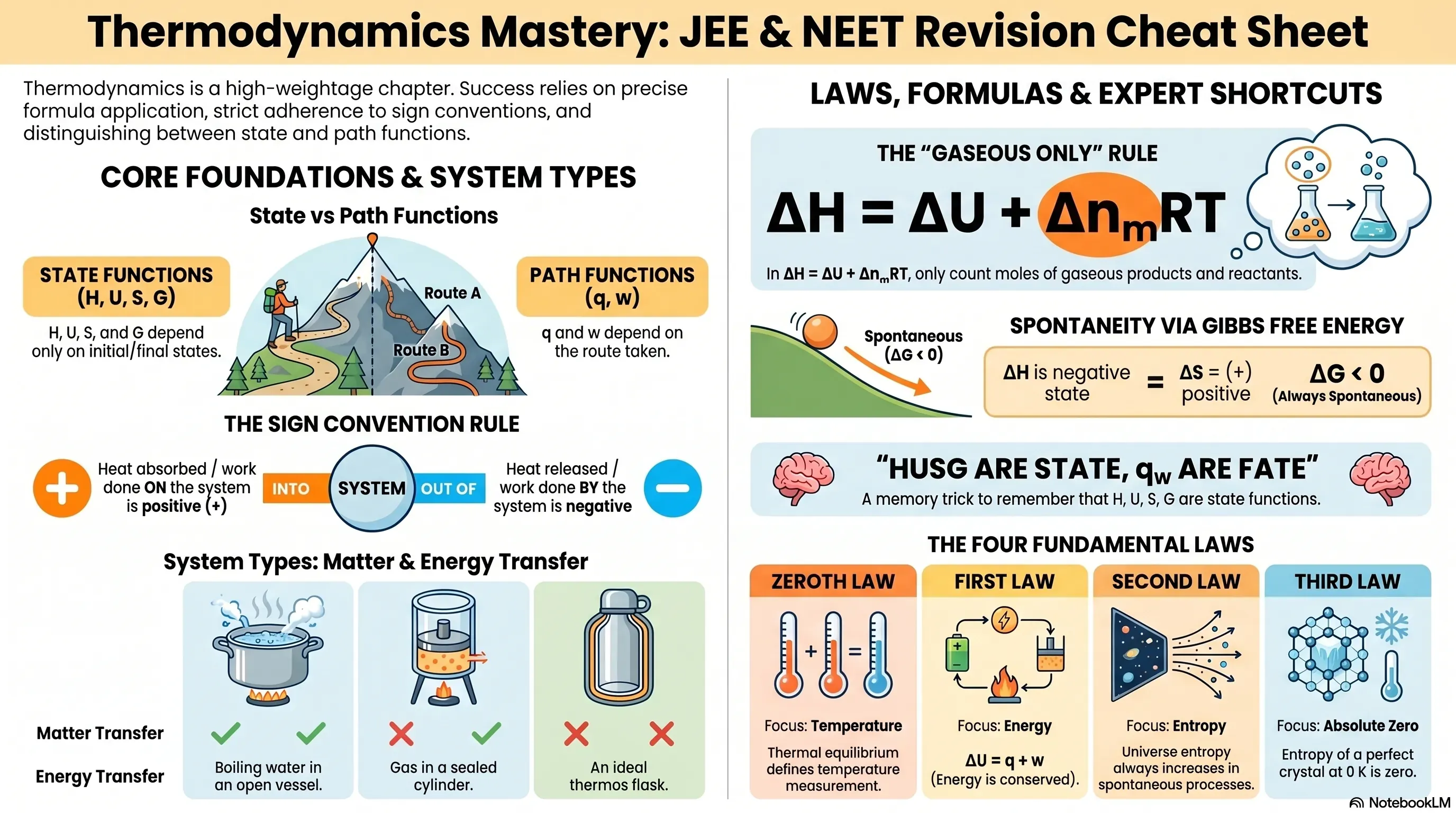
This page is about Thermodynamics in Chemistry. It is Chapter 5 of the current NCERT Class 11 Chemistry book (Chapter 6 in older books). Class 11 Physics also has a chapter with the same name, which covers heat engines, the laws in terms of gases and the Carnot cycle, so do not mix the two. These Thermodynamics Short Notes follow the NCERT chemistry chapter, and they link it to equilibrium and electrochemistry.
Thermodynamics Short Notes: Chapter Overview and Syllabus
Topic | NCERT Class 11 Chemistry | JEE Main and NEET |
|---|---|---|
System, surroundings, types of systems, state functions | Yes | Yes |
First law, work, heat, internal energy, enthalpy | Yes | Yes |
Heat capacity and calorimetry | Yes | Yes |
Enthalpies of formation, combustion, atomisation, bond dissociation, solution and others | Yes | Yes |
Hess’s law | Yes | Yes |
Spontaneity, entropy, second and third laws | Yes | Yes |
Gibbs energy, and $\Delta G^\circ$ and the equilibrium constant | Yes | Yes |
Check the latest syllabi of CBSE, NTA (JEE Main) and NMC (NEET) for the exact lists.
💡 Expert Tip by Prateek Gupta, IIT Bombay: "In JEE Main, Thermodynamics questions are almost always formula-application based — not conceptual traps. If you know the formulas and the sign conventions cold, you pick up these marks in under 2 minutes per question. That is free time for harder questions."
Thermodynamics Short Notes
India's Best Exam Preparation for Class 11th - Download Now
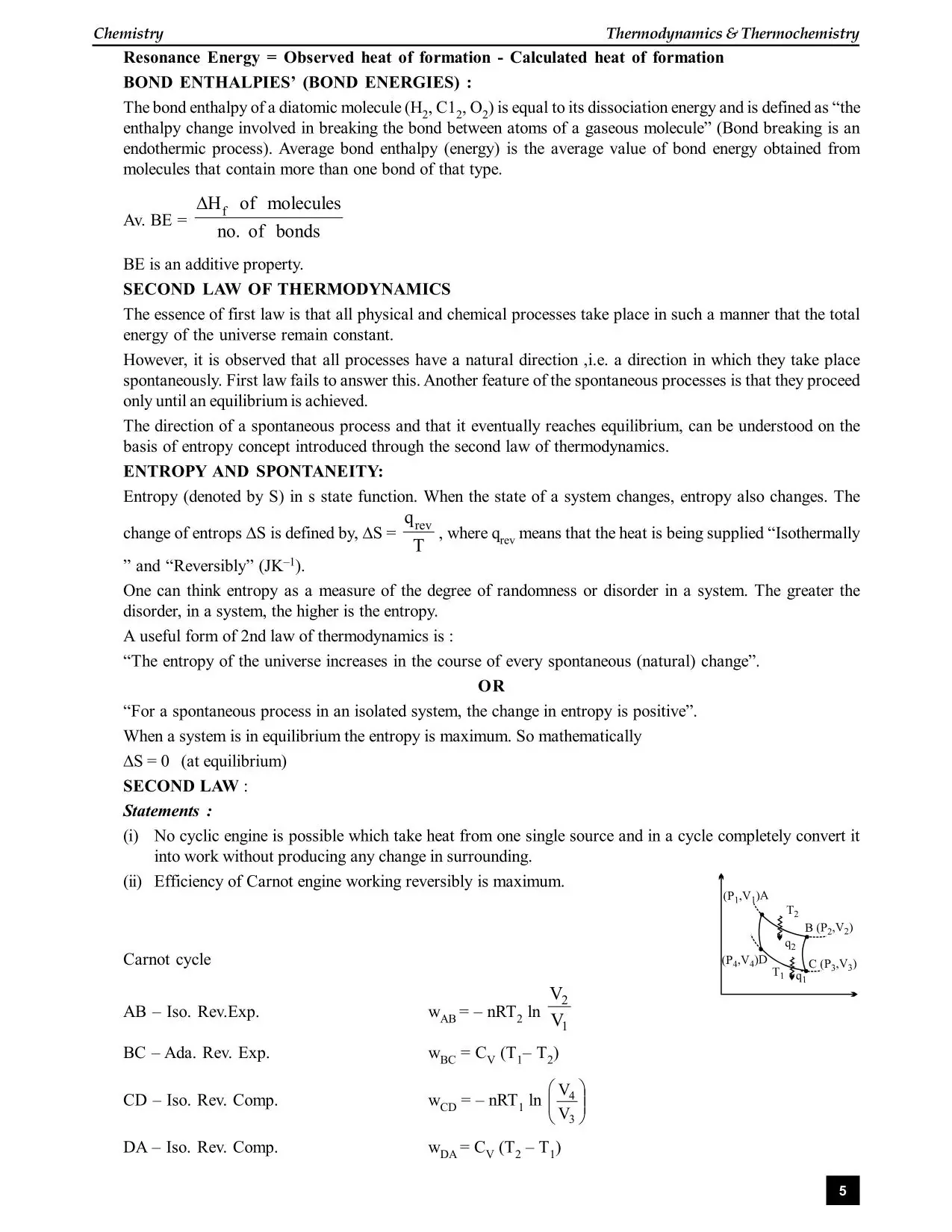
Basic Terms in Thermodynamics Short Notes
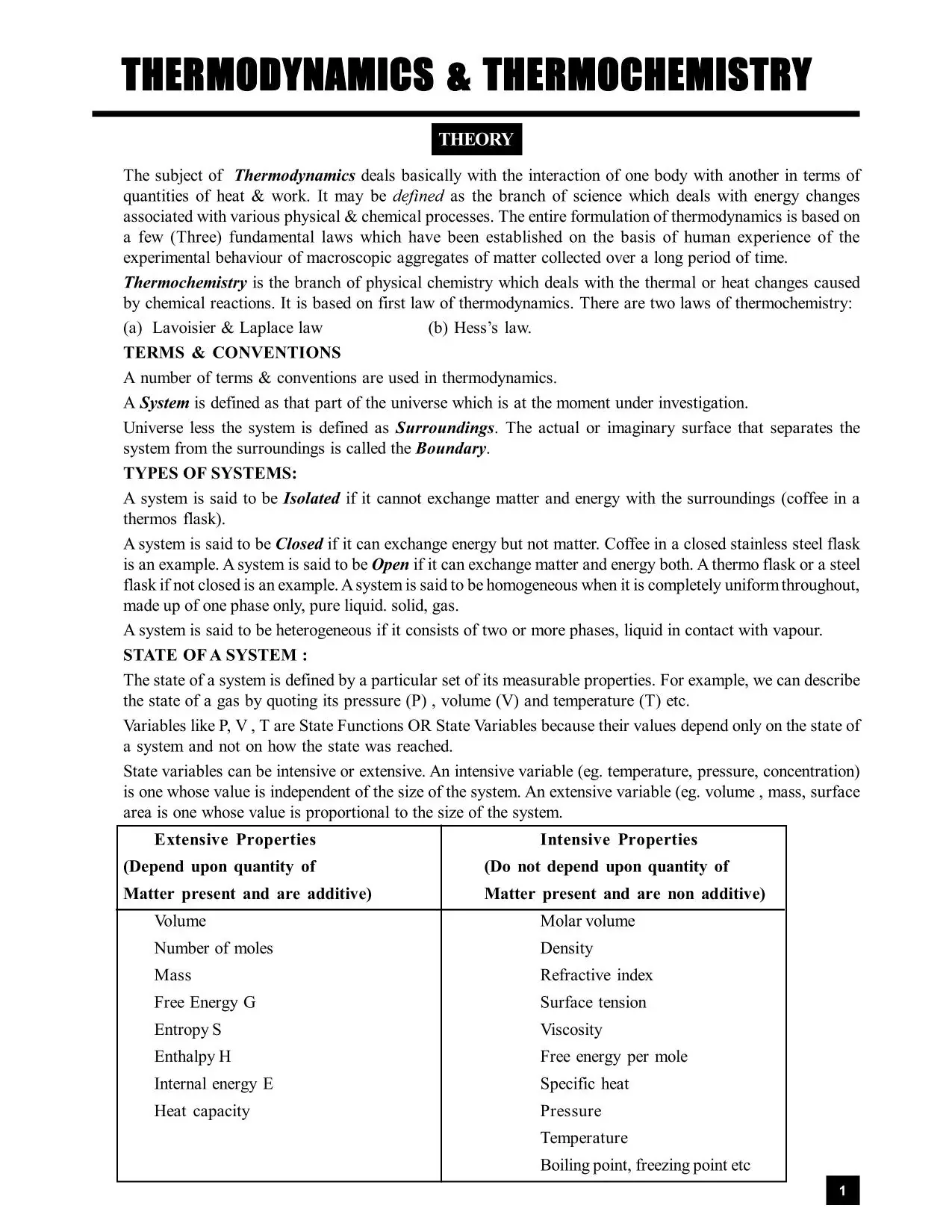
- System: the part of the universe that is under study. Surroundings: everything else. Boundary: the real or imaginary surface between them.
- A state function depends only on the initial and the final state: $U$, $H$, $S$ and $G$. A path function depends on the path: $q$ and $w$.
- Extensive properties depend on the amount of matter ($U$, $H$, $S$, $G$, $V$), and intensive properties do not ($T$, $P$, density).
Type of system | Matter exchange | Energy exchange | Example |
|---|---|---|---|
Open | Yes | Yes | Boiling water in an open vessel |
Closed | No | Yes | Gas in a sealed cylinder |
Isolated | No | No | An ideal thermos flask |
Process | Condition | Result for an ideal gas |
|---|---|---|
Isothermal | $T$ constant | $\Delta U = 0$ |
Adiabatic | $q = 0$ | $\Delta U = w$ |
Isobaric | $P$ constant | $q_p = \Delta H$ |
Isochoric | $V$ constant | $w = 0$, so $q_v = \Delta U$ |
First Law of Thermodynamics in Thermodynamics Short Notes
Zeroth law: if A and B are each in thermal equilibrium with C, then A and B are in thermal equilibrium with each other. This is the basis of temperature measurement.
First law: the internal energy of an isolated system is constant, and energy is conserved:
$$\Delta U = q + w$$
Sign convention (IUPAC): $q > 0$ when heat is absorbed by the system, and $w > 0$ when work is done on the system.
Case | Work |
|---|---|
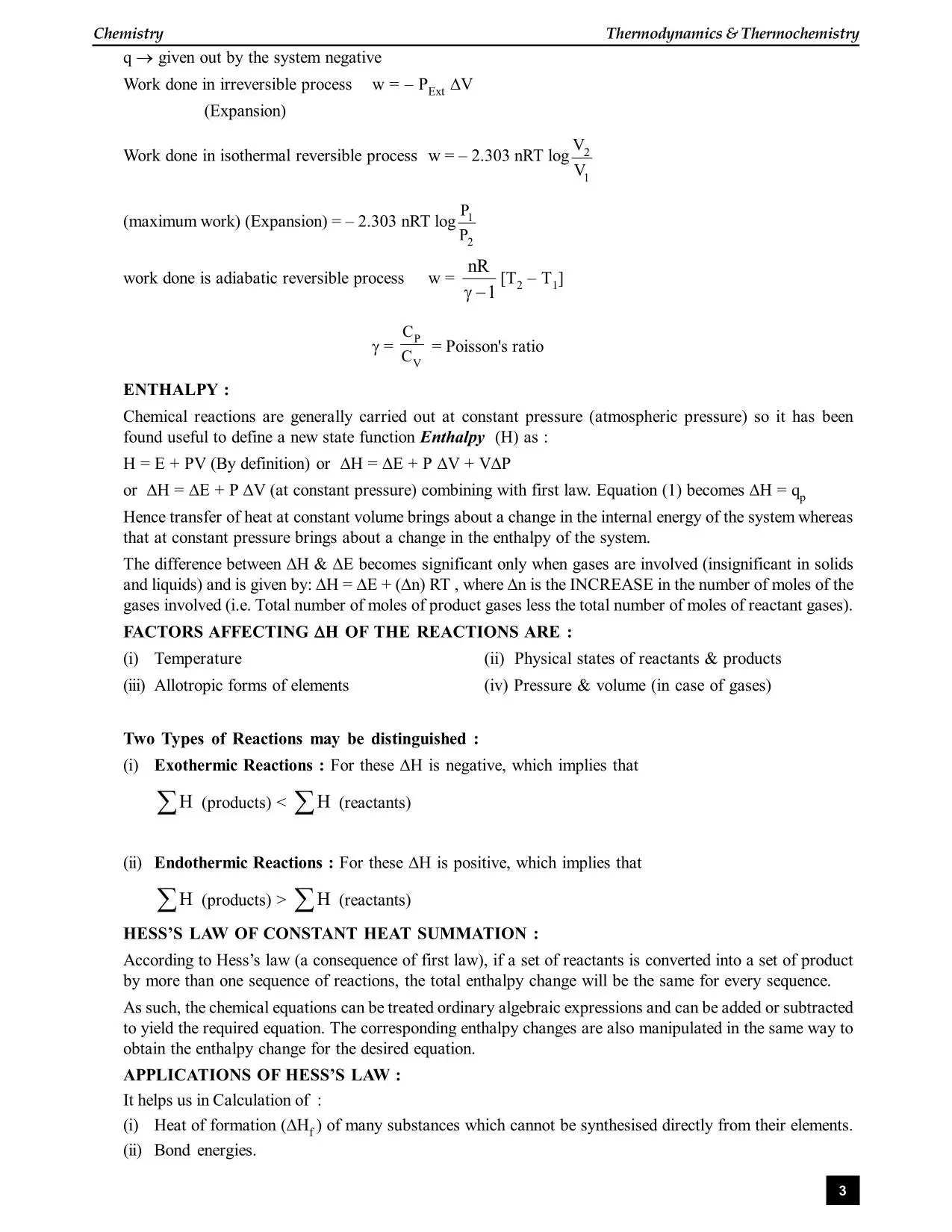
Expansion against a constant external pressure | $w = -P_{ext}\,\Delta V$ |
Free expansion (into a vacuum) | $w = 0$ |
Reversible isothermal expansion of an ideal gas | $w = -2.303\,nRT\log\dfrac{V_2}{V_1} = -nRT\ln\dfrac{V_2}{V_1}$ |
Adiabatic process | $w = \Delta U = nC_V\,\Delta T$ |
For an isothermal change of an ideal gas, $\Delta U = 0$, so $q = -w$. (1 L bar $= 100$ J.)
Enthalpy and Heat Capacity in Thermodynamics Short Notes
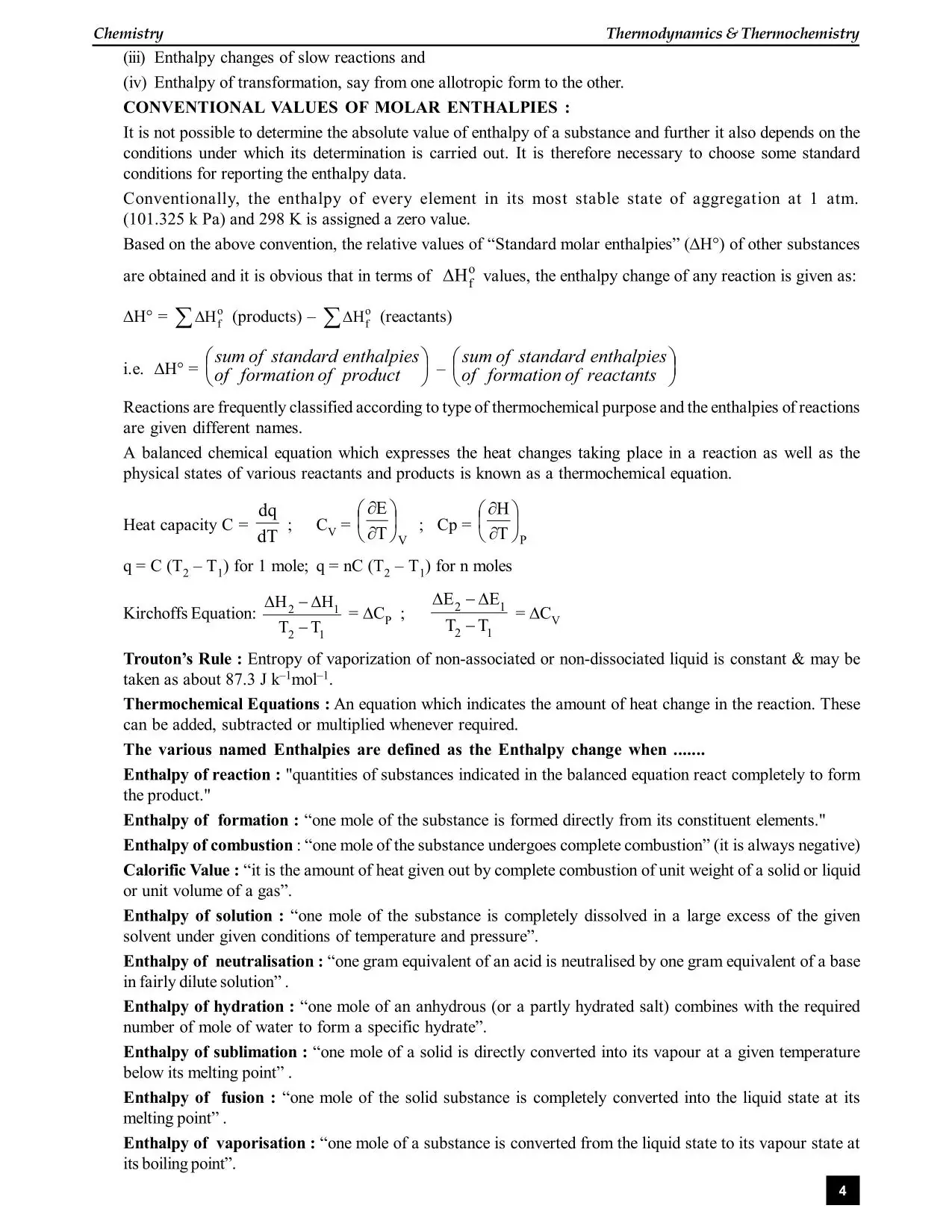
$$H = U + PV, \qquad \Delta H = \Delta U + \Delta n_g\,RT$$
$\Delta n_g$ is the change in the number of moles of gaseous substances only, which is the moles of gaseous products minus the moles of gaseous reactants. At constant pressure, $q_p = \Delta H$, and at constant volume, $q_V = \Delta U$.
Heat capacity: $q = C\,\Delta T = m\,c\,\Delta T$. For one mole of an ideal gas, $C_p - C_V = R$. A bomb calorimeter measures $\Delta U$ at constant volume, and a coffee-cup calorimeter measures $\Delta H$ at constant pressure.
Types of Enthalpy Change
Enthalpy | Meaning |
|---|---|
Standard enthalpy of formation, $\Delta_f H^\circ$ | Formation of 1 mol of a compound from its elements in their standard states |
Enthalpy of combustion, $\Delta_c H^\circ$ | Complete burning of 1 mol of a substance in oxygen |
Enthalpy of atomisation | Formation of 1 mol of gaseous atoms from the substance |
Bond dissociation enthalpy | Breaking of 1 mol of a bond in the gas phase |
Enthalpy of fusion and vaporisation | Melting and vaporising 1 mol at the transition temperature |
Enthalpy of neutralisation | Formation of 1 mol of water from an acid and a base (about $-57.1$ kJ for a strong acid and a strong base) |
Enthalpy of solution | Dissolving 1 mol of a substance in a large amount of solvent |
Lattice enthalpy | Formation of 1 mol of an ionic solid from its gaseous ions (it is exothermic) |
Hess’s Law and Bond Enthalpy in Thermodynamics Short Notes
Hess’s law: the enthalpy change of a reaction is the same whether it takes place in one step or in several steps. To use it:
- Write the target reaction.
- Reverse a given reaction when its substance is on the wrong side, and change the sign of $\Delta H$.
- Multiply a reaction by a factor, and multiply its $\Delta H$ by the same factor.
- Add the reactions, and add the $\Delta H$ values.
$$\Delta H^\circ_{rxn} = \sum \Delta_f H^\circ(\text{products}) - \sum \Delta_f H^\circ(\text{reactants})$$
Bond enthalpy method (gaseous species only):
$$\Delta H^\circ_{rxn} = \sum (\text{bond enthalpies of bonds broken}) - \sum (\text{bond enthalpies of bonds formed})$$
Breaking bonds takes energy (positive), and forming bonds releases energy (negative).
Entropy, Second Law and Third Law in Thermodynamics Short Notes
Entropy $S$ measures the disorder of a system. For a reversible change at a temperature $T$:
$$\Delta S = \frac{q_{rev}}{T}$$
Case | Formula |
|---|---|
Phase change at its transition temperature | $\Delta S = \dfrac{\Delta H_{transition}}{T}$ |
Isothermal expansion of an ideal gas | $\Delta S = nR\ln\dfrac{V_2}{V_1}$ |
Heating at constant volume | $\Delta S = nC_V\ln\dfrac{T_2}{T_1}$ |
A reaction | $\Delta S^\circ = \sum S^\circ(\text{products}) - \sum S^\circ(\text{reactants})$ |
Second law: in a spontaneous process, the entropy of the universe increases:
$$\Delta S_{universe} = \Delta S_{system} + \Delta S_{surroundings} > 0$$
Third law: the entropy of a perfectly crystalline substance is zero at $0$ K.
Gibbs Energy and Spontaneity in Thermodynamics Short Notes
$$\Delta G = \Delta H - T\,\Delta S$$
A process is spontaneous at constant $T$ and $P$ if $\Delta G < 0$, it is at equilibrium if $\Delta G = 0$, and it is non-spontaneous if $\Delta G > 0$.
$\Delta H$ | $\Delta S$ | Spontaneity |
|---|---|---|
$-$ | $+$ | Spontaneous at all temperatures |
$+$ | $-$ | Non-spontaneous at all temperatures |
$-$ | $-$ | Spontaneous at low temperature |
$+$ | $+$ | Spontaneous at high temperature |
At equilibrium, $\Delta G = 0$, so $T_{eq} = \dfrac{\Delta H}{\Delta S}$.
Links to equilibrium and electrochemistry:
$$\Delta G^\circ = -RT\ln K = -2.303\,RT\log K, \qquad \Delta G = \Delta G^\circ + RT\ln Q, \qquad \Delta G^\circ = -nFE^\circ$$
The first two are used in eSaral’s Chemical Equilibrium Class 11 notes, and the third in the Electrochemistry Class 12 notes.
Key Formulas in Thermodynamics Short Notes
Concept | Formula |
|---|---|
First law | $\Delta U = q + w$ |
Work of expansion | $w = -P_{ext}\Delta V$ |
Reversible isothermal work | $w = -2.303\,nRT\log\dfrac{V_2}{V_1}$ |
Enthalpy | $H = U + PV$, $\Delta H = \Delta U + \Delta n_g RT$ |
Heat capacities | $C_p - C_V = R$ |
Heat of reaction | $\Delta H^\circ = \sum\Delta_fH^\circ(P) - \sum\Delta_fH^\circ(R)$ |
Bond enthalpy method | $\Delta H^\circ = \sum(\text{broken}) - \sum(\text{formed})$ |
Entropy | $\Delta S = \dfrac{q_{rev}}{T}$ |
Gibbs energy | $\Delta G = \Delta H - T\Delta S$ |
Equilibrium constant | $\Delta G^\circ = -2.303\,RT\log K$ |
Solved Examples from Thermodynamics Short Notes
Example 1 (work of expansion): A gas expands from 2 L to 5 L against a constant external pressure of 1 bar. Find the work done.
$w = -P_{ext}\Delta V = -1 \times (5 - 2) = -3$ L bar $= -300$ J. The negative sign shows that the system does the work.
Example 2 (first law): A system absorbs 150 J of heat and does 60 J of work. Find $\Delta U$.
$q = +150$ J and $w = -60$ J, so $\Delta U = 150 - 60 = +90$ J.
Example 3 ($\Delta H$ and $\Delta U$): For $\mathrm{N_2(g) + 3H_2(g) \rightarrow 2NH_3(g)}$, $\Delta H = -92.4$ kJ at 298 K. Find $\Delta U$.
$\Delta n_g = 2 - 4 = -2$, so $\Delta U = \Delta H - \Delta n_g RT = -92.4 - (-2)(8.314 \times 10^{-3})(298) \approx -92.4 + 4.96 = -87.4$ kJ.
Example 4 (Hess’s law): Given $\mathrm{C(s) + O_2(g) \rightarrow CO_2(g)}$, $\Delta H = -393.5$ kJ, and $\mathrm{CO(g) + \tfrac{1}{2}O_2(g) \rightarrow CO_2(g)}$, $\Delta H = -283.0$ kJ, find $\Delta H$ for $\mathrm{C(s) + \tfrac{1}{2}O_2(g) \rightarrow CO(g)}$.
Reverse the second reaction (so $\Delta H = +283.0$ kJ), and add it to the first: $\Delta H = -393.5 + 283.0 = -110.5$ kJ.
Example 5 (bond enthalpy): Find $\Delta H$ for $\mathrm{H_2 + Cl_2 \rightarrow 2HCl}$, given the bond enthalpies H–H $= 436$, Cl–Cl $= 242$ and H–Cl $= 431$ kJ mol⁻¹.
$\Delta H = (436 + 242) - 2(431) = 678 - 862 = -184$ kJ.
Example 6 (spontaneity): A reaction has $\Delta H = +30$ kJ mol⁻¹ and $\Delta S = +100$ J K⁻¹ mol⁻¹. Above which temperature is it spontaneous?
Both are positive, so it is spontaneous at high temperature. $T_{eq} = \dfrac{30\,000}{100} = 300$ K, so it is spontaneous above 300 K.
Example 7 ($\Delta G^\circ$ and $K$): Find $\Delta G^\circ$ for a reaction with $K = 10$ at 300 K.
$\Delta G^\circ = -2.303\,RT\log K = -2.303 \times 8.314 \times 300 \times 1 \approx -5744$ J, or $-5.74$ kJ mol⁻¹.
Example 8 (entropy of vaporisation): The enthalpy of vaporisation of water is 40.7 kJ mol⁻¹ at 373 K. Find $\Delta S_{vap}$.
$\Delta S_{vap} = \dfrac{\Delta H_{vap}}{T} = \dfrac{40\,700}{373} \approx 109$ J K⁻¹ mol⁻¹.
Example 9 (reversible isothermal expansion): One mole of an ideal gas at 300 K expands reversibly and isothermally to twice its volume. Find $w$, $q$ and $\Delta S$.
$w = -2.303 \times 8.314 \times 300 \times \log 2 \approx -1729$ J. $\Delta U = 0$, so $q = +1729$ J. $\Delta S = R\ln 2 \approx 5.76$ J K⁻¹.
Common Mistakes in Thermodynamics Short Notes Problems
Mistake | Correct approach |
|---|---|
Using the wrong sign for work | Under the IUPAC convention, $w = -P\Delta V$, so an expansion has negative work |
Counting solids and liquids in $\Delta n_g$ | Use only the gaseous substances |
Not changing the sign of $\Delta H$ when reversing a reaction in Hess’s law | Reversing a reaction changes the sign of $\Delta H$ |
Confusing $\Delta G^\circ$ with $\Delta G$ | $\Delta G = \Delta G^\circ + RT\ln Q$ for non-standard conditions |
Taking a negative $\Delta H$ alone as spontaneous | Use the sign of $\Delta G$, which also depends on $T\Delta S$ |
Using bond enthalpies for liquids and solids | The bond enthalpy method is for gaseous species |
Calling $q$ and $w$ state functions | They are path functions |
Mixing the Chemistry chapter with the Physics chapter | They are separate chapters with different content |
How to Study Thermodynamics Short Notes
- Read the NCERT Chemistry chapter once fully, and download the textbook from eSaral’s NCERT books for Class 11 page. Understand the reason for each law before you learn the formulas.
- Write all the formulas on one page, with the sign convention at the top.
- Practise numericals in this order: work and $\Delta U$, then $\Delta H$ and Hess’s law, then bond enthalpy, and then entropy and Gibbs energy.
- Revise with eSaral’s Class 11 Chemistry notes and JEE Main Chemistry revision notes.
- Then solve previous years’ questions with eSaral’s JEE Main chapter-wise PYQs and NEET chapter-wise PYQs.
Frequently Asked Questions
What are the most important topics in Thermodynamics short notes for NEET and JEE Main?
The first law and the sign convention, $\Delta H = \Delta U + \Delta n_g RT$, Hess’s law and the enthalpies of formation and combustion, bond enthalpy calculations, and Gibbs energy with spontaneity and $\Delta G^\circ = -RT\ln K$. The number of questions changes every year, so check previous years’ papers. eSaral’s Thermodynamics Short Notes list each of these with the formula.
What is the difference between $\Delta H$ and $\Delta U$?
$\Delta U$ is the change in internal energy, and it equals the heat at constant volume, $q_V$. $\Delta H$ is the change in enthalpy, and it equals the heat at constant pressure, $q_p$. They are related by $\Delta H = \Delta U + \Delta n_g RT$, where $\Delta n_g$ counts only gaseous substances. If $\Delta n_g = 0$, then $\Delta H = \Delta U$.
What are state functions and path functions?
A state function depends only on the initial and the final state of the system. Internal energy, enthalpy, entropy and Gibbs energy are state functions. Heat and work are path functions, because their values depend on the path. In Thermodynamics Short Notes, this is a frequently tested distinction.
What is the sign convention for heat and work in Class 11 Chemistry?
Under the IUPAC convention, $q$ is positive when the system absorbs heat, and $w$ is positive when work is done on the system. So $\Delta U = q + w$, and for expansion against an external pressure, $w = -P_{ext}\Delta V$ is negative.
How do you use Hess’s law?
Write the target reaction, then reverse or multiply the given reactions so that they add up to it. Change the sign of $\Delta H$ when you reverse a reaction, multiply $\Delta H$ by the same factor when you multiply a reaction, and add the $\Delta H$ values. This is shown in Example 4 of these Thermodynamics Short Notes.
What is Gibbs energy, and when is a reaction spontaneous?
Gibbs energy is $\Delta G = \Delta H - T\Delta S$. A reaction at constant temperature and pressure is spontaneous when $\Delta G < 0$. If $\Delta H < 0$ and $\Delta S > 0$, it is spontaneous at all temperatures, and if $\Delta H > 0$ and $\Delta S < 0$, it is never spontaneous. For the other two cases, the temperature decides, and $T_{eq} = \Delta H/\Delta S$.
Is the Thermodynamics chapter of Chemistry the same as that of Physics in Class 11?
No. The Chemistry chapter deals with enthalpy, Hess’s law, entropy and Gibbs energy for chemical reactions. The Physics chapter deals with heat engines, the laws for gases and the Carnot cycle. Both start from the first law, and these Thermodynamics Short Notes cover the Chemistry chapter.
Which chapter number is Thermodynamics in Class 11 Chemistry?
In the current NCERT Class 11 Chemistry book, Thermodynamics is Chapter 5, and in older books it was Chapter 6. The next chapter is Equilibrium. These Thermodynamics Short Notes follow the NCERT chapter.
Where can I find more Class 11 Chemistry notes on eSaral?
eSaral has chapter-wise Class 11 Chemistry notes, NCERT books, notes on Chemical Equilibrium and Electrochemistry, JEE Main and NEET chapter-wise PYQs and these Thermodynamics Short Notes, all linked on this page.
Team eSaral
eSaral Academic and Editorial Team
Team eSaral is the collective author profile for educational content created by eSaral’s teachers and academic contributors. The team draws on expertise from IIT graduates, doctors, experienced educators and subject specialists to develop resources for JEE, NEET and school students. Our articles aim to explain concepts clearly and help students study with confidence.
Related Posts

BITSAT 2027: Registration Date, Exam Date, Syllabus, Eligibility, Pattern & Fees
BITSAT 2027 exam dates, registration timeline, eligibility criteria, exam pattern, marking scheme, syllabus and fees in one page.

BITSAT Previous Year Question Paper PDF (2017-2026)
Download BITSAT previous year question papers PDF from 2017 to 2026,session-wise. Memory-based papers,exam pattern, paper analysis and how to practise

CBSE Class 10 Date Sheet 2027: Expected Exam Dates, Release Date, Admit Card & Result Timeline
CBSE Class 10 date sheet 2027 is awaited. See the expected exam dates, release window, how to download the PDF, admit card and result timelines.

NCERT Physics Class 10 Book PDF in Hindi 2026-27 – भौतिक विज्ञान के 4 अध्याय (Free Download)
NCERT Physics Class 10 book PDF in Hindi 2026-27: download all 4 chapters (अध्याय 9–12) free, with topics and important formulas.

NCERT Biology Class 9 Book Anveshan PDF in Hindi - जीव विज्ञान कक्षा 9 पुस्तक अन्वेषण PDF
Download NCERT Biology Class 9 book PDF in Hindi chapterwise for 2026-27: Cell, Tissues, Reproduction and Diversity. Free PDFs.

Essay On Artificial Intelligence in English (100,150, 200, 250, 300, 500 Words)
This is in contrast to the natural intelligence of humans. With Artificial Intelligence, machines can perform

Essay on 78th India Independence Day in English for Student (100, 150, 200, 250, 300, 500 Words)
Read the best essays on India's Independence Day in English. Short & long essays (100, 150, 200, 250, 300, 500 words) perfect for school exams
NCERT Class 11 English Snapshots book - Free PDF download- Esaral
Download NCERT Class 11 English Snapshots book PDF for free. Get all 8 chapters, chapter-wise. Start your prep today!
NCERT Class 10 biology book pdf - Free PDF Download - eSaral
NCERT Class 10 Biology book PDF 2026-27: all 5 chapters (Life Processes to Our Environment) in English & Hindi, with CBSE syllabus, marks & practical

Essay on Global Warming in English (100,150, 200, 250, 300, 500 Words)
Global warming means the Earth is getting hotter. This happens because of things like pollution from cars and factories.