
JEE Main 2026 Jan 28 Shift 1 Paper Analysis: Difficulty, Weightage & Student Reactions

eSaral Academic and Editorial Team
Summary
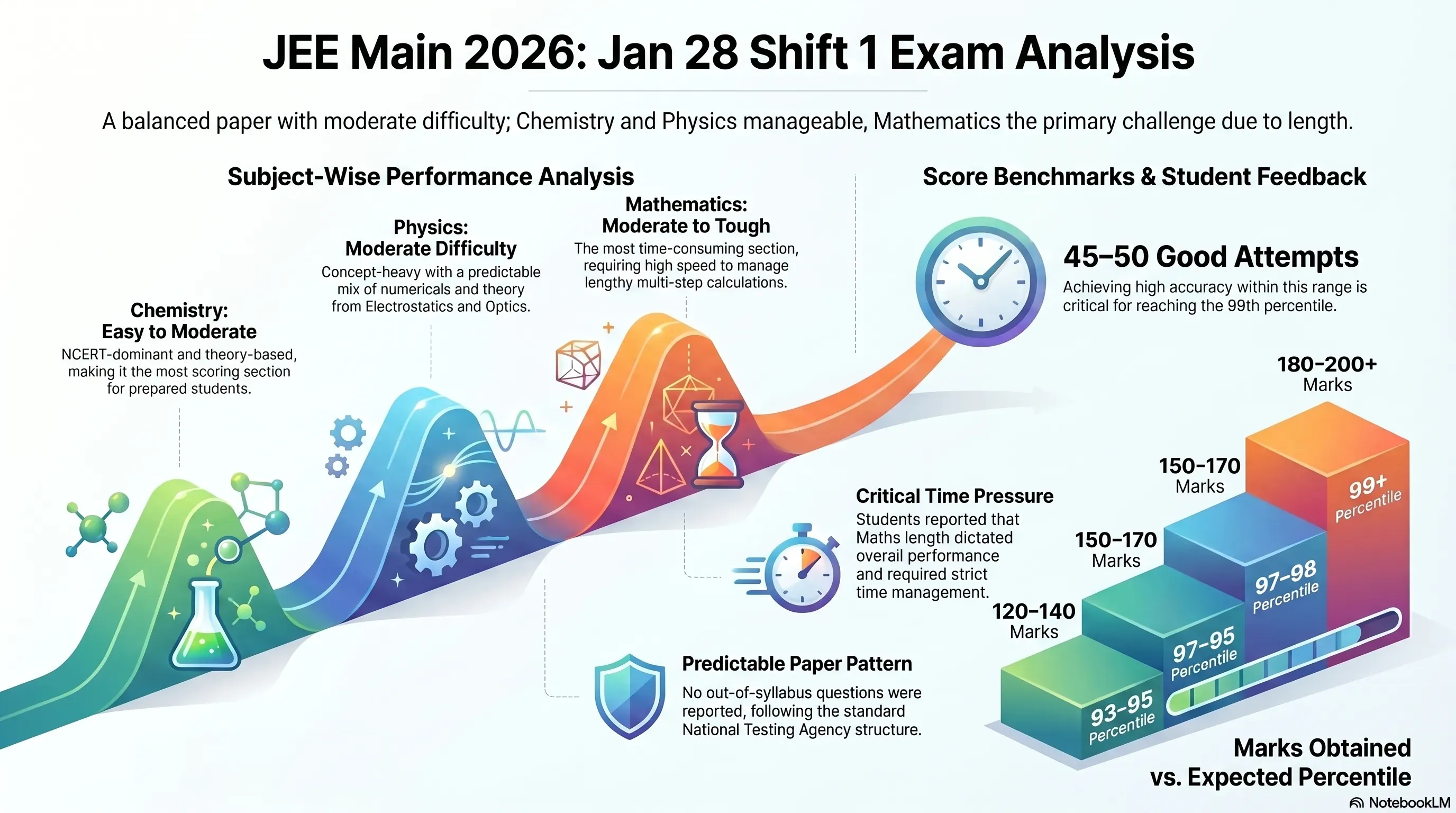
JEE Main 2026 Jan 28 Shift 1 was a moderate and balanced paper, with Physics and Chemistry being relatively straightforward while Mathematics was lengthy and time-consuming, making speed, accuracy, and time management crucial for a high percentile.
eSaral › JEE › JEE Main ›JEE Main 2026 Jan 28 Shift 1 Paper Analysis: Difficulty, Weightage & Student Reactions

🚀 Checkout eSaral Courses
The JEE Main 2026 January 28 Shift 1 exam was conducted by NTA in the morning session. Based on student feedback and exam pattern observations, the paper followed the standard JEE Main structure with a balanced mix of conceptual understanding and calculation-based questions.
This detailed analysis covers:
- Overall paper difficulty
- Subject-wise review
- Chapter-wise weightage trends
- Toughness level
- Student reactions
- Performance outlook
Overall Difficulty Level – Jan 28 Shift 1
Parameter | Level |
Overall Difficulty | Moderate |
Paper Length | Moderate to Lengthy |
Conceptual Level | Moderate |
Calculation Intensity | Moderate |
Time Management | Important |
📌 Students reported that the paper was balanced overall, but Mathematics required good time management.
Subject-wise Paper Analysis – Jan 28 Shift 1
Physics Analysis
Difficulty Level: Moderate
Physics was largely concept-based with a mix of numerical and theory questions. The paper followed a predictable JEE Main pattern.
Important Topics Asked:
- Electrostatics
- Current Electricity
- Magnetic Effects of Current
- Ray Optics
- Modern Physics
Student Reaction:
Physics was balanced and manageable with clear concepts.
Chemistry Analysis
Difficulty Level: Easy to Moderate
Chemistry was NCERT-dominant, making it one of the more scoring sections for prepared students.
Important Topics Asked:
- Coordination Compounds
- Biomolecules
- Chemical Kinetics
- Thermodynamics
- Organic Reaction Mechanism
Student Reaction:
Chemistry was direct and theory-based, mostly from NCERT.
Mathematics Analysis
Difficulty Level: Moderate to Tough
Mathematics was the most time-consuming section in this shift, with lengthy calculation-based and multi-step questions.
Important Topics Asked:
- Vector & 3D Geometry
- Matrices and Determinants
- Integration
- Differential Calculus
- Conic Sections
Student Reaction:
Maths was lengthy and required strong speed and accuracy.
Chapter-wise Weightage Trend (Observed)
Physics
- Electrostatics & Magnetism
- Optics
- Modern Physics
Chemistry
- Inorganic Chemistry (NCERT)
- Physical Chemistry numericals
- Organic Chemistry reactions
Mathematics
- Calculus
- Vector & 3D Geometry
- Algebra
- Coordinate Geometry
Good Attempts & Expected Performance – Jan 28 Shift 1
Parameter | Expected Range |
Good Attempts | 45–50 |
High Accuracy Attempts | Critical for 99%ile |
Time Pressure Sections | Mathematics |
Expected Marks vs Percentile (Indicative)
Marks | Expected Percentile |
180–200+ | 99+ |
150–170 | 97–98 |
120–140 | 93–95 |
100–120 | 90–92 |
👉 Students can estimate their percentile using a detailed JEE Mains Marks vs Percentile analysis.
Student Reactions – Jan 28 Shift 1
What Students Liked 👍
- Predictable paper pattern
- Physics and Chemistry were manageable
- No out-of-syllabus questions
What Students Found Difficult 👎
- Lengthy Mathematics
- Time pressure in calculations
Overall Student Opinion:
“The paper was balanced, but Mathematics decided the final performance.”
Comparison with Other Shifts
Date & Shift | Difficulty |
Jan 24 Shift 2 | Moderate to Moderately Tough |
Jan 28 Shift 1 | Moderate |
Jan 23 Shift 2 | Moderate to Moderately Tough |
📌 Jan 28 Shift 1 was considered more balanced than tougher shifts like Jan 22 Shift 2, but still required strong time management.
What Students Should Learn from Jan 28 Shift 1
- NCERT remains the foundation for Chemistry
- Speed and accuracy matter in Mathematics
- Strong conceptual clarity helps in Physics
- Regular time-based mock practice is essential
For students preparing for upcoming attempts or JEE Advanced, joining a focused JEE Crash Course can significantly improve revision efficiency and score potential.
Frequently Asked Questions
What was the overall difficulty level of JEE Main 2026 January 28 Shift 1?
The overall difficulty level was moderate. Physics was concept-based and manageable, Chemistry was NCERT-driven and scoring, and Mathematics was the most challenging section due to lengthy, multi-step calculations. Students with strong fundamentals and good time management were able to attempt 45–50 questions accurately.
Which section was the toughest in Jan 28 Shift 1?
Mathematics was the toughest section. It involved multi-step calculations and lengthy questions — particularly in Calculus, Vector & 3D Geometry, and Conic Sections. Students reported running short on time even when they knew the method to solve the questions.
Was Chemistry NCERT-based in this shift?
Yes, Chemistry questions were predominantly based on NCERT Class 11 and Class 12 content. Topics like Coordination Compounds, Biomolecules, and Organic Reaction Mechanisms were directly NCERT-aligned. Students who had read NCERT text thoroughly found this section the most straightforward of all three.
How many attempts are considered good in this shift for 99 percentile?
Attempting 45–50 questions with high accuracy is considered the benchmark for 99+ percentile in this shift. Accuracy matters more than attempt count in JEE Main because of the –1 negative marking on incorrect MCQ answers. Attempting fewer questions correctly is better than attempting more with errors.
What score is needed for 97–98 percentile in Jan 28 Shift 1?
Based on the observed difficulty level of this shift, a score of approximately 150–170 marks is expected to yield 97–98 percentile. These are indicative estimates; actual percentile figures depend on NTA's normalisation process across all shifts and sessions.
Team eSaral
eSaral Academic and Editorial Team
Team eSaral is the collective author profile for educational content created by eSaral’s teachers and academic contributors. The team draws on expertise from IIT graduates, doctors, experienced educators and subject specialists to develop resources for JEE, NEET and school students. Our articles aim to explain concepts clearly and help students study with confidence.
Related Posts

BITSAT 2027: Registration Date, Exam Date, Syllabus, Eligibility, Pattern & Fees
BITSAT 2027 exam dates, registration timeline, eligibility criteria, exam pattern, marking scheme, syllabus and fees in one page.

BITSAT Previous Year Question Paper PDF (2017-2026)
Download BITSAT previous year question papers PDF from 2017 to 2026,session-wise. Memory-based papers,exam pattern, paper analysis and how to practise

CBSE Class 10 Date Sheet 2027: Expected Exam Dates, Release Date, Admit Card & Result Timeline
CBSE Class 10 date sheet 2027 is awaited. See the expected exam dates, release window, how to download the PDF, admit card and result timelines.

NCERT Physics Class 10 Book PDF in Hindi 2026-27 – भौतिक विज्ञान के 4 अध्याय (Free Download)
NCERT Physics Class 10 book PDF in Hindi 2026-27: download all 4 chapters (अध्याय 9–12) free, with topics and important formulas.

NCERT Biology Class 9 Book Anveshan PDF in Hindi - जीव विज्ञान कक्षा 9 पुस्तक अन्वेषण PDF
Download NCERT Biology Class 9 book PDF in Hindi chapterwise for 2026-27: Cell, Tissues, Reproduction and Diversity. Free PDFs.

Essay On Artificial Intelligence in English (100,150, 200, 250, 300, 500 Words)
This is in contrast to the natural intelligence of humans. With Artificial Intelligence, machines can perform

Essay on 78th India Independence Day in English for Student (100, 150, 200, 250, 300, 500 Words)
Read the best essays on India's Independence Day in English. Short & long essays (100, 150, 200, 250, 300, 500 words) perfect for school exams
NCERT Class 11 English Snapshots book - Free PDF download- Esaral
Download NCERT Class 11 English Snapshots book PDF for free. Get all 8 chapters, chapter-wise. Start your prep today!
NCERT Class 10 biology book pdf - Free PDF Download - eSaral
NCERT Class 10 Biology book PDF 2026-27: all 5 chapters (Life Processes to Our Environment) in English & Hindi, with CBSE syllabus, marks & practical

Essay on Global Warming in English (100,150, 200, 250, 300, 500 Words)
Global warming means the Earth is getting hotter. This happens because of things like pollution from cars and factories.