
JEE NEET Preparation from Class 9: Why Early Start Wins

eSaral Academic and Editorial Team
Summary
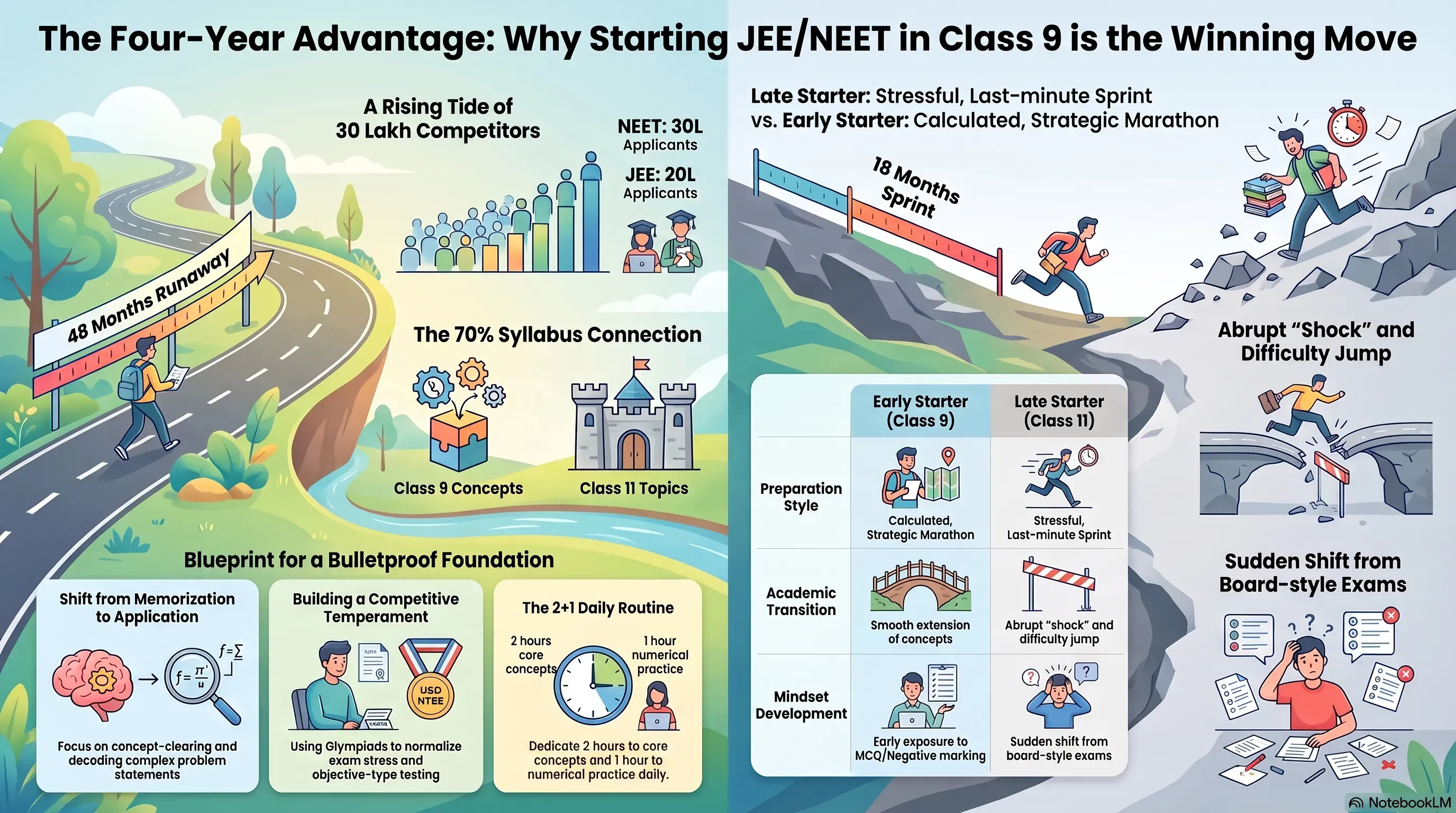
Starting JEE NEET preparation from Class 9 gives students nearly 48 months of preparation time instead of the 18 months available from Class 11, allowing concepts like kinematics, mechanics, and organic reactions to be mastered gradually through an integrated study approach rather than under exam-year pressure.

eSaral ›Foundation courses ›JEE NEET Preparation from Class 9: Why Early Start Wins

Why Competition Makes an Early Start Worth It
More than 15 lakh students currently appear for JEE, and this number is expected to rise to around 20 lakh by the time a Class 9 student reaches the exam. In NEET, the numbers are even sharper: over 25 lakh students currently appear, a figure projected to climb toward 30 lakh. Competing against this many students for a limited number of seats in top IITs and AIIMS colleges is the reality every aspirant has to accept.
Fighting this level of competition takes time, and that time is exactly what an early start provides.
The Time Advantage: 48 Months vs 18 Months
A student who begins preparation at the start of Class 11 gets only 18 months of actual preparation time before facing JEE Main or NEET. A student who begins in Class 9 gets close to 48 months — roughly 30 months more.
Most top rankers begin their preparation from Class 9 for this reason. Mastering a concept and then practicing it thoroughly both take time, and that time is available right now for a Class 9 student. Instead of turning the preparation into a stressful last-minute sprint, this extra runway converts it into what can be called a calculated, strategic marathon.
How Class 9-10 Topics Connect to the JEE and NEET Syllabus
Up to 70% of the Physics, Chemistry, and Biology topics taught in Class 11 and 12 directly match what is already being studied in Class 9. In Physics specifically, the Class 9 chapter on motion becomes Kinematics 1D and Kinematics 2D in Class 11 — an upgraded version of the same concept. Similarly, the Class 9 chapter on force becomes Newton's Laws of Motion (NLM) in Class 11, as covered under the JEE Main syllabus.
Upgrading these concepts now to the level required for JEE Main and NEET means Class 9-10 topics function as a direct, structured extension of the syllabus rather than something separate. Students who build mastery at this stage avoid the shock many others feel on entering Class 11, when questions suddenly demand a level far beyond board-exam requirements. A strong foundation built now leads to a smooth transition later, rather than an abrupt one.
Building a Bulletproof Foundation Through Integrated Study
Trying to first "finish" Class 9, then Class 10, and only then start Class 11 preparation does not work in practice — Class 10 board pressure alone typically prevents Class 11 topics from ever being picked up on schedule. The alternative is to run Class 9, Class 10, and JEE/NEET preparation together at the same time, so that by the time Class 11 begins, more than half the relevant syllabus is already complete.
This is the idea behind an integrated study approach, such as the one followed in eSaral's Shakti Integrated Course, which takes a Class 9 student through a complete curriculum, system, syllabus, and practice track aligned to the JEE/NEET level, continuing the same integration through Class 10.
Building a bulletproof foundation this way requires moving away from basic school-level memorisation that gets recalled for an exam and then forgotten. Instead, it calls for:
- Developing a genuine understanding of each concept through concept-clearing, rather than memorising it
- Building the habit of solving more application-based problems and numericals
- Analysing every problem statement carefully — decoding what is being asked and identifying how to reach the solution, rather than just recalling a formula
This analytical, problem-solving approach is what both JEE and NEET demand, and it only develops once the foundation itself is strong.
Why a Competitive Mindset Matters Early
Class 9 and 10 students typically have no competitive exam mindset — school exams reward writing down memorised answers, with step-wise marking available even for partial answers. Competitive exams work differently: an answer is either right or wrong, and negative marking applies.
Building this mindset early means practicing objective-type, MCQ-based questions in the same pattern as JEE and NEET, rather than only board-style questions. Appearing for Olympiads — such as NSO, NTSE, and NSEJS — is recommended for Class 9 and 10 students as part of this process. The goal at this stage is not the medal itself, but developing the temperament to handle competitive exam stress, so that when the actual JEE or NEET exam arrives, the pressure no longer feels unfamiliar and questions can be solved smoothly.
A Daily Study Plan for Class 9 JEE NEET Aspirants
A realistic day for a Class 9 aspirant balances school, core JEE/NEET concepts, and numerical practice:
Time Block | Focus |
|---|---|
6 hours | School subjects and homework |
2 hours | Core JEE/NEET concept classes for topics related to Class 9-10 (for example, daily special classes as followed in the Shakti course) |
1 hour | Daily numerical practice across Physics, Chemistry, and Mathematics |
Remaining time | Identifying weak areas from the day's study and working through them with a strategic, focused analysis |
The last part of the day matters as much as the concept classes themselves: identifying exactly where a doubt or an application-based question caused difficulty, and converting that weak area into a strength while there is still time to do so.
Weekend Plan: Clearing Backlogs and Practicing MCQs
Weekday backlogs are common and expected — the plan for Saturday and Sunday is built around resolving them rather than pretending they won't happen. On the weekend, a student is expected to:
- Clear any pending school backlog
- Clear any pending backlog from the integrated JEE/NEET study track
- Solve at least 50 objective/MCQ-based questions following the JEE/NEET pattern, available through the integrated practice sheets
Alongside this, setting aside time for sports, movies, a park visit, friends, relatives, or parents is part of the plan too — the goal is to become a good engineer or doctor while also remaining a good student, a good child, and a good friend.
Following this routine from Class 9 is presented as a realistic path toward admission into a student's dream IIT — whether IIT Bombay, IIT Delhi, or IIT Madras — or dream AIIMS, whether in Delhi, Patna, or Rishikesh, provided the routine is actually followed consistently.
Frequently Asked Questions
Is it too early to start JEE NEET preparation from Class 9?
No, starting from Class 9 is not too early — it gives close to 48 months of preparation time compared to just 18 months if preparation starts in Class 11. This extra 30 months is used to master difficult concepts like mechanics and organic reactions without the pressure of an approaching exam year.
How much of the Class 9-10 syllabus actually overlaps with JEE and NEET?
Up to 70% of Class 11 and 12 Physics, Chemistry, and Biology topics match what is already covered in Class 9. For example, the Class 9 motion chapter becomes Kinematics 1D and 2D, and the force chapter becomes Newton's Laws of Motion in Class 11.
What is the Shakti Integrated Course by eSaral?
The Shakti Integrated Course is eSaral's Class 9 integrated study program that combines school curriculum with JEE/NEET-level preparation in one continuous track. It is designed to take a student through Class 9 and 10 school topics alongside JEE/NEET concepts, so more than half the JEE/NEET syllabus is already covered before Class 11 begins.
How many hours should a Class 9 student studying for JEE NEET dedicate daily?
A Class 9 aspirant should give around 6 hours to school and homework, 2 hours to core JEE/NEET concept classes tied to Class 9-10 topics, and 1 hour to daily numerical practice, with the remaining time used to work on identified weak areas.
Should Class 9 students appear for Olympiads like NSO or NTSE?
Yes, appearing for Olympiads such as NSO, NTSE, and NSEJS is recommended for Class 9-10 students, not primarily for the medals but to build the temperament needed to handle competitive-exam stress ahead of JEE and NEET.
Team eSaral
eSaral Academic and Editorial Team
Team eSaral is the collective author profile for educational content created by eSaral’s teachers and academic contributors. The team draws on expertise from IIT graduates, doctors, experienced educators and subject specialists to develop resources for JEE, NEET and school students. Our articles aim to explain concepts clearly and help students study with confidence.
Related Posts

BITSAT 2027: Registration Date, Exam Date, Syllabus, Eligibility, Pattern & Fees
BITSAT 2027 exam dates, registration timeline, eligibility criteria, exam pattern, marking scheme, syllabus and fees in one page.

BITSAT Previous Year Question Paper PDF (2017-2026)
Download BITSAT previous year question papers PDF from 2017 to 2026,session-wise. Memory-based papers,exam pattern, paper analysis and how to practise

CBSE Class 10 Date Sheet 2027: Expected Exam Dates, Release Date, Admit Card & Result Timeline
CBSE Class 10 date sheet 2027 is awaited. See the expected exam dates, release window, how to download the PDF, admit card and result timelines.

NCERT Physics Class 10 Book PDF in Hindi 2026-27 – भौतिक विज्ञान के 4 अध्याय (Free Download)
NCERT Physics Class 10 book PDF in Hindi 2026-27: download all 4 chapters (अध्याय 9–12) free, with topics and important formulas.

NCERT Biology Class 9 Book Anveshan PDF in Hindi - जीव विज्ञान कक्षा 9 पुस्तक अन्वेषण PDF
Download NCERT Biology Class 9 book PDF in Hindi chapterwise for 2026-27: Cell, Tissues, Reproduction and Diversity. Free PDFs.

Essay On Artificial Intelligence in English (100,150, 200, 250, 300, 500 Words)
This is in contrast to the natural intelligence of humans. With Artificial Intelligence, machines can perform

Essay on 78th India Independence Day in English for Student (100, 150, 200, 250, 300, 500 Words)
Read the best essays on India's Independence Day in English. Short & long essays (100, 150, 200, 250, 300, 500 words) perfect for school exams
NCERT Class 11 English Snapshots book - Free PDF download- Esaral
Download NCERT Class 11 English Snapshots book PDF for free. Get all 8 chapters, chapter-wise. Start your prep today!
NCERT Class 10 biology book pdf - Free PDF Download - eSaral
NCERT Class 10 Biology book PDF 2026-27: all 5 chapters (Life Processes to Our Environment) in English & Hindi, with CBSE syllabus, marks & practical

Essay on Global Warming in English (100,150, 200, 250, 300, 500 Words)
Global warming means the Earth is getting hotter. This happens because of things like pollution from cars and factories.