
Matrices - JEE Main Previous Year Question with Solutions
eSaral › JEE › JEE Main ›Matrices - JEE Main Previous Year Question with Solutions

🚀 Checkout eSaral Courses
Why Matrices Matter in JEE Main
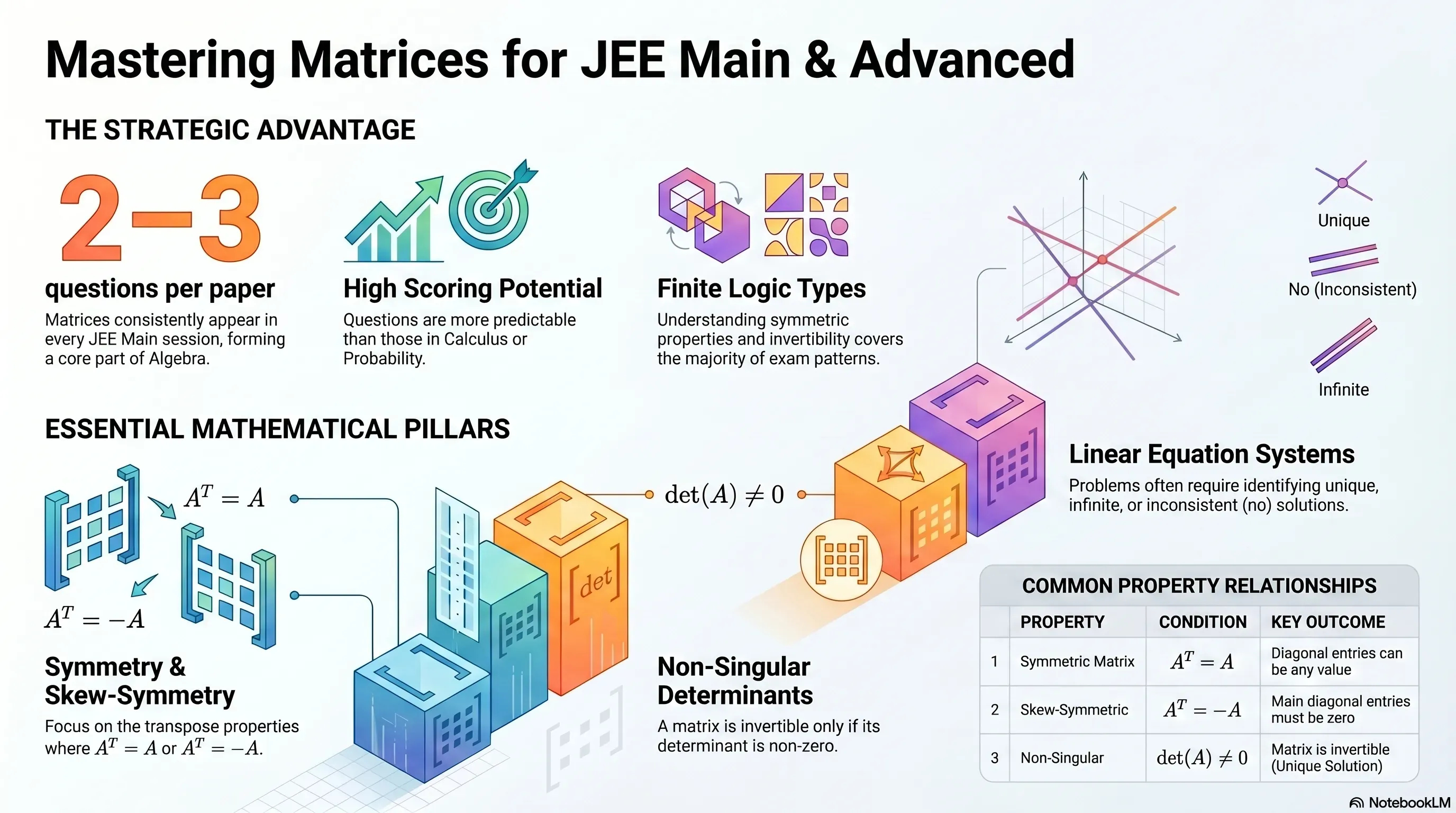
Matrices is one of the most scoring and consistently examined topics in JEE Main mathematics. According to the official NTA JEE syllabus, it forms a core part of the Class 12 Algebra section and carries direct questions almost every year — sometimes up to 2–3 questions in a single paper.
For JEE aspirants, this is good news. Unlike Calculus or Probability, Matrices has a finite, predictable set of question types. Once you understand the logic behind symmetric and skew-symmetric properties, determinant relationships, and matrix invertibility, the same ideas appear in different forms year after year.
JEE Main Previous Year Question
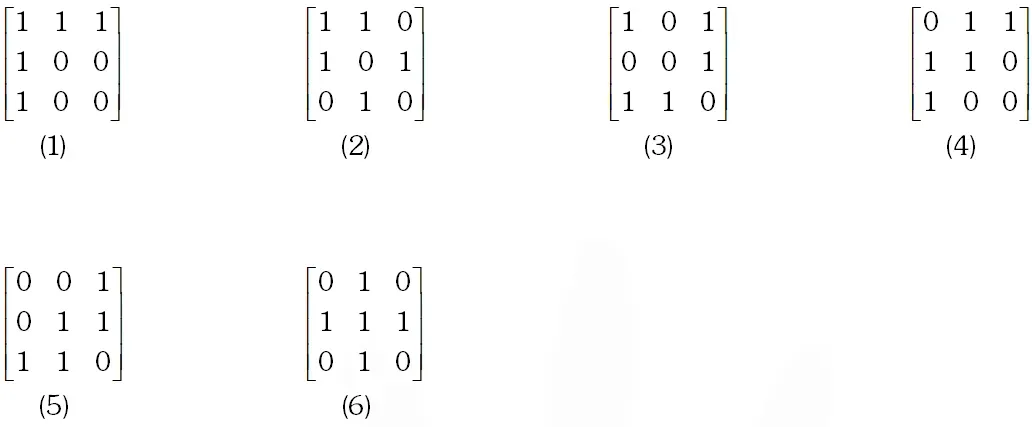
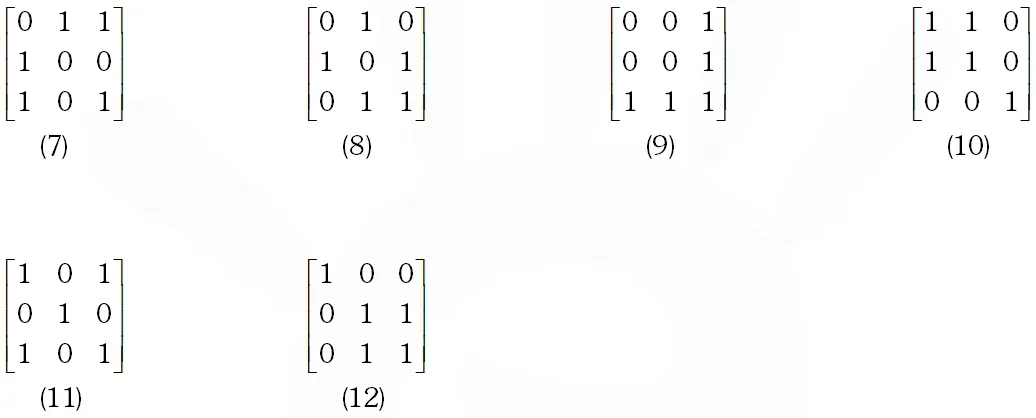
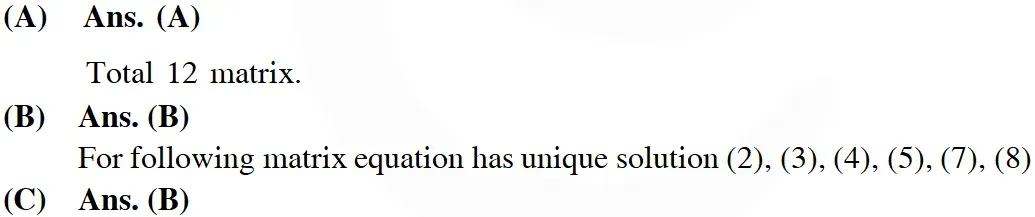
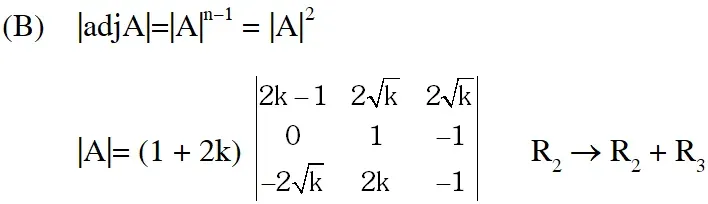
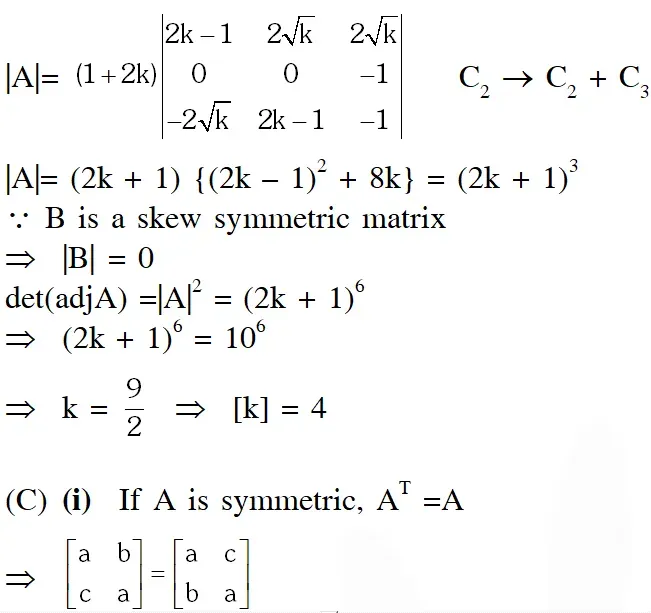
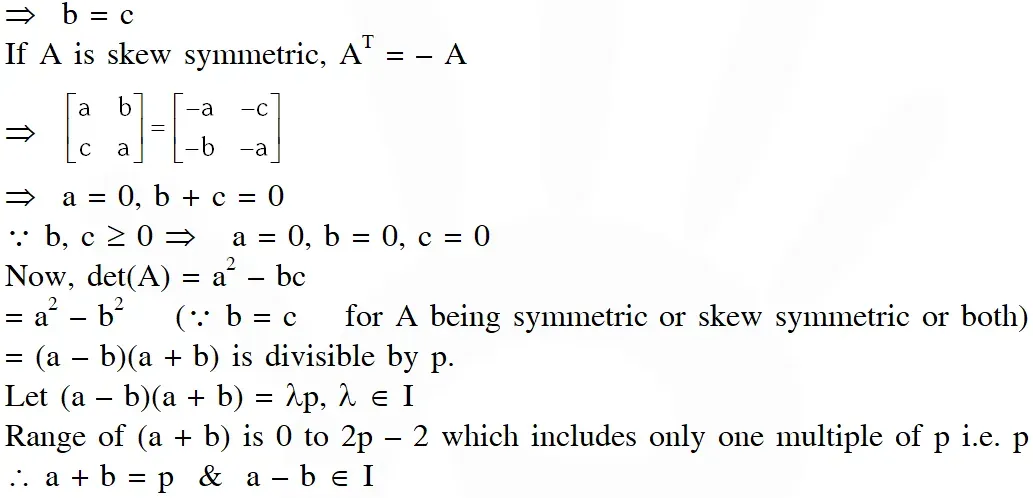
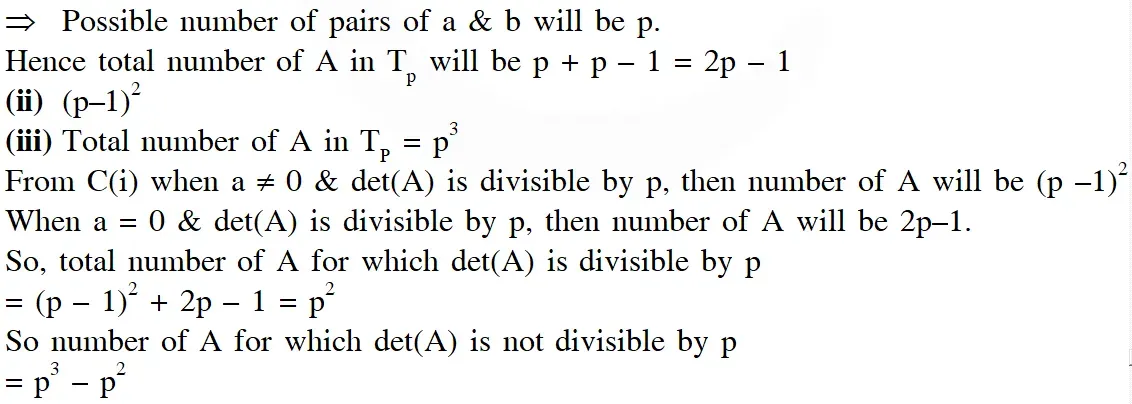
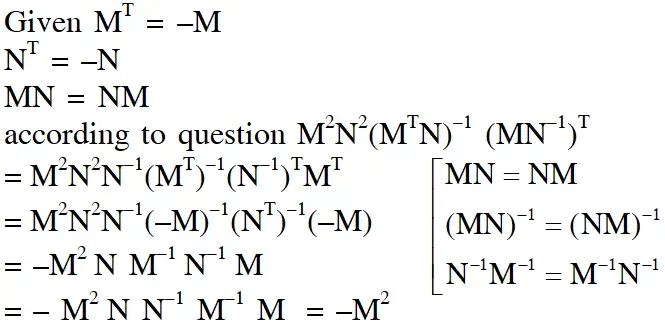
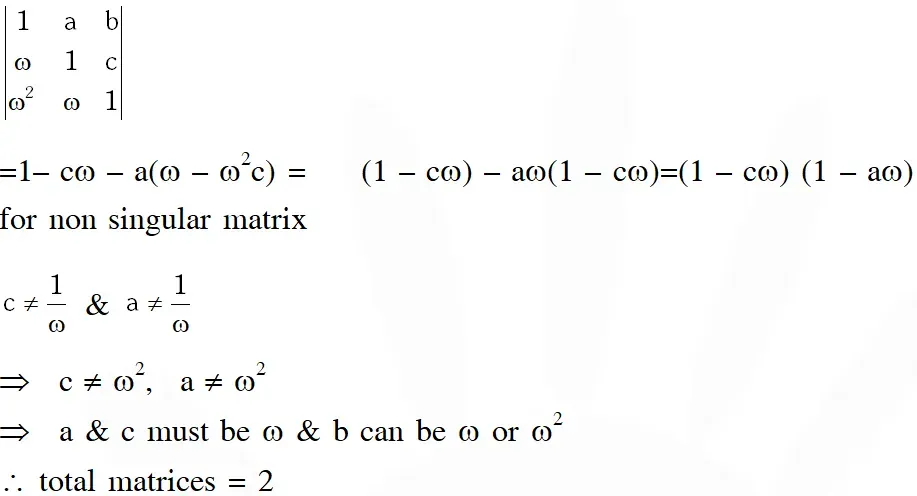
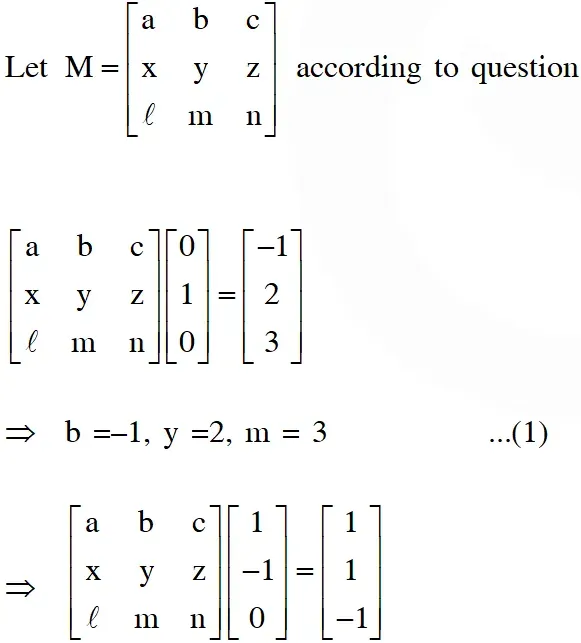
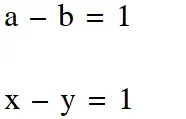
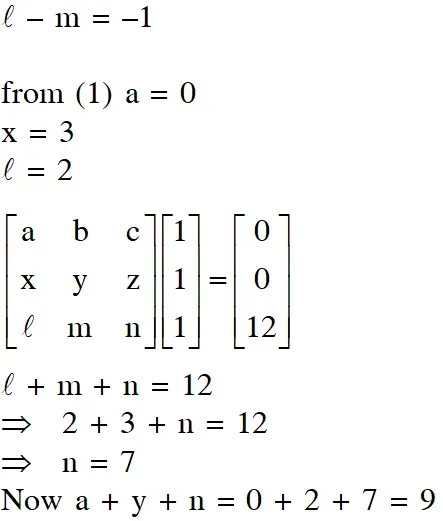
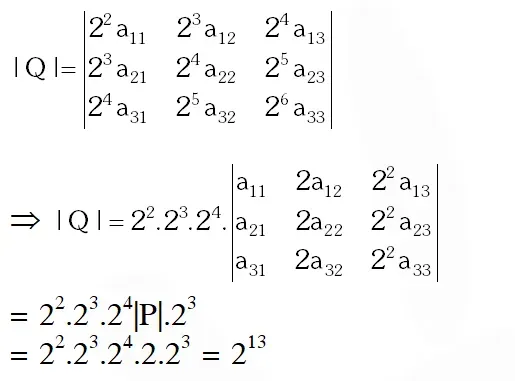
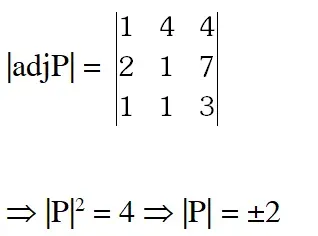
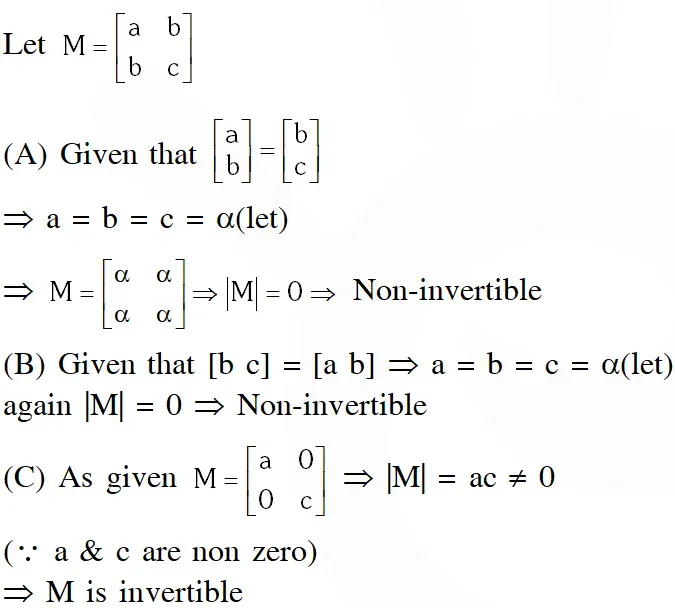
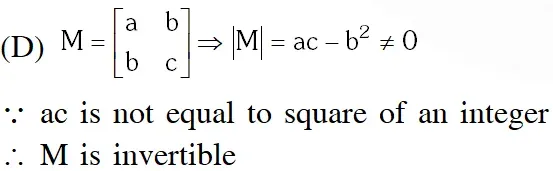
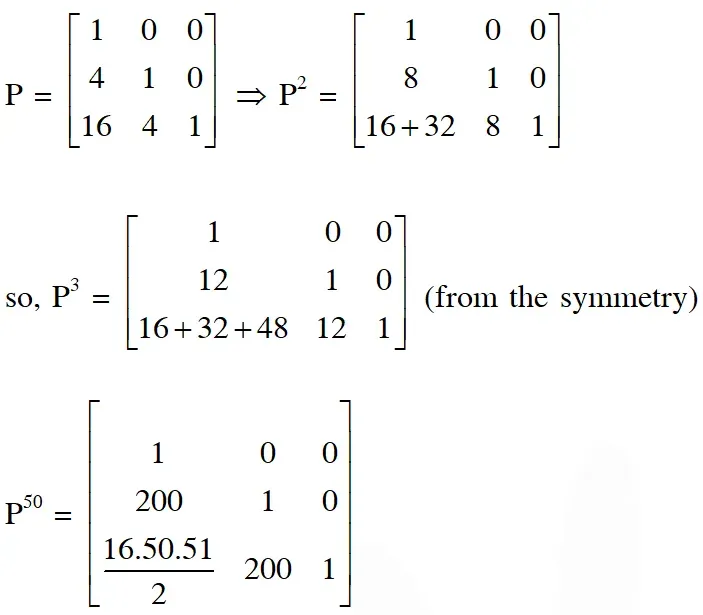
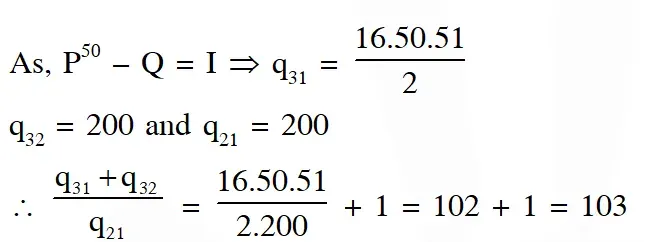
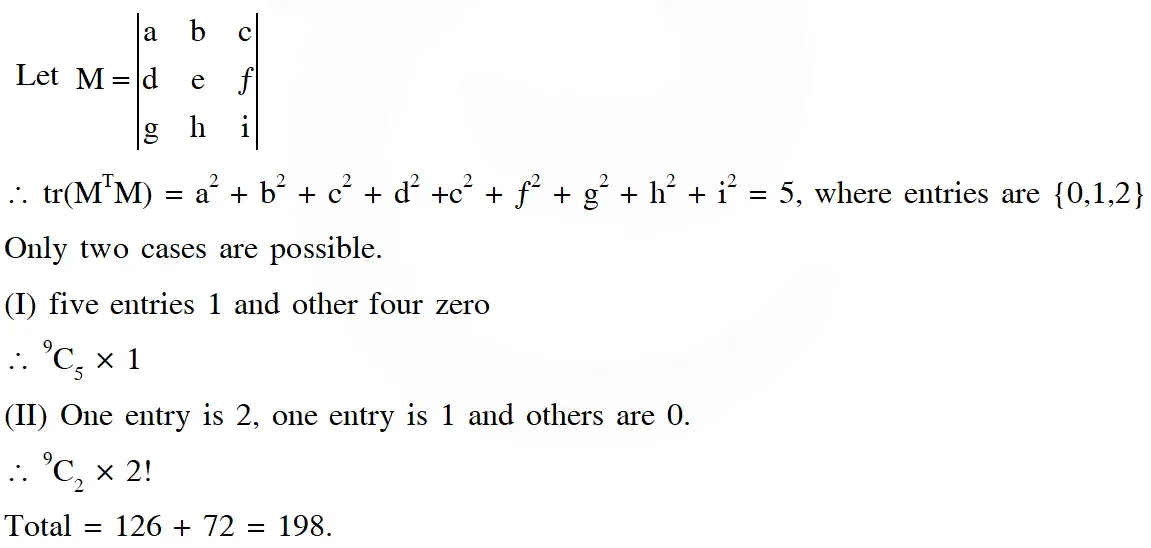
Download eSaral app for free study material and video tutorials. [esquestion] Let A be the set of all 3 3 symmetric matrices all of whose entries are either 0 or 1. Five of these entries are 1 and four of them are 0. (A) The number of matrices in A is – (A) 12 (B) 6 (C) 9 (D) 3 (B) The number of matrices A in A for which the system of linear equations $A\left[\begin{array}{l}{x} \\ {y} \\ {z}\end{array}\right]=\left[\begin{array}{l}{1} \\ {0} \\ {0}\end{array}\right]$ has a unique solution, is – (A) less than 4 (B) at least 4 but less than 7 (C) at least 7 but less than 10 (D) at least 10 (C) The number of matrices A in A for which the system of linear equations $A\left[\begin{array}{l}{x} \\ {y} \\ {z}\end{array}\right]=\left[\begin{array}{l}{1} \\ {0} \\ {0}\end{array}\right]$ is inconsistent, is – (A) 0 (B) more than 2 (C) 2 (D) 1 #tag# [JEE 2009, 4+4+4] #sol# ( (A) A ,(b) B, (c) B ) [/esquestion] [esquestion] (A) The number of 3 3 matrices A whose entries are either 0 or 1 and for which the system $A\left[\begin{array}{l}{x} \\ {y} \\ {z}\end{array}\right]=\left[\begin{array}{l}{1} \\ {0} \\ {0}\end{array}\right]$ has exactly two distinct solutions, is (A) 0 (B) $2^{9}-1$ (C) 168 (D) 2 (B) Let $\mathrm{k}$ be a positive real number and let $\mathrm{A}=\left[\begin{array}{ccc}{2 \mathrm{k}-1} & {2 \sqrt{\mathrm{k}}} & {2 \sqrt{\mathrm{k}}} \\ {2 \sqrt{\mathrm{k}}} & {1} & {-2 \mathrm{k}} \\ {-2 \sqrt{\mathrm{k}}} & {2 \mathrm{k}} & {-1}\end{array}\right]$ and $\mathrm{B}=\left[\begin{array}{ccc}{0} & {2 \mathrm{k}-1} & {\sqrt{\mathrm{k}}} \\ {1-2 \mathrm{k}} & {0} & {2 \sqrt{\mathrm{k}}} \\ {-\sqrt{\mathrm{k}}} & {-2 \sqrt{\mathrm{k}}} & {0}\end{array}\right]$ If $\operatorname{det}(\operatorname{adj} \mathrm{A})+\operatorname{det}(\operatorname{adj} \mathrm{B})=10^{6},$ then $[\mathrm{k}]$ is equal to [Note : adj M denotes the adjoint of a square matrix M and [k] denotes the largest integer less than or equal to k]. (C) Let p be an odd prime number and Tp be the following set of 2 2 matrices: $\mathrm{T}_{\mathrm{p}}=\left\{\mathrm{A}=\left[\begin{array}{ll}{\mathrm{a}} & {\mathrm{b}} \\ {\mathrm{c}} & {\mathrm{a}}\end{array}\right]: \mathrm{a}, \mathrm{b}, \mathrm{c} \in\{0,1,2, \ldots \ldots, \mathrm{p}-1\}\right.$ (i) The number of $A$ in $T_{p}$ such that $A$ is either symmetric or skew symmetric or both, and det(A) divisible by p is – (A) $(\mathrm{p}-1)^{2}$ (B) 2 (p – 1) (C) $(p-1)^{2}+1$ (D) 2p –1 (ii) The number of $A$ in $T_{p}$ such that the trace of $A$ is not divisible by $p$ but det (A) is divisible by p is – [Note : The trace of a matrix is the sum of its diagonal entries.] (A) $(p-1)\left(p^{2}-p+1\right)$ (B) $\mathrm{p}^{3}-(\mathrm{p}-1)^{2}$ (C) $(p-1)^{2}$ (D) $(p-1)\left(p^{2}-2\right)$ (iii) The number of $A$ in $T_{p}$ such that $\operatorname{det}(A)$ is not divisible by $p$ is – (A) $2 p^{2}$ (B) $\mathrm{p}^{3}-5 \mathrm{p}$ (C) $\mathrm{p}^{3}-3 \mathrm{p}$ (D) $\mathrm{p}^{3}-\mathrm{p}^{2}$ #tag# [JEE 2010, 3+3+3+3+3] #sol# ($(a) A,(b) 4 ;(c)(i) D,(i i) C,(\text { iii }) D$) For the matrix $(6),(9),(10),(11)$ the system of linear equation is incosistent. (A) The given matrix system is a linear system in $\mathrm{x}, \mathrm{y}, \mathrm{z},$ hence it can have either a unique solution or no-solution or infinitely many solutions. It can never have exactly two distinct solutions. [/esquestion] [esquestion] Let $\mathrm{M}$ and $\mathrm{N}$ be two $3 \times 3$ non-singular skew-symmetric matrices such that $\mathrm{MN}=\mathrm{NM}$. If $\mathrm{P}^{\mathrm{T}}$ denotes the transpose of $\mathrm{P},$ then $\mathrm{M}^{2} \mathrm{N}^{2}\left(\mathrm{M}^{\mathrm{T}} \mathrm{N}\right)^{-1}\left(\mathrm{MN}^{-1}\right)^{\mathrm{T}}$ is equal to – (A) $\mathbf{M}^{2}$ (B) $-N^{2}$ (C) $-M^{2}$ (D) MN #tag# [JEE 2011, 4] #sol# (Bonus) (Comment : Although 3 3 skew symmetric matrices can never be non-singular. Therefore the information given in question is wrong. Now if we consider only non singular skew symmetric matrices M & N, then the solution is-) [/esquestion] [esquestion] Let $\omega \neq 1$ be a cube root of unity and $S$ be the set of all non-singular matrices of the form $\left[\begin{array}{lll}{1} & {a} & {b} \\ {\omega} & {1} & {c} \\ {\omega^{2}} & {\omega} & {1}\end{array}\right],$ where each of a,b and $c$ is either $\omega$ or $\omega^{2} .$ Then the number of distinct matrices in the set $\mathrm{S}$ is- (A) 2 (B) 6 (C) 4 (D) 8 #tag# [JEE 2011, 3, (–1)] #sol# (A) [/esquestion] [esquestion] Let M be 3 3 matrix satisfying $\mathbf{M}\left[\begin{array}{l}{0} \\ {1} \\ {0}\end{array}\right]=\left[\begin{array}{r}{-1} \\ {2} \\ {3}\end{array}\right], \mathbf{M}\left[\begin{array}{c}{1} \\ {-1} \\ {0}\end{array}\right]=\left[\begin{array}{r}{1} \\ {1} \\ {-1}\end{array}\right]$ and $\mathbf{M}\left[\begin{array}{l}{1} \\ {1} \\ {1}\end{array}\right]=\left[\begin{array}{c}{0} \\ {0} \\ {12}\end{array}\right]$ Then the sum of the diagonal entries of M is #tag# [JEE 2011, 4] #sol# 9 [/esquestion] [esquestion] Let $\mathrm{P}=\left[\mathrm{a}_{\mathrm{ij}}\right]$ be a $3 \times 3$ matrix and let $\mathrm{Q}=\left[\mathrm{b}_{\mathrm{ij}}\right],$ where $\mathrm{b}_{\mathrm{ij}}=2^{\mathrm{i}+\mathrm{j}} \mathrm{a}_{\mathrm{ij}}$ for $1 \leq \mathrm{i}, \mathrm{j} \leq 3$ If the determinant of $\mathrm{P}$ is $2,$ then the determinant of the matrix $\mathrm{Q}$ is – (A) $2^{10}$ (B) $2^{11}$ (C) $2^{12}$ $(D) 2^{13}$ #tag# [JEE 2011, 4] #sol# (D) [/esquestion] [esquestion] If $\mathrm{P}$ is a $3 \times 3$ matrix such that $\mathrm{P}^{\mathrm{T}}=2 \mathrm{P}+\mathrm{I},$ where $\mathrm{P}^{\mathrm{T}}$ is the transpose of $\mathrm{P}$ and $\mathrm{I}$ is the $3 \times 3 \times 3$ identity matrix, then there exists a column matrix $\mathrm{X}=\left[\begin{array}{l}{\mathrm{x}} \\ {\mathrm{y}} \\ {\mathrm{z}}\end{array}\right] \neq\left[\begin{array}{l}{0} \\ {0} \\ {0}\end{array}\right]$ such that (A) $\mathrm{PX}=\left[\begin{array}{l}{0} \\ {0} \\ {0}\end{array}\right]$ (B) PX = X (C) PX = 2X (D) PX = –X #tag# [JEE 2012, 3M, –1M] #sol# (D) $\mathrm{P}^{\mathrm{T}}=2 \mathrm{P}+\mathrm{I}$ $\Rightarrow \mathrm{P}=2 \mathrm{P}^{\mathrm{T}}+\mathrm{I}$ $\Rightarrow \mathrm{P}=2(2 \mathrm{P}+\mathrm{I})+\mathrm{I}$ $\Rightarrow P=4 P+3 I$ $\Rightarrow P=-I$ $\Rightarrow \mathrm{PX}=-\mathrm{X}$ [/esquestion] [esquestion] If the adjoint of a $3 \times 3$ matrix $\mathrm{P}$ is $\left[\begin{array}{ccc}{1} & {4} & {4} \\ {2} & {1} & {7} \\ {1} & {1} & {3}\end{array}\right],$ then the possible value(s) of the determinant of $\mathrm{P}$ is (are) (A) –2 (B) –1 (C) 1 (D) 2 #tag# [JEE 2012, 4M] #sol# (A,D) [/esquestion] [esquestion] For 3 3 matrices M and N, which of the following statement(s) is (are) NOT correct ? (A) $\mathbf{N}^{\mathrm{T}} \mathbf{M}$ N is symmetric or skew symmetric, according as M is symmetric or skew symmetric (B) MN – NM is skew symmetric for all symmetric matrices M and N (C) MN is symmetric for all symmetric matrices M and N (D) (adj M) (adj N) = adj (M N) for all invertible matrices M and N #tag# [JEE-Advanced 2013, 4, (–1)] #sol# (C,D) (A) $\mathrm{B}=\mathrm{N}^{\mathrm{T}} \mathrm{MN}$ $\mathrm{B}^{\mathrm{T}}=\left(\mathrm{N}^{\mathrm{T}} \mathrm{MN}\right)^{\mathrm{T}}=\mathrm{N}^{\mathrm{T}} \mathrm{M}^{\mathrm{T}} \mathrm{N}$ Now it depands on $\mathrm{M}$ if $\mathrm{M}=\mathrm{M}^{\mathrm{T}}$ So A is true $(\mathrm{B}) \mathrm{B}=(\mathrm{MN}-\mathrm{NM})$ $\mathrm{B}=(\mathrm{MN}-\mathrm{NM})^{\mathrm{T}}$ $=\mathbf{N}^{\mathrm{T}} \mathbf{M}^{\mathrm{T}}-\mathbf{M}^{\mathrm{N}} \mathbf{N}^{\mathrm{T}}$ $=\mathrm{NM}-\mathrm{MN}=-(\mathrm{B})$ Skew symmetric B is ture $(\mathrm{C}) \mathrm{B}=\mathrm{MN}$ $\mathrm{B}^{\mathrm{T}}=(\mathrm{MN})^{\mathrm{T}}$ $\mathrm{B}^{\mathrm{T}}=\mathrm{N}^{\mathrm{T}} \mathrm{M}^{\mathrm{T}}$ $\mathrm{B}^{\mathrm{T}}=\mathrm{NM} \neq \mathrm{B}$ so wrong statement (D) Obviousely wrong because adj $(\mathrm{BA})=\operatorname{adj}(\mathrm{A}) \cdot \operatorname{adJ}(\mathrm{B})$ [/esquestion] [esquestion] Let M be a 2 2 symmetric matrix with integer entries. Then M is invertible if (A) the first column of M is the transpose of the second row of M (B) the second row of M is the transpose of the first column of M (C) M is a diagonal matrix with nonzero entries in the main diagonal (D) the product of entries in the main diagonal of M is not the square of an integer #tag# [JEE(Advanced)-2014, 3] #sol# (C,D) [/esquestion] [esquestion] Let $\mathrm{M}$ and $\mathrm{N}$ be two $3 \times 3$ matrices such that $\mathrm{MN}=\mathrm{NM}$. Further, if $\mathrm{M} \neq \mathrm{N}^{2}$ and $\mathrm{M}^{2}=$ $\mathrm{N}^{4},$ then (A) determinant of $\left(\mathrm{M}^{2}+\mathrm{MN}^{2}\right)$ is 0 (B) there is a $3 \times 3$ non-zero matrix $\mathrm{U}$ such that $\left(\mathrm{M}^{2}+\mathrm{MN}^{2}\right) \mathrm{U}$ is zero Matrix (C) determinant of $\left(\mathrm{M}^{2}+\mathrm{MN}^{2}\right) \geq 1$ (D) for a $3 \times 3$ matrix $\mathrm{U},$ if $\left(\mathrm{M}^{2}+\mathrm{MN}^{2}\right)$ U equals the zero matrix then $\mathrm{U}$ is the zero matrix #tag# [JEE(Advanced)-2014, 3] #sol# (A,B) $\mathrm{M}^{2}=\mathrm{N}^{4}$ $\mathrm{M}^{2}=\mathrm{N}^{4}=0(\therefore \mathrm{MN}=\mathrm{NM})$ $\left(\mathrm{M}+\mathrm{N}^{2}\right)\left(\mathrm{M}-\mathrm{N}^{2}\right)=0$ So $\left(\mathrm{M}+\mathrm{N}^{2}\right)=0$ $\mathrm{Now} \mathrm{M} \cdot\left(\mathrm{M}+\mathrm{N}^{2}\right)=0$ $\mathrm{M}^{2}+\mathrm{MN}^{2}=0$ $\left|\mathrm{M}^{2}+\mathrm{MN}^{2}\right|=0$ Option A is right So we know $A \cdot B=0$ when $\mathrm{B} \neq 0$ $\Rightarrow(\mathrm{A})=0$ So in $\mathrm{U}\left(\mathrm{M}^{2}+\mathrm{MN}^{2}\right) \mathrm{U}=0$ Because $\mathrm{U} \neq 0$ But $\left|\mathrm{M}^{2}+\mathrm{MN}^{2}\right|=0$ So option $\mathrm{B}$ is also right [/esquestion] [esquestion] Let X and Y be two arbitrary, 3 3, non-zero, skew-symmetric matrices and Z be an arbitrary 3 × 3, non-zero, symmetric matrix. Then which of the following matrices is (are) skew symmetric ? (A) $\mathrm{Y}^{3} \mathrm{Z}^{4}-\mathrm{Z}^{4} \mathrm{Y}^{3}$ (B) $\mathrm{X}^{44}+\mathrm{Y}^{44}$ (C) $\mathrm{X}^{4} \mathrm{Z}^{3}-\mathrm{Z}^{3} \mathrm{X}^{4}$ (D) $\mathrm{X}^{23}+\mathrm{Y}^{23}$ #tag# [JEE(Advanced)-2015, 4M, –2M] #sol# (C,D) $\mathrm{x}^{\mathrm{T}}=-\mathrm{x}, \mathrm{y}^{\mathrm{T}}=-\mathrm{y}, \mathrm{z}^{\mathrm{T}}=\mathrm{z}$ (A) Let $P=y^{3} z^{4}-z^{4} y^{3}$ $\mathrm{P}^{\mathrm{T}}=\left(\mathrm{y}^{3} \mathrm{z}^{4}\right)^{\mathrm{T}}-\left(\mathrm{z}^{4} \mathrm{y}^{3}\right)^{\mathrm{T}}$ $=-z^{4} y^{3}+y^{3} z^{4}=P \Rightarrow$ symmetric (B) $\quad$ Let $\mathrm{P}=\mathrm{x}^{44}+\mathrm{y}^{44}$ $\mathrm{P}^{\mathrm{T}}=\left(\mathrm{X}^{44}\right)^{\mathrm{T}}+\left(\mathrm{y}^{44}\right)^{\mathrm{T}}=\mathrm{P} \Rightarrow$ symmetric (C) Let $P=x^{4} z^{3}-z^{3} x^{4}$ $\mathrm{P}^{\mathrm{T}}=\left(\mathrm{z}^{3}\right)^{\mathrm{T}}\left(\mathrm{x}^{4}\right)^{\mathrm{T}}-\left(\mathrm{x}^{4}\right)^{\mathrm{T}}\left(\mathrm{z}^{3}\right)^{\mathrm{T}}$ $=\mathrm{z}^{3} \mathrm{x}^{4}-\mathrm{x}^{4} \mathrm{z}^{3}=-\mathrm{P} \Rightarrow$ skew symmetric (D) Let $P=x^{23}+y^{23}$ $\mathrm{P}^{\mathrm{T}}=-\mathrm{x}^{23}-\mathrm{y}^{23}=-\mathrm{P} \Rightarrow$ skew symmetric [/esquestion] [esquestion] Let $P=\left[\begin{array}{ccc}{3} & {-1} & {-2} \\ {2} & {0} & {\alpha} \\ {3} & {-5} & {0}\end{array}\right],$ where $\alpha \in R,$ Suppose $Q=\left[q_{i j}\right]$ is a matrix such that $P Q=k I$ where $\mathrm{k} \in \mathrm{R}, \mathrm{k} \neq 0$ and $\mathrm{I}$ is the identity matrix of order $3 .$ If $\mathrm{q}_{23}=-\frac{\mathrm{k}}{8}$ and $\operatorname{det}(\mathrm{Q})=\frac{\mathrm{k}^{2}}{2}$ then- (A) = 0, k = 8 (B) $4 \alpha-k+8=0$ (C) $\operatorname{det}(\operatorname{Padj}(\mathrm{Q}))=2^{9}$ (D) det(Qadj(P)) = $2^{13}$ #tag# [JEE(Advanced)-2016] #sol# (B,C) $\mathrm{PQ}=\mathrm{kI}$ $|\mathrm{P}| \cdot|\mathrm{Q}|=\mathrm{k}^{3} \Rightarrow|\mathrm{P}|=2 \mathrm{k} \neq 0 \Rightarrow \mathrm{P}$ is an invertible matrix $\because \mathrm{PQ}=\mathrm{kI}$ $\therefore \mathrm{Q}=\mathrm{k} \mathrm{P}^{-1} \mathrm{I}$ $\therefore \mathrm{Q}=\frac{\mathrm{adj.P}}{2}$ $\because \mathrm{q}_{23}=-\frac{\mathrm{k}}{8}$ $\therefore \frac{-(3 \alpha+4)}{2}=-\frac{k}{8} \Rightarrow k=4$ $\therefore|\mathrm{P}|=2 \mathrm{k} \Rightarrow \mathrm{k}=10+6 \alpha \ldots(\mathrm{i})$ Put value of $k$ in (i).. we get $\alpha=-1$ $\therefore 4 \alpha-k+8=0$ $\& \operatorname{det}(\mathrm{P}(\mathrm{adj} . \mathrm{Q}))=|\mathrm{P}||\operatorname{adj} . \mathrm{Q}|=2 \mathrm{k} \cdot\left(\frac{\mathrm{k}^{2}}{2}\right)^{2}=\frac{\mathrm{k}^{5}}{2}=2^{9}$ [/esquestion] [esquestion] Let $P=\left[\begin{array}{lll}{1} & {0} & {0} \\ {4} & {1} & {0} \\ {16} & {4} & {1}\end{array}\right]$ and $I$ be the identity matrix of order $3 .$ If $Q=\left[q_{i j}\right]$ is a matrix such that $\mathrm{P}^{50}-\mathrm{Q}=\mathrm{I},$ then $\frac{\mathrm{q}_{31}+\mathrm{q}_{32}}{\mathrm{q}_{21}}$ equals (A) 52 (B) 103 (C) 201 (D) 205 #tag# [JEE(Advanced)-2016] #sol# (A) [/esquestion] [esquestion] Which of the following is(are) NOT the square of a 3 3 matrix with real entries ? #tag# [JEE(Advanced)-2017] #sol# (A,B) [/esquestion] [esquestion] How many $3 \times 3$ matrices $\mathrm{M}$ with entries from $\{0,1,2\}$ are there, for which the sum of the diagonal entries of $\mathrm{M}^{\mathrm{T}} \mathrm{M}$ is $5 ?$ (A) 198 (B) 126 (C) 135 (D) 16 #tag# [JEE(Advanced)-2017] #sol# (A) [/esquestion] [esquestion] Let S be the of all column matrices $\left[\begin{array}{l}{b_{1}} \\ {b_{2}} \\ {b_{3}}\end{array}\right]$ such that $b_{1}, b_{2}, b_{3} \in \square$ and the system of equations (in real variables) $-x+2 y+5 z=b_{1}$ $2 x-4 y+3 z=b_{2}$ $x-2 y+2 z=b_{3}$ has at least one solution. Then, which of the following system(s) (in real variables) has (have) at least one solution of each $\left[\begin{array}{l}{b_{1}} \\ {b_{2}} \\ {b_{3}}\end{array}\right] \in S ?$ (A) $\mathrm{x}+2 \mathrm{y}+3 \mathrm{z}=\mathrm{b}_{1}, 4 \mathrm{y}+5 \mathrm{z}=\mathrm{b}_{2}$ and $\mathrm{x}+2 \mathrm{y}+6 \mathrm{z}=\mathrm{b}_{3}$ (B) $x+y+3 z=b_{1}, 5 x+2 y+6 z=b_{2}$ and $-2 x-y-3 z=b_{3}$ (C) $-\mathrm{x}+2 \mathrm{y}-5 \mathrm{z}=\mathrm{b}_{1}, 2 \mathrm{x}-4 \mathrm{y}+10 \mathrm{z}=\mathrm{b}_{2}$ and $\mathrm{x}-2 \mathrm{y}+5 \mathrm{z}=\mathrm{b}_{3}$ (D) $x+2 y+5 z=b_{1}, 2 x+3 z=b_{2}$ and $x+4 y-5 z=b_{3}$ #tag# [JEE(Advanced)-2018, 4(–2)] #sol# (A,C,D) [/esquestion]

For offline Matrices practice, students can use the JEE Mains PYQs chapter wise page to access other Maths chapters too
Don't stop at Matrices alone — our previous years JEE Main question papers lets you attempt complete question sets exactly as NTA set them.
Frequently Asked Questions
Are matrices asked in JEE Advanced as well?
Yes. Matrices is part of the JEE Advanced syllabus and tends to appear in multiple-correct or integer-type formats, which are more demanding than JEE Main MCQs. Questions often involve proofs of matrix properties, conditions for consistency of linear systems, and properties of symmetric/skew-symmetric matrices combined.
What is the formula for det(adj A) in JEE problems?
For an n×n matrix A, det(adj A) = [det(A)]^(n–1). For a 3×3 matrix, this becomes det(adj A) = [det(A)]². This formula is directly tested in questions like the 2009 and 2010 JEE papers where det(adj A) + det(adj B) = 10⁶ is given to find the value of k.
Can a 3×3 skew-symmetric matrix be non-singular?
No. A 3×3 skew-symmetric matrix always has determinant 0, making it singular. This is because for any odd-order skew-symmetric matrix A, det(A) = det(A^T) = det(–A) = (–1)³ det(A) = –det(A), which forces det(A) = 0. The JEE 2011 "Bonus" question was awarded bonus marks precisely because it assumed otherwise.
What is the difference between adj(MN) and (adj M)(adj N)?
The correct identity is adj(MN) = adj(N) · adj(M) — note the reversed order, similar to the transpose and inverse rules. The statement (adj M)(adj N) = adj(MN) is false and was tested as an incorrect statement in JEE Advanced 2013. Knowing this distinction is worth guaranteed marks.
How do I approach "system of linear equations" questions in matrix form?
First, check the determinant of the coefficient matrix. If det(A) ≠ 0, the system has a unique solution. If det(A) = 0, check consistency using the augmented matrix. If consistent with det = 0, there are infinitely many solutions. A linear system can never have exactly two solutions — a fact directly tested in JEE 2010 (Q.(A), answer: 0).