
Matrices Notes for Class 12 for CBSE and JEE

eSaral Academic and Editorial Team
Summary
Matrices Notes for Class 12 cover the definition and order of a matrix, types of matrices, addition, scalar multiplication and multiplication of matrices, transpose, symmetric and skew-symmetric matrices, and the inverse of a matrix. This page gives the formulas in LaTeX, solved examples and handwritten notes for CBSE boards and JEE Main.
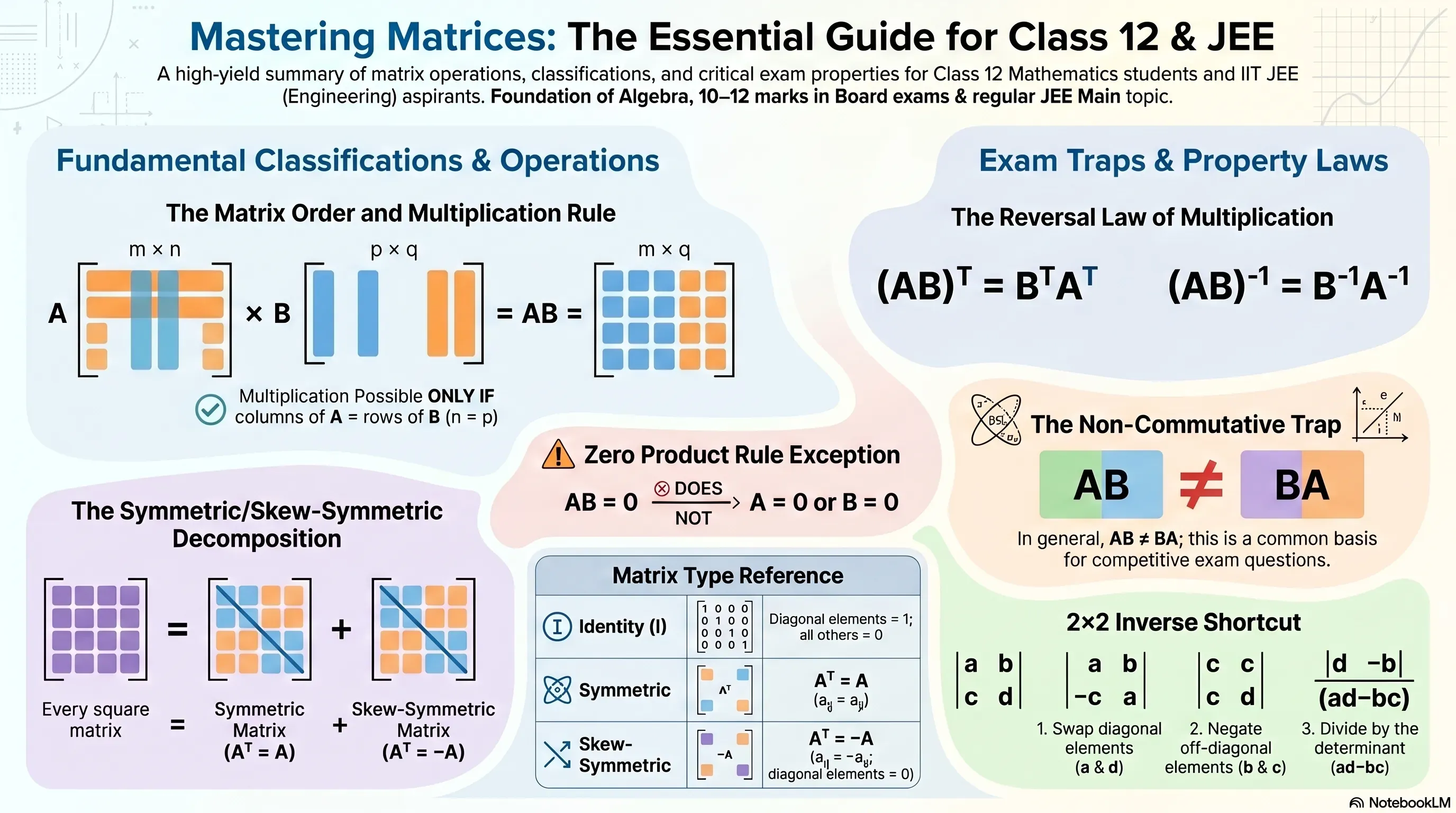
Matrices is Chapter 3 of NCERT Class 12 Mathematics, and Determinants is Chapter 4. In the CBSE theory paper, Matrices and Determinants together form the Algebra unit, which carries 10 marks out of 80. The chapter is the base for solving systems of linear equations, and it is used again in the Determinants chapter. These Matrices Notes for Class 12 follow the current CBSE 2026-27 syllabus and also cover what JEE Main needs.
Matrices Notes for Class 12: Chapter Overview and Syllabus
The CBSE 2026-27 syllabus for Matrices covers:
- Concept, notation, order and equality of matrices
- Types of matrices, zero matrix and identity matrix
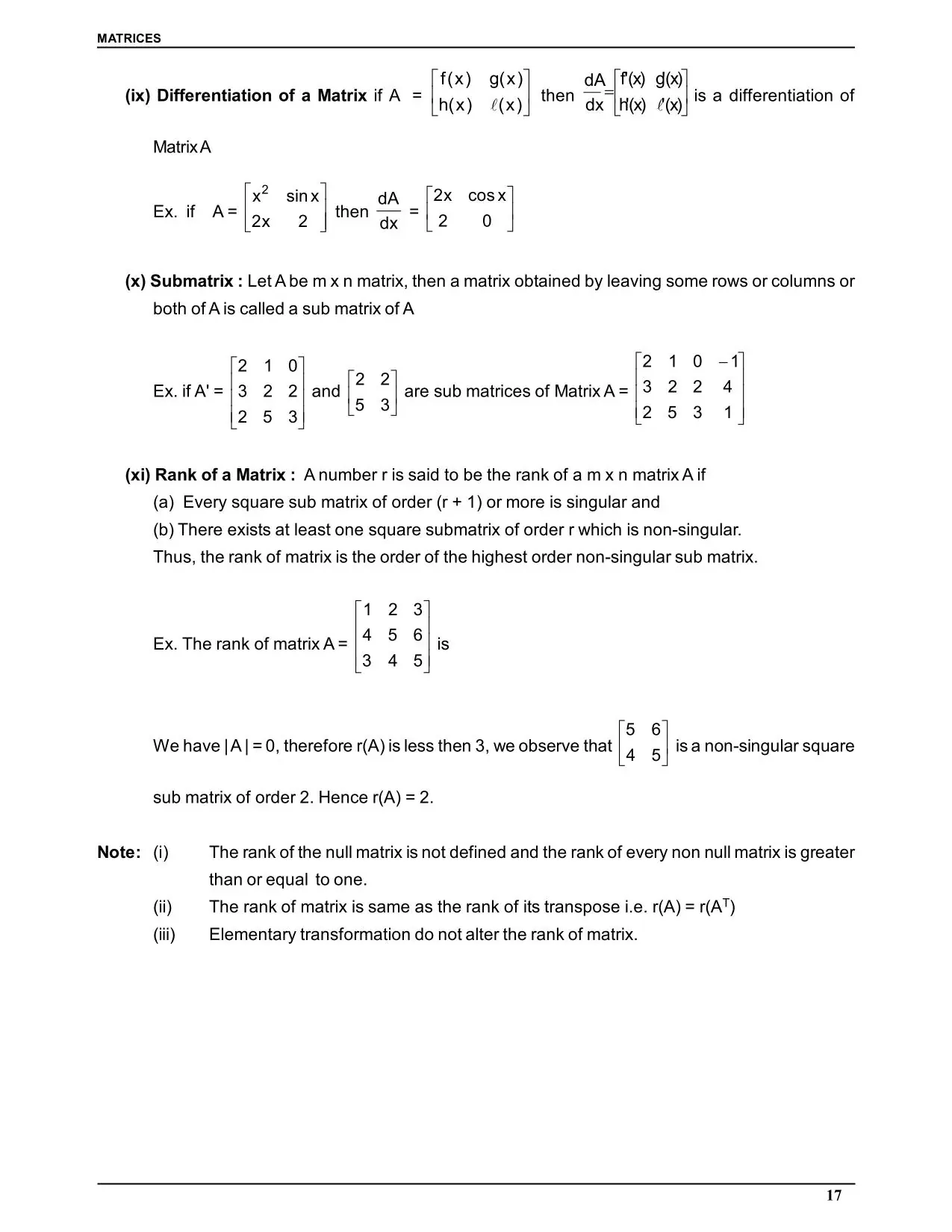
- Transpose of a matrix, symmetric and skew-symmetric matrices
- Addition, multiplication by a scalar and multiplication of matrices, and their simple properties
- Non-commutativity of matrix multiplication, and non-zero matrices whose product is the zero matrix (for square matrices of order 2)
- Invertible matrices and the uniqueness of the inverse
Syllabus note: the concept of elementary row and column operations has been deleted from the CBSE syllabus, so the method of finding an inverse by row operations is not needed for the boards. The inverse of a matrix of order 3 is found by the adjoint method in the Determinants chapter. JEE Main lists matrices of order two and three, their addition and multiplication, the adjoint and inverse, and the solution of simultaneous linear equations. Check the latest syllabi of CBSE and NTA.
💡 Expert Tip by eSaral Mathematics Faculty: Before every matrix operation, write the orders of the matrices. Most mistakes in multiplication come from forgetting that the number of columns of the first matrix must equal the number of rows of the second.
Matrices Notes for Class 12
India's Best Exam Preparation for Class 12th - Download Now
India's Best Exam Preparation for Class 12th - Download Now
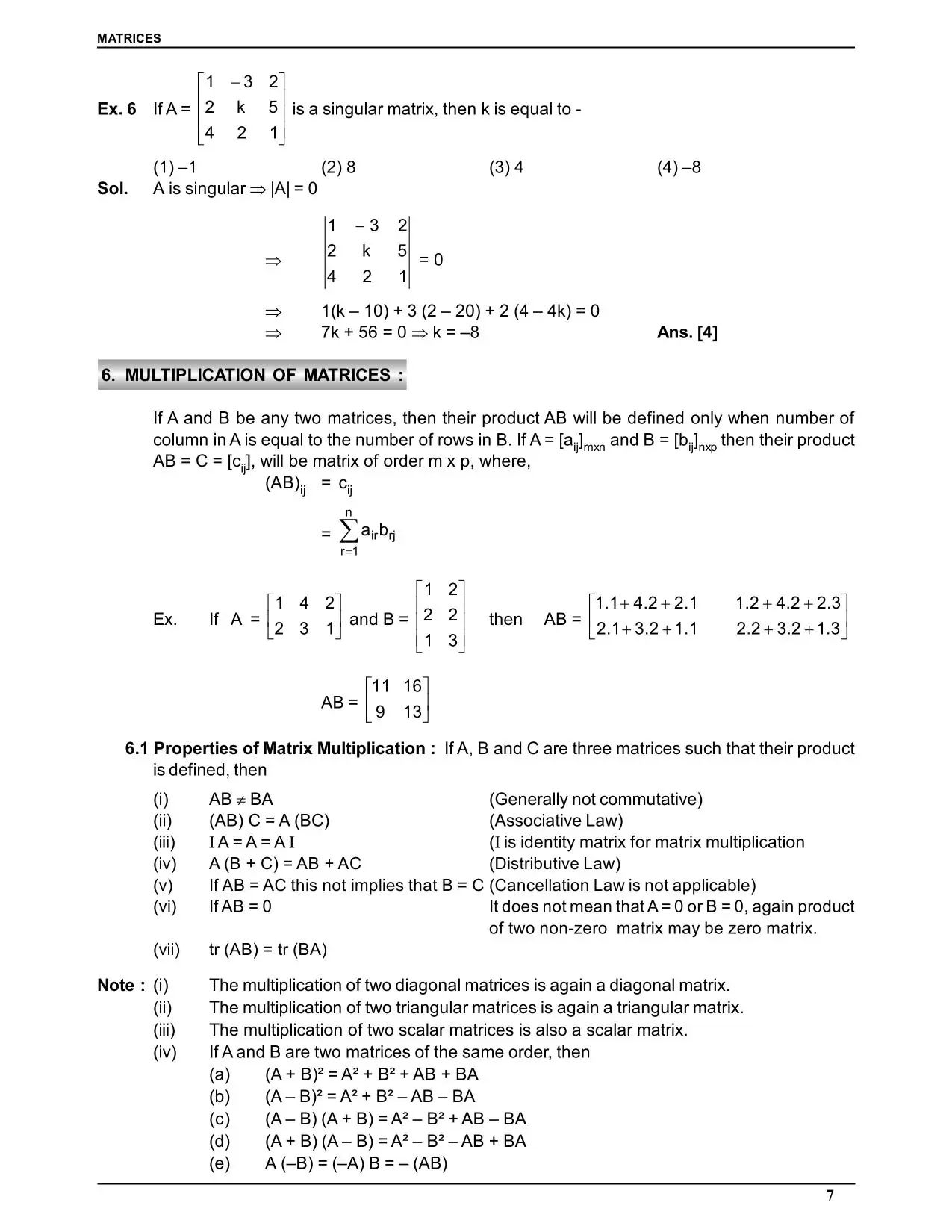
India's Best Exam Preparation for Class 12th - Download Now
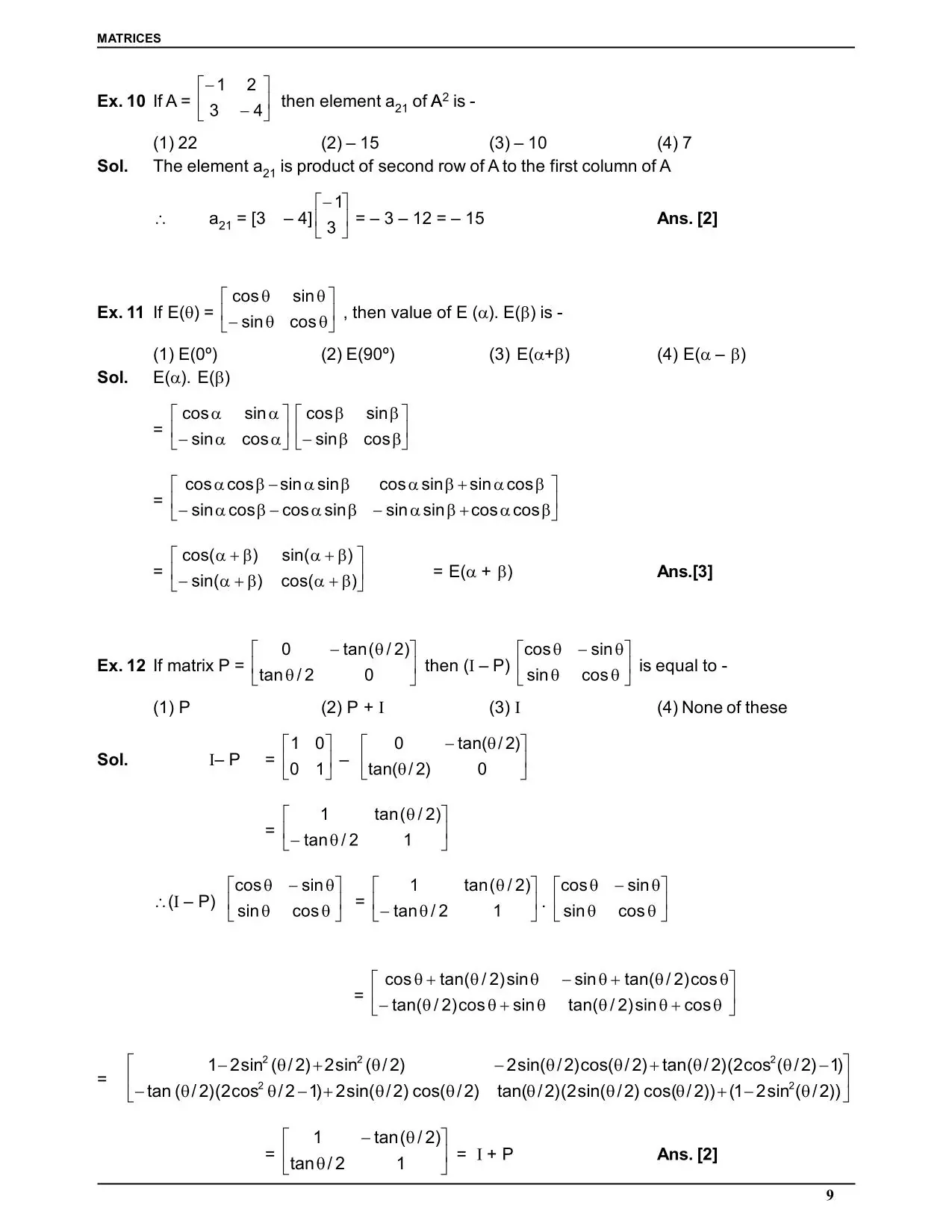
India's Best Exam Preparation for Class 12th - Download Now
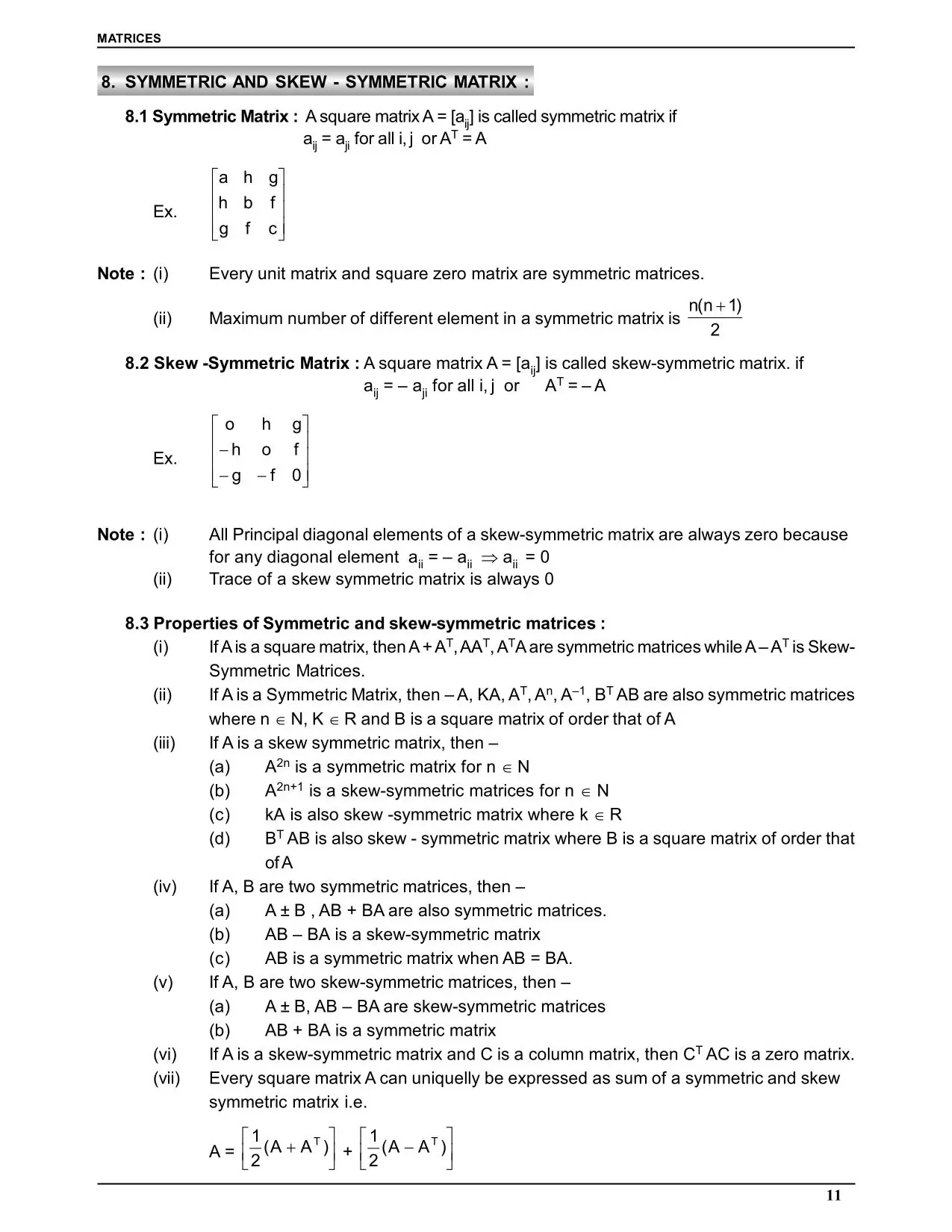
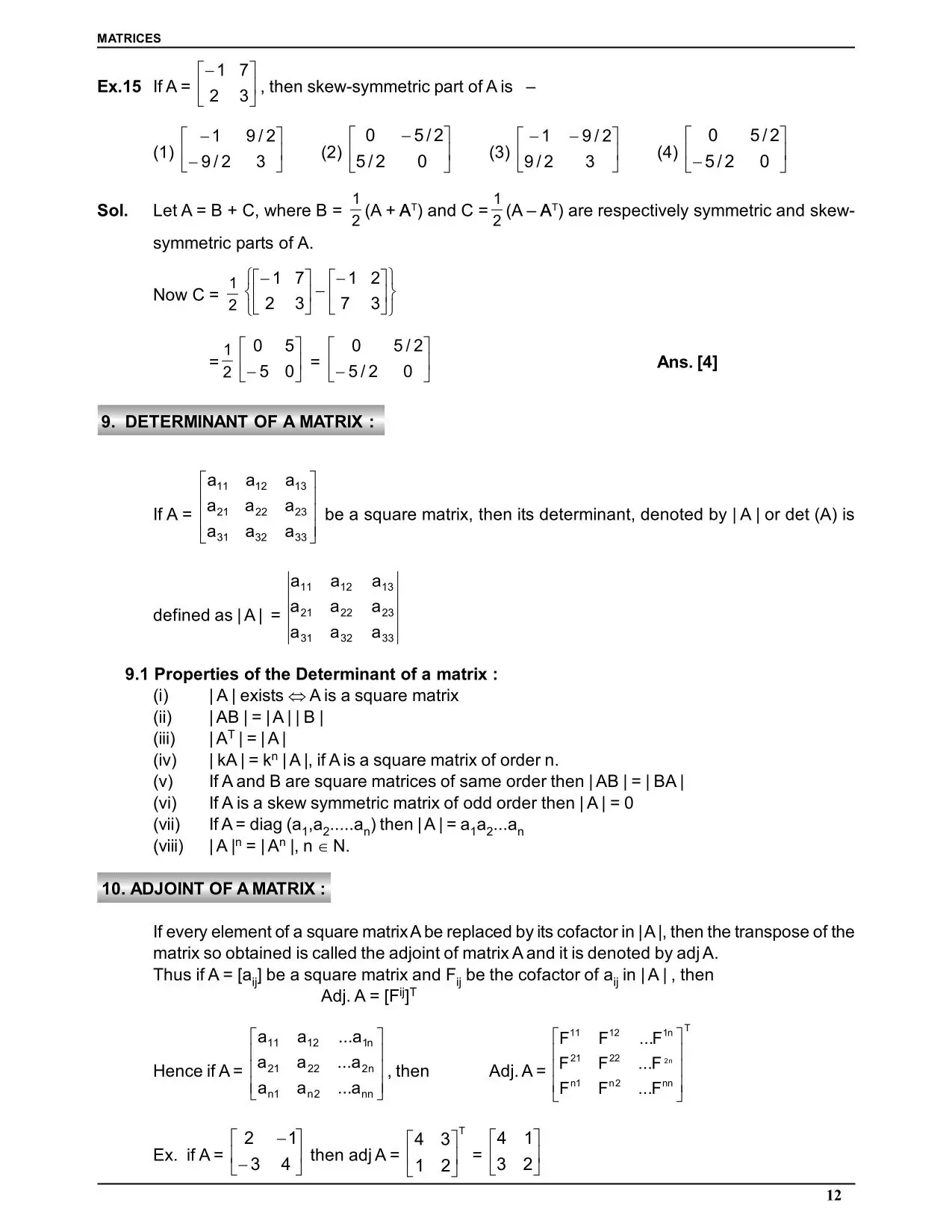
India's Best Exam Preparation for Class 12th - Download Now
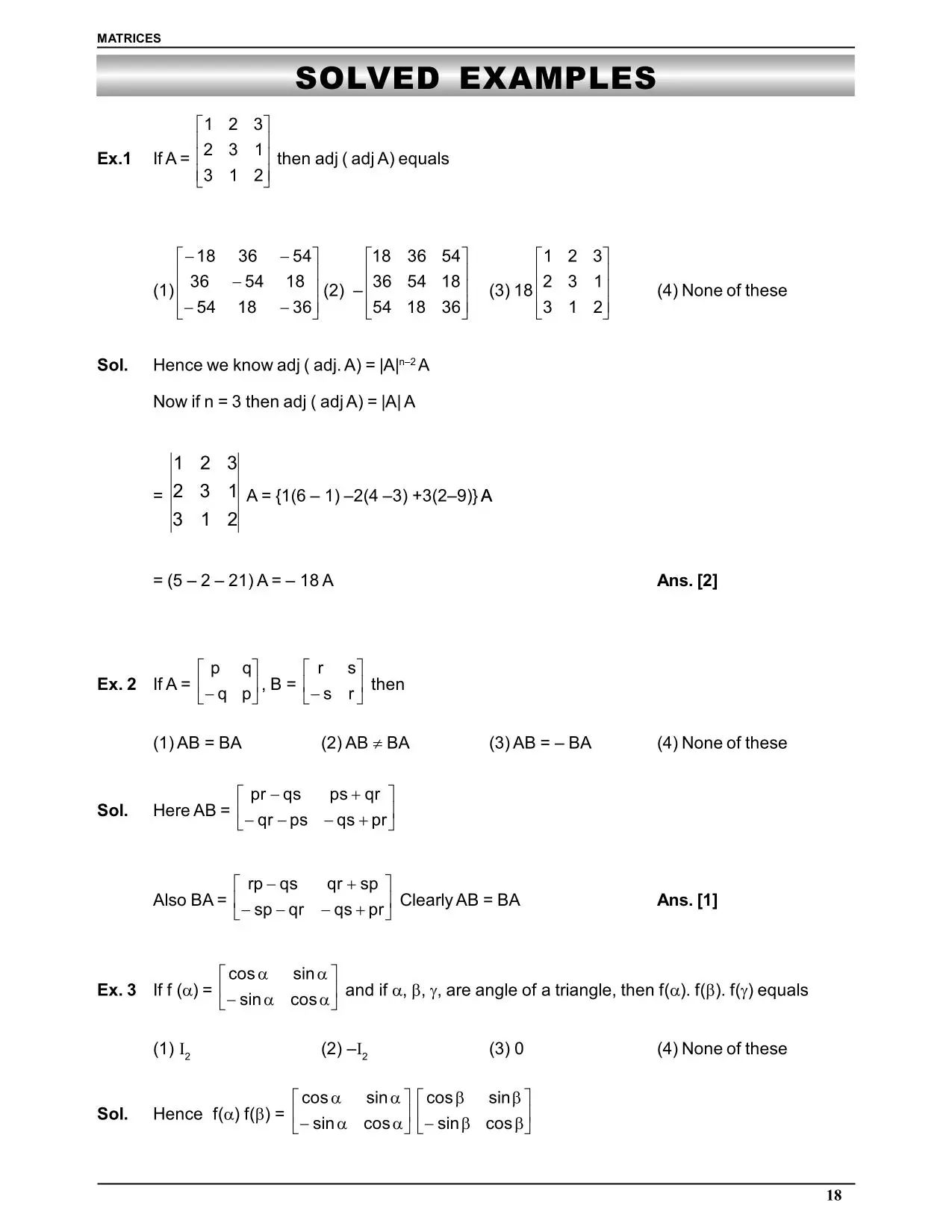
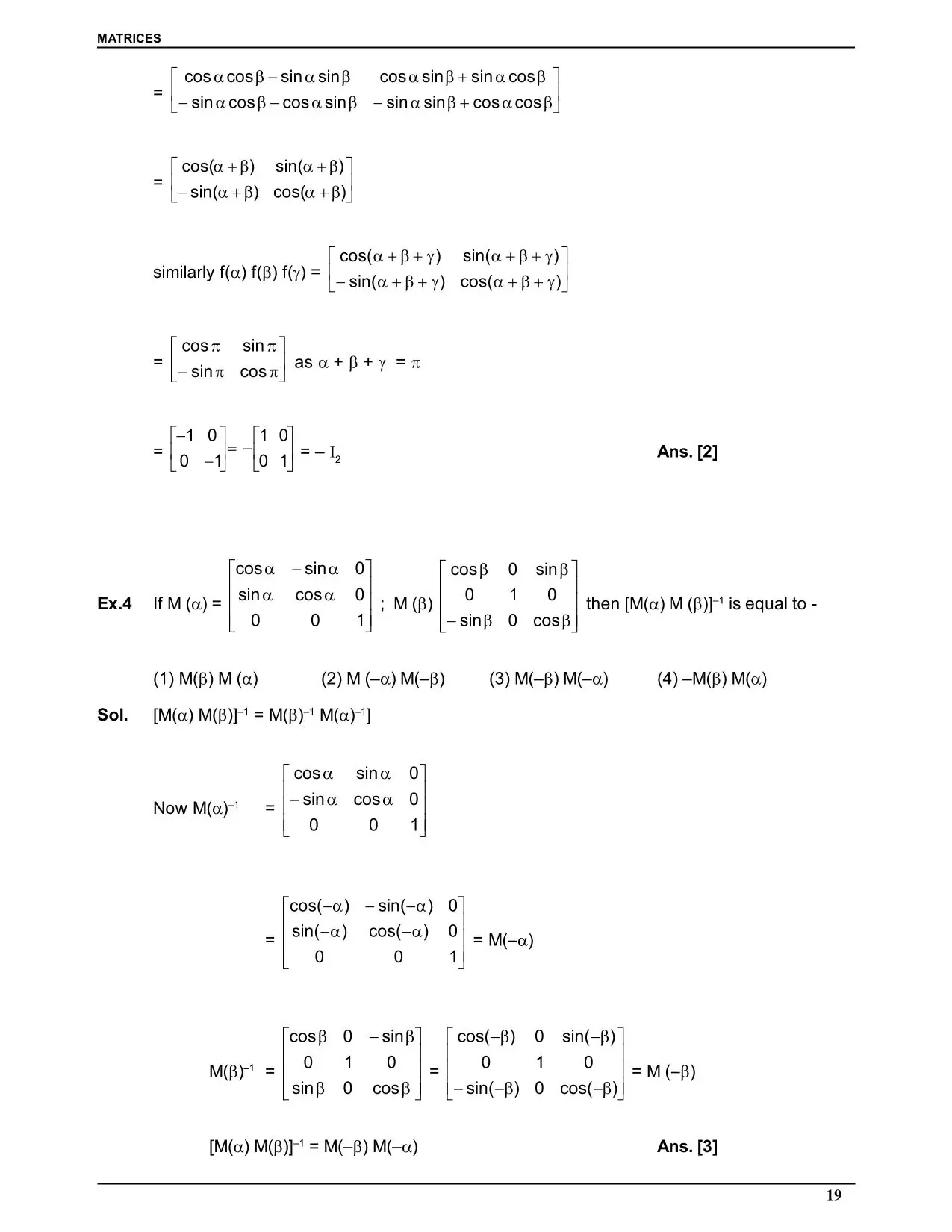
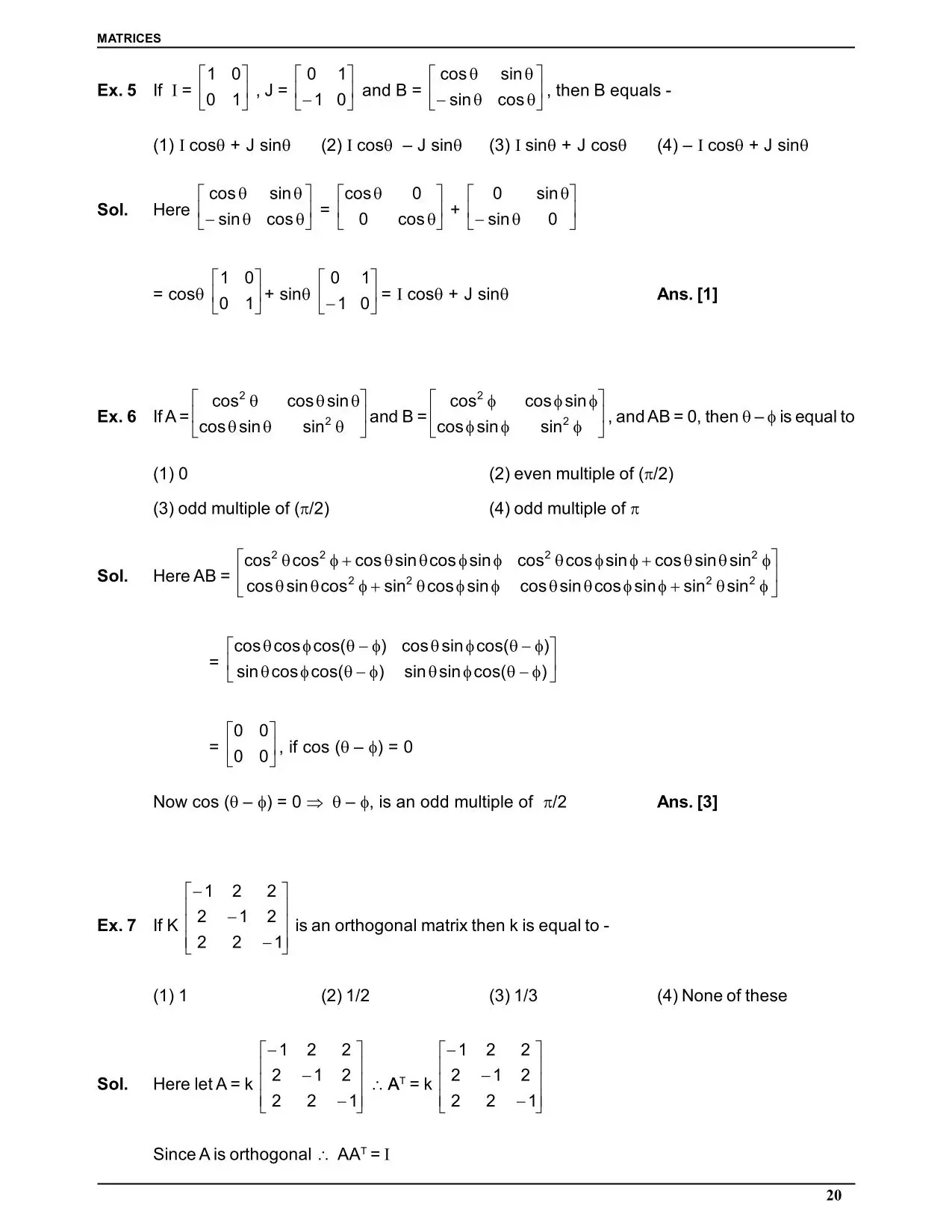
India's Best Exam Preparation for Class 12th - Download Now
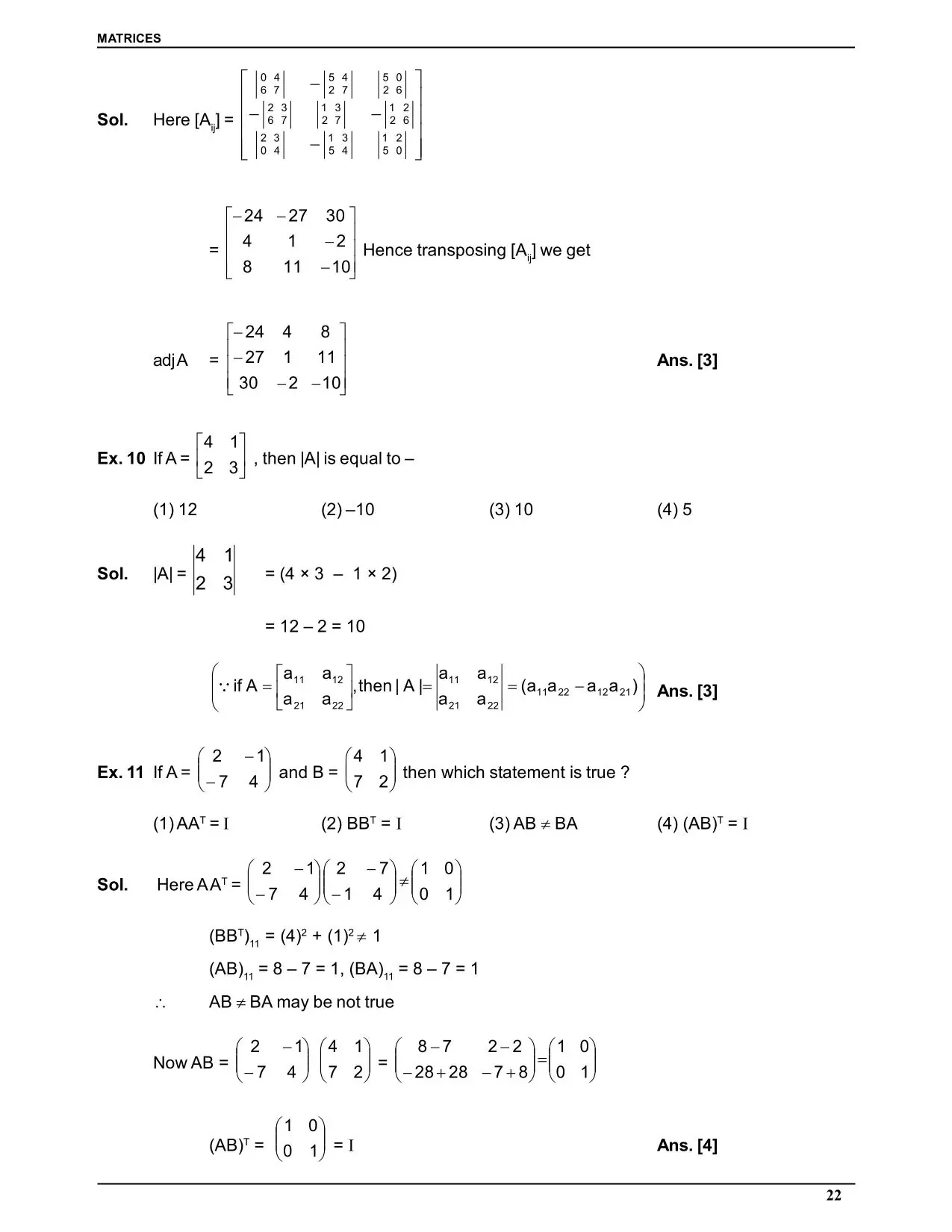
India's Best Exam Preparation for Class 12th - Download Now
What Is a Matrix? Definition, Order and Equality in Matrices Notes for Class 12
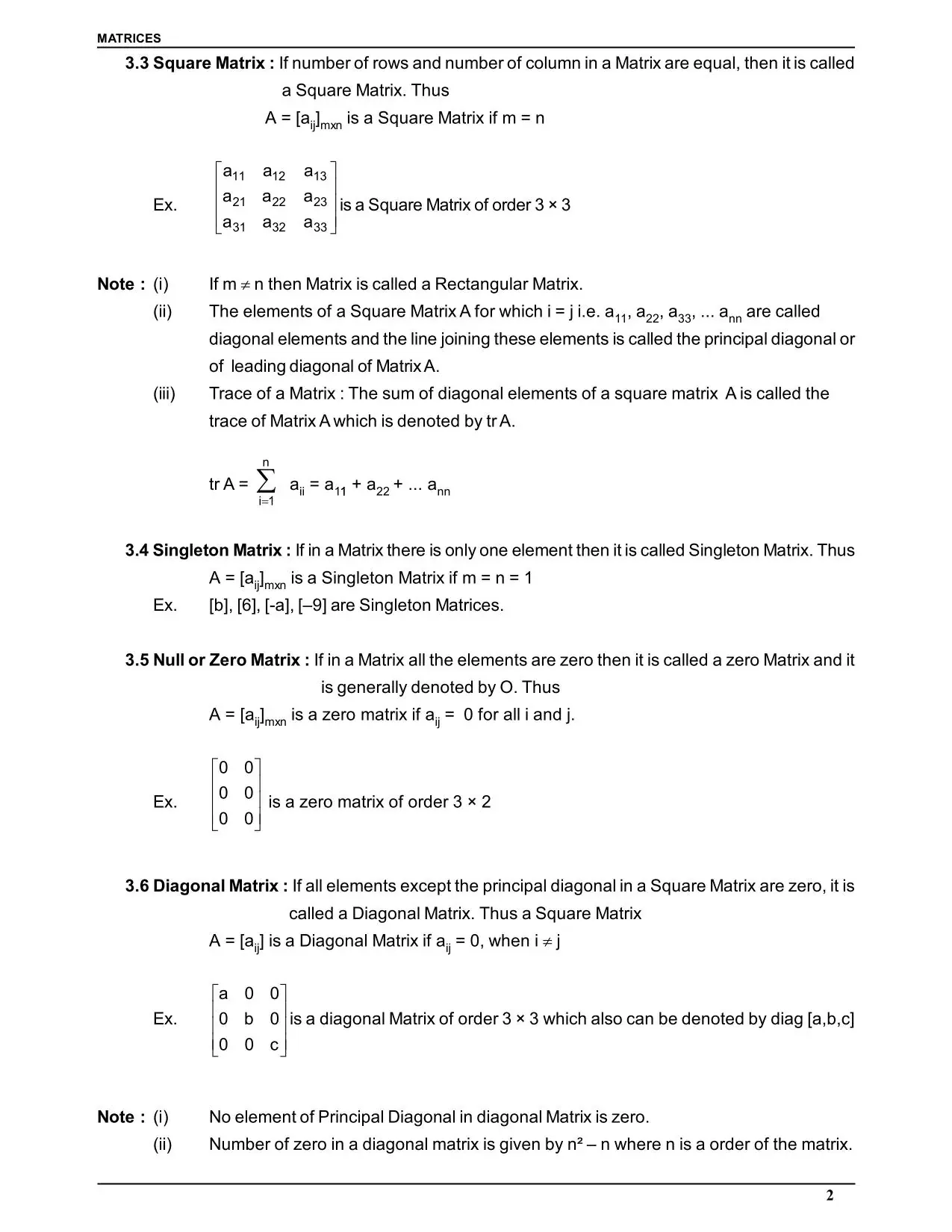
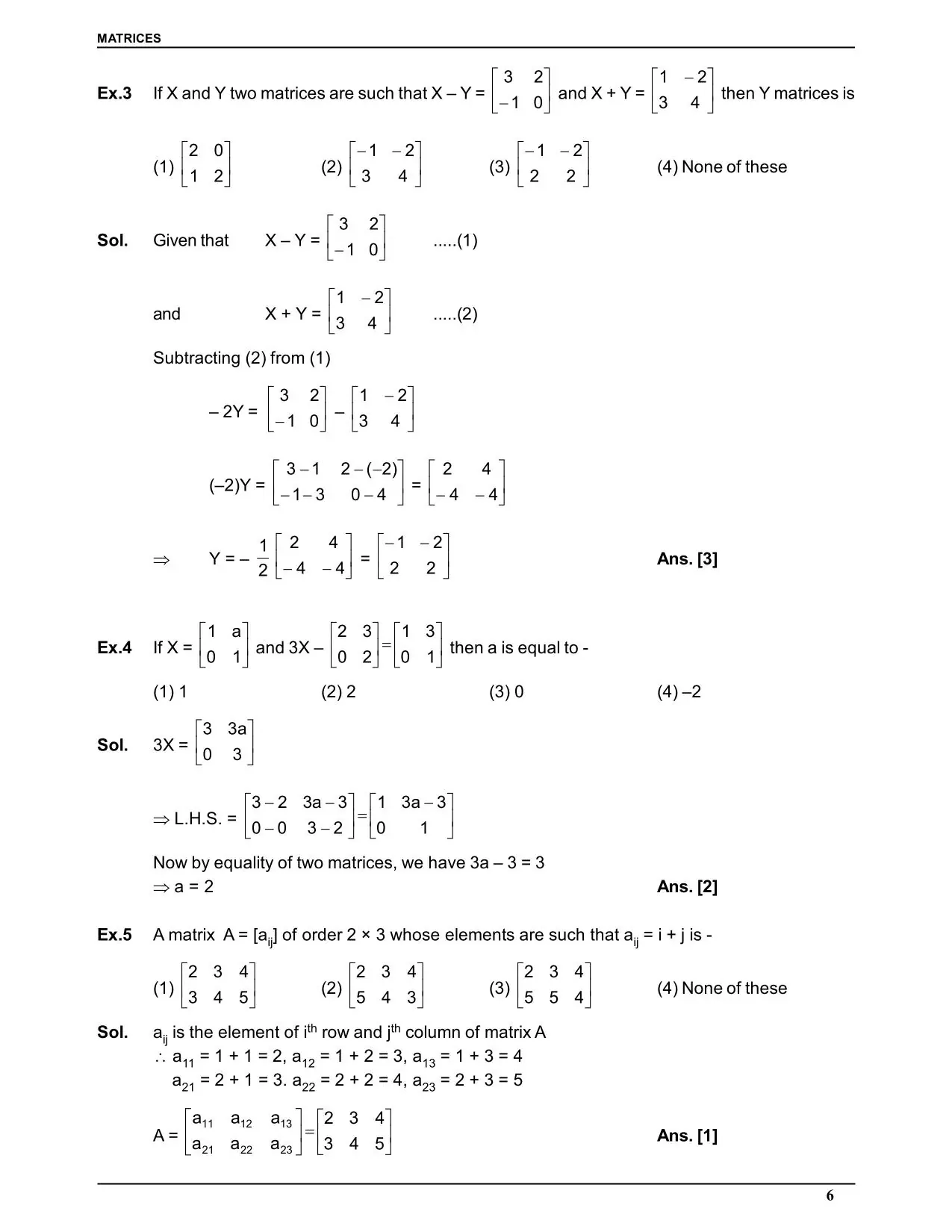
A matrix is a rectangular arrangement of numbers in rows and columns. A matrix with $m$ rows and $n$ columns has order $m \times n$, and it has $mn$ elements.
$$A = \begin{bmatrix} a_{11} & a_{12} & \cdots & a_{1n} \\ a_{21} & a_{22} & \cdots & a_{2n} \\ \vdots & \vdots & \ddots & \vdots \\ a_{m1} & a_{m2} & \cdots & a_{mn} \end{bmatrix}$$
The element in the $i$-th row and $j$-th column is written $a_{ij}$. Two matrices $A$ and $B$ are equal if they have the same order and $a_{ij} = b_{ij}$ for every $i$ and $j$.
Types of Matrices in Matrices Notes for Class 12
Type | Definition | Condition |
|---|---|---|
Row matrix | Only one row | Order $1 \times n$ |
Column matrix | Only one column | Order $m \times 1$ |
Square matrix | Rows equal columns | Order $n \times n$ |
Diagonal matrix | Square, and all non-diagonal elements are zero | $a_{ij} = 0$ for $i \neq j$ |
Scalar matrix | Diagonal matrix with equal diagonal elements | $a_{ii} = k$ |
Identity matrix $I$ | Scalar matrix with $k = 1$ | $a_{ii} = 1$, $a_{ij} = 0$ for $i \neq j$ |
Zero matrix $O$ | All elements are zero | $a_{ij} = 0$ for all $i, j$ |
Upper triangular | Elements below the main diagonal are zero | $a_{ij} = 0$ for $i > j$ |
Lower triangular | Elements above the main diagonal are zero | $a_{ij} = 0$ for $i < j$ |
Symmetric matrix | Equal to its transpose | $A^T = A$, so $a_{ij} = a_{ji}$ |
Skew-symmetric matrix | Negative of its transpose | $A^T = -A$, so $a_{ij} = -a_{ji}$ |
Operations on Matrices: Addition, Scalar Multiplication and Multiplication in Matrices Notes for Class 12
Addition and Subtraction
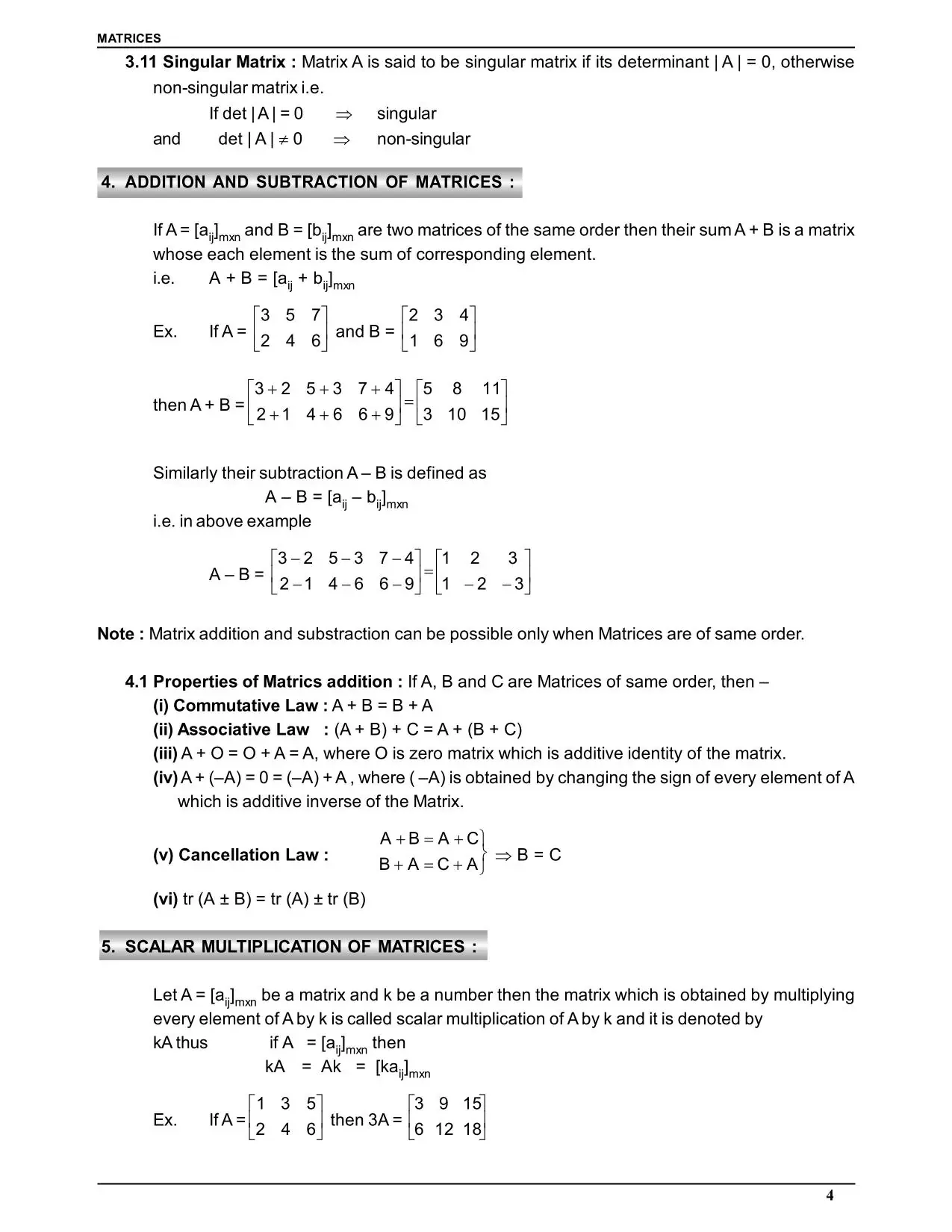
Two matrices can be added or subtracted only if they have the same order, and the operation is done element by element: $A \pm B = [a_{ij} \pm b_{ij}]$.
- Commutative: $A + B = B + A$
- Associative: $(A + B) + C = A + (B + C)$
- Identity and inverse: $A + O = A$ and $A + (-A) = O$
Multiplication by a Scalar
$kA = [k\,a_{ij}]$. The properties are $k(A + B) = kA + kB$, $(k + l)A = kA + lA$ and $k(lA) = (kl)A$.
Multiplication of Matrices
If $A$ has order $m \times n$ and $B$ has order $n \times p$, the product $AB$ exists and has order $m \times p$:
$$(AB)_{ij} = \sum_{k=1}^{n} a_{ik}\, b_{kj}$$
Property | Statement | Note |
|---|---|---|
Associative | $(AB)C = A(BC)$ | Always true |
Distributive | $A(B + C) = AB + AC$ | Always true |
Identity | $AI = IA = A$ | $I$ has the matching order |
Not commutative | $AB \neq BA$ in general | A classic trap |
Zero product | $AB = O$ does not mean $A = O$ or $B = O$ | A classic trap |
Cancellation | $AB = AC$ does not mean $B = C$ | True only if $A$ is invertible |
Non-commutativity example: for $A = \begin{bmatrix} 1 & 2 \\ 3 & 4 \end{bmatrix}$ and $B = \begin{bmatrix} 0 & 1 \\ 1 & 0 \end{bmatrix}$, $AB = \begin{bmatrix} 2 & 1 \\ 4 & 3 \end{bmatrix}$ but $BA = \begin{bmatrix} 3 & 4 \\ 1 & 2 \end{bmatrix}$.
Zero-product example: for $A = \begin{bmatrix} 0 & 1 \\ 0 & 0 \end{bmatrix}$, $A \neq O$ but $A^2 = O$.
Transpose, Symmetric and Skew-Symmetric Matrices in Matrices Notes for Class 12
The transpose $A^T$ is obtained by interchanging the rows and columns. If $A$ has order $m \times n$, then $A^T$ has order $n \times m$.
Property | Formula |
|---|---|
Double transpose | $(A^T)^T = A$ |
Sum | $(A + B)^T = A^T + B^T$ |
Scalar multiple | $(kA)^T = kA^T$ |
Product (reversal law) | $(AB)^T = B^T A^T$ |
- For a skew-symmetric matrix, all diagonal elements are zero, because $a_{ii} = -a_{ii}$.
- For any square matrix $A$, the matrix $A + A^T$ is symmetric, and $A - A^T$ is skew-symmetric.
- Every square matrix is the sum of a symmetric and a skew-symmetric matrix:
$$A = \frac{1}{2}\left(A + A^T\right) + \frac{1}{2}\left(A - A^T\right)$$
Inverse of a Matrix in Matrices Notes for Class 12
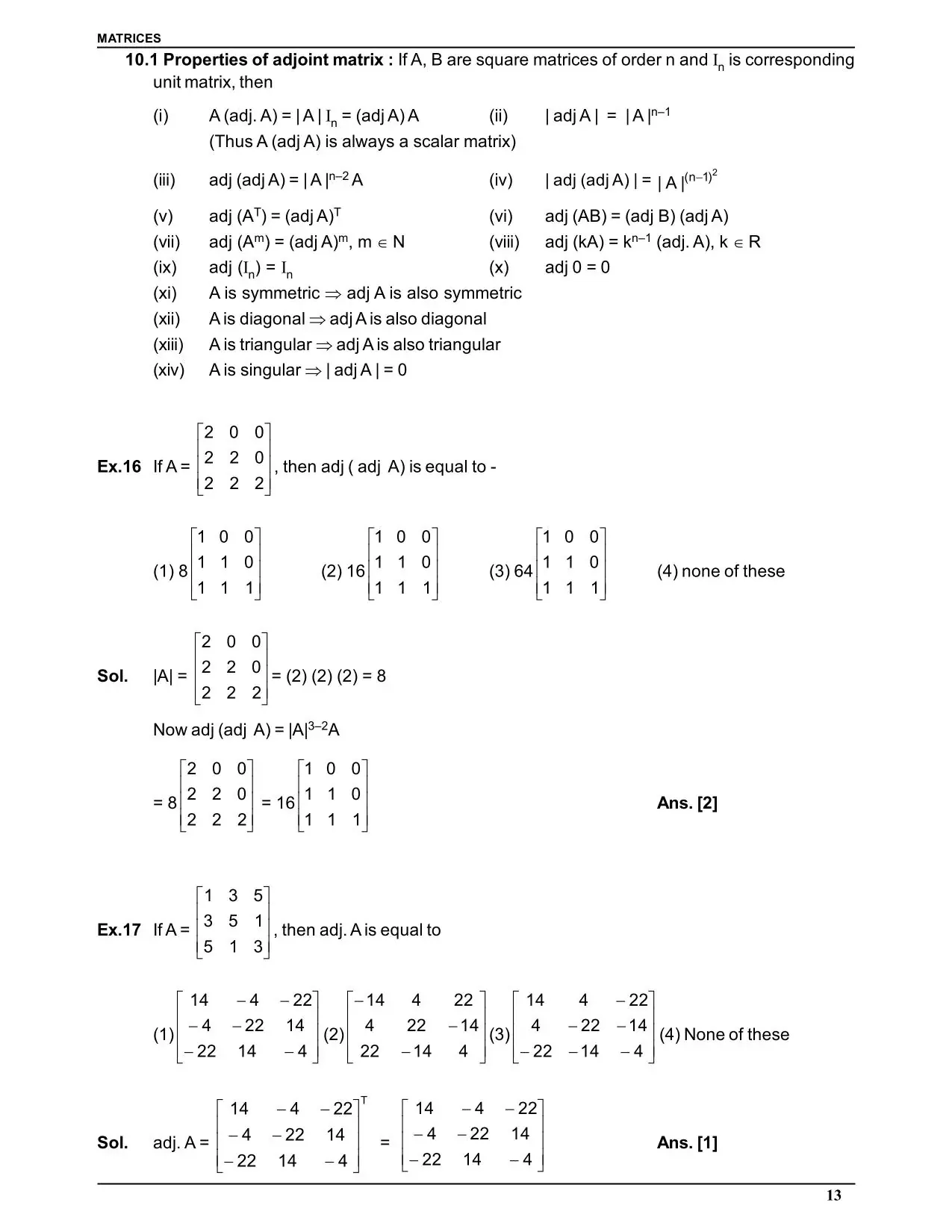
A square matrix $A$ is invertible if there is a matrix $B$ such that $AB = BA = I$. Then $B = A^{-1}$, and the inverse is unique. The inverse exists only if $\det A \neq 0$.
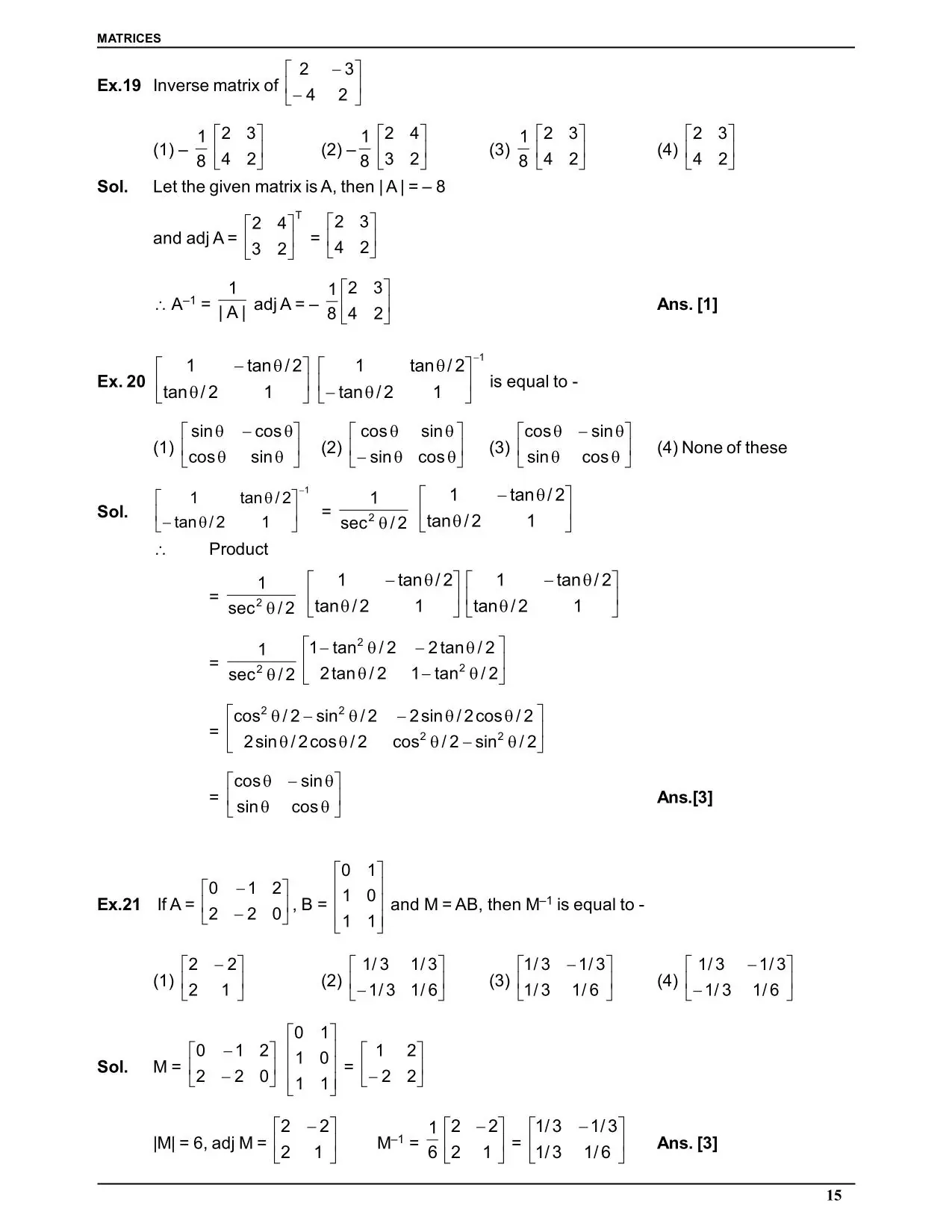
For a matrix of order 2, $A = \begin{bmatrix} a & b \\ c & d \end{bmatrix}$ with $ad - bc \neq 0$:
$$A^{-1} = \frac{1}{ad - bc}\begin{bmatrix} d & -b \\ -c & a \end{bmatrix}$$
For any invertible square matrix, the adjoint method (Chapter 4) gives:
$$A^{-1} = \frac{1}{\det A}\,\operatorname{adj}A$$
Property | Formula |
|---|---|
Inverse of the inverse | $(A^{-1})^{-1} = A$ |
Inverse of the transpose | $(A^T)^{-1} = (A^{-1})^T$ |
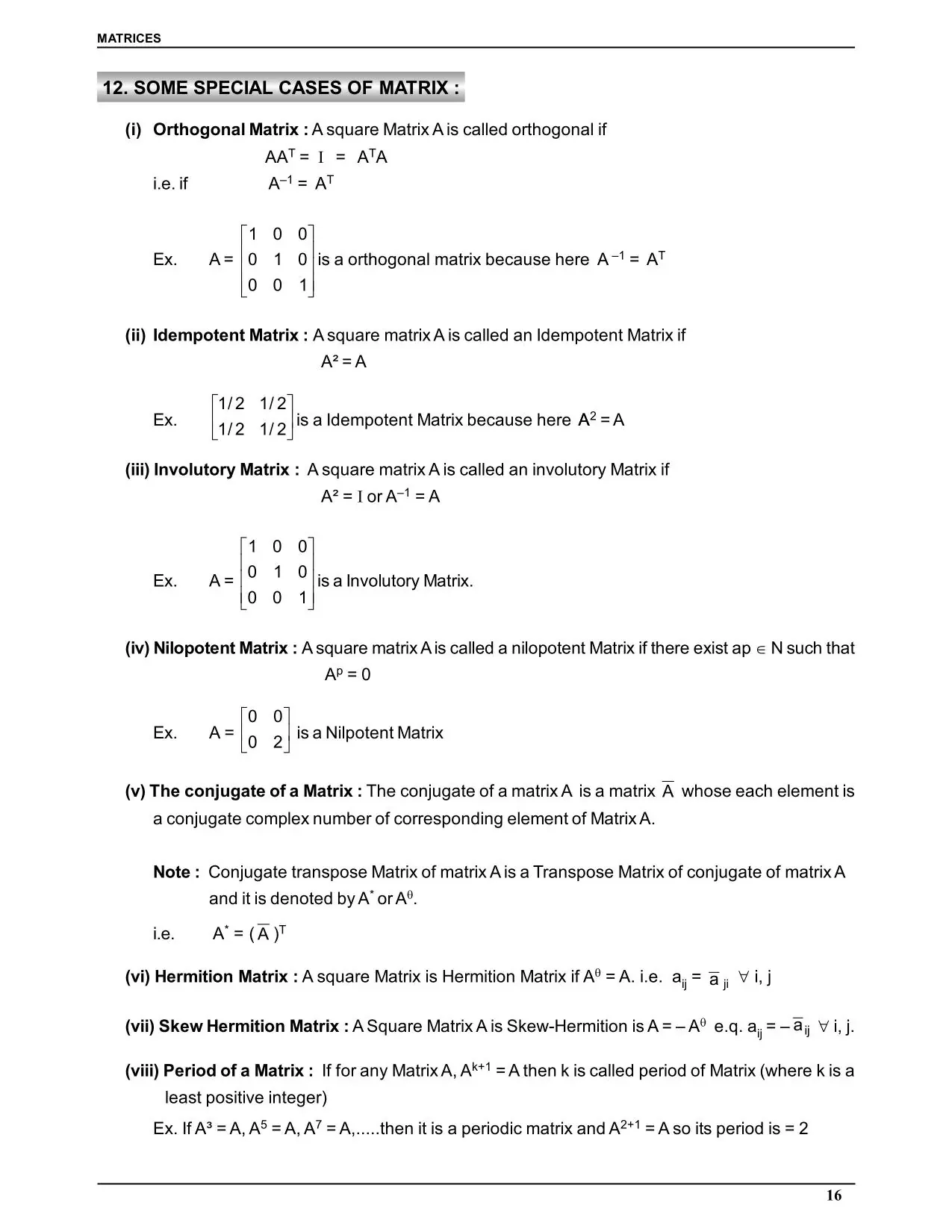
Inverse of a product (reversal law) | $(AB)^{-1} = B^{-1}A^{-1}$ |
Inverse of a scalar multiple | $(kA)^{-1} = \dfrac{1}{k}A^{-1}$, for $k \neq 0$ |
Elementary Operations: Extra Reading in Matrices Notes for Class 12
The three elementary row operations are the interchange $R_i \leftrightarrow R_j$, the scaling $R_i \to kR_i$ with $k \neq 0$, and the replacement $R_i \to R_i + kR_j$. The same operations apply to columns. These operations are not part of the CBSE 2026-27 syllabus. For reference, a matrix $A$ can be reduced as follows, and the inverse then appears on the right:
$$[A \mid I] \xrightarrow{\text{row operations}} [I \mid A^{-1}]$$
Key Formulas in Matrices Notes for Class 12
Concept | Formula |
|---|---|
Order of a product | $(m \times n)(n \times p) = m \times p$ |
Matrix product | $(AB)_{ij} = \sum_{k=1}^{n} a_{ik}\, b_{kj}$ |
Reversal law (transpose) | $(AB)^T = B^T A^T$ |
Reversal law (inverse) | $(AB)^{-1} = B^{-1}A^{-1}$ |
Symmetric and skew-symmetric parts | $A = \frac{1}{2}(A + A^T) + \frac{1}{2}(A - A^T)$ |
Inverse of order 2 | $A^{-1} = \dfrac{1}{ad - bc}\begin{bmatrix} d & -b \\ -c & a \end{bmatrix}$ |
Inverse by the adjoint | $A^{-1} = \dfrac{\operatorname{adj}A}{\det A}$ |
Condition for invertibility | $\det A \neq 0$ |
Solved Examples from Matrices Notes for Class 12
Example 1 (order of a product): If $A$ has order $2 \times 3$ and $B$ has order $3 \times 4$, find the order of $AB$.
The number of columns of $A$ (3) equals the number of rows of $B$ (3), so $AB$ exists and has order $2 \times 4$.
Example 2 (multiplication): Find $AB$ for $A = \begin{bmatrix} 1 & 2 \\ 3 & 4 \end{bmatrix}$ and $B = \begin{bmatrix} 2 & 0 \\ 1 & 3 \end{bmatrix}$.
$$AB = \begin{bmatrix} 1\cdot 2 + 2\cdot 1 & 1\cdot 0 + 2\cdot 3 \\ 3\cdot 2 + 4\cdot 1 & 3\cdot 0 + 4\cdot 3 \end{bmatrix} = \begin{bmatrix} 4 & 6 \\ 10 & 12 \end{bmatrix}$$
Example 3 (symmetric and skew-symmetric parts): Express $A = \begin{bmatrix} 1 & 5 \\ 3 & 2 \end{bmatrix}$ as the sum of a symmetric and a skew-symmetric matrix.
$A^T = \begin{bmatrix} 1 & 3 \\ 5 & 2 \end{bmatrix}$. The symmetric part is $P = \frac{1}{2}(A + A^T) = \begin{bmatrix} 1 & 4 \\ 4 & 2 \end{bmatrix}$, and the skew-symmetric part is $Q = \frac{1}{2}(A - A^T) = \begin{bmatrix} 0 & 1 \\ -1 & 0 \end{bmatrix}$. Check: $P + Q = \begin{bmatrix} 1 & 5 \\ 3 & 2 \end{bmatrix} = A$.
Example 4 (inverse of order 2): Find $A^{-1}$ for $A = \begin{bmatrix} 2 & 1 \\ 5 & 3 \end{bmatrix}$.
$\det A = 2\cdot 3 - 1\cdot 5 = 1$, so $A^{-1} = \begin{bmatrix} 3 & -1 \\ -5 & 2 \end{bmatrix}$.
Example 5 (non-invertible matrix): Find $k$ for which $A = \begin{bmatrix} k & 2 \\ 3 & 6 \end{bmatrix}$ has no inverse.
$A$ is not invertible when $\det A = 6k - 6 = 0$, so $k = 1$.
Example 6 (reversal law): If $A$ and $B$ are invertible of the same order, show that $(AB)^{-1} = B^{-1}A^{-1}$.
$(AB)(B^{-1}A^{-1}) = A(BB^{-1})A^{-1} = AIA^{-1} = AA^{-1} = I$. By the uniqueness of the inverse, $(AB)^{-1} = B^{-1}A^{-1}$.
Common Mistakes in Matrices Notes for Class 12 Problems
Mistake | Correct approach |
|---|---|
Multiplying matrices of incompatible orders | Check that the columns of $A$ equal the rows of $B$ |
Assuming $AB = BA$ | Matrix multiplication is not commutative |
Concluding $A = O$ or $B = O$ from $AB = O$ | A product of non-zero matrices can be zero |
Writing $(AB)^T = A^T B^T$ | The correct law is $(AB)^T = B^T A^T$ |
Writing $(AB)^{-1} = A^{-1}B^{-1}$ | The correct law is $(AB)^{-1} = B^{-1}A^{-1}$ |
Forgetting that diagonal elements of a skew-symmetric matrix are zero | Use $a_{ii} = -a_{ii}$, which gives $a_{ii} = 0$ |
How to Study Matrices Notes for Class 12
- Learn the types of matrices with one example of each, and practise writing the order before every operation.
- Practise multiplication of matrices of order 2 and 3 until it is fast and accurate.
- Solve all the exercises of Chapter 3 with eSaral’s NCERT Solutions for Class 12 Maths Chapter 3. Download the textbook from eSaral’s NCERT Class 12 Maths book page.
- Learn the inverse by the adjoint method with the Determinants chapter, and revise all the chapters with eSaral’s Class 12 Maths notes.
Frequently Asked Questions
What are the important topics in Matrices Notes for Class 12 for CBSE and JEE?
The important topics are the types of matrices, multiplication of matrices and its properties (non-commutativity and the zero product), the transpose and its reversal law, symmetric and skew-symmetric matrices with the decomposition $A = \frac{1}{2}(A + A^T) + \frac{1}{2}(A - A^T)$, and the inverse of a matrix. eSaral’s Matrices Notes for Class 12 cover each of these with examples.
What are the key formulas in Matrices Class 12?
The key formulas are $(AB)^T = B^T A^T$, $(AB)^{-1} = B^{-1}A^{-1}$, $A^{-1} = \dfrac{1}{ad - bc}\begin{bmatrix} d & -b \\ -c & a \end{bmatrix}$ for a matrix of order 2, $A^{-1} = \dfrac{\operatorname{adj}A}{\det A}$ and $A = \frac{1}{2}(A + A^T) + \frac{1}{2}(A - A^T)$. They are collected in the key formulas table of these Matrices Notes for Class 12.
When does a matrix not have an inverse?
A square matrix has no inverse when its determinant is zero. Such a matrix is called singular. For a matrix of order 2, $A = \begin{bmatrix} a & b \\ c & d \end{bmatrix}$, the inverse does not exist when $ad - bc = 0$.
What is the difference between a symmetric and a skew-symmetric matrix?
A symmetric matrix satisfies $A^T = A$, so $a_{ij} = a_{ji}$. A skew-symmetric matrix satisfies $A^T = -A$, so $a_{ij} = -a_{ji}$, and all its diagonal elements are zero. Every square matrix can be written as the sum of a symmetric and a skew-symmetric matrix.
Why is matrix multiplication not commutative?
The product $AB$ combines the rows of $A$ with the columns of $B$, while $BA$ combines the rows of $B$ with the columns of $A$. Even when both products exist, the results can differ, as in the example on this page where $AB \neq BA$. In Matrices Notes for Class 12, this is one of the most common trap questions.
How many marks does Matrices carry in CBSE Class 12 boards?
Matrices and Determinants together form the Algebra unit, which carries 10 marks out of 80 in the CBSE Class 12 Mathematics paper. The marks for each chapter are not published separately, so check the latest CBSE sample paper for the pattern.
Is the inverse by elementary row operations in the Class 12 syllabus?
No. The concept of elementary row and column operations has been deleted from the CBSE 2026-27 syllabus. The inverse of a matrix is found by the adjoint method, $A^{-1} = \dfrac{\operatorname{adj}A}{\det A}$, which is covered with Determinants. Check the NTA syllabus for JEE Main.
Which chapter number is Matrices in Class 12 Maths?
In the NCERT Class 12 Mathematics book, Matrices is Chapter 3, and Determinants is Chapter 4. These Matrices Notes for Class 12 follow the NCERT chapter order.
Where can I find more Class 12 Maths notes on eSaral?
eSaral has chapter-wise Class 12 Maths notes, NCERT solutions and the NCERT book, linked with these Matrices Notes for Class 12 on this page, so you can study the chapter and revise it in one place.
Team eSaral
eSaral Academic and Editorial Team
Team eSaral is the collective author profile for educational content created by eSaral’s teachers and academic contributors. The team draws on expertise from IIT graduates, doctors, experienced educators and subject specialists to develop resources for JEE, NEET and school students. Our articles aim to explain concepts clearly and help students study with confidence.
Related Posts

BITSAT 2027: Registration Date, Exam Date, Syllabus, Eligibility, Pattern & Fees
BITSAT 2027 exam dates, registration timeline, eligibility criteria, exam pattern, marking scheme, syllabus and fees in one page.

BITSAT Previous Year Question Paper PDF (2017-2026)
Download BITSAT previous year question papers PDF from 2017 to 2026,session-wise. Memory-based papers,exam pattern, paper analysis and how to practise

CBSE Class 10 Date Sheet 2027: Expected Exam Dates, Release Date, Admit Card & Result Timeline
CBSE Class 10 date sheet 2027 is awaited. See the expected exam dates, release window, how to download the PDF, admit card and result timelines.

NCERT Physics Class 10 Book PDF in Hindi 2026-27 – भौतिक विज्ञान के 4 अध्याय (Free Download)
NCERT Physics Class 10 book PDF in Hindi 2026-27: download all 4 chapters (अध्याय 9–12) free, with topics and important formulas.

NCERT Biology Class 9 Book Anveshan PDF in Hindi - जीव विज्ञान कक्षा 9 पुस्तक अन्वेषण PDF
Download NCERT Biology Class 9 book PDF in Hindi chapterwise for 2026-27: Cell, Tissues, Reproduction and Diversity. Free PDFs.

Essay On Artificial Intelligence in English (100,150, 200, 250, 300, 500 Words)
This is in contrast to the natural intelligence of humans. With Artificial Intelligence, machines can perform

Essay on 78th India Independence Day in English for Student (100, 150, 200, 250, 300, 500 Words)
Read the best essays on India's Independence Day in English. Short & long essays (100, 150, 200, 250, 300, 500 words) perfect for school exams
NCERT Class 11 English Snapshots book - Free PDF download- Esaral
Download NCERT Class 11 English Snapshots book PDF for free. Get all 8 chapters, chapter-wise. Start your prep today!
NCERT Class 10 biology book pdf - Free PDF Download - eSaral
NCERT Class 10 Biology book PDF 2026-27: all 5 chapters (Life Processes to Our Environment) in English & Hindi, with CBSE syllabus, marks & practical

Essay on Global Warming in English (100,150, 200, 250, 300, 500 Words)
Global warming means the Earth is getting hotter. This happens because of things like pollution from cars and factories.