
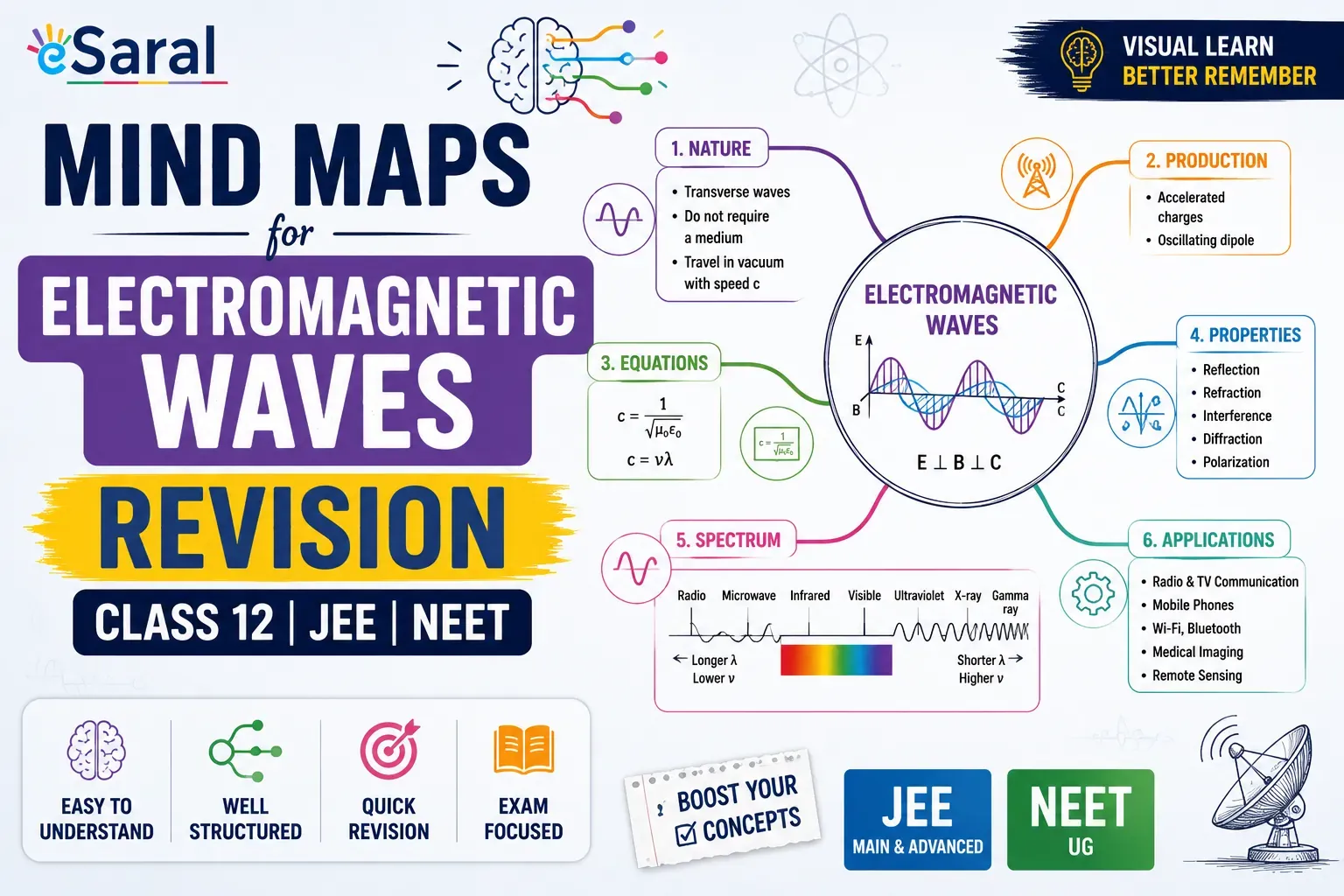
Mind Maps for Electromagnetic Waves Revision - Class 12, JEE, NEET
Home » Mind Maps » Electromagnetic Waves Mind Map

Get to learn all the formulae and important points of Electromagnetic Waves through this mind map. Download and share with your friends also.
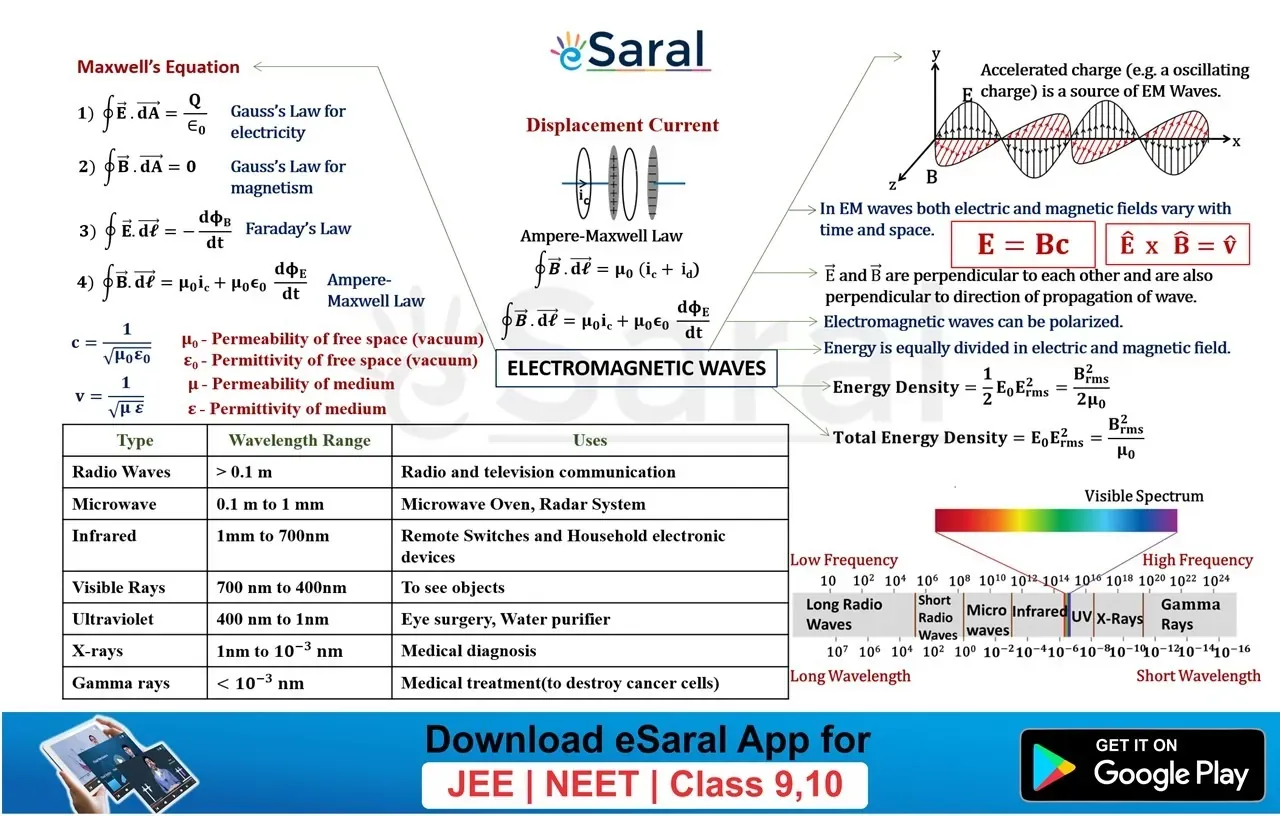
EM Spectrum: Complete Table for Revision
EM Wave Type | Frequency Range | Wavelength Range | Key Sources | Common Applications |
|---|---|---|---|---|
Radio Waves | < $10^9$ Hz | > 0.1 m | LC oscillators, antennas | AM/FM radio, TV broadcasts |
Microwaves | $10^9$ – $10^{12}$ Hz | 0.1 mm – 0.1 m | Klystron, magnetron tubes | Radar, microwave ovens, satellite communication |
Infrared (IR) | $10^{12}$ – $4\times10^{14}$ Hz | 700 nm – 0.1 mm | Hot objects, IR LEDs | Thermal imaging, remote controls, heating |
Visible Light | $4\times10^{14}$ – $7\times10^{14}$ Hz | 400 nm – 700 nm | Sun, lamps, LEDs | Vision, photography, optical fibre |
Ultraviolet (UV) | $7\times10^{14}$ – $10^{17}$ Hz | 10 nm – 400 nm | Sun, mercury lamps | Sterilisation, LASIK surgery, forensic analysis |
X-Rays | $10^{17}$ – $10^{19}$ Hz | 0.01 nm – 10 nm | X-ray tubes, synchrotrons | Medical imaging, crystallography |
Gamma Rays | > $10^{19}$ Hz | < 0.01 nm | Radioactive nuclei | Cancer radiotherapy, sterilisation |
Memory Trick for the Spectrum Order
To remember the electromagnetic spectrum from low to high frequency, use this mnemonic:
Running Miles In Very Unusual X-tra Gear
Radio → Microwaves → Infrared → Visible → Ultraviolet → X-Rays → Gamma Rays
What Property Is Common to All EM Waves?
All electromagnetic waves, regardless of type, travel at the speed of light in vacuum ($c = 3\times10^8\ \text{m/s}$), carry no electric charge, and do not require any material medium for propagation. They transfer both energy and momentum.
Key Formulae You Must Know for JEE & NEET
Core Equations
Formula | Symbol Meaning | Context |
|---|---|---|
$c=\frac{1}{\sqrt{\mu_0\varepsilon_0}}$ | $c$ = speed of light, $\mu_0$ = permeability of free space, $\varepsilon_0$ = permittivity of free space | Speed of electromagnetic waves in vacuum |
$c=\frac{E_0}{B_0}$ | $E_0$ = electric field amplitude, $B_0$ = magnetic field amplitude | Ratio of electric and magnetic field amplitudes |
$u=\frac{1}{2}\varepsilon_0E^2+\frac{B^2}{2\mu_0}$ | $u$ = energy density | Energy stored in an electromagnetic wave |
$I=u_{\text{avg}}c$ | $I$ = intensity | Average intensity of an electromagnetic wave |
$p=\frac{U}{c}$ | $p$ = momentum, $U$ = energy | Momentum carried by an electromagnetic wave |
$I_d=\varepsilon_0\frac{d\Phi_E}{dt}$ | $I_d$ = displacement current | Modified Ampere's Law |
Which Formula Appears Most in JEE Main?
The relationships $c=\frac{E_0}{B_0}$ and $p=\frac{U}{c}$ are among the most frequently tested formulas from Electromagnetic Waves in JEE Main. Numerical questions often provide the intensity or electric field amplitude and ask you to calculate radiation pressure or momentum transfer.
Expert Tip: Most students lose marks on radiation pressure questions because they confuse the formula for absorbing surfaces, $P=\frac{I}{c}$, with the formula for perfectly reflecting surfaces, $P=\frac{2I}{c}$. This distinction appears regularly in JEE Main. Make a separate note of both formulas while revising your mind map.
Frequently Asked Questions
Which electromagnetic wave has the highest frequency?
Gamma rays have the highest frequency (greater than 10¹⁹ Hz) and therefore the shortest wavelength (less than 0.01 nm) in the EM spectrum. They carry the most energy per photon (E = hf) and are produced by nuclear transitions in radioactive atoms. In NEET, gamma rays are also tested in the context of nuclear medicine and cancer radiotherapy.
What is the speed of electromagnetic waves in vacuum?
All electromagnetic waves travel at c = 3 × 10⁸ m/s in vacuum, regardless of their frequency or wavelength. This value is derived from c = 1/√(μ₀ε₀), where μ₀ = 4π × 10⁻⁷ T·m/A and ε₀ = 8.85 × 10⁻¹² C²/N·m². In a medium, the speed reduces to v = c/n, where n is the refractive index.
What is the most important topic in Electromagnetic Waves for JEE Main?
Displacement current is the most frequently tested concept in JEE Main from this chapter. It appears as both a conceptual question (why Maxwell introduced it) and a numerical question (calculating I_d from changing electric flux). After displacement current, radiation pressure and the EM spectrum application matching are the next most important areas
What is displacement current and why did Maxwell introduce it?
Displacement current (I_d = ε₀ × dΦ_E/dt) was introduced by Maxwell to remove an inconsistency in Ampere's circuital law. The original Ampere's law failed when applied to a surface passing between the plates of a charging capacitor — no conduction current crosses that surface, yet a magnetic field clearly exists there. Displacement current accounts for this and completes the symmetry between electric and magnetic fields.
Can I download the Electromagnetic Waves mind map as a PDF?
Yes. The eSaral Electromagnetic Waves mind map is available as a free PDF download directly on this page. Click the Download button above to save it to your device. You can also access all physics mind maps through the eSaral app, where Kota-quality faculty including IIT Bombay AIR-41 have created visual revision sheets for every Class 12 Physics chapter.
Is Electromagnetic Waves important for NEET?
Yes, Electromagnetic Waves is part of the NEET Physics syllabus and typically contributes 1 question per paper. NEET focuses more on the qualitative side — identifying wave types from their uses, understanding the ozone layer's role in blocking UV, and knowing which EM waves are used in medical imaging. A mind map revision is sufficient for NEET coverage of this chapter.