
Mind Maps For Permutation And Combination - Class 11, JEE (Main + Advanced)

eSaral Academic and Editorial Team
Summary
Mind maps for Permutation and Combination (Class 11) are single-page visual summaries covering all key formulas — nPr, nCr, circular permutations, restrictions, and selections — exactly as tested in JEE Main and JEE Advanced. Three downloadable mind maps are available free on eSaral, created by IIT Bombay faculty.
Home » Mind Maps » Mind Maps for Permutation and Combination Class 11

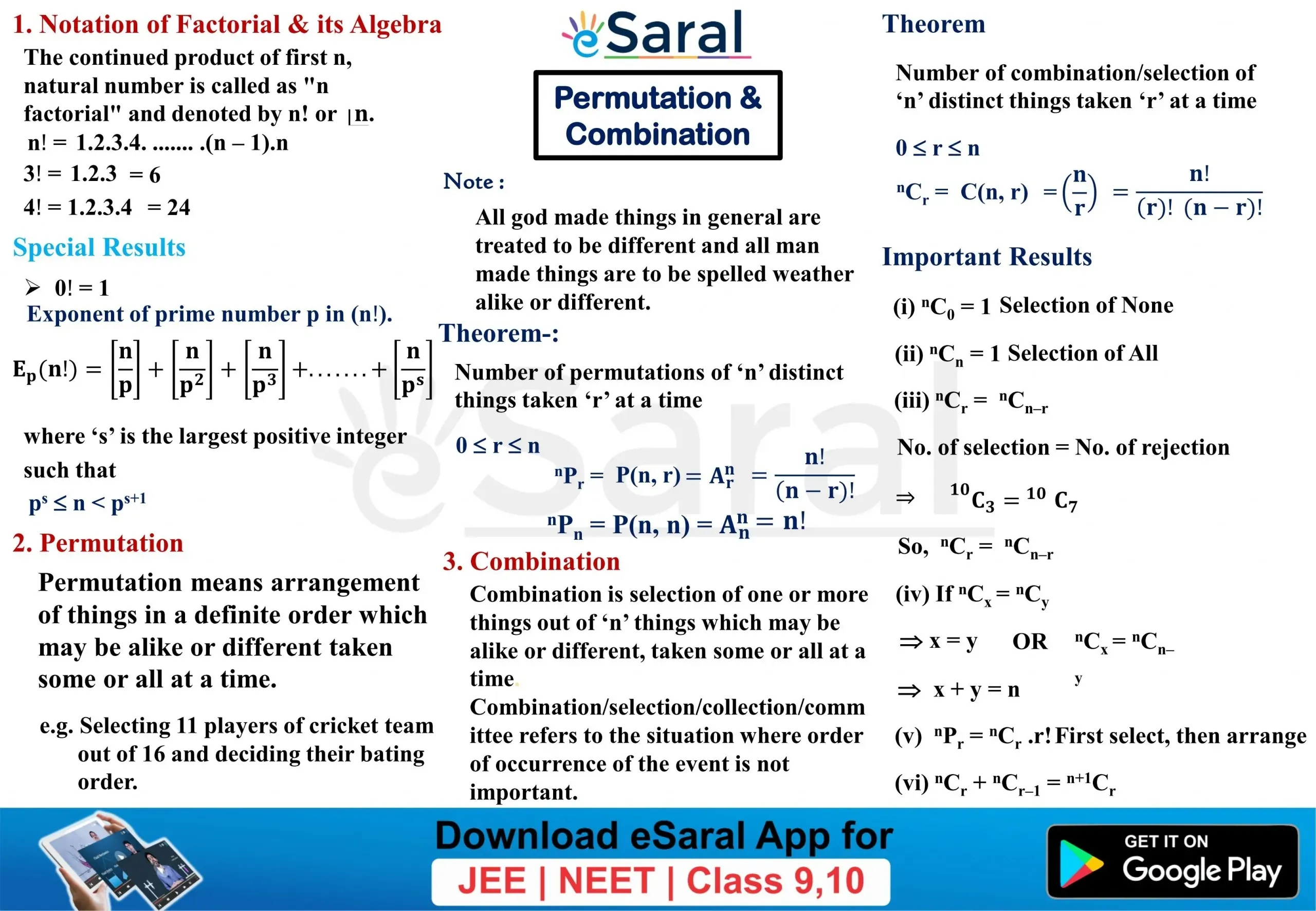
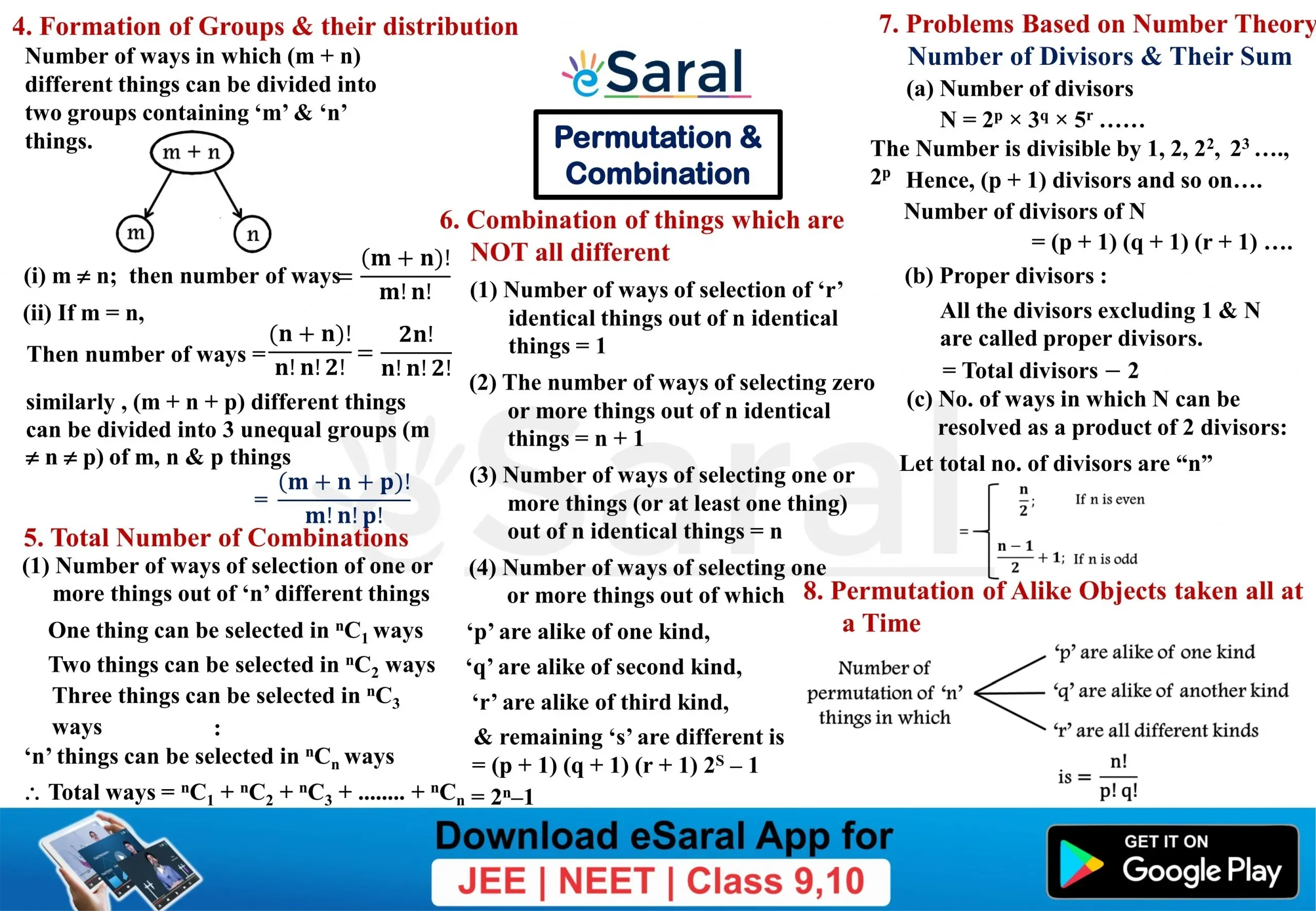
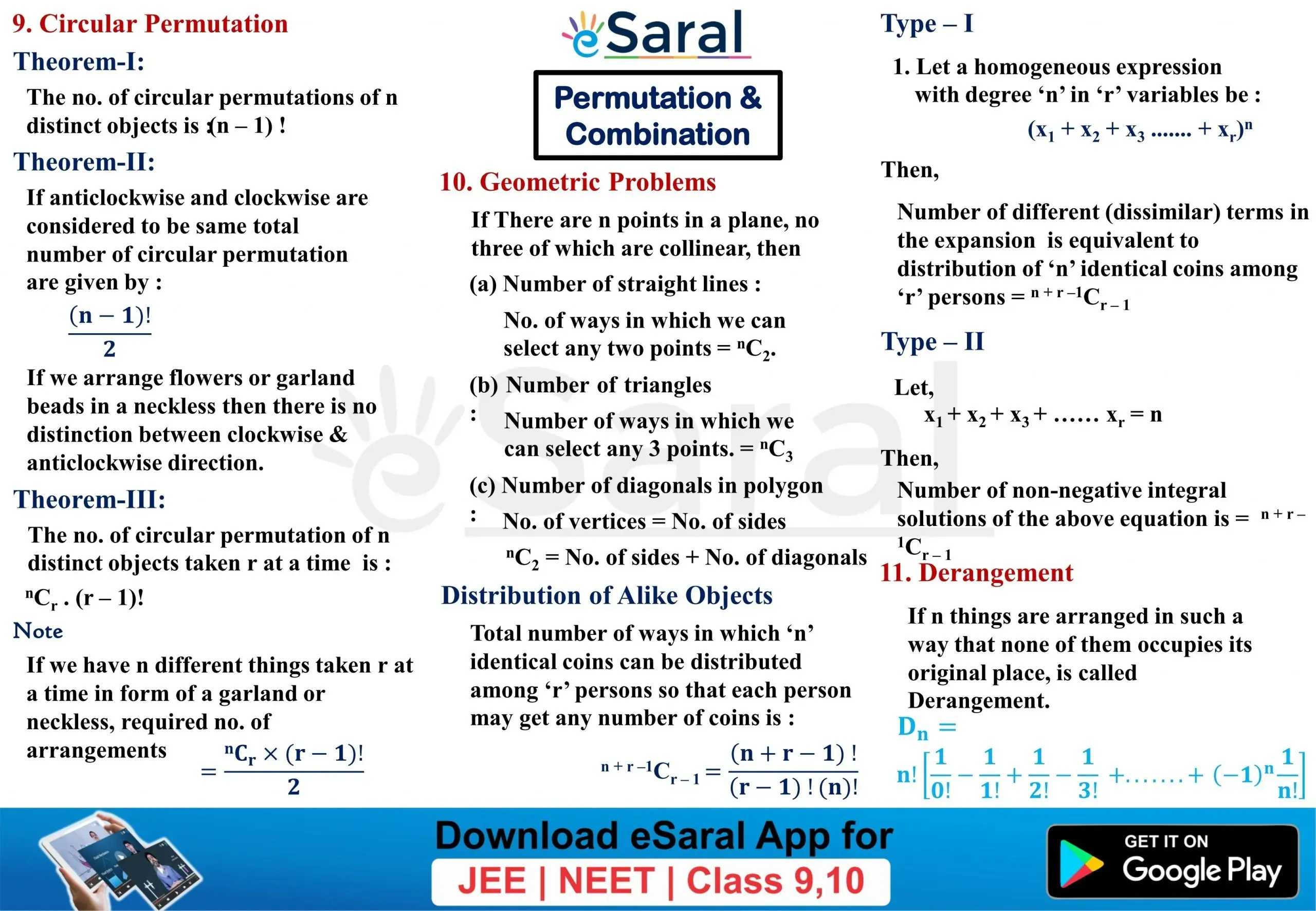
Get to learn all the formulae and important points of Class 11th Chapter Permutation And Combination Theorem through these Mind Maps. Download and share with your friends also.
India's Best Exam Preparation for Class 11th - Download Now
Mind Map - 1
Mind Map - 2
India's Best Exam Preparation for Class 11th - Download Now
Mind Map - 3
India's Best Exam Preparation for Class 11th - Download Now
India's Best Exam Preparation for Class 11th - Download Now
Frequently Asked Questions
Are these mind maps enough for JEE Advanced P&C preparation?
The mind maps cover all foundational and intermediate concepts needed for JEE Advanced. However, JEE Advanced problems often combine P&C with probability or combinatorics in non-standard ways. You should use these maps for formula revision and then practise previous year JEE Advanced questions to build problem-solving flexibility. eSaral's video lectures by IIT Bombay faculty add the deeper reasoning layer these maps do not carry alone.
How many questions from Permutation and Combination appear in JEE Main?
JEE Main typically includes 1 to 2 questions from Permutation and Combination per paper, carrying 4–8 marks. These questions are usually at moderate difficulty and test formula application, word formation, or selection with restrictions. Consistent revision using structured notes and previous year papers is the most reliable preparation strategy, as per NTA's official JEE Main information bulletin.
What is the formula for Permutation and Combination in Class 11?
The permutation formula is nPr = n! / (n–r)!, which gives the number of ways to arrange r objects from n distinct objects where order matters. The combination formula is nCr = n! / [r!(n–r)!], used when order does not matter. Both formulas are central to Chapter 7 of NCERT Class 11 Maths and appear directly in JEE Main.
Where can I find NCERT-based solutions for Permutation and Combination?
Step-by-step NCERT solutions for every exercise in Chapter 7 (Permutations and Combinations) are available on eSaral. The NCERT Solutions for Class 11 Maths page covers all exercises with detailed working, making it easy to cross-check your approach against the standard method before attempting JEE-level problems.
How do I revise Permutation and Combination quickly before JEE Main?
The fastest revision method is: (1) Review the mind maps to refresh all formulas, (2) Solve 15–20 previous year JEE Main questions on P&C under timed conditions, (3) Note down any formula you hesitated on and do one active recall session. This 3-step process can be completed in under 3 hours and is sufficient for a confident attempt on exam day.
What is the difference between circular permutation and linear permutation?
In a linear permutation, n distinct objects can be arranged in n! ways. In a circular permutation, because rotations of the same arrangement are considered identical, the number of ways is (n–1)!. For a necklace or bracelet where flipping is also identical, the count reduces further to (n–1)!/2. This distinction is a common JEE trap that Mind Map 3 specifically address
Team eSaral
eSaral Academic and Editorial Team
Team eSaral is the collective author profile for educational content created by eSaral’s teachers and academic contributors. The team draws on expertise from IIT graduates, doctors, experienced educators and subject specialists to develop resources for JEE, NEET and school students. Our articles aim to explain concepts clearly and help students study with confidence.
Related Posts

BITSAT 2027: Registration Date, Exam Date, Syllabus, Eligibility, Pattern & Fees
BITSAT 2027 exam dates, registration timeline, eligibility criteria, exam pattern, marking scheme, syllabus and fees in one page.

BITSAT Previous Year Question Paper PDF (2017-2026)
Download BITSAT previous year question papers PDF from 2017 to 2026,session-wise. Memory-based papers,exam pattern, paper analysis and how to practise

CBSE Class 10 Date Sheet 2027: Expected Exam Dates, Release Date, Admit Card & Result Timeline
CBSE Class 10 date sheet 2027 is awaited. See the expected exam dates, release window, how to download the PDF, admit card and result timelines.

NCERT Physics Class 10 Book PDF in Hindi 2026-27 – भौतिक विज्ञान के 4 अध्याय (Free Download)
NCERT Physics Class 10 book PDF in Hindi 2026-27: download all 4 chapters (अध्याय 9–12) free, with topics and important formulas.

NCERT Biology Class 9 Book Anveshan PDF in Hindi - जीव विज्ञान कक्षा 9 पुस्तक अन्वेषण PDF
Download NCERT Biology Class 9 book PDF in Hindi chapterwise for 2026-27: Cell, Tissues, Reproduction and Diversity. Free PDFs.

Essay On Artificial Intelligence in English (100,150, 200, 250, 300, 500 Words)
This is in contrast to the natural intelligence of humans. With Artificial Intelligence, machines can perform

Essay on 78th India Independence Day in English for Student (100, 150, 200, 250, 300, 500 Words)
Read the best essays on India's Independence Day in English. Short & long essays (100, 150, 200, 250, 300, 500 words) perfect for school exams
NCERT Class 11 English Snapshots book - Free PDF download- Esaral
Download NCERT Class 11 English Snapshots book PDF for free. Get all 8 chapters, chapter-wise. Start your prep today!
NCERT Class 10 biology book pdf - Free PDF Download - eSaral
NCERT Class 10 Biology book PDF 2026-27: all 5 chapters (Life Processes to Our Environment) in English & Hindi, with CBSE syllabus, marks & practical

Essay on Global Warming in English (100,150, 200, 250, 300, 500 Words)
Global warming means the Earth is getting hotter. This happens because of things like pollution from cars and factories.