
NCERT Solutions for Class 12 Chemistry PDF
eSaral › Class 12 › NCERT Solutions for Class 12 Chemistry PDF

🚀 Checkout eSaral Courses
Updated Class 12 Chemistry Syllabus 2026-27 — Chapters In and Chapters Removed
NCERT revised the Class 12 Chemistry syllabus for 2023-24 onwards, removing six chapters from the textbook. Students must be aware of this before downloading any solutions — older solution sets may include chapters that are no longer in scope for CBSE Boards, JEE Main, or NEET.
Status | Chapters |
|---|---|
In syllabus (2026-27) | Solutions, Electrochemistry, Chemical Kinetics, d and f Block Elements, Coordination Compounds, Haloalkanes and Haloarenes, Alcohols, Phenols and Ethers, Aldehydes, Ketones and Carboxylic Acids, Amines, Biomolecules |
Removed from NCERT syllabus | Solid State, Surface Chemistry, General Principles and Processes of Isolation of Elements, The p-Block Elements, Polymers, Chemistry in Everyday Life |
💡 Expert Tip by Prateek Gupta, IIT Bombay: "The removed chapters are no longer in CBSE Class 12 boards — but several still appear in JEE Main and NEET. p-Block Elements and Solid State, for example, continue to be tested in JEE Main. Students planning for competitive exams should study the removed chapters separately using dedicated JEE/NEET resources, not NCERT solutions."
Chapterwise NCERT Solutions
Chapter | Topic | Board Weightage | JEE Relevance | NEET Relevance |
|---|---|---|---|---|
Chapter 1 | Solutions | High | Moderate | High |
Chapter 2 | Electrochemistry | High | High | Moderate |
Chapter 3 | Chemical Kinetics | High | High | High |
Chapter 4 | d and f Block Elements | High | High | High |
Chapter 5 | Coordination Compounds | High | High | High |
Chapter 6 | Haloalkanes and Haloarenes | High | High | High |
Chapter 7 | Alcohols, Phenols and Ethers | High | High | High |
Chapter 8 | Aldehydes, Ketones and Carboxylic Acids | High | High | High |
Chapter 9 | Amines | Moderate | Moderate | High |
Chapter 10 | Biomolecules | Moderate | Low | High |
All 10 chapters are covered with complete in-text question solutions, end-of-chapter exercise solutions, and additional questions where relevant.
Chapterwise links
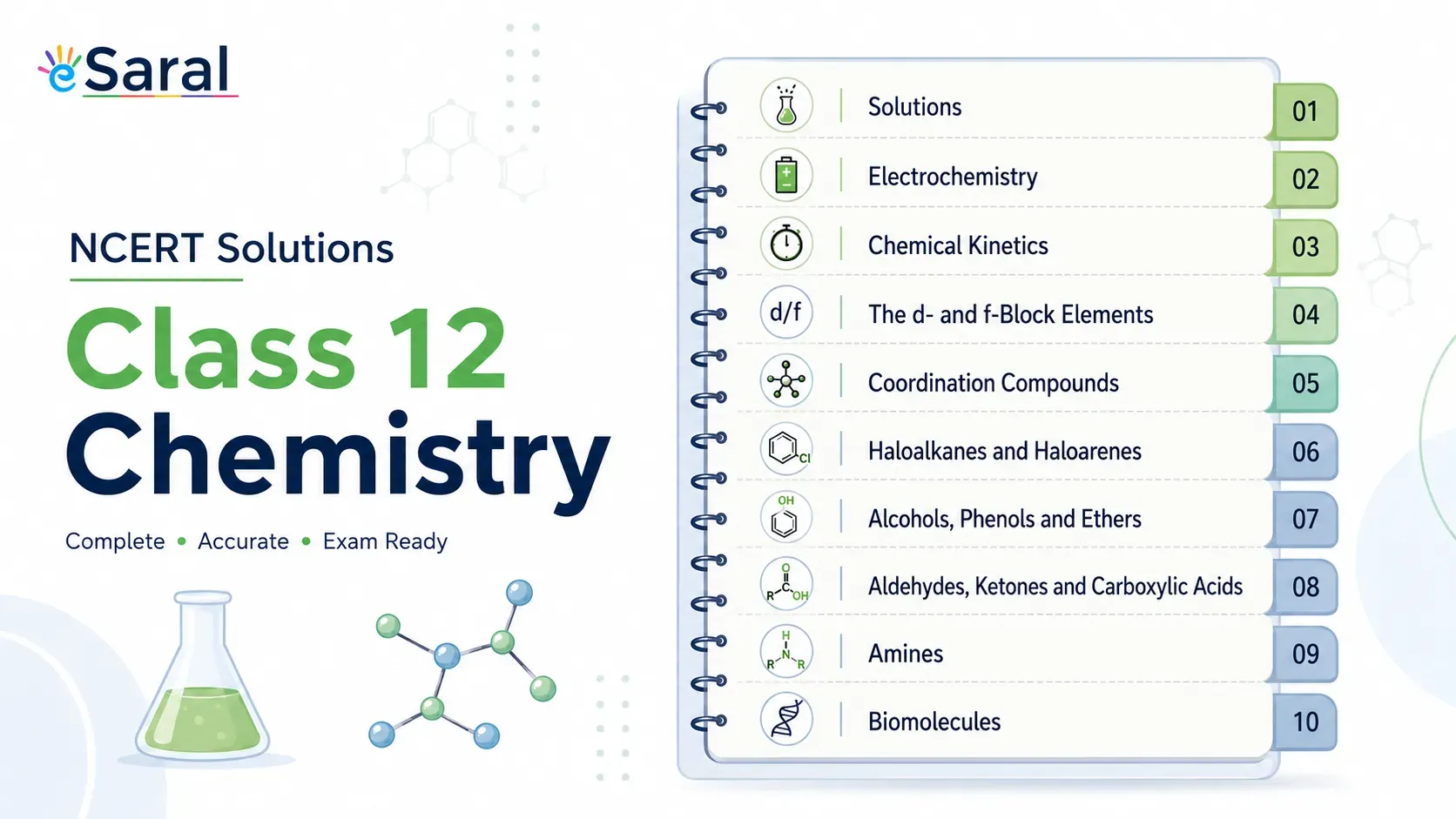
- Chapter 1: Solution
- Chapter 2: Electrochemistry
- Chapter 3: Chemical Kinetics
- Chapter 4: The D and F-Block Elements
- Chapter 5: Coordination Compounds
- Chapter 6: Haloalkanes and Haloarenes
- Chapter 7: Alcohols, Phenols and Ethers
- Chapter 8: Aldehydes, Ketones and Carboxylic Acids
- Chapter 9: Amines
- Chapter 10: Biomolecules
Chapter-by-Chapter Overview: Key Concepts, Subtopics and Exam Relevance
Chapter 1 — Solutions
What this chapter covers: Solutions introduces the quantitative chemistry of liquid mixtures — how solutes dissolve, how concentration is expressed, and how dissolved particles affect the physical properties of the solvent.
Key subtopics and their exam significance:
Subtopic | CBSE Board | JEE Main | NEET |
|---|---|---|---|
Types of solutions and concentration terms | ✓ | ✓ | ✓ |
Henry's Law and Raoult's Law | ✓ | ✓ | ✓ |
Ideal vs non-ideal solutions, azeotropes | ✓ | ✓ | — |
Colligative properties (all four) | ✓ | ✓ | ✓ |
van't Hoff factor and abnormal molar mass | ✓ | ✓ | ✓ |
Most tested in NEET and JEE: Colligative properties calculations (especially osmotic pressure and depression of freezing point) and the van't Hoff factor for electrolytes.
Chapter 2 — Electrochemistry
What this chapter covers: Electrochemistry connects chemical reactions to electrical energy — how galvanic cells generate electricity and how electrolytic cells use it to drive non-spontaneous reactions.
Key subtopics:
Subtopic | CBSE Board | JEE Main | NEET |
|---|---|---|---|
Electrochemical cells and EMF | ✓ | ✓ | — |
Nernst equation and equilibrium constant | ✓ | ✓ | — |
Conductance and molar conductivity | ✓ | ✓ | — |
Electrolysis and Faraday's laws | ✓ | ✓ | ✓ |
Batteries, fuel cells, corrosion | ✓ | — | ✓ |
Most tested in JEE Main: Nernst equation calculations and EMF of cell reactions. Most tested in NEET: Faraday's laws and electrochemical series.
Chapter 3 — Chemical Kinetics
What this chapter covers: Chemical Kinetics studies how fast reactions occur and what factors control the rate — concentration, temperature, catalysts, and reaction mechanisms.
Key subtopics:
Subtopic | CBSE Board | JEE Main | NEET |
|---|---|---|---|
Rate law and rate constant | ✓ | ✓ | ✓ |
Order and molecularity | ✓ | ✓ | ✓ |
Integrated rate equations (zero, first order) | ✓ | ✓ | ✓ |
Half-life calculations | ✓ | ✓ | ✓ |
Arrhenius equation and activation energy | ✓ | ✓ | ✓ |
Collision theory | ✓ | — | — |
Most tested everywhere: First-order integrated rate law, half-life, and Arrhenius equation. This is one of the highest-scoring chapters in NCERT for all three exams — the questions are numerical and follow predictable formats.
Chapter 4 — d and f Block Elements
What this chapter covers: This chapter covers the transition metals (d-block, Groups 3–12) and the f-block elements (lanthanoids and actinoids) — their electronic configurations, variable oxidation states, colour, magnetic properties, and important compounds.
Key subtopics:
Subtopic | CBSE Board | JEE Main | NEET |
|---|---|---|---|
Electronic configurations and exceptions (Cr, Cu) | ✓ | ✓ | ✓ |
Variable oxidation states | ✓ | ✓ | ✓ |
Colour and magnetic properties | ✓ | ✓ | ✓ |
KMnO₄ and K₂Cr₂O₇ reactions | ✓ | ✓ | ✓ |
Lanthanoid contraction | ✓ | — | ✓ |
Lanthanoids vs actinoids | ✓ | — | ✓ |
Chapter 5 — Coordination Compounds
What this chapter covers: Coordination Compounds explores how transition metals form complex ions with ligands — their nomenclature, bonding theories (VBT and CFT), isomerism, and applications.
Key subtopics:
Subtopic | CBSE Board | JEE Main | NEET |
|---|---|---|---|
Werner's theory and nomenclature (IUPAC) | ✓ | ✓ | ✓ |
Types of ligands and coordination number | ✓ | ✓ | ✓ |
Valence Bond Theory (VBT) | ✓ | ✓ | ✓ |
Crystal Field Theory (CFT) — splitting | ✓ | ✓ | — |
Isomerism (structural and stereoisomerism) | ✓ | ✓ | ✓ |
Stability and applications | ✓ | — | ✓ |
💡 Expert Tip by Prateek Gupta, IIT Bombay: "Coordination Compounds is the chapter where NCERT solutions alone are not enough for JEE Main. The board-level questions test nomenclature and VBT — NCERT covers these fully. But JEE Main tests CFT splitting patterns, EAN rule, and isomerism at a level above NCERT. Treat NCERT as the floor for this chapter, not the ceiling."
Chapter 6 — Haloalkanes and Haloarenes
What this chapter covers: This chapter covers the chemistry of organic halogen compounds — how they are prepared, the mechanisms of their reactions (SN1, SN2, elimination), and the properties of polyhalogen compounds.
Key subtopics:
- Classification and IUPAC nomenclature
- Methods of preparation (from alcohols, alkenes, arenes)
- Physical properties and nature of the C–X bond
- Chemical reactions: nucleophilic substitution (SN1 and SN2), elimination (E1 and E2)
- Polyhalogen compounds (DDT, chloroform, iodoform)
Board exam focus: Mechanism of SN2 vs SN1, Wurtz reaction, Grignard reagent preparation. JEE/NEET focus: Stereochemistry of SN2 (inversion), regioselectivity in elimination reactions.
Chapter 7 — Alcohols, Phenols and Ethers
Key subtopics:
- IUPAC nomenclature and classification
- Preparation of alcohols (from alkenes, aldehydes, Grignard reagent)
- Reactions of alcohols (with Na, PCl₅, oxidation, dehydration)
- Acidity of alcohols vs phenols (resonance stabilisation in phenols)
- Preparation and reactions of ethers (Williamson synthesis)
Most tested in JEE/NEET: Acidity comparison (phenol > alcohol > water), mechanism of dehydration of alcohols, and distinction tests between primary, secondary, tertiary alcohols.
Chapter 8 — Aldehydes, Ketones and Carboxylic Acids
Key subtopics:
- Structure of carbonyl and carboxyl groups
- Preparation of aldehydes and ketones (from alcohols, ozonolysis, hydration of alkynes)
- Nucleophilic addition reactions (addition of HCN, Grignard reagent, reduction)
- Aldol condensation, Cannizzaro reaction
- Preparation and acidity of carboxylic acids
Most tested everywhere: Aldol condensation, Cannizzaro reaction, Lucas test, Tollens' test, Fehling's test. This is the most reaction-heavy chapter in Class 12 Organic Chemistry and requires substantial practice beyond NCERT.
Chapter 9 — Amines
Key subtopics:
- Classification (primary, secondary, tertiary; aliphatic vs aromatic)
- IUPAC nomenclature
- Preparation methods (reduction of nitro compounds, Gabriel synthesis, Hoffmann bromamide)
- Basicity comparison: aliphatic > ammonia > aromatic amines
- Diazonium salts — preparation and reactions (Sandmeyer, Gattermann reactions)
Most tested in NEET: Basicity order of amines, diazonium salt reactions, Gabriel synthesis mechanism.
Chapter 10 — Biomolecules
Key subtopics:
- Carbohydrates — classification (aldose/ketose, mono/di/polysaccharides), mutarotation, structures of glucose
- Proteins — amino acids, peptide bond, primary to quaternary structure, denaturation
- Enzymes — mechanism and significance
- Vitamins — fat-soluble (A, D, E, K) vs water-soluble (B, C)
- Nucleic acids — DNA vs RNA, base pairing, double helix
- Hormones — types and functions
Most tested in NEET: Structures and reducing/non-reducing sugars, essential amino acids, deficiency diseases of vitamins, base pairing rules in DNA. This chapter is almost entirely factual recall in NEET.
How to Use NCERT Solutions for Class 12 Chemistry Effectively
Using NCERT solutions as an answer key is the least productive way to use them. The following workflow extracts full exam value:
Step 1: Attempt Every Question Before Consulting the Solution
Close the solution. Attempt every in-text question and exercise question independently. Write your answer — do not type it. Chemistry answers that are written are retained far better than those that are read. If you cannot attempt a question, mark it and return to the relevant concept in the chapter before looking at the solution.
Step 2: Use the Solution to Check Method, Not Just the Answer
When you check your answer, compare your method step-by-step with the NCERT solution method. In Chemistry, marks in CBSE Boards are awarded for each step — a correct final answer written without correct working can score zero. Identify any step where your method diverged and understand why the NCERT method is preferred.
Step 3: Maintain a Reaction Compendium for Organic Chemistry Chapters
For Chapters 6 through 9, create a running list of every named reaction, every reagent, and every mechanism step encountered in NCERT. After completing each chapter, add its reactions to the list. By the time all organic chapters are done, this compendium becomes the most efficient pre-exam revision tool available — every reaction CBSE and JEE will test is in one place.
Step 4: Solve Intext Questions, Not Just End-of-Chapter Exercises
Many students solve only the end-of-chapter exercises. NCERT intext questions (embedded within the reading) are equally testable in CBSE Boards and are often more concept-specific. Both sets must be solved.
Step 5: After Each Chapter, Attempt Previous Year Board and JEE Questions
NCERT solutions build the foundation. After completing each chapter's solutions, search for the last 5 years of CBSE Board questions and JEE Main questions for that chapter. The gap between what NCERT asks and what CBSE/JEE asks reveals exactly which concepts need deeper practice beyond NCERT.
Which Class 12 Chemistry Chapters Are Most Important for JEE and NEET?
For JEE Main (Chemistry section — 30 questions, 120 marks)
Priority | Chapters from Class 12 | Reason |
|---|---|---|
Highest | Electrochemistry, Chemical Kinetics, Coordination Compounds, Haloalkanes | Numerical + mechanism questions; 2–3 questions per chapter per paper |
High | d and f Block Elements, Aldehydes, Ketones, Carboxylic Acids, Alcohols, Phenols, Ethers | High factual and reaction content; consistent 1–2 questions per chapter |
Moderate | Solutions, Amines | Numerical (Solutions) and basicity/diazonium (Amines); 1 question |
Lower | Biomolecules | Mostly factual; rarely more than 1 question in JEE Main |
For NEET (Chemistry section — 45 questions, 180 marks)
Priority | Chapters from Class 12 | Reason |
|---|---|---|
Highest | d and f Block, Coordination Compounds, Biomolecules | 2–3 questions per chapter per paper; mostly direct recall |
High | Chemical Kinetics, Haloalkanes, Aldehydes, Ketones, Carboxylic Acids, Amines | Reaction mechanisms and numerical questions |
Moderate | Solutions, Electrochemistry, Alcohols, Phenols, Ethers | Mixed question types; 1–2 questions each |
For complete NEET chapter-wise PYQs with solutions, visit eSaral's NEET previous year question bank.
Go deeper with higher-order Exemplar problems: NCERT Exemplar Class 12 Chemistry PDF →
Download the full textbook reference: NCERT Class 12 Chemistry Book PDF →
Frequently Asked Questions
Are NCERT solutions enough for Class 12 Chemistry CBSE Boards?
Yes — NCERT solutions are sufficient for CBSE Class 12 Chemistry Boards if both intext and exercise questions are studied. CBSE Board papers draw most questions directly from NCERT exercises or close variants. Students who solve all NCERT questions, understand each solution step-by-step, and practise previous year Board papers perform well without additional resources.
Which chapters have been removed from NCERT Class 12 Chemistry in 2026-27?
Six chapters were removed from the NCERT Class 12 Chemistry textbook for 2026-27 onwards: Solid State, Surface Chemistry, General Principles and Processes of Isolation of Elements, The p-Block Elements, Polymers, and Chemistry in Everyday Life. The current syllabus has 10 chapters. Note that some removed chapters still appear in JEE Main and NEET — they require separate preparation beyond NCERT.
How to use NCERT solutions for Class 12 Chemistry for JEE preparation?
NCERT solutions establish the conceptual foundation for JEE Main Chemistry. Complete all NCERT solutions chapter by chapter, then move to JEE-level module problems for the same chapter. NCERT is sufficient for JEE Main in chapters like Solutions, Chemical Kinetics, and Biomolecules. For Coordination Compounds and Organic Chemistry, JEE Main requires significant practice beyond NCERT at higher difficulty.
Is NCERT Class 12 Chemistry enough for NEET?
NCERT is the primary source for NEET Chemistry — approximately 80% of NEET Chemistry questions are either directly from NCERT or are close variants. Biomolecules, d and f Block Elements, and Coordination Compounds are almost entirely testable from NCERT. Organic Chemistry chapters (Haloalkanes, Aldehydes, Amines) require practicing mechanisms and named reactions beyond NCERT for reliable NEET scores.
What is the best way to study organic chemistry chapters in Class 12 NCERT?
The most effective method is to build a reaction compendium — a running list of every named reaction, reagent, and mechanism from Chapters 6 through 9. Attempt each NCERT question before consulting solutions. Compare methods step-by-step, not just final answers. After each chapter, solve previous year NEET and JEE Main questions to identify the gap between NCERT level and exam level.
Is class 12 chemistry ncert solutions enough without coaching material?
For CBSE Boards, yes — ncert solutions class 12 chemistry cover close to 100% of what the board paper tests. For JEE Main and NEET, NCERT solutions are the necessary foundation but not sufficient alone, especially for Coordination Compounds and the four organic chemistry chapters, which need JEE/NEET-level practice beyond NCERT.