
NEET Botany Syllabus 2027: Chapter-Wise List & Weightage

eSaral Academic and Editorial Team
Summary
The NEET botany syllabus 2027 is the plant half of NMC’s 10-unit biology syllabus: 45 questions worth 180 marks, drawn from about 20 NCERT chapters of Class 11 and Class 12. NMC notified this list on 22 December 2025 for NEET (UG) 2026 and removed no biology unit. We found no separate 2027 notice as of 26 October 2026, so prepare from it. Transport in plants, mineral nutrition, vernalisation, plant breeding and environmental issues are no longer tested.
What Is the NEET Botany Syllabus 2027?
It covers the plant-side portion of the NMC biology units, including 9 of the 10 units and every NCERT chapter on plants, cells, genetics, microbes, and ecology. Only Unit 5, Human Physiology, has no botany content.
Detail | NEET Botany 2027 |
|---|---|
Questions and marks | 45 questions, 180 marks (25% of the 720-mark paper) |
NCERT chapters | About 20: 11 from Class 11 and 9 from Class 12 (eSaral count, with Biomolecules placed here) |
NMC units covered | 9 of 10 (all except Human Physiology) |
Marking | +4 for a correct answer, −1 for a wrong one |
Prescribed by | National Medical Commission (NMC); exam conducted by NTA |
Status for 2027 | Same list as 2026; no separate 2027 notice found as of 26 Oct 2026 |
Botany and Zoology carry 45 questions each, and units 3, 7, 9 and 10 are shared, so a botany chapter can be asked from the animal side too. For the complete 10-unit view, see the NEET biology syllabus; for the animal and human side, see the NEET zoology syllabus. Whether NMC will revise anything is tracked on the NEET syllabus 2027 page.
NEET Botany Syllabus 2027 for Class 11: Chapter-Wise Topics
Class 11 botany has 11 chapters across Units 1 to 4, from the Living World to Plant Growth. ★ marks chapters shared with Zoology.
Unit | NCERT chapter | Topics to cover |
|---|---|---|
1. Diversity in the Living World | The Living World | What is living; biodiversity; need for classification; taxonomy and systematics; species and taxonomic hierarchy; binomial nomenclature |
1 | Biological Classification ★ | Five-kingdom system; Monera, Protista and Fungi; lichens; viruses and viroids |
1 | Plant Kingdom | Salient features and classification of algae, bryophytes, pteridophytes and gymnosperms (three to five features and two examples each) |
2. Structural Organisation | Morphology of Flowering Plants | Root, stem, leaf, inflorescence (cymose and racemose), flower, fruit, seed; modifications; five families: Malvaceae, Cruciferae, Leguminosae, Compositae, Gramineae |
2 | Anatomy of Flowering Plants | Tissues and tissue systems; anatomy of root, stem and leaf (dicot and monocot); secondary growth as covered in NCERT |
3. Cell Structure and Function | Cell: The Unit of Life ★ | Cell theory; prokaryotic and eukaryotic cells; plant and animal cell; cell envelope, membrane and wall; organelles; endomembrane system; cytoskeleton, cilia, flagella, centrioles; nucleus |
3 | Biomolecules ★ | Proteins, carbohydrates, lipids, nucleic acids; enzyme types, properties, action, classification and nomenclature |
3 | Cell Cycle and Cell Division ★ | Cell cycle, mitosis, meiosis and their significance |
4. Plant Physiology | Photosynthesis in Higher Plants | Site and pigments; light (photochemical) and biosynthetic phases; cyclic and non-cyclic photophosphorylation; chemiosmotic hypothesis; photorespiration; C3 and C4 pathways; limiting factors |
4 | Respiration in Plants | Glycolysis; fermentation; TCA cycle; electron transport system; ATP yield; amphibolic pathway; respiratory quotient |
4 | Plant Growth and Development | Seed germination; phases and rate of growth; conditions of growth; differentiation, dedifferentiation, redifferentiation; auxin, gibberellin, cytokinin, ethylene, ABA |
Practise with NCERT Solutions for Class 11 and read from the official NCERT textbooks.
NEET Botany Syllabus 2027 for Class 12: Chapter-Wise Topics
Class 12 botany has 9 chapters across Units 6 to 10, led by genetics, which links to both Botany and Zoology.
Unit | NCERT chapter | Topics to cover |
|---|---|---|
6. Reproduction | Sexual Reproduction in Flowering Plants | Flower structure; male and female gametophytes; pollination types and agencies; outbreeding devices; pollen-pistil interaction; double fertilisation; endosperm, embryo, seed and fruit; apomixis, parthenocarpy, polyembryony |
7. Genetics and Evolution | Principles of Inheritance and Variation ★ | Mendel’s laws and deviations; chromosomal theory; linkage; sex determination; mutation; pedigree analysis; Mendelian and chromosomal disorders |
7 | Molecular Basis of Inheritance ★ | Genetic material and its search; DNA and RNA structure; packaging; replication; transcription; genetic code; translation and protein biosynthesis; gene regulation (lac operon); Human Genome Project; DNA fingerprinting |
8. Human Welfare | Microbes in Human Welfare | Microbes in household and industrial products, sewage treatment, biogas, biocontrol and biofertilisers |
9. Biotechnology | Biotechnology: Principles and Processes ★ | Recombinant DNA technology; tools such as restriction enzymes and vectors; PCR; bioreactors; downstream processing |
9 | Biotechnology and Its Applications ★ | Applications in health and agriculture; GM crops; biosafety |
10. Ecology | Organisms and Populations ★ | Organism and environment; population attributes and growth; life history variation; population interactions |
10 | Ecosystem ★ | Structure, productivity, decomposition, energy flow, ecological pyramids |
10 | Biodiversity and Conservation ★ | Patterns and loss of biodiversity; conservation, hotspots, extinction, Red Data Book, biosphere reserves, national parks, sanctuaries, sacred groves |
Use NCERT Solutions for Class 12 alongside this list.
Which Botany Topics Are Deleted From the NEET Syllabus 2027?
Six botany areas were removed and remain out for 2027: parts of Diversity, Plant Physiology, Reproduction, Human Welfare and Ecology. Several still sit in your school NCERT, so do not study them for NEET unless NMC reinstates them.
Unit | Removed from NEET | Still in |
|---|---|---|
1. Diversity | Three domains of life; taxonomic aids (herbaria, botanical gardens); classification of angiosperms up to class level | Five kingdoms; algae, bryophytes, pteridophytes, gymnosperms |
4. Plant Physiology | Transport in plants; mineral nutrition, nitrogen cycle, nitrogen fixation, hydroponics; seed dormancy, vernalisation, photoperiodism | Photosynthesis, respiration, plant growth and PGRs |
6. Reproduction | Reproduction in organisms (asexual reproduction, vegetative propagation) | Sexual reproduction in flowering plants |
8. Human Welfare | Plant breeding, tissue culture, single cell protein, biofortification | Microbes in human welfare |
10. Ecology | Habitat and niche; adaptations; ecological succession; nutrient cycling; ecological services; environmental issues (pollution, solid waste, ozone depletion, deforestation) | Populations, ecosystem, biodiversity and conservation |
Some websites and AI-generated summaries still list Strategies for Enhancement in Food Production, Environmental Issues, vernalisation and photoperiodism as botany content. Check any list against the unit text on nmc.org.in.
What Was Added or Newly Emphasised in NEET Botany?
- Five plant families: Malvaceae, Cruciferae, Leguminosae, Compositae and Gramineae
- Classification and nomenclature of enzymes
- Protein biosynthesis within Molecular Basis of Inheritance
NEET Botany Chapter-Wise Weightage: Which Chapters Matter Most?
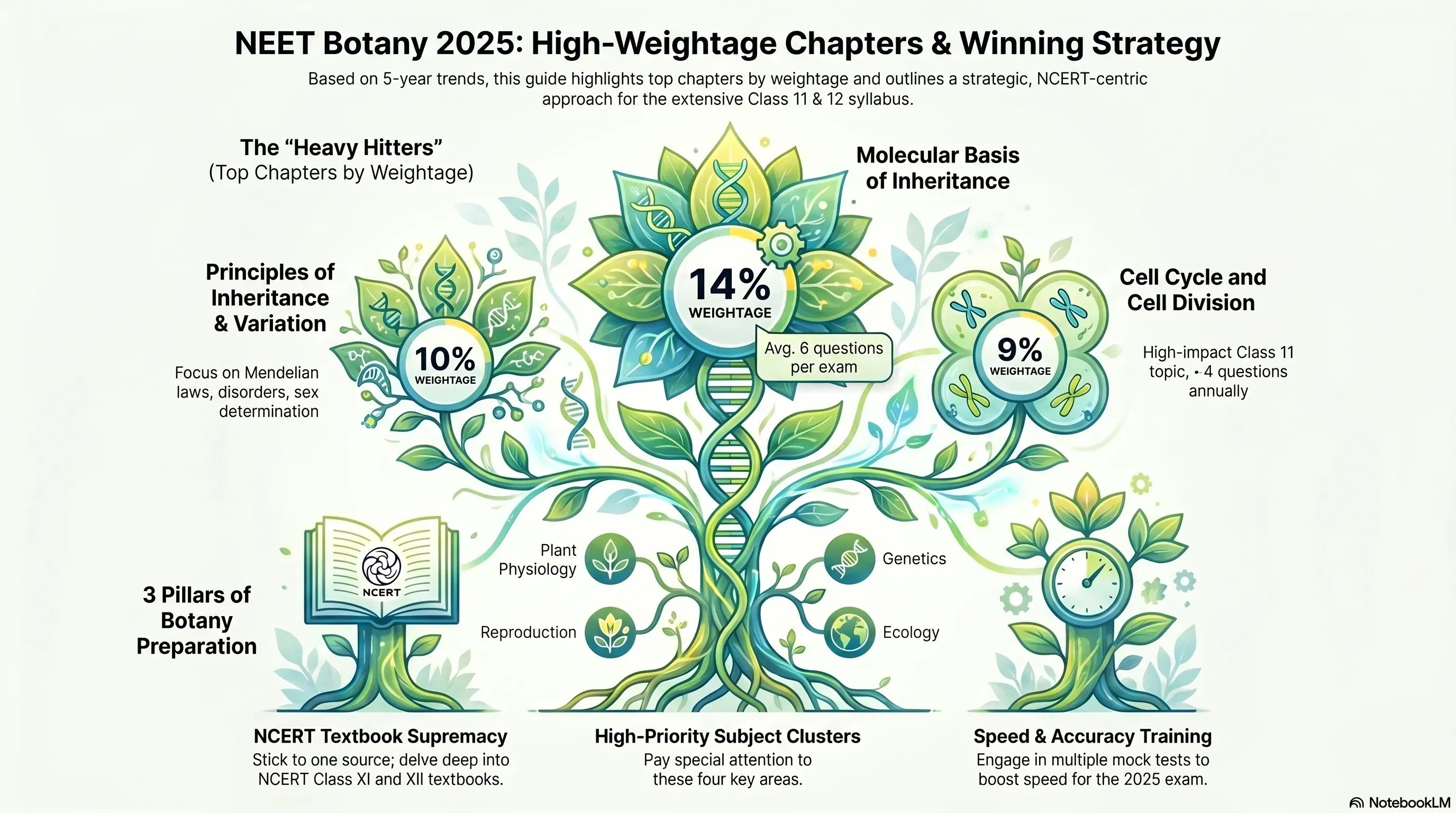
Cell: The Unit of Life led the NEET 2026 biology paper with 7 to 8 questions, followed by Biological Classification and Photosynthesis. Use weightage to set revision order, never to skip a chapter.
Botany-side chapter | 3 May 2026 paper (eSaral analysis) | Re-NEET, 21 June 2026 |
|---|---|---|
Cell: The Unit of Life | 7 | 8 |
Biological Classification | 5 | 5 |
Photosynthesis in Higher Plants | 4 to 5 | 5 |
Morphology of Flowering Plants | Not in top list | 4 |
Principles of Inheritance and Variation | Not in top list | 4 |
Biotechnology: Principles and Processes | Not in top list | 4 |
Organisms and Populations | Not in top list | 4 |
Counts differ between analyses because papers were set in several codes, and some chapters are shared with Zoology, so treat them as indicative of one year, not a rule. Anatomy of Flowering Plants had no questions in the Re-NEET analysis but is still in the syllabus. Read the full NEET 2026 paper analysis, then drill chapter-wise NEET PYQs with solutions.
How to Study Botany for NEET 2027
Read NCERT line by line, convert every pathway into a flowchart, and solve chapter-wise previous year questions. Botany questions repeat NCERT facts, tables and diagrams, so accuracy comes from recall, not from lengthy theory.
Botany block | How to study |
|---|---|
Diversity (Living World, Classification, Plant Kingdom) | Build comparison tables for kingdoms and plant groups; memorise examples and life-cycle patterns. |
Morphology and Anatomy | Redraw diagrams; learn floral formulae for the five families; compare dicot and monocot structures. |
Cell, Biomolecules, Cell Division | Redraw organelles and mitosis/meiosis stages; learn enzyme classes. This is the top-scoring block. |
Photosynthesis, Respiration, Growth | Write each pathway as a flowchart with inputs, outputs and locations; keep a PGR table. |
Sexual Reproduction in Plants | Practise stage-wise diagrams of gametophytes, fertilisation, endosperm and embryo. |
Genetics and Molecular Basis | Solve crosses and pedigrees daily; learn replication, transcription and translation in order. |
Biotechnology and Ecology | Learn techniques step by step; memorise NCERT examples, numbers and tables. |
Fit this into the 6-month NEET 2027 plan, then revise with NEET revision notes and revision videos and mind maps. Test yourself with NEET important questions and the NEET test series.
Which Are the Best Books for NEET Botany?
NCERT Biology for Class 11 and Class 12 is the base text, and it is enough for the large majority of questions. Add one supplementary source, such as Trueman’s Biology, only after at least two full NCERT readings. Keep the NCERT books open as the final authority.
NEET Botany Syllabus 2027 PDF: Where to Download It
There is no separate botany PDF; botany sits inside the single biology section of the official NMC syllabus.
- Download the official NEET (UG) syllabus PDF and read the Biology section.
- Check nmc.org.in for any new NEET UG notice.
- Cross-check against neet.nta.nic.in when the NEET 2027 bulletin is released. The paper layout is in the NEET exam pattern guide.
For expert-led, chapter-by-chapter coverage, see eSaral NEET courses.
Frequently Asked Questions
What is the NEET botany syllabus 2027?
It is the plant-side of the NMC biology syllabus: about 20 NCERT chapters from Class 11 and 12, carrying 45 questions and 180 marks. The list is the NEET (UG) 2026 syllabus notified on 22 December 2025, and no separate 2027 notice had been found as of 26 October 2026.
How many chapters of botany are in NEET 2027?
About 20 NCERT chapters: 11 in Class 11 and 9 in Class 12. The exact count varies by source because Biomolecules, Biotechnology and ecology chapters are shared with Zoology. The official count is 10 biology units, of which botany touches 9.
Will the NEET syllabus change in 2027?
No change has been announced. NMC kept the 2026 syllabus unchanged from 2025, so a carry-forward is the most likely outcome, but that is an expectation, not an announcement. Live status is on the NEET syllabus 2027 page.
How many questions come from botany in NEET?
45 compulsory questions, worth 180 marks. Biology has 90 questions (360 marks) in total, split equally between Botany and Zoology. Each correct answer earns +4 and each wrong answer costs −1.
Which botany topics are deleted from the NEET syllabus?
Transport in plants, mineral nutrition, seed dormancy, vernalisation, photoperiodism, asexual reproduction, plant breeding, tissue culture, nutrient cycling, ecological succession and environmental issues. The three domains of life and angiosperm classification up to class level are also removed.
Is transport in plants in the NEET syllabus 2027?
No. Transport in plants and mineral nutrition (including the nitrogen cycle and hydroponics) were removed. Plant Physiology now covers photosynthesis, respiration, and plant growth and development.
Are Environmental Issues and Strategies for Enhancement in Food Production in NEET botany?
No. Pollution, solid waste, ozone depletion and deforestation were removed from Ecology, and plant breeding, tissue culture, single cell protein and biofortification were removed from Human Welfare. Some third-party lists still show them, so follow the NMC unit text.
Which chapter has the highest weightage in NEET botany?
Cell: The Unit of Life in 2026, with 7 questions on 3 May and 8 in the Re-NEET. Biological Classification (5) and Photosynthesis in Higher Plants (4 to 5) followed. Counts vary slightly by paper code.
Is NCERT enough for NEET botany?
Yes for most questions, because botany is built on NCERT lines, tables and diagrams. Follow the NMC unit list rather than the textbook alone, since some NCERT chapters still contain deleted topics. Add previous year questions and timed mocks.
What is newly added in the NEET botany syllabus?
Five plant families (Malvaceae, Cruciferae, Leguminosae, Compositae, Gramineae), classification and nomenclature of enzymes, and protein biosynthesis.
Is botany easy in NEET?
It is usually the more predictable half of biology because it is NCERT-driven, but Cell, Genetics and Plant Physiology need diagram and pathway practice. eSaral’s analysis found Biology the easiest section in 2026, so accuracy here protects your rank.
NEET Botany ka syllabus kya hai?
NEET Botany mein Class 11 aur 12 ke lagbhag 20 NCERT chapters aate hain, jinse 45 questions (180 marks) puchhe jaate hain. Poori chapter-wise list is page par upar di gayi hai.
Team eSaral
eSaral Academic and Editorial Team
Team eSaral is the collective author profile for educational content created by eSaral’s teachers and academic contributors. The team draws on expertise from IIT graduates, doctors, experienced educators and subject specialists to develop resources for JEE, NEET and school students. Our articles aim to explain concepts clearly and help students study with confidence.
Related Posts
NEET Registration 2027: Last Date, Process, Form, Admit Card & Exam Date
NEET registration 2027 live updates: NEET registration process, NEET registration last date, NEET form fee, admit card for NEET, and NEET exam date.
NEET Biology Syllabus 2027: 10 Units, Botany–Zoology Split & Weightage
NEET Biology Syllabus 2027: chapter-wise weightage and preparation tips. Complete NCERT-based guide with eSaral courses to boost your NEET score.
NEET Chemistry Syllabus
Check the NEET Chemistry syllabus 2027 unit-wise for Class 11 & 12. Get NCERT-focused tips to finish on time and score higher.
NEET 2025 Question Paper with Solution: Download PDF & Answer Key
Download the NEET 2025 question paper PDF with solutions for codes 45- 48,with the answer key,subject-wise analysis and the final categorywise cutoff.
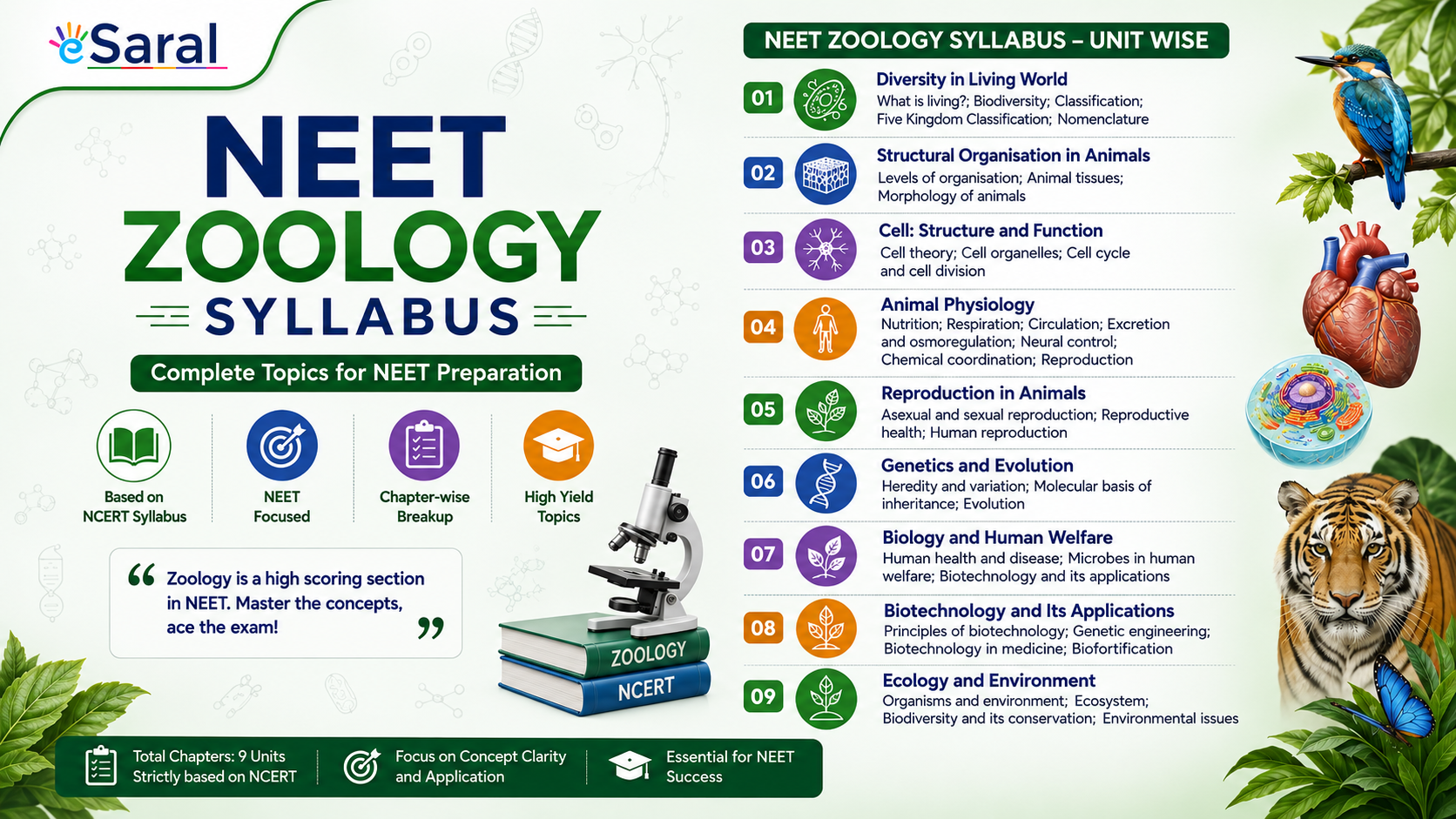
NEET Zoology Syllabus (Latest) PDF– Chapter-wise Topics, Weightage & Expert Tips
Get the complete NEET Zoology Syllabus with chapter-wise topics, weightage & expert tips. Based on NTA guidelines. Start your prep smarter today!
NEET Physics Syllabus 2027 : Unit-Wise Topics & Weightage
NEET Physics Syllabus 2027 PDF: chapter-wise topics for Classes 11 & 12, plus the best preparation tips. Check important topics & start preparation.
NEET Syllabus 2027: Subject-Wise Chapters & Official PDF
Check the NEET syllabus 2027 unit-wise: Physics, Chemistry, Biology chapters, official PDF and weightage. Updated Oct 2026 as per NMC
NEET 2026 Question Paper with Solution: Re-NEET PDF, Answer Key, Analysis and Cutoff
NEET 2026 question paper with solution PDF for Re-NEET (21 June) Codes 50, 60, 70 and 80, plus the May 3 paper, answer key, analysis and cutoff.
NEET 2024 Question Papers With Solutions - Free PDF Download
Download NEET 2024 Question Paper PDF with solutions — subject-wise, free. Includes exam pattern, marking scheme, and 6-year PYQ archive.
Re-NEET 2026 Question Paper with Solution: PDF Download, Answer Key & Paper Analysis (June 21)
Download Re-NEET 2026 question paper PDF with solutions for all codes. Get answer key, subject-wise paper analysis, expected cutoff