
Oscillations Class 11: Simple Harmonic Motion Notes for IIT JEE & NEET

eSaral Academic and Editorial Team
Summary
Simple Harmonic Motion Notes for Class 11 IIT JEE and NEET cover periodic and oscillatory motion, the definition and the equation of simple harmonic motion (SHM), displacement, velocity and acceleration with their phase relations, the link with uniform circular motion, energy in SHM, the spring–mass system with springs in series and parallel, the simple pendulum and its variations, other oscillators (physical, torsional, a floating body and liquid in a U-tube), the superposition of two SHMs, and damped and forced oscillations with resonance.
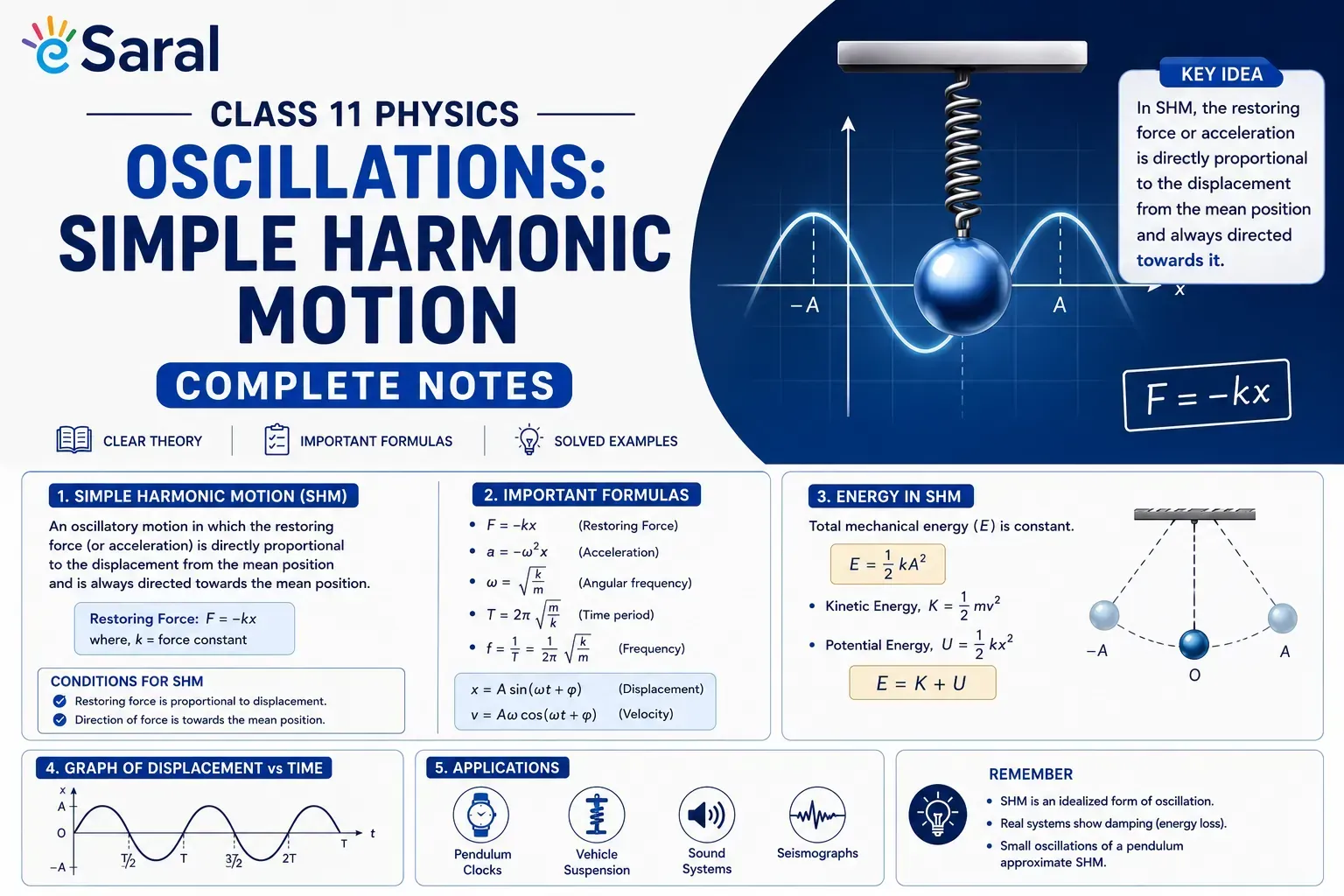
Oscillations is Chapter 13 of the current NCERT Class 11 Physics book (Chapter 14 in older books), and it is followed by Waves. In the JEE Main 2026 syllabus, it is part of the unit Oscillations and Waves. These Simple Harmonic Motion Notes follow the NCERT chapter and add the IIT JEE and NEET problem types.
Simple Harmonic Motion Notes: Chapter Overview and Syllabus
Topic | NCERT and CBSE (Class 11) | IIT JEE and NEET |
|---|---|---|
Periodic motion, period, frequency, displacement as a function of time | Yes | Yes |
SHM and its equation, phase | Yes | Yes |
Velocity and acceleration in SHM, SHM and uniform circular motion | Yes | Yes |
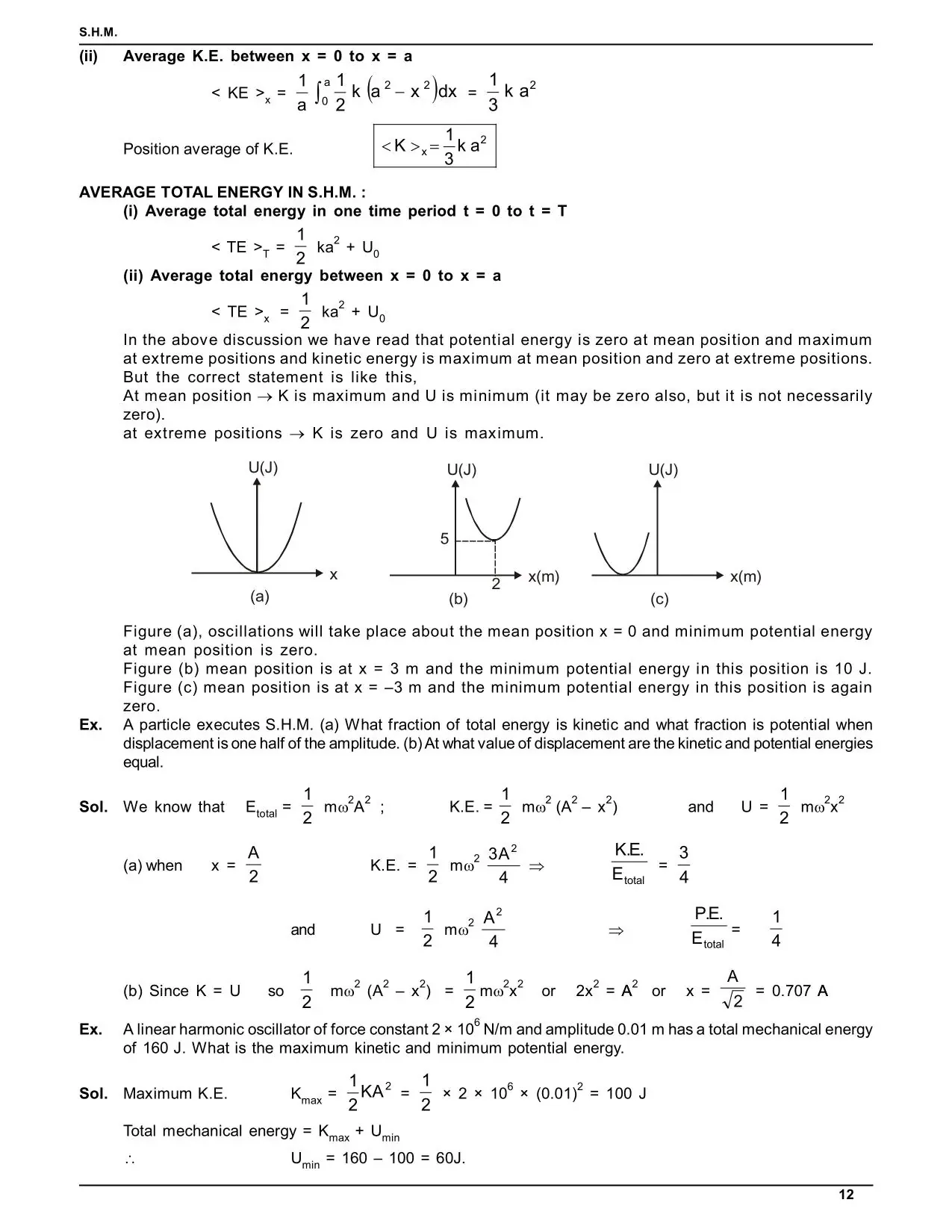
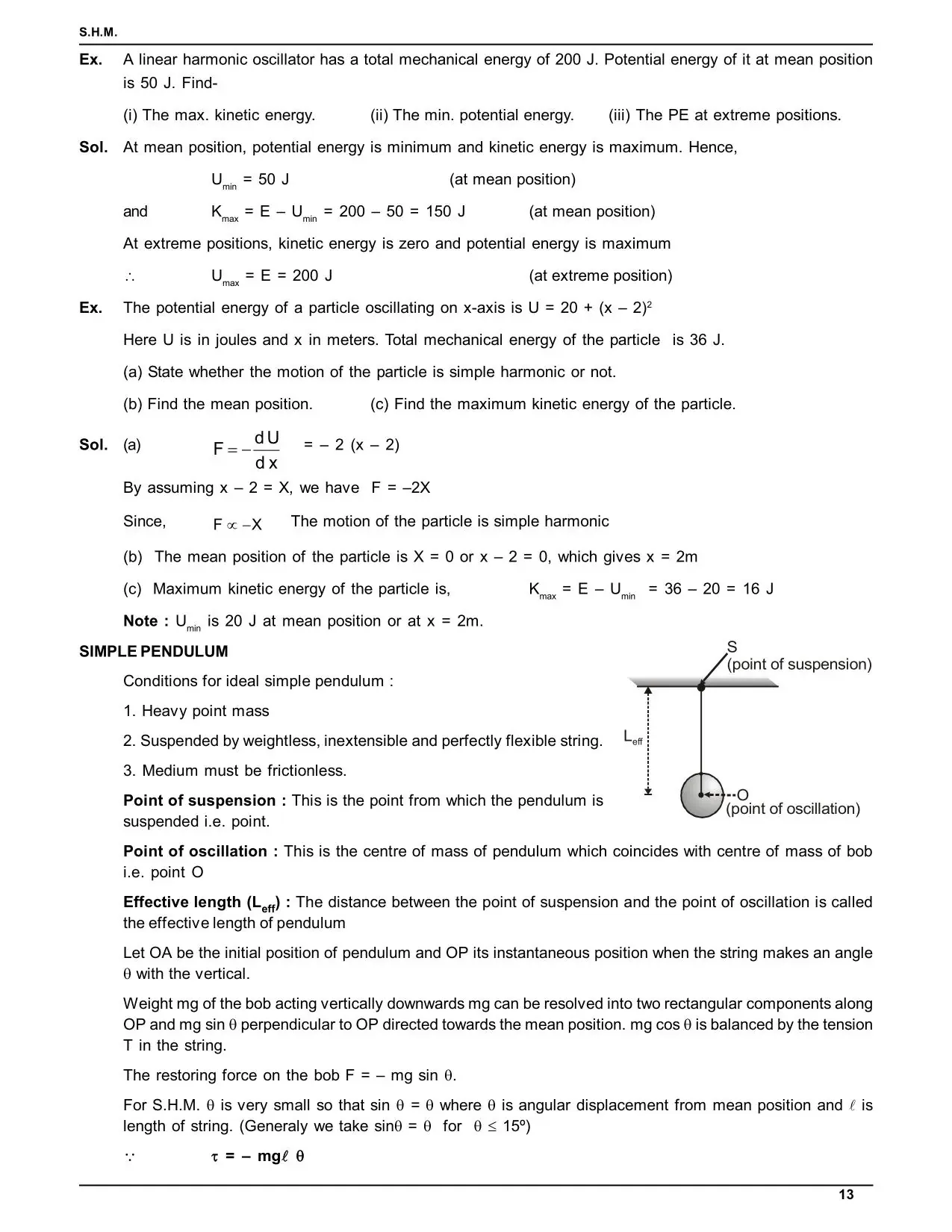
Energy in SHM (kinetic and potential) | Yes | Yes |
Oscillations of a loaded spring, restoring force and force constant | Yes | Yes (series and parallel combinations) |
Simple pendulum, derivation of its time period | Yes | Yes (variations in a lift, a liquid and a vehicle) |
Physical pendulum, torsional pendulum, floating body, U-tube | Not in the board syllabus | Common in IIT JEE problems |
Free, damped and forced oscillations, resonance | Check the latest CBSE syllabus | Qualitative questions |
Check the latest CBSE, NTA (JEE Main), JEE Advanced and NMC (NEET) syllabi for the exact lists. The number of questions changes every year, so use previous years’ papers to see the trend.
Tip from the eSaral Physics team: To prove or to use SHM, write the acceleration as $a = -\omega^{2}x$. Whatever the system is (a spring, a pendulum, a floating body), the coefficient of $-x$ is $\omega^{2}$, and the time period is $T = 2\pi/\omega$ at once.
Simple Harmonic Motion Notes for IIT JEE and NEET
India's Best Exam Preparation for Class 11th - Download Now
India's Best Exam Preparation for Class 11th - Download Now
India's Best Exam Preparation for Class 11th - Download Now
India's Best Exam Preparation for Class 11th - Download Now
India's Best Exam Preparation for Class 11th - Download Now
India's Best Exam Preparation for Class 11th - Download Now
India's Best Exam Preparation for Class 11th - Download Now
India's Best Exam Preparation for Class 11th - Download Now
Periodic and Oscillatory Motion in Simple Harmonic Motion Notes
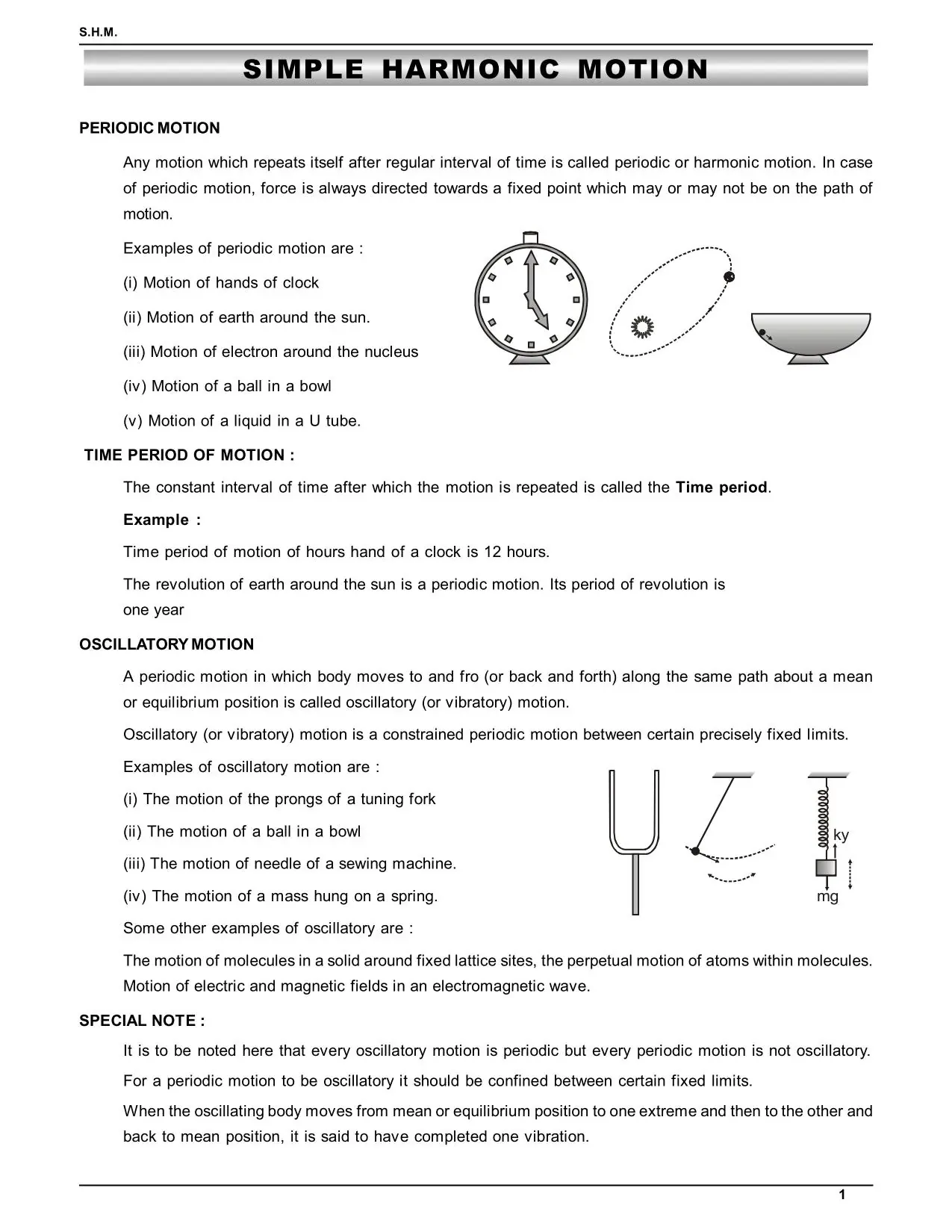
A motion that repeats itself after a fixed interval is periodic. A periodic motion in which a body moves back and forth about a mean position is oscillatory. All oscillatory motion is periodic, but not all periodic motion is oscillatory (for example, the uniform circular motion of a particle).
Term | Meaning | Relation |
|---|---|---|
Time period $T$ | Time for one complete oscillation | – |
Frequency $f$ | Number of oscillations per second (Hz) | $f = \dfrac{1}{T}$ |
Angular frequency $\omega$ | Rate of change of the phase (rad/s) | $\omega = 2\pi f = \dfrac{2\pi}{T}$ |
Amplitude $A$ | Maximum displacement from the mean position | – |
Simple Harmonic Motion: Definition and Equation in Simple Harmonic Motion Notes
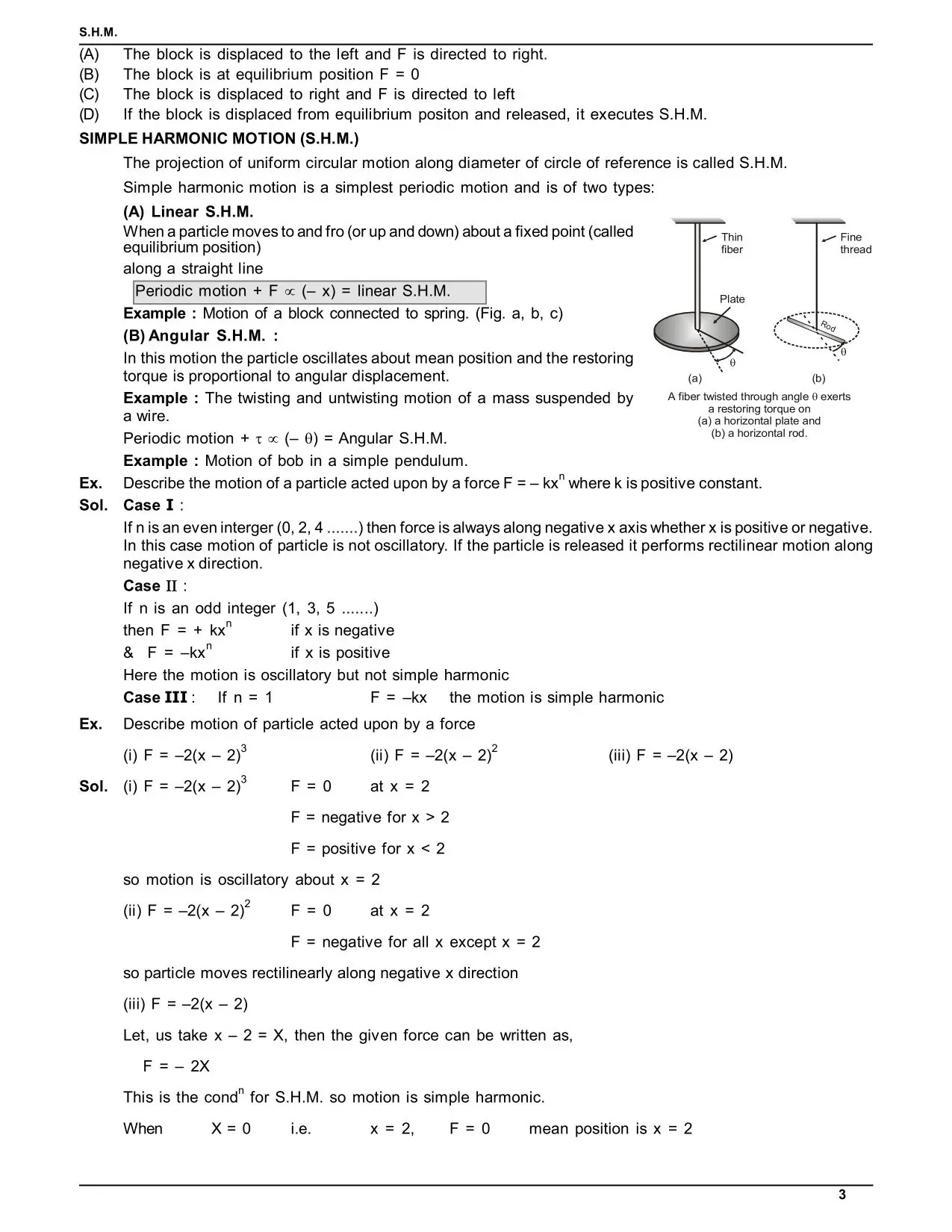
A particle executes simple harmonic motion if the restoring force on it is proportional to its displacement from the mean position and is always directed towards it:
$$F = -kx \quad \Rightarrow \quad a = -\omega^{2}x, \qquad \frac{d^{2}x}{dt^{2}} + \omega^{2}x = 0, \qquad \omega = \sqrt{\frac{k}{m}}$$
The solution of this equation is:
$$x(t) = A\sin(\omega t + \phi) \quad \text{or} \quad x(t) = A\cos(\omega t + \phi)$$
Here $(\omega t + \phi)$ is the phase, and $\phi$ is the initial phase (the phase constant). The time period is $T = \dfrac{2\pi}{\omega}$, and it does not depend on the amplitude (isochronous oscillation).
Periodic motion vs SHM: all SHM is periodic, but not all periodic motion is SHM. A particle that bounces between two walls with a constant speed is periodic, but it has no restoring force that is proportional to the displacement, so it is not SHM.
Velocity and Acceleration in SHM in Simple Harmonic Motion Notes
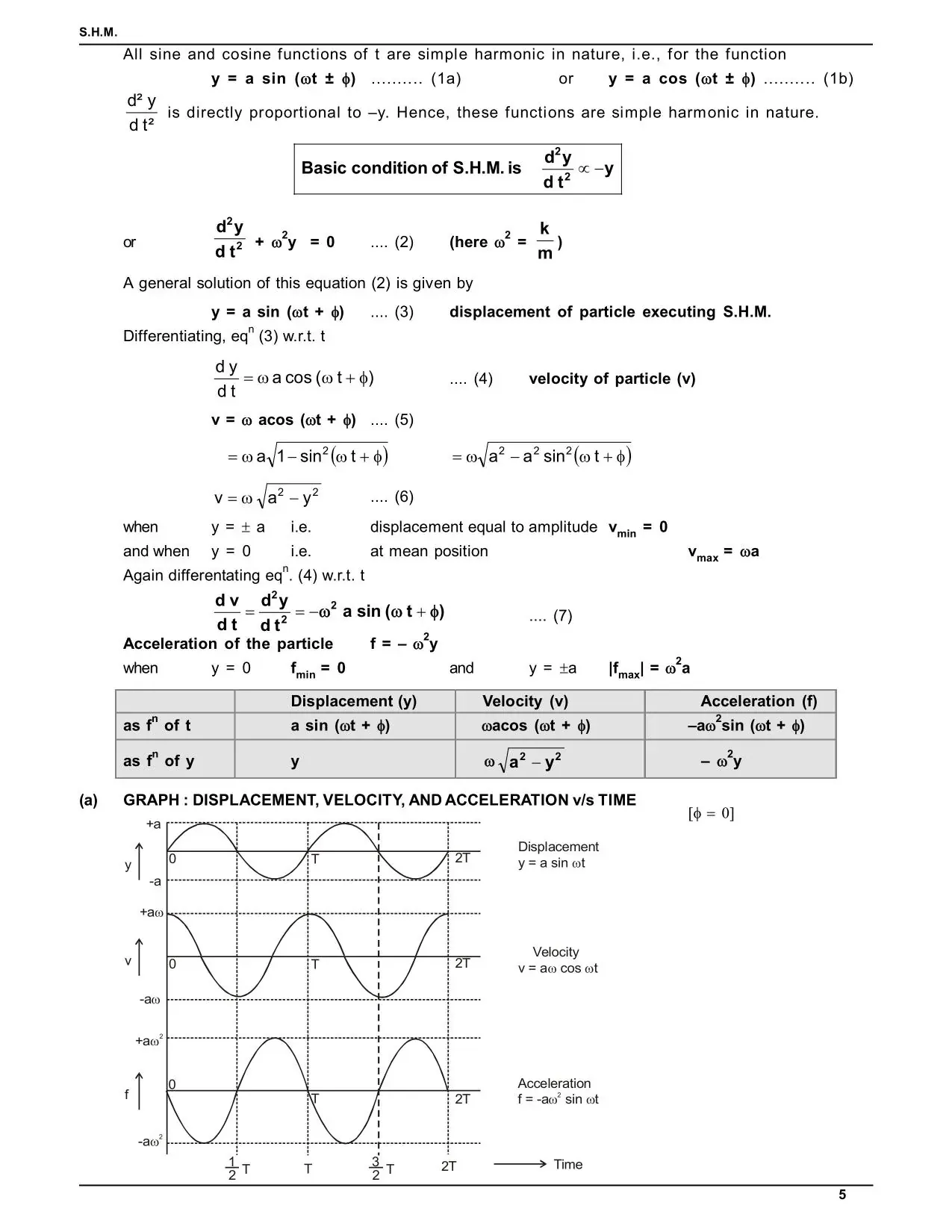
For $x = A\sin(\omega t + \phi)$:
Quantity | Expression | Maximum value, and where |
|---|---|---|
Displacement | $x = A\sin(\omega t + \phi)$ | $A$, at the extreme positions |
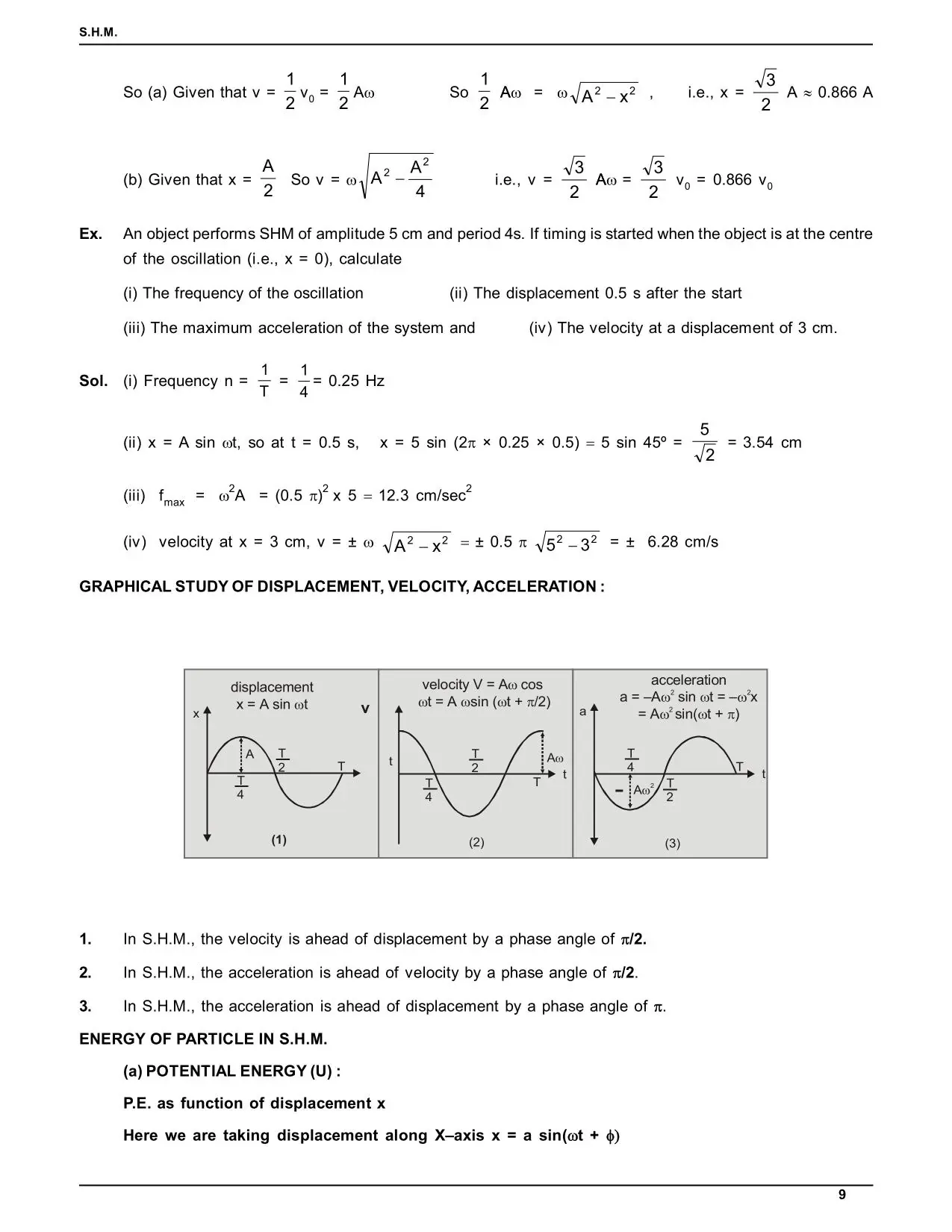
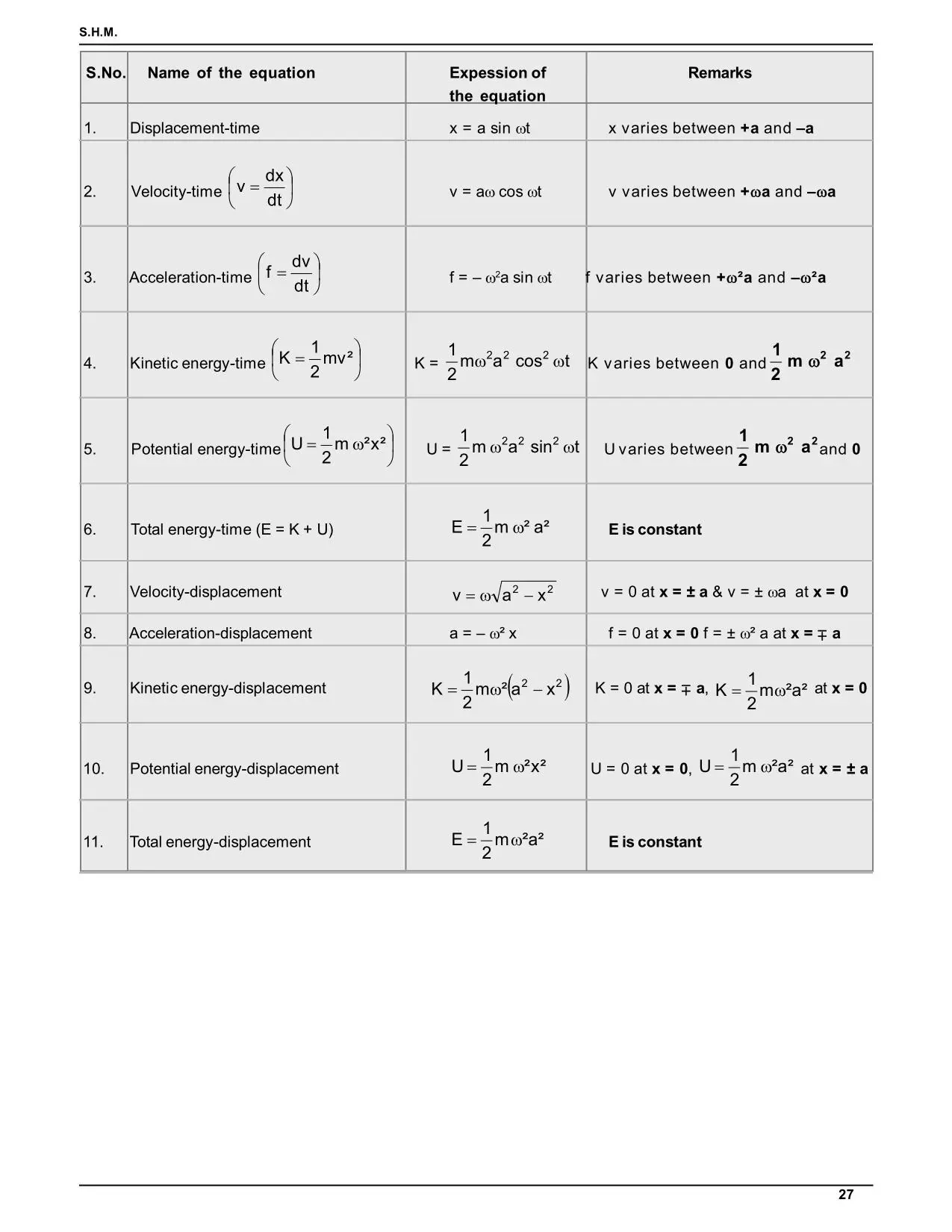
Velocity | $v = A\omega\cos(\omega t + \phi) = \pm\omega\sqrt{A^{2} - x^{2}}$ | $A\omega$, at the mean position ($x = 0$) |
Acceleration | $a = -\omega^{2}x$ | $\omega^{2}A$, at the extreme positions |
- At the mean position, $v$ is maximum and $a = 0$. At an extreme position, $v = 0$ and $\lvert a\rvert$ is maximum.
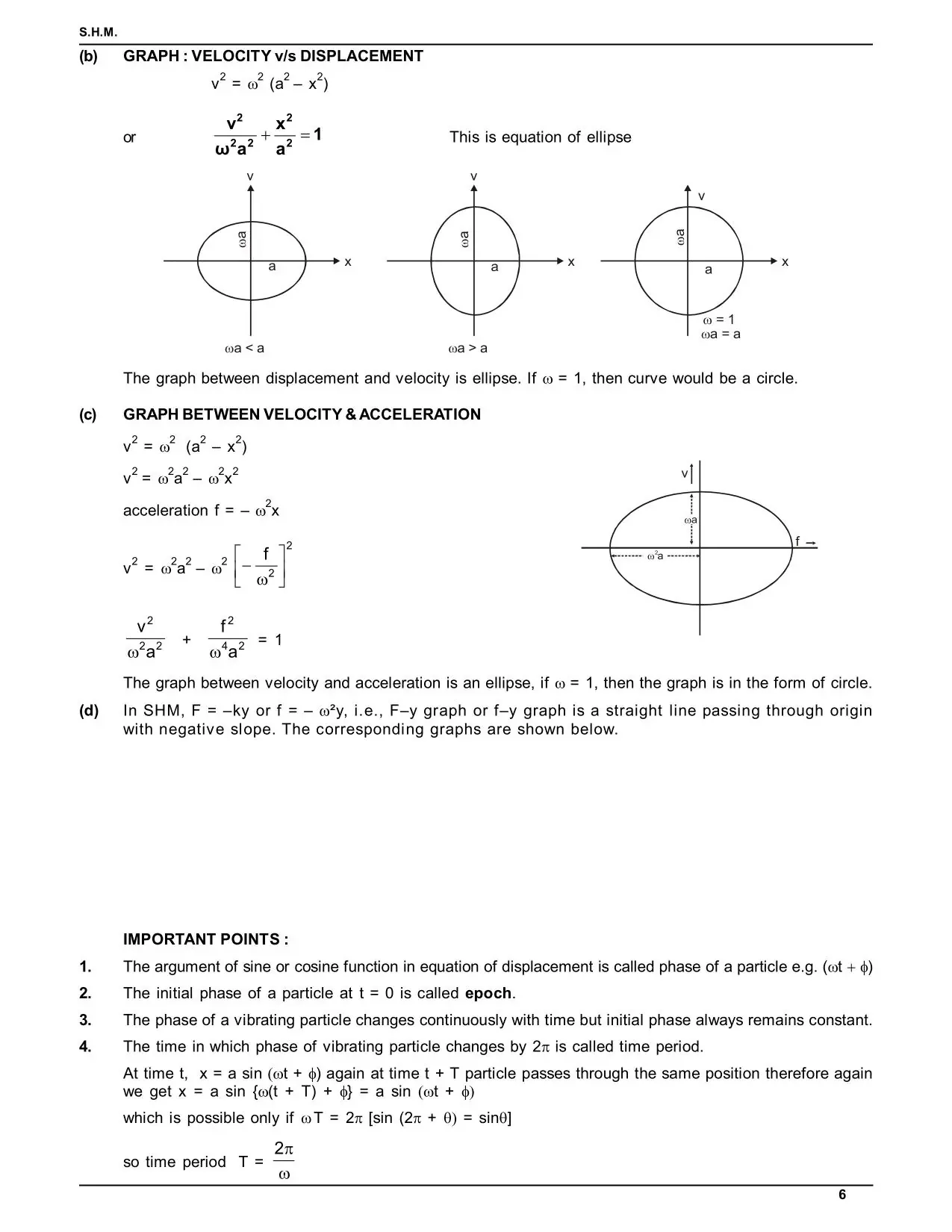
- The velocity leads the displacement by $\dfrac{\pi}{2}$, and the acceleration is in opposite phase to the displacement (a phase difference of $\pi$).
- The graphs of $x$, $v$ and $a$ against the time are all sine or cosine curves with the same period.
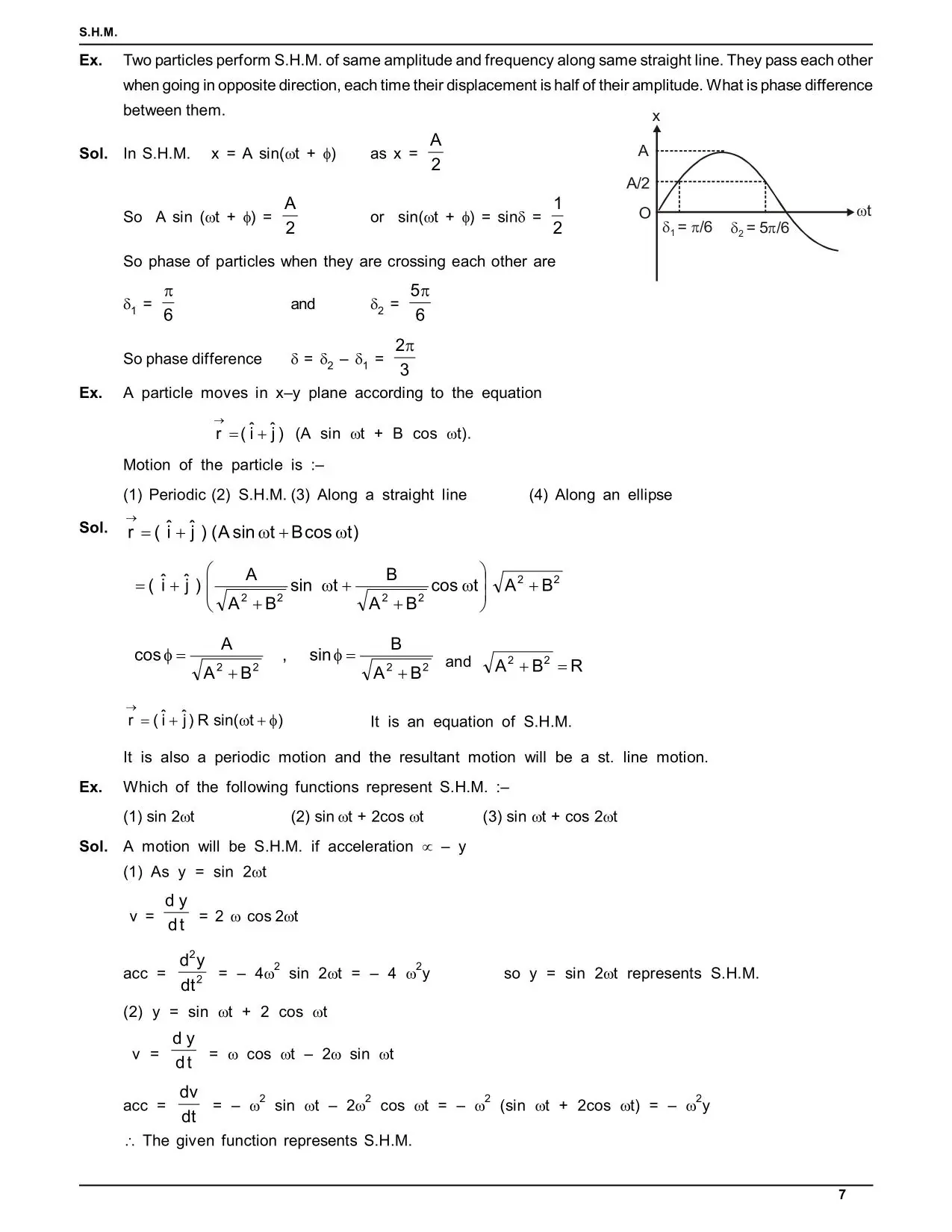
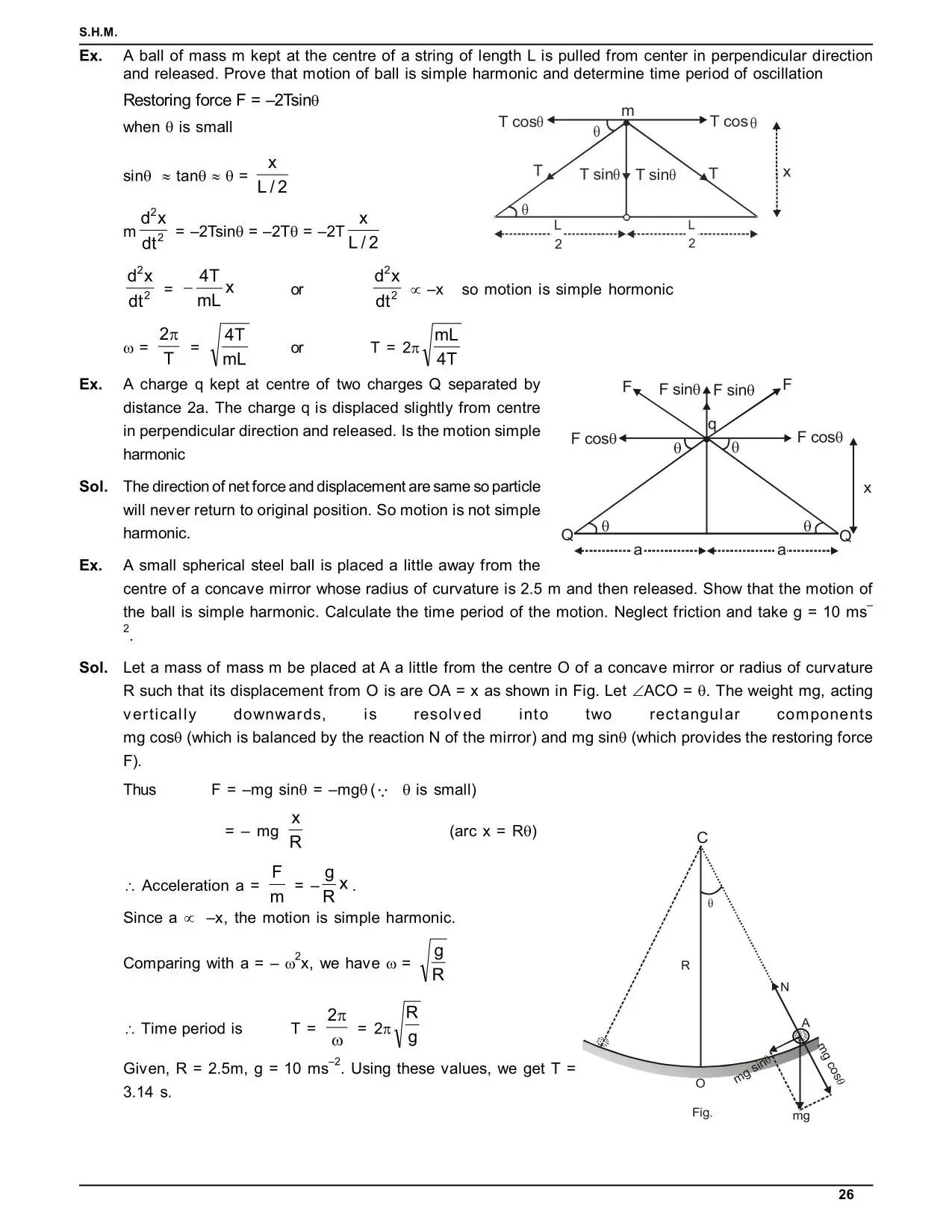
SHM and uniform circular motion: the projection of a particle that moves in a circle of radius $A$ with the angular speed $\omega$, on a diameter, executes SHM of amplitude $A$ and angular frequency $\omega$. This reference circle is a useful way to find the time taken between two positions: find the angle that the particle covers on the circle, and divide by $\omega$. For example, the time from $x = 0$ to $x = A/2$ is $\dfrac{\pi/6}{\omega} = \dfrac{T}{12}$.
Energy in SHM in Simple Harmonic Motion Notes
Energy | Expression |
|---|---|
Kinetic energy | $K = \tfrac{1}{2}mv^{2} = \tfrac{1}{2}m\omega^{2}(A^{2} - x^{2})$ |
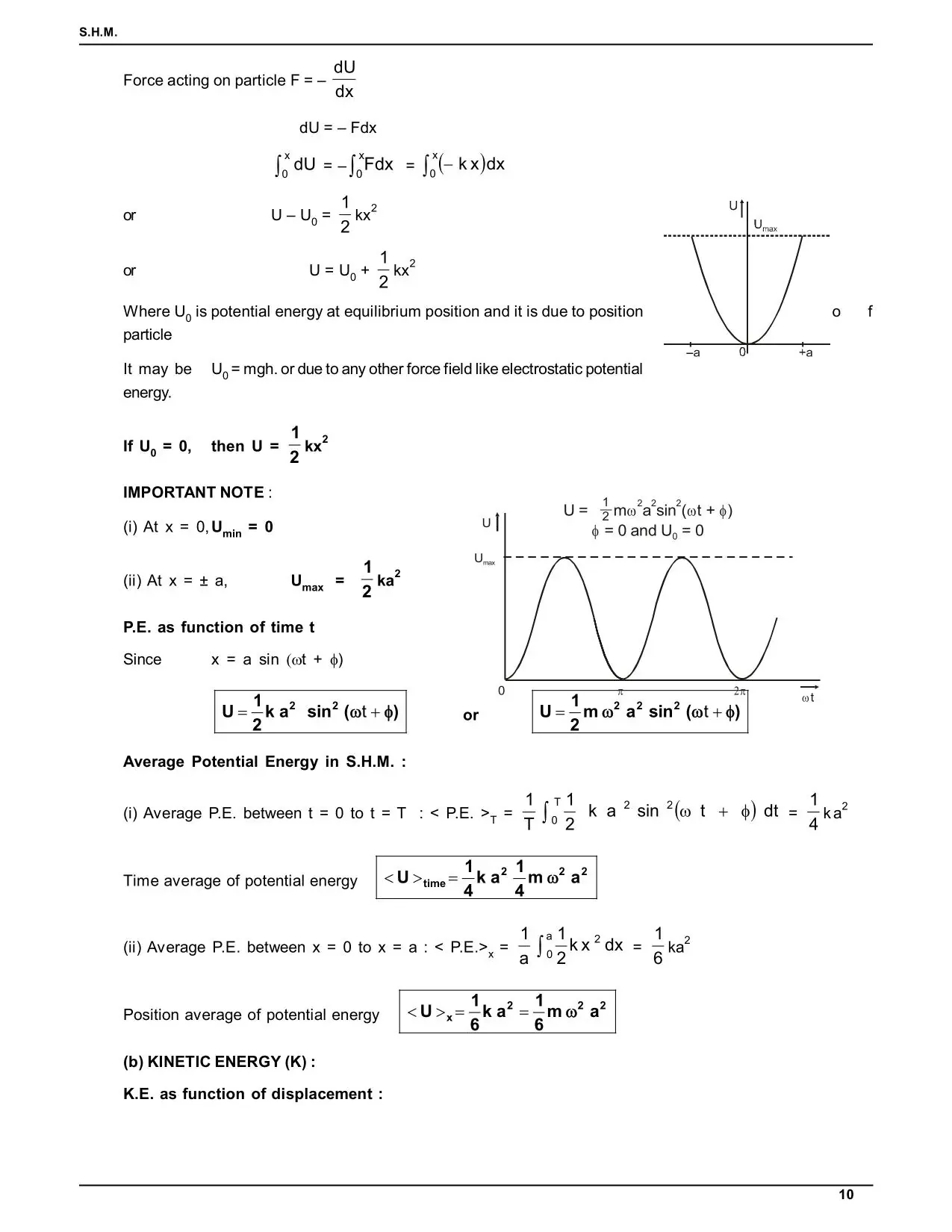
Potential energy | $U = \tfrac{1}{2}kx^{2} = \tfrac{1}{2}m\omega^{2}x^{2}$ |
Total energy | $E = K + U = \tfrac{1}{2}m\omega^{2}A^{2} = \tfrac{1}{2}kA^{2}$ (constant) |
- At the mean position, the energy is all kinetic, and at the extreme positions, it is all potential.
- $K = U$ at $x = \pm\dfrac{A}{\sqrt{2}}$.
- The time averages are $\langle K\rangle = \langle U\rangle = \dfrac{E}{2}$. The kinetic and the potential energies oscillate with the frequency $2f$, which is twice the frequency of the SHM.
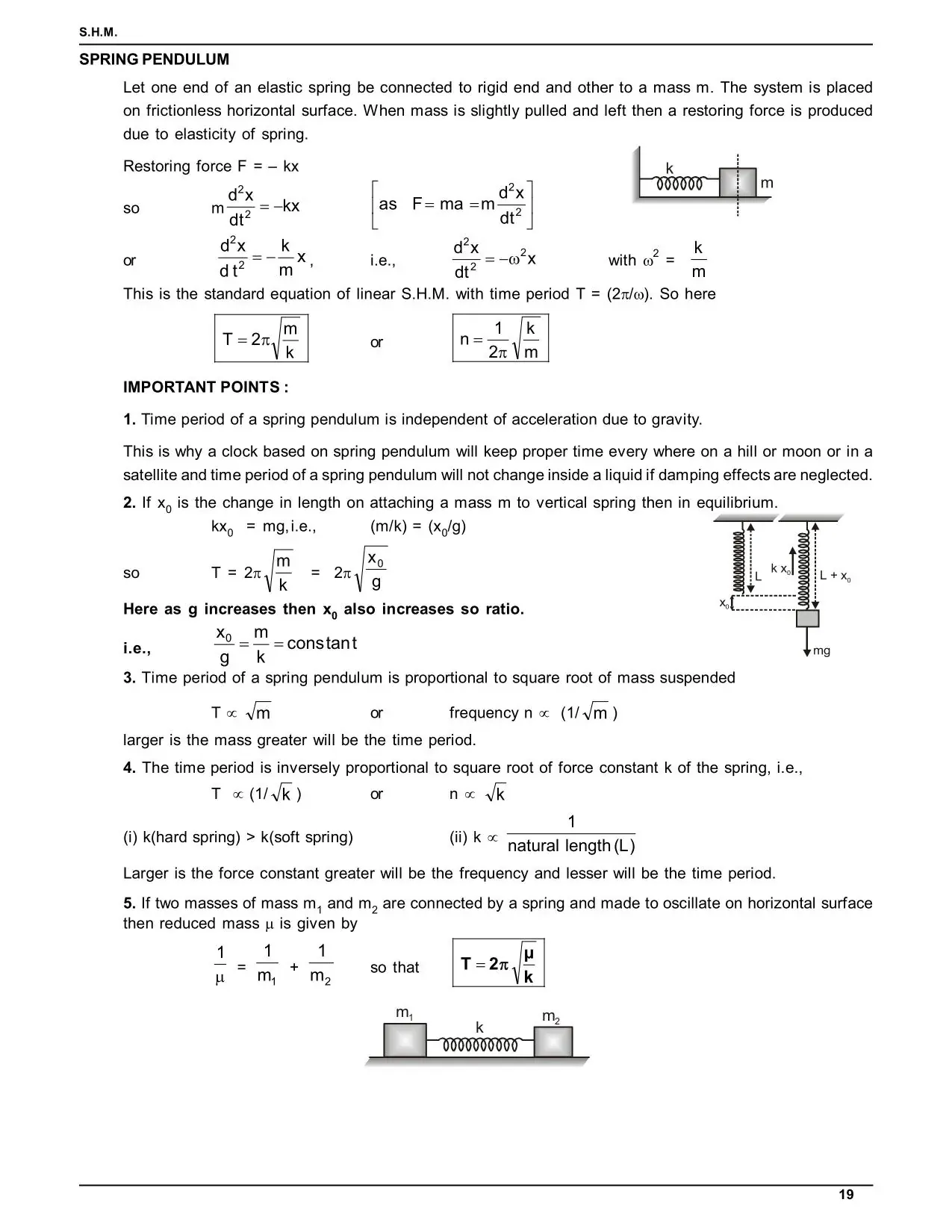
Spring–Mass System in Simple Harmonic Motion Notes
$$T = 2\pi\sqrt{\frac{m}{k}}, \qquad f = \frac{1}{2\pi}\sqrt{\frac{k}{m}}$$
- A vertical spring has the same time period, because gravity only shifts the mean position. If the extension at equilibrium is $x_0$ ($mg = kx_0$), then $T = 2\pi\sqrt{x_0/g}$.
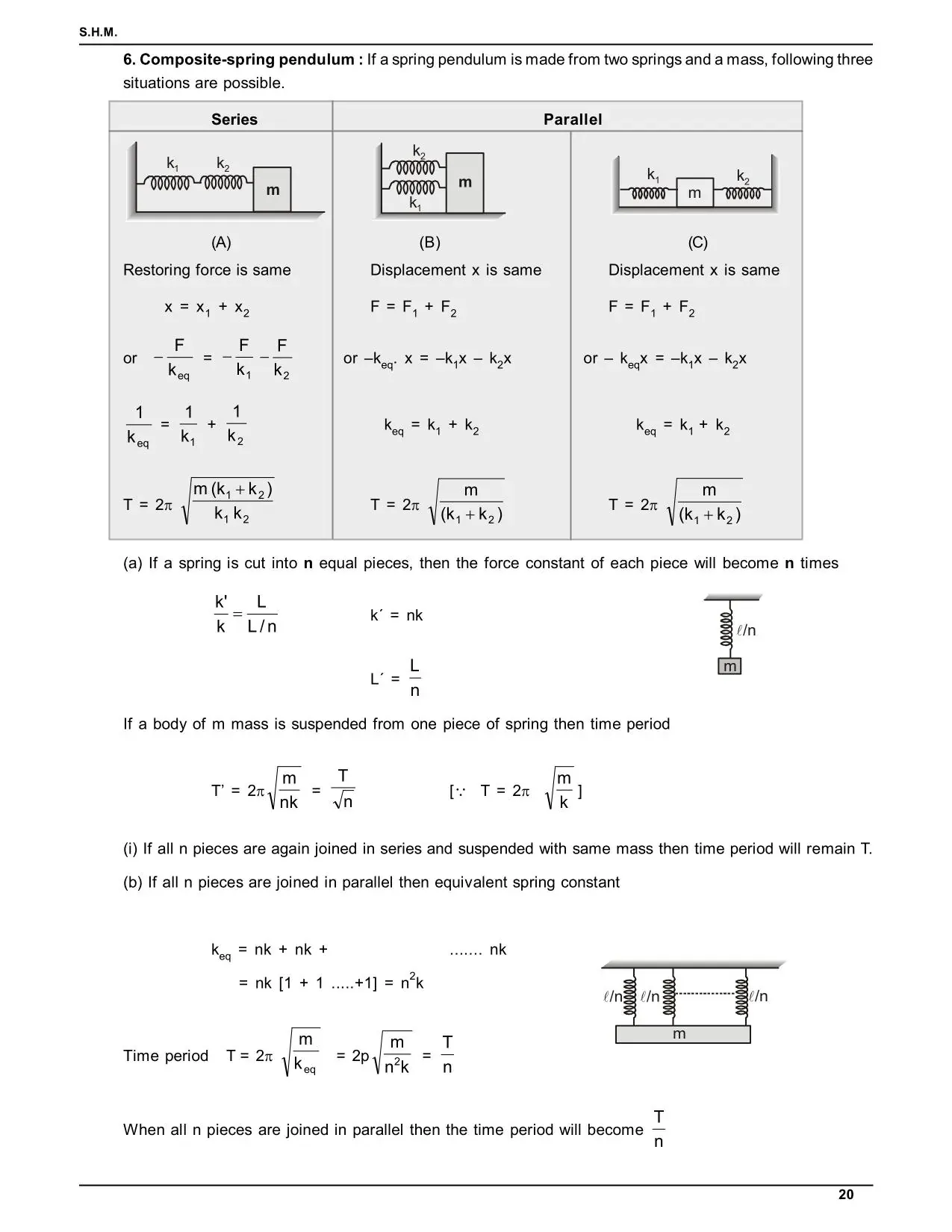
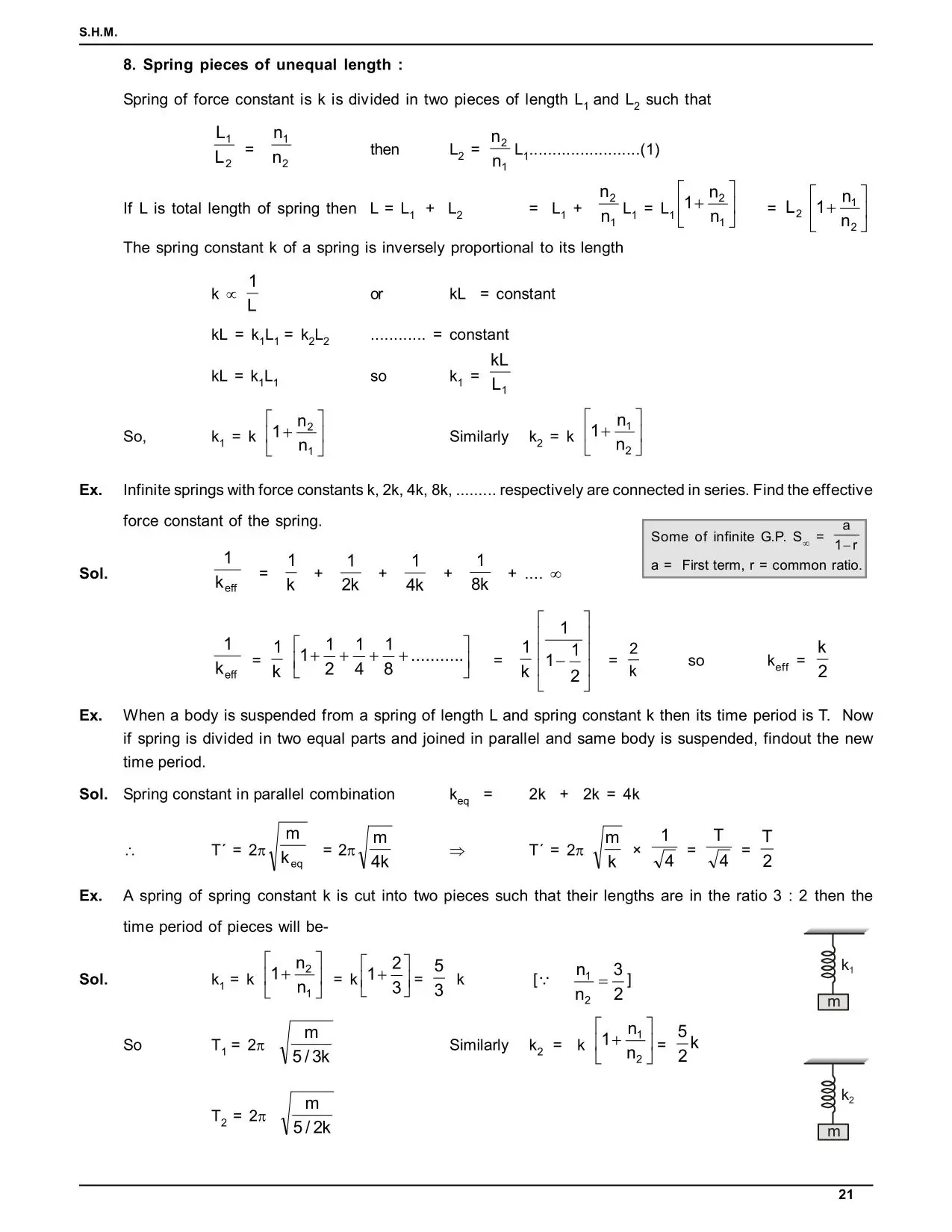
- Springs in parallel (or a mass between two springs): $k_{eq} = k_1 + k_2$. Springs in series: $\dfrac{1}{k_{eq}} = \dfrac{1}{k_1} + \dfrac{1}{k_2}$.
- The force constant is inversely proportional to the length of the spring. A spring cut into $n$ equal parts has the force constant $nk$ for each part.
- The time period of a spring does not change on the Moon or in a lift in free fall (the mean position changes, but $T$ does not).
Simple Pendulum in Simple Harmonic Motion Notes
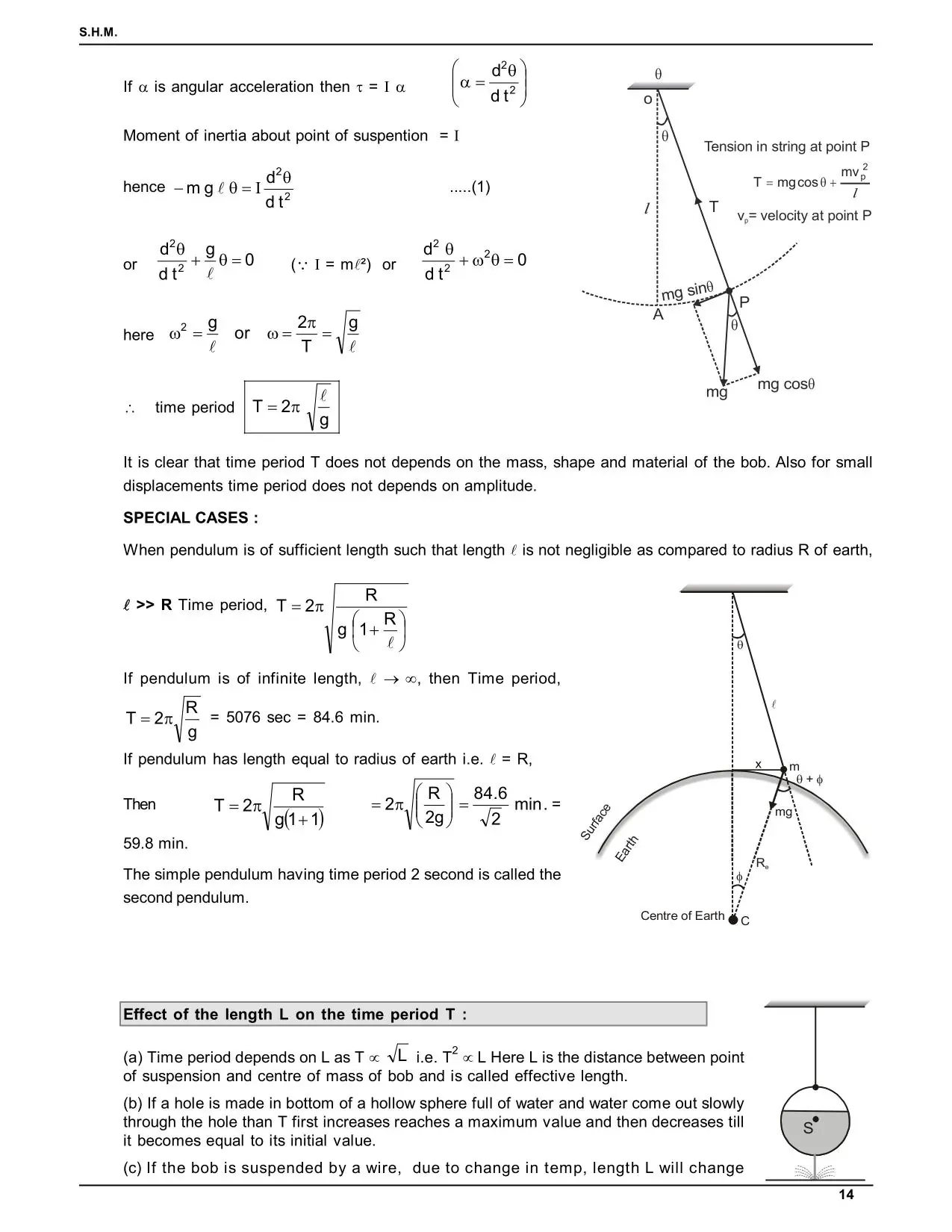
For small angles of oscillation (about $\theta < 15^\circ$, so that $\sin\theta \approx \theta$), the restoring torque gives $a = -\dfrac{g}{L}x$ along the arc, so:
$$T = 2\pi\sqrt{\frac{L}{g}}$$
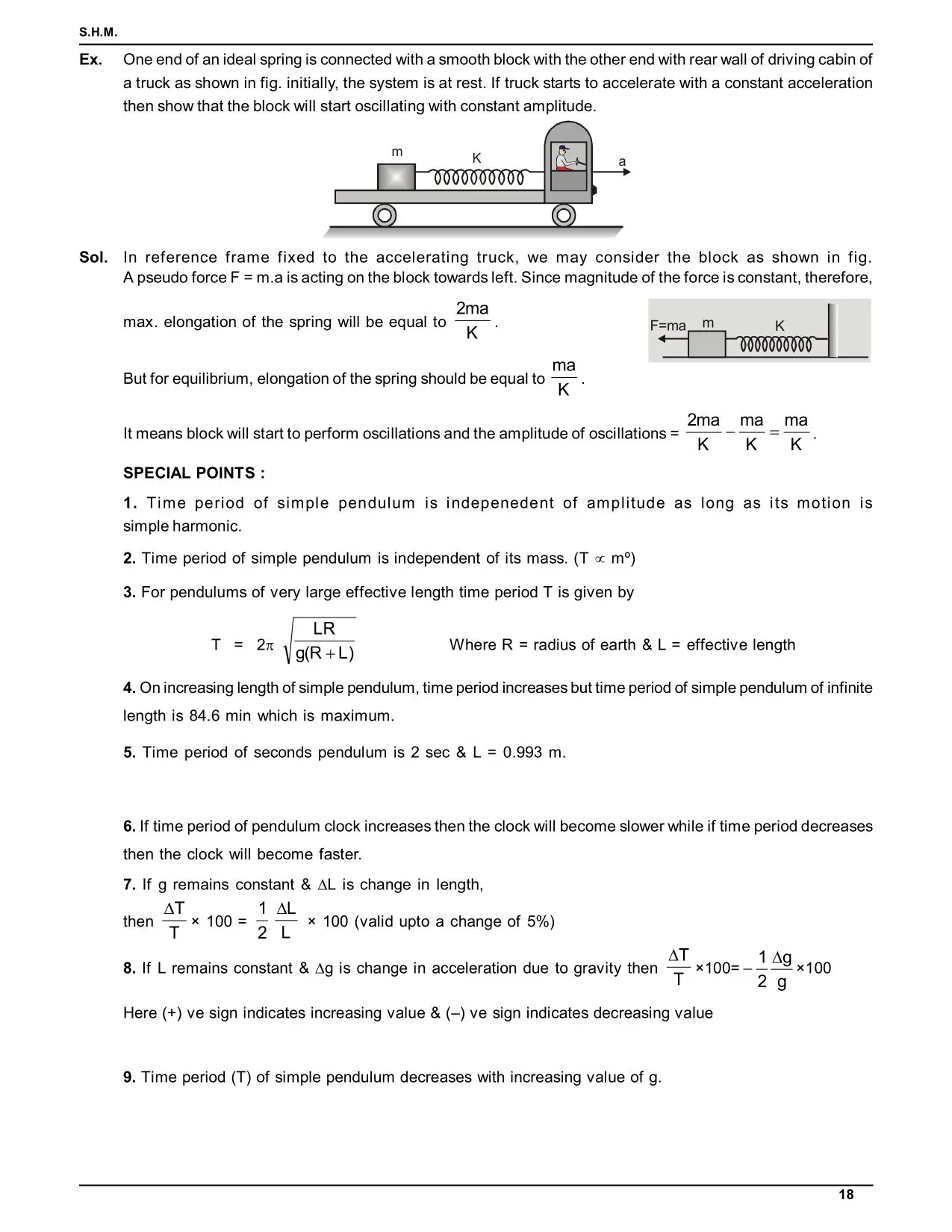
The time period depends on $L$ and $g$, and not on the mass of the bob or on the amplitude (for small angles). A seconds pendulum has $T = 2$ s, which gives $L \approx 1$ m on the Earth.
Situation | Effective $g$ and the time period |
|---|---|
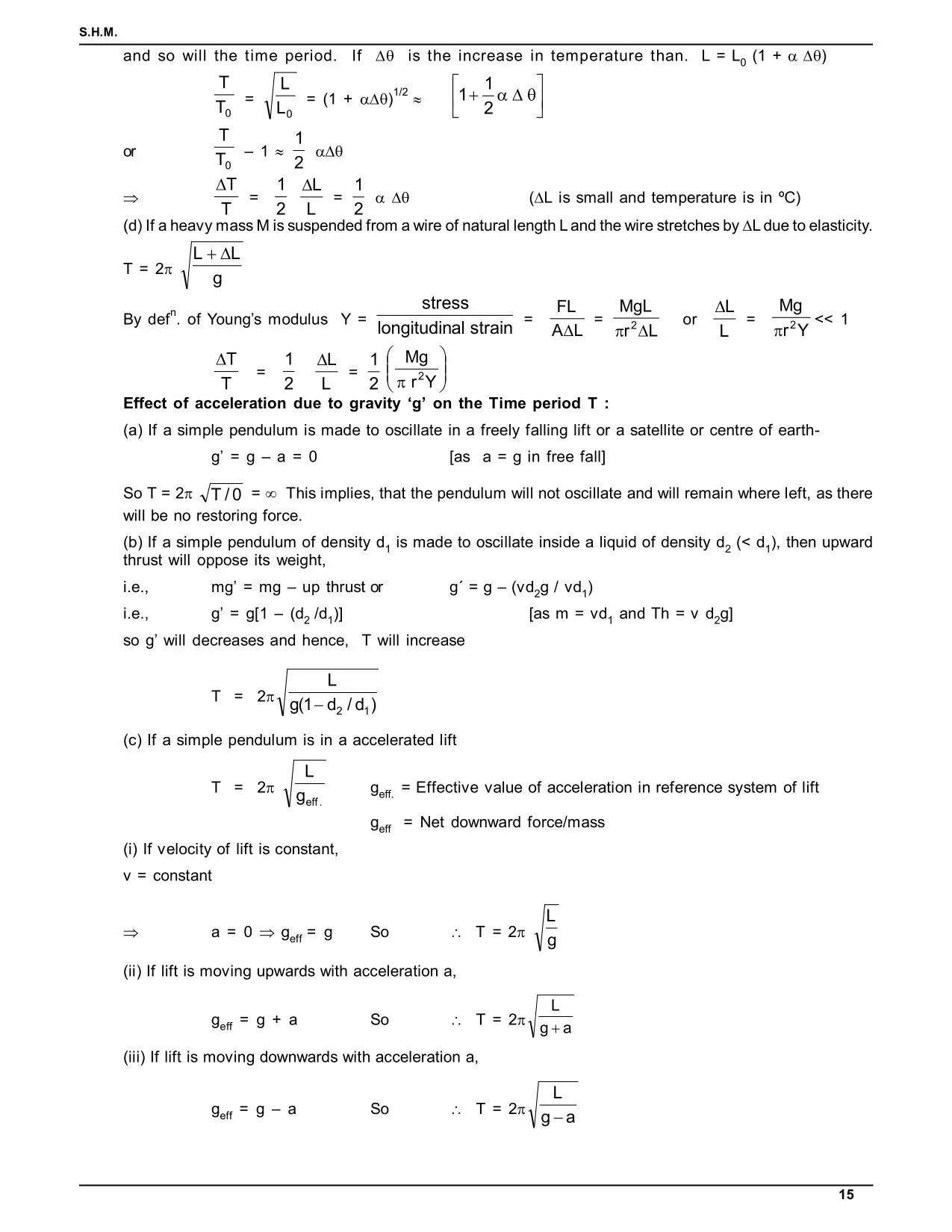
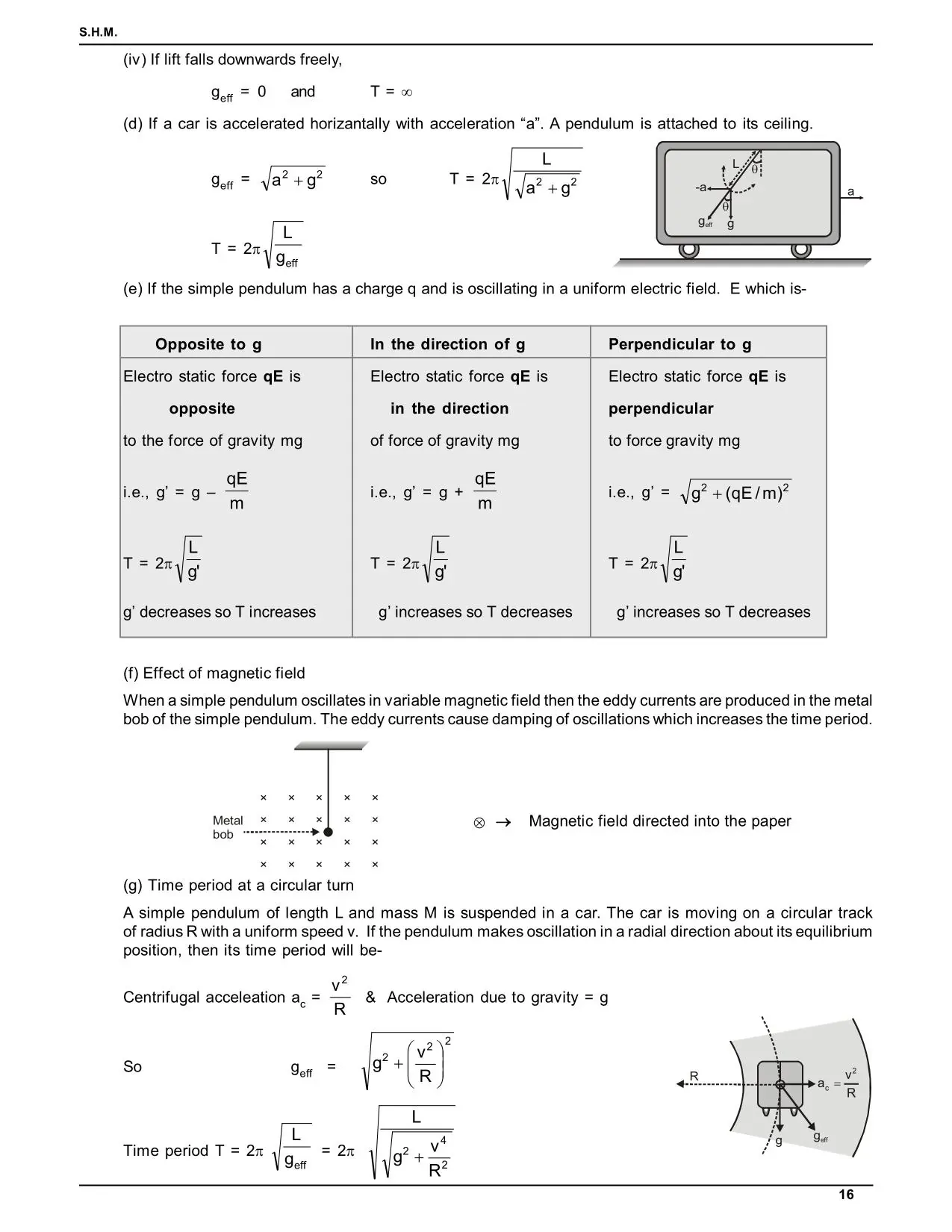
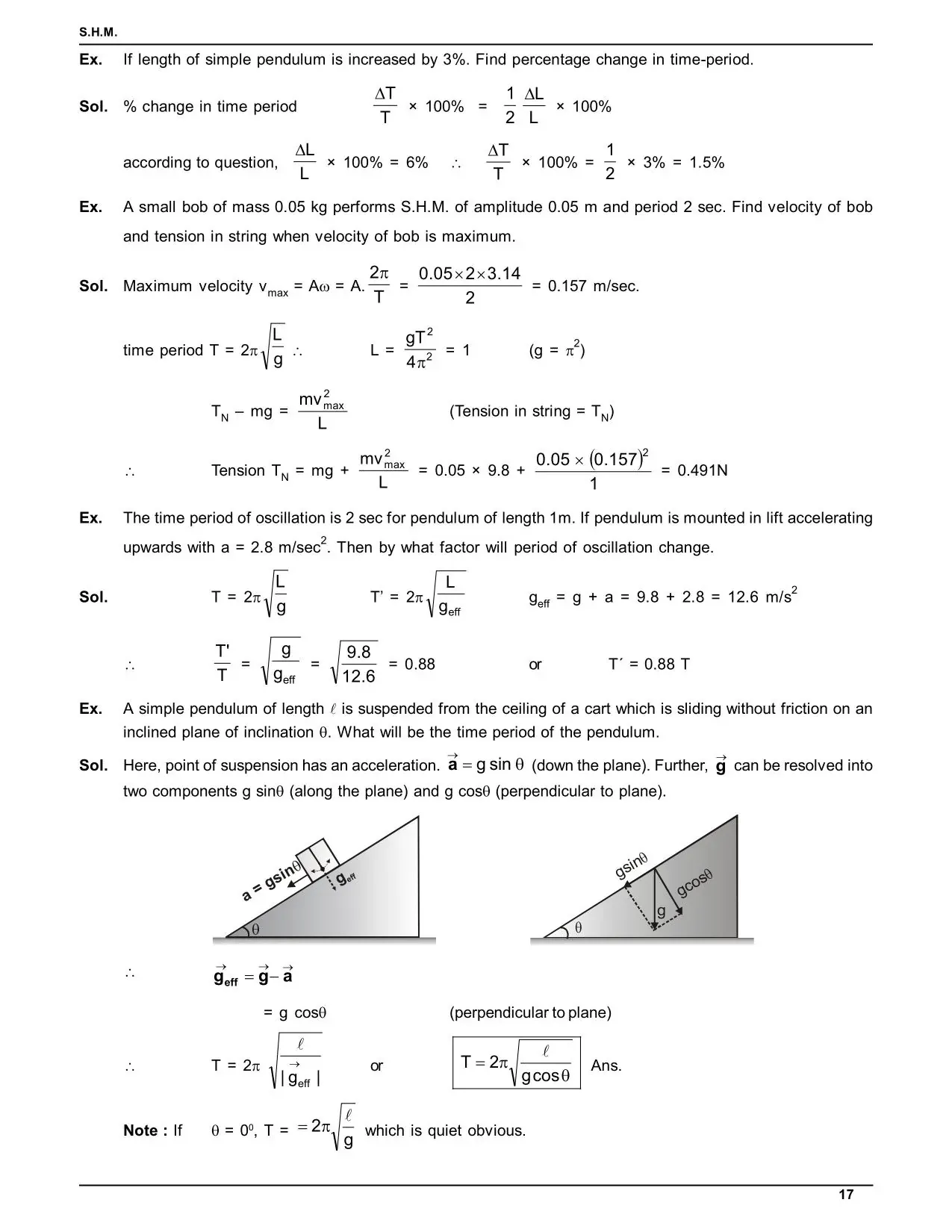
Lift accelerating upward with $a$ | $g_{eff} = g + a$, so $T$ decreases |
Lift accelerating downward with $a$ | $g_{eff} = g - a$, so $T$ increases |
Lift in free fall | $g_{eff} = 0$, so $T \to \infty$ (no oscillation) |
Vehicle accelerating horizontally with $a$ | $g_{eff} = \sqrt{g^{2} + a^{2}}$ |
Bob (density $\rho$) in a liquid (density $\rho_l$) | $g_{eff} = g\left(1 - \dfrac{\rho_l}{\rho}\right)$ |
A very long pendulum of the length $L$ ($R$ = radius of the Earth) | $T = 2\pi\sqrt{\dfrac{1}{g\left(\frac{1}{L} + \frac{1}{R}\right)}}$, so $T \to 2\pi\sqrt{R/g} \approx 84$ minutes for $L \to \infty$ |
If the length of the pendulum increases with the temperature, the clock loses time (the time period increases).
Other Oscillators for IIT JEE in Simple Harmonic Motion Notes
System | Time period |
|---|---|
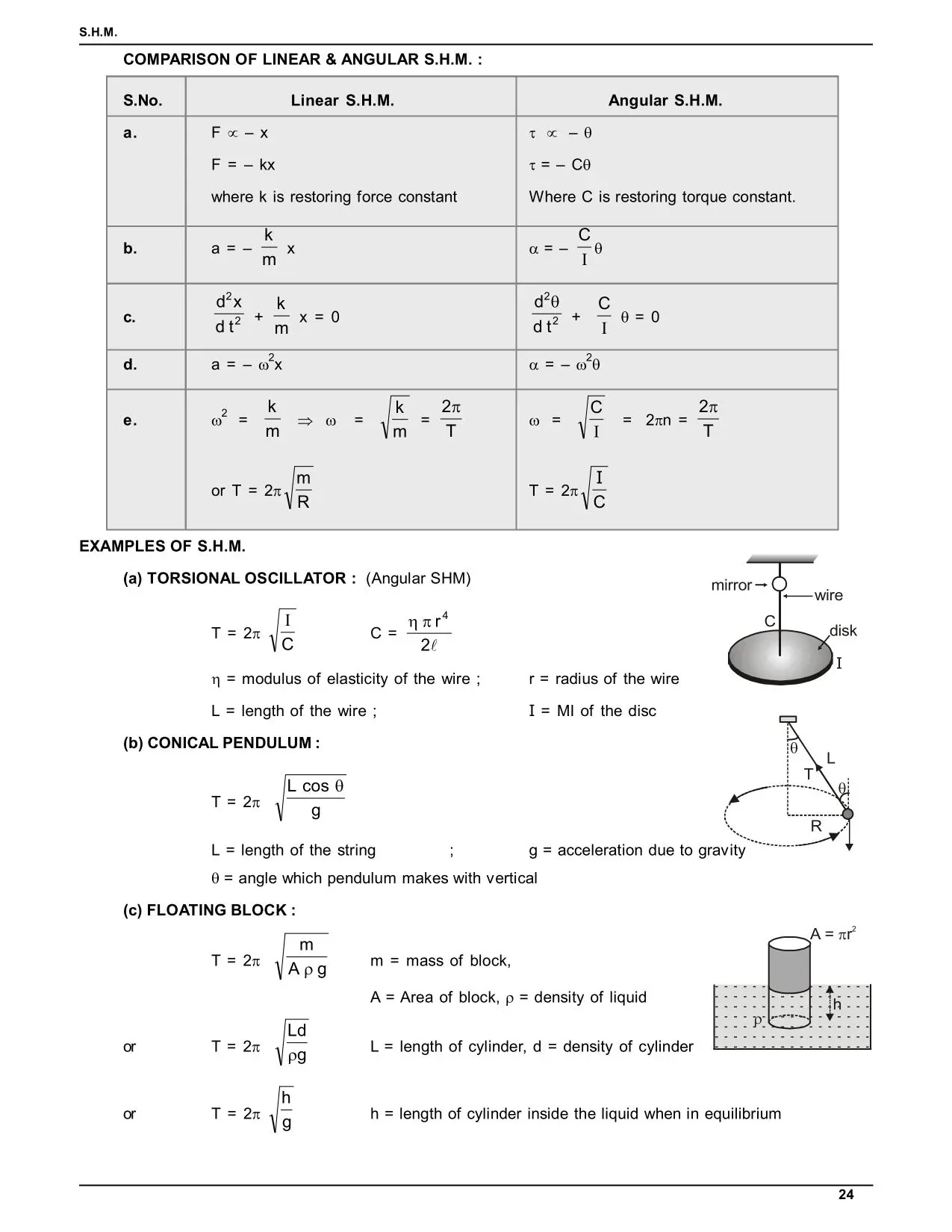
Physical (compound) pendulum, with the moment of inertia $I$ about the pivot and the distance $d$ from the pivot to the centre of mass | $T = 2\pi\sqrt{\dfrac{I}{mgd}}$ |
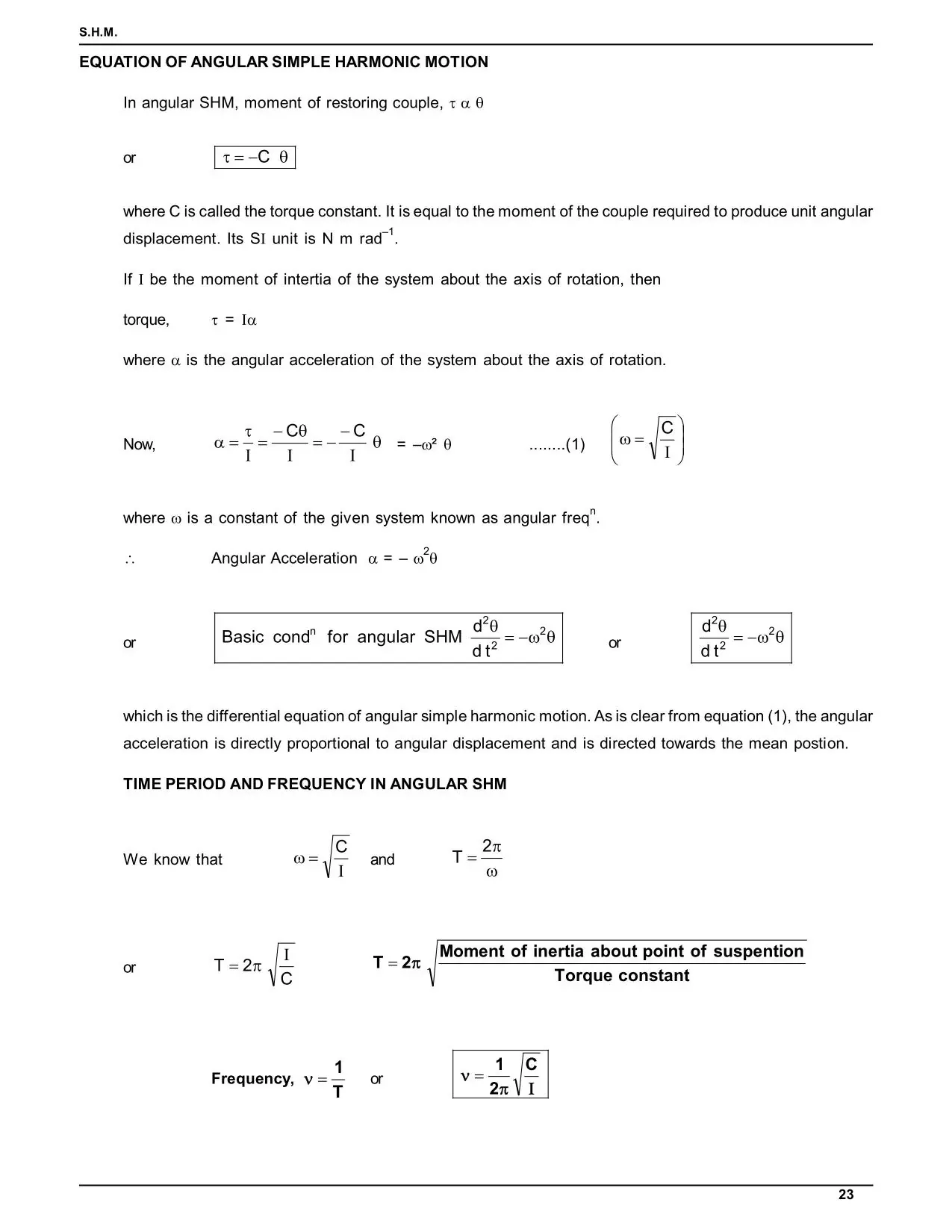
Torsional pendulum, with the torsional constant $C$ | $T = 2\pi\sqrt{\dfrac{I}{C}}$ |
A cylinder of mass $m$ and cross-section $A$ floating in a liquid of density $\rho_l$ | $T = 2\pi\sqrt{\dfrac{m}{A\rho_lg}}$ |
Liquid in a U-tube (the total length of the liquid column $L$) | $T = 2\pi\sqrt{\dfrac{L}{2g}}$ |
Superposition of two SHMs of the same angular frequency along the same line, with the amplitudes $A_1$ and $A_2$ and the phase difference $\phi$, gives another SHM of the same frequency:
$$A = \sqrt{A_1^{2} + A_2^{2} + 2A_1A_2\cos\phi}$$
Free, Damped and Forced Oscillations and Resonance in Simple Harmonic Motion Notes
- Free oscillations go on with the natural frequency $\omega_0 = \sqrt{k/m}$ and a constant amplitude (an ideal case).
- Damped oscillations: a resistive force (for example $-bv$) takes energy from the system, so the amplitude decreases. For light damping:
$$x(t) = A_0e^{-bt/2m}\cos(\omega' t + \phi), \qquad \omega' = \sqrt{\frac{k}{m} - \frac{b^{2}}{4m^{2}}}$$
The energy falls as $E \propto e^{-bt/m}$. With critical or heavy damping, the system returns to equilibrium without oscillating (critical damping is the fastest return).
- Forced oscillations: a periodic external force of the angular frequency $\omega_d$ drives the system. After a short time, the system oscillates with $\omega_d$, and resonance occurs when $\omega_d \approx \omega_0$: the amplitude becomes maximum. Examples are a swing that is pushed at the right moments, the tuning of a radio and the failure of a bridge under marching soldiers.
Key Formulas in Simple Harmonic Motion Notes
Concept | Formula |
|---|---|
SHM equation | $a = -\omega^{2}x$, $x = A\sin(\omega t + \phi)$ |
Velocity | $v = \omega\sqrt{A^{2} - x^{2}}$, $v_{max} = A\omega$ |
Maximum acceleration | $a_{max} = \omega^{2}A$ |
Total energy | $E = \tfrac{1}{2}m\omega^{2}A^{2}$ |
Spring–mass | $T = 2\pi\sqrt{m/k}$ |
Springs | Parallel: $k_1 + k_2$. Series: $\frac{1}{k} = \frac{1}{k_1} + \frac{1}{k_2}$ |
Simple pendulum | $T = 2\pi\sqrt{L/g}$ |
Physical pendulum | $T = 2\pi\sqrt{I/mgd}$ |
Superposition of two SHMs | $A = \sqrt{A_1^2 + A_2^2 + 2A_1A_2\cos\phi}$ |
IIT JEE and NEET Problem Tips in Simple Harmonic Motion Notes
- Check for SHM: find the net force (or torque) as a function of the displacement. If it is $-(\text{constant})\times x$, it is SHM, and the constant gives $\omega^{2}$.
- Use the reference circle for the time between two positions, and for the phase.
- Use the energy method when the force is not easy to find: $E = \tfrac{1}{2}m\omega^{2}A^{2}$, and $v = \omega\sqrt{A^{2} - x^{2}}$ for the speed at any displacement.
- Spring problems: cut, series and parallel changes only $k$, and the mass is the same. Do not use the length of the spring in $T$ except through $k \propto 1/\text{length}$.
- Pendulum problems: find $g_{eff}$ first, because a lift, a vehicle and a liquid only change $g_{eff}$.
Solved Examples from Simple Harmonic Motion Notes
Example 1 (reading the equation): A particle moves as $x = 0.05\sin\left(10\pi t + \dfrac{\pi}{6}\right)$ (SI units). Find the amplitude, the frequency, the time period and the initial phase.
$A = 0.05$ m. $\omega = 10\pi$ rad/s, so $f = \dfrac{\omega}{2\pi} = 5$ Hz and $T = 0.2$ s. The initial phase is $\dfrac{\pi}{6}$.
Example 2 (maximum velocity and acceleration): A particle executes SHM with the amplitude 10 cm and the time period 2 s. Find $v_{max}$ and $a_{max}$.
$\omega = \dfrac{2\pi}{T} = \pi$ rad/s. $v_{max} = A\omega = 0.1\pi \approx 0.314$ m/s. $a_{max} = \omega^{2}A = 0.1\pi^{2} \approx 0.987$ m/s$^{2}$.
Example 3 (speed at a displacement): The amplitude is 5 cm and $\omega = 4$ rad/s. Find the speed at $x = 3$ cm.
$v = \omega\sqrt{A^{2} - x^{2}} = 4\sqrt{25 - 9} = 16$ cm/s.
Example 4 (spring): A mass of 0.5 kg is attached to a spring of the force constant 200 N/m. Find the time period and the frequency.
$T = 2\pi\sqrt{\dfrac{0.5}{200}} = 2\pi \times 0.05 \approx 0.314$ s, and $f \approx 3.18$ Hz.
Example 5 (energy): A particle of mass 0.1 kg has $\omega = 10$ rad/s and $A = 0.1$ m. Find its total energy.
$E = \tfrac{1}{2}m\omega^{2}A^{2} = \tfrac{1}{2}\times 0.1\times 100\times 0.01 = 0.05$ J.
Example 6 (where $K = U$): For the particle of Example 5, at what displacement are the kinetic and the potential energies equal?
$x = \dfrac{A}{\sqrt{2}} = \dfrac{0.1}{1.414} \approx 0.0707$ m, which is 7.07 cm.
Example 7 (springs in series and parallel): Two springs, each of $k = 100$ N/m, are connected to a 1 kg mass in series and in parallel. Find the time periods.
Series: $k_{eq} = 50$ N/m, so $T = 2\pi\sqrt{\dfrac{1}{50}} \approx 0.89$ s. Parallel: $k_{eq} = 200$ N/m, so $T = 2\pi\sqrt{\dfrac{1}{200}} \approx 0.44$ s. The ratio of the two time periods is $\sqrt{4} = 2$.
Example 8 (a pendulum in a lift): A simple pendulum of length 1 m is in a lift that accelerates upward at 2 m/s$^{2}$ ($g = 9.8$ m/s$^{2}$). Find its time period.
$T = 2\pi\sqrt{\dfrac{1}{9.8 + 2}} \approx 1.83$ s (compared with $2.01$ s at rest).
Example 9 (a seconds pendulum): Find the length of a seconds pendulum ($g = 9.8$ m/s$^{2}$).
$L = \dfrac{gT^{2}}{4\pi^{2}} = \dfrac{9.8\times 4}{39.48} \approx 0.99$ m.
Example 10 (a floating cylinder): A cylinder of mass 0.5 kg and cross-section 20 cm$^{2}$ floats upright in water. It is pushed down slightly and released. Find the time period ($\rho_l = 1000$ kg/m$^3$).
$T = 2\pi\sqrt{\dfrac{m}{A\rho_lg}} = 2\pi\sqrt{\dfrac{0.5}{20\times10^{-4}\times1000\times9.8}} = 2\pi\sqrt{\dfrac{0.5}{19.6}} \approx 1.0$ s.
Example 11 (liquid in a U-tube): A liquid column of the total length 0.4 m oscillates in a U-tube. Find the time period.
$T = 2\pi\sqrt{\dfrac{L}{2g}} = 2\pi\sqrt{\dfrac{0.4}{19.6}} \approx 0.90$ s.
Example 12 (superposition): Two SHMs of the same frequency along the same line have the amplitudes 3 cm and 4 cm and a phase difference of $90^\circ$. Find the resultant amplitude.
$A = \sqrt{9 + 16 + 2(3)(4)\cos 90^\circ} = 5$ cm.
Common Mistakes in Simple Harmonic Motion Notes Problems
Mistake | Correct approach |
|---|---|
Saying that any periodic motion is SHM | SHM needs a restoring force proportional to the displacement |
Taking the time period of a spring as dependent on the amplitude | It depends only on $m$ and $k$ |
Using the pendulum formula for a large angle | $T = 2\pi\sqrt{L/g}$ holds only for small angles |
Putting the mass of the bob in the pendulum formula | The time period does not depend on the mass |
Forgetting that $K$ and $U$ oscillate at the frequency $2f$ | The energy has a period of $T/2$ |
Using the velocity formula $v = A\omega\cos(\omega t)$ at a given displacement | Use $v = \omega\sqrt{A^{2} - x^{2}}$ |
Adding $k$ for springs in series | In series, $\dfrac{1}{k_{eq}} = \sum\dfrac{1}{k_i}$, and in parallel, $k_{eq} = \sum k_i$ |
Using $g$ in a lift problem | Use $g_{eff} = g \pm a$ |
How to Study Simple Harmonic Motion Notes
- Read the NCERT chapter first, and download the textbook from eSaral’s NCERT books for Class 11 page.
- Learn the SHM equation and the table of $x$, $v$ and $a$, then the energy formulas, then the spring and the pendulum, and last the other oscillators and damping.
- Practise one problem each on the equation of SHM, the time between two positions, energy, spring combinations, a pendulum in a lift and a floating body.
- Go to the next chapter with eSaral’s Waves Physics Class 11 notes, and revise with eSaral’s Class 11 Physics notes and the free Physics revision series on YouTube.
- Test yourself with eSaral’s JEE Main chapter-wise PYQs and NEET chapter-wise PYQs.
Click Here for Complete Physics Revision Series by Saransh Gupta Sir (AIR-41) About Saransh Gupta Sir: Computer Science Graduate from IIT Bombay. Cracked IIT-JEE with AIR-41 and AIEEE (JM) with AIR-71 in 2006. He is the author of the JEE Mentorship Book “StrateJEE”. He taught Physics for 5 years at Allen and was loved immensely by all the students. Many of his students bagged success with flying colours in JEE & NEET Exams. eSaral brings you detailed Class 11th Physics study material. eSaral provides a series of detailed chapter-wise notes for all the Subjects of class 11th and 12th.
Frequently Asked Questions
What is simple harmonic motion in Class 11 Physics?
Simple harmonic motion (SHM) is a periodic oscillation in which the restoring force on a particle is proportional to its displacement from the mean position and is directed towards it, $F = -kx$. It gives $a = -\omega^{2}x$ and $x = A\sin(\omega t + \phi)$. eSaral’s Simple Harmonic Motion Notes cover the equation, the energy and the standard systems.
What is the difference between periodic motion and SHM?
In Simple Harmonic Motion Notes, the first point is that all SHM is periodic, but not all periodic motion is SHM. SHM needs a restoring force that is proportional to the displacement ($F \propto -x$). Uniform circular motion is periodic, but it is not SHM, although its projection on a diameter is SHM. A particle that bounces between two walls with a constant speed is periodic, but not SHM.
What is the formula for the time period in SHM?
For a spring–mass system, $T = 2\pi\sqrt{m/k}$, and for a simple pendulum, $T = 2\pi\sqrt{L/g}$ (small angles). In general, $T = 2\pi/\omega$, where $\omega^{2}$ is the coefficient of $-x$ in the acceleration. In Simple Harmonic Motion Notes, this is the quickest way to find the time period of an unfamiliar system.
How is the total energy in SHM calculated?
In Simple Harmonic Motion Notes, the total mechanical energy is $E = \tfrac{1}{2}m\omega^{2}A^{2} = \tfrac{1}{2}kA^{2}$, and it is constant. At the displacement $x$, the kinetic energy is $\tfrac{1}{2}m\omega^{2}(A^{2} - x^{2})$, and the potential energy is $\tfrac{1}{2}m\omega^{2}x^{2}$. The two are equal at $x = \pm A/\sqrt{2}$.
What are damped oscillations?
Damped oscillations occur when a resistive force (such as air resistance) acts on the oscillating system, so the amplitude decreases with the time, and the mechanical energy is converted into heat. Light damping still gives oscillations, with a slightly lower frequency. Critical and heavy damping bring the system back to equilibrium without oscillating. In Simple Harmonic Motion Notes, the amplitude falls as $e^{-bt/2m}$.
What is resonance in oscillations?
In Simple Harmonic Motion Notes, resonance occurs when the frequency of an external periodic force is equal to the natural frequency of the system, and the amplitude of the forced oscillation becomes maximum. Examples are a swing that is pushed at the right moments and the tuning of a radio.
How do you find the time period of a pendulum in a lift?
Replace $g$ by the effective acceleration: $g_{eff} = g + a$ when the lift accelerates upward, and $g - a$ when it accelerates downward. Then $T = 2\pi\sqrt{L/g_{eff}}$. In free fall, $g_{eff} = 0$, and the pendulum does not oscillate. These Simple Harmonic Motion Notes give the same method for a liquid and a vehicle.
How many questions come from Oscillations in IIT JEE and NEET?
Oscillations is part of the Oscillations and Waves unit of the JEE Main syllabus and of the NEET syllabus. The number of questions changes every year, so check previous years’ papers. The common topics are the velocity–displacement relation, energy at a given position, spring combinations and the time period of a pendulum in different conditions.
Which chapter number is Oscillations in Class 11 Physics?
In the current NCERT Class 11 Physics book, Oscillations is Chapter 13 (Chapter 14 in older books), and Waves is Chapter 14. These Simple Harmonic Motion Notes follow the NCERT chapter and add the IIT JEE and NEET topics.
Where can I find more Class 11 Physics notes on eSaral?
eSaral has chapter-wise Class 11 Physics notes, NCERT books, a free Physics revision series on YouTube, notes on Waves, JEE Main and NEET chapter-wise PYQs and these Simple Harmonic Motion Notes, all linked on this page.
Team eSaral
eSaral Academic and Editorial Team
Team eSaral is the collective author profile for educational content created by eSaral’s teachers and academic contributors. The team draws on expertise from IIT graduates, doctors, experienced educators and subject specialists to develop resources for JEE, NEET and school students. Our articles aim to explain concepts clearly and help students study with confidence.
Related Posts

BITSAT 2027: Registration Date, Exam Date, Syllabus, Eligibility, Pattern & Fees
BITSAT 2027 exam dates, registration timeline, eligibility criteria, exam pattern, marking scheme, syllabus and fees in one page.

BITSAT Previous Year Question Paper PDF (2017-2026)
Download BITSAT previous year question papers PDF from 2017 to 2026,session-wise. Memory-based papers,exam pattern, paper analysis and how to practise

CBSE Class 10 Date Sheet 2027: Expected Exam Dates, Release Date, Admit Card & Result Timeline
CBSE Class 10 date sheet 2027 is awaited. See the expected exam dates, release window, how to download the PDF, admit card and result timelines.

NCERT Physics Class 10 Book PDF in Hindi 2026-27 – भौतिक विज्ञान के 4 अध्याय (Free Download)
NCERT Physics Class 10 book PDF in Hindi 2026-27: download all 4 chapters (अध्याय 9–12) free, with topics and important formulas.

NCERT Biology Class 9 Book Anveshan PDF in Hindi - जीव विज्ञान कक्षा 9 पुस्तक अन्वेषण PDF
Download NCERT Biology Class 9 book PDF in Hindi chapterwise for 2026-27: Cell, Tissues, Reproduction and Diversity. Free PDFs.

Essay On Artificial Intelligence in English (100,150, 200, 250, 300, 500 Words)
This is in contrast to the natural intelligence of humans. With Artificial Intelligence, machines can perform

Essay on 78th India Independence Day in English for Student (100, 150, 200, 250, 300, 500 Words)
Read the best essays on India's Independence Day in English. Short & long essays (100, 150, 200, 250, 300, 500 words) perfect for school exams
NCERT Class 11 English Snapshots book - Free PDF download- Esaral
Download NCERT Class 11 English Snapshots book PDF for free. Get all 8 chapters, chapter-wise. Start your prep today!
NCERT Class 10 biology book pdf - Free PDF Download - eSaral
NCERT Class 10 Biology book PDF 2026-27: all 5 chapters (Life Processes to Our Environment) in English & Hindi, with CBSE syllabus, marks & practical

Essay on Global Warming in English (100,150, 200, 250, 300, 500 Words)
Global warming means the Earth is getting hotter. This happens because of things like pollution from cars and factories.