
Ray Optics - JEE Main Previous Year Questions with Solutions

eSaral Academic and Editorial Team
Summary
Ray Optics is a highly important and frequently tested JEE Main Physics chapter covering reflection, refraction, lenses, mirrors, prisms, total internal reflection, and optical instruments, where practicing previous-year questions helps students master recurring concepts and improve problem-solving accuracy.
eSaral › JEE › JEE Main ›Ray Optics - JEE Main Previous Year Questions with Solutions

🚀 Checkout eSaral Courses
Why Ray Optics Matters in JEE Main
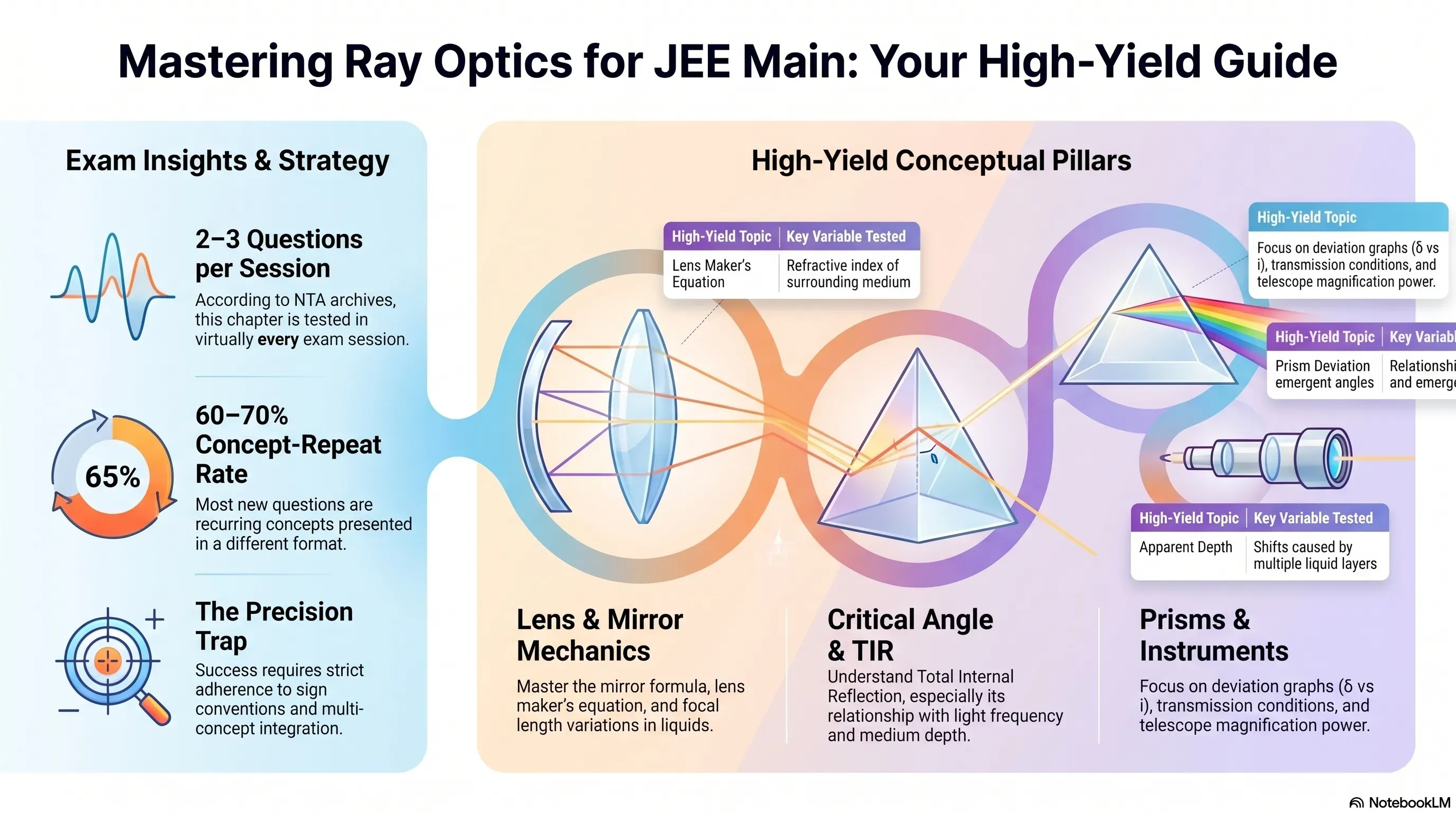
Ray Optics is one of the most consistently tested chapters in JEE Main Physics. According to NTA's official question paper archives, at least 2 questions from this chapter appear in virtually every session — sometimes 3. The concepts tested range from the mirror formula and lens maker's equation to total internal reflection, apparent depth, and deviation through a prism.
What makes this chapter both scoring and tricky is that questions look deceptively simple but demand precision with sign conventions and the ability to switch between multiple concepts within a single problem. Students who practise previous year questions systematically find that nearly 60–70% of new questions are concept-repeats in a new wrapper.
Ray Optics - JEE Main Previous Year Questions with Solutions
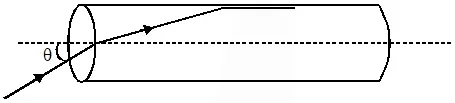
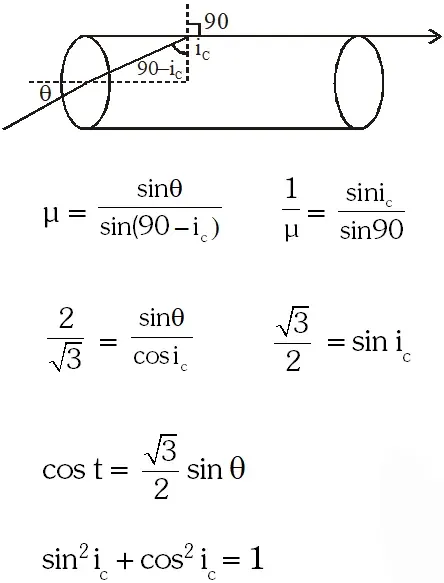
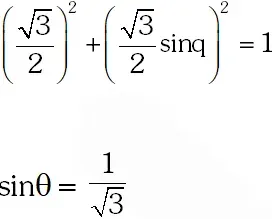
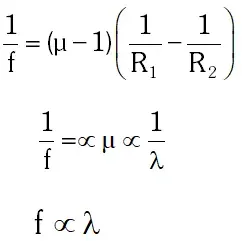
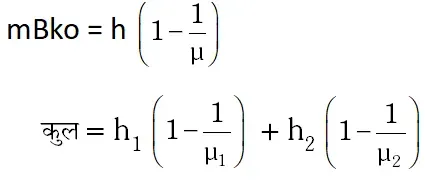
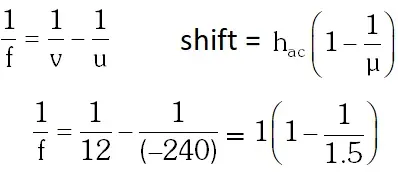
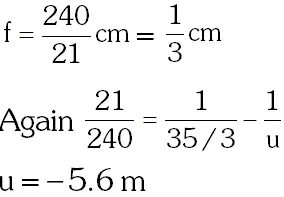
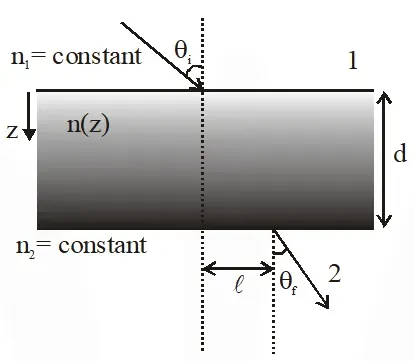
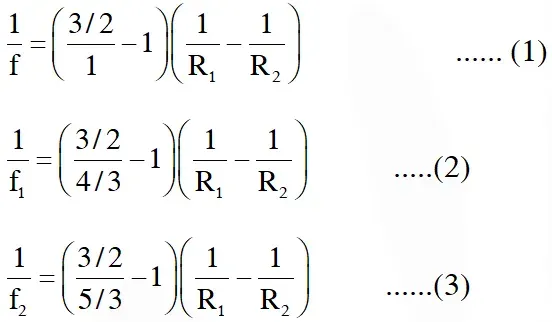
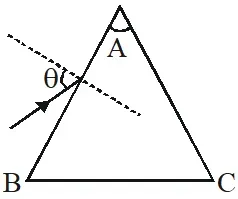
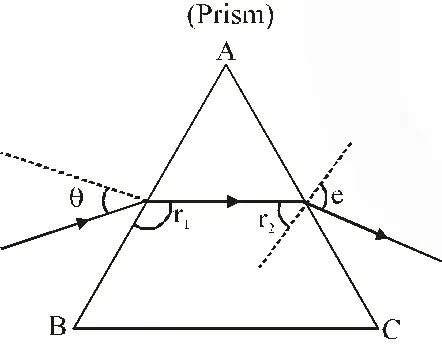
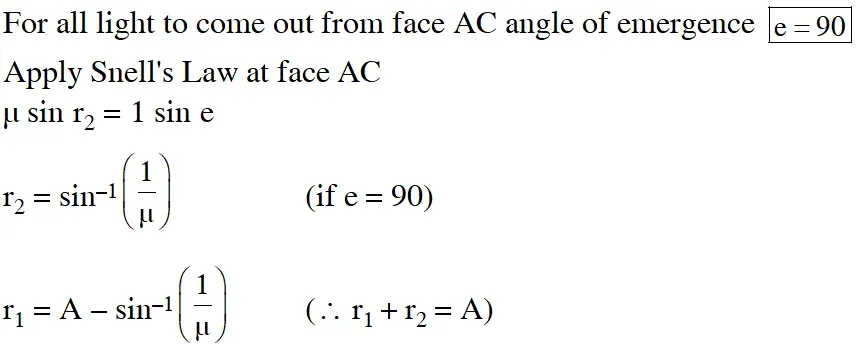
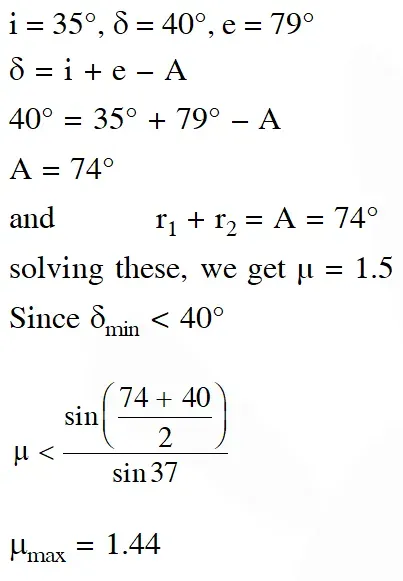
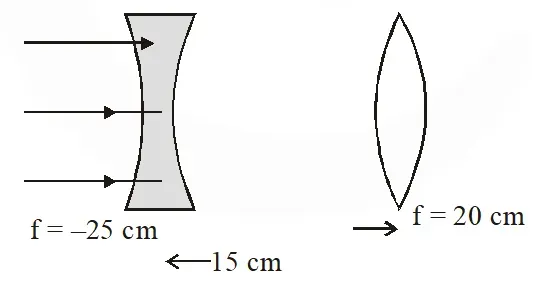
JEE Main Previous Year Question of Physics with Solutions are available here. Practicing JEE Main Previous Year Papers Questions of Physics will help all the JEE aspirants in realizing the question pattern as well as help in analyzing their weak & strong areas. Get detailed Class 11th &12th Physics Notes to prepare for Boards as well as competitive exams like IIT JEE, NEET etc. eSaral helps the students in clearing and understanding each topic in a better way. eSaral is providing complete chapter-wise notes of Class 11th and 12th both for all subjects. Besides this, eSaral also offers NCERT Solutions, Previous year questions for JEE Main and Advance, Practice questions, Test Series for JEE Main, JEE Advanced and NEET, Important questions of Physics, Chemistry, Math, and Biology and many more. Download eSaral app for free study material and video tutorials. Simulator Previous Years AIEEE/JEE Mains Questions [esquestion] A transparent solid cyclindrical rod has a refractive index of . It is surrounded by air. A light ray is incident at the mid-point of one end of the rod as shown in the figure. The incident angle $\theta$ for which the light ray grazes along the wall of the rod is :- ( 1) $\sin ^{-1}\left(\frac{2}{\sqrt{3}}\right)$ (2) $\sin ^{-1}\left(\frac{1}{\sqrt{3}}\right)$ (3) $\sin ^{-1}\left(\frac{1}{2}\right)$ ( 4) $\sin ^{-1}\left(\frac{\sqrt{3}}{2}\right)$ #tag# [AIEEE - 2009] #sol# (2) [/esquestion] [esquestion] A car is fitted with a convex side-view mirror of focal length 20 cm. A second car 2.8 m behind the first car is overtaking the first car at a relative speed of 15 m/s. The speed of the image of the second car as seen in the mirror of the first one is:- (1) 10 m/s (2) 15 m/s (3) $\frac{1}{10} \mathrm{m} / \mathrm{s}$ (4) $\frac{1}{15} \mathrm{m} / \mathrm{s}$ #tag# [AIEEE- 2011] #sol# (4) $V_{i z f r}=-\left[\frac{f}{f-u}\right]^{2} V_{\text {olrq }}=-\left[\frac{20}{20+280}\right]^{2} \times 15$ [/esquestion] [esquestion] When monochromatic red light is used instead of blue light in a convex lens, its focal length will :- (1) Does not depend on colour of light (2) Increase (3) Decrease (4) Remain same #tag# [AIEEE-2011] #sol# (2) [/esquestion] [esquestion] A beaker contains water up to a height $\mathrm{h}_{1}$ and kerosene of height $\mathrm{h}_{2}$ above watger so that the total height of (water + kerosene) is $\left(\mathrm{h}_{1}+\mathrm{h}_{2}\right)$. Refractive index of water is $\mu_{1}$ and that of kerosene is $\mu_{2}$. The apparent shift in the position of the bottom of the beaker when viewed from above is :- $(1)\left(1-\frac{1}{\mu_{1}}\right) \mathrm{h}_{2}+\left(1-\frac{1}{\mu_{2}}\right) \mathrm{h}_{1}$ (2) $\left(1+\frac{1}{\mu_{1}}\right) \mathrm{h}_{1}-\left(1+\frac{1}{\mu_{2}}\right) \mathrm{h}_{2}$ (3) $\left(1-\frac{1}{\mu_{1}}\right) \mathrm{h}_{1}+\left(1-\frac{1}{\mu_{2}}\right) \mathrm{h}_{2}$ $(4)\left(1+\frac{1}{\mu_{1}}\right) \mathrm{h}_{2}-\left(1+\frac{1}{\mu_{2}}\right) \mathrm{h}_{1}$ #tag# [AIEEE- 2011] #sol# (3) [/esquestion] [esquestion] An object 2.4 m in front of a lens forms a sharp image on a film 12 cm behind the lens. A glass plate 1 cm thick, of refractive index 1.50 is interposed between lens and film with its plane faces parallel to film. At what distance (from lens) should object be shifted to be in sharp focus on film ? (1) 5.6 m (2) 7.2 m (3) 2.4 m (4) 3.2 m #tag# [AIEEE- 2012] #sol# (1) [/esquestion] [esquestion] Diameter of a plano-convex lens is 6cm and thickness at the centre is 3 mm. If speed of light in material of lens is $2 \times 10^{8} \mathrm{m} / \mathrm{s}$, the focal length of the lens is : (1) 15 cm (2) 20 cm (3) 30 cm (4) 10 cm #tag# [JEE-Mains- 2013] #sol# (3) $\frac{1}{\mathrm{f}}=(\mu-1)\left(\frac{1}{\mathrm{R}_{1}}-\frac{1}{\mathrm{R}_{2}}\right)=\left(\frac{3 \times 10^{8}}{2 \times 10^{8}}-1\right)\left(\frac{1}{15}-\frac{1}{\infty}\right)$ f = 30 cm [/esquestion] [esquestion] The graph between angle of deviation $(\delta)$ and angle of incidence (i) for a triangular prism is represented by :- #tag# [JEE-Mains- 2013] #sol# (3) Refer NCERT [/esquestion] [esquestion] A thin convex lens made from crown glass $\left(\mu=\frac{3}{2}\right)$ has focal length ƒ. When it is measured in two different liquids having refractive indices $\frac{4}{3}$ and $\frac{5}{3}$ and , it has the focal length $f_{1}$ and $f_{2}$ respectively. The correct relation between the focal lengths is : (1) $f_{2}>f$ and $f_{1}$ becomes negative (2) $f_{1}$ and $f_{2}$ both become negative (3) $f_{1}=f_{2}<f$ (4) $f_{1}>f$ and $f_{2}$ become negative #tag# [JEE-Mains- 2014] #sol# (4) [/esquestion] [esquestion] A green light is incident from the water to the air - water interface at the critical angle ($\theta$). Select the correct statement. (1) The spectrum of visible light whose frequency is more than that of green light will come out to the air medium. (2) The entire spectrum of visible light will come out of the water at various angles to the normal (3) The entire spectrum of visible light will come out of the water at an angle of $90^{\circ}$ to the normal. (4) The spectrum of visible light whose frequency is less than that of green light will come out to the air medium. #tag# [JEE-Mains- 2014] #sol# (4) Frequency of light () > frequency of green light ($v_{G}$) µ is also greater than $\mu_{\mathrm{G}}$ and critical angle of light is less than green light therefore light will got total internal reflaction and not come out to the air. For frequency of light $(v)<v_{\mathrm{G}}$ ; light will not suffer T.I.R. Therefore light come out to the air [/esquestion] [esquestion] Monochromatic light is incident on a glass prism of angle A. If the refractive index of the material of the prism is $\mu$, a ray, incident at an angle $\theta$, on the face AB would get transmitted through the face AC of the prism provided : $(1) \theta>\cos ^{-1}\left[\mu \sin \left(A+\sin ^{-1}\left(\frac{1}{\mu}\right)\right)\right]$ (2) $\theta<\cos ^{-1}\left[\mu \sin \left(A+\sin ^{-1}\left(\frac{1}{\mu}\right)\right)\right]$ (3) $\theta>\sin ^{-1}\left[\mu \sin \left(A-\sin ^{-1}\left(\frac{1}{\mu}\right)\right)\right]$ (4) $\theta<\sin ^{-1}\left[\mu \sin \left(A-\sin ^{-1}\left(\frac{1}{\mu}\right)\right)\right]$ #tag# [JEE-Mains- 2015] #sol# (3) Apply Snell's law at face AB $1 \sin \theta=\mu \sin \left(r_{1}\right)$ $\theta=\sin ^{-1}\left(\mu \sin \left(A-\sin ^{-1}\left(\frac{1}{\mu}\right)\right)\right.$ for all light transmitted through $\mathrm{AC}, \mathrm{e}<90^{\circ}$ $\Rightarrow \theta>\sin ^{-1}\left(\mu \sin \left(A-\sin ^{-1}\left(\frac{1}{\mu}\right)\right)\right.$ [/esquestion] [esquestion] An observer looks at a distant tree of height 10 m with a telescope of magnifying power of 20. To the observer the tree appears : (1) 20 times nearer (2) 10 times taller (3) 10 times nearer (4) 20 times taller #tag# [JEE-Mains- 2016] #sol# (4) Angular magnification is 20. [/esquestion] [esquestion] In an experiment for determination of refractive index of glass of a prism by i – , plot, it was found that a ray incident at angle $35^{\circ}$, suffers a deviation of $40^{\circ}$ and that it emerges at angle $79^{\circ}$. In that case which of the following is closest to the maximum possible value of the refractive index? (1) 1.8 (2) 1.5 (3) 1.6 (4) 1.7 #tag# [JEE-Mains- 2016] #sol# (2) [/esquestion] [esquestion] A diverging lens with magnitude of focal length 25 cm is placed at a distance of 15 cm from a converging lens of magnitude of focal length 20 cm. A beam of parallel light falls on the diverging lens. The final image formed is : (1) real and at a distance of 40 cm from the divergent lens (2) real and at a distance of 6 cm from the conver (3) real and at a distance of 40 cm from convergent lens (4) virtual and at a distance of 40 cm from convergent lens. #tag# [JEE-Mains- 2017] #sol# (3) As parallel beam incident on diverging lens if forms virtual image at $\mathbf{V}_{1}$ = –25 cm from the diverging lense which works as a object for the converging lense (f = 20 cm) So for converging lens u = –40 cm, f = 20 cm $\therefore \quad$ Final image $\frac{1}{\mathrm{V}}-\frac{1}{-40}=\frac{1}{20}$ V = 40 cm from converging lenses. [/esquestion]\
Once Ray Optics is complete, use the JEE PYQ chapter wise archive to pick up another chapter without searching for individual pages.
This Ray Optics set covers one chapter only — for entire papers exactly as they appeared on exam day, check our JEE Main previous year question paper.
Frequently Asked Questions
How many questions come from Ray Optics in JEE Main?
Ray Optics consistently contributes 2–3 questions per JEE Main session, each carrying 4 marks. Over the last 10 years, this chapter has never been absent from a JEE Main paper. That makes it one of the highest-reliability scoring chapters in Physics — practising previous year questions here gives a very strong return on time invested.
What are the most important topics in Ray Optics for JEE Main?
The most frequently tested topics are: (1) mirror and lens formula with sign convention, (2) lens maker's equation including lens in a liquid, (3) total internal reflection and critical angle, (4) refraction through a prism and the minimum deviation condition, and (5) apparent depth with single or multiple media. Optical instruments (telescope and microscope) appear less frequently but carry straightforward marks.
Is Ray Optics easy to score in JEE Main?
Yes — Ray Optics is among the more formula-driven chapters, which means consistent practice of previous year questions leads directly to marks. Students in eSaral's batches — taught by IIT Bombay faculty including AIR-2 and AIR-41 rankers — regularly score full marks on this chapter after completing the structured question bank and doubt-clearing sessions.
What is the trick for lens-in-liquid questions in JEE Main?
Always check the ratio μ_glass/μ_liquid first. If this ratio > 1, the lens behaves as expected (convex = converging). If the ratio < 1, the lens reverses its behaviour — a convex lens becomes diverging and has a negative focal length. This single check prevents the most common error in this question type.
How do I solve apparent depth problems with multiple liquids quickly?
Add the apparent shifts from each layer independently. For a layer of actual depth h and refractive index μ, the apparent shift = h(1 – 1/μ). Sum these for all layers. This works because each interface produces an independent shift when viewed from air above.
Team eSaral
eSaral Academic and Editorial Team
Team eSaral is the collective author profile for educational content created by eSaral’s teachers and academic contributors. The team draws on expertise from IIT graduates, doctors, experienced educators and subject specialists to develop resources for JEE, NEET and school students. Our articles aim to explain concepts clearly and help students study with confidence.
Related Posts
Plant Cell Diagram: Labelled Structure, Parts and Functions
Simple, labelled plant cell diagram with parts and functions. Covers plant cell structure for Class 6, 7, 8, 9, 10 and 11 students, CBSE-aligned.
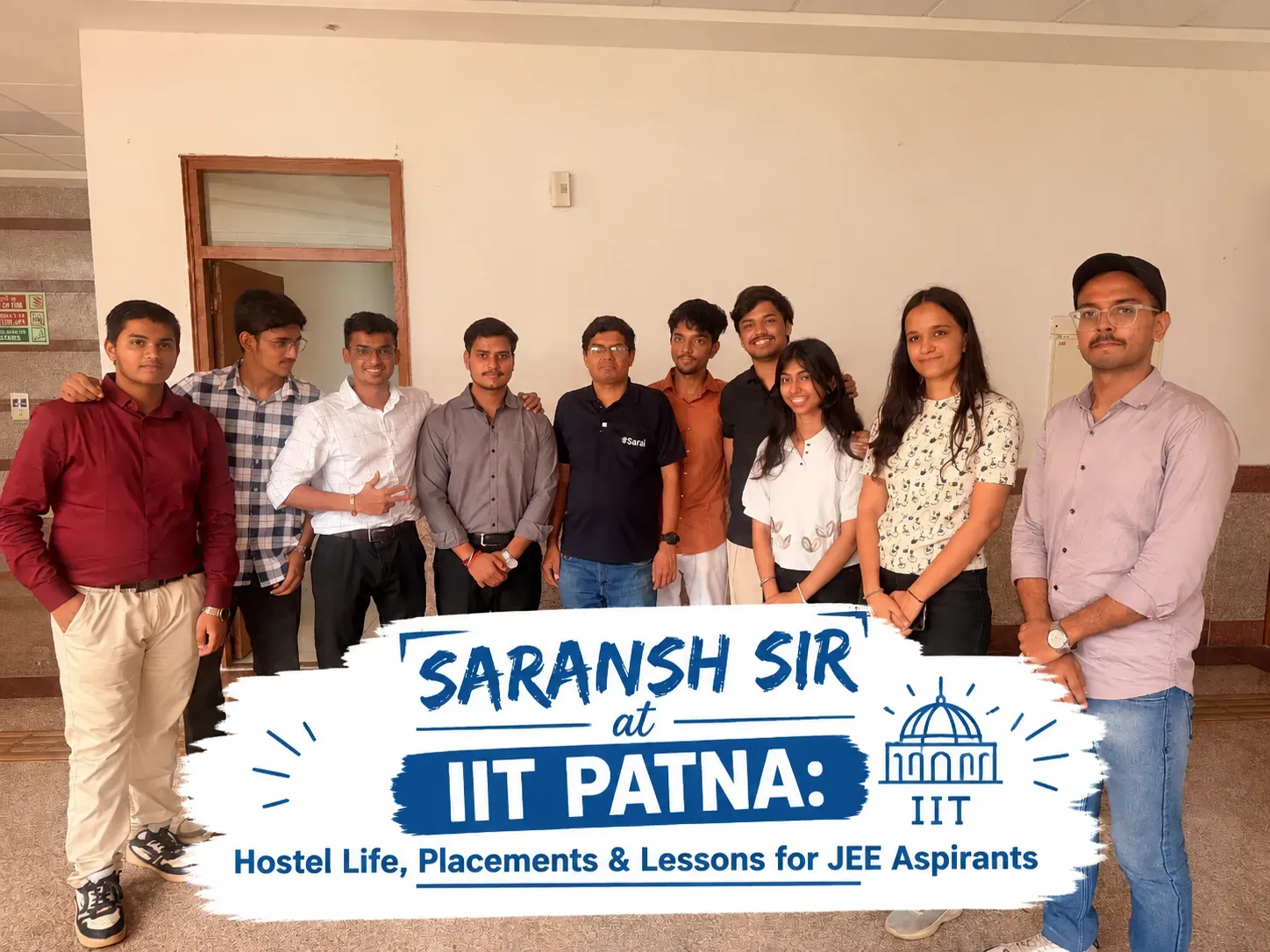
Saransh Gupta Sir's Visit to IIT Patna: Hostel Life, Placements & Lessons for JEE Aspirants
Inside Saransh Gupta Sir's IIT Patna visit — hostel life, the library, placements, internships, and real advice for JEE aspirants from students living the IIT dream.
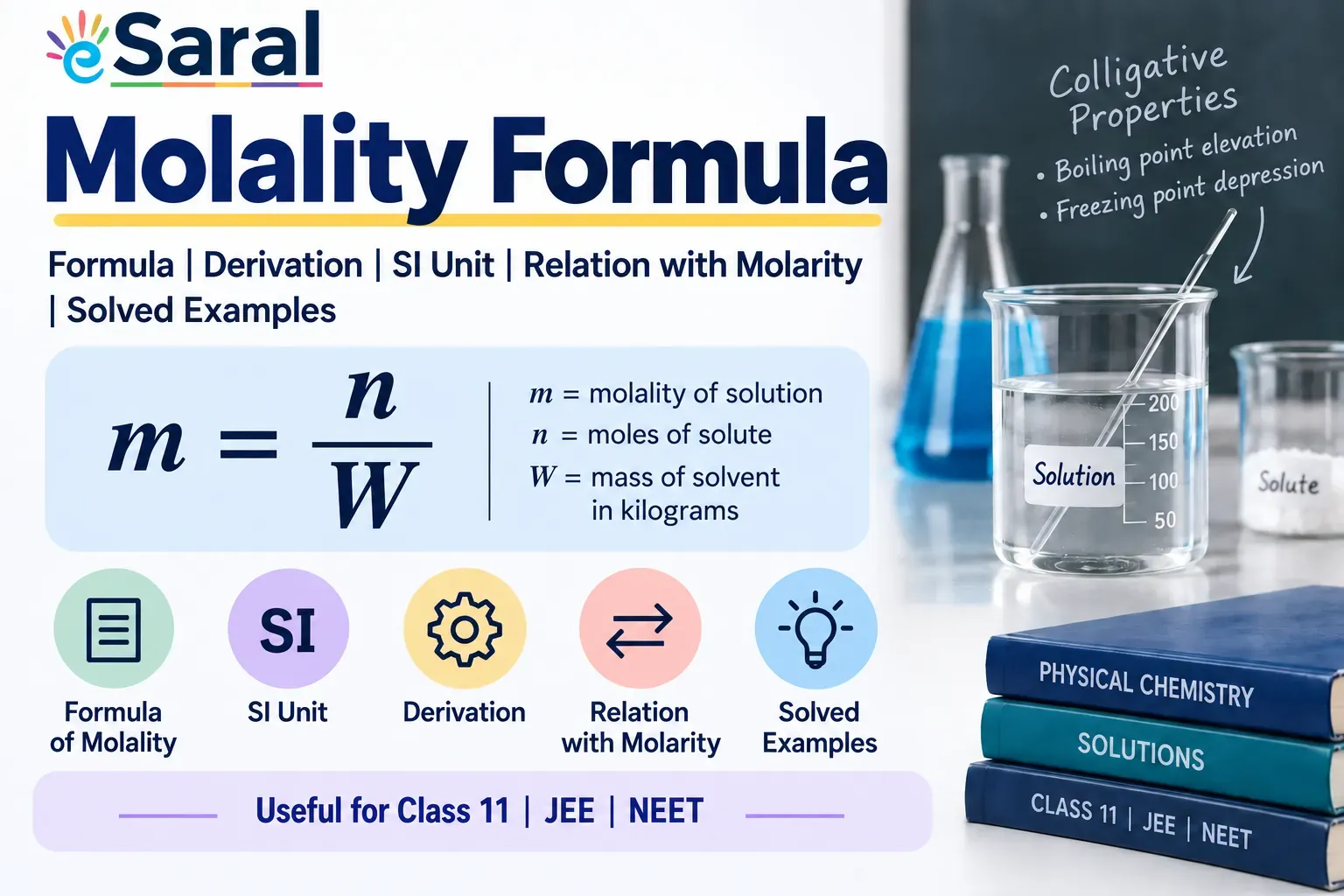
Molality Formula: Formula for Molality, Derivation & Solved Examples
Molality formula is $m = \dfrac{n}{W}$. Learn the formula of molality, its SI unit, derivation, relation with molarity, and solved examples for Class 11, JEE and NEET.
BITSAT Previous Year Question Paper PDF
Download BITSAT previous year question papers PDF. Get year-wise BITSAT PYQs, memory-based papers, exam pattern, and preparation tips to improve your BITSAT preparation.

Teachers’ Day 2026 at eSaral Gurukul: Celebrating the Bond Between Students, Teachers & Mentors
See how Teachers’ Day 2026 was celebrated at eSaral Gurukul, reflecting the bond among students, teachers, and mentors, and the role of guidance beyond academics.
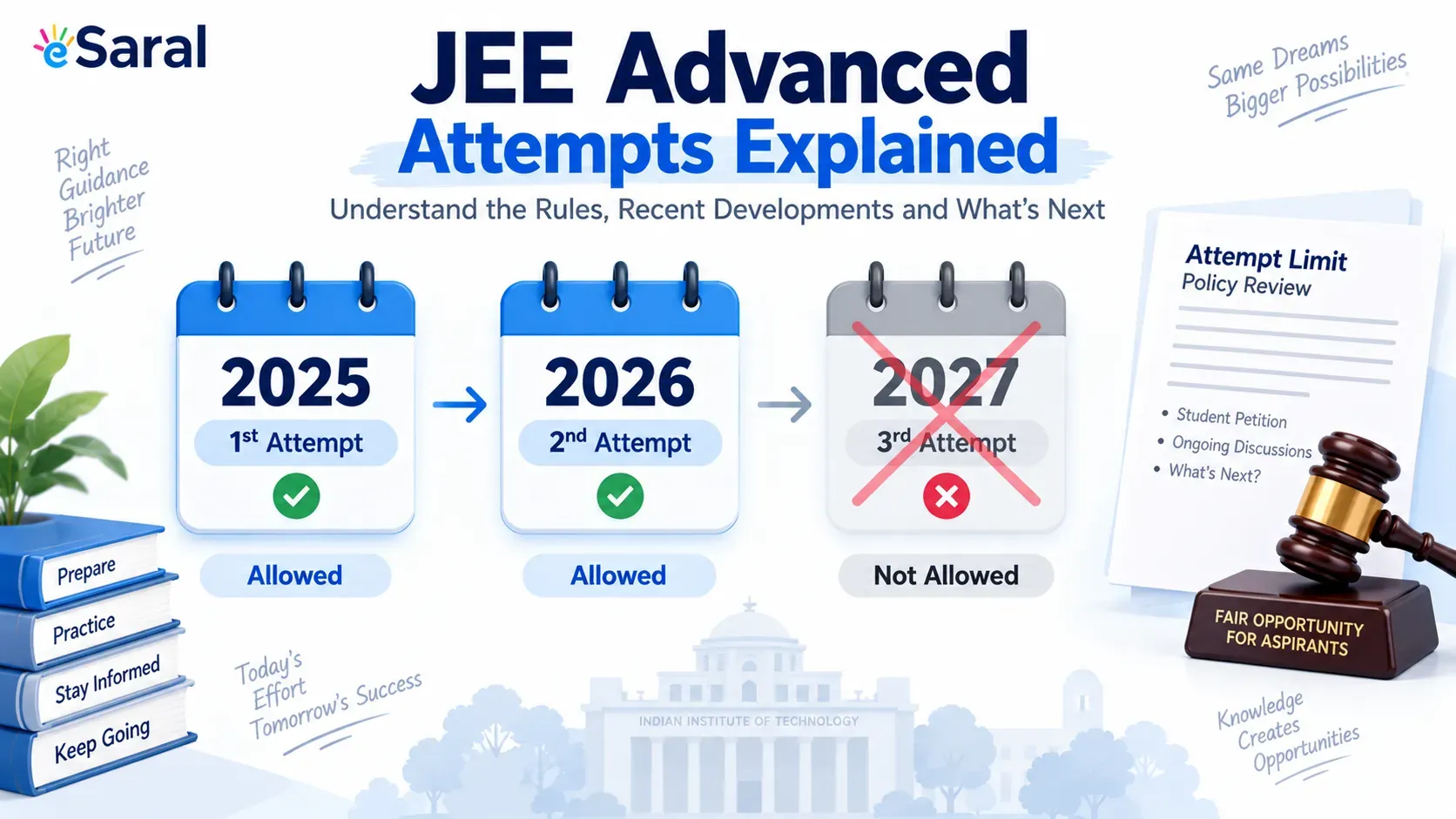
JEE Advanced Attempts: Can You Give It a Third Time? Rules Explained
JEE Advanced attempts: current rule is 2 consecutive years only: full eligibility criteria, the 2025 third-attempt controversy, and the latest 2026 petition news.

Best JEE Preparation App
Best JEE preparation app for Main & Advanced: AI mock tests, live doubt-solving, thousands of practice questions. JEE preparation app for droppers & Class 11-12.
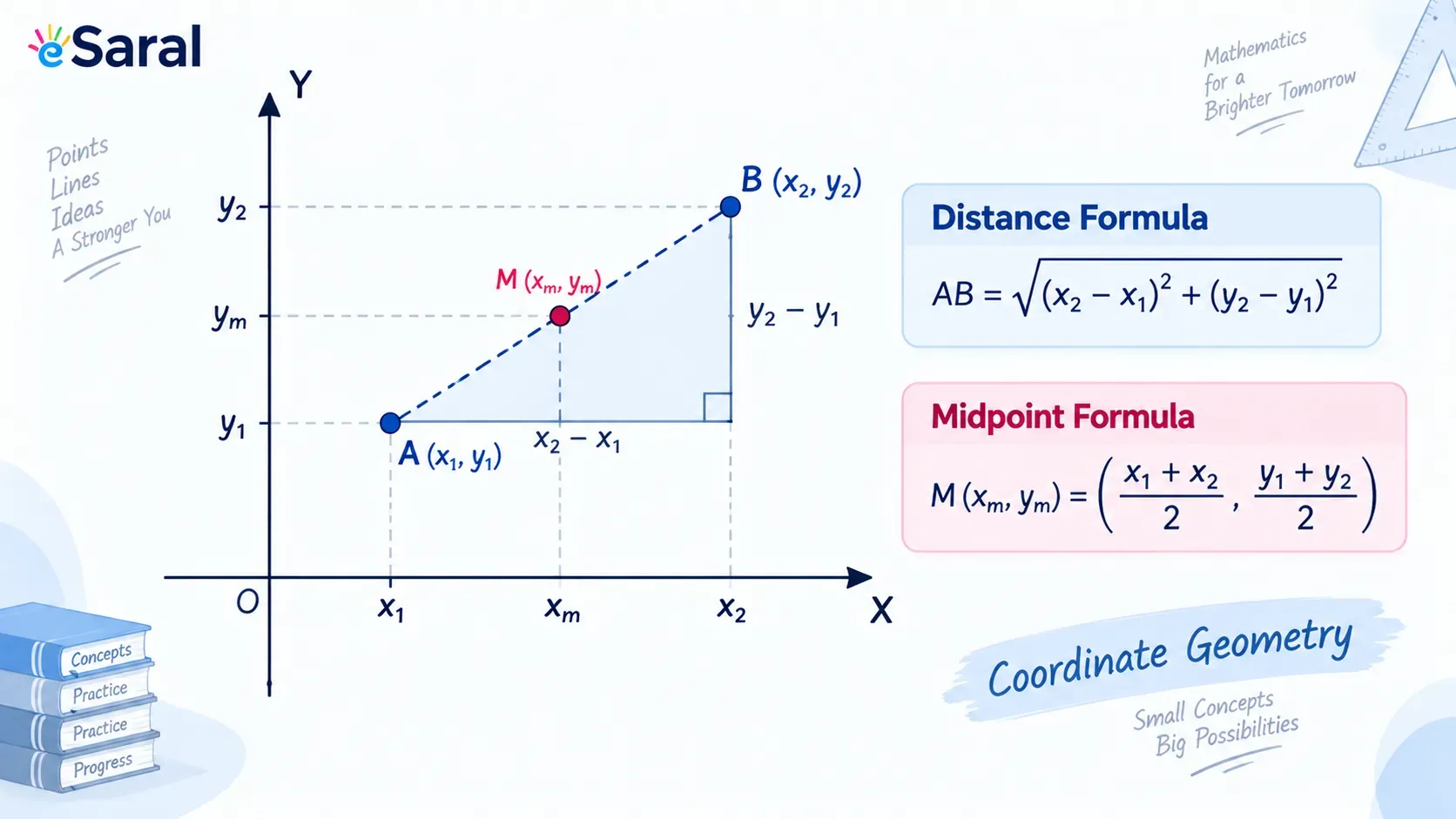
Coordinate Geometry Class 10: Formulas, Notes & Solved Examples
Coordinate geometry class 10: complete CBSE formulas — distance, section, midpoint and area of triangle — with derivation, notes and solved examples.
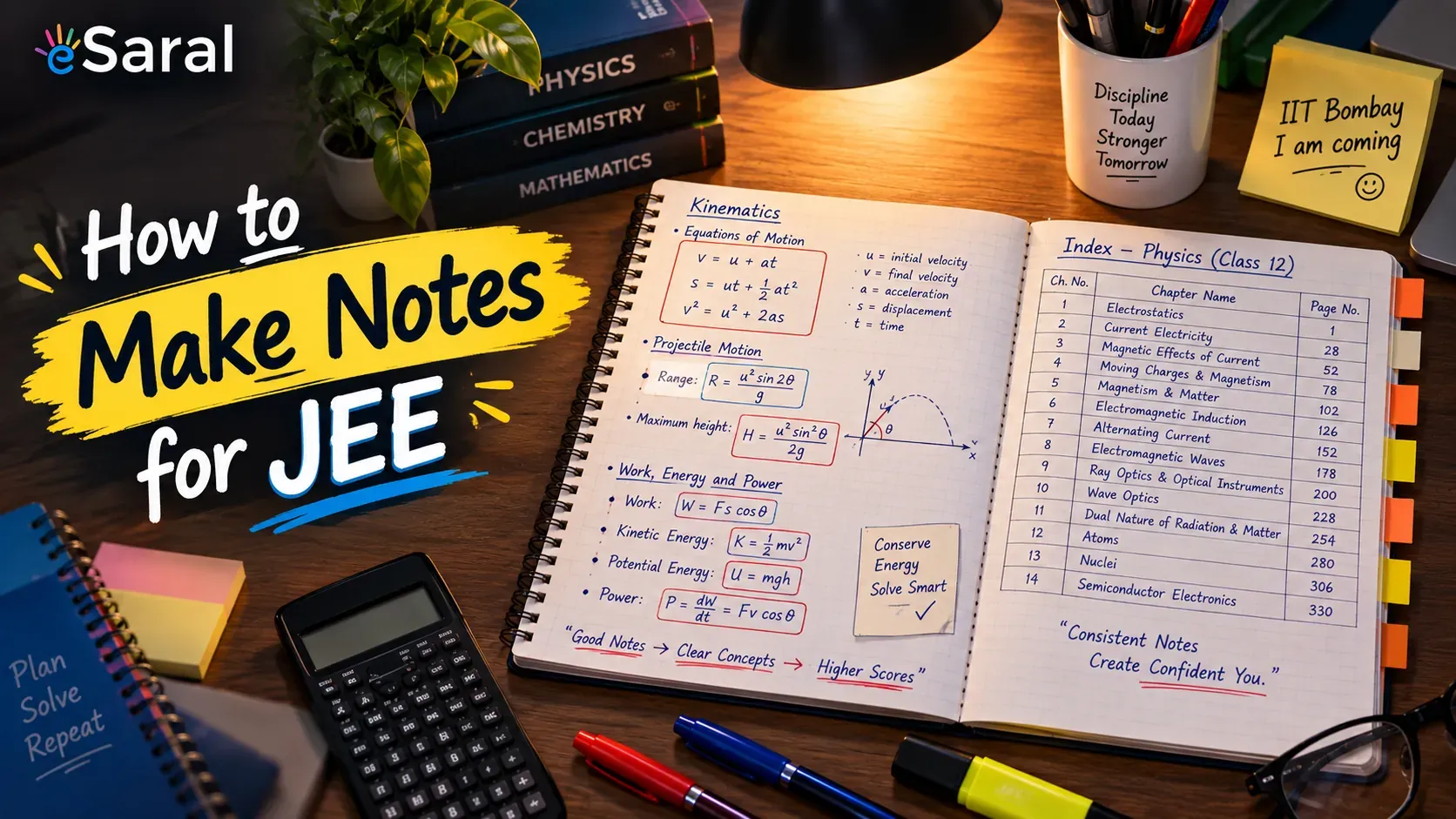
How to make Notes For JEE Smart Notes Strategy of an AIR 41
Learn how to make notes for JEE the way toppers do — indexing, shorthand, and smart short notes for JEE that cut revision time to just 5–7 days.
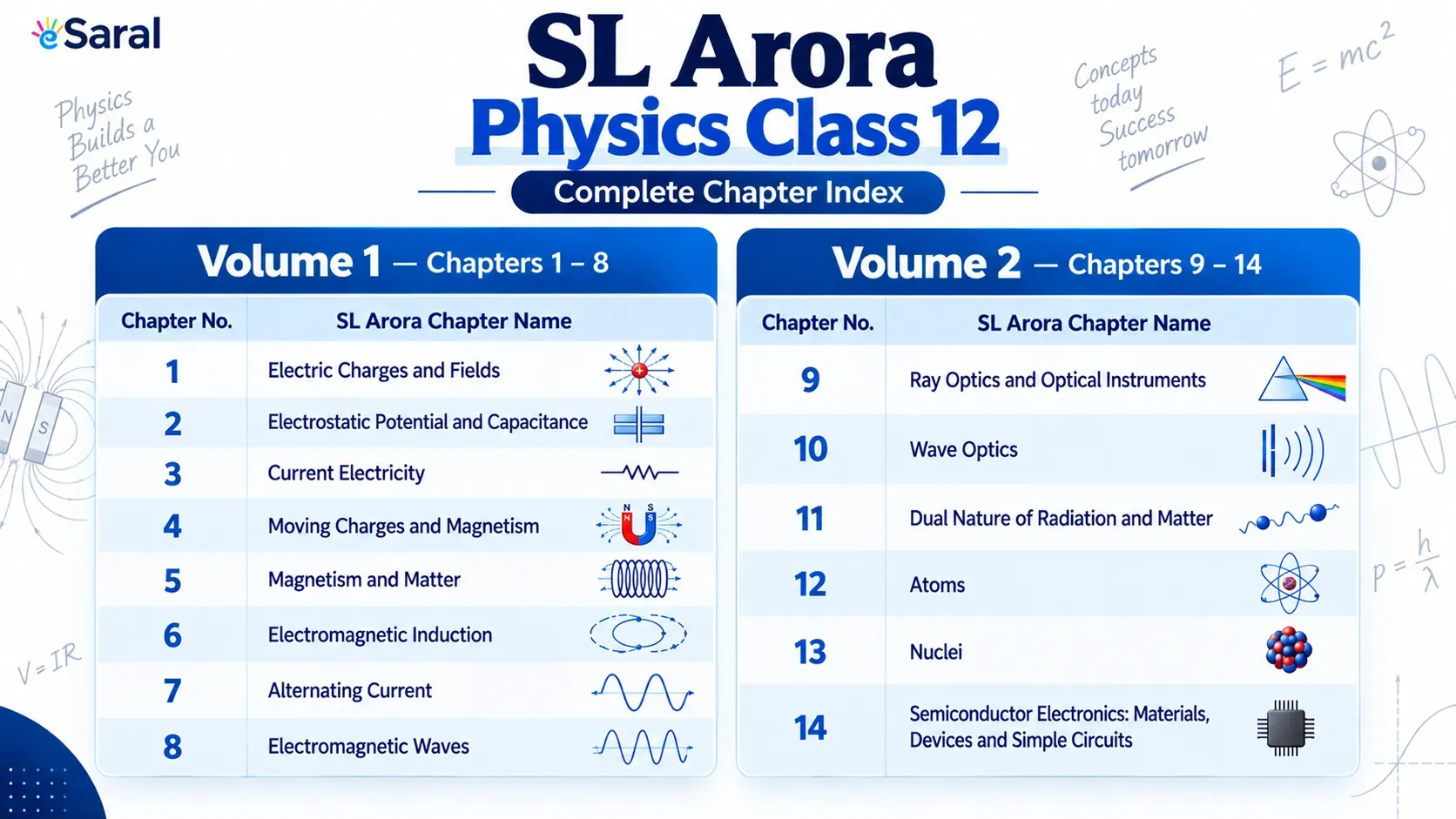
SL Arora Physics Class 12 Index – Chapter List for Volume 1 & 2
SL Arora Physics Class 12 index — complete chapter list for Volume 1 & 2, mapped to NCERT solutions for board, JEE Main, and NEET preparation.