
Relative Velocity Concept for Class 11, JEE and NEET: Formulas, River-Boat, Rain-Man and Closest Approach

eSaral Academic and Editorial Team
Summary
The Relative Velocity Concept explains how the velocity of one object looks to an observer who is moving. This page covers relative velocity in one and two dimensions, the vector triangle, river-boat, rain-man and aeroplane-wind problems, relative motion of projectiles and the closest approach of two moving bodies. It gives all the formulas, three diagrams, solved examples and handwritten notes for CBSE, JEE Main and NEET.
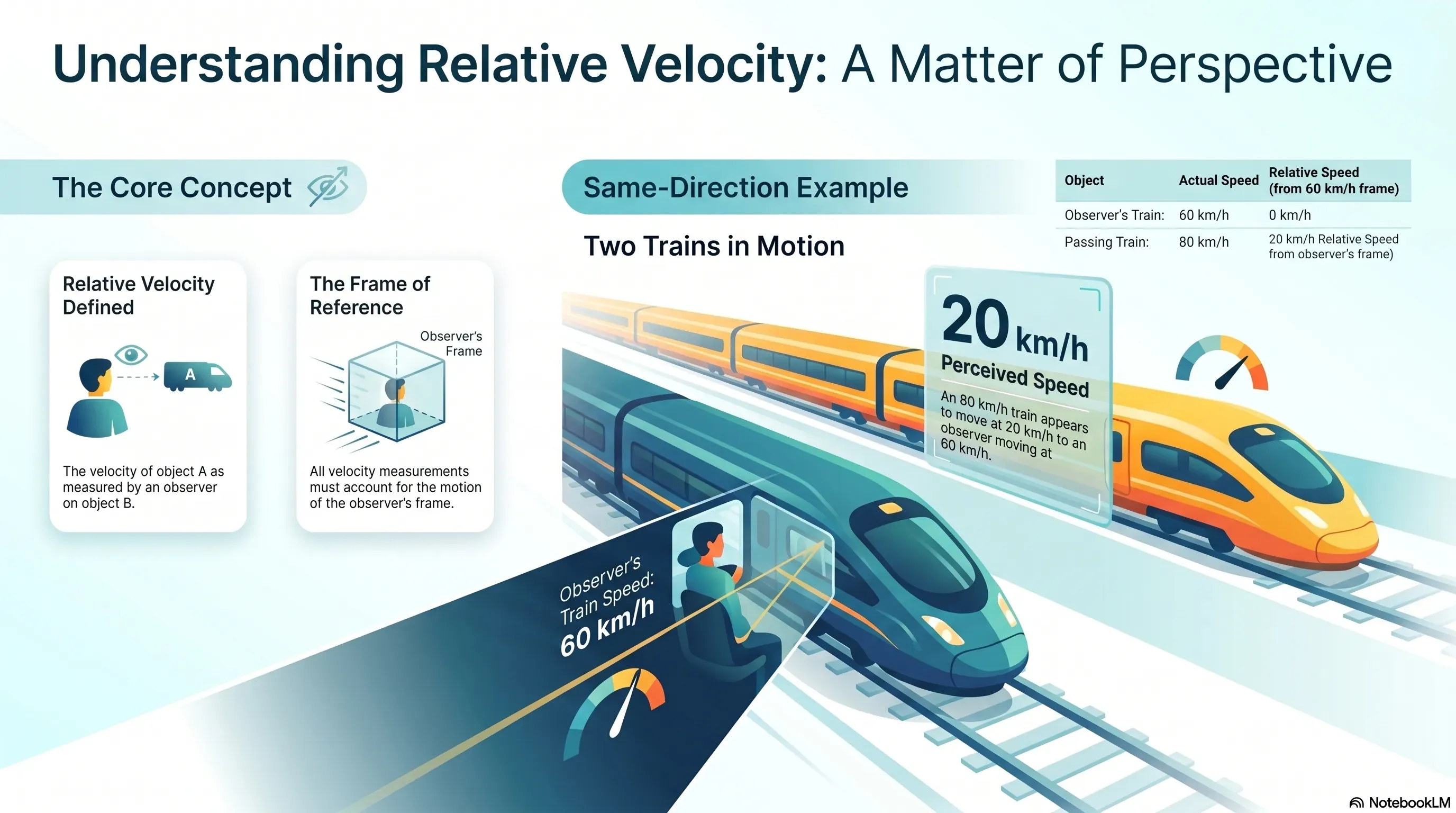
Relative velocity is part of kinematics. The one-dimensional case belongs to Motion in a Straight Line (Chapter 2 of NCERT Class 11 Physics), and the two-dimensional case uses the vectors of Motion in a Plane (Chapter 3). The JEE Main 2026 syllabus lists relative velocity in Unit 2, Kinematics. These notes give you the method once, and then show it in every problem type that exams use.
Relative Velocity Concept: Chapter Overview and Syllabus
Topic | Where it belongs | What to learn |
|---|---|---|
Relative velocity in one dimension | Motion in a Straight Line | $v_{AB} = v_A - v_B$, overtaking, crossing of trains |
Relative velocity in two dimensions | Motion in a Plane | Vector subtraction, resultant and direction |
River-boat, rain-man, aeroplane-wind | Applications | Shortest time, shortest path, tilt of an umbrella |
Relative motion of projectiles | Projectile motion | Zero relative acceleration |
Closest approach | JEE problems | $d_{min}$ and the time to reach it |
Check the latest syllabi of CBSE, NTA (JEE Main) and NMC (NEET) for the exact lists.
Tip from the eSaral Physics team: For every relative motion problem, first name the observer (the object whose point of view you take), and then subtract the observer’s velocity from the velocity of the other object. If you do this one step first, the sign mistakes mostly disappear.
What Is Relative Velocity? in Relative Velocity Concept
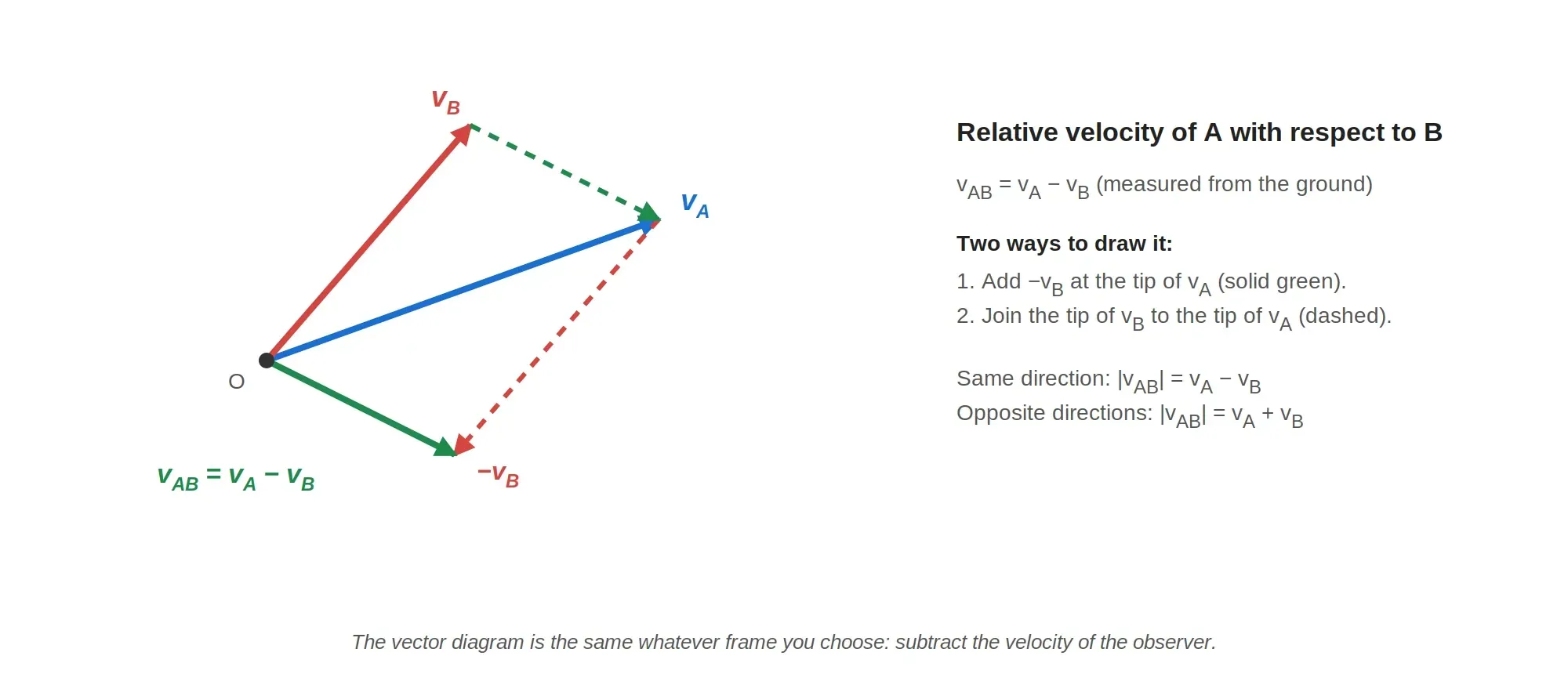
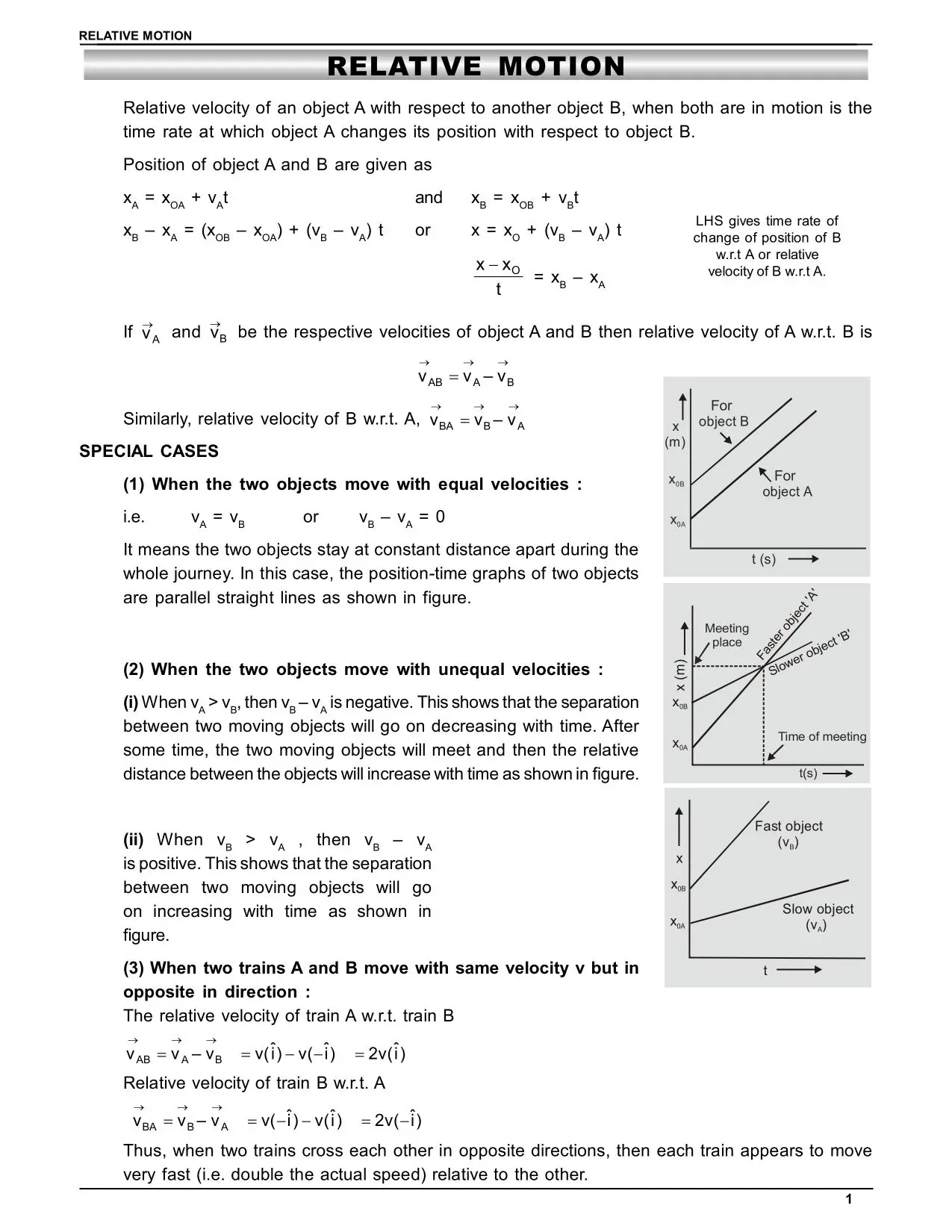
Every velocity is measured with respect to a frame of reference. There is no absolute velocity. When we say “a car moves at 60 km/h”, we mean with respect to the ground. The relative velocity of A with respect to B is the velocity of A as seen by an observer who is moving with B:
$$\vec{v}_{AB} = \vec{v}_A - \vec{v}_B$$
where $\vec{v}_A$ and $\vec{v}_B$ are the velocities of A and B measured in the same frame (usually the ground). Two results follow:
- $\vec{v}_{BA} = -\vec{v}_{AB}$. The velocity of B as seen from A is the opposite of the velocity of A as seen from B.
- If you change to another frame that is not accelerating, both $\vec{v}_A$ and $\vec{v}_B$ change by the same amount, so $\vec{v}_{AB}$ stays the same in every such frame.
Everyday example: you sit in a train moving at 60 km/h, and another train passes at 80 km/h in the same direction. It seems to move at only $80 - 60 = 20$ km/h relative to you.
Relative Velocity in One Dimension in Relative Velocity Concept
Take one direction as positive and write each velocity with its sign.
Situation | Relative velocity of A with respect to B |
|---|---|
A and B move in the same direction | $v_{AB} = v_A - v_B$ (the difference of the speeds) |
A and B move in opposite directions | $v_{AB} = v_A + v_B$ in magnitude (the sum of the speeds) |
A and B have equal velocities | $v_{AB} = 0$ (each looks at rest to the other) |
Relative acceleration and displacement:
$$a_{AB} = a_A - a_B, \qquad x_{AB} = x_A - x_B$$
If the relative acceleration is constant, the equations of motion hold for the relative quantities: $v_{AB} = u_{AB} + a_{AB}t$ and $s_{AB} = u_{AB}t + \tfrac{1}{2}a_{AB}t^2$. For the equations themselves, see eSaral’s Motion in a Straight Line JEE notes.
Meeting, overtaking and crossing:
- Two bodies approaching from a distance $d$ meet after $t = \dfrac{d}{v_{rel}}$.
- A train of length $L_1$ crosses a train (or a pole, with $L_2 = 0$) of length $L_2$ in $t = \dfrac{L_1 + L_2}{v_{rel}}$, where $v_{rel}$ is the difference of the speeds (same direction) or the sum (opposite directions).
Relative Velocity in Two Dimensions in Relative Velocity Concept
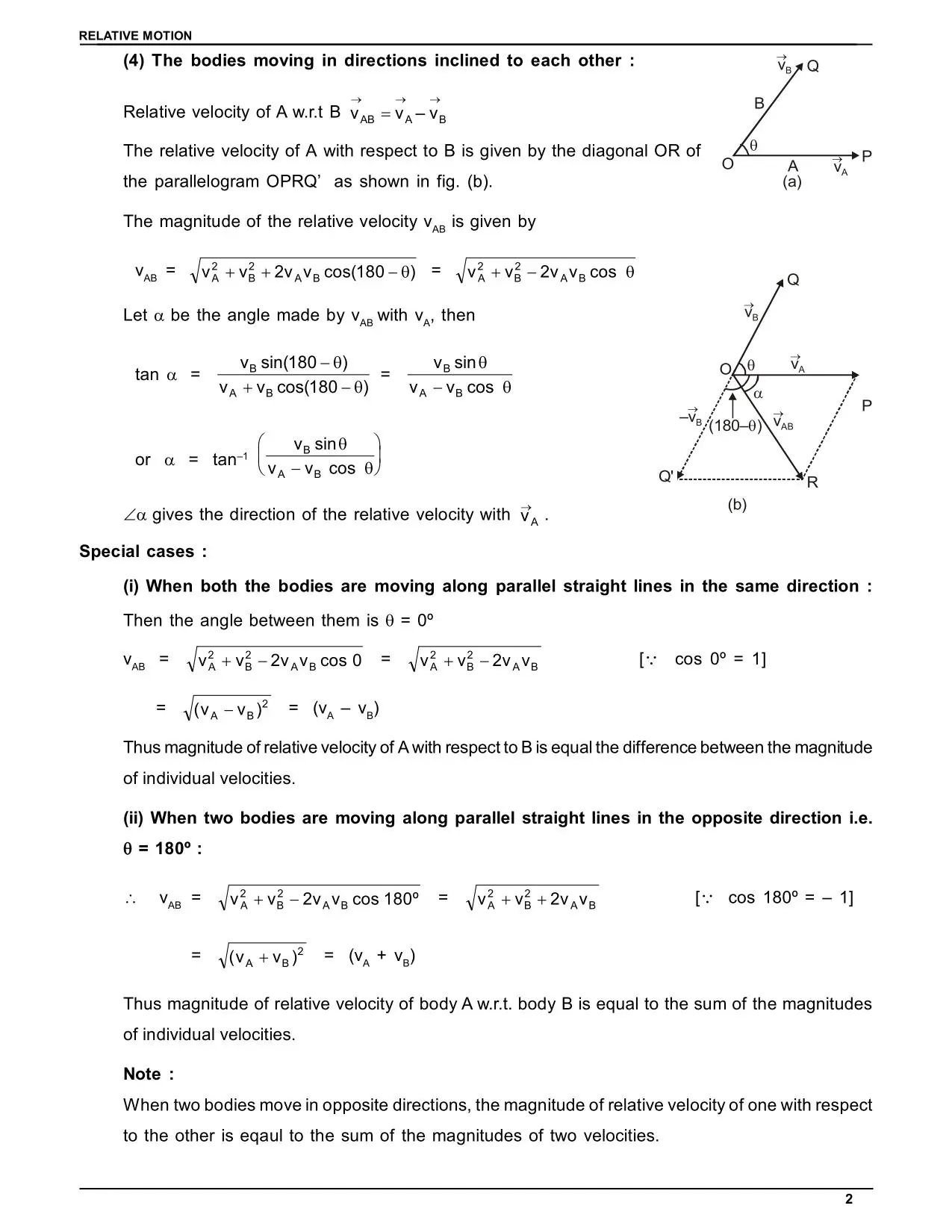
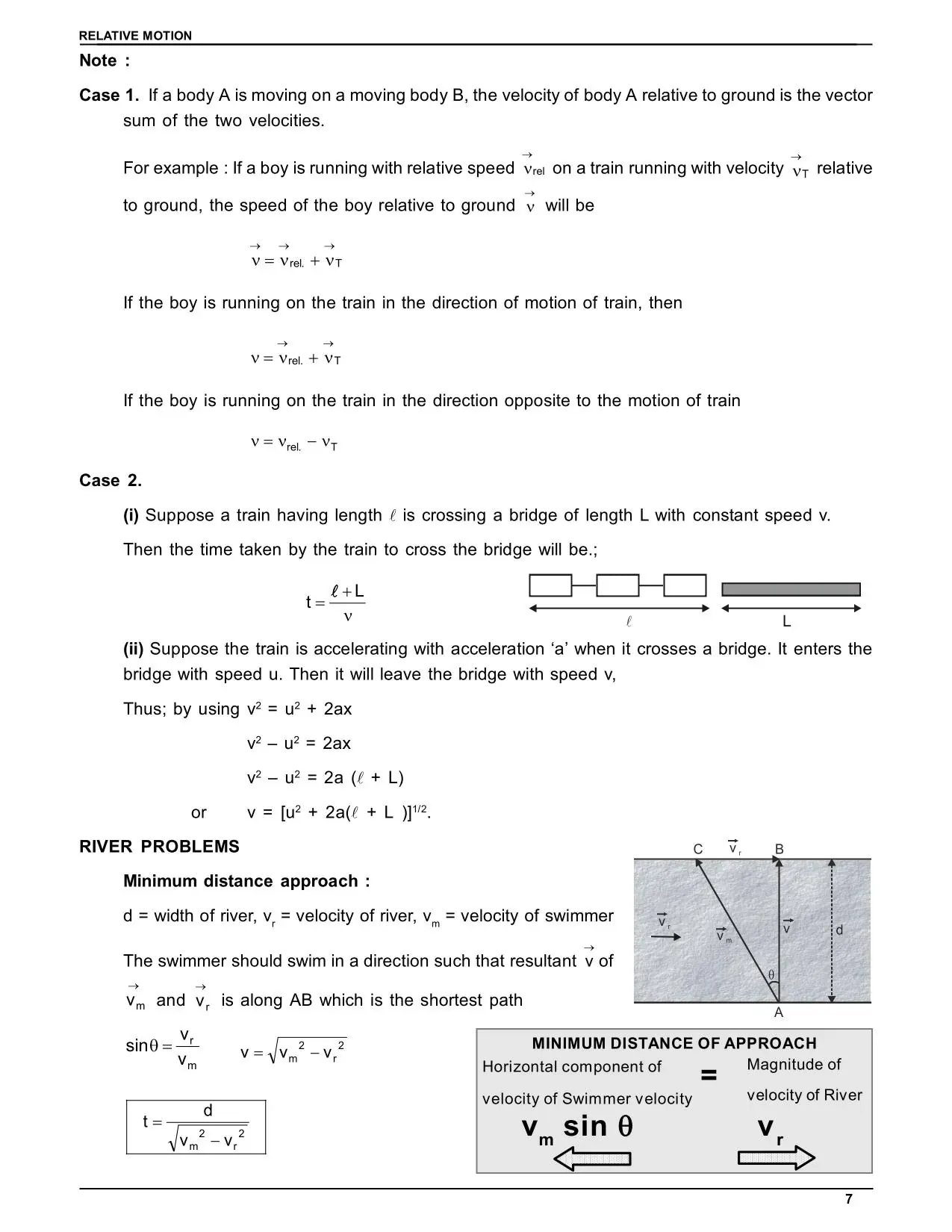
In two dimensions, subtract the velocities as vectors. Take the components along the $x$ and $y$ axes:
$$\vec{v}_{AB} = (v_{Ax} - v_{Bx})\,\hat{i} + (v_{Ay} - v_{By})\,\hat{j}$$
If $\vec{v}_A$ and $\vec{v}_B$ have magnitudes $v_A$ and $v_B$ and the angle between them is $\theta$:
$$\lvert \vec{v}_{AB} \rvert = \sqrt{v_A^{2} + v_B^{2} - 2\,v_A v_B \cos\theta}$$
For $\theta = 0^\circ$ (the same direction), this gives $v_A - v_B$, and for $\theta = 180^\circ$ (opposite directions), it gives $v_A + v_B$. The direction of $\vec{v}_{AB}$ is found from its components. Revise vector subtraction in eSaral’s vectors and two-dimensional motion notes if you need it.
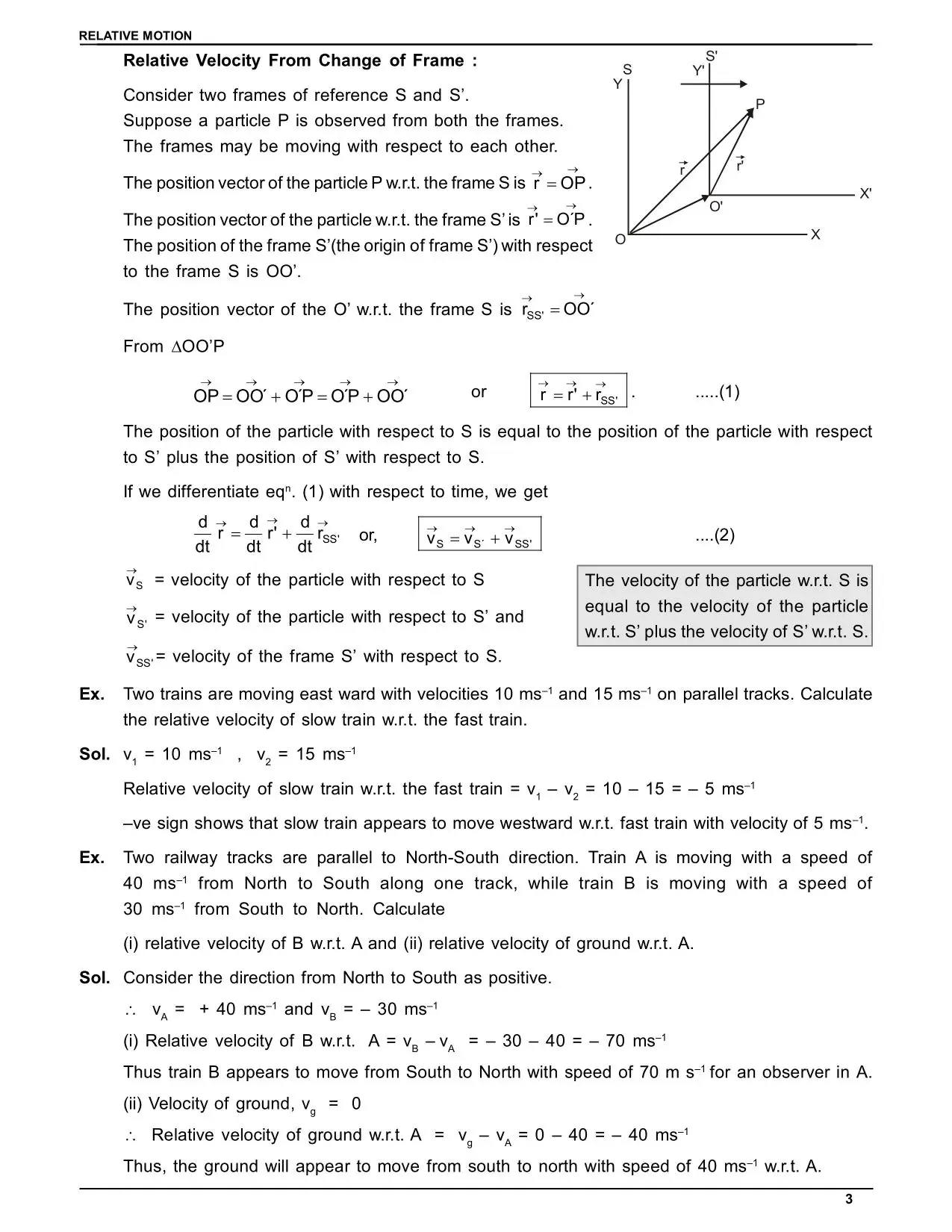
Chain rule for relative velocities: for three objects (or frames) A, B and C:
$$\vec{v}_{AC} = \vec{v}_{AB} + \vec{v}_{BC}$$
This is the equation behind river-boat and aeroplane-wind problems, because it adds the velocity of the object with respect to a medium to the velocity of the medium with respect to the ground.
River-Boat Problems in Relative Velocity Concept
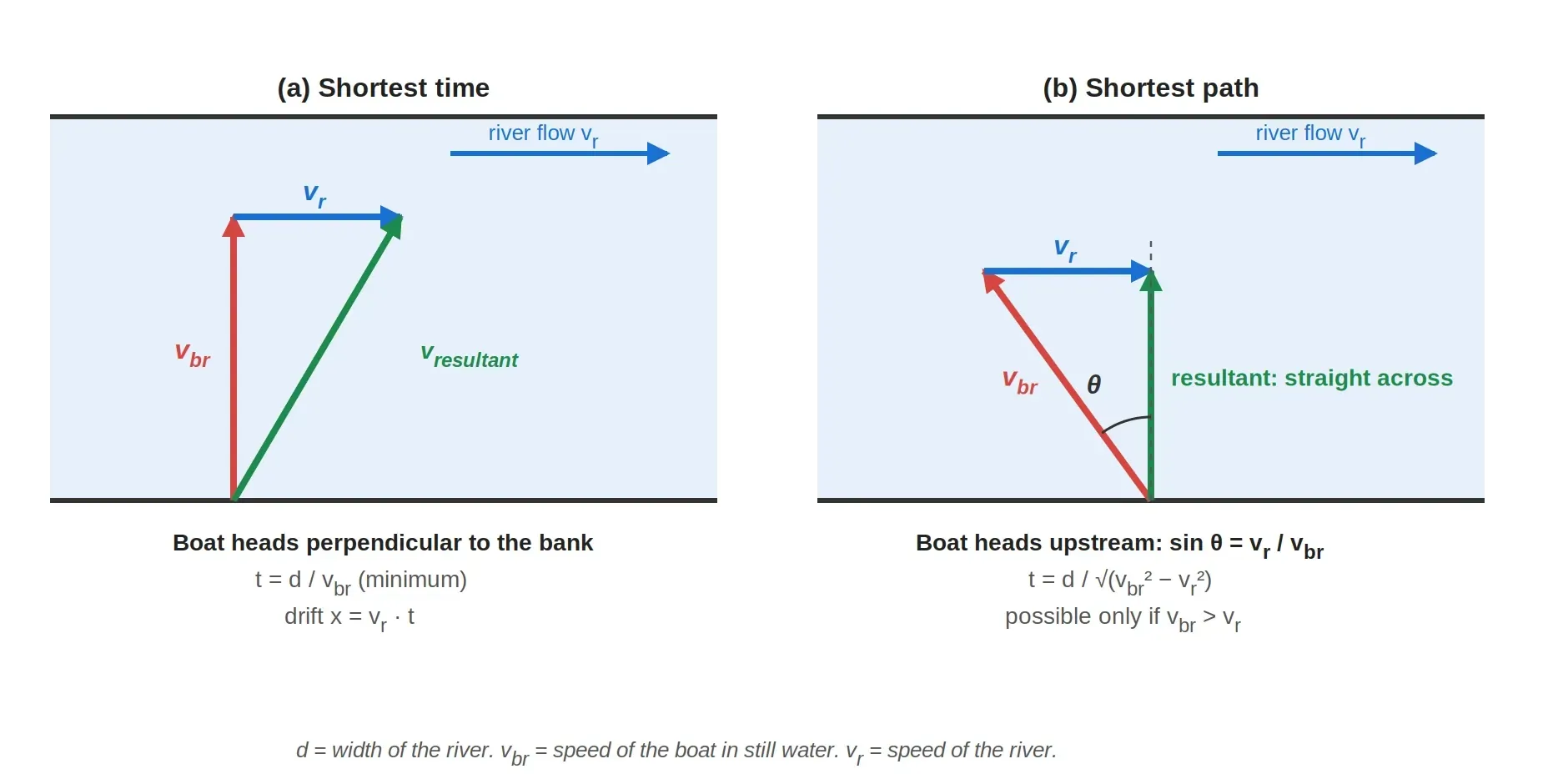
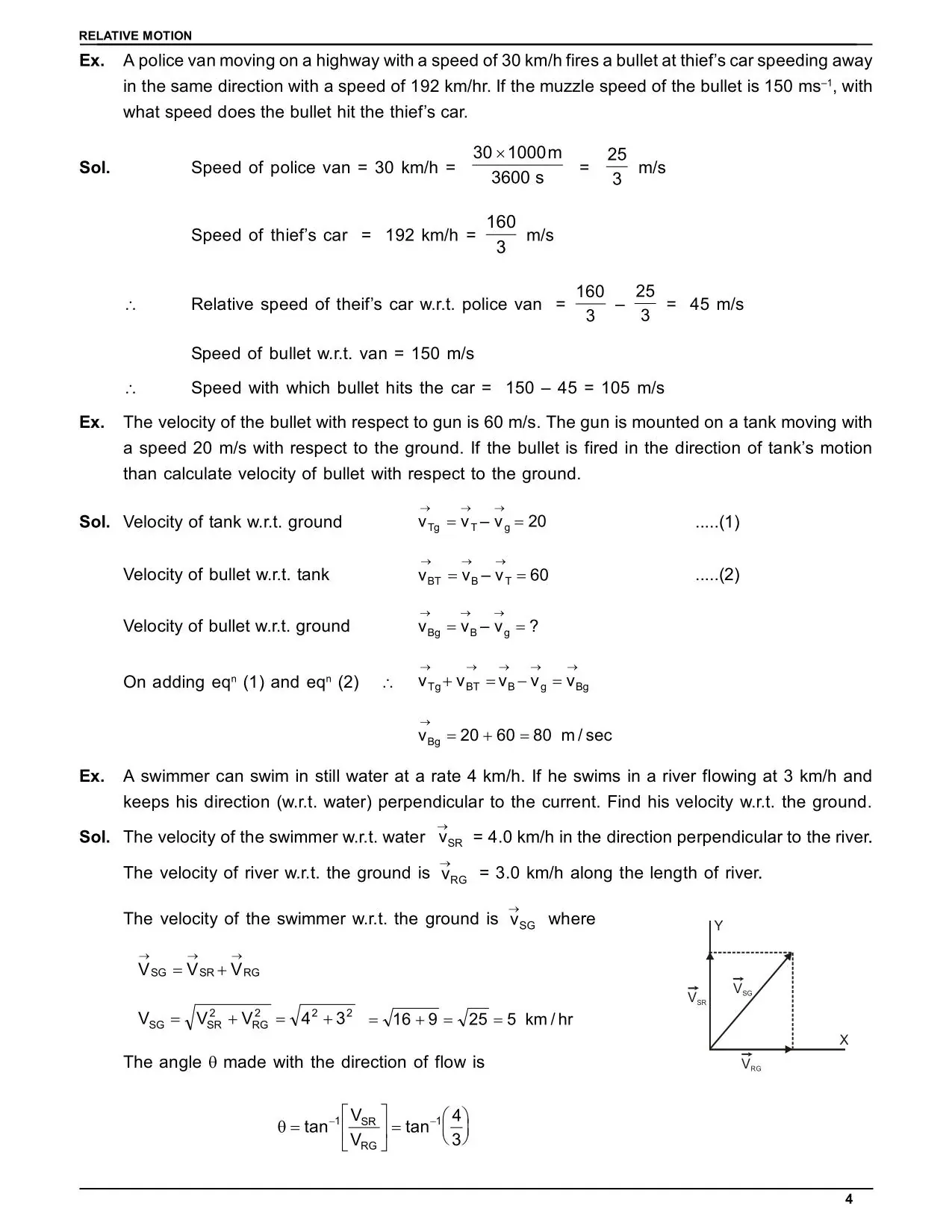
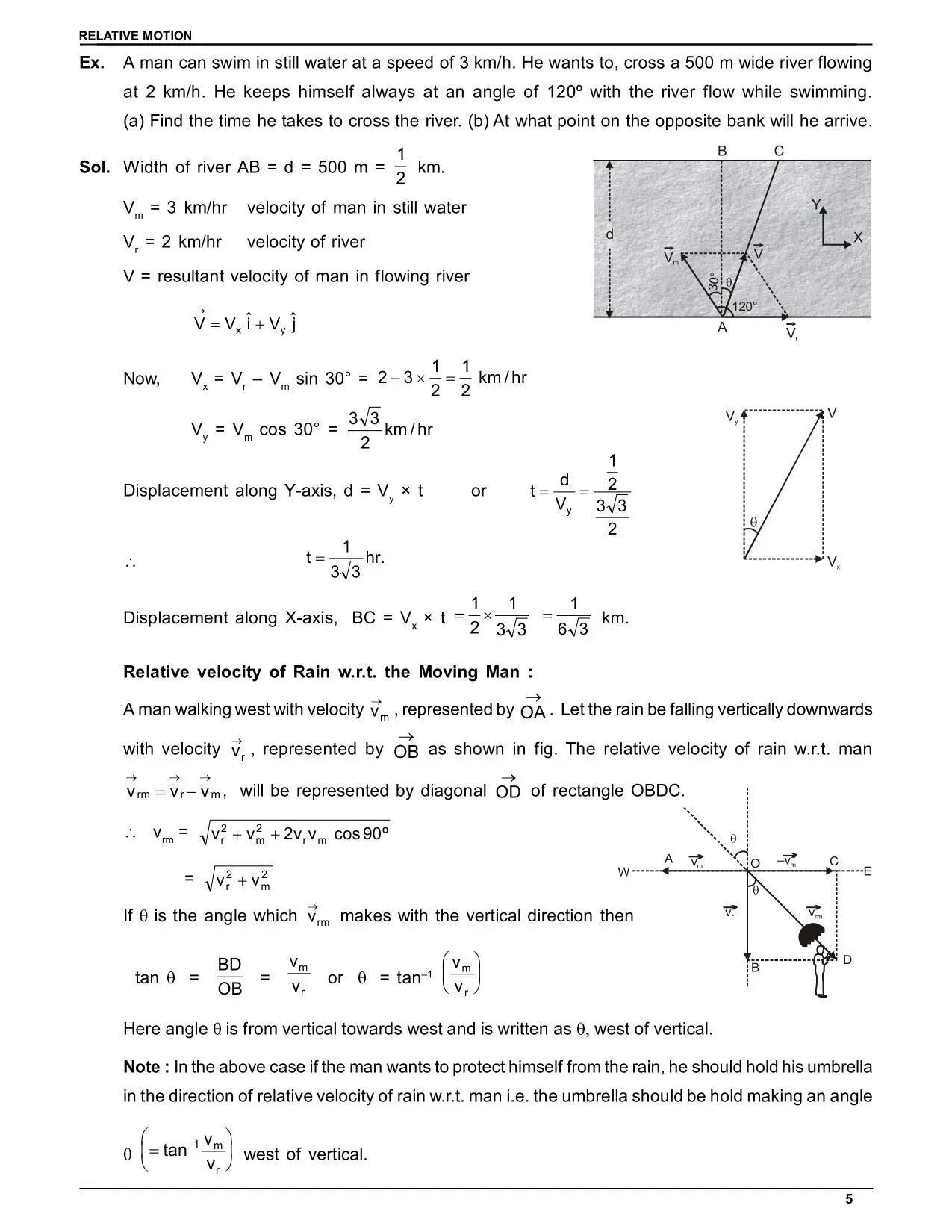
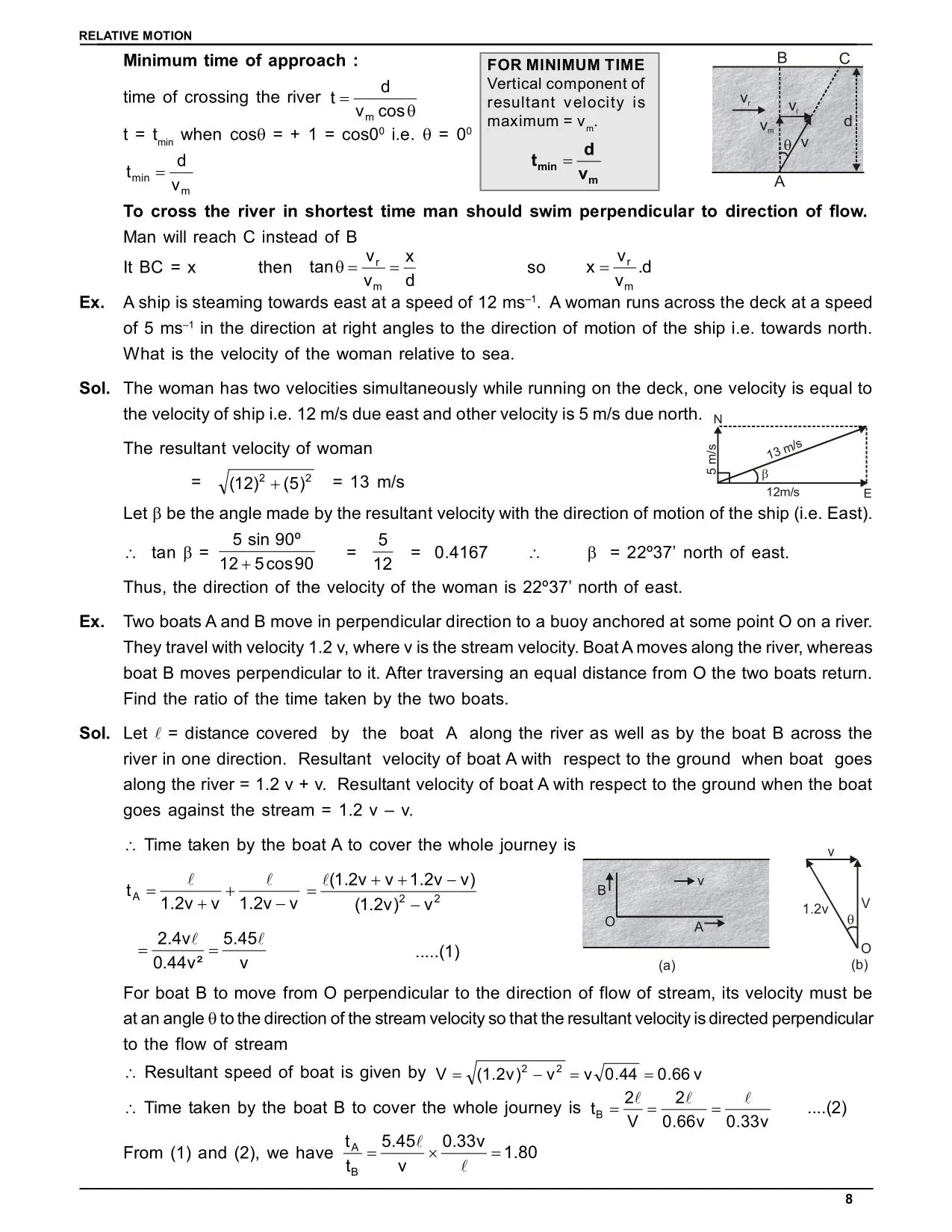
Let $v_{br}$ be the speed of the boat in still water, $v_r$ the speed of the river and $d$ the width of the river. The velocity of the boat with respect to the ground is $\vec{v}_{bg} = \vec{v}_{br} + \vec{v}_{r}$. If the boat heads at an angle $\theta$ upstream from the perpendicular to the bank:
$$t = \frac{d}{v_{br}\cos\theta}, \qquad x_{\text{drift}} = \big(v_r - v_{br}\sin\theta\big)\,t$$
Case | Heading | Result |
|---|---|---|
Shortest time | Perpendicular to the bank ($\theta = 0$) | $t_{min} = \dfrac{d}{v_{br}}$, and the drift is $x = \dfrac{v_r\,d}{v_{br}}$ |
Shortest path (zero drift), $v_{br} > v_r$ | Upstream with $\sin\theta = \dfrac{v_r}{v_{br}}$ | $t = \dfrac{d}{\sqrt{v_{br}^{2} - v_r^{2}}}$ |
Minimum drift when $v_r > v_{br}$ | Upstream with $\sin\theta = \dfrac{v_{br}}{v_r}$ | $x_{min} = \dfrac{d\sqrt{v_r^{2} - v_{br}^{2}}}{v_{br}}$ |
If $v_r > v_{br}$, the boat cannot reach the point directly opposite. The time to cross depends only on the component of the boat’s velocity perpendicular to the bank, so the river does not change it.
Rain-Man Problems in Relative Velocity Concept
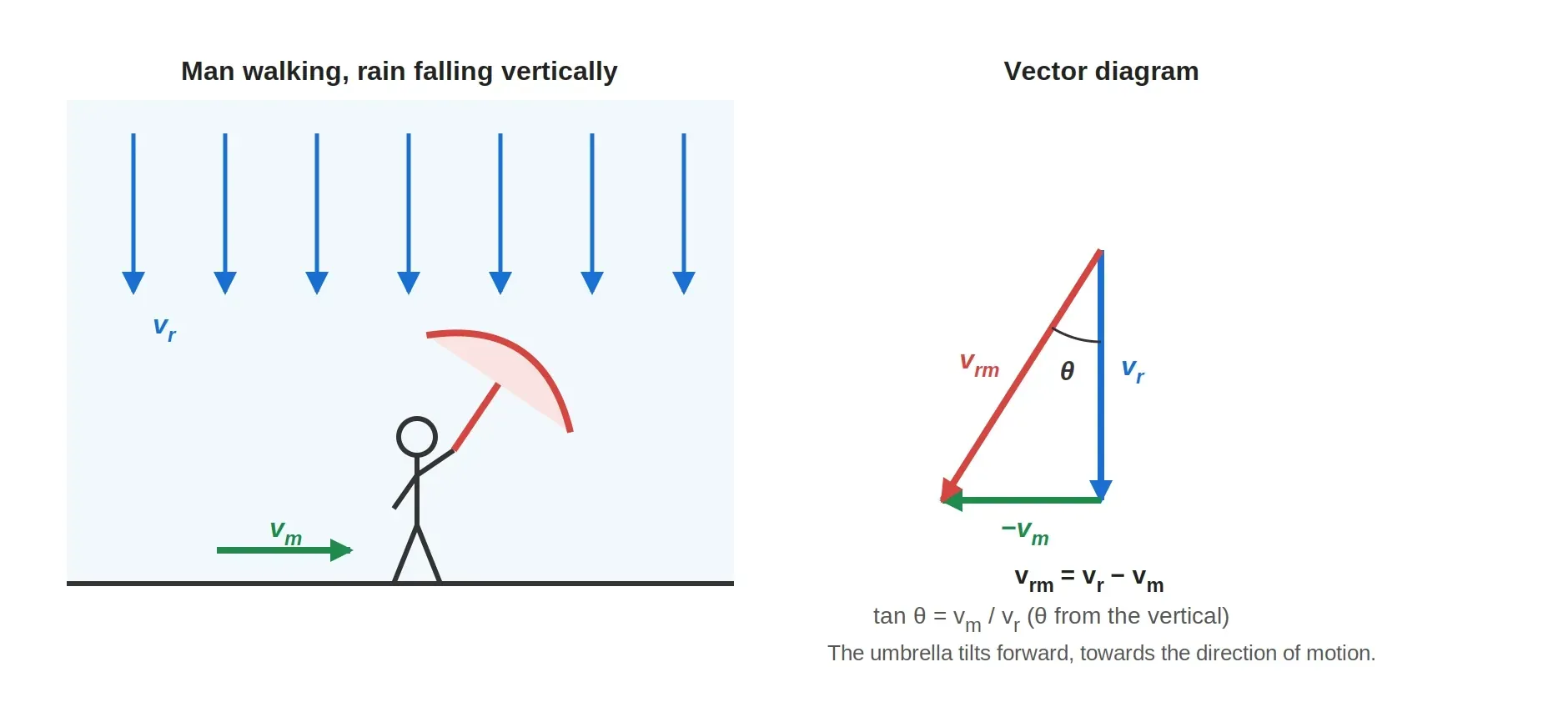
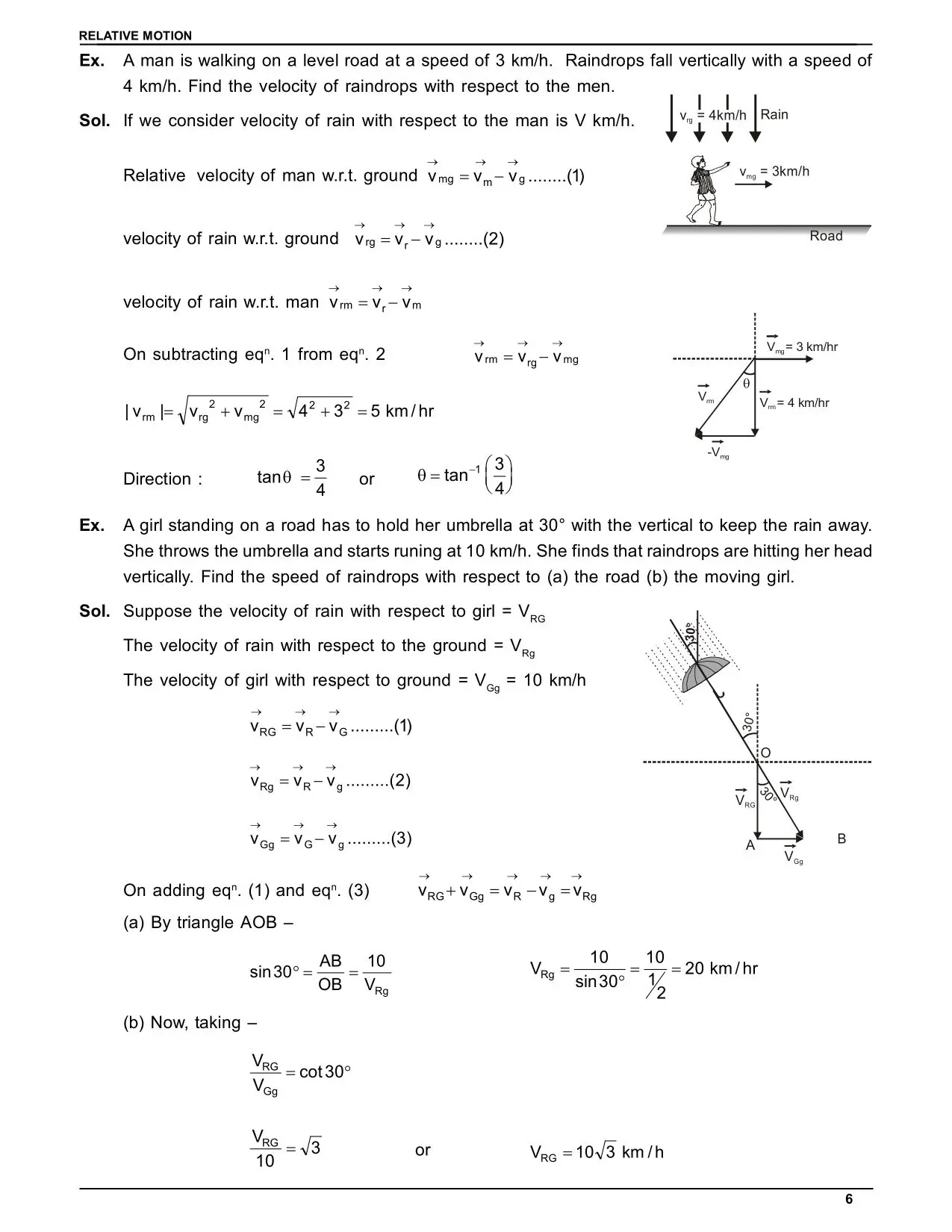
The velocity of the rain with respect to the man is:
$$\vec{v}_{rm} = \vec{v}_r - \vec{v}_m$$
For vertical rain of speed $v_r$ and a man walking horizontally at $v_m$, the rain seems to come at an angle $\theta$ from the vertical, in the direction opposite to the man’s motion, so he must tilt the umbrella forward:
$$\tan\theta = \frac{v_m}{v_r}, \qquad \lvert \vec{v}_{rm} \rvert = \sqrt{v_r^{2} + v_m^{2}}$$
If the rain falls with speed $v_r$ at an angle $\alpha$ from the vertical, blown in the direction of the man’s motion, the horizontal and vertical components of $\vec{v}_{rm}$ are $v_r\sin\alpha - v_m$ and $v_r\cos\alpha$. Then:
$$\tan\theta = \frac{\lvert v_r\sin\alpha - v_m \rvert}{v_r\cos\alpha}$$
Aeroplane and Wind Problems in Relative Velocity Concept
Use the chain rule: $\vec{v}_{ag} = \vec{v}_{aw} + \vec{v}_{wg}$, where $\vec{v}_{aw}$ is the velocity of the aeroplane with respect to the air (its airspeed and heading), $\vec{v}_{wg}$ is the velocity of the wind with respect to the ground, and $\vec{v}_{ag}$ is the velocity of the aeroplane with respect to the ground. The method is the same as for a boat in a river.
Relative Motion of Two Projectiles in Relative Velocity Concept
Two projectiles that move under gravity alone have the same acceleration, $\vec{g}$. So their relative acceleration is zero, and their relative velocity is constant:
$$\vec{a}_{AB} = \vec{g} - \vec{g} = 0, \qquad \vec{v}_{AB} = \vec{u}_A - \vec{u}_B \ \text{(constant)}$$
When two projectiles are launched at the same instant, each moves in a straight line as seen from the other, with constant relative speed. Their separation after time $t$ is $\lvert \vec{u}_A - \vec{u}_B \rvert\,t$ plus their initial separation along the same line.
Closest Approach of Two Moving Bodies in Relative Velocity Concept
Two bodies move with constant velocities, and the distance between them at the start is $d$. Work in the frame of one body. The other body moves in a straight line with the relative velocity $\vec{v}_{rel}$. If $\theta$ is the angle between $\vec{v}_{rel}$ and the line that joins the bodies (taken towards the observer), then:
$$d_{min} = d\sin\theta, \qquad t_{min} = \frac{d\cos\theta}{v_{rel}}$$
If $\theta = 0$, the bodies collide. In vector form, with $\vec{r}$ the relative position, $d_{min} = \dfrac{\lvert \vec{r} \times \vec{v}_{rel} \rvert}{\lvert \vec{v}_{rel} \rvert}$.
Key Formulas in Relative Velocity Concept
Concept | Formula |
|---|---|
Relative velocity | $\vec{v}_{AB} = \vec{v}_A - \vec{v}_B$ |
Reverse observer | $\vec{v}_{BA} = -\vec{v}_{AB}$ |
Chain rule | $\vec{v}_{AC} = \vec{v}_{AB} + \vec{v}_{BC}$ |
Magnitude in 2D | $\sqrt{v_A^2 + v_B^2 - 2v_Av_B\cos\theta}$ |
Relative acceleration | $a_{AB} = a_A - a_B$ |
Crossing time | $t = \dfrac{L_1 + L_2}{v_{rel}}$ |
River, shortest time | $t = \dfrac{d}{v_{br}}$, drift $= \dfrac{v_r d}{v_{br}}$ |
River, shortest path | $\sin\theta = \dfrac{v_r}{v_{br}}$, $t = \dfrac{d}{\sqrt{v_{br}^2 - v_r^2}}$ |
Rain-man (vertical rain) | $\tan\theta = \dfrac{v_m}{v_r}$ |
Closest approach | $d_{min} = d\sin\theta$, $t = \dfrac{d\cos\theta}{v_{rel}}$ |
Solved Examples from Relative Velocity Concept
Example 1 (overtaking): A train of length 100 m moves at 54 km/h and overtakes a train of length 150 m that moves at 36 km/h on a parallel track. How long does the overtaking take?
$v_{rel} = 54 - 36 = 18$ km/h $= 5$ m/s. The distance to cover is $100 + 150 = 250$ m, so $t = \dfrac{250}{5} = 50$ s.
Example 2 (opposite directions): Car A moves at 30 m/s east, and car B moves at 20 m/s west. They are 500 m apart and approaching each other. When do they meet?
$v_{rel} = 30 + 20 = 50$ m/s, so $t = \dfrac{500}{50} = 10$ s.
Example 3 (two dimensions): A moves at 3 m/s east, and B moves at 4 m/s north. Find $\vec{v}_{AB}$.
$\vec{v}_{AB} = (3, 0) - (0, 4) = (3, -4)$ m/s. The magnitude is $\sqrt{9 + 16} = 5$ m/s, and the direction is $\tan^{-1}\dfrac{4}{3} \approx 53^\circ$ south of east.
Example 4 (river, shortest time): A river is 100 m wide, and it flows at $v_r = 3$ m/s. A boat has $v_{br} = 5$ m/s. Find the shortest time to cross and the drift.
$t_{min} = \dfrac{100}{5} = 20$ s, and the drift is $x = 3 \times 20 = 60$ m.
Example 5 (river, shortest path): For the same river and boat, find the heading and the time to reach the point directly opposite.
$\sin\theta = \dfrac{3}{5}$, so $\theta \approx 37^\circ$ upstream from the perpendicular. The resultant speed is $\sqrt{5^2 - 3^2} = 4$ m/s, so $t = \dfrac{100}{4} = 25$ s.
Example 6 (rain-man): Rain falls vertically at 10 m/s, and a man walks at 5 m/s. At what angle should he tilt the umbrella, and how fast does the rain seem to fall?
$\tan\theta = \dfrac{5}{10} = 0.5$, so $\theta \approx 26.6^\circ$ from the vertical, tilted forward. The rain seems to fall at $\sqrt{10^2 + 5^2} \approx 11.2$ m/s.
Example 7 (aeroplane and wind): An aeroplane has an airspeed of 200 km/h and heads north. The wind blows towards the east at 50 km/h. Find its velocity with respect to the ground.
$\vec{v}_{ag} = \vec{v}_{aw} + \vec{v}_{wg}$ has components $(50, 200)$ km/h. The speed is $\sqrt{50^2 + 200^2} \approx 206$ km/h, and the direction is $\tan^{-1}\dfrac{50}{200} \approx 14^\circ$ east of north.
Example 8 (closest approach): Body A is at the origin and moves at 4 m/s east. Body B is at (0, 100) m and moves at 3 m/s south. Find the closest distance and the time at which it occurs.
$\vec{v}_{BA} = (0, -3) - (4, 0) = (-4, -3)$ m/s, so $v_{rel} = 5$ m/s. The angle between $\vec{v}_{BA}$ and the line from B to A satisfies $\cos\theta = \dfrac{3}{5}$, so $\sin\theta = 0.8$. Then $d_{min} = 100 \times 0.8 = 80$ m, and $t = \dfrac{100 \times 0.6}{5} = 12$ s.
Example 9 (two projectiles): Two balls are thrown from the same point at the same instant, each with a speed of 20 m/s, at angles of 30° and 60° to the horizontal. Find their separation after 2 s.
$\vec{u}_1 - \vec{u}_2 = (20\cos 30^\circ - 20\cos 60^\circ,\ 20\sin 30^\circ - 20\sin 60^\circ) \approx (7.32, -7.32)$ m/s. The relative speed is about 10.35 m/s, and it is constant, so the separation after 2 s is about 20.7 m.
Relative Velocity Class 11 – Formula, Examples
Common Mistakes in Relative Velocity Concept Problems
Mistake | Correct approach |
|---|---|
Writing $v_{AB} = v_B - v_A$ | $v_{AB}$ is the velocity of A as seen from B, so it is $v_A - v_B$ |
Using the speeds without signs in one dimension | Write each velocity with its sign, and then subtract |
Saying that velocity is “absolute” with respect to the ground | The ground is only a convenient frame. Every velocity is relative. |
Adding the river speed to the time of crossing | The time depends only on the component perpendicular to the bank |
Tilting the umbrella backward | Tilt it forward, towards the direction of motion |
Taking the angle for the shortest path from the bank | $\theta$ is measured from the perpendicular to the bank |
Using $\sin\theta = v_r/v_{br}$ when $v_r > v_{br}$ | The boat cannot go straight across, so use the minimum drift condition |
How to Study Relative Velocity Concept
- Revise one-dimensional kinematics with eSaral’s Motion in a Straight Line JEE notes, and vector subtraction with the vectors and two-dimensional motion notes.
- For every problem, write the observer, draw the vector triangle, and then calculate.
- Practise one problem type each day: trains, river-boat, rain-man, aeroplane-wind, projectiles and closest approach.
- Revise the Kinematics unit with eSaral’s JEE Main Physics revision notes, and test yourself with eSaral’s JEE Main chapter-wise PYQs and NEET chapter-wise PYQs.
Frequently Asked Questions
What is relative velocity in simple words?
Relative velocity is the velocity of one object as seen by an observer who is moving. It is the velocity of A minus the velocity of B, $\vec{v}_{AB} = \vec{v}_A - \vec{v}_B$, when both are measured in the same frame. If two cars move at 60 km/h in the same direction, each looks at rest to the other. eSaral’s Relative Velocity Concept notes explain this with diagrams.
What is the formula for relative velocity?
$\vec{v}_{AB} = \vec{v}_A - \vec{v}_B$. In one dimension, take the signs of the velocities into account: the same direction gives the difference of the speeds, and opposite directions give the sum. In two dimensions, subtract the components, or use $\sqrt{v_A^2 + v_B^2 - 2v_Av_B\cos\theta}$ for the magnitude.
When is the relative velocity equal to the sum of the speeds?
When the two objects move in exactly opposite directions. If A moves at 30 m/s east and B moves at 20 m/s west, the relative velocity of A with respect to B is $30 + 20 = 50$ m/s (towards the east). This is part of the Relative Velocity Concept for one dimension.
How do you solve rain-man problems?
Find the velocity of the rain with respect to the man, $\vec{v}_{rm} = \vec{v}_r - \vec{v}_m$. For vertical rain, the umbrella must tilt forward, towards the direction of motion, by an angle $\theta$ with $\tan\theta = v_m/v_r$. Draw the vector triangle first, to avoid sign errors.
How do you find the shortest time and the shortest path in a river-boat problem?
For the shortest time, head perpendicular to the bank, so $t = d/v_{br}$, and the boat drifts by $v_r t$. For the shortest path (no drift), head upstream with $\sin\theta = v_r/v_{br}$ (this needs $v_{br} > v_r$), so $t = d/\sqrt{v_{br}^2 - v_r^2}$. These are the two standard cases of the Relative Velocity Concept for JEE.
Is velocity absolute or relative?
All velocities are relative to a frame of reference. The velocity “with respect to the ground” is just the velocity in a convenient frame, and it changes if you change the frame. This is the key point of the Relative Velocity Concept, and it is why we subtract the observer’s velocity.
Why is the relative acceleration of two projectiles zero?
Both projectiles have the same acceleration $\vec{g}$ (if air resistance is ignored), so $\vec{a}_{AB} = \vec{g} - \vec{g} = 0$. Their relative velocity is therefore constant, and each projectile moves in a straight line as seen from the other.
Which chapter is relative velocity in Class 11 Physics?
The one-dimensional case is in Motion in a Straight Line (Chapter 2), and the two-dimensional case uses the vectors of Motion in a Plane (Chapter 3). The JEE Main 2026 syllabus lists relative velocity in Unit 2, Kinematics. These Relative Velocity Concept notes cover both cases.
Where can I find more Class 11 Physics notes on eSaral?
eSaral has chapter-wise Class 11 Physics notes, NCERT solutions, JEE Main and NEET chapter-wise PYQs, notes on Motion in a Straight Line and on vectors, and these Relative Velocity Concept notes, all linked on this page.
Team eSaral
eSaral Academic and Editorial Team
Team eSaral is the collective author profile for educational content created by eSaral’s teachers and academic contributors. The team draws on expertise from IIT graduates, doctors, experienced educators and subject specialists to develop resources for JEE, NEET and school students. Our articles aim to explain concepts clearly and help students study with confidence.
Related Posts

NCERT Physics Class 10 Book PDF in Hindi 2026-27 – भौतिक विज्ञान के 4 अध्याय (Free Download)
NCERT Physics Class 10 book PDF in Hindi 2026-27: download all 4 chapters (अध्याय 9–12) free, with topics and important formulas.

NCERT Biology Class 9 Book Anveshan PDF in Hindi - जीव विज्ञान कक्षा 9 पुस्तक अन्वेषण PDF
Download NCERT Biology Class 9 book PDF in Hindi chapterwise for 2026-27: Cell, Tissues, Reproduction and Diversity. Free PDFs.

Essay On Artificial Intelligence in English (100,150, 200, 250, 300, 500 Words)
This is in contrast to the natural intelligence of humans. With Artificial Intelligence, machines can perform

Essay on 78th India Independence Day in English for Student (100, 150, 200, 250, 300, 500 Words)
Read the best essays on India's Independence Day in English. Short & long essays (100, 150, 200, 250, 300, 500 words) perfect for school exams
NCERT Class 11 English Snapshots book - Free PDF download- Esaral
Download NCERT Class 11 English Snapshots book PDF for free. Get all 8 chapters, chapter-wise. Start your prep today!
NCERT Class 10 biology book pdf - Free PDF Download - eSaral
NCERT Class 10 Biology book PDF 2026-27: all 5 chapters (Life Processes to Our Environment) in English & Hindi, with CBSE syllabus, marks & practical

Essay on Global Warming in English (100,150, 200, 250, 300, 500 Words)
Global warming means the Earth is getting hotter. This happens because of things like pollution from cars and factories.

NCERT Class 12 English Book 2026-27: Flamingo, Vistas and Kaleidoscope PDF, Chapters and Syllabus
NCERT Class 12 English book 2026-27: Flamingo & Vistas (English Core) and Kaleidoscope (Elective) PDFs chapter-wise, with syllabus and sample papers.
NCERT Class 11 Physics Book —Part1 & Part 2 download in Hindi - NCERT भौतिकी कक्षा 11 पुस्तक
Download Class 11 Physics NCERT book PDF in Hindi – all 15 chapters, chapterwise links, JEE & NEET tips. Free PDF, no signup needed.

NCERT Class 10 Hindi Book PDF 2026-27 – क्षितिज, कृतिका, स्पर्श, संचयन (Chapterwise Free Download)
Download NCERT Class 10 Hindi Book PDF 2026-27 free, chapterwise: Kshitij, Kritika, Sparsh, Sanchayan. Includes CBSE syllabus & deleted chapters.