
Sets - JEE Main Previous Year Question with Solutions

eSaral Academic and Editorial Team
Summary
Practice JEE Main Sets previous year questions with detailed solutions, covering set operations, subsets, intersections, unions, and problem-solving techniques frequently asked in the exam.
eSaral › JEE › JEE Main ›Sets - JEE Main Previous Year Question with Solutions

🚀 Checkout eSaral Courses
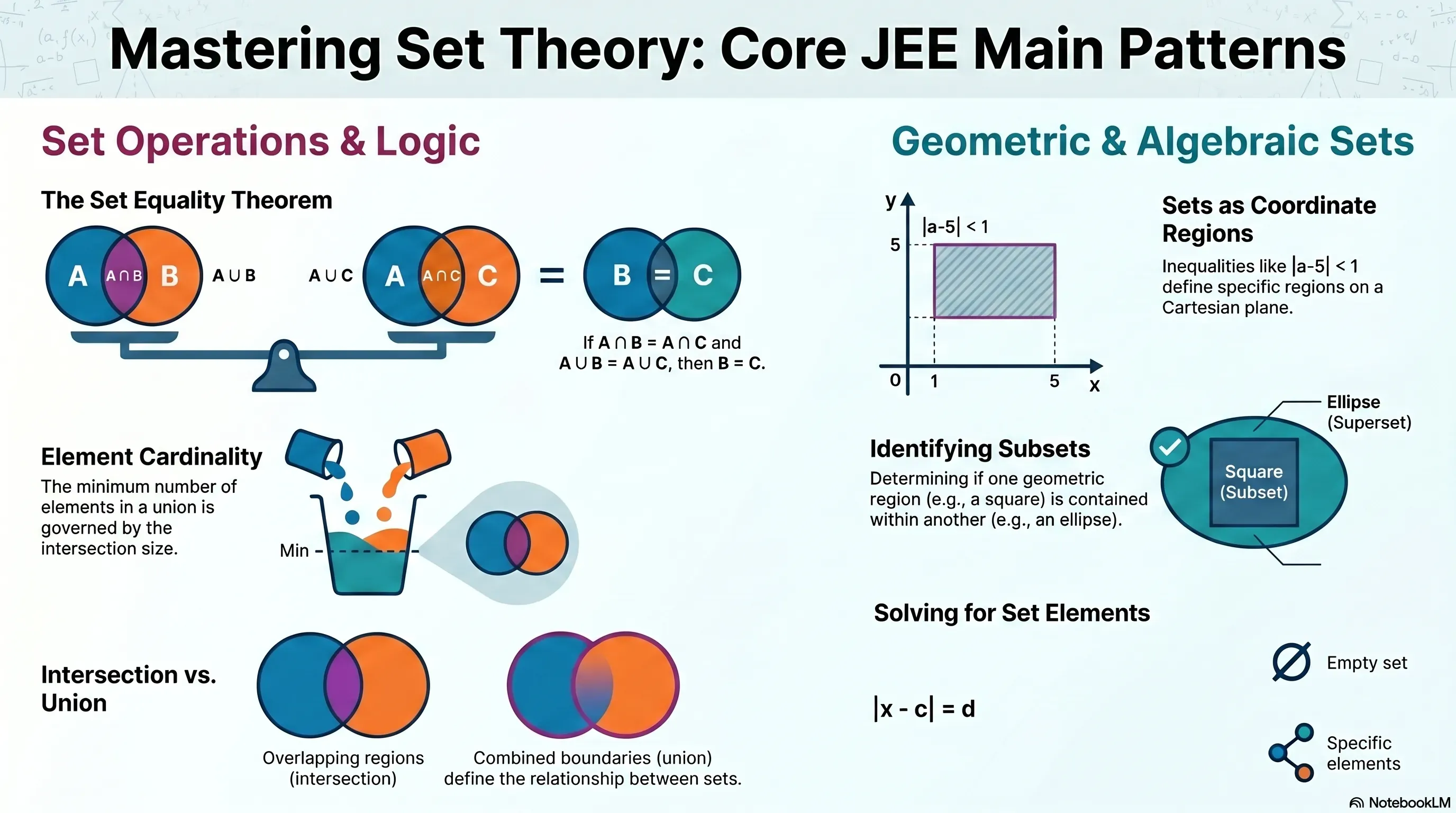
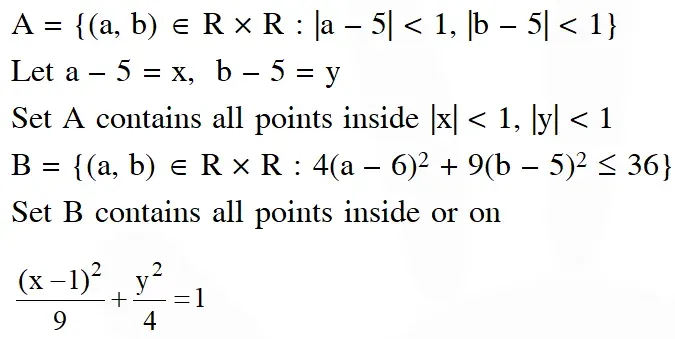
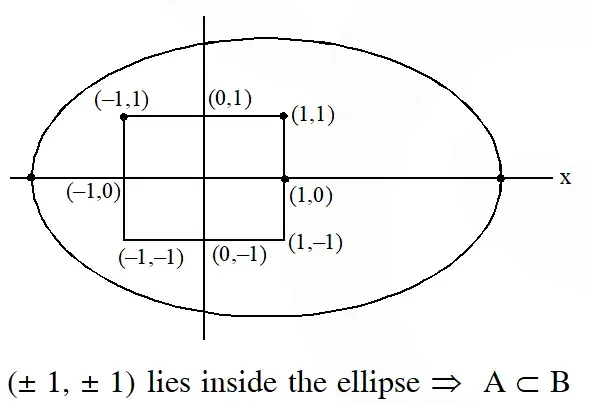
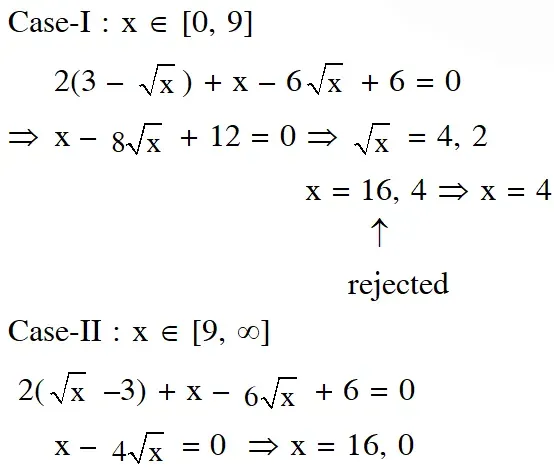
Download eSaral app for free study material and video tutorials. [esquestion] If $\mathrm{A}, \mathrm{B}$ and $\mathrm{C}$ are three sets such that $\mathrm{A} \cap \mathrm{B}=\mathrm{A} \cap \mathrm{C}$ and $\mathrm{A} \cup \mathrm{B}=\mathrm{A} \cup \mathrm{C},$ then :- (1) B = C $(2) \mathrm{A} \cap \mathrm{B}=\phi$ (3) A = B (4) A = C #tag# [AIEEE- 2009] #sol# (1) $\mathrm{n}(\mathrm{A})=3, \mathrm{n}(\mathrm{B})=6, \mathrm{n}(\mathrm{A} \cap \mathrm{B})=3(\text { maximum })$ so $\mathrm{n}(\mathrm{A} \cup \mathrm{B})=\mathrm{n}(\mathrm{A})+\mathrm{n}(\mathrm{B})-\mathrm{n}(\mathrm{A} \cap \mathrm{B})$ $3+6-3$ $\mathrm{n}(\mathrm{A} \cup \mathrm{B})=6$ so minimum no of elements in $\mathrm{A} \cup \mathrm{B}$ is $6 .$ [/esquestion] [esquestion] Two sets A and B are as under $\mathrm{A}=\{(\mathrm{a}, \mathrm{b}) \in \mathrm{R} \times \mathrm{R}:|\mathrm{a}-5|<1 \text { and }|\mathrm{b}-5|<1\}$ $\mathrm{B}=\left\{(\mathrm{a}, \mathrm{b}) \in \mathrm{R} \times \mathrm{R}: 4(\mathrm{a}-6)^{2}+9(\mathrm{b}-5)^{2} \leq 36\right\} .$ Then (1) $\mathrm{A} \subset \mathrm{B}$ (2) $\mathrm{A} \cap \mathrm{B}=\phi$ (an empty set) (3) neither $\mathrm{A} \subset \mathrm{B}$ nor $\mathrm{B} \subset \mathrm{A}$ (4) $\mathrm{B} \subset \mathrm{A}$ #tag# [JEE-MAINS-2018] #sol# (1) [/esquestion] [esquestion] Let $\mathrm{S}=\{\mathrm{x} \in \mathrm{R}: \mathrm{x} \geq 0 \text { and } 2|\sqrt{\mathrm{x}}-3|+\sqrt{\mathrm{x}}(\sqrt{\mathrm{x}}-6)+6=0\} .$ Then $\mathrm{S}:$ (1) contains exactly one element. (2) contains exactly two elements. (3) contains exactly four elements. (4) is an empty set. #tag# [JEE-MAINS-2018] #sol# (2) [/esquestion]
This is one chapter within the larger Maths syllabus, so students can continue with the JEE Mains PYQ chapter wise collection.
To revise Sets alongside every other chapter in one sitting, switch to our JEE Main last year question paper, which has complete, session-wise papers.
Frequently Asked Questions
Are Sets important for JEE Main?
Yes, Sets is one of the fundamental topics in Mathematics and forms the base for Relations, Functions, Probability, and Logic. JEE Main regularly includes direct and concept-based questions from Sets.
What are the most important concepts in Sets for JEE Main?
The most important concepts include union of sets, intersection of sets, complement of a set, difference of sets, Venn diagrams, subsets, power sets, and set identities.
How many questions from Sets are usually asked in JEE Main?
Generally, 1–2 questions are asked from Sets and related topics in JEE Main. These questions are often straightforward and scoring.
Why should I solve JEE Main previous year questions on Sets?
Previous year questions help you understand the exam pattern, identify frequently tested concepts, and improve your speed and accuracy in solving problems.
Are Venn diagrams useful for solving Sets questions?
Yes, Venn diagrams are extremely useful for visualizing relationships between sets and solving problems involving unions, intersections, and complements.
Team eSaral
eSaral Academic and Editorial Team
Team eSaral is the collective author profile for educational content created by eSaral’s teachers and academic contributors. The team draws on expertise from IIT graduates, doctors, experienced educators and subject specialists to develop resources for JEE, NEET and school students. Our articles aim to explain concepts clearly and help students study with confidence.
Related Posts

BITSAT 2027: Registration Date, Exam Date, Syllabus, Eligibility, Pattern & Fees
BITSAT 2027 exam dates, registration timeline, eligibility criteria, exam pattern, marking scheme, syllabus and fees in one page.

BITSAT Previous Year Question Paper PDF (2017-2026)
Download BITSAT previous year question papers PDF from 2017 to 2026,session-wise. Memory-based papers,exam pattern, paper analysis and how to practise

CBSE Class 10 Date Sheet 2027: Expected Exam Dates, Release Date, Admit Card & Result Timeline
CBSE Class 10 date sheet 2027 is awaited. See the expected exam dates, release window, how to download the PDF, admit card and result timelines.

NCERT Physics Class 10 Book PDF in Hindi 2026-27 – भौतिक विज्ञान के 4 अध्याय (Free Download)
NCERT Physics Class 10 book PDF in Hindi 2026-27: download all 4 chapters (अध्याय 9–12) free, with topics and important formulas.

NCERT Biology Class 9 Book Anveshan PDF in Hindi - जीव विज्ञान कक्षा 9 पुस्तक अन्वेषण PDF
Download NCERT Biology Class 9 book PDF in Hindi chapterwise for 2026-27: Cell, Tissues, Reproduction and Diversity. Free PDFs.

Essay On Artificial Intelligence in English (100,150, 200, 250, 300, 500 Words)
This is in contrast to the natural intelligence of humans. With Artificial Intelligence, machines can perform

Essay on 78th India Independence Day in English for Student (100, 150, 200, 250, 300, 500 Words)
Read the best essays on India's Independence Day in English. Short & long essays (100, 150, 200, 250, 300, 500 words) perfect for school exams
NCERT Class 11 English Snapshots book - Free PDF download- Esaral
Download NCERT Class 11 English Snapshots book PDF for free. Get all 8 chapters, chapter-wise. Start your prep today!
NCERT Class 10 biology book pdf - Free PDF Download - eSaral
NCERT Class 10 Biology book PDF 2026-27: all 5 chapters (Life Processes to Our Environment) in English & Hindi, with CBSE syllabus, marks & practical

Essay on Global Warming in English (100,150, 200, 250, 300, 500 Words)
Global warming means the Earth is getting hotter. This happens because of things like pollution from cars and factories.