
Types of Equilibrium - What is Equilibrium? - eSaral

eSaral Academic and Editorial Team
Summary
Types of Equilibrium explains stable, unstable, and neutral equilibrium based on force, potential energy, and a body's response to small displacements, helping students understand equilibrium conditions in mechanics.
eSaral › JEE › JEE Main ›Types of Equilibrium

🚀 Checkout eSaral Courses
What is Equilibrium?
A body is said to be in translatory equilibrium if the net force acting on the body is zero, $\overrightarrow{\mathrm{F}}_{\text {net }}=0$
If the force are conservative then $\mathrm{F}=-\frac{\mathrm{dU}}{\mathrm{dr}}$
For equilibrium F = 0.
So, $-\frac{d U}{d r}=0$
Or
$\frac{\mathrm{dU}}{\mathrm{dr}}=0$
At equilibrium position slope of U-r graph is zero or the potential energy is optimum (maximum or minimum or constant).
Types of Equilibrium.
- Stable Equilibrium
- Unstable Equilibrium
- Neutral Equilibrium
Stable Equilibrium:
When a particle is slightly displaced from equilibrium and it tends to come back towards equilibrium then it is said to be in stable equilibrium
Unstable Equilibrium:
When a particle is displaced from equilibrium and it tends to move away from equilibrium position then it is said to be in unstable equilibrium
Neutral Equilibrium:
When a particle is displaced from equilibrium and no force acts on it then the equilibrium is said to be neutral equilibrium
The situation where F = 0 and $\frac{\mathrm{d} \mathrm{U}}{\mathrm{dr}}=0$ can be obtained under three conditions.
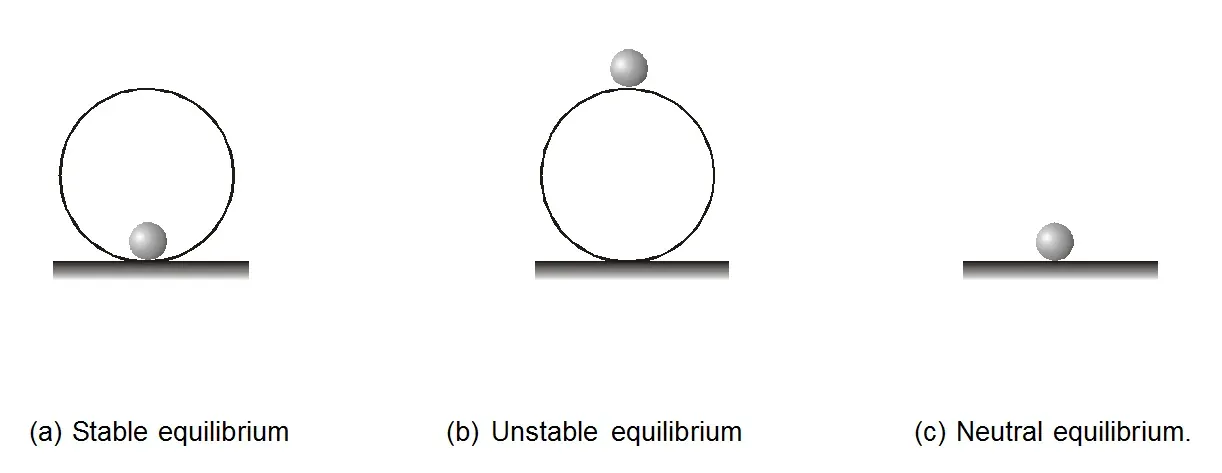
Three identical balls are placed in equilibrium in positions as shown in fig. (a), (b), and (c) respectively.
- The ball is placed inside a smooth spherical shell. This ball is in a stable equilibrium position.
- The ball is placed over a smooth sphere. This is in the Unstable equilibrium position.
- The ball is placed on smooth horizontal ground. This ball is in the Neutral equilibrium position.
Difference Between Stable, Unstable, and Neutral Equilibrium
S.no | Stable equilibrium | Unstable equilibrium | Neutral equilibrium |
1 | Net force is zero | Net force is zero | Net force is zero |
2 | $\frac{d U}{d r}=0$ or slope of $U-r$ graph is zero | $\frac{\mathrm{dU}}{\mathrm{dr}}=0$ or slope of U-r graph is zero. | $\frac{\mathrm{dU}}{\mathrm{dr}}=0$ or slope of U-r graph is zero. |
3 | When displaced slightly, from its equilibrium position a net restoring force starts acting on the body which has a tendency to bring the body back to its equilibrium position. | When displaced slightly from its equilibrium position, a net force starts acting on the body which moves the body in the direction of displacement or away from the equilibrium position. | When displaced slightly from its equilibrium position the body has neither the tendency to come back to original position nor to move away from the original position. |
4 | Potential energy in equilibrium position is minimum as compared to its neighboring | Potential energy in equilibrium position is maximum as compared to its neighboring points | Potential energy remains constant even if the body is displaced from its equilibrium position. |
5 | When displaced from equilirbium position the centre of gravity of the body | When displaced from equilibrium position the centre of gravity of the body comes down. | When displaced from equilibrium position the centre of gravity of the body remains at the same level. |
So, that's all from this article. If you found this Explanation of Types of Equilibrium helpful then please share it with your friends.
For a better understanding of this chapter, please check the detailed notes of the Work Energy and Power. To watch Free Learning Videos on physics by Saransh Gupta sir Install the eSaral App.
Frequently Asked Questions
What are the three types of equilibrium in physics?
The three types of equilibrium in physics are stable, unstable, and neutral equilibrium. In stable equilibrium, a body returns to its original position after a small displacement. In unstable equilibrium, it moves further away. In neutral equilibrium, it remains in its new position. All three require net force = 0 and dU/dr = 0.
How is unstable equilibrium different from stable equilibrium?
In stable equilibrium, the potential energy is at a minimum and d²U/dr² > 0, so a displaced body returns. In unstable equilibrium, potential energy is at a maximum and d²U/dr² < 0, so a displaced body accelerates away. The key physical difference: the direction of the net force after displacement is opposite in the two cases.
What does d²U/dr² = 0 mean for equilibrium?
When d²U/dr² = 0 at an equilibrium point, the body is in neutral equilibrium. The potential energy remains constant with displacement — there is no force (restoring or otherwise) acting on the body. It will remain wherever it is placed. A ball on a perfectly flat horizontal surface is the most common example.
Is equilibrium possible without the net force being zero?
No. A fundamental requirement for any type of equilibrium — stable, unstable, or neutral — is that the net force on the body must be zero (F_net = 0). If a net force acts, the body accelerates and is therefore not in equilibrium. The type of equilibrium only becomes relevant after this condition is satisfied.
How is equilibrium related to potential energy in JEE problems?
In JEE Main and JEE Advanced, equilibrium questions typically give a U(r) function and ask you to find the equilibrium position and its type. The method is: (1) differentiate U and set dU/dr = 0 to find equilibrium positions; (2) calculate d²U/dr² at each position; (3) use the sign of d²U/dr² to classify as stable, unstable, or neutral. For more solved problems, check the NCERT Solutions for Class 12 Physics.
Team eSaral
eSaral Academic and Editorial Team
Team eSaral is the collective author profile for educational content created by eSaral’s teachers and academic contributors. The team draws on expertise from IIT graduates, doctors, experienced educators and subject specialists to develop resources for JEE, NEET and school students. Our articles aim to explain concepts clearly and help students study with confidence.
Related Posts

BITSAT 2027: Registration Date, Exam Date, Syllabus, Eligibility, Pattern & Fees
BITSAT 2027 exam dates, registration timeline, eligibility criteria, exam pattern, marking scheme, syllabus and fees in one page.

BITSAT Previous Year Question Paper PDF (2017-2026)
Download BITSAT previous year question papers PDF from 2017 to 2026,session-wise. Memory-based papers,exam pattern, paper analysis and how to practise

CBSE Class 10 Date Sheet 2027: Expected Exam Dates, Release Date, Admit Card & Result Timeline
CBSE Class 10 date sheet 2027 is awaited. See the expected exam dates, release window, how to download the PDF, admit card and result timelines.

NCERT Physics Class 10 Book PDF in Hindi 2026-27 – भौतिक विज्ञान के 4 अध्याय (Free Download)
NCERT Physics Class 10 book PDF in Hindi 2026-27: download all 4 chapters (अध्याय 9–12) free, with topics and important formulas.

NCERT Biology Class 9 Book Anveshan PDF in Hindi - जीव विज्ञान कक्षा 9 पुस्तक अन्वेषण PDF
Download NCERT Biology Class 9 book PDF in Hindi chapterwise for 2026-27: Cell, Tissues, Reproduction and Diversity. Free PDFs.

Essay On Artificial Intelligence in English (100,150, 200, 250, 300, 500 Words)
This is in contrast to the natural intelligence of humans. With Artificial Intelligence, machines can perform

Essay on 78th India Independence Day in English for Student (100, 150, 200, 250, 300, 500 Words)
Read the best essays on India's Independence Day in English. Short & long essays (100, 150, 200, 250, 300, 500 words) perfect for school exams
NCERT Class 11 English Snapshots book - Free PDF download- Esaral
Download NCERT Class 11 English Snapshots book PDF for free. Get all 8 chapters, chapter-wise. Start your prep today!
NCERT Class 10 biology book pdf - Free PDF Download - eSaral
NCERT Class 10 Biology book PDF 2026-27: all 5 chapters (Life Processes to Our Environment) in English & Hindi, with CBSE syllabus, marks & practical

Essay on Global Warming in English (100,150, 200, 250, 300, 500 Words)
Global warming means the Earth is getting hotter. This happens because of things like pollution from cars and factories.