
Photoelectric Effect Class 12 – Definition, Laws, Experiment & JEE Tips

eSaral Academic and Editorial Team
Summary
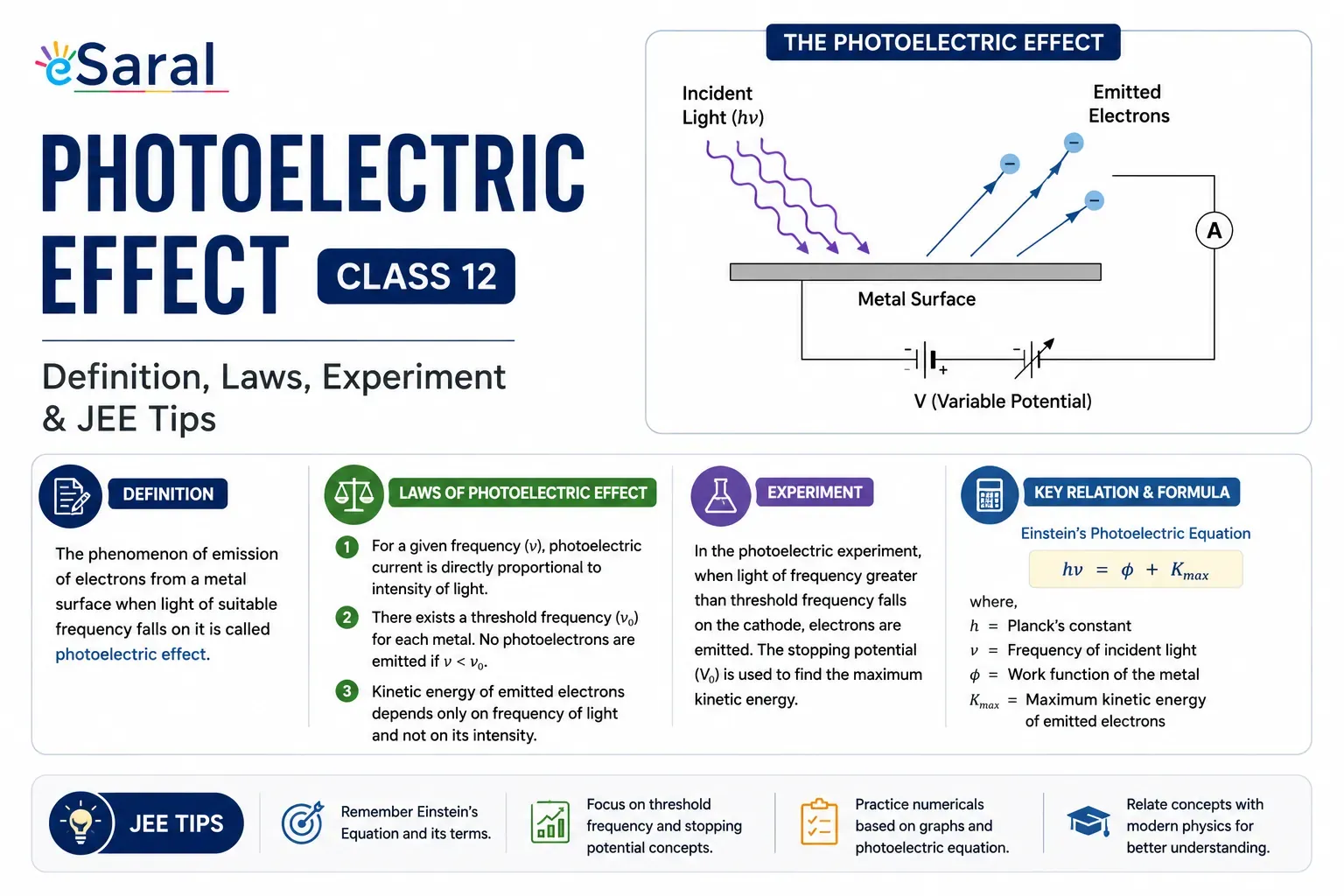
The photoelectric effect is the emission of electrons from a metal surface when light of sufficient frequency strikes it. Discovered by Hallwach and explained by Einstein using quantum theory, it proves that light behaves as packets of energy called photons. It is a core topic in Class 12 Physics (Chapter 11 — Dual Nature of Radiation and Matter) and carries direct weightage in JEE Main and NEET.
Home > Modern Physics > Photoelectric Effect Class 12

India's Best Exam Preparation for Class 12th - Download Now
What is the photoelectric effect?
The emission of electrons from the surface of a metal when light of a suitable frequency falls on it is called the photoelectric effect.
- The ejected electrons are called photoelectrons
- The current produced due to emitted electrons is called photocurrent.
- The photoelectric effect proves the quantum nature of radiation.
- The classical electromagnetic theory fails to explain the photoelectric effect.
- Einstein explained the photoelectric effect using quantum nature of radiation.
- Hallwach is credited with discovery of the photoelectric effect.
India's Best Exam Preparation for Class 12th - Download Now
Key Terms You Must Know
Before studying the experiment, make sure you are clear on these terms. JEE and NEET questions are often built around precise definitions.
Term | Definition |
|---|---|
Photoelectrons | Electrons are emitted from the metal surface due to incident radiation. |
Photocurrent | An electric current is produced by the flow of photoelectrons. |
Threshold Frequency ($\nu_0$) | Minimum frequency of light required to eject photoelectrons from a metal. |
Work Function ($\phi$) | Minimum energy needed to liberate an electron from the metal surface; $\phi = h\nu_0$. |
Stopping Potential ($V_s$) | Negative potential is applied to the anode to reduce the photocurrent to zero. |
Saturation Current | Maximum photocurrent is achieved when all emitted photoelectrons reach the anode. |
Intensity of Radiation | Number of photons incident per second per unit area. |
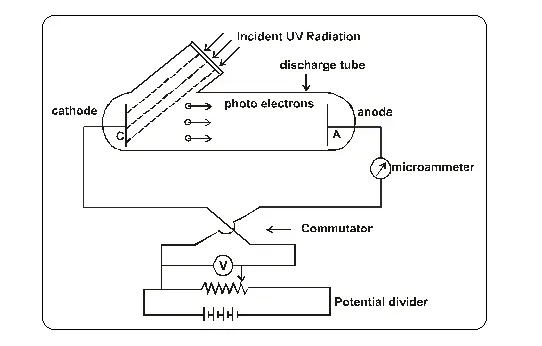
Experimental study of the photoelectric effect
Effect of the intensity of incident radiation
- The number of incident photons per second on a metal plate is called the intensity of incident radiation.
- For a fixed incident frequency, the saturation photocurrent is directly proportional to the intensity of incident radiation
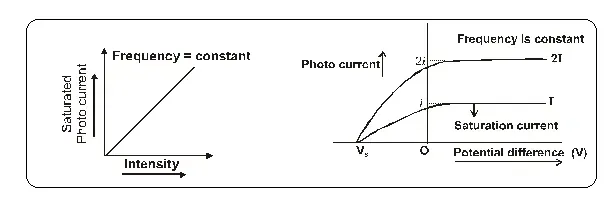 e.g. when the intensity of radiation is doubled at constant frequency, the saturation photocurrent is also doubled.
India's Best Exam Preparation for Class 12th - Download Now
- Saturation current: When all photo electrons produced reach anode the photocurrent becomes maximum and is independent of applied potential difference. This current is called saturation or maximum current.
Effect of potential
- When the polarity of the electrodes is reversed with a commutator, the current is reduced but does not become zero. This shows that emitted photoelectrons have kinetic energy.
- The negative potential of the anode at which the photo current becomes zero is called the stopping potential $\left(\mathrm{V}_{\mathrm{s}}\right)$. At this potential, the electrons with maximum kinetic energy are stopped from reaching the anode.
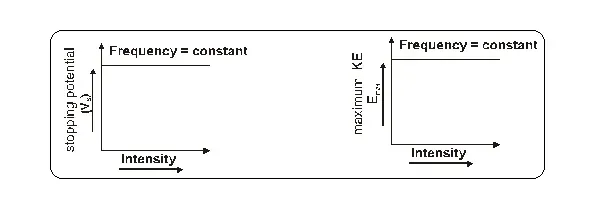
- No photo current is produced even when the intensity of incident radiation when the anode is at the stopping potential. Thus, stopping potential is independent of the intensity of incident radiation.
- The stopping potential is a measure of the maximum kinetic energy of photoelectrons. $E_{\max }$ $=\mathrm{eV}_{\mathrm{s}}$
India's Best Exam Preparation for Class 12th - Download Now
Effect of frequency of incident radiation
- The minimum frequency of incident radiation that can eject photoelectrons from a metal is known as the threshold frequency $\left(v_{0}\right)$.
- At the stopping potential, if the frequency of incident radiation is increased, then current starts flowing again. This can be made zero by increasing the stopping potential.
- Thus, the maximum kinetic energy of a photoelectron or stopping potential increases with an increase in the frequency of incident radiation. The maximum kinetic energy of a photoelectron increases linearly with an increase in the frequency of the incident light.
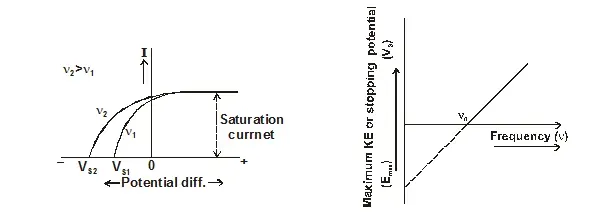
Effect of the material of the cathode
The stopping potential, work function, and threshold frequency depend on the nature of the material of the cathode. Work function: The minimum energy required for emission of electrons from a metal is called work function $\phi=\mathrm{hv}_{0}$, where $v_{0}$ is the threshold frequency.
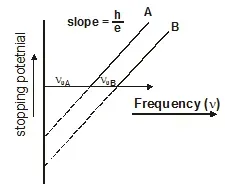
so, that's all from this article. I hope you get the idea about what the photoelectric effect is in class 12. If you found this article informative, then please share it with your friends. If you have any confusion related to this topic then feel free to ask in the comments section down below.
India's Best Exam Preparation for Class 12th - Download Now
For a better understanding of this chapter, please check the detailed notes of the Dual Nature of Radiation and matter. To watch Free Learning Videos on physics by Saransh Gupta sir Install the eSaral App.
Einstein's Photoelectric Equation
Einstein proposed that light consists of discrete energy packets called photons, each carrying energy:
$$E = h\nu$$
where $h = 6.626 \times 10^{-34}\ \text{J·s}$ (Planck's constant) and $\nu$ is the frequency.
When a photon strikes a metal surface:
- Part of the photon's energy is used to overcome the work function ($\phi$) of the metal.
- The remaining energy appears as the kinetic energy of the emitted photoelectron.
This gives Einstein's Photoelectric Equation:
$$\frac{1}{2}mv_{max}^{2}=h\nu-\phi=h\nu-h\nu_{0}=h(\nu-\nu_{0})$$
Or equivalently:
$$eV_{s}=h\nu-\phi$$
This single equation explains all four experimental observations — the role of frequency, independence of stopping potential from intensity, the existence of a threshold frequency, and the instantaneous emission of electrons.
Why Classical Electromagnetic Theory Fails to Explain the Photoelectric Effect
Classical wave theory predicts that:
- Any frequency of light — given sufficient intensity — should eject electrons (intensity should control emission, not frequency).
- There should be a time delay between light hitting the surface and electron emission, as the electron would need time to absorb enough wave energy.
- Kinetic energy of emitted electrons should increase with intensity.
All three predictions are experimentally wrong. The photoelectric effect shows:
- Only light above threshold frequency ejects electrons, regardless of intensity.
- Emission is instantaneous.
- Kinetic energy depends on frequency, not intensity.
This is why the photoelectric effect was a landmark event in the development of quantum mechanics.
Quick Comparison Table: Intensity vs Frequency Effects
Parameter Changed | Effect on Photocurrent | Effect on Stopping Potential ($V_s$) | Effect on Max KE |
|---|---|---|---|
Intensity increased (frequency fixed) | Increases proportionally | No change | No change |
Frequency increased (intensity fixed) | Slight change (threshold effect) | Increases | Increases |
Frequency below $\nu_0$ | Zero (no emission) | Not applicable | Not applicable |
New cathode material (higher $\phi$) | Decreases or zero | Decreases | Decreases |
Use this table for quick revision before JEE Main or board exams. For fully solved examples and NCERT exercise solutions, check the NCERT Solutions for Class 12 Physics on eSaral.
Frequently Asked Questions
What is threshold frequency and why does it exist?
Threshold frequency (ν₀) is the minimum frequency of light that can eject photoelectrons from a specific metal. It exists because each electron is bound to the metal with a minimum energy called the work function (φ = hν₀). Photons with energy below this value cannot liberate electrons, no matter how many photons hit the surface.
What is stopping potential in the photoelectric effect?
Stopping potential (Vₛ) is the minimum negative voltage applied to the anode that completely stops the photocurrent. It equals the maximum kinetic energy of photoelectrons divided by the electron charge: Vₛ = E_max / e. Stopping potential increases with frequency but does not change with intensity.
What is the photoelectric effect in simple words?
The photoelectric effect is the release of electrons from a metal surface when light of sufficient frequency hits it. The emitted electrons are called photoelectrons. Einstein explained this using the particle nature of light — photons. It is direct proof that light is quantised, not a continuous wave.
What is Einstein's photoelectric equation?
Einstein's photoelectric equation is: eVₛ = hν − φ, where hν is the photon energy, φ is the work function of the metal, and eVₛ is the maximum kinetic energy of the emitted photoelectron. This equation correctly predicts the linear dependence of stopping potential on frequency and the existence of a threshold frequency.
Why does doubling the intensity not change the stopping potential?
Stopping potential depends on the maximum kinetic energy of emitted electrons, which depends only on the photon energy (i.e., frequency). Doubling intensity doubles the number of photons, producing more electrons but at the same individual energy. Since each photon-electron interaction is independent, the maximum KE and hence Vₛ remain unchanged.
What is Einstein's photoelectric equation?
Yes. According to the NTA-prescribed JEE Main and NEET syllabi, the photoelectric effect is a direct part of the Dual Nature of Radiation and Matter chapter. JEE Main typically features 1–2 MCQs from this chapter, often testing Einstein's equation, stopping potential calculations, or the effect of changing intensity vs frequency. NEET usually has 1 conceptual question
Who discovered the photoelectric effect?
Hallwach is credited with the experimental discovery of the photoelectric effect. Philipp Lenard conducted detailed experiments and won the 1905 Nobel Prize partly for this work. However, it was Albert Einstein who provided the correct quantum theoretical explanation in 1905, for which he received the Nobel Prize in Physics in 1921 — not for relativity, as many students mistakenly believe.
Team eSaral
eSaral Academic and Editorial Team
Team eSaral is the collective author profile for educational content created by eSaral’s teachers and academic contributors. The team draws on expertise from IIT graduates, doctors, experienced educators and subject specialists to develop resources for JEE, NEET and school students. Our articles aim to explain concepts clearly and help students study with confidence.
Related Posts

NCERT Physics Class 10 Book PDF in Hindi 2026-27 – भौतिक विज्ञान के 4 अध्याय (Free Download)
NCERT Physics Class 10 book PDF in Hindi 2026-27: download all 4 chapters (अध्याय 9–12) free, with topics and important formulas.

NCERT Biology Class 9 Book Anveshan PDF in Hindi - जीव विज्ञान कक्षा 9 पुस्तक अन्वेषण PDF
Download NCERT Biology Class 9 book PDF in Hindi chapterwise for 2026-27: Cell, Tissues, Reproduction and Diversity. Free PDFs.

Essay On Artificial Intelligence in English (100,150, 200, 250, 300, 500 Words)
This is in contrast to the natural intelligence of humans. With Artificial Intelligence, machines can perform

Essay on 78th India Independence Day in English for Student (100, 150, 200, 250, 300, 500 Words)
Read the best essays on India's Independence Day in English. Short & long essays (100, 150, 200, 250, 300, 500 words) perfect for school exams
NCERT Class 11 English Snapshots book - Free PDF download- Esaral
Download NCERT Class 11 English Snapshots book PDF for free. Get all 8 chapters, chapter-wise. Start your prep today!
NCERT Class 10 biology book pdf - Free PDF Download - eSaral
NCERT Class 10 Biology book PDF 2026-27: all 5 chapters (Life Processes to Our Environment) in English & Hindi, with CBSE syllabus, marks & practical

Essay on Global Warming in English (100,150, 200, 250, 300, 500 Words)
Global warming means the Earth is getting hotter. This happens because of things like pollution from cars and factories.

NCERT Class 12 English Book 2026-27: Flamingo, Vistas and Kaleidoscope PDF, Chapters and Syllabus
NCERT Class 12 English book 2026-27: Flamingo & Vistas (English Core) and Kaleidoscope (Elective) PDFs chapter-wise, with syllabus and sample papers.
NCERT Class 11 Physics Book —Part1 & Part 2 download in Hindi - NCERT भौतिकी कक्षा 11 पुस्तक
Download Class 11 Physics NCERT book PDF in Hindi – all 15 chapters, chapterwise links, JEE & NEET tips. Free PDF, no signup needed.

NCERT Class 10 Hindi Book PDF 2026-27 – क्षितिज, कृतिका, स्पर्श, संचयन (Chapterwise Free Download)
Download NCERT Class 10 Hindi Book PDF 2026-27 free, chapterwise: Kshitij, Kritika, Sparsh, Sanchayan. Includes CBSE syllabus & deleted chapters.