
Work, Power & Energy- JEE Advanced Previous Year Questions with Solutions

eSaral Academic and Editorial Team
eSaral › JEE › JEE Main ›Work, Power & Energy- JEE Advanced Previous Year Questions with Solutions

🚀 Checkout eSaral Courses
Simulator Previous Years JEE Advanced Questions
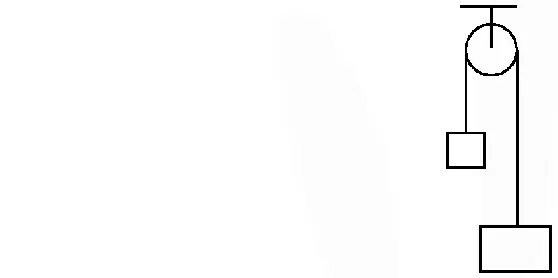
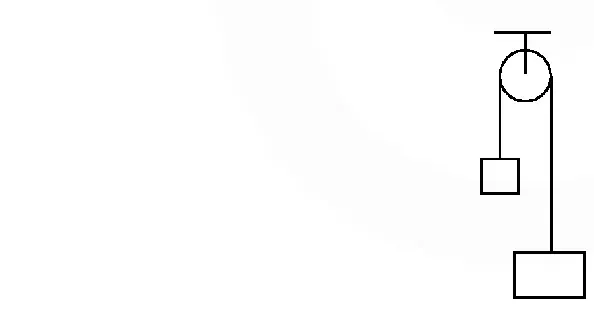
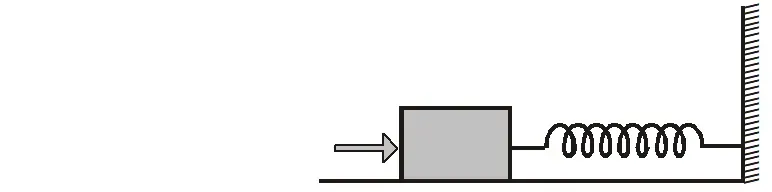
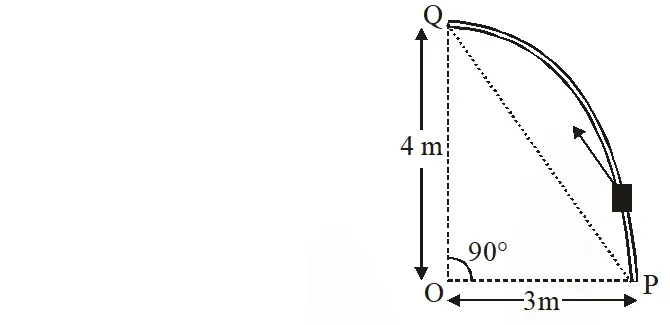
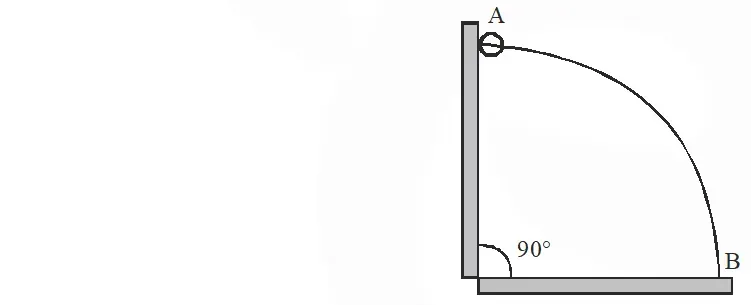
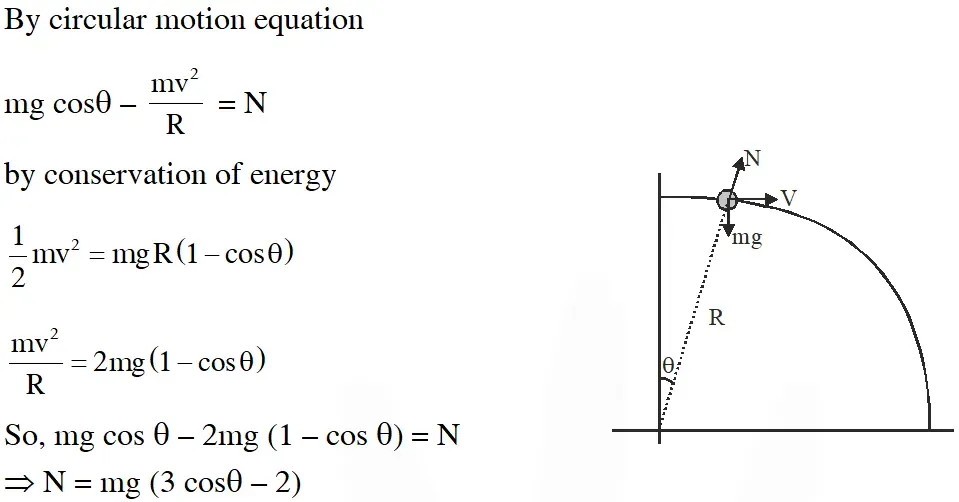
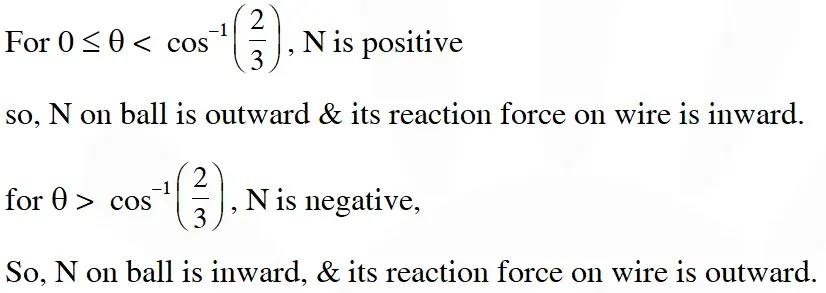
[esquestion] A light inextensible string that goes over a smooth fixed pulley as shown in the figure connects two blocks of masses 0.36 kg and 0.72 kg. Taking g = 10 $\mathrm{m} / \mathrm{s}^{2}$, find the work done (in joules) by the string on the block of mass 0.36 kg during the first second after the system is released from rest. #tag# [IIT-JEE-2009] #sol# 8 $\mathrm{a}=\frac{(0.73-0.36) \times 10}{(0.72+0.36)}$ $=\frac{10}{3} \mathrm{m} / \mathrm{s}^{2}$ $\mathrm{T}=0.36\left(10+\frac{10}{3}\right)=4.8 \mathrm{N}$ $\Delta y=\frac{1}{2} \times \frac{10}{3} \times 1^{2}$ $\mathrm{W}_{\mathrm{T}}=4.8 \times \frac{5}{3}=8 \mathrm{J}$ [/esquestion] [esquestion] A light inextensible string that goes over a smooth fixed pulley as shown in the figure connects two blocks of masses 0.36 kg and 0.72 kg. Taking g = 10 m/s2, find the work done (in joules) by the string on the block of mass 0.36 kg during the first second after the system is released from rest. #tag# [IIT-JEE-2009] #sol# $-\frac{1}{2} \times 2 \times(0.06)^{2}-0.18 \times 0.06=-\frac{1}{2} \times 0.18 \times v^{2}$ $\Rightarrow 0.0036+0.0108=0.09 \mathrm{v}^{2}$ $\Rightarrow \mathrm{v}=0.4=\frac{4}{10} \mathrm{m} / \mathrm{sec}$ [/esquestion] [esquestion] A block of mass 0.18 kg is attached to a spring of force-constant 2 N/m. The coefficient of friction between the block and the floor is 0.1. Initially the block is at rest and the spring is un-stretched. An impulse is given to the block as shown in the figure. The block slides a distance of 0.06 m and comes to rest for the first time. The initial velocity of the block in m/s is V= N/10. Then N is #tag# [IIT-JEE-2011] #sol# 0 $\overrightarrow{\mathrm{F}}=\mathrm{k}\left[\frac{\overrightarrow{\mathrm{r}}}{\mathrm{r}^{3}}\right] \Rightarrow$ force is radial. So W = 0 [/esquestion] [esquestion] A particle of mass 0.2 kg is moving in one dimension under a force that delivers a constant power 0.5 W to the particle. If the initial speed $\left(\text { in } \mathrm{ms}^{-1}\right)$ of the particle is zero, the speed $\left(\text { in } \mathrm{ms}^{-1}\right)$ after 5 s is. #tag# [JEE-Advance-2013] #sol# 5t $\mathrm{P}=\mathrm{F} \cdot \mathrm{v} \Rightarrow 0.5=0.2 \mathrm{v} \frac{\mathrm{dv}}{\mathrm{dt}} \Rightarrow \mathrm{v}^{2}=5 \mathrm{t}$ [/esquestion] Paragraph for Questions 5 and 6 A small block of mass 1 kg is released from rest at the top of a rough track. The track is a circular arc of radius 40 m. The block slides along the track without toppling and a frictional force acts on it in the direction opposite to the instantaneous velocity. The work done in overcoming the friction up to the point Q, as shown in the figure below, is 150 J. (Take the acceleration due to gravity, g = 10 $\mathrm{m} \mathrm{s}^{-2}$) [esquestion] The magnitude of the normal reaction that acts on the block at the point Q is (A) 7.5 N (B) 8.6 N (C) 11.5 N (D) 22.5 N #tag# [JEE-Advance-2013] #sol# (A) [/esquestion] [esquestion] The speed of the block when it reaches the point Q is (A) $5 \mathrm{ms}^{-1}$ (B) $10 \mathrm{ms}^{-1}$ (C) $10 \sqrt{3} \mathrm{ms}^{-1}$ (D) $20 \mathrm{ms}^{-1}$ #tag# [JEE-Advance-2013] #sol# (B) [/esquestion] [esquestion] Consider an elliptically shaped rail PQ in the vertical plane with OP = 3 m and OQ = 4m. A block of mass 1 kg is pulled along the rail from P to Q with a force of 18 N, which is always parallel to line PQ (see the figure given). Assuming no frictional losses, the kinetic energy of the block when it reaches Q is (n × 10) Joules. The value of n is (take acceleration due to gravity = 10 $\mathrm{ms}^{-2}$ ) #tag# [JEE-Advance-2014] #sol# 5 $\mathrm{K}_{\mathrm{f}}-\mathrm{K}_{\mathrm{i}}=\mathrm{W}_{\mathrm{all}}$ $\mathrm{K}_{\mathrm{f}}=\mathrm{W}_{\mathrm{ext}}+\mathrm{W}_{\mathrm{gr}}$ = 18 × 5 J – 1 × 10 × 4 J = 50 J = 5 × 10 J [/esquestion] [esquestion] A wire, which passes through the hole in a small bead, is bent in the form of quarter of a circle. The wire is fixed vertically on ground as shown in the figure. The bead is released from near the top of the wire and it slides along the wire without friction. As the bead moves from A to B, the force it applies on the wire is :- (A) Always radially outwards (B) Always radially inwards (C) Radially outwards initially and radially inwards later. (D) Radially inwards initially and radially outwards later. #tag# [JEE Advanced-2014] #sol# (D) [/esquestion] [esquestion] A particle of mass m is initially at rest at the origin. It is subjected to a force and starts moving along the x-axis. Its kinetic energy K changes with time as dK/dt = $\gamma \mathrm{t}$, where is a positive constant of appropriate dimensions. Which of the following statements is (are) true ? (A) The force applied on the particle is constant (B) The speed of the particle is proportional to time (C) The distance of the particle from the origin increses linerarly with time (D) The force is conservative #tag# [JEE Advanced-2018] #sol# (A,B,D) $\frac{\mathrm{d} \mathrm{k}}{\mathrm{dt}}=\gamma \mathrm{t}$ as $\mathrm{k}=\frac{1}{2} \mathrm{mv}^{2}$ $\therefore \frac{\mathrm{dk}}{\mathrm{dt}}=\mathrm{mv} \frac{\mathrm{d} \mathrm{v}}{\mathrm{dt}}=\gamma \mathrm{t}$ $\therefore \mathrm{m} \int_{0}^{\mathrm{v}} \mathrm{vdv}=\gamma \int_{0}^{\mathrm{t}} \mathrm{tdt}$ $\frac{\mathrm{mv}^{2}}{2}=\frac{\gamma \mathrm{t}^{2}}{2}$ $\mathrm{v}=\sqrt{\frac{\gamma}{\mathrm{m}} \mathrm{t}} \textrm{ } \quad \ldots \ldots$ (i) $\mathrm{a}=\frac{\mathrm{d} \mathrm{v}}{\mathrm{dt}}=\sqrt{\frac{\gamma}{\mathrm{m}}}=\mathrm{constant}$ since F = ma $\therefore \mathrm{F}=\mathrm{m} \sqrt{\frac{\gamma}{\mathrm{m}}}=\sqrt{\gamma \mathrm{m}}=\mathrm{constant}$ [/esquestion]
If you want to go beyond board-level and JEE Main-level Work, Power & Energy problems, our Irodov questions for JEE page has a curated set of Work, Power & Energy and other advanced questions.
Every Work, Power & Energy - JEE Advanced PYQs (Physics) question can be placed in context by reviewing the original papers in the JEE Advanced PYQ collection.
Frequently Asked Questions
How many questions come from Work, Power & Energy in JEE Advanced each year?
JEE Advanced typically includes 1–3 questions from Work, Power & Energy per paper. The chapter carries significant weight because its concepts overlap with rotational motion, SHM, and thermodynamics. In recent years, it has appeared in both Paper 1 and Paper 2 in various formats — integer type, MCQ single, and MCQ multiple correct.
Is the work-energy theorem enough to solve all JEE Advanced problems in this chapter?
The work-energy theorem (ΔKE = W_net) solves the majority of problems, but you must also know how to handle variable forces, conservative potential energy functions, and power-velocity differential equations. Problems like Q4 (constant power) require calculus-based approaches that go beyond the basic theorem.
What is the difference between conservative and non-conservative forces in JEE Advanced problems?
A conservative force does zero net work over any closed path — gravity and spring force are classic examples. A non-conservative force like friction converts mechanical energy to heat. In JEE Advanced, identifying whether a force is conservative determines whether you can define a potential energy function for it. The 2018 question (Q9) directly tests this concept.
How do I avoid sign errors in work-energy problems?
Always define a positive direction at the start of every problem. Write the work done by each force separately — tension, gravity, friction, normal force — then sum them algebraically. Friction always does negative work on a sliding object. Spring force does positive work when the spring returns toward natural length and negative work when it is being stretched or compressed.
Which topics in Work, Power & Energy are most important for JEE Advanced 2025–26?
Based on the 10-year PYQ trend, the highest-priority subtopics are: (1) work-energy theorem with multiple forces including friction, (2) constant power problems using P = mv(dv/dt), (3) normal reaction in circular/curved motion combined with energy methods, and (4) identifying conservative vs. non-conservative forces. These four areas cover 85–90% of all past questions.
Team eSaral
eSaral Academic and Editorial Team
Team eSaral is the collective author profile for educational content created by eSaral’s teachers and academic contributors. The team draws on expertise from IIT graduates, doctors, experienced educators and subject specialists to develop resources for JEE, NEET and school students. Our articles aim to explain concepts clearly and help students study with confidence.
Related Posts

BITSAT 2027: Registration Date, Exam Date, Syllabus, Eligibility, Pattern & Fees
BITSAT 2027 exam dates, registration timeline, eligibility criteria, exam pattern, marking scheme, syllabus and fees in one page.

BITSAT Previous Year Question Paper PDF (2017-2026)
Download BITSAT previous year question papers PDF from 2017 to 2026,session-wise. Memory-based papers,exam pattern, paper analysis and how to practise

CBSE Class 10 Date Sheet 2027: Expected Exam Dates, Release Date, Admit Card & Result Timeline
CBSE Class 10 date sheet 2027 is awaited. See the expected exam dates, release window, how to download the PDF, admit card and result timelines.

NCERT Physics Class 10 Book PDF in Hindi 2026-27 – भौतिक विज्ञान के 4 अध्याय (Free Download)
NCERT Physics Class 10 book PDF in Hindi 2026-27: download all 4 chapters (अध्याय 9–12) free, with topics and important formulas.

NCERT Biology Class 9 Book Anveshan PDF in Hindi - जीव विज्ञान कक्षा 9 पुस्तक अन्वेषण PDF
Download NCERT Biology Class 9 book PDF in Hindi chapterwise for 2026-27: Cell, Tissues, Reproduction and Diversity. Free PDFs.

Essay On Artificial Intelligence in English (100,150, 200, 250, 300, 500 Words)
This is in contrast to the natural intelligence of humans. With Artificial Intelligence, machines can perform

Essay on 78th India Independence Day in English for Student (100, 150, 200, 250, 300, 500 Words)
Read the best essays on India's Independence Day in English. Short & long essays (100, 150, 200, 250, 300, 500 words) perfect for school exams
NCERT Class 11 English Snapshots book - Free PDF download- Esaral
Download NCERT Class 11 English Snapshots book PDF for free. Get all 8 chapters, chapter-wise. Start your prep today!
NCERT Class 10 biology book pdf - Free PDF Download - eSaral
NCERT Class 10 Biology book PDF 2026-27: all 5 chapters (Life Processes to Our Environment) in English & Hindi, with CBSE syllabus, marks & practical

Essay on Global Warming in English (100,150, 200, 250, 300, 500 Words)
Global warming means the Earth is getting hotter. This happens because of things like pollution from cars and factories.