
Zeroth law of thermodynamics - Explanation, Defination.

eSaral Academic and Editorial Team
Zeroth law of thermodynamics
Zeroth law of thermodynamics states that If objects A and B are separately in thermal equilibrium with a third object C (the thermometer), then objects A and B are in thermal equilibrium with each other.
Zeroth law of thermodynamics introduces thermodynamic quantity called temperature.
Two objects (or systems) are said to be in thermal equilibrium if their temperatures are the same.
In measuring the temperature of a body, it is important that the thermometer is in the thermal equilibrium with the body whose temperature is to be measured.
Temperature
- Temperature is a macroscopic physical quantity related to our sense of hot and cold.
- Temperature is basically a measure of the degree of hotness or coldness of a body.
- The natural flow of heat is from higher temperature to lower temperature, i.e. Temperature determines the thermal state of a body, whether it can give or receive heat.
- Two bodies are said to be in thermal equilibrium if and only if they are at same temperature. In this situation heat in the two bodies may or may not be equal.
- The temperature of a body is directly proportional to the kinetic energy of the random motion of the molecules or atoms of the substance.
- Temperature is one of seven fundamental quantities with dimensions (q). It is a scalar physical quantity with SI unit kelvin (K).
- The highest possible laboratory temperature is about $10^{8} \mathrm{~K}$ (in fusion test reactor) while the lowest $10^{-3} \mathrm{~K}$ (achieved in 1990 through nuclear spin colling).
- The theory has established that 0 K can never be achieved practically.
Thermal equilibrium
Heat is the transfer of energy from one object to another object as a result of a difference in temperature between them.
Thermal equilibrium is a situation in which two objects in thermal contact cease to exchange energy by the process of heat.
Different types of temperature scales
(a) The Kelvin temperature scale is also known as thermodynamic scale.The Sl unit of temperature is the kelvin and is defined as $(1 / 273.16)$ of the temperature of the triple point of water. The triple point of water is that point on a P-T diagram where the three phases of water, the solid, the liquid and the gas, can coexist in equilibrium.
(b) In addition to Kelvin temperature scale, there are other temperature scales also like Celsius, Fahrenheit, Reaumer, Rankine, etc. Temperature on one scale can be converted into other scale by using the following identity :
$\frac{\text { Reading on any scale - lower fixed point (LFP) }}{\text { Upper fixed point (UFP) - lower fixed po int (LFP) }}$ = constant for all scales
Hence,
$\frac{t^{\circ} \mathrm{C}-0^{\circ}}{100^{\circ}-0^{\circ}}=\frac{t^{\circ} \mathrm{F}-32^{\circ}}{212^{\circ}-32^{\circ}}=\frac{\mathrm{tK}-273 \cdot 15}{373 \cdot 15-273.15}$
(c) Different temperature scales :
S.no Scale | Name of the Scale | Symbol for each degree | Lower Fixed Point (LFP) | Upper Fixed Point (UFP) | Number of Divisions on the Scale |
1 | Celsius | °C | 0°C | 100°C | 100 |
2 | Fahrenheit | °F | 32°F | 212°F | 180 |
3 | Kelvin | K | 273.15 K | 373.15 K | 100 |
For a better understanding of this chapter, please check the detailed notes of the Thermodynamics. If you want more Free Learning Videos and Study Material Then don’t forget to download the eSaral App.
Team eSaral
eSaral Academic and Editorial Team
Team eSaral is the collective author profile for educational content created by eSaral’s teachers and academic contributors. The team draws on expertise from IIT graduates, doctors, experienced educators and subject specialists to develop resources for JEE, NEET and school students. Our articles aim to explain concepts clearly and help students study with confidence.
Related Posts

Plant Cell Diagram: Labelled Structure, Parts and Functions
Simple, labelled plant cell diagram with parts and functions. Covers plant cell structure for Class 6, 7, 8, 9, 10 and 11 students, CBSE-aligned.

Saransh Gupta Sir's Visit to IIT Patna: Hostel Life, Placements & Lessons for JEE Aspirants
Inside Saransh Gupta Sir's IIT Patna visit — hostel life, the library, placements, internships, and real advice for JEE aspirants from students living the IIT dream.
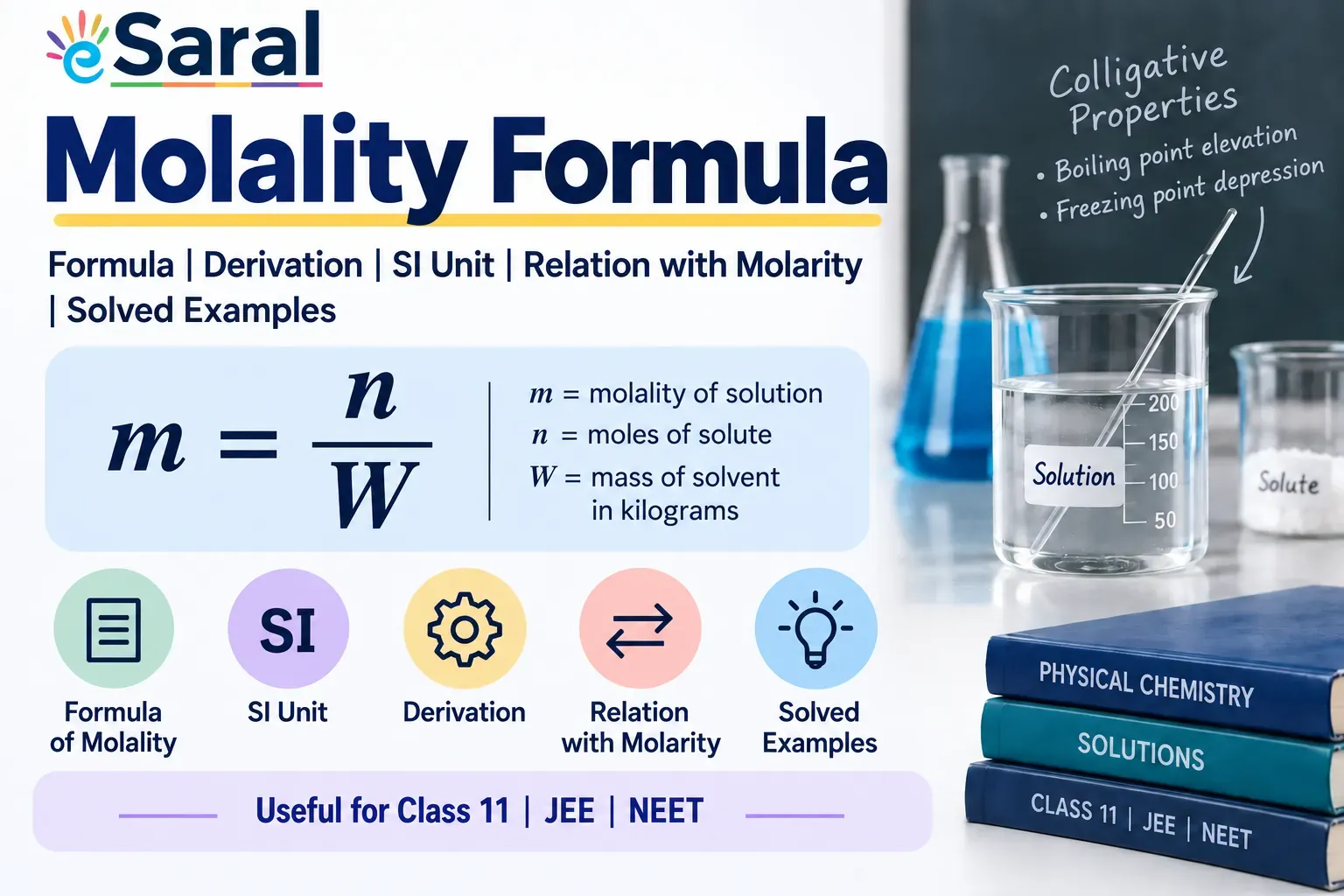
Molality Formula: Formula for Molality, Derivation & Solved Examples
Molality formula is $m = \dfrac{n}{W}$. Learn the formula of molality, its SI unit, derivation, relation with molarity, and solved examples for Class 11, JEE and NEET.
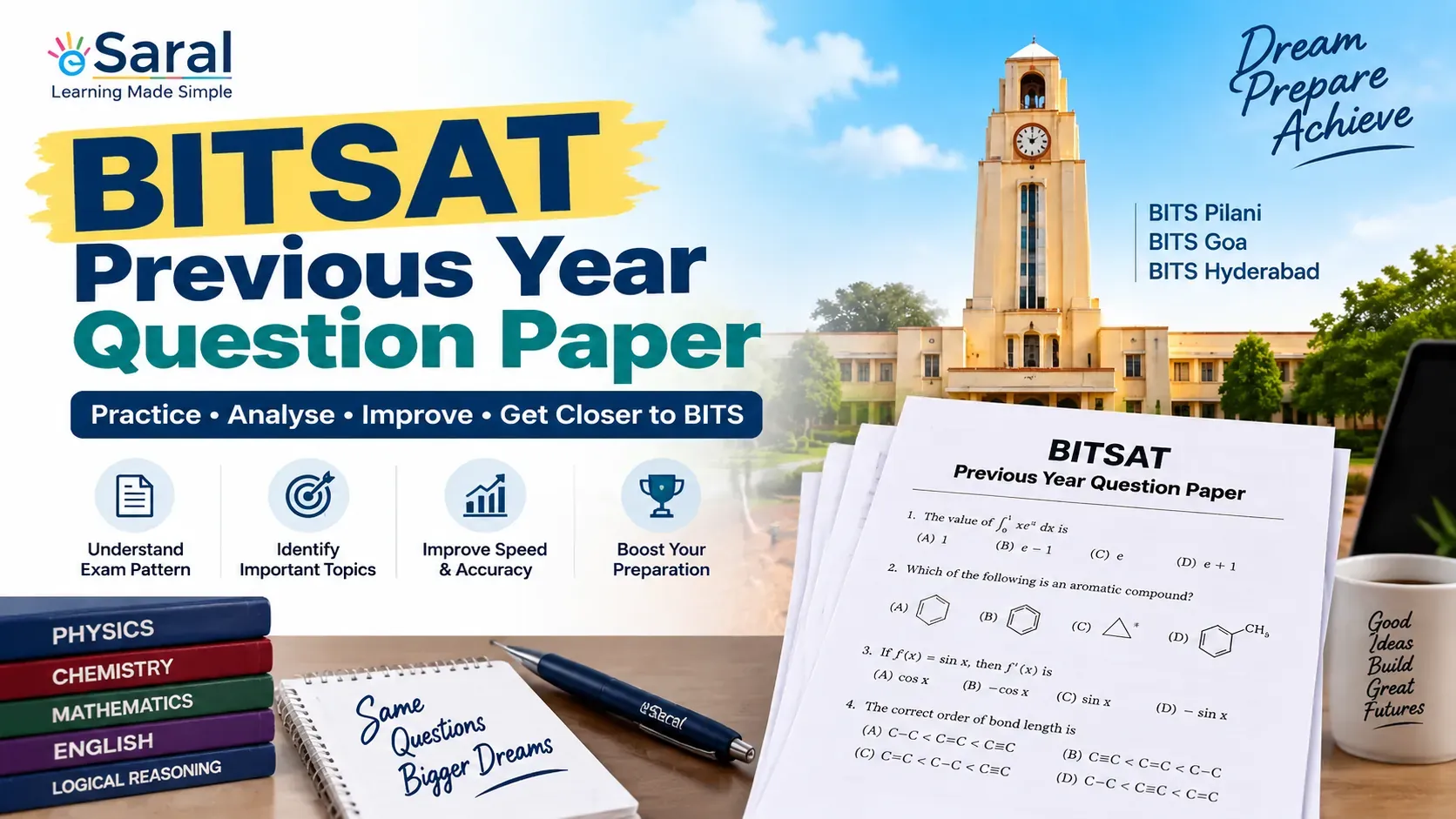
BITSAT Previous Year Question Paper PDF
Download BITSAT previous year question papers PDF. Get year-wise BITSAT PYQs, memory-based papers, exam pattern, and preparation tips to improve your BITSAT preparation.

Teachers’ Day 2026 at eSaral Gurukul: Celebrating the Bond Between Students, Teachers & Mentors
See how Teachers’ Day 2026 was celebrated at eSaral Gurukul, reflecting the bond among students, teachers, and mentors, and the role of guidance beyond academics.

JEE Advanced Attempts: Can You Give It a Third Time? Rules Explained
JEE Advanced attempts: current rule is 2 consecutive years only: full eligibility criteria, the 2025 third-attempt controversy, and the latest 2026 petition news.

Best JEE Preparation App
Best JEE preparation app for Main & Advanced: AI mock tests, live doubt-solving, thousands of practice questions. JEE preparation app for droppers & Class 11-12.
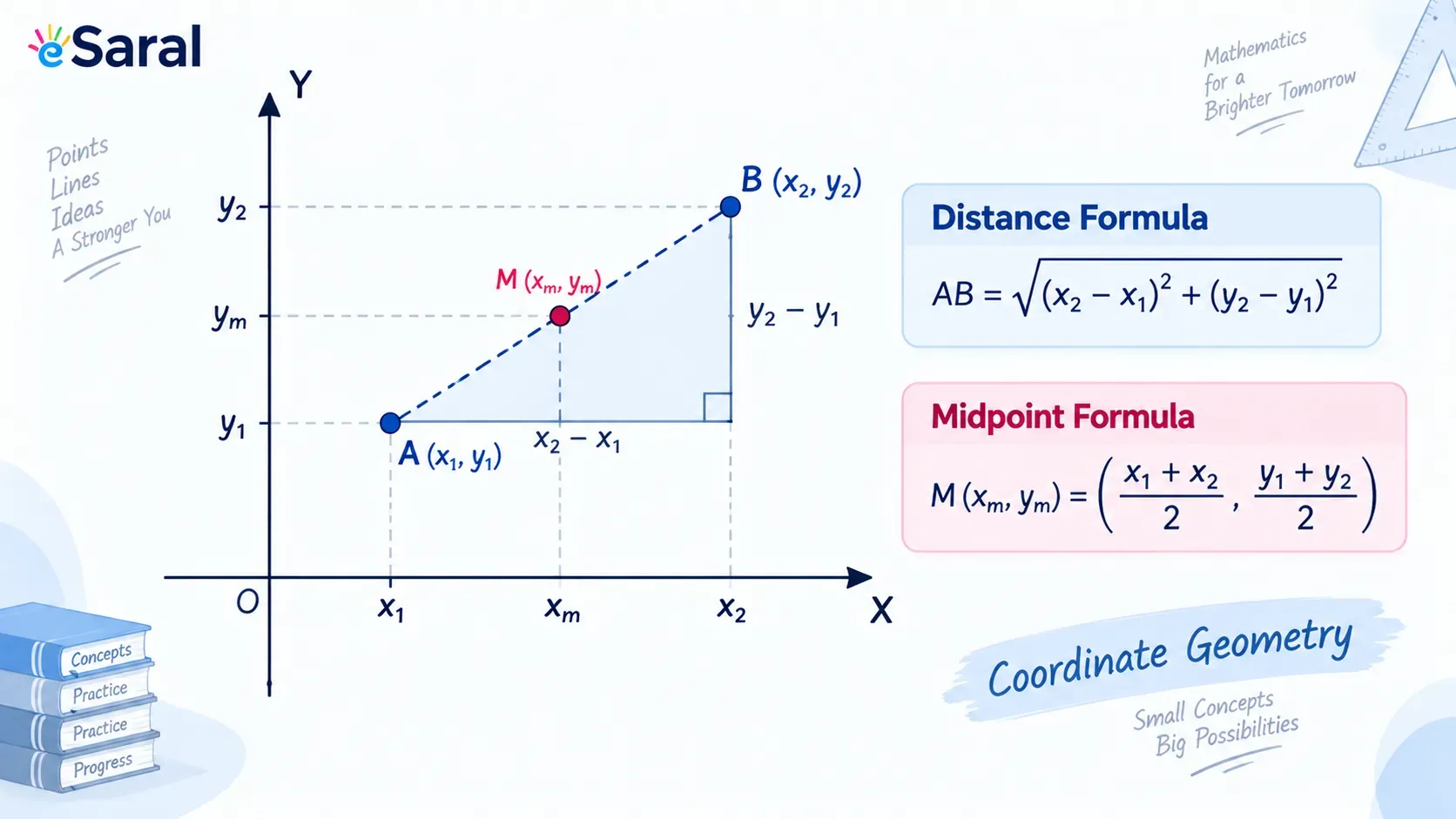
Coordinate Geometry Class 10: Formulas, Notes & Solved Examples
Coordinate geometry class 10: complete CBSE formulas — distance, section, midpoint and area of triangle — with derivation, notes and solved examples.
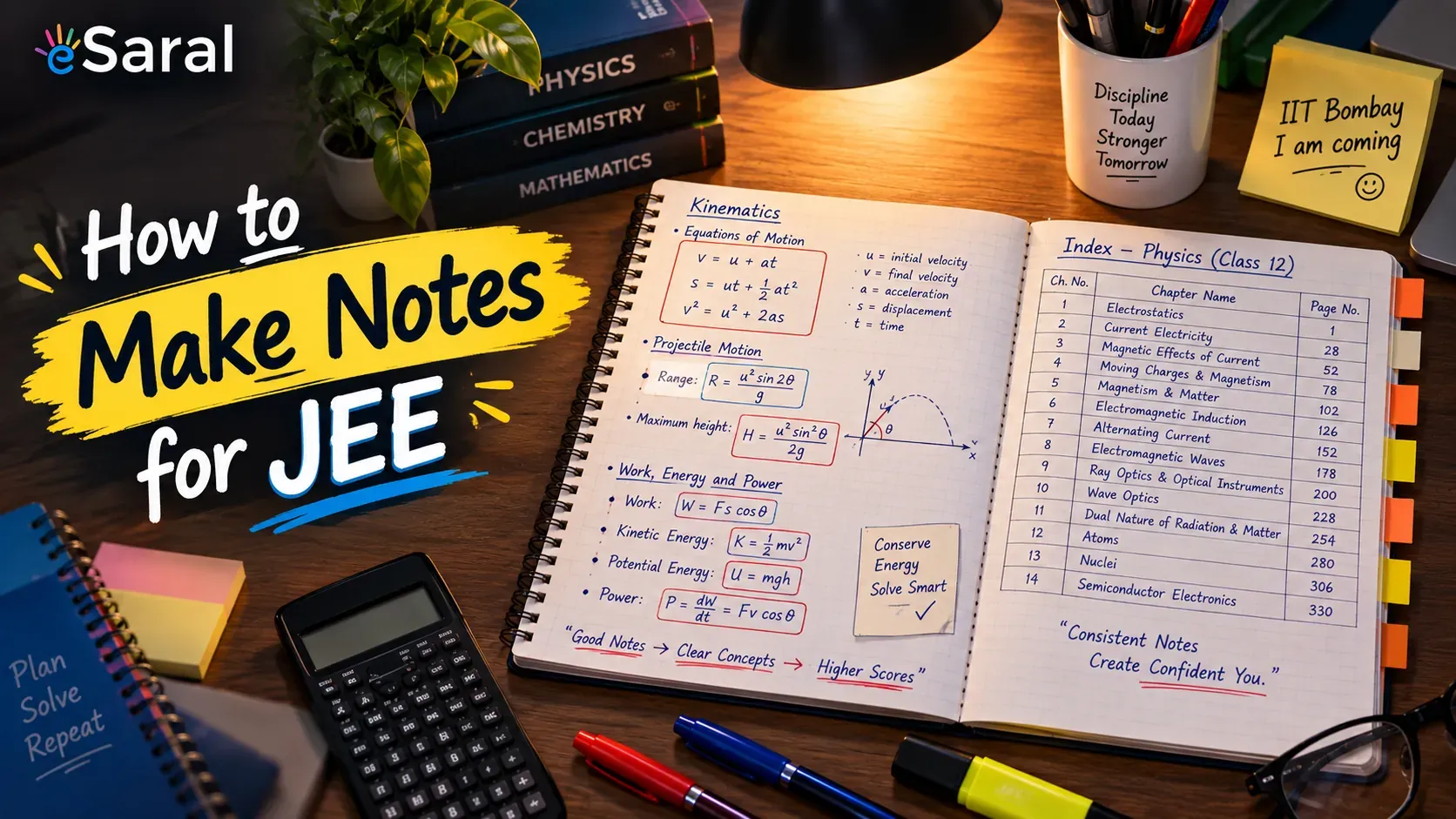
How to make Notes For JEE Smart Notes Strategy of an AIR 41
Learn how to make notes for JEE the way toppers do — indexing, shorthand, and smart short notes for JEE that cut revision time to just 5–7 days.
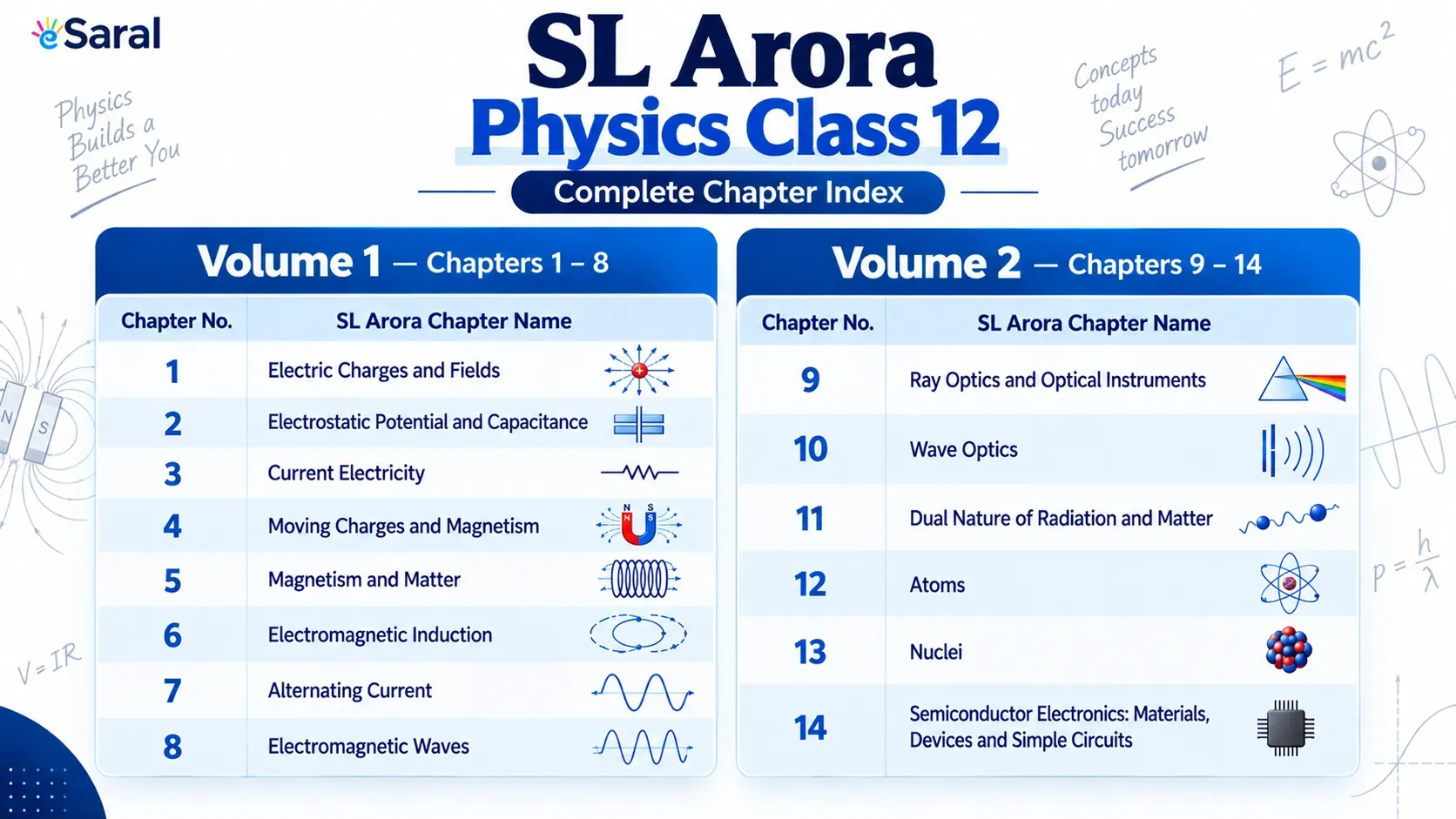
SL Arora Physics Class 12 Index – Chapter List for Volume 1 & 2
SL Arora Physics Class 12 index — complete chapter list for Volume 1 & 2, mapped to NCERT solutions for board, JEE Main, and NEET preparation.